Synthesis of (Y,Er)
2O
3Films from Multiple-Nuclei EDTA·(Y,Er)·H Complexes
by Flame Spray Method
Keiji Komatsu
1,+, Tetsuo Sekiya
1, Ayumu Toyama
1, Tomoyuki Shirai
1, Atsushi Nakamura
1,2,
Shigeo Ohshio
1, Ikumi Toda
1, Hiroyuki Muramatsu
1and Hidetoshi Saitoh
11Department of Materials Science and Technology, Nagaoka University of Technology, Nagaoka 940-2188, Japan 2Chubu Chelest, Yokkaichi 510-0886, Japan
In this investigation, rare earth metal oxidefilms were synthesized from metal complexes of ethylenediaminetetraacetic acid (metal-EDTA) by utilizing aflame spray technique. Two raw metal-EDTA powders were prepared as starting materials in order to synthesize (Y,Er)2O3films on
stainless steel (SUS) substrates by a reaction that is promoted by the combustion of gaseous H2-O2. Molecularly mixed EDTA·(Y,Er)·H and
mechanically mixed EDTA·Y·H+EDTA·Er·H complexes were subsequently prepared. The existence of Y2O3and Er2O3crystalline phases was
confirmed for the EDTA·Y·H+EDTA·Er·H mixtures. Lamellar structures were formed on thefilm with a porosity of 9.5%. Alternatively, a homogenous, (Y,Er)2O3film was obtained from the EDTA·(Y,Er)·H complex, with afilm porosity of 31.8%. These results indicate that uniform
(Y,Er)2O3films were synthesized on SUS substrates from molecularly mixed EDTA·(Y,Er)·H powders. [doi:10.2320/matertrans.T-M2015832]
(Received May 12, 2014; Accepted September 29, 2015; Published November 13, 2015)
Keywords: kinetic energy, uniform multi-rare earth oxide, chelate
1. Introduction
Metal-ethylenediaminetetraacetic acid (metal-EDTA) com-plexes are key intermediates in the synthesis of metal oxides. Some characteristics of metal-EDTA complexes include low decomposition temperatures,1,2)and a uniform stoichiometry that can be utilized in the design of metal-EDTA solutions.3) The metal-EDTA complexes are converted to metal oxides through firing in an atmosphere containing an oxidative conditions. Additionally, multiple-nuclei metal oxides are synthesized from multiple-nuclei EDTA complexes.4,5) For example, hollow metal oxide particles were obtained through spray drying and oxidation processes in air.6,7) The obtained metal oxide particles possessed a uniform stoichiometry, which was confirmed by a particle analyzing system.8) Another example was reported by Nakamuraet al., in which strontium titanium oxide (SrTiO3)films were fabricated with a Sr/Ti elemental ratio of approximately 1.00.9) The EDTA·Sr·NH4 and EDTA·Ti·NH4 pellets were then applied as a target in the production of the SrTiO3 films using the laser deposition method. Therefore, the synthesis of metal oxides using a metal-EDTA complex is advantageous for easily obtaining well-organized ceramic powders with a complicated metallic composition.
Various metal oxide films were synthesized from metal-EDTA powders in a commercialflame spray apparatus.10,11) For example, a thick yttria (Y2O3) film was fabricated on a stainless steel (SUS) substrate with the EDTA·Y complex in the presence of the combustion gases C2H2-O2 and H2-O2. The formation of thick metal oxides, Y2O3, europia (Eu2O3), and erubia (Er2O3) films with high deposition rate was accomplished with metal-EDTA powders in an H2-O2 flame.12) The decomposition and oxidation of the metal-EDTA subsequently occurred, and the porosity of the films was in the range of 615%. The properties of thefilms varied with the species of metal ion in the metal-EDTA complex. The degree of collision of the particles at the impact to
substrate is also thought to be a function of the volume and mass of the particles. Therefore, the true density of the metal oxide particles is quite significant in this process.
In this study, the molecularly mixed EDTA·(Y,Er)·H and mechanically mixed EDTA·Y·H+EDTA·Er·H complexes were utilized as the starting materials, and the formation of (Y,Er)2O3 films on SUS substrates is expected from this work. There exist three potential candidates for the reactions involving metal-EDTA complexes. One expected process is the independent decomposition/oxidation for EDTA·Y·H and EDTA·Er·H complexes. The second potential process involves the preferential decomposition/oxidation of either the EDTA·Y·H or EDTA·Er·H complex. The third potential process is the simultaneous decomposition/oxidation of both the EDTA·Y·H and EDTA·Er·H. We investigated the obtained films using techniques such as X-ray diffraction (XRD), scanning electron microscopy (SEM), and energy dispersive X-ray analysis (EDX). The thicknesses and cross-sectional porosities of thefilms were also estimated from the obtained SEM and EDX images. The reaction processes for the molecularly mixed EDTA·(Y,Er)·H and the mechanically mixed EDTA·Y·H+EDTA·Er·H complexes are subse-quently discussed.
2. Experimental Procedure
2.1 Process and materials
We prepared raw materials via metal-EDTA route.612)For example, the reagent used was obtained from Y2(CO3)3 for the preparation of crystalline EDTA·Y·H complexes. A mixture of Y2(CO3)3 and EDTA·4H·solution was stirred. Then, the solution with EDTA·Y·H was concentrated using an evaporator to form a slurry. The slurry was cooled to room temperature and stirred. Finally, the crystalline EDTA·Y·H was separated from the slurry using a centrifuge. Based on the protocol mentioned above, the EDTA·Y·H, the EDTA·Er·H and EDTA·(Y,Er)·H complexes (Chubu Chelest Co., Ltd.) were prepared for the synthesis of thefilms in this study. The molar ratio for the EDTA·(Y,Er)·H complex was Y : Er=
+Corresponding author, E-mail: Keiji_Komatsu@mst.nagaokaut.ac.jp
unit was then turned on. The carrier gas flow rate was 7.1 L/min. A mixture of H2 and O2 at flow rates of 32.6 and 43.0 L/min, respectively, was used as the flame gas. The EDTA·(Y,Er)·H and the EDTA·Y·H+EDTA·Er·H powders were mixed with the flame and reacted with O2 after the thermal decomposition of EDTA. The reacted particles were then sprayed onto a SUS substrate (SUS304, 30 mm© 50 mm©1 mm) that was previously sand-blasted by #60 alumina particles (99.7%pure, 212250 µm particle size, Fuji Manufacturing Co., Ltd.), resulting in the deposition of a metal oxide film. The stand-off distance (a distance between the spray gun and the substrate) was 150 mm. Gun traverse rate was 50 mm/s. The spray nozzle was moved in a longitudinal direction, and the duration of the deposition to go through whole substrate was approximately 6 s/scan without pre-heating the substrate. The total duration of the deposition was 24 s for total spraying time. An interval duration of approximately 30 s was set for each spray scan.
2.2 Evaluation method
XRD (M03XHF22, MAC Science Co., Ltd.) was con-ducted with Cu K¡radiation in order to observe the crystal structure. The surface and cross-sectional morphologies of the films were observed by performing field-emission scanning electron microscopy (FE-SEM, JSM-6700F, JEOL). The elements contained in the sample, and their distributions, were estimated by performing energy-dispersive X-ray (EDX) spectroscopy, combined with FE-SEM. Film thick-nesses and cross-sectional porosities for the obtained samples were estimated by using ImageJ software (available for free at http://rsbweb.nih.gov/ij/).
3. Results and Discussion
We prepared EDTA·(Y,Er)·H and EDTA·Y·H+ EDTA·Er·H complexes as starting materials. From surface SEM observation, the morphologies of the two complexes are quite different, as shown in Fig. 1. The mechanically mixed EDTA·Y·H+EDTA·Er·H complex consists of an aggrega-tion of rectangular parallelepipeds (Fig. 1(a)). The powder was simple mixture of the particle containing Y or Er based complex (Fig. 1(b)). Alternatively, the aspect ratio of the molecularly mixed EDTA·(Y,Er)·H complex was higher than the aspect ratio of the mechanically mixed EDTA·Y·H+EDTA·Er·H complex (Fig. 1(c)). Each particle contains both of Y and Er based complexes (Fig. 1(d)).
Therefore, the elemental distributions in the raw metal-EDTA complexes were quite different.
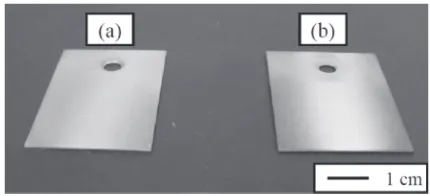
[image:2.595.308.545.69.235.2]A photograph of the two metal oxide films fabricated on the SUS304 substrates is shown in Fig. 2. For the deposition of the Y2O3and Er2O3films on SUS substrates, the colors of these films were white and pink, respectively.12)This result implies that the color of obtainedfilms would be a blend of the colors of these films, which is referred to as magnolia. The color of obtained metal oxide films is in fact magnolia, which is thought to be derived from the color of the raw metal-EDTA powders.
Figure 3 displays the SEM of the film surfaces, and the elemental mapping images of the obtained films for the EDTA·Y·H+EDTA·Er·H and EDTA·(Y,Er)·H complexes. For the mechanically mixed EDTA·Y·H+EDTA·Er·H com-plex (Fig. 3(a) and Fig. 3(b)), the powder was simple mixture of the particle containing Y or Er based complex. Mixture of the metal oxide particles was observed. The mixture was synthesized from Y or Er based complex. Particularly, theflat morphology of the obtained particles with the Er count was confirmed in the film. Alternatively, each particle was contained both of Y and Er atoms counts for molecularly mixed EDTA·(Y,Er)·H complex (Fig. 3(c) and Fig. 3(d)). The existence area of elemental amounts was equal for both Y and Er. The elemental distributions of the obtained metal oxidefilms varied according to the mixing procedure for the raw metal-EDTA complex. In a previous study, the metal species in the raw metal-EDTA complex changed the particle
Fig. 1 SEM and elemental mapping images of raw metal-EDTA com-plexes: (a), (b) EDTA·Y·H+EDTA·Er·H, and (c), (d) EDTA·(Y,Er)·H. Black points indicate Er atom, and gray points indicate Y atom.
[image:2.595.319.534.292.390.2]behavior during the reaction process.12) Therefore, these results implied that the formation of the obtained metal oxide films would be different between the mechanically mixed EDTA·Y·H+EDTA·Er·H complex and the molecularly mixed EDTA·(Y,Er)·H complex.
The cross-sectional morphology and elemental distri-bution were observed by conducting SEM and EDX analyses. Figure 4 displays the cross-sectional SEM and elemental mapping images for the obtained films of the EDTA·Y·H+EDTA·Er·H and EDTA·(Y,Er)·H complexes. An average thickness of 12.6 µm was reported for the film synthesized on the SUS substrate with mechanically mixed EDTA·Y·H+EDTA·Er·H complex. The estimated cross-sectional porosity was 9.5%. The sample was contained Y or Er atom from cross-sectional observation, and the lamellar elemental distributions of Y and Er atoms were confirmed. Alternatively, the sample was contained both of Y and Er
atoms in the film obtained from the molecularly mixed EDTA·(Y,Er)·H complex, and an average thickness of 21.6 µm was reported for the film synthesized on SUS substrate. The estimated cross-sectional porosity was 31.8%. The estimatedfilm thickness and porosity varied according to the mixing procedure of the raw metal-EDTA complex. From observed microstructures in obtained films, the decomposi-tion/oxidation processes for these complexes would be depended on their preparation method. These phenomena were different from established thermal spray techniques. In established techniques, collision energy offlying particles to the substrate during deposition is one of key factors for determiningfilm’s microstructure.13,14)
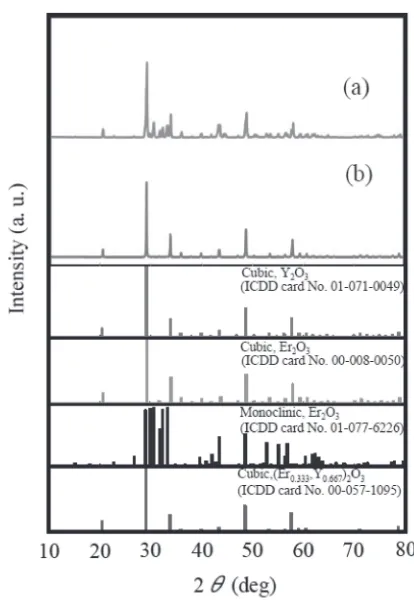
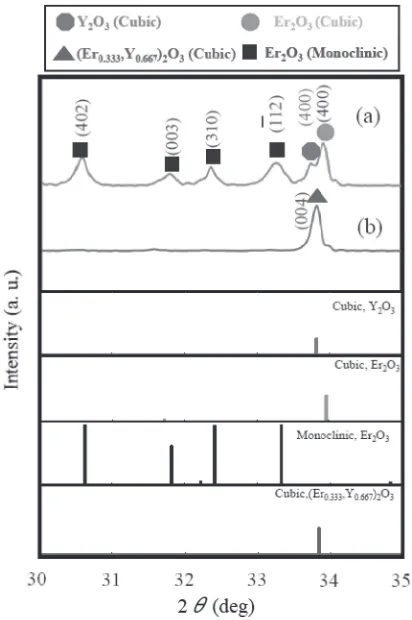
Identification of the crystalline structure of the obtained films was conducted by XRD measurements. Figure 5 displays the XRD profiles at 1080° of the two films deposited on SUS substrates. Diffraction peak splitting was observed in the deposited film containing the EDTA·Y·H+EDTA·Er·H complex. Alternatively, splitting was not observed in the deposited film containing the EDTA·(Y,Er)·H complex. Next, the peak assignments for the films were performed using ICDD cards. The XRD profiles at 3035° of the two films deposited on the SUS are shown in Fig. 6. The existence of three crystalline structures®Er2O3 with monoclinic (ICDD card No: 01-077-6226), Er2O3with cubic (ICDD card No.: 00-008-0050), and Y2O3 with cubic systems (ICDD card: 00-041-1105)®were confirmed for the film obtained from EDTA·Y·H+EDTA·Er·H. In a previous study, cubic Er2O3films were synthesized using the atomic
Fig. 3 Surface SEM and elemental mapping images offilms synthesized on SUS304 substrates using the flame spray apparatus from (a), (b) EDTA·Y·H+EDTA·Er·H, (c), (d) EDTA·(Y,Er)·H crystals. Black points indicate Er atom, and gray points indicate Y atom.
Fig. 4 Cross-sectional SEM and elemental mapping images of films synthesized on SUS304 substrates using theflame spray apparatus from (a), (b) EDTA·Y·H+EDTA·Er·H, (c), (d) EDTA·(Y,Er)·H crystals. Black points indicate Er atom, and gray points indicate Y atom.
[image:3.595.321.528.65.365.2] [image:3.595.49.290.67.250.2] [image:3.595.48.289.316.513.2]layer deposition method.15)The Er
2O3 films are a candidate material for optical communications16) and prototype reac-tors.17)Alternatively, the crystal species of the (Y,Er)2O3were confirmed in the films containing the EDTA·(Y,Er)·H complex. Six ICDD cards of the (Y,Er)2O3 crystal exist, which are (Er0.9,Y0.1)2O3 (ICDD card No: 00-058-0482), (Er0.8,Y0.2)2O3 (ICDD card No: 00-058-0589), (Er0.667, Y0.333)2O3 (ICDD card No: 00-0587-1094), (Er0.333, Y0.667)2O3 (ICDD card No: 00-057-1095), (Er0.2,Y0.8)2O3 (ICDD card No: 00-057-1093), and (Er0.1,Y0.9)2O3 (ICDD card No: 00-057-1092). An ICDD card for the (Er0.333, Y0.667)2O3 crystal is shown in Figs. 5 and 6. Small differences were observed in the ICDD cards for the Y2O3, Er2O3, and (Y,Er)2O3 crystals. The coating would be composed of the solid solution of Y2O3and Er2O3in various compositions. Therefore, we conducted quantitative elemen-tal analysis for the obtained meelemen-tal oxide particles under the same conditions as the EDTA·(Y,Er)·H complex by ICP-AES, which was conducted in order to investigate the stoichiometric values of Y and Er atoms in the sample. The quantitative analysis results are shown below. The obtained molar ratio was Y : Er=1.052 : 1.000 for these particles. Alternatively, the obtained ratio for the EDTA·(Y,Er)·H complex was 1.007 : 1. These ratio values indicate that no deviation of the Y and Er compositions from the raw materials occurred. A uniform (Y,Er)2O3layer was then synthesized on the SUS substrate with multiple-nuclei EDTA·(Y,Er)·H complexes using a commercialflame spray apparatus.
(particle sizes, shapes, densities and so on). The attainment duration to the SUS substrate for these flying particles depended on the oxide species. Therefore, a lamellar structure layer of Y2O3 and Er2O3 was formed from the mechanically mixed EDTA·Y·H+EDTA·Er·H complex. Alternatively, the formation of a uniform (Y,Er)2O3 layer was obtained from the EDTA·(Y,Er)·H complex in an H2-O2 flame. After the decomposition and oxidation processes of the EDTA·(Y,Er)·H complex, theflying particles of (Y,Er)2O3 produced a porous metal oxide layer with the EDTA·(Y,Er)·H complex. These results indicate that a uniform multi-metal oxide layer was synthesized from the multiple-nuclei EDTA·(Y,Er)·H complex. Additionally, these results suggest that the metal oxide layer structures are controlled by the combination methods of the metal ions and the metal complex.
4. Conclusion
Metal oxide films containing multiple nuclei were synthesized on a SUS substrate with two forms of metal-EDTA complexes. Molecularly mixed metal-EDTA·(Y,Er)·H and mechanically mixed EDTA·Y·H+EDTA·Er·H complexes were subsequently prepared. The inhomogeneous, lamellar structures of Y2O3 and Er2O3with 9.5% film porosity were synthesized on SUS substrate by the EDTA·Y·H+ EDTA·Er·H complexes. Alternatively, the homogenous, (Y,Er)2O3 crystalline phase based on Y2O3-Er2O3 system with a porosity of 31.8% was synthesized on the SUS substrate. Therefore, the formation of a (Y,Er)2O3 crystal-line phase was carried out by the molecularly mixed EDTA·(Y,Er)·H powder.
REFERENCES
1) W. Zhou, Z. Shao and W. Jin:J. Alloy. Compd.426(2006) 368374.
2) D. Zhang, X. Zhang, X. Ni, J. Song and H. Zheng:Cryst. Growth Des.
7(2007) 21172119.
3) H.-W. Wang, D. A. Hall and F. R. Sale:J. Am. Ceram.75(1992) 124 130.
4) Y. Narendar and G. L. Messing:Catal. Today35(1997) 247268.
5) G. Herrera, E. Chavira, J. J.-Mierc, A. Ordonez, E. F.-Israel, L. Banos, E. Bucio, J. Guzman, O. Novelo and C. Flores:J. Alloy. Compd.479
(2009) 511519.
6) H. Saitoh, K. Kawahara, S. Ohshio, A. Nakamura and N. Nambu:J. J. Ceram. Sci.110(2002) 874876.
7) H. Saitoh, R. Satoh, A. Nakamura, N. Nambu and S. Ohshio:J. Mater. Sci.37(2002) 43154320.
[image:4.595.66.272.69.379.2]8) H. Saitoh, K. Kawahara, S. Ohshio, A. Nakamura and N. Nambu:Sci. Tech. Adv. Mater.6(2005) 205209.
9) A. Nakamura, R. Satoh, S. Ohshio, N. Nambu and H. Saitoh:J. J. Appl. Phys.41(2002) 30333038.
10) H. Akasaka, M. Ohto, Y. Hasebe, A. Nakamura, S. Ohshio and H. Saitoh:Surf. Coat. Tech.205(2012) 38773880.
11) K. Komatsu, T. Tsuchiya, Y. Hasebe, T. Sekiya, Y. Hasebe, A. Toyama, A. Nakamura, H. Akasaka and H. Saitoh:J. Thermal Spray Technol.23
(2014) 885889.
12) K. Komatsu, T. Sekiya, A. Toyama, Y. Hasebe, A. Nakamura, M. Noguchi, Y. Li, S. Ohshio, H. Akasaka, H. Muramatsu and H. Saitoh:
J. Thermal Spray Technol.23(2014) 833838.
13) P. Fogarassy, D. Gerday and A. Lodin:Mech. Res. Comm.32(2005) 221239.
14) S. Sampath, X. Y. Jiang, J. Matejicek, L. Prchlik, A. Kulkarni and A. Vaidya:Mater. Sci. Eng. A364(2004) 216231.
15) J. Paivasaari, C. L. Dezelah, IV, D. Back, H. M. E. Kaderi, M. J. Heeg, M. Putkonen, L. Niinisto and C. H. Winter:J. Mater. Chem.15(2005) 42244233.
16) M. Nolan and S. D. Elliott:Chem. Mater.22(2010) 117129.
17) A. Suzuki, T. Chikada and T. Tanaka: J. Plasma Fusion Res.89(2013) 349358.