Morphological Cues for Lexical S e m a n t i c s
Marc Light
S e m i n a r ffir S p r a c h w i s s e n s c h a f t U n i v e r s i t g t T f i b i n g e n
W i l h e l m s t r . 113 D-72074 T f i b i n g e n
G e r m a n y
light~sf s. nph±l, uni-tuebingen,
deA b s t r a c t
Most natural language processing tasks re- quire lexical semantic information. Au- tomated acquisition of this information would thus increase the robustness
and
portability of NLP systems. This pa- per describes an acquisition method which makes use of fixed correspondences be- tween derivational affixes and lexical se- mantic information. One advantage of this method, and of other methods that rely only on surface characteristics of language, is that the necessary input is currently available.1
I n t r o d u c t i o n
Some natural language processing (NLP) tasks can be performed with only coarse-grained semantic in- formation about individual words. For example, a system could utilize word frequency and a word cooccurrence matrix in order to perform informa- tion retrieval. However, many NLP tasks require at least a partial understanding of every sentence or utterance in the input and thus have a much greater need for lexical semantics. Natural language gen- eration, providing a natural language front end to a database, information extraction, machine trans- lation, and task-oriented dialogue understanding all require lexical semantics. The lexical semantic in- formation commonly utilized includes verbal argu- ment structure and selectional restrictions, corre- sponding nominal semantic class, verbal aspectual class, synonym and antonym relationships between words, and various verbal semantic features such as causation and manner.
Machine readable dictionaries do not include much of this information and it is difficult and time consuming to encode it by hand. As a consequence, current NLP systems have only small lexicons and thus can only operate in restricted domains. Auto- mated methods for acquiring lexical semantics could increase both the robustness and the portability of
such systems. In addition, such methods might pro- vide inSight into human language acquisition.
After considering different possible approaches to acquiring lexicM semantic information, this paper concludes that a "surface cueing" approach is cur- rently the most promising. It then introduces mor- phological cueing, a type of surface cueing, and dis- cusses an implementation. It concludes by evalu- ating morphological cues with respect to a list of desiderata for good surface cues.
2
A p p r o a c h e s to A c q u i r i n g Lexical
S e m a n t i c s
One intuitively appealing idea is that humans ac- quire the meanings of words by relating them to semantic representations resulting from perceptual or cognitive processing. For example, in a situation where the father says Kim is throwing the ball and points at Kim who is throwing the ball, a child might be able learn what throw and ball mean. In the human language acquisition literature, Grimshaw (1981) and Pinker (1989) advocate this approach; others have described partial computer implementa- tions: Pustejovsky (1988) and Siskind (1990). How- ever, this approach cannot yet provide for the auto- matic acquisition of lexical semantics for use in NLP systems, because the input required must be hand coded: no current artificial intelligence system has the perceptual and cognitive capabilities required to produce the needed semantic representations.
Another approach would be to use the semantics of surrounding words in an utterance to constrain the meaning of an unknown word. Borrowing an example from Pinker (1994), upon hearing I glipped the paper to shreds, one could guess that the mean- ing of glib has something to do with tearing. Sim- ilarly, one could guess that filp means something like eat upon hearing I filped the delicious sandwich and now I'm full. These guesses are cued by the meanings of paper, shreds, sandwich, delicious, full, and the partial syntactic analysis of the utterances that contain them. Granger (1977), Berwick (1983), and Hastings (1994) describe computational systems
that implement this approach. However, this ap- proach is hindered by the need for a large amount of initial lexical semantic information and the need for a robust natural language understanding system that produces semantic representations as output, since producing this o u t p u t requires precisely the lexical semantic information the system is trying to acquire.
A third approach does not require any semantic information related to perceptual input or the in- put utterance. Instead it makes use of fixed cor- respondences between surface characteristics of lan- guage input and lexical semantic information: sur- face characteristics serve as cues for lexical seman- tics of the words. For example, if a verb is seen with a noun phrase subject and a sentential comple- ment, it often has verbal semantics involving spa- tial perception and cognition, e.g., believe, think, worry, and see (Fisher, Gleitman, and Gleitman, 1991; Gleitman, 1990). Similarly, the occurrence of a verb in the progressive tense can be used as a cue for the non-stativeness of the verb (Dorr and Lee, 1992); stative verbs cannot appear in the progress tense ( e.g.,* Mary is loving her new shoes).
Another example is the use of patterns such as
N P , N P * ,and o t h e r N P to find lexical semantic information such as h y p o n y m (Hearst, 1992). Tem- ples, treasuries, and other important civic buildings
is an example of this pattern and from it the infor- mation that temples and treasuries are types of civic buildings would be cued. Finally, inducing lexical semantics from distributional data (e.g., (Brown et al., 1992; Church et al., 1989)) is also a form of sur- face cueing. It should be noted t h a t the set of fixed correspondences between surface characteristics and lexical semantic information, at this point, have to be acquired through the analysis of the researcher-- the issue of how the fixed correspondences can be automatically acquired will not be addressed here.
T h e main advantage of the surface cueing ap- proach is that the input required is currently avail- able: there is an ever increasing supply of on- line text, which can be automatically part-of-speech tagged, assigned shallow syntactic structure by ro- bust partial parsing systems, and morphologically analyzed, all without any prior lexical semantics.
A possible disadvantage of surface cueing is that surface cues for a particular piece oflexical semantics might be difficult to uncover or they might not exist at all. In addition, the cues might not be present for the words of interest. Thus, it is an empirical question whether easily identifiable abundant sur- face cues exist for the needed lexical semantic infor- mation. T h e next section explores the possibility of using derivational affixes as surface cues for lexical semantics.
3 M o r p h o l o g i c a l C u e s f o r L e x i c a l S e m a n t i c I n f o r m a t i o n
Many derivational affixes only apply to bases with certain semantic characteristics and only produce derived forms with certain semantic characteristics. For example, the verbal prefix un- applies to telic verbs and produces telic derived forms. Thus, it is possible to use un- as a cue for telicity. By search- ing a sufficiently large corpus we should be able to identify a number of telic verbs. Examples from the Brown corpus include clasp, coil, fasten, lace, and s c r e w .
A more implementation-oriented description of the process is the following: (i) analyze affixes by hand to gain fixed correspondences between affix and lexical semantic information (ii) collect a large cor- pus of text, (iii) tag it with part-of-speech tags, (iv) morphologically analyze its words, (v) assign word senses to the base and the derived forms of these analyses, and (vi) use this morphological structure plus fixed correspondences to assign semantics to both the base senses and the derived form senses. Step (i) amounts to doing a semantic analysis of a number of affixes the goal of which is to find se- mantic generalizations for an affix t h a t hold for a large percentage of its instances. Finding the right generalizations and stating them explicitly can be time consuming but is only performed once. Tagging the corpus is necessary to make word sense disam- biguation and morphological analysis easier. Word sense disambiguation is necessary because one needs to know which sense of the base is involved in a particular derived form, more specifically, to which sense should one assign the feature cued by the affix. For example, stress can be either a noun the stress on the third syllable or a verb the advisor stressed the importance of finishing quickly. Since the suffix
-ful applies to nominal bases, only a noun reading is possible as the stem of stressful and thus one would attach the lexical semantics cued by -ful to the noun sense. However, stress has multiple readings even as a noun: it also has the reading exemplified by
the new parent was under a lot of stress. Only this reading is possible for stressful.
1994). T h e Alvey morphological analyzer (Ritchie et al., 1992) was used to assign morphological struc- ture. It uses a lexicon with just over 62,000 en- tries. This lexicon was derived from a machine read- able dictionary but contains no semantic informa- tion. Word sense disambiguation for the bases and derived forms t h a t could not be resolved using part- of-speech tags was not performed. However, there exist systems for such word sense disambiguation which do not require explicit lexical semantic infor- m a t i o n (Yarowsky, 1993; Schiitze, 1992).
Let us consider an example. One sense of the suf- fix
-ize
applies to adjectival bases(e.g., centralize).
This sense of the affix will be referred to as-Aize.
(A related but different sense applies to nouns,e.g.,
glamorize.
T h e part-of-speech of the base is used to d i s a m b i g u a t e these two senses of-ize.)
First, the regular expressions ".*IZ(E[ING[ES[ED)$" and "^V. *" are used to collect tokens f r o m the corpus t h a t were likely to have been derived using-ize.
The Alvey morphological analyzer is then applied to each type. It strips off-Aize
from a word if it can find an entry with a reference f o r m of the appropriate or- thographic shape and has the features "uninflected," "latinate," and "adjective." It m a y also build an ap- propriate base using other affixes,e.g.,[[tradition-a~
-Aize]. 1
Finally, all derived forms are assigned the lexical semantic feature CHANGE-OF-STATE and all the bases are assigned the lexical semantic featureI Z E - D E P E N D E N T . Only the C H A N G E - O F - S T A T E fea- ture will be discussed here. It is defined by the axiom below.
For all predicates P with features
CHANGE-OF-STATE and DYADIC : V x , y , e [ P ( x , y ) * * e - >
[3ol
: [at-end-of (el, e) Acause(e, el)]
[rstate(P) (y)**el] A 3e2 : at-beginning-of (e2, e)
[-~rstate (P) (y)**e2]] J
The operator ** is analogous to ~ in situation
semantics; it indicates, a m o n g other things, t h a t a f o r m u l a describes an event. P is a place holder for the semantic predicate corresponding to the word sense which has the feature. It is assumed t h a t each word sense corresponds to a single semantic predi- cate. T h e axiom states t h a t if a CHANGE-OF-STATE predicate describes an event, then the result state of this predicate holds at the end of this event and t h a t it did not hold at the beginning,
e.g.,
if one wants to1In an alternative version of the method, the mor- phological analyzer is also able to construct a base on its own when it is unable to find an appropriate base in its lexicon. However, these "new" bases seldom cor- respond to actual words and thus the results presented here were derived using a morphological analyzer config- ured to only use bases that are directly in its lexicon or can be constructed from words in its lexicon.
27
formalize something it m u s t be non-formal to begin with and will be formal after. T h e result s t a t e of an
-Aize
predicate is the predicate corresponding to its base; this is stated in another axiom.Precision figures for the m e t h o d were collected as follows. The m e t h o d returns a set of normalized (i. e., uninflected) w o r d / f e a t u r e pairs. A h u m a n then determines which pairs are "correct" where correct means t h a t the axiom defining the feature holds for the instances (tokens) of the word (type). Because of the lack of word senses, the semantics assigned to a particular word is only considered correct~ if it holds for all senses occurring in the relevant derived word tokens. 2 For example, the axiom above m u s t hold for all senses of
centralize
occurring in the corpus in order for thecentralize~CHANGE-OF-STATE
pair to be correct. T h e axiom for IZE-DEPENDENT m u s t hold only for those senses ofcentral
t h a t occur in the tokens ofcentralize
for thecentral/IzE-DEPENDENT
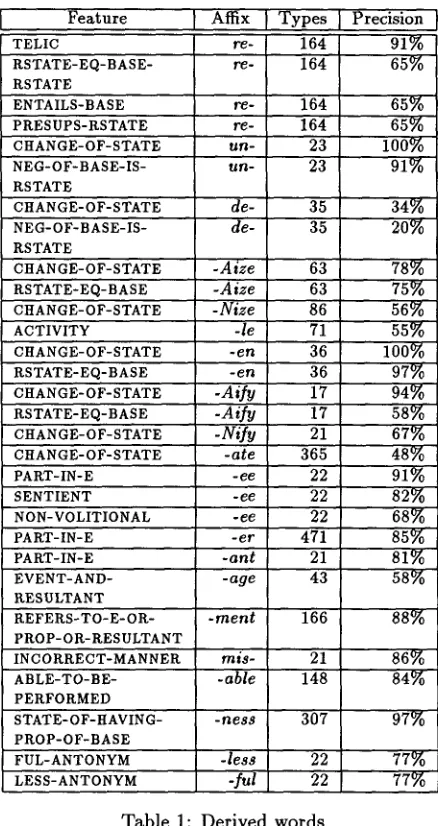
pair to be correct. This definition of correct was constructed, in part, to m a k e relatively quick hu- m a n judgements possible. It should also be noted t h a t the semantic j u d g e m e n t s require t h a t the se- mantics be expressed in a precise way. This discipline is enforced in part by requiring t h a t the features be axiomatized in a denotational logic. Another argu- ment for such an axiomatization is t h a t m a n y N L P systems utilize a denotational logic for representing semantic information and thus the axioms provide a straightforward interface to the lexicon.To return to our example, as shown in Table 1, there were 63
-Aize
derived words (types) of which 78 percent conform to the CHANGE-OF-STATE ax- iom. Of the bases, 80 percent conform to the IZE-D E P E N D E N T axiom which will be discussed in the
next section. A m o n g the conforming words were
equalize, stabilize,
andfederalize.
T w o words t h a t seem to be derived using the-ize
suffix but do not conform to the CHANGE-OF-STATE axiom arepenal-
ize
andsocialize (with the guests).
A different sort of non-conformity is produced when the morpholog- ical analyzer finds a spurious parse. For example, it analyzedsubsidize as [sub- [side -ize]]
and thus pro- duced thesidize/CHANGE-OF-STATE
pair which for the relevant tokens was incorrect. In the first sort, the non-conformity arises because the cue does not always correspond to the relevant lexical semantic information. In the second sort, the non-conformity arises because a cue has been found where one does not exist. A system t h a t utilizes a lexicon so con- structed is interested primarily in the overall preci- sion of the information contained within and thus the results presented in the next section conflate these two types of false positives.4 R e s u l t s
This section starts by discussing the semantics of 18 derivational affixes: re-, un-, d e - , - i z e , - e n , - i f y , - l e , -ate, -ee, -er, -ant, -age, -ment, mis-,-able, -ful, - less, and -ness. Following this discussion, a table of precision statistics for the performance of these sur- face cues is presented. Due to space limitations, the lexical semantics cued by these affixes can only be loosely specified. However, they have been axiom- atized in a fashion exemplified by the CHANGE-OF- STATE axiom above (see (Light, 1996; Light, 1992)).
T h e verbal prefixes un-, de-, and re- cue aspec- tual information for their base and derived forms. Some examples from the Brown corpus are unfas- ten, unwind, decompose, defocus, reactivate, and readapt. Above it was noted t h a t un- is a cue for telicity. In fact, b o t h un- and de- cue the CHANGE- OF-STATE feature for their base and derived f o r m s - - the CHANGE-OF-STATE feature entails the TELIC fea- ture. In addition, for un- and de-, the result state of the derived form is the negation of the result state of the base (NEG-OF-BASE-IS-RSTATE), e.g., the result of unfastening something is the opposite of the result of fastening it. As shown by examples like reswim the last lap, re- only cues the TELIC feature for its base and derived forms: the lap might have been swum previously and thus the negation of the result state does not have to have held previously (DoTty, 1979). For re-, the result state of the derived form is the same as t h a t of the base (RSTATE-EQ-BASE- RSTATE), e.g., the result of reactivating something is the same as activating it. In fact, if one reactivates something then it is also being activated: the derived form entails the base (ENTAILS-BASE). Finally, for re-, the derived form entails that its result state held previously, e.g., if one recentralizes something then it must have been central at some point previous to the event of recentralization (PRESUPS-RSTATE).
T h e suffixes -Aize, -Nize, -en, -Airy, -Nify all cue the CHANGE-OF-STATE feature for their derived form as was discussed for -Aize above. Some ex- emplars are centralize, formalize, categorize, colo- nize, brighten, stiffen, falsify, intensify, mummify, and glorify. For -Aize, -en and -Airy a bit more can be said a b o u t the result state: it is the base predi- cate (RSTATE-EQ-BASE), e.g., the result of formaliz- ing something is that it is formal. Finally -Aize, -en, and -Airy cue the following feature for their bases: if a state holds of some individual then either an event described by the derived form predicate oc- curred previously or the predicate was always true of the individual (IZE-DEPENDENT), e.g., if some- thing is central then either it was centralized or it was always central.
T h e "suffixes" -le and -ate should really be called verbal endings since they are not suffixes in English, i.e., if one strips them off one is seldom left with a word. (Consequently, only regular expressions were
used to collect types; the morphological analyzer was not used.) Nonetheless, they cue lexical semantics and are easily identified. Some examples are chuckle, dangle, alleviate, and assimilate. T h e ending -ate cues a CHANGE-OF-STATE verb and -le an ACTIVITY verb.
T h e derived forms produced by -ee, -er, and -ant all refer to participants of an event described by their base (PART-IN-E). Some examples are appointee, de- porlee, blower, campaigner, assailant, and claimant. In addition, the derived form of -ee is also sentient of this event and non-volitional with respect to it (Barker, 1995).
The nominalizing suffixes -age and -ment both produce derived forms t h a t refer to something re- sulting from an event of the verbal base predicate. Some examples are blockage, seepage, marriage, pay- ment, restatement, shipment, and treatment. T h e derived forms of -age entail t h a t an event occurred and refer to something resulting from it (EVENT- AND-RESULTANT)), e.g., seepage entails t h a t seep- ing took place and t h a t the seepage resulted from this seeping. Similarly, the derived forms of -ment entail that an event took place and refer either to this event, the proposition t h a t the event occurred, or something resulting from the event (REFERS-TO- E-OR-PROP-OI~-RESULT), e.g., a restatement entails that a restating occurred and refers either to this event, the proposition that the event occurred, or to the actual utterance or written document resulting from the restating event. (This analysis is based on (Zucchi, 1989).)
T h e verbal prefix mis-, e.g., miscalculate and mis- quote, cues the feature that an action is performed in an incorrect manner (INCORRECT-MANNER.). T h e suffix -able cues a feature t h a t it is possible to per- form some action (ABLE-TO-BE-PEP, FORMED), e.g., something is enforceable if it is possible t h a t some- thing can enforce it (DoTty, 1979). T h e words de- rived using -hess refer to a state of something having the property of the base (STATE-OF-HAVING-PROP- OF-BASE), e.g., in Kim's fierceness at the meeting yesterday was unusual the word fierceness refers to a state of Kim being fierce. T h e suffix -ful marks its base as abstract (ABSTRACT): careful, peaceful, powerful, etc. In addition, it marks its derived form as the antonym of a form derived by -less if it exists (LESS-ANTONYM). The suffix -less marks its derived forms with the analogous feature (FUL-ANTONYM). Some examples are colorful/less, fearful/less, harm- ful/less, and tasteful/less.
this s u m by the total n u m b e r of types. Using this statistic it can be said t h a t if a r a n d o m word is de- rived, its features have a 76 percent chance of being true and if it is a s t e m of a derived form, its features have a 82 percent chance of being true.
C o m p u t i n g recall requires finding all true tokens of a cue. This is a labor intensive task. It was performed for the verbal prefix re- and the recall was found to be 85 percent. T h e m a j o r i t y of the missed re- verbs were due to the fact t h a t the system only looked at verbs starting with R E and not other parts-of-speech, e.g., m a n y nominalizations such as r e a c c o m m o d a t i o n contain the re- morphological cue. However, increasing recall by looking at all open class categories would p r o b a b l y decrease precision. Another cause of reduced recall is t h a t some stems were not in the Alvey lexicon or could not be prop- erly extracted by the morphological analyzer. For example, - N i z e could not be stripped from hypoth- esize because Alvey failed to reconstruct h y p o t h e s i s from h y p o t h e s . However, for the affixes discussed here, 89 percent of the bases were present in the Alvey lexicon.
5
E v a l u a t i o n
G o o d surface cues are easy to identify, abundant, and correspond to the needed lexical semantic in- f o r m a t i o n (Hearst (1992) identifies a similar set of desiderata). W i t h respect to these desiderata, derivational m o r p h o l o g y is b o t h a good cue and a b a d cue.
Let us s t a r t with why it is a bad cue: there m a y be no derivational cues for the lexical semantics of a particular word. This is not the case for other surface cues, e.g., distributional cues exist for every word in a corpus. In addition, even if a derivational cue does exist, the reliability (on average approxi- m a t e l y 76 percent) of the lexical semantic informa- tion is too low for m a n y N L P tasks. This unrelia- bility is due in p a r t to the inherent exceptionality of lexical generalization and thus can be improved only partially.
However, derivational m o r p h o l o g y is a good cue in the following ways. It provides exactly the type of lexical semantics needed for m a n y N L P tasks: the affixes discussed in the previous section cued nomi- nal semantic class, verbal aspectual class, a n t o n y m relationships between words, sentience, etc. In ad- dition, working with the Brown corpus (1.1 million words) and 18 affixes provided such information for over 2500 words. Since corpora with over 40 million words are c o m m o n and English has over 40 com- m o n derivational affixes, one would expect to be able to increase this n u m b e r by an order of magnitude. In addition, m o s t English words are either derived themselves or serve as bases of at least one deriva- tional affix. 3 Finally, for some N L P tasks, 76 per-
3The following experiment supports this claim. Just
29
Feature
TELIC
RSTATE-EQ-BASE- R S T A T E
ENTAILS-BASE
P R E S U P S - R S T A T E C H A N G E - O F - S T A T E
NEG-OF-BASE-IS- R S T A T E
C H A N G E - O F - S T A T E
NEG-OF-BASE-IS- R S T A T E
C H A N G E - O F - S T A T E
R S T A T E - E Q - B A S E C H A N G E - O F - S T A T E
ACTIVITY
C H A N G E - O F - S T A T E
R S T A T E - E Q - B A S E C H A N G E - O F - S T A T E
R S T A T E - E Q - B A S E C H A N G E - O F - S T A T E
C H A N G E - O F - S T A T E
PART-IN-E S E N T I E N T N O N - V O L I T I O N A L
PART-IN-E PART-IN-E E V E N T - A N D -
RESULTANT REFERS-TO-E-OR- PROP-OR-RESULTANT INCORRECT-MANNER ABLE-TO-BE- PERFORMED STATE-OF-HAVING- PROP-OF-BASE FUL-ANTONYM LESS-ANTONYM
] Affix I Types ] Precision I re- 164 91%
re- 164 65%
re- 164 65% re- 164 65%
un- 23 100%
un- 23 91%
de- 35 34% de- 35 20%
- A i z e 63 78% -Aize 63 75% -Nize 86 56% -le 71 55%
-en 36 100%
-en 36 97% -Airy 17 94% - A i f y 17 58% -Nify 21 67% -ate 365 48%
-ee 22 91%
-ee 22 82%
-ee 22 68%
-er 471 85% - a n t 21 81% -age 43 58%
- m e n t 166 88%
mis- 21 86% -able 148 84%
-hess 307 97%
.less 22 77% -]ul 22 77%
Table 1: Derived words
Feature I Affix [ T y p e s [Precision
TELIC re- 164 91%
CHANGE-OF-STATE Vun- 23 91%
CHANGE-OF-STATE Vde- 33 36%
IZE-DEPENDENT -Aize 64 80%
IZE-DEPENDENT -en 36 72%
IZE-DEPENDENT -Airy 15 40%
ABSTRACT -ful 76 93%
[image:5.612.310.529.102.515.2]cent reliability may be adequate. In addition, some affixes are much more reliable cues than others and thus if higher reliability is required then only the affixes with high precision might be used.
The above discussion makes it clear that morpho- logical cueing provides only a partial solution to the problem of acquiring lexical semantic information. However, as mentioned in section 2 there are many types of surface cues which correspond to a vari- ety of lexical semantic information. A combination of cues should produce better precision where the same information is indicated by multiple cues. For example, the morphological cue re- indicates telic- ity and as mentioned above, the syntactic cue the progressive tense indicates non-stativity (Dorr and Lee, 1992). Since telicity is a type of non-stativity, the information is mutually supportive. In addition, using many different types of cues should provide a greater variety of information in general. Thus mor- phological cueing is best seen as one type of surface cueing that can be used in combination with others to provide lexical semantic information.
6 A c k n o w l e d g e m e n t s
A portion of this work was performed at the Uni- versity of Rochester Computer Science Department and supported by ONR/ARPA research grant num- ber N00014-92-J-1512.
R e f e r e n c e s
Barker, Chris. 1995. The semantics of -ee. In
Pro-
ceedings of the SALT conference.
Berwick, Robert. 1983. Learning word meanings from examples. In
Proceedings of the 8th Interna-
tional Joint Conference on Artificial Intelligence
(IJCAI-S3).
Brill, Eric. 1994. Some advances in transformation- based part of speech tagging. In
Proceedings of
the Twelfth National conference on Artificial In-
telligence: American Association for Artificial In-
telligence (AAAI).
Brown, Peter F., Vincent J. Della Pietra, Peter V. deSouza, Jennifer C. Lai, and Robert L. Mercer. 1992. Class-based n-gram models of natural lan- guage.
Computational Linguistics,
18(4).Church, Kenneth, William Gale, Patrick Hanks, and Donald Hindle. 1989. Parsing, word associa- tions and typical predicate-argument relations. In
International P~'~rkshop on Parsing Technologies,
pages 389-98.over 400 open class words were picked randomly from the Brown corpus and the derived forms were marked by hand. Based on this data, a random open class word in the Brown corpus has a 17 percent chance of being derived, a 56 percent chance of being a stem of a derived form, and an 8 percent chance of being both.
Dorr, Bonnie J. and Ki Lee. 1992. Building a lex- icon for machine translation: Use of corpora for aspectual classification of verbs. Technical Report CS-TR-2876, University of Maryland.
Dowty, David. 1979.
I~rd Meaning and Montague
Grammar.
Reidel.Fisher, Cynthia, Henry Gleitman, and Lila R. Gleit- man. 1991. On the semantic content of subcatego- rization frames.
Cognitive Psychology,
23(3):331- 392.Gleitman, Lila. 1990. The structural sources of verb meanings.
Language Acquisition,
1:3-55.Granger, R. 1977. Foulup: a program that figures out meanings of words from context. In
Proceed-
ings of the 5th International Joint Conference on
Artificial Intelligence.
Grimshaw, Jane. 1981. Form, function, and the lan- guage acquisition device. In C. L. Baker and J. J. McCarthy, editors,
the logical problem of language
acquisition.
MIT Press.Hastings, Peter. 1994.
Automatic Acquistion of
I~rd Meaning from Context.
Ph.D. thesis, Uni- versity of Michigan.Hearst, Marti. 1992. Automatic acquisition of hy- ponyms from large text corpora. In
Proceedings
of the fifteenth International Conference on Com-
putational Linguistics (COLING).
Hwang, Chung Hee and Lenhart Schubert. 1993. Episodic logic: a comprehensive natural represen- tation for language understanding.
Mind and Ma-
chine,
3(4):381-419.Light, Marc. 1992. Rehashing
Re-.
InProceedings
of the Eastern States Conference on Linguistics.
Cornell University Linguistics Department Work- ing Papers.Light, Marc. 1996.
Morphological Cues for Lexical
Semantics.
Ph.D. thesis, University of Rochester, Rochester, NY.Marcus, Mitchell, Beatrice Santorini, and Mary Ann Marcinkiewicz. 1993. Building a large annotated corpus of English: The Penn Treebank.
Compu-
tational Linguistics,
19(2):313-330.Merialdo, Bernard. 1994. Tagging English text with a probabilistic model.
Computational Linguistics,
20(2):155-172.Pinker, Steven. 1989.
Learnability and Cognition:
The Acquisition of Argument Structure.
MIT Press.Pinker, Steven. 1994. How could a child use verb syntax to learn verb semantics?
Lingua,
92:377- 410.Ritchie, Graeme D., Graham J. Russell, Alan W. Black, and Steve G. Pulman. 1992.
Computa-
tional Morphology: Practical Mechanisms for the
English Lexicon.
MIT press.Schiitze, Hinrich. 1992. Word sense disambiguation with sublexical representations. In
Statistically-
Based NLP Techniques (American Association
for Artificial Intelligence l~'~rkshop, July 12-16,
1992, San Jose, CA.),
pages 109-113.Siskind, Jeffrey M. 1990. Acquiring core meanings of words, represented as Jackendoff-style concep- tual structures, from correlated streams of linguis- tic and non-linguistic input. In
Proceedings of
the 28th Meeting of the Association for Compu-
tational Linguistics.
Yarowsky, David. 1993. One sense per collocation. In
Proceedings of the ARPA l~'~rkshop on Human
Language Technology.
Morgan Kaufmann.Zucchi, Alessandro. 1989.
The Language of Propo-
sitions and Events: Issues in the Syntax and the