A t a b u l a r i n t e r p r e t a t i o n o f a c l a s s o f 2 - S t a c k A u t o m a t a
E r i c V i l l e m o n t e d e l a C l e r g e r i e I N R I A - R o c q u e n c o u r t - B . P . 105 7 8 1 5 3 L e C h e s n a y C e d e x , F R A N C E [email protected]
M i g u e l A l o n s o P a r d o U n i v e r s i d a d d e L a C o r u f i a
C a m p u s d e E l v i f i a s / n 15071 L a C o r u f i a , S P A I N
alonso©dc, fi. udc. es
Abstract
T h e paper presents a tabular interpretation for a kind of 2-Stack Automata. These a u t o m a t a may be used to describe various parsing strategies, ranging from purely top-down to purely bottom-up, for LIGs and TAGs. The tabular interpretation ensures, for all strategies, a time complexity in O(n 6) and space complexity in
O(n 5)
where n is the length of the input string.I n t r o d u c t i o n
2-Stack a u t o m a t a [2SA] have been identified as pos- sible operational devices to describe parsing strate- gies for Linear Indexed G r a m m a r s [LIG] or Tree Ad- joining G r a m m a r s [TAG] (mirroring the traditional use of Push-Down A u t o m a t a [PDA] for Context- Free G r a m m a r s [CFG]). Different variants of 2SA (or not so distant Embedded Push-Down Automata) have been proposed, some to describe top-down strategies (Vijay-Shanker, 1988; Becker, 1994), some to describe b o t t o m - u p strategies (Rambow, 1994; Nederhof, 1998; Alonso P a r d o et al., 1997), but none (that we know) that are able to describe both kinds of strategies.
The same dichotomy also exists in the different tabular algorithms that has been proposed for spe- cific parsing strategies with complexity ranging from O(n 6) for bottom-up strategies to
O(n 9)
for prefix- valid top-down strategies (with the exception of a O(n 6) tabular interpretation of a prefix-valid hybrid strategy (Nederhof, 1997)). It must also be noted that the different tabular algorithms may be diffi- cult to understand and it is often unclear to know if the algorithms still hold for different strategies.This paper overcomes these problems by (a) in- troducing
strongly-driven 2SA
[SD-2SA] that may be used to describe parsing strategies for TAGs and LIGs, ranging from purely top-down to purely bottom-up, and (b) presenting a tabular interpre- tation of these a u t o m a t a in time complexity O(n 6) and space complexity O(nS).The tabular interpretation follows the principles of Dynamic Programming: the derivations are bro- ken into elementary sub-derivations that may (a) be
combined in different contexts to retrieve all possi- ble derivations and (b) be represented in a compact way by
items,
allowing tabulation.T h e strongly-driven 2SA are introduced and moti- vated in Section 1. We illustrate in Sections 2 and 3 their power by describing several parsing strategies for LIGs and TAGs. Items are presented in Sec- tion 4. Section 5 lists the rules to combine items and transitions and establishes correctness theorems. 1 S t r o n g l y - d r i v e n 2 - S t a c k A u t o m a t a 2SA are natural extensions of Push-Down A u t o m a t a working on a pair of stacks. However, it is known that unrestricted 2SA have the power of a Turing Machine. The remedy is to consider asymmetric stacks, one being the Master Stack M S where most of the work is done and the other being the Auxiliary Stack A S mainly used for restricted "bookkeeping". T h e following remarks are intended to give an idea of the restrictions we want to enforce. T h e first ones are rather standard and may be found under differ- ent forms in the literature. T h e last one justifies the qualification of "strongly-driven" for our automata. [Session] A S should actually be seen as a stack of
session stacks,
each one being associated to asession.
Only the topmost session stack may be consulted or modified. This idea is closely related to the notion ofEmbedded Push-Down
Automata
(Rambow, 1994, 96-102).[ L i n e a r i t y ] A session starts in mode write w and switches at some point in mode erase e. In mode w (resp. e), no element can be popped from (resp. pushed to) the master stack M S . Switching back from e to w is not allowed. This requirement is related to linearity because it means that a same session stack is never used twice by "descendants" of an element in M S . [Soft S e s s i o n E x i t ] Exiting a session is only possi-
ble when reaching back, with an empty session stack and in mode erase, the M S element that initiated the session.
<
/zW
\ W
/ZE
\ E
I I I I
--*W ~ W Write Mode
11
-~E
~E
I I I I I I I I I I I I I I I •
Master stack
Figure 1: Representation of transitions and derivations
took place on the session stack. T h e popping of this mark (in erase mode) will guide which action should take place on the session stack. In other words, we want the erasing actions to faithfully retrace the writing actions.
Formally, a SD-2SA .A is specified by a tuple (~, .M, X, $0, $l, O) where ~ denotes the finite set of terminals, .M the finite set of master stack elements and X the finite set of auxiliary stack elements. T h e i n i t symbol $0 and f i n a l symbol $y are distinguished elements of Ad. O is a finite set of transitions.
T h e master stack M S is a word in (D.M)* where 2) denotes the set {/~, x.~, ---% ~ } of a c t i o n m a r k s used to remember which action (w.r.t. the auxiliary stack A S ) takes place when pushing the next master stack element. T h e e m p t y master stack is noted e and a non-empty master stack ~1A1 . . . ~nAn where A,~ denotes the topmost element.
T h e meaning of the action marks is: /2 Pushing of an element on AS.
"x~ Popping of the topmost element of A S . --* No action on AS.
Creation of a new session (with a new e m p t y session stack on A S ) .
T h e auxiliary stack A S is a word of (K:X*)* where K: = { ~ w , ~ e } is a set of two elements used to delimit session stacks in AS. Delimiter ~ w (resp. ~ e ) is used to start a new session from a session which is in writing (resp. erasing) mode. T h e empty auxiliary stack is noted e.
Given some input string xl . . . x i E E*, a configu- ration of .A is a tuple (m, u, ~, ~) where m E {w, e} denotes a mode (writing or erasing), u a string posi- tion in [0, f], -- the master stack and ~ the auxiliary stack. Modes are ordered by w -~ e to capture the fact that no switching from e to w is possible. T h e initial configuration of ,4 is (w, 0, ~$0, ~ w ) and the final one (e, f ,
~$f, ~W).
A transition is given as a pair (p, --, ~), z (q, O, 0) where p, q are modes (or, with some abuse, variables ranging over modes), z in E*, .-- and O suffixes of
master stacks in .M(2)Ad)*, and ~,0 suffixes of aux- iliary stacks in
X*(~gX*)*
= (XUK:)*. Such a transi- tion applies on any configuration (p, u, k~--, ~b~) such t h a t xu+l . . . x , = z and returns (q, v, ~ 0 , ¢0).We restrict the kind of allowed transitions: S W A P (p, A, ~), z (q, B, ~) with p _ q and either
e K: ("session b o t t o m check") or ~ = e ("no A S consultation") .
/ - W R I T E ( w , A , e), z (w, A T B , b) / - E R A S E (e, A/ZB,a) , z (e, D, e) - - * - W R I T E (w, A, e), ~ , (w, A-*B, e) - - * - E R A S E (e, A-+B, e) , ~ ~ (e, C, e) ~ - W R I T E (m, A, e), z, (w, A ~ B , ~m) ~ - E R A S E (e, A ~ B , ~m) ~i~ (m, C, e) x , ~ - W R I T E (w, A, a ) , ~, (w, A'x~B, e) " ~ - E R A S E (e, A"~B, e) , ~ , (e, C, c)
Figure 1 graphically outlines the different kinds of transitions using a 2D representation where the X-axis (Y-axis) is related to the master (resp. aux- iliary) stack. Figure 1 also shows the two forms of derivations we encounter (during a same session). 2 U s i n g 2 S A t o p a r s e L I G s
Indexed G r a m m a r s (Aho, 1968) are an extension of Context-free G r a m m a r s in which a stack of indices is associated with each non-terminal symbol. Linear Indexed G r a m m a r s (Gazdar, 1987) are a restricted form of Indexed G r a m m a r s in which the index stack of at most one body non-terminal (the
child)
is re- lated with the stack of the head non-terminal (thefather).
T h e other stacks of the production must have a bounded stack size. [image:2.612.84.528.76.174.2][Terminal] Ak,o[] --+ ak where ak • VT U {•}, [ P O P ] Ak,o [oo] --. Ak,t [ ] . . . Ak,d[oo'y]... Ak,.~ [] [ P U S H ] Ak,0[ooT]--* Ak,1 [ ] . . . Ak,d[OO]... Ak,,~ [] [HOR] Ak,0[oo] ~ ak,1 [ 1 . . . Ak,d[OO]... a~,,~ [1
To each production k of type PUSH, P O P or HOR, we associate a characteristic tuple t(k) =
(d, 5, a,/3) where d is the position of the child and the other arguments given by the following table:
Type 5 a
P U S H / z e 7 P O P ~ 7 e H O R ---* e •
We introduce symbols ~'k,i as a shortcut for dotted productions [Ak,0~Ak,1 . . . Ak,i • Ak,i+ l . . . Ak,,~ ].
In order to design a broad class of parsing strate- gies ranging from pure top-down to pure bottom-up, we parameterize the automaton to be presented by a call projection -'* from 12 to )2 cart and a return projection *'-" from 12 to "W et where ~ = VN U VI
and ]2 cart and V ret are two sets of elements. We re- quire ]2 cart N ]2 ret = 0 and ("-*, +'-) to be invertible, i.eVX, r e v , ( X , * X ) = ( V , ~ ) =:~ x = r
The projections extend to sequences by taking X 1 . . . X : = X-~I . . . ~ and "~ = e (similarly for +-).
Given a LIG G and a choice of projections, we define the 2SA .A(G, -~, ~-) = (Vr, M , X, -~, ~ , O) where M = {Vk,i}U~TU~TT, X = ~//U~//, and whose transitions are built using the following rules.
• Call/Return of a non child
C A L L : (m, Vk,i,e)* , (w, V k , i ~ , ~ rn)
R E T : (e, , (m, Vk,i+,,e)
• Call/Return of a child for t(k) = (i + 1,5, a,/3).
C A L L ( 5 ) : (w, Vk,i, W ) , ~_~ (w, Vk,iSAk,-~+l, "-~)
R E T ( 5 ) : (e, Vk,iSAk,i++'-'-';1, /3) , , (e, Vk.i+l, W) • Production Selection
S E L : (w,A---~,0, e), , (w, Vk,0, e) • Production Publishing
P U B : (e, Vk,n~,e), , (e, ~0k,0, e) • Scanning (for terminal productions)
S C A N : (w, Ak,0, ~ )~---*(e, Ak,0, ~ ) ' m a~ ~ m The reader may easily check that A(G,-'-*, ~-'-) recognizes L(G). The choice of the call and r e t u r n elements for the M S (A~k,i and Ak,i) and the A S ('-~ and ~ ' ) defines a parsing strategy, by controlling how information flow between the phases of predic- tion and propagation. The following table lists the choices corresponding to the main parsing strategies (but others are definable).
Strategy ~ ~- -~ ~- Top-Down A _l_ 7 .l_ Bottom-Up 2. A' _l_ 7
Earley A A' 7 7'
It is also worth to note that the descrip- tion of A ( G , - * , +--) could be simplified. In- deed, for every configuration ( m , u , E , ~ ) deriv- able with .A(G, "--*,*-"), we can show that --- =
~ V k l , i l S t . . . Vk.,i,,SnX, and that 5t only depends on Vk~,i~. That means that we could use a master stack without action marks, these marks being im- plicitly given by the elements XTk,i.
3 U s i n g 2 S A t o p a r s e T A G s
Tree Adjoining Grammars are a extension of CFG introduced by Joshi in (Joshi, 1987) that use trees instead of productions as primary represent- ing structure. Formally, a TAG is a 5-tuple G =
(VN,VT, S , I , A ) , where VN is a finite set of non- terminal symbols, VT a finite set of terminal sym- bols, S the axiom of the grammar, I a finite set of
initial trees and A a finite set of auxiliary trees. I U A
is the set of elementary trees. Internal nodes are la- beled by non-terminals and leaf nodes by terminals or e, except for exactly one leaf per auxiliary tree (the foot) which is labeled by the same non-terminal used as label of its root node.
New trees are derived by adjoining: let be a a tree containing a node u labeled by A and let be fl an auxiliary tree whose root and foot nodes are also labeled by A. Then, the adjoining of/3 at the
adjunction node u is obtained by excising the subtree a~ of a with root u, attaching/3 to u and attaching the excised subtree to the foot of/3 (See Fig. 2).
pine
Figure 2: Traversal of an adjunction An elementary tree a may be represented by a set P ( a ) of context free productions, each one being either of the form
• Yk,O ---4 P k , 1 . . . P k , n ~ , where Yk,o denotes s o m e
• vk,0 --* al¢, where vk,0 denotes some leaf node k of c~ with terminal label ak.
As done for LIGs, we introduce symbols Vk,i to denote dotted productions and consider pro- jections "* and ~ to define the parameterized 2SA .A(G, -'-*, *") =
(VT, At, At, v0,0, ~0,0, O) where
At = {Vk,i) U {vk,i} U {v~,/). T h e transitions are given by the following rules (and illustrated in Fig- ure 2).• Call / R e t u r n for a node not on a spine. The call starts a new session, exited at return. C A L L : (m, Vk,i,e) , , ( w ,
m
R E T : (e, V k , / ~ v k . i + l , ~ ) ' ' (m, Vk,i+l,e) • Call / R e t u r n for a node
vk,i+l
on a spine.T h e adjunction stack is propagated un-modified along the spine.
S C A L L : (w, V k , i , e ) , ,
(w, Vk,i---*vk,i+~,e)
S R E T : (e, Vk,i--*bk,i+l, e) , ~ (e, Vk,i+l,e)• Call / R e t u r n for an adjunction on node uk,0. The computation is diverted to parse some ac- ceptable auxiliary tree ~ (with root node rh), and a continuation point is stored on the auxil- iary stack.
A C A L L : (w, vk,0,e) , ,
Vk,o/Zr~,Vk,o)
A R E T : (e,v~,o/ZF3Z,Vk,,~), , (e, ~ - " e) /]k,0,• Call / R e t u r n for a foot node f~. T h e continu- ation stored by the adjunction is used to parse the excised subtree.
F C A L L : (w, f ~ , A ) ,- , (w, f-'-~"~A, e) F R E T : (e, f~'%A,~) , , (e, ]~,A)
Note: These two transitions use a variable A over At. This is a slight extension of 2SA that preserves correctness and complexity.
• P r o d u c t i o n Selection
S E L : (w, vk.~,e), , (w, Vk,0,e) • P r o d u c t i o n Publishing
P U B : (m, Vk,n~,e), ( e , ~ /]k,0, e) • Scanning
S C A N : (w, v~,0, ~m), ~ , ( e , ~---
Different parsing strategies can be obtained by choosing the call (vk,i) and r e t u r n (vk,i) elements:
S t r a t e g y
prefix-valid Top-Down v _l_ B o t t o m - U p _L v' prefix-valid Earley v v'
Non prefix-valid variants of the top-down and Earley-like strategies can also be defined, by tak- ing ~ = _L and ~ = r~ for every root node r~ of
an auxiliary tree j3 (the projections being unmodi- fied on the other elements). In other words, we get a full prediction on the context-free backbone of G but no prediction on the adjunctions.
4 I t e m s
We identify two kinds of elementary deriva- tions, namely C o n t e x t - F r e e [CF] and e s c a p e d C o n t e x t - F r e e [xCF] derivations, respectively rep- resented by CF and x C F items. An item keeps the pertinent information relative to a derivation, which allows to apply the sequence of transitions associ- ated with the derivation in different contexts.
Before presenting these items, we introduce the following classification about derivations.
A derivation
(p,u, EA,~)[--~7
/ (q,v,O,O)
is said r i g h t w a r d if no element of E is accessed (even for consultation) during the derivation and if A is only consulted. Then F~A is a prefix of O.Similarly, a derivation (p, u, E, ~)1-~" (q, v, O, 0) is said u p w a r d if no element of ~ is accessed (even for consultation). Then ~ is a prefix of 0.
We also note
w[q/p]
the prefix substitution of p by q for all wordsw,p, q on some vocabulary such that
p is prefix of w.4.1 C o n t e x t - F r e e D e r i v a t i o n s
A C o n t e x t - F r e e [CF] derivation only depends on the topmost element A of the initial stack M S . T h a t means that no element of the initial A S and no ele- ment of M S below element A is needed:
(o, u , - A , ~)l-~l (w, v, OB, 0)1-~2 (m, w, OBhC, ~c)
where
• dl and
did2
are both rightward and upward. • d 2 is rightward.• either (5 # ~ , o = w, and c e A') or (5 = ~ , and c = ~o).
For such a derivation, we have:
P r o p o s i t i o n 4.1
For all prefix stacks
E',~',(o,u,E'A,(')
I-~, ( w , v , O ' B , 8 ' )(re, w, O ' B 6 C , ( c )
w h e r e O ' = and o' = O[gl ].
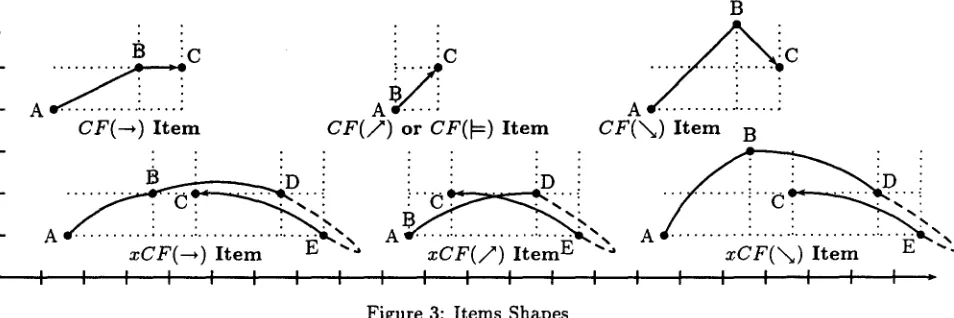
T h e proposition suggests representing the CF derivation by a CF item of the form
ABh(7, m
B
~c
A .t~.--. " "
CF(-*) I t e m
C F ( 7 )
o rC F ( ~ )
I t e mB
CF(X~)
I t e m B• : : :
• : : :
xCF(--*)
I t e m r~I I I I I I I I
: : :
x C F ( / z )
I t e m r~ "-~I I I I I I
Figure 3: Items Shapes
A
x C F ( ' x ~ ) I t e m
r~
I I I I I I I ,
4.2 E s c a p e d C o n t e x t - F r e e D e r i v a t i o n s An e s c a p e d C o n t e x t - F r e e [xCF] derivation is al- most a CF derivation, except for an
escape
sub- derivation that accesses deep elements of AS.where
(w, u, EA, ~)
I~
(w,v, e B , e)[ *--"- d~ ( w , s, @ D , ~d)
I*--
d x(e,t,@DX,~E,¢)
I-~;
(e, w, OBSC,
¢c)
• dl and
did2
are both rightward and upward• • d2 anddx
are rightward•• d3 is upward• • 5 # ~ and d, c E X.
P r o p o s i t i o n 4.2
For all prefix stacks ~ and ~',
stack ¢~, and rightward derivation
(w,
s, @'D,
~'d)l~x ,
(e, t, @'DX,~E,
¢')where
~' = ¢ [ ~ ' / E ] ,we have
(w, u, E'A, ~ ' ) [ - ~ -I~*
d2I~*
d3(w, v, e[='/--]B, e[~'/~])
(w,
s,
¢[-' lZ] D, ~' d)
.( e, t, ¢[E' /E]DX~E,
¢')(e,
w, O[~-'/Z]BSC,
¢'c)
The proposition suggests representing the xCF derivation by an xCF item of the form
ABS[i:) E]Ce
where A = (u,A), B -- (v,B/, /~ = ( s , D , d / , E = (t, E / and C -- (w, C, c/.
In order to homogenize notations, we also use the alternate notation
ABS[oo]Cm
to represent CF itemABSC'rn,
introducing a dummy symbol o.The specific forms taken by CF and xCF items for the different actions 5 are outlined in Figure 3.
5
C o m b i n i n g i t e m s and t r a n s i t i o n s
We provide the rules to combine items and transi- tions in order to retrieve all possible 2SA derivations. These rules do not explicit the scanning con- straints and suppose that the string z may be read between positions w and k of the input string• They use holes * to denote slots that not need be con- sulted. For any mini configuration A = (u, A, a), we note ~ o = (u, A) its micro projection•
[ - - * - W R I T E ] r = (w, C, e), ~, (w,
C--*F, e)
A**[oo]Cw = ~ A C ° ~ [ o o ] ~ ' w
where C = <w, C, c>, and F = (k, F, c).
[ / - W R I T E ] r = (w, C, e), ~, (w,
C/ZF, f)
(1)A**[oo] Cw ==~ G ° G °/z [oo] Fw
where C = (w, C, c), and F = (k, F, f).
[~-WRITE] r = (m, C, e) vz. " (w,
C~F, ~"~)
(2)A**[oo]Cm ==~
C ° C ° ~ [ o ¢ ] F w where C = (w, C, c), and F = {k, F, ~m).i X - W R I T E ] T = (W, C, c): z (w,
CX~F,e)
(3)]i°**[°°]CWM**[oo]Aw } ~ M C ° \ [ ° ° ] F w (4)
where C = (w,C,c), A = (u,A,a), and F = <k,F,a).
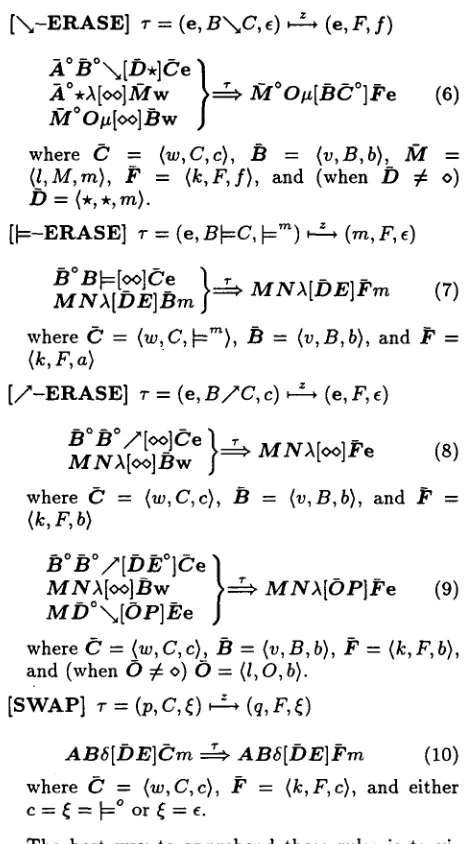
[ - - * - E R A S E ] r = (e,
B--*C, e) , ~ , (e, F, e)
A ° M A [ ° ° ]
]~w'4°]~°~[DE]Oe } ~ A ° M A [ D E ] F e (5)
[image:5.612.63.540.65.224.2][x,~-ERASE] ~- = (e,
Bx~C,e),
z ( e , f , f) 21° B°"~[D*]C'e}
~I°*A [oo]-~lw = ~ -/V/° O#[]~C°] ~'e (6)
f~°o~[oolBw
where C' = (w,C,c), /~ = (v,B,b), M = ( / , M , m ) , ~' = ( k , F , f ) , and (when D ~ o) D = (*,*,m).
I F - E R A S E ] ~- = (e,
B ~ C , ~'~) ~
(m, F, e)
/~°B~[oo]Ce
} ~
M N A [ D E ] F m
(7)M N A [ D E ] B m
where C = (w~C,~m),
B = (v,B,b),
and ~' =(k,F,a)
[ / Z - E R A S E ] r = (e,
B/ZC, c) ,
= ~(e, F, e)
MNA[~]l~w/~°]~/°/Z[°°]Ce }==~ M N A [ ° ° ] / a e (S)
where (~7 = (w,C,c/, B = (v,B,b/, and ~' = (k, F, b)
.B°B°/Z[DE°]Ce }
M N A [ o o l B w
~
M N A [ O P I ~ ' e
(9)MD°x,~[OP]E,e
where C' = (w, C, c), /~ = (v, B, b), ~' = {k, F, b), and (when O # o) O = <l, O, b).
[SWAP] r = (p, C,~), z (q, F,~)
A B 6 [ D E ] C m ~
AB6[DEI~'m
(10)
where C? = (w, C, c), ~' = (k, F, c), and eitherc=~=~°or~=e.
The best way to apprehend these rules is to vi- sualize them graphically as done for the two most complex ones (Rules 6 and 9) in Figures 4 and 5.
A "--L
Figure 4: Application of Rule 6
N C D
~M P "~'-"~
Figure 5: Application of Rule 9
5.1 R e d u c i n g the complexity
A n analysis of the time complexity to apply each rule gives us polynomial complexities
O(n")
with u <_ 6 except for Rule 9 where u = 8. However, by adapt- ing an idea from (Nederhof, 1997), we replace Rule 9 by the alternate and equivalent Rule 11."B°*/[b'E°]C'e
}
,D° x,,~[OP]~'e
MNA[oo]l~w
~
M N A [ O P I ~ e
(11)M .'%[O P]*e
where C7 : (w,C,c), B = (v,B,b), ~' = (k,F,b), and (when O ¢ v) O = (l, O, b).
Rule 11 has same complexity than Rule 9, but may actually be split into two rules of lesser complex- ity
O(n6),
introducing an intermediary pseudo-itemBB/Z[[OP]]Ce
(intuitively assimilable to a "deeply escaped" CF derivation).Rule 12 collects these pseudo-items (indepen- dently from any transition) while Rule 13 combines them with items (given a / Z - E R A S E transition ~-).
B B / Z [ / ) E ° ] C ' e }===~
BB/Z[[OP]](3'e
(12)* D ° \ [ O P ] E , e
1~° ]~°/Z[[OP]]Ce }
MNA[c~]I~w
~
M N A [ O P ] F e
(13)M * ~,~[OP]*e
where C7 = (w,C,c}, B = (v,B,b), ~' = (k,F,b), and (when
O ¢ o) O = (l, O, b).
T h e o r e m 5.1
The worst time complexity of the ap-
plication rules (1,2,3,4,5,6,7,8,10,12,13)
is O(n 6)
where n is the length of the input string. The worst
space complexity is O(nS).
5.2 C o r r e c t n e s s r e s u l t s
Two main theorems establish the correctness of derivable items w.r.t, derivable configurations.
A derivable item is either the initial i t e m or an item resulting from the application of a combi- nation rules on derivable items. The initial item (0, e)(0, e)~[oo] <0, $0, ~ w > w stands for the virtual
derivation step (w, 0, e, e)[- (w, 0, ~$0, ~ w ) .
T h e o r e m 5.2 ( S o u n d n e s s ) F o r
every derivable
item Z = AB6[£IE]Cm, there exists a derivation
on configurations
(o,
e) I-D--- Ul~-
vsuch that H[-~- V is a CF or xCF derivation repre-
sentable by I.
[image:6.612.77.309.66.488.2] [image:6.612.78.309.529.701.2]T h e o r e m 5.3 ( C o m p l e t e n e s s ) For all derivable
configuration (m, w, EC , ~c), there exists a derivable
item A B ~ [ D E ] C m such that C = (w, C, c}.
Proof: By induction on the configuration deriva-
tion length and by case analysis of the different ap- plication rules. We also need the following "Extrac- tion Lemma". |
P r o p o s i t i o n 5.1 From any derivation
(0, e)I--~- (m, w, EC, ~c)
may be extracted a suffix CF or xCF sub-derivation U[~ (m, .,, ~.C, ~c) for some configuration U.
5.3 Illustration
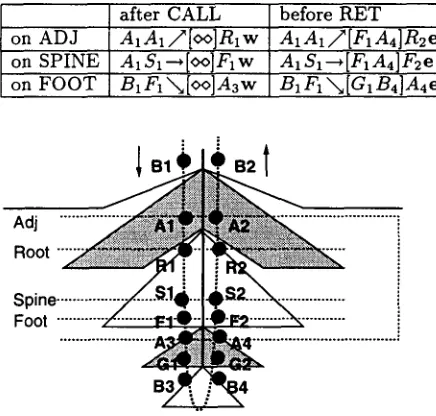
In the context of TAG parsing (Sect. 3), we can provide some intuition of the items that are built with .A(G, "-*, +-), using some characteristic points encountered during the traversal of an adjunction (Fig. 6).
on ADJ on SPINE on FOOT
after CALL
A1A1/[oo]RIw AI SI'--'~[oO]Fl W Bi Fl"N[oo]Aaw
before RET
AIAI/[F1A4]R2e
AI S1---+[FI A4]F2e
B1 F1 ",.~ [G, B4]A4 e
Figure 6: Adjunction and Items
6 C o n c l u s i o n
This paper unifies different results about TAGs and LIGs in an uniform setting and illustrates the ad- vantages of a clear distinction between the use of an operational device and the evaluation of this de- vice. The operational device (here SD-2SA) helps us to focus on the description of parsing strategies (for LIGs and TAGs), while, independently, we design an efficient evaluation mechanism for this device (here tabular interpretation with complexity O(n6)).
Besides illustrating a methodology, we believe our approach also opens new axes of research.
For instance, even if the tabular interpretation we have presented has (we believe) the best possi- ble complexity, it is still possible (using techniques outside the scope of this paper, (Barth61emy and Villemonte de la Clergerie, 1996)) to improve its ef- ficiency by refining what information should be kept in each kind of items (hence increasing computation sharing and reducing the number of items).
To handle TAGs or LIGs with attributes, we also plan to extend SD-2SA to deal with first-order terms (rather than just symbols) using unification to apply transitions and subsumption to check items. R e f e r e n c e s
Alfred V. Aho. 1968. Indexed grammars - - an ex- tension of context-free grammars. Journal of the
ACM, 15(4):647-671, October.
Miguel Angel Alonso Pardo, Eric de la Clergerie, and Manuel Vilares Ferro. 1997. Automata-based parsing in dynamic programming for Linear In- dexed Grammars. In A. S. Narin'yani, editor,
Proc. of DIALOGUE'97 Computational Linguis- tics and its Applications International Workshop,
pages 22-27, Moscow, Russia, June.
F. P. Barth~lemy and E. Villemonte de la Clergerie. 1996. Information flow in tabular interpretations for generalized push-down automata. To appear in journal of TCS.
Tilman Becker. 1994. A new automaton model for TAGs: 2-SA. Computational Intelligence,
10(4):422-430.
Gerald Gazdar. 1987. Applicability of indexed grammars to natural languages. In U. Reyle and C. Rohrer, editors, Natural Language Parsing and
Linguistic Theories, pages 69-94. D. Reidel Pub-
lishing Company.
Aravind K. Joshi. 1987. An introduction to tree adjoining grammars. In Alexis Manaster-Ramer, editor, Mathematics of Language, pages 87- 115. John Benjamins Publishing Co., Amster- dam/Philadelphia.
Mark-Jan Nederhof. 1997. Solving the correct- prefix property for TAGs. In T. Becker and H.-V. Krieger, editors, Proc. of MOL'97, pages 124-130, Schloss Dagstuhl, Germany, August.
Mark-Jan Nederhof. 1998. Linear indexed automata and tabulation of TAG parsing. In Proc. of First Workshop on Tabulation in Parsing and Deduc-
tion (TAPD'98), pages 1-9, Paris, France, April.
Owen Rambow. 1994. Formal and Computational
Aspects of Natural Language Syntax. Ph.D. thesis,
University of Pennsylvania.
K. Vijay-Shanker. 1988. A Study of Tree Adjoining
Grammars. Ph.D. thesis, University of Pennsyl-
[image:7.612.62.280.334.542.2]