(Received November 14, 2012; Accepted December 17, 2012; Published February 1, 2013)
Keywords: magnesium alloys, directional solidification, dislocation, electron backscattering diffraction, long-period stacking ordered phase
1. Introduction
Many kinds of Mg alloys have been recently developed due to their light weight and ease of recycling.1)Their use is expected to reduce the weight of transportation systems, contributing to the improvement of fuel efficiency and thereby lead to CO2 reduction. Among these Mg alloys, significant attention has been paid to alloys containing the long-period stacking ordered (LPSO) phase.222) In our previous work, we examined the mechanical properties of a Mg97Zn1Y2(at%) Mg/LPSO two-phase extruded alloy with the LPSO phase volume fraction of ³24%, and confirmed that the alloy shows an extremely high yield strength with keeping considerable ductility at room temperature (RT).1416) In addition, this alloy has a high potential for application as a high-temperature structural alloy because the strength remains very high at least up to 200°C.15,21,22) The mechanical properties of a Mg89Zn4Y7(at%) extruded alloy containing the LPSO phase of more than 85 vol%were also examined, and we clarified that the alloy shows an extremely high yield stress of³480 MPa atRT.23)Therefore, there is a strong possibility that the high-volume-fraction LPSO phase alloys could be used in structural materials requiring an extremely high strength/weight ratio. However, one of the drawbacks of this high-volume-fraction LPSO phase alloy is that its workability is low. In conventional facilities, the extrusion treatment is difficult at low temperatures due to the extremely high strength of the alloy. However, extrusion became possible at 450°C.23) This suggests that the controlling mechanism of the deformation may change at around this temperature. Management of non-basal slip must be one of the important factors in controlling the high-temperature deformation behavior, as this is known in Mg-alloys.24) In previous papers,13,18,23) we clarified that (0001) basal slip dominantly carries the strain in the LPSO phase. Kink deformation also effectively accommodates the stress concentration, contributing to the development of ductility in the LPSO phase. In addition, the operation of non-basal slip was observed under the limited conditions including the
high-temperatures.13,25) Therefore, it is extremely important to identify the nature of the non-basal slip system in order to improve the workability of high-volume-fraction LPSO phase alloys and to control the high-temperature deformation behavior of Mg-based alloys containing an LPSO phase. However, little information on non-basal slip in the LPSO phase is available at present; the slip plane, the Burgers vector of the dislocation, and the critical resolved shear stress (CRSS) are all unknown due to the difficulty in making an LPSO phase single crystal. It is known that the Mg12ZnY LPSO phase exhibits several different crystal structures characterized by changing the stacking sequence of the close-packed (0001) plane and by the peculiar chemical modulation of the Zn and Y atoms on the close-packed plane; such a structure is called a“synchronized LPSO structure”26). In this paper, operative non-basal slip in the Mg12ZnY phase with the synchronized LPSO structure is describedfirst, and then its variation depending on the crystal structure is discussed.
2. Experimental Procedure
Mother ingots with a composition of Mg88Zn5Y7 (at%) were prepared by induction melting in a carbon crucible. The DS treatment was conducted using the mother ingots by Bridgman technique (Nissin giken, Japan, NEV-DS2) under an Ar gas atmosphere at a crystal growth rate of 5.0 mm/h. In addition, the LPSO phase extruded alloy with a composition of Mg89Zn4Y7 was also prepared in order to obtain the specimen with a similar texture and much finer structure. The details of the preparation method, micro-structure and texture in the DS alloy and extruded alloy were reported in previous papers of Refs. 13) and 23), respec-tively. The obtained DS alloy and extruded alloy contained small amounts of Mg3Zn3Y2 phase (W-phase) and Mg phases, but it was composed primarily of LPSO phase grains with a volume fraction of more than 85%. By transmission electron microscopy (TEM, JEOL JEM-3010) observation, the LPSO phases in the DS-grown crystal and the as-extruded alloy were confirmed to have an 18R crystal structure with a rhombohedral unit cell. Some amounts of gained as-DS grown crystals were then heat-treated at 525°C
for three days under Ar atmosphere to transform the crystal structure of the LPSO phase from an 18R structure to a 14H structure with the hexagonal unit cell.18) Note that in this paper, the crystal structure of the 18R LPSO phase is indexed by the hexagonal notation by considering a unit cell whose volume is three times larger than that of the rhombohedral cell; this helps to clarify the differences between the 18R and 14H crystal structures of the LPSO phase.
The mechanical properties were examined by compression tests. Rectangular specimens approximately 2©2©5 mm3 in size were cut from the central parts of the DS alloys and extruded alloys using electrodischarge machining (EDM). The loading axis was set to be parallel to the growth direction or extruded direction. By the previous researches, the basal planes in most of grains in the DS alloy and extruded alloy were confirmed to be aligned parallel to the growth direction and extruded direction, respectively, i.e., they have the“basal
fiber texture”.13,23)Due to the development of the basalfiber texture, the Schmid factor for the basal slip was very small in most of grains at these loading orientations. This loading orientation parallel to the growth direction or extruded direction is called “0°-orientation” hereafter. Compressive deformation was applied to the specimen at a nominal strain rate of 1.67©10¹4s¹1, mainly at 400°C in order to cause the non-basal slips in the specimens. Slip trace observation was conducted by optical microscopy (OM) with Nomarski interference contrast. The slip plane was identified by the so-called two-face analysis using the electron-backscatter diffraction pattern observation technique in scanning electron microscopy (SEM-EBSD, SEM: JEOL JEM-6500F, EBSP: TSL Solutions K.K.) in the DS crystal. The Burgers vector of the dislocation operative on the non-basal plane was identified by the g·b contrast analysis in the TEM operated at 300 kV.
3. Results and Discussions
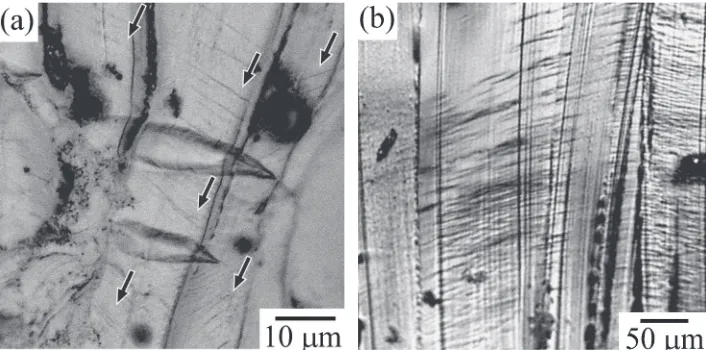
Figure 1(a) shows the deformation markings introduced in the high-volume-fraction LPSO phase extruded alloy deformed at RT, and Fig. 1(b) shows the typical slip traces
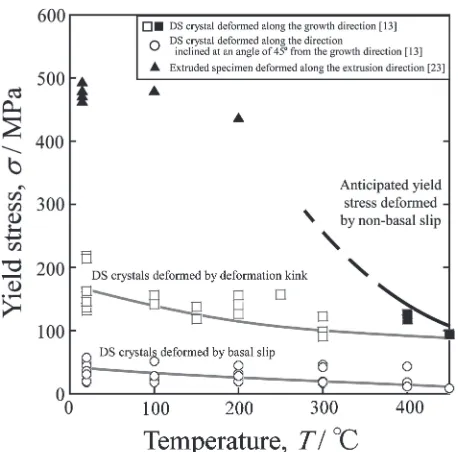
introduced in the as-grown DS specimen deformed at 400°C to³8%plastic strain. As described in our previous papers, in the deformation of LPSO phase alloy at 0°-orientation, kink deformation band is introduced and dominantly carries the strain in the LPSO crystal due to the suppression of the basal slip at low temperatures.13,23) Non-basal slip was hardly observed at RT in the DS crystal, which had a yield stress of³165 MPa. However, non-basal slip was locally observed to be operative in the deformation of the extruded alloy even at RT, particularly around the kink deformation band to accommodate the strain, as shown in Fig. 1(a). This non-basal slip was due to the extremely high yield stress of ³480 MPa in the extruded alloy derived from thefiner LPSO phase grain microstructure; in the DS crystal the average thickness of the grain is³100 µm while it is³10 µm in the extruded alloy. The similar deformation microstructure in the extruded specimen was observed in the deformation at 200°C. On the other hand, at high temperatures of 400°C and above, the operation of the non-basal slip came to frequently appear in addition to the deformation kink also in the DS crystal, as shown in Fig. 1(b). The above experimental results demonstrate that the CRSS of non-basal slip shows strong temperature dependence, and that it rapidly decreases at around 400°C. The precise value of the CRSS for the non-basal slip has not been determined yet due to the difficulty of making the single crystal, but from the above results the yield stress of the alloy deformed by the operation of non-basal slip at this 0°-orientation where the loading axis is approximately parallel to (0001) in most of grains is roughly anticipated as shown in Fig. 2. Thus, high-temperature deformation behav-ior of the LPSO phase alloys must be strongly affected by the non-basal slip. Indeed, it was previously reported that the yield stress of high-temperature annealed Mg89Zn4Y7 extruded alloys, in which the textures were considerably randomized by the annealing, largely drops above 300°C accompanied by the local operation of non-basal slip.25)The non-basal slip was confirmed to frequently appear at the intersection of the plate-like shape of grains where the piling up of the basal dislocation occurs, to accommodate the stress concentration. This results in the decrease in k-values in Fig. 1 Slip traces of non-basal slip observed in (a) the Mg89Zn4Y7high-volume-fraction LPSO phase extruded alloy specimen deformed
[image:2.595.122.475.70.245.2]the HallPetch relation ·y=·0+kd¹1/2 obtained for LPSO phase alloys with random textures, and it leads to the large decrease in yield stress at 300°C.25)
In order to identify the slip plane of the operative non-basal slip, a so-called two-face slip trace analysis, which is usually conducted in a single crystal, was attempted in the deformed DS crystal. Figures 3(a), 3(b) show the OM images of the non-basal slip traces introduced in the grains located at the side edge of the DS specimens with the 18R structure in deformation at 400°C. In addition, by conducting the heat-treatment prior to the compression tests, the DS specimen with the 14H structure was also prepared,18)and then the non-basal slip traces were introduced by the deformation at 400°C as the same way, as shown in Figs. 3(e), 3(f ). Because the LPSO phase grains show a peculiar plate-like shape with the interface parallel to (0001) and they are aligned parallel to the loading axis due to the basal fiber texture,13)we were able to find grains located almost parallel to the side edge of the specimen, as shown in the images. The proof that we observed the same grain from two different directions was confirmed by conducting a tilting observation in the SEM. The slip traces were not perfectly straight but showed slightly wavy morphology in some parts. This suggests the occurrence of the cross slip, although the extent was not so significant as observed in bcc materials. The angle of the introduced slip traces with respect to the side edge of the specimens was measured as indicated in the images. Then, by confirming the plane normal direction of the observed grains, the slip plane could be determined on the stereographic projection. The corresponding plane normal directions of the grains were evaluated by SEM-EBSD analysis. The orienta-tion analysis of the LPSO phase by the SEM-EBSP method has not been reported until now due to their complex crystal structures. First we conducted the X-ray diffraction analysis (XRD) and determined the structural data of the LPSO phases
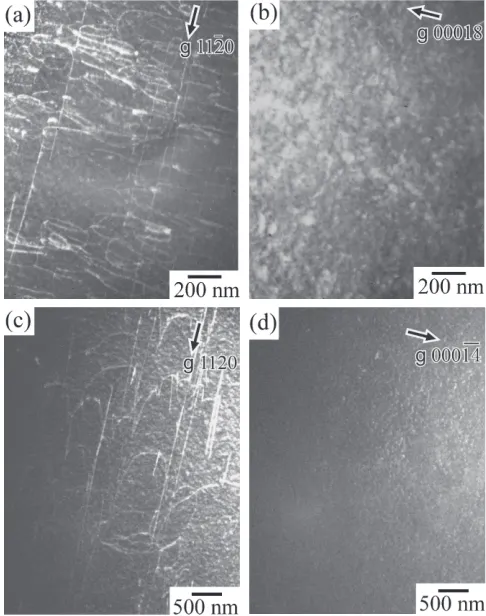
edge of the specimens were plotted on both the circumference and the horizontal line in the stereograph. By drawing a great circle passing through the two points, the slip plane could be determined. The same analyses were conducted for the slip traces in two other grains and the results obtained are also plotted in the figures. The evaluated results show some scattering, but it is obvious that the slip plane is almost parallel to thef1010gin both the 18R and 14H LPSO phases. The Burgers vectors of the operative dislocations were identified by the g·b contrast analysis in the TEM. Figures 4(a), 4(b) and 4(c), 4(d) show the dark-field images of dislocations observed with different reflection vectors (g-vectors) in the DS specimen deformed at 400°C to ³4% plastic strain in the 18R and 14H crystals, respectively. The observed beam direction was parallel to ½1100. As shown in Fig. 4(a), when observed with g=1120, in addition to the straight dislocation aligned parallel to the (0001), many round-shaped dislocations, which were rarely observed at low-temperatures, were confirmed. That is, the round-shaped dislocations are non-basal dislocations that extend out of the basal plane. Note that all these dislocations lost their contrast when observed with g=00018 as shown in Fig. 4(b). This indicates that the observed non-basal dislocations do not have a c-component in their Burgers vectors. Then, taking the slip plane off1100gconfirmed by two-face slip trace analysis into consideration, the Burgers vector of the dislocation is determined to h1120i. The same dislocation features were confirmed in the 14H crystal, as shown in Figs. 4(c), 4(d).
It was clarified from the above experimental results that
f1100gh1120i prism slip is operative as a non-basal slip system in both the 18R and 14H LPSO phases. In the present study, the operation of dislocation whose Burgers vector contains the c-component was not observed. This must be due to the complex arrangement of atoms on non-basal planes in the LPSO phase compared to that in hcp-Mg. Instead, the dislocation operative on non-basal slip had the Burgers vector parallel to h1120i, since it does not disturb the peculiar chemical modulation in the LPSO phase by its motion.
The operation of f1100gh1120i prism slip is coincident with the expected one for the 14H phase with a hexagonal unit cell, but it is somewhat curious in the 18R phase with a rhombohedral unit cell. The slip system in the LPSO phase with a rhombohedral unit cell was previously investigated in a Ni3(Ti0.9Nb0.1) 9R LPSO phase, and (0001)h1120ibasal slip andf1101gh1120i pyramidal slip were determined to be Fig. 2 Temperature dependence of the yield stress of the DS and extruded
[image:3.595.55.284.67.293.2]operative.27)Figure 5 shows the projection images of the 2H-Mg, 18R-LPSO, and 14H-LPSO phases crystal structures viewed along the ½1120 direction (showing two unit cells
respectively). As is seen in thefigure, the atomic arrangement on theð1100Þ prism plane is complex and is not periodical along the c-axis in either the 14H and 18R crystals due to the complex long-period stacking sequence of the basal plane compared to the 2H-Mg. In the 18R crystal, however, the constituent atoms are periodically arranged on some pyram-idal planes such as f1108g because the crystal symmetry changed to a rhombohedral system; these planes correspond to relatively low index planes in the rhombohedral notation. Fig. 4 Dark-field images of dislocations observed with different reflection
vectors (g-vectors) in the DS specimen deformed at 400°C to³4%plastic strain in the (a), (b) 18R and (c), (d) 14H crystals. (a)g=1120in 18R, (b)g=00018 in 18R, (c)g=1120in 14H, and (d)g=00014in 14H. The observed beam direction is parallel to½1100.
Fig. 3 (a, b) OM images of non-basal slip traces introduced in the grains at the side edge of the 18R-phase DS specimen deformed at 400°C to³4%plastic strain. (c) Orientation map examined by SEM-EBSD analysis corresponding to the area shown in Fig. 3(a). (d) Stereographic projection of the crystal orientation detected in Fig. 3(c), and the analyzed result on the trace of the non-basal slip plane. The slip planes of two other grains were confirmed by the same measurement method and are also plotted in the figures. (e)(h) Corresponding results which were confirmed in the 14H-phase DS specimens.
[image:4.595.82.510.71.282.2] [image:4.595.304.548.366.580.2] [image:4.595.47.290.367.675.2]primarily of Mg atoms. A phase with the similar structure was reported also in MgAlGd system, although the atomic arrangement of Al and Gd is more strongly ordered in that system.29) As a possibility, this peculiar chemically modu-lated structure might affect the dislocation core structure of non-basal slip, resulting in the variation in the selection of operative non-basal slip systems compared to those in Ni-based LPSO phases. Further study including the atomic scale observation of the dislocation core structure must be required to elucidate this.
4. Conclusions
In this study, the operative non-basal slip system in the Mg12ZnY LPSO phase, which is increased at high-temper-atures and would affect the mechanical properties, were investigated, focusing on the variation in it depending on the stacking sequence in the LPSO structure. As a result, the
f1100gh1120iprism slip was identified in both 18R and 14H LPSO phases, even though they have the different lattice systems. This behavior is different from that observed in a Ni-based LPSO phase. The peculiar chemical modulation in the Mg12ZnY LPSO phase may affect the selection of operative slip systems.
Acknowledgements
This work was supported by a Grant-in-Aid for Scientific Research on Innovative Areas “Materials Science on Synchronized LPSO Structure” from the MEXT of Japan, and by “Funding Program for Next Generation World-Leading Researchers”of Japan Society for the Promotion of Science, and in part by the Kumamoto Prefecture CREATE project from Japan Science and Technology Agency.
and Y. Kawamura:Mater. Trans.49(2008) 12941297.
10) T. Itoi, K. Takahashi, H. Moriyama and M. Hirohashi:Scr. Mater.59
(2008) 11551158.
11) M. Noda, T. Mayama and Y. Kawamura:Mater. Trans.50(2009) 2526 2531.
12) Y. J. Wu, X. Q. Zeng, D. L. Lin, L. M. Peng and W. J. Ding:J. Alloy. Compd.477(2009) 193197.
13) K. Hagihara, N. Yokotani and Y. Umakoshi:Intermetallics18(2010) 267276.
14) K. Hagihara, A. Kinoshita, Y. Sugino, M. Yamasaki, Y. Kawamura, H. Y. Yasuda and Y. Umakohsi:Acta Mater.58(2010) 62826293. 15) K. Hagihara, A. Kinoshita, Y. Sugino, M. Yamasaki, Y. Kawamura,
H. Y. Yasuda and Y. Umakohsi:Trans. Nonferrous Met. Soc. China20
(2010) 12591268.
16) M. Hirano, M. Yamasaki, K. Hagihara, K. Higashida and Y. Kawamura:Mater. Trans.51(2010) 16401647.
17) X. H. Shao, Z. Q. Yang and X. L. Ma:Acta Mater.58(2010) 4760 4771.
18) K. Hagihara, Y. Sugino, Y. Fukusumi, Y. Umakoshi and T. Nakano: Mater. Trans.52(2011) 10961103.
19) M. Yamasaki, K. Hashimoto, K. Hagihara and Y. Kawamura: Acta Mater.59(2011) 36463658.
20) E. Oñorbe, G. Garcés, P. Pérez, S. Cabezas, M. Klaus, C. Genzel, E. Frutos and P. Adeva:Scr. Mater.65(2011) 719722.
21) E. Oñorbe, G. Garcés, P. Pérez and P. Adeva:J. Mater. Sci.47(2012) 10851093.
22) K. Hagihara, A. Kinoshita, Y. Fukusumi, M. Yamasaki and Y. Kawamura:Mater. Sci. Eng. A560(2013) 7179.
23) K. Hagihara, A. Kinoshita, Y. Sugino, M. Yamasaki, Y. Kawamura, H. Y. Yasuda and Y. Umakoshi:Intermetallics18(2010) 10791085. 24) N. Ono, R. Nowak and S. Miura:Mater. Lett.58(2003) 3943. 25) K. Hagihara, A. Kinoshita, Y. Fukusumi, M. Yamasaki and Y.
Kawamura:Mater. Sci. Forum706709(2012) 11581163.
26) E. Abe, A. Ono, T. Itoi, M. Yamasaki and Y. Kawamura:Philos. Mag. Lett.91(2011) 690696.
27) K. Hagihara, T. Tanaka, T. Nakano and Y. Umakoshi:Acta Mater.53
(2005) 50515059.
28) D. Egusa and E. Abe:Acta Mater.60(2012) 166178.