A Pipeline Framework for Dependency Parsing
Ming-Wei Chang Quang Do Dan Roth Department of Computer Science
University of Illinois at Urbana-Champaign Urbana, IL 61801
{mchang21, quangdo2, danr}@uiuc.edu
Abstract
Pipeline computation, in which a task is decomposed into several stages that are solved sequentially, is a common compu-tational strategy in natural language pro-cessing. The key problem of this model is that it results in error accumulation and suffers from its inability to correct mis-takes in previous stages. We develop a framework for decisions made via in pipeline models, which addresses these difficulties, and presents and evaluates it in the context of bottom up dependency parsing for English. We show improve-ments in the accuracy of the inferred trees relative to existing models. Interestingly, the proposed algorithm shines especially when evaluated globally, at a sentence level, where our results are significantly better than those of existing approaches. 1 Introduction
A pipeline process over the decisions of learned classifiers is a common computational strategy in natural language processing. In this model a task is decomposed into several stages that are solved sequentially, where the computation in the ith
stage typically depends on the outcome of com-putations done in previous stages. For example, a semantic role labeling program (Punyakanok et al., 2005) may start by using a part-of-speech tag-ger, then apply a shallow parser to chunk the sen-tence into phrases, identify predicates and argu-ments and then classify them to types. In fact, any left to right processing of an English sentence may be viewed as a pipeline computation as it pro-cesses a token and, potentially, makes use of this result when processing the token to the right.
The pipeline model is a standard model of computation in natural language processing for good reasons. It is based on the assumption that some decisions might be easier or more reliable than others, and their outcomes, therefore, can be counted on when making further decisions. Nev-ertheless, it is clear that it results in error accu-mulation and suffers from its inability to correct mistakes in previous stages. Researchers have re-cently started to address some of the disadvantages of this model. E.g., (Roth and Yih, 2004) suggests a model in which global constraints are taken into account in a later stage to fix mistakes due to the pipeline. (Punyakanok et al., 2005; Marciniak and Strube, 2005) also address some aspects of this problem. However, these solutions rely on the fact that all decisions are made with respect to the same input; specifically, all classifiers considered use the same examples as their input. In addition, the pipelines they study are shallow.
This paper develops a general framework for decisions in pipeline models which addresses these difficulties. Specifically, we are interested indeep pipelines– a large number of predictions that are being chained.
A pipeline process is one in which decisions made in the ith stage (1) depend on earlier
deci-sions and (2) feed on input that depends on earlier decisions. The latter issue is especially important at evaluation time since, at training time, a gold standard data set might be used to avoid this issue. We develop and study the framework in the con-text of abottom up approach to dependency pars-ing. We suggest that two principles to guide the pipeline algorithm development:
(i) Make local decisions as reliable as possible. (ii) Reduce the number of decisions made.
Using these as guidelines we devise an
rithm for dependency parsing, prove that it satis-fies these principles, and show experimentally that this improves the accuracy of the resulting tree.
Specifically, our approach is based on a shift-reduced parsing as in (Yamada and Matsumoto, 2003). Our general framework provides insights that allow us to improve their algorithm, and to principally justify some of the algorithmic deci-sions. Specifically, the first principle suggests to improve the reliability of the local predictions, which we do by improving the set of actions taken by the parsing algorithm, and by using a look-ahead search. The second principle is used to jus-tify the control policy of the parsing algorithm – which edges to consider at any point of time. We prove that our control policy is optimal in some sense, and that the decisions we made, guided by these, principles lead to a significant improvement in the accuracy of the resulting parse tree.
1.1 Dependency Parsing and Pipeline Models
Dependency trees provide a syntactic reresenta-tion that encodes funcreresenta-tional relareresenta-tionships between words; it is relatively independent of the grammar theory and can be used to represent the structure of sentences in different languages. Dependency structures are more efficient to parse (Eisner, 1996) and are believed to be easier to learn, yet they still capture much of the predicate-argument information needed in applications (Haghighi et al., 2005), which is one reason for the recent in-terest in learning these structures (Eisner, 1996; McDonald et al., 2005; Yamada and Matsumoto, 2003; Nivre and Scholz, 2004).
Eisner’s work –O(n3
)parsing time generative algorithm – embarked the interest in this area. His model, however, seems to be limited when dealing with complex and long sentences. (Mc-Donald et al., 2005) build on this work, and use a global discriminative training approach to im-prove the edges’ scores, along with Eisner’s algo-rithm, to yield the expected improvement. A dif-ferent approach was studied by (Yamada and Mat-sumoto, 2003), that develop a bottom-up approach and learn the parsing decisions between consecu-tive words in the sentence. Local actions are used to generate a dependency tree using a shift-reduce parsing approach (Aho et al., 1986). This is a true pipeline approach, as was done in other suc-cessful parsers, e.g. (Ratnaparkhi, 1997), in that the classifiers are trained on individual decisions
rather than on the overall quality of the parser, and chained to yield the global structure. Clearly, it suffers from the limitations of pipeline process-ing, such as accumulation of errors, but neverthe-less, yields very competitive parsing results. A somewhat similar approach was used in (Nivre and Scholz, 2004) to develop a hybrid bottom-up/top-down approach; there, the edges are also labeled with semantic types, yielding lower accuracy than the works mentioned above.
The overall goal of dependency parsing (DP) learning is to infer a tree structure. A common way to do that is to predict with respect to each potential edge(i, j)in the tree, and then choose a global structure that (1) is a tree and that (2) max-imizes some score. In the context of DPs, this “edge based factorization method” was proposed by (Eisner, 1996). In other contexts, this is similar to the approach of (Roth and Yih, 2004) in that scoring each edge depends only on the raw data observed and not on the classifications of other edges, and that global considerations can be used to overwrite the local (edge-based) decisions.
On the other hand, the key in a pipeline model is that making a decision with respect to the edge (i, j) may gain from taking into account deci-sions already made with respect to neighboring edges. However, given that these decisions are noisy, there is a need to devise policies for reduc-ing the number of predictions in order to make the parser more robust. This is exemplified in (Ya-mada and Matsumoto, 2003) – a bottom-up ap-proach, that is most related to the work presented here. Their model is a “traditional” pipeline model – a classifier suggests a decision that, once taken, determines the next action to be taken (as well as the input the next action observes).
In the rest of this paper, we propose and jus-tify a framework for improving pipeline process-ing based on the principles mentioned above: (i) make local decisions as reliably as possible, and (ii) reduce the number of decisions made. We use the proposed principles to examine the (Ya-mada and Matsumoto, 2003) parsing algorithm and show that this results in modifying some of the decisions made there and, consequently, better overall dependency trees.
2 Efficient Dependency Parsing
pro-pose an improved pipeline framework based on the mentioned principles.
For many languages such as English, Chinese and Japanese (with a few exceptions), projective dependency trees (that is, DPs without edge cross-ings) are sufficient to analyze most sentences. Our work is therefore concerned only with projective trees, which we define below.
For wordsx, y in the sentenceT we introduce
the following notations:
x→y:xis thedirect parentofy. x→∗ y:xis anancestorofy;
x↔y:x→yory→x. x < y:xisto the leftofyinT.
Definition 1 (Projective Language) (Nivre, 2003)∀a, b, c ∈ T, a ↔ band a < c < bimply thata→∗ c or b→∗ c.
2.1 A Pipeline DP Algorithm
Our parsing algorithm is a modified shift-reduce parser that makes use of the actions described be-low and applies them in a left to right manner on consecutive pairs of words (a, b) (a < b) in
the sentence. This is a bottom-up approach that uses machine learning algorithms to learn the pars-ing decisions (actions) between consecutive words in the sentences. The basic actions used in this model, as in (Yamada and Matsumoto, 2003), are:
Shift: there is no relation between aandb, or
the action is deferred because the relationship be-tweenaandbcannot be determined at this point.
Right:bis the parent ofa,
Left:ais the parent ofb.
This is a true pipeline approach in that the clas-sifiers are trained on individual decisions rather than on the overall quality of the parsing, and chained to yield the global structure. And, clearly, decisions make with respect to a pair of words af-fect what is considered next by the algorithm.
In order to complete the description of the algo-rithm we need to describe which edge to consider once an action is taken. We describe it via the no-tion of the focus point: when the algorithm con-siders the pair(a, b),a < b, we call the wordathe
currentfocus point.
Next we describe several policies for determin-ing the focus point of the algorithm followdetermin-ing an action. We note that, with a few exceptions, de-termining the focus point does not affect the cor-rectnessof the algorithm. It is easy to show that for (almost) any focus point chosen, if the correct
action is selected for the corresponding edge, the algorithm will eventually yield the correct tree (but may require multiple cycles through the sentence). In practice, the actions selected are noisy, and a wasteful focus point policy will result in a large number of actions, and thus in error accumulation. To minimize the number of actions taken, we want to find a good focus point placement policy.
AfterS, the focus point always moves one word to the right. After LorRthere are there natural placement policies to consider:
Start Over: Move focus to the first word inT.
Stay: Move focus to the next word to the right. That is, forT = (a, b, c), and focus beinga, an
Laction will result is the focus beinga, whileR
action results in the focus beingb.
Step Back: The focus moves to the previous word (on the left). That is, forT = (a, b, c), and focus beingb, in both cases,awill be the focus point.
In practice, different placement policies have a significant effect on the number of pairs consid-ered by the algorithm and, therefore, on the fi-nal accuracy1. The following analysis justifies the
Step Back policy. We claim that if Step Back
is used, the algorithm will not waste any action. Thus, it achieves the goal of minimizing the num-ber of actions in pipeline algorithms. Notice that using this policy, whenLis taken, the pair(a, b)is reconsidered, but with new information, since now it is known thatcis the child ofb. Although this
seems wasteful, we will show this is a necessary movement to reduce the number of actions.
As mentioned above, each of these policies yields the correct tree. Table 1 compares the three policies in terms of the number of actions required to build a tree.
Policy #Shift #Left #Right
Start over 156545 26351 27918 Stay 117819 26351 27918 Step back 43374 26351 27918 Table 1: The number of actions required to build all the trees for the sentences in section23of Penn Treebank (Marcus et al., 1993) as a function of the focus point placement policy. The statistics are taken with the correct (gold-standard) actions.
It is clear from Table 1 that the policies result 1Note that (Yamada and Matsumoto, 2003) mention that
Algorithm 2 Pseudo Code of the dependency parsing algorithm. getFeatures extracts the fea-tures describing the word pair currently consid-ered;getAction determines the appropriate action for the pair;assignParentassigns a parent for the child word based on the action; and deleteWord
deletes the child word inT at thefocus once the
action is taken.
Lettrepresents for a word token
For sentenceT ={t1, t2, . . . , tn} focus= 1
whilefocus<|T|do
~v=getF eatures(tf ocus, tf ocus+1) α=getAction(tf ocus, tf ocus+1, ~v)
ifα=Lorα =Rthen
assignP arent(tf ocus, tf ocus+1, α) deleteW ord(T, f ocus, α)
// performing Step Back here
f ocus=f ocus−1
else
f ocus=f ocus+ 1
end if end while
in very different number of actions and thatStep Back is the best choice. Note that, since the ac-tions are the gold-standard acac-tions, the policy af-fects only the number ofS actions used, and not
the LandR actions, which are a direct function
of the correct tree. The number of required ac-tions in the testing stage shows the same trend and theStep Backalso gives the best dependency ac-curacy. Algorithm 2 depicts the parsing algorithm.
2.2 Correctness and Pipeline Properties
We can prove two properties of our algorithm. First we show that the algorithm builds the de-pendency tree in only one pass over the sentence. Then, we show that the algorithm does not waste actions in the sense that it never considers a word pair twice in the same situation. Consequently, this shows that under the assumption of a perfect action predictor, our algorithm makes the smallest possible number of actions, among all algorithms that build a tree sequentially in one pass.
Note that this may not be true if the action clas-sifier is not perfect, and one can contrive examples in which an algorithm that makes several passes on a sentence can actually make fewer actions than a single pass algorithm. In practice, however, as our experimental data shows, this is unlikely.
Lemma 1 A dependency parsing algorithm that uses the Step Back policy completes the tree when it reaches the end of the sentence for the first time.
In order to prove the algorithm we need the fol-lowing definition. We call a pair of words(a, b)a
free pairif and only if there is a relation between
aandband the algorithm can performLorR
ac-tions on that pair when it is considered. Formally,
Definition 2 (free pair) A pair (a, b) considered
by the algorithm is a free pair, if it satisfies the following conditions:
1. a↔b
2. a, b are consecutive in T (not necessary in the original sentence).
3. No other word inT is the child ofaorb. (a andbare now part of a complete subtree.)
Proof.: It is easy to see that there is at least one
free pairinT, with |T| > 1. The reason is that if no such pair exists, there must be three words {a, b, c}s.t. a ↔ b, a < c < b and¬(a → c∨
b→ c). However, this violates the properties of a projective language.
Assume{a, b, d}are three consecutive words in
T. Now, we claim that when usingStep Back, the
focus point is always to the left of all free pairs in
T. This is clearly true when the algorithm starts.
Assume that(a, b)is the firstfree pairinTand let cbe just to the left ofaandb. Then, the algorithm
will not make a L or R action before the focus
point meets(a, b), and will make one of these ac-tions then. It’s possible that(c, a∨b) becomes a free pair after removing a orb in T so we need
to move the focus point back. However, we also know that there is no free pair to the left of c.
Therefore, during the algorithm, the focus point will always remain to the left of all free pairs. So, when we reach the end of the sentence, every free pair in the sentence has been taken care of, and the sentence has been completely parsed.2
Lemma 2 All actions made by a dependency parsing algorithm that uses the Step Back policy are necessary.
Lis taken, eitheraorbwill become a child word
and be eliminate from further consideration by the algorithm. Therefore, if the action taken on(a, b) isRorL, it will never be considered again.
Assume that the action taken isS, and, w.l.o.g. that this is the rightmost S action taken before a non-Saction happens. Note that it is possible that there is a relation between aand b, but we
can-not perform R or L now. Therefore, we should consider (a, b) again only if a child ofaorbhas
changed. When Step Back is used, we will con-sider (a, b) again only if the next action isL. (If next action isR,bwill be eliminated.) This is true
because the focus point will move back after per-forming L, which implies that b has a new child
so we are indeed in a new situation. Since, from Lemma 1, the algorithm only requires one round. we therefore consider(a, b)again only if the situ-ation has changed.2
2.3 Improving the Parsing Action Set
In order to improve the accuracy of the action pre-dictors, we suggest a new (hierarchical) set of ac-tions: Shift, Left, Right, WaitLeft, WaitRight. We believe that predicting these is easier due to finer granularity – theSaction is broken to sub-actions in a natural way.
WaitLeft: a < b. ais the parent of b, but it’s
possible thatbis a parent of other nodes. Action is
deferred. If we performLeftinstead, the child ofb
can not find its parents later.
WaitRight: a < b. bis the parent of a, but it’s
possible thatais a parent of other nodes. Similar
toWL, action is deferred.
Thus, we also change the algorithm to perform
Sonly if there is no relationship betweenaandb2.
The new set of actions is shown to better support our parsing algorithm, when tested on different placement policies. WhenWaitLeftorWaitRight
is performed, the focus will move to the next word. It is very interesting to notice that WaitRight is not needed in projective languages if Step Back
is used. This give us another strong reason to use
Step Back, since the classification becomes more accurate – a more natural class of actions, with a smaller number of candidate actions.
Once the parsing algorithm, along with the fo-cus point policy, is determined, we can train the 2Interestingly, (Yamada and Matsumoto, 2003) mention
the possibility of an additionalsingleWaitaction, but do not add it to the model.
action classifiers. Given an annotated corpus, the parsing algorithm is used to determine the action taken for each consecutive pair; this is used to train a classifier to predict one of the five actions. The details of the classifier and the feature used are given in Section 4.
When the learned model is evaluated on new data, the sentence is processed left to right and the parsing algorithm, along with the action classifier, are used to produce the dependency tree. The eval-uation process is somewhat more involved, since the action classifier is not used as is, but rather via a look ahead inference step described next.
3 A Pipeline Model with Look Ahead The advantage of a pipeline model is that it can use more information, based on the outcomes of previ-ous predictions. As discussed earlier, this may re-sult in accumulating error. The importance of hav-ing a reliable action predictor in a pipeline model motivates the following approach. We devise a look ahead algorithm and use it as a look ahead policy, when determining the predicted action.
This approach can be used in any pipeline model but we illustrate it below in the context of our dependency parser.
The following example illustrates a situation in which an early mistake in predicting an action causes a chain reaction and results in further mis-takes. This stresses the importance of correct early decisions, and motivates our look ahead policy.
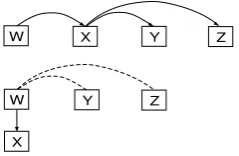
Let(w, x, y, z)be a sentence of four words, and assume that the correct dependency relations are as shown in the top part of Figure 1. If the system mistakenly predicts thatxis a child ofwbeforey
andzbecomesx’s children, we can only consider
the relationship betweenwandyin the next stage.
Consequently, we will never find the correct parent fory andz. The previous prediction error
propa-gates and impacts future predictions. On the other hand, if the algorithm makes a correct prediction, in the next stage, we do not need to considerwand y. As shown, getting useful rather than misleading
information in a pipeline model, requires correct early predictions. Therefore, it is necessary to uti-lize some inference framework to that may help resolving the error accumulation problem.
in-X Y
W Z
X
Y
[image:6.595.122.242.67.145.2]W Z
Figure 1: Top figure: the correct dependency rela-tions betweenw,x,yandz. Bottom figure: if the
algorithm mistakenly decides thatxis a child ofw
before deciding thaty andzare x’s children, we
cannot find the correct parent foryandz.
tractable to find the global optimal prediction se-quences in a pipeline model of the depth we con-sider. Therefore, we use a look ahead strategy, implemented via a local search framework, which uses additional information but is still tractable.
The local search algorithm is presented in Algo-rithm 3. The algoAlgo-rithm accepts three parameters,
model, depth and State. We assume a classifier that can give a confidence in its prediction. This is represented here bymodel.
As our learning algorithm we use a regularized variation of the perceptron update rule, as incorpo-rated in SNoW (Roth, 1998; Carlson et al., 1999), a multi-class classifier that is tailored for large scale learning tasks and has been used successfully in a large number of NLP tasks (e.g., (Punyakanok et al., 2005)). SNoW uses softmax over the raw activation values as its confidence measure, which can be shown to produce a reliable approximation of the labels’ conditional probabilities.
The parameterdepth is to determine the depth of the search procedure. Stateencodes the config-uration of the environment (in the context of the dependency parsing this includes the sentence, the focus point and the current parent and children for each word). Note that Statechanges when a pre-diction is made and that the features extracted for the action classifier also depend onState.
The search algorithm will perform a search of length depth. Additive scoring is used to score the sequence, and the first action in this sequence is selected and performed. Then, theStateis up-dated, the new features for the action classifiers are computed andsearchis called again.
One interesting property of this framework is that it allows that use of future information in ad-dition to past information. The pipeline model nat-urally allows access to all the past information.
Algorithm 3Pseudo code for the look ahead algo-rithm. yrepresents a action sequence. The
func-tionsearchconsiders all possible action sequences with|depth|actions and returns the sequence with the highest score.
AlgopredictAction(model,depth,State)
x= getNextFeature(State)
y=search(x,depth,model,State) lab=y[1]
State=update(State,lab)
returnlab
Algosearch(x,depth,model,State) maxScore=−∞
F ={y| kyk=depth}
foryinF do
s= 0,TmpState=State
for i= 1. . .depthdo
x= getNextFeature(TmpState) s=s+score(y[i],x, model) TmpState=update(TmpState,y[i])
end for
ifs >maxScorethen
ˆ
y=y
maxScore=s
end if end for
returnyˆ
Since the algorithm uses a look ahead policy, it also uses future predictions. The significance of this becomes clear in Section 4.
There are several parameters, in addition to
depththat can be used to improve the efficiency of the framework. For example, given that the action predictor is a multi-class classifier, we do not need to consider all future possibilities in order to de-cide the current action. For example, in our exper-iments, we only consider two actions with highest score at each level (which was shown to produce almost the same accuracy as considering all four actions).
4 Experiments and Results
23of the Penn Treebank).
4.1 Features for Action Classification
For each word pair (w1, w2) we use the words,
their POS tags and also these features of the chil-dren of w1 andw2. We also include the lexicon
and POS tags of2 words beforew1 and4 words
after w2 (as in (Yamada and Matsumoto, 2003)).
The key additional feature we use, relative to (Ya-mada and Matsumoto, 2003), is that we include the previous predicted action as a feature. We also add conjunctions of above features to ensure expressiveness of the model. (Yamada and Mat-sumoto, 2003) makes use of polynomial kernels of degree2which is equivalent to using even more conjunctive features. Overall, the average number of active features in an example is about50.
4.2 Evaluation
We use the same evaluation metrics as in (McDon-ald et al., 2005). Dependency accuracy (DA) is the proportion of non-root words that are assigned the correct head. Complete accuracy (CA) indicates the fraction of sentences that have a complete cor-rect analysis. We also measure that root accuracy (RA) and leaf accuracy (LA), as in (Yamada and Matsumoto, 2003). When evaluating the result, we exclude the punctuation marks, as done in (Mc-Donald et al., 2005) and (Yamada and Matsumoto, 2003).
4.3 Results
We present the results of several of the experi-ments that were intended to help us analyze and understand several of the design decisions in our pipeline algorithm.
To see the effect of the additional action, we present in Table2a comparison between a system that does not have the WaitLeft action (similar
to the (Yamada and Matsumoto, 2003) approach) with one that does. In both cases, we do not use the look ahead procedure. Note that, as stated above, the actionWaitRightis never needed for our
pars-ing algorithm. It is clear that addpars-ingWaitLeft
in-creases the accuracy significantly.
Table3investigates the effect of the look ahead, and presents results with different depth param-eters (depth= 1 means “no search”), showing a consistent trend of improvement.
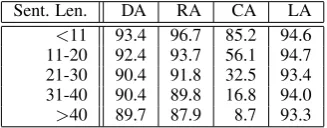
Table 4 breaks down the results as a function of the sentence length; it is especially noticeable that the system also performs very well for long
method DA RA CA LA
[image:7.595.319.517.61.96.2]w/oWaitLeft 90.27 90.73 39.28 93.87 wWaitLeft 90.53 90.76 39.74 93.94
Table 2: The significant of the actionWaitLeft.
method DA RA CA LA
depth=1 90.53 90.76 39.74 93.94 depth=2 90.67 91.51 40.23 93.96 depth=3 90.69 92.05 40.52 93.94 depth=4 90.79 92.26 40.68 93.95
Table 3: The effect of differentdepthsettings.
sentences, another indication for its global perfor-mance robustness.
Table5shows the results with three settings of the POS tagger. The best result is, naturally, when we use the gold standard also in testing. How-ever, it is worthwhile noticing that it is better to train with the same POS tagger available in test-ing, even if its performance is somewhat lower.
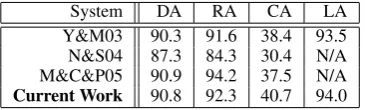
Table 6 compares the performances of several of the state of the art dependency parsing systems with ours. When comparing with other depen-dency parsing systems it is especially worth notic-ing that our system gives significantly better accu-racy on completely parsed sentences.
Interestingly, in the experiments, we allow the parsing algorithm to run many rounds to parse a sentece in the testing stage. However, we found that over 99% sentences can be parsed in a single round. This supports for our justification about the correctness of our model.
5 Further Work and Conclusion
We have addressed the problem of using learned classifiers in a pipeline fashion, where a task is de-composed into several stages and stage classifiers are used sequentially, where each stage may use the outcome of previous stages as its input. This is a common computational strategy in natural lan-guage processing and is known to suffer from error accumulation and an inability to correct mistakes in previous stages.
Sent. Len. DA RA CA LA
<11 93.4 96.7 85.2 94.6
11-20 92.4 93.7 56.1 94.7 21-30 90.4 91.8 32.5 93.4 31-40 90.4 89.8 16.8 94.0
>40 89.7 87.9 8.7 93.3
[image:7.595.327.506.128.182.2] [image:7.595.335.499.665.729.2]Train-Test DA RA CA LA gold−pos 90.7 92.0 40.8 93.8
pos−pos 90.8 92.3 40.7 94.0
[image:8.595.99.267.62.106.2]gold−gold 92.0 93.9 43.6 95.0 Table 5: Comparing different sources of POS tag-ging in a pipeline model. We set depth= 4in all the experiments of this table.
System DA RA CA LA
Y&M03 90.3 91.6 38.4 93.5 N&S04 87.3 84.3 30.4 N/A M&C&P05 90.9 94.2 37.5 N/A Current Work 90.8 92.3 40.7 94.0
Table 6: The comparison between the current work with other dependency parsing systems.
We abstracted two natural principles, one which calls for making the local classifiers used in the computation more reliable and a second, which suggests to devise the pipeline algorithm in such a way that minimizes the number of decisions (ac-tions) made.
We study this framework in the context of de-signing abottom up dependency parsing. Not only we manage to use this framework to justify several design decisions, but we also show experimentally that following these results in improving the accu-racy of the inferred trees relative to existing mod-els. Interestingly, we can show that the trees pro-duced by our algorithm are relatively good even for long sentences, and that our algorithm is do-ing especially well when evaluated globally, at a sentence level, where our results are significantly better than those of existing approaches – perhaps showing that the design goals were achieved.
Our future work includes trying to generalize this work to non-projective dependency parsing, as well as attempting to incorporate additional sources of information (e.g., shallow parsing in-formation) into the pipeline process.
6 Acknowledgements
We thank Ryan McDonald for providing the anno-tated data set and to Vasin Punyakanok for useful comments and suggestions.
This research is supported by the Advanced Research and Development Activity (ARDA)’s Advanced Question Answering for Intelligence (AQUAINT) Program and a DOI grant under the Reflex program.
References
A. V. Aho, R. Sethi, and J. D. Ullman. 1986. Compilers: Principles, techniques, and tools. InAddison-Wesley Pub-lishing Company, Reading, MA.
A. Carlson, C. Cumby, J. Rosen, and D. Roth. 1999. The SNoW learning architecture. Technical Report UIUCDCS-R-99-2101, UIUC Computer Science Depart-ment, May.
J. Eisner. 1996. Three new probabilistic models for de-pendency parsing: An exploration. In Proc. the Inter-national Conference on Computational Linguistics (COL-ING), pages 340–345, Copenhagen, August.
A. Haghighi, A. Ng, and C. Manning. 2005. Robust textual inference via graph matching. InProceedings of Human Language Technology Conference and Conference on Em-pirical Methods in Natural Language Processing, pages 387–394, Vancouver, British Columbia, Canada, October. Association for Computational Linguistics.
T. Marciniak and M. Strube. 2005. Beyond the pipeline: Dis-crete optimization in NLP. In Proceedings of the Ninth Conference on Computational Natural Language Learn-ing (CoNLL-2005), pages 136–143, Ann Arbor, Michigan, June. Association for Computational Linguistics. M. P. Marcus, B. Santorini, and M. Marcinkiewicz. 1993.
Building a large annotated corpus of English: The Penn Treebank. Computational Linguistics, 19(2):313–330, June.
R. McDonald, K. Crammer, and F. Pereira. 2005. Online large-margin training of dependency parsers. InProc. of the Annual Meeting of the ACL, pages 91–98, Ann Arbor, Michigan.
J. Nivre and M. Scholz. 2004. Deterministic dependency parsing of english text. InCOLING2004, pages 64–70. Joakim Nivre. 2003. An efficient algorithm for projective
dependency parsing. InIWPT, Nancy, France.
V. Punyakanok, D. Roth, and W. Yih. 2005. The necessity of syntactic parsing for semantic role labeling. InProc. of the International Joint Conference on Artificial Intelli-gence (IJCAI), pages 1117–1123.
A. Ratnaparkhi. 1997. A linear observed time statistical parser based on maximum entropy models. In EMNLP-97, The Second Conference on Empirical Methods in Nat-ural Language Processing, pages 1–10.
D. Roth and W. Yih. 2004. A linear programming for-mulation for global inference in natural language tasks. In Hwee Tou Ng and Ellen Riloff, editors, Proc. of the Annual Conference on Computational Natural Language Learning (CoNLL), pages 1–8. Association for Computa-tional Linguistics.
D. Roth. 1998. Learning to resolve natural language ambi-guities: A unified approach. InProc. National Conference on Artificial Intelligence, pages 806–813.
K. Toutanova, D. Klein, and C. Manning. ”2003”. Feature-rich part-of-speech tagging with a cyclic dependency net-work. InProceedings of HLT-NAACL 03.
[image:8.595.91.274.167.222.2]