Stochastic Iterative Alignment for Machine Translation Evaluation
Ding Liu and Daniel Gildea
Department of Computer Science University of Rochester
Rochester, NY 14627
Abstract
A number of metrics for automatic eval-uation of machine translation have been proposed in recent years, with some met-rics focusing on measuring the adequacy of MT output, and other metrics focus-ing on fluency. Adequacy-oriented met-rics such as BLEU measuren-gram
over-lap of MT outputs and their references, but do not represent sentence-level informa-tion. In contrast, fluency-oriented metrics such as ROUGE-W compute longest com-mon subsequences, but ignore words not aligned by the LCS. We propose a metric based on stochastic iterative string align-ment (SIA), which aims to combine the strengths of both approaches. We com-pare SIA with existing metrics, and find that it outperforms them in overall evalu-ation, and works specially well in fluency evaluation.
1 Introduction
Evaluation has long been a stumbling block in the development of machine translation systems, due to the simple fact that there are many correct translations for a given sentence. Human evalu-ation of system output is costly in both time and money, leading to the rise of automatic evalua-tion metrics in recent years. In the 2003 Johns Hopkins Workshop on Speech and Language En-gineering, experiments on MT evaluation showed that BLEU and NIST do not correlate well with human judgments at the sentence level, even when they correlate well over large test sets (Blatz et al., 2003). Liu and Gildea (2005) also pointed out that due to the limited references for every MT output, using the overlapping ratio ofn-grams
longer than 2 did not improve sentence level eval-uation performance of BLEU. The problem leads
to an even worse result in BLEU’S fluency eval-uation, which is supposed to rely on the long n
-grams. In order to improve sentence-level evalu-ation performance, several metrics have been pro-posed, including ROUGE-W, ROUGE-S (Lin and Och, 2004) and METEOR (Banerjee and Lavie, 2005). ROUGE-W differs from BLEU and NIST in that it doesn’t require the common sequence be-tween MT output and the references to be consec-utive, and thus longer common sequences can be found. There is a problem with loose-sequence-based metrics: the words outside the longest com-mon sequence are not considered in the metric, even if they appear both in MT output and the reference. ROUGE-S is meant to alleviate this problem by computing the common skipped bi-grams instead of the LCS. But the price ROUGE-S pays is falling back to the shorter sequences and losing the advantage of long common sequences. METEOR is essentially a unigram based metric, which prefers the monotonic word alignment be-tween MT output and the references by penalizing crossing word alignments. There are two prob-lems with METEOR. First, it doesn’t consider gaps in the aligned words, which is an important feature for evaluating the sentence fluency; sec-ond, it cannot use multiple references simultane-ously.1ROUGE and METEOR both use WordNet
and Porter Stemmer to increase the chance of the MT output words matching the reference words. Such morphological processing and synonym ex-traction tools are available for English, but are not always available for other languages. In order to take advantage of loose-sequence-based metrics and avoid the problems in ROUGE and METEOR, we propose a new metric SIA, which is based on loose sequence alignment but enhanced with the following features:
1METEOR and ROUGE both compute the score based on the best reference
• Computing the string alignment score based
on the gaps in the common sequence. Though ROUGE-W also takes into consider the gaps in the common sequence between the MT output and the reference by giving more cred-its to then-grams in the common sequence,
our method is more flexible in that not only do the strict n-grams get more credits, but
also the tighter sequences.
• Stochastic word matching. For the purpose
of increasing hitting chance of MT outputs in references, we use a stochastic word match-ing in the strmatch-ing alignment instead of WORD-STEM and WORD-NET used in METEOR and ROUGE. Instead of using exact match-ing, we use a soft matching based on the sim-ilarity between two words, which is trained in a bilingual corpus. The corpus is aligned in the word level using IBM Model4 (Brown et al., 1993). Stochastic word matching is a uniform replacement for both morphological processing and synonym matching. More im-portantly, it can be easily adapted for differ-ent kinds of languages, as long as there are bilingual parallel corpora available (which is always true for statistical machine transla-tion).
• Iterative alignment scheme. In this scheme,
the string alignment will be continued until there are no more co-occuring words to be found between the MT output and any one of the references. In this way, every co-occuring word between the MT output and the refer-ences can be considered and contribute to the final score, and multiple references can be used simultaneously.
The remainder of the paper is organized as fol-lows: section 2 gives a recap of BLEU, ROUGE-W and METEOR; section 3 describes the three components of SIA; section 4 compares the per-formance of different metrics based on experimen-tal results; section 5 presents our conclusion.
2 Recap of BLEU, ROUGE-W and
METEOR
The most commonly used automatic evaluation metrics, BLEU (Papineni et al., 2002) and NIST (Doddington, 2002), are based on the assumption that “The closer a machine translation is to a
pro-mt1: Life is like one nice chocolate in box ref: Life is just like a box of tasty chocolate
ref: Life is just like a box of tasty chocolate
mt2: Life is of one nice chocolate in box Figure 1: Alignment Example for ROUGE-W
fessional human translation, the better it is” (Pa-pineni et al., 2002). For every hypothesis, BLEU computes the fraction of n-grams which also
ap-pear in the reference sentences, as well as a brevity penalty. NIST uses a similar strategy to BLEU but further considers thatn-grams with different
fre-quency should be treated differently in the evalu-ation (Doddington, 2002). BLEU and NIST have been shown to correlate closely with human judg-ments in ranking MT systems with different qual-ities (Papineni et al., 2002; Doddington, 2002).
ROUGE-W is based on the weighted longest common subsequence (LCS) between the MT out-put and the reference. The common subsequences in ROUGE-W are not necessarily strict n-grams,
and gaps are allowed in both the MT output and the reference. Because of the flexibility, long common subsequences are feasible in ROUGE-W and can help to reflect the sentence-wide sim-ilarity of MT output and references. ROUGE-W uses a weighting strategy where the LCS contain-ing strictn-grams is favored. Figure 1 gives two
examples that show how ROUGE-W searches for the LCS. Formt1, ROUGE-W will choose either life is like chocolateorlife is like boxas the LCS,
since neither of the sequences ’like box’ and ’like chocolate’ are strictn-grams and thus make no
dif-ference in ROUGE-W (the only strictn-grams in
the two candidate LCS is life is). For mt2, there
is only one choice of the LCS:life is of chocolate.
The LCS ofmt1andmt2have the same length and
the same number of strictn-grams, thus they get
the same score in ROUGE-W. But it is clear to us thatmt1is better thanmt2. It is easy to verify that mt1andmt2have the same number of common
1-grams, 2-1-grams, and skipped 2-grams with the ref-erence (they don’t have common n-grams longer
than 2 words), thus BLEU and ROUGE-S are also not able to differentiate them.
se-mt1: Life is like one nice chocolate in box ref: Life is just like a box of tasty chocolate
ref: Life is just like a box of tasty chocolate
mt2: Life is of one nice chocolate in box Figure 2: Alignment Example for METEOR
quence based metrics. It has several phases and in each phase different matching techniques (EX-ACT, PORTER-STEM, WORD-NET) are used to make an alignment for the MT output and the ref-erence. METEOR doesn’t require the alignment to be monotonic, which means crossing word map-pings (e.g. a b is mapped to b a) are allowed, though doing so will get a penalty. Figure 2 shows the alignments of METEOR based on the same example as ROUGE. Though the two alignments have the same number of word mappings,mt2gets
more crossed word mappings thanmt1, thus it will
get less credits in METEOR. Both ROUGE and METEOR normalize their evaluation result based on the MT output length (precision) and the ref-erence length (recall), and the final score is com-puted as the F-mean of them.
3 Stochastic Iterative Alignment (SIA)
for Machine Translation Evaluation We introduce three techniques to allow more sen-sitive scores to be computed.
3.1 Modified String Alignment
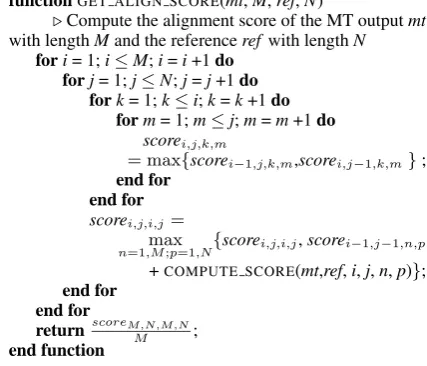
This section introduces how to compute the string alignment based on the word gaps. Given a pair of strings, the task of string alignment is to obtain the longest monotonic common sequence (where gaps are allowed). SIA uses a different weighting strategy from ROUGE-W, which is more flexible. In SIA, the alignments are evaluated based on the geometric mean of the gaps in the reference side and the MT output side. Thus in the dynamic pro-gramming, the state not only includes the current covering length of the MT output and the refer-ence, but also includes the last aligned positions in them. The algorithm for computing the alignment score in SIA is described in Figure 3. The sub-routine COMPUTE SCORE, which computes the
score gained from the current aligned positions, is shown in Figure 4. From the algorithm, we can
functionGET ALIGN SCORE(mt,M,ref,N)
.Compute the alignment score of the MT outputmt with lengthMand the referencerefwith lengthN
for i= 1;i≤M;i=i+1do for j= 1;j≤N;j=j+1do
for k= 1;k≤i;k=k+1do for m= 1;m≤j;m=m+1do
scorei,j,k,m
= max{scorei−1,j,k,m,scorei,j−1,k,m};
end for end for scorei,j,i,j=
max
n=1,M;p=1,N{scorei,j,i,j,scorei−1,j−1,n,p
+COMPUTE SCORE(mt,ref,i,j,n,p)};
end for end for
returnscoreM,N,M,N
M ;
[image:3.595.312.526.66.249.2]end function
Figure 3: Alignment Algorithm Based on Gaps
functionCOMPUTE SCORE(mt,ref,i,j,n,p)
if mt[i] ==ref[j]then return1/p
(i−n)×(j−p);
else return0; end if end function
Figure 4: Compute Word Matching Score Based on Gaps
see that not only will strict n-grams get higher
scores than non-consecutive sequences, but also the non-consecutive sequences with smaller gaps will get higher scores than those with larger gaps. This weighting method can help SIA capture more subtle difference of MT outputs than ROUGE-W does. For example, if SIA is used to align mt1
andref in Figure 1, it will chooselife is like box
instead oflife is like chocolate, because the
aver-age distance of ’box-box’ to its previous mapping ’like-like’ is less than ’chocolate-chocolate’. Then the score SIA assigns tomt1is:
1 1×1 +
1 1×1 +
1
√
1×2+ 1
√
2×5
×18 = 0.399 (1) For mt2, there is only one possible alignment,
its score in SIA is computed as:
1 1×1 +
1 1×1 +
1
√
1×5+ 1
√
2×3
×1
8 = 0.357 (2) Thus,mt1will be considered better thanmt2in
make full use of word-level information. This de-fect could potentially lead to a poor performance in adequacy evaluation, considering the case that the ignored words are crucial to the evaluation. In the later part of this section, we will describe an it-erative alignment scheme which is meant to com-pensate for this defect.
3.2 Stochastic Word Mapping
In ROUGE and METEOR, PORTER-STEM and WORD-NET are used to increase the chance of the MT output words matching the references. We use a different stochastic approach in SIA to achieve the same purpose. The string alignment has a good dynamic framework which allows the stochastic word matching to be easily incorporated into it. The stochastic string alignment can be im-plemented by simply replacing the functionCOM -PUTE SCORE with the function of Figure 5. The
function similarity(word1, word2) returns a ratio
which reflects how similar the two words are. Now we consider how to compute the similarity ratio of two words. Our method is motivated by the phrase extraction method of Bannard and Callison-Burch (2005), which computes the similarity ratio of two words by looking at their relationship with words in another language. Given a bilingual parallel corpus with aligned sentences, say English and French, the probability of an English word given a French word can be computed by training word alignment models such as IBM Model4. Then for every English worde, we have a set of conditional
probabilities given each French word: p(e|f1),
p(e|f2), ... ,p(e|fN). If we consider these proba-bilities as a vector, the similarities of two English words can be obtained by computing the dot prod-uct of their corresponding vectors.2 The formula
is described below:
similarity(ei, ej) = N
X
k=1
p(ei|fk)p(ej|fk) (3)
Paraphrasing methods based on monolingual par-allel corpora such as (Pang et al., 2003; Barzilay and Lee, 2003) can also be used to compute the similarity ratio of two words, but they don’t have as rich training resources as the bilingual methods do.
2Although the marginalized probability (over all French words) of an English word given the other English word (PN
k=1p(ei|fk)p(fk|ej)) is a more intuitive way of measur-ing the similarity, the dot product of the vectorsp(e|f)
de-scribed above performed slightly better in our experiments.
functionSTO COMPUTE SCORE(mt,ref,i,j,n,p)
if mt[i] ==ref[j]then return1/p
(i−n)×(j−p);
else
returnsimilarity√ (mt[i],ref[i])
(i−n)×(j−p) ; end if
end function
Figure 5: Compute Stochastic Word Matching Score
3.3 Iterative Alignment Scheme
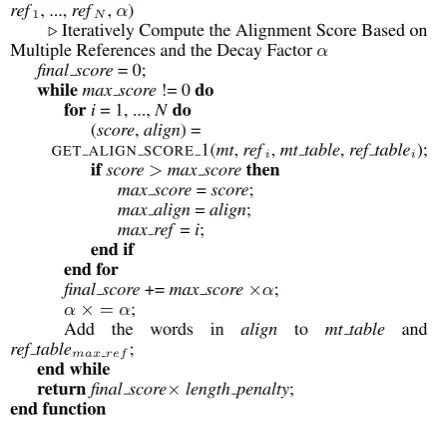
ROUGE-W, METEOR, and WER all score MT output by first computing a score based on each available reference, and then taking the highest score as the final score for the MT output. This scheme has the problem of not being able to use multiple references simultaneously. The itera-tive alignment scheme proposed here is meant to alleviate this problem, by doing alignment be-tween the MT output and one of the available ref-erences until no more words in the MT output can be found in the references. In each align-ment round, the score based on each reference is computed and the highest one is taken as the score for the round. Then the words which have been aligned in best alignment will not be con-sidered in the next round. With the same num-ber of aligned words, the MT output with fewer alignment rounds should be considered better than those requiring more rounds. For this reason, a decay factor α is multiplied with the scores of
each round. The final score of the MT output is then computed by summing the weighted scores of each alignment round. The scheme is described in Figure 6.
The function GET ALIGN SCORE 1 used
in GET ALIGN SCORE IN MULTIPLE REFS
is slightly different from GET ALIGN SCORE
described in the prior subsection. The dynamic programming algorithm for getting the best alignment is the same, except that it has two more tables as input, which record the unavailable po-sitions in the MT output and the reference. These positions have already been used in the prior best alignments and should not be considered in the ongoing alignment. It also returns the aligned positions of the best alignment. The pseudocode for GET ALIGN SCORE 1 is shown in Figure 7.
function GET ALIGN SCORE IN MULTIPLE REFS(mt,
ref1, ...,refN,α)
.Iteratively Compute the Alignment Score Based on
Multiple References and the Decay Factorα
final score= 0; while max score!= 0do
for i= 1, ...,N do (score,align) =
GET ALIGN SCORE1(mt,refi,mt table,ref tablei);
if score>max score then max score=score; max align=align; max ref=i; end if
end for
final score+=max score×α; α×=α;
Add the words in align to mt table and ref tablemax ref;
end while
return final score×length penalty;
[image:5.595.76.293.71.284.2]end function
Figure 6: Iterative Alignment Scheme
references, and otherwise is set to the ratio of the two. Figure 8 shows how the iterative alignment scheme works with an evaluation set containing one MT output and two references. The selected alignment in each round is shown, as well as the unavailable positions in MT output and refer-ences. With the iterative scheme, every common word between the MT output and the reference set can make a contribution to the metric, and by such means SIA is able to make full use of the word-level information. Furthermore, the order (alignment round) in which the words are aligned provides a way to weight them. In BLEU, multiple references can be used simultaneously, but the commonn-grams are treated equally.
4 Experiments
Evaluation experiments were conducted to com-pare the performance of different metrics includ-ing BLEU, ROUGE, METEOR and SIA.3The test
data for the experiments are from the MT evalu-ation workshop at ACL05. There are seven sets of MT outputs (E09 E11 E12 E14 E15 E17 E22), all of which contain 919 English sentences. These sentences are the translation of the same Chinese input generated by seven different MT systems. The fluency and adequacy of each sentence are manually ranked from 1 to 5. For each MT output, there are two sets of human scores available, and
3METEOR and ROUGE can be downloaded at http://www.cs.cmu.edu/˜alavie/METEOR and http://www.isi.edu/licensed-sw/see/rouge
functionGET ALIGN SCORE1(mt,ref,mttable,reftable) .Compute the alignment score of the MT outputmt with lengthMand the referenceref with lengthN, without considering the positions inmttableandreftable
M=|mt|;N=|ref|;
for i= 1;i≤M;i=i+1do for j= 1;j≤N;j=j+1do
for k= 1;k≤i;k=k+1do for m= 1;m≤j;m=m+1do
scorei,j,k,m
= max{scorei−1,j,k,m,scorei,j−1,k,m}; end for
end for
if iis not inmttableandjis not inreftable then scorei,j,i,j= max
n=1,M;p=1,N{scorei,j,i,j,
scorei−1,j−1,n,p+COMPUTE SCORE(mt,ref,i,j,n,p)};
end if end for end for
returnscoreM,N,M,N
M and the corresponding alignment;
[image:5.595.314.529.117.335.2]end function
Figure 7: Alignment Algorithm Based on Gaps Without Considering Aligned Positions
m: England with France discussed this crisis in London
r1: Britain and France consulted about this crisis in London with each other r2: England and France discussed the crisis in London
m: England with France discussed this crisis in London
r2: England and France discussed the crisis in London
r1: Britain and France consulted about this crisis in London with each other
m: England with France discussed this crisis in London
r1: Britain and France consulted about this crisis in London with each other r2: England and France discussed the crisis in London
we randomly choose one as the score used in the experiments. The human overall scores are calcu-lated as the arithmetic means of the human fluency scores and adequacy scores. There are four sets of human translations (E01, E02, E03, E04) serv-ing as references for those MT outputs. The MT outputs and reference sentences are transformed to lower case. Our experiments are carried out as fol-lows: automatic metrics are used to evaluate the MT outputs based on the four sets of references, and the Pearson’s correlation coefficient of the au-tomatic scores and the human scores is computed to see how well they agree.
4.1 N-gram vs. Loose Sequence
One of the problems addressed in this paper is the different performance ofn-gram based metrics
and loose-sequence-based metrics in sentence-level evaluation. To see how they really differ in experiments, we choose BLEU and ROUGE-W as the representative metrics for the two types, and used them to evaluate the 6433 sentences in the 7 MT outputs. The Pearson correlation coeffi-cients are then computed based on the 6433 sam-ples. The experimental results are shown in Ta-ble 1. BLEU-n denotes the BLEU metric with
the longest n-gram of length n. F denotes
flu-ency, A denotes adequacy, and O denotes overall. We see that with the increase of n-gram length,
BLEU’s performance does not increase monoton-ically. The best result in adequacy evaluation is achieved at 2-gram and the best result in fluency is achieved at 4-gram. Usingn-grams longer than 2
doesn’t buy much improvement for BLEU in flu-ency evaluation, and does not compensate for the loss in adequacy evaluation. This confirms Liu and Gildea (2005)’s finding that in sentence level eval-uation, longn-grams in BLEU are not beneficial.
The loose-sequence-based ROUGE-W does much better than BLEU in fluency evaluation, but it does poorly in adequacy evaluation and doesn’t achieve a significant improvement in overall evaluation. We speculate that the reason is that ROUGE-W doesn’t make full use of the available word-level information.
4.2 METEOR vs. SIA
SIA is designed to take the advantage of loose-sequence-based metrics without losing word-level information. To see how well it works, we choose E09 as the development set and the sentences in the other 6 sets as the test data. The decay
fac-B-3 R 1 R 2 M S
F 0.167 0.152 0.192 0.167 0.202 A 0.306 0.304 0.287 0.332 0.322 O 0.265 0.256 0.266 0.280 0.292 Table 2: Sentence level evaluation results of BLEU, ROUGE, METEOR and SIA
tor in SIA is determined by optimizing the over-all evaluation for E09, and then used with SIA to evaluate the other 5514 sentences based on the four sets of references. The similarity of English words is computed by training IBM Model 4 in an English-French parallel corpus which contains seven hundred thousand sentence pairs. For every English word, only the entries of the top 100 most similar English words are kept and the similarity ratios of them are then re-normalized. The words outside the training corpus will be considered as only having itself as its similar word. To com-pare the performance of SIA with BLEU, ROUGE and METEOR, the evaluation results based on the same testing data is given in Table 2. B-3 denotes BLEU-B-3; R 1 denotes the skipped bi-gram based ROUGE metric which considers all skip distances and uses PORTER-STEM; R 2 notes ROUGE-W with PORTER-STEM; M de-notes the METEOR metric using PORTER-STEM and WORD-NET synonym; S denotes SIA.
We see that METEOR, as the other metric sitting in the middle of n-gram based metrics
[image:6.595.316.519.63.116.2]diffi-BLEU-1 BLEU-2 BLEU-3 BLEU-4 BLEU-5 BLEU-6 ROUGE-W
F 0.147 0.162 0.166 0.168 0.165 0.164 0.191
A 0.288 0.296 0.291 0.285 0.279 0.274 0.268
O 0.243 0.256 0.255 0.251 0.247 0.244 0.254
Table 1: Sentence level evaluation results of BLEU and ROUGE-W
low mean high
[image:7.595.310.482.270.365.2]B-3 (-16.6%) 0.138 0.165 0.192 (+16.4%) R 1 (-17.8%) 0.124 0.151 0.177 (+17.3%) R 2 (-14.3%) 0.164 0.191 0.218 (+14.2%) M (-15.8%) 0.139 0.166 0.191 (+15.5%) S (-13.3%) 0.174 0.201 0.227 (+13.3%) Table 3: 95% significance intervals for sentence-level fluency evaluation
low mean high
B-3 (-08.2%) 0.280 0.306 0.330 (+08.1%) R 1 (-08.5%) 0.278 0.304 0.329 (+08.4%) R 2 (-09.2%) 0.259 0.285 0.312 (+09.5%) M (-07.3%) 0.307 0.332 0.355 (+07.0%) S (-07.9%) 0.295 0.321 0.346 (+07.8%) Table 4: 95% significance intervals for sentence-level adequacy evaluation
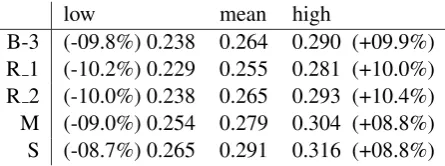
cult for one metric to significantly outperform an-other metric in sentence-level evaluation. The re-sults show that the mean of the correlation factors converges right to the value we computed based on the whole testing set, and the confidence intervals correlate with the means.
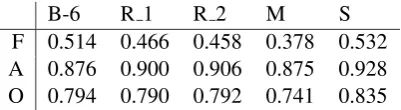
While sentence-level evaluation is useful if we are interested in a confidence measure on MT out-puts, syste-x level evaluation is more useful for comparing MT systems and guiding their develop-ment. Thus we also present the evaluation results based on the 7 MT output sets in Table 6. SIA uses the same decay factor as in the sentence-level eval-uation. Its system-level score is computed as the arithmetic mean of the sentence level scores, and
low mean high
[image:7.595.72.295.641.724.2]B-3 (-09.8%) 0.238 0.264 0.290 (+09.9%) R 1 (-10.2%) 0.229 0.255 0.281 (+10.0%) R 2 (-10.0%) 0.238 0.265 0.293 (+10.4%) M (-09.0%) 0.254 0.279 0.304 (+08.8%) S (-08.7%) 0.265 0.291 0.316 (+08.8%) Table 5: 95% significance intervals for sentence-level overall evaluation
WLS WLS WLS WLS
PROB INCS PROB INCS
F 0.189 0.202 0.188 0.202
A 0.295 0.310 0.311 0.322
O 0.270 0.285 0.278 0.292
Table 7: Results of different components in SIA
WLS WLS WLS WLS
INCS INCS INCS INCS
STEM WN STEM
WN
F 0.188 0.188 0.187 0.191
A 0.311 0.313 0.310 0.317
O 0.278 0.280 0.277 0.284
Table 8: Results of SIA working with Porter-Stem and WordNet
so are ROUGE, METEOR and the human judg-ments. We can see that SIA achieves the best per-formance in both fluency and adequacy evaluation of the 7 systems. Though the 7-sample based re-sults are not reliable, we can get a sense of how well SIA works in the system-level evaluation.
4.3 Components in SIA
B-6 R 1 R 2 M S F 0.514 0.466 0.458 0.378 0.532 A 0.876 0.900 0.906 0.875 0.928 O 0.794 0.790 0.792 0.741 0.835
Table 6: Results of BLEU, ROUGE, METEOR and SIA in system level evaluation
both used, PORTER-STEM is used first. We can see that they are not as good as using the stochastic word matching. Since INCS and PROB are inde-pendent of WLS, we believe they can also be used to improve other metrics such as ROUGE-W and METEOR.
5 Conclusion
This paper describes a new metric SIA for MT evaluation, which achieves good performance by combining the advantages of n-gram-based
met-rics and loose-sequence-based metmet-rics. SIA uses stochastic word mapping to allow soft or partial matches between the MT hypotheses and the ref-erences. This stochastic component is shown to be better than PORTER-STEM and WordNet in our experiments. We also analyzed the effect of other components in SIA and speculate that they can also be used in other metrics to improve their performance.
Acknowledgments This work was supported
by NSF ITR 09325646 and NSF ITR IIS-0428020.
References
Satanjeev Banerjee and Alon Lavie. 2005. Meteor: An automatic metric for mt evaluation with improved
correlation with human judegments. In
Proceed-ings of the ACL-04 workshop on Intrinsic and Ex-trinsic Evaluation Measures for Machine Transla-tion and/or SummarizaTransla-tion, Ann Arbor, Michigan.
Colin Bannard and Chris Callison-Burch. 2005.
Para-phrasing with bilingual parallel corpora. In
Pro-ceedings of the 43rd Annual Conference of the As-sociation for Computational Linguistics (ACL-05).
Regina Barzilay and Lillian Lee. 2003. Learning to paraphrase: An unsupervised approach using
multiple-sequence alignment. InProceedings of the
2003 Meeting of the North American chapter of the Association for Computational Linguistics (NAACL-03), pages 16–23.
John Blatz, Erin Fitzgerald, George Foster, Simona Gandrabur, Cyril Goutte, Alex Kulesza, Alberto Sanchis, and Nicola Ueffing. 2003. Confidence es-timation for machine translation. Technical report,
Center for Language and Speech Processing, Johns Hopkins University, Baltimore. Summer Workshop Final Report.
Peter F. Brown, Stephen A. Della Pietra, Vincent J. Della Pietra, and Robert L. Mercer. 1993. The mathematics of statistical machine translation:
Pa-rameter estimation. Computational Linguistics,
19(2):263–311.
G. Doddington. 2002. Automatic evaluation
of machine translation quality using n-gram
co-occurrence statistics. InIn HLT 2002, Human
Lan-guage Technology Conference, San Diego, CA.
Philipp Koehn. 2004. Statistical significance tests
for machine translation evaluation. In 2004
Con-ference on Empirical Methods in Natural Language Processing (EMNLP), pages 388–395, Barcelona,
Spain, July.
Chin-Yew Lin and Franz Josef Och. 2004. Auto-matic evaluation of machine translation quality us-ing longest common subsequence and skip-bigram statistics. InProceedings of the 42th Annual Confer-ence of the Association for Computational Linguis-tics (ACL-04), Barcelona, Spain.
Ding Liu and Daniel Gildea. 2005. Syntactic fea-tures for evaluation of machine translation. InACL 2005 Workshop on Intrinsic and Extrinsic Evalua-tion Measures for Machine TranslaEvalua-tion and/or Sum-marization.
Bo Pang, Kevin Knight, and Daniel Marcu. 2003. Syntax-based alignment of multiple translations: Extracting paraphrases and generating new
sen-tences. In Proceedings of the 2003 Meeting of the
North American chapter of the Association for Com-putational Linguistics (NAACL-03).