Effect of Si on Precipitation Behavior of Nb-Laves Phase
and Amount of Nb in Solid Solution at Elevated Temperature
in High Purity 17%Cr-0.5%Nb Steels
Yasushi Kato
1, Masatoshi Ito
2, Yoshimine Kato
2and Osamu Furukimi
21Steel Research Lab., JFE Steel Corp., Chiba 260-0836, Japan
2Department of Materials Science & Engineering, Kyushu University, Fukuoka 819-0395, Japan
The effect of Si was investigated on the precipitation behavior and the amount of Nb in solid solution at temperature ranging from 1073 to 1173 K in high purity 17Cr-0.5Nb steels. Adding Si promoted the precipitation of the Nb Laves phase and then decreased the solubility of Nb in steels. The Nb Laves phase which was composed of Fe, Cr and Nb could be expressed as (Fe, Cr)2Nb in a 0.002 mass% Si steel. On the other hand, in a 0.5 mass% Si steel the Nb Laves phase which was composed of Fe, Si, Cr and Nb could be expressed as (Fe, Si, Cr)2Nb. Based on calculations from the experimental results assuming the Laves phase is Fe2Nb, the standard free energy change of the Fe2Nb precipitation reaction was about61k J/mol for a 0.002 mass% Si steel. [doi:10.2320/matertrans.M2010112]
(Received March 29, 2010; Accepted June 28, 2010; Published August 25, 2010)
Keywords: stainless steels, ferritic steels, Laves phases, precipitation
1. Introduction
The solubility of carbon and nitrogen in ferritic stainless steels, which have a bcc structure, is so low that corrosion resistance tends to decline due to the formation of a Cr-depleted zone along the grain boundaries resulting from precipitation of Cr-carbonitrides at the grain boundaries during heat treatment.1)Sensitization can be suppressed by adding Nb, which has greater chemical affinity to C and N than Cr.2)Niobium is also an effective alloying element for
enhancing strength at elevated temperatures in solid solu-tion.3) Therefore, Nb-bearing ferritic stainless steels have
been developed and used mainly as materials for automotive exhaust parts.
Niobium forms a hexagonal Laves phase, a C14 type, of Fe2Nb at high temperature, and various properties of
Nb-bearing ferritic stainless steels are significantly influenced by the precipitation of the Laves phase.4–6) For instance,
high temperature strength of steels decreases as a result of the reduced amount of Nb in solid solution due to the precipitation of the Laves phase.5)The Laves phase also acts as a notch in the matrix, deteriorating the toughness of steels.6)Therefore, clarification of the precipitation behavior of the Laves phase is an important research issue for developing Nb-bearing ferritic stainless steels with higher heat resistance than the conventional steels. Estimation of the amount of Nb in solid solution in steels during high temperature service is required in order to analyze their strength quantitatively.
It has been reported that the Laves phase, MX type carbonitrides and M6C type carbide (Fe3Nb3C) can
precip-itate in Nb-bearing ferritic stainless steels.7,8) At high
temperature, precipitation of the Laves phase competes with that of M6C. Concerning this competition, Fujita et al.7)
reported that M6C was a stable precipitate at 973–1123 K in
a 19Cr-0.4Nb-0.014C-0.017N (mass%) steel and at 1023– 1173 K in a 19Cr-0.8Nb-0.014C-0.016N (mass%) steel. On the other hand, in a 14Cr-0.3Nb-0.15Ti-0.5Mo-0.011C-0.010N (mass%) steel, the Laves phase was a stable
precipitate at 973–1173 K when M6C precipitation was
suppressed by Ti addition, and the solubility product of the Laves phase was obtained experimentally under certain assumptions.7) Because Si is a useful alloying element for
oxidation property,9)a moderate amount of Si, 0.3–1 mass%, is added to commercial Nb-bearing ferritic stainless steels.10) The effect of Si on the precipitation behavior of the Laves phase in a martenstic 9Cr-2Mo steel was reported by Iseda
et al.11) The precipitation of the Mo Laves phase (Fe2Mo)
was promoted and the solubility of Mo was lowered with increasing Si contents when the material was subjected to temperatures in the range of 773–973 K for a long period. However, the effect of Si on the precipitation behavior of the Nb Laves phase in ferritic stainless steels has not been revealed.
In this study, in order to clarify the inherent precipitation behavior of the Nb Laves phase, high purity 17Cr-0.5Nb steels with small amounts of C and N were used, as both of these elements tend to form precipitates of Nb in forms of MX and M6C. The objective of this study is to clarify the
effect of Si on the precipitation behavior of the Nb Laves phase and the amount of Nb in solid solution at elevated temperatures in 17%Cr-0.5%Nb ferritic stainless steels.
2. Experimental Procedures
Finally, the sheets were annealed at 1323 K for 60 s in an Ar atmosphere for recrystallization and then water-cooled. The cold-rolled and annealed sheets were subjected to aging at 1073 K and 1173 K for various times in an Ar atmosphere in order to investigate the change in precipitates. Quantitative analysis of Nb precipitates was performed as described below.12) The Nb precipitates were totally extracted from
the specimens by means of electrochemical dissolution of 10 vol% acetylaceton and 1 vol% tetramethylammomium chloride in methanol. The residue was filtered with 200 nm diameter pores to trap fine particles. The residue was dissolved in a solvent and analyzed using Inductive Coupled Plasma (ICP). The results corresponded to the total amount of precipitates. Furthermore, the residue was immersed in a 25 vol% sulfuric hydroric acid solution and then dissolved in a 1 mass% potassium permanganate and 25 vol% sulfuric hydroric acid solution in order to dissolve the Laves phase only. The residue was analyzed by the same method mentioned above. The results were equivalent to the amount of precipitates except the Laves phase. Therefore, the amount of the Laves phase in the precipitates was obtained as the difference between the analytical results of this residue and the total amount of precipitates. Identification of the precipitates was made with extracted residue using X-ray diffraction spectroscopy (XRD). The precipitates were observed with extracted residue using scanning electron microscopy (SEM) and with thin foil using transmission electron microscopy (TEM).
3. Results and Discussion
Figure 1 shows the results of XRD of the total extracted residues samples before and after the aging at 1073 K for 360 ks. The Nb(C,N) and M6C were identified as
precip-itates of the specimen before aging. Furthermore, Nb Laves
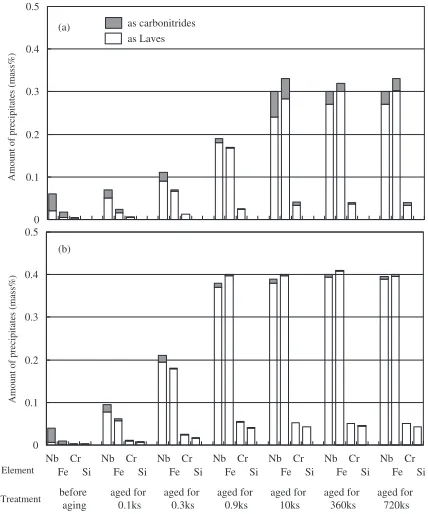
phase was detected as precipitates in the aged specimens other than carbonitrides. Figure 2 shows the amounts of Nb, Fe, Cr and Si as the precipitates with aging time at 1073 K. As the Laves phase precipitated, the total amount of precipitates increased after aging at 1073 K in both steels. In the base steel, the amount of the Laves phase increased after aging for more than 0.3 ks, and became constant after 10 ks. On the other hand, in the 0.5Si steel, the amount of the Laves phase increased after aging for more than 0.1 ks, and became constant at 0.9 ks. This result revealed that the precipitation reaction of the Nb Laves phase was promoted by adding Si.
[image:2.595.320.534.73.330.2]Figure 3 shows the comparison for the amount of Nb, Fe, Cr and Si as the precipitates between 1073 K–360 ks aged Table 1 Chemical compositions of specimens.
(mass%)
Steel Cr Si Nb Mn C N S O P
base 16.9 0.002 0.51 0.01 0.0013 0.0018 0.0007 0.0023 0.006 0.5Si 17.0 0.50 0.50 0.01 0.0013 0.0012 0.0007 0.0011 0.005
(a)
(c) (d)
2000cps
(b)
2θθ/ deg
2θ/ deg 42 44 46 48
38 40 36 34
42 44 46 48 38 40
36 34
Fig. 1 X-ray diffraction pattern of residues extracted. : Fe2Nb, : Fe3Nb3C, : Nb(C,N) (a) base steel (before aging) (b) base steel (after aging at 1073 K for 360 ks) (c) 0.5Si steel (before aging) (d) 0.5Si steel (after aging at 1073 K for 360 ks)
0 0.1 0.2 0.3 0.4 0.5 0 0.1 0.2 0.3 0.4 0.5 Nb Fe Cr Si Nb Fe Cr Si Nb Fe Cr Si Nb Fe Cr Si Nb Fe Cr Si Nb Fe Cr Si Nb Fe Cr Si before aging aged for 0.1ks aged for 0.3ks aged for 0.9ks aged for 10ks aged for 360ks aged for 720ks as Laves as carbonitrides (a) (b)
Amount of precipitates (mass%)
Amount of precipitates (mass%)
Element
Treatment
Fig. 2 Changes in amount of Nb, Fe, Cr and Si as precipitates with aging in 17%Cr-0.5%Nb steels at 1073 K. (a) base steel, (b) 0.5Si steel
0 0.1 0.2 0.3 0.4 0.5 as Laves as carbonitrides Nb
FeCr NbFeCr NbFeCrSi NbFeCrSi
1073K 1173K 1073K 1173K
base Steel 0.5Si steel
Amount of precipitates (mass%)
Element Aging temp.
[image:2.595.53.284.94.303.2] [image:2.595.326.529.383.571.2]specimens and 1173 K–360 ks aged specimens. In both steels, the amounts of Nb in total precipitates and in the Laves phase of the specimens aged at 1173 K were smaller than those of the specimens aged at 1073 K. The amounts of the carboni-trides precipitates aged at 1173 K is larger compared with those in the specimens aged at 1073 K, in spite of the Si contents. Taking into account the Fe3Nb3C solubility product
reported by Fujitaet al.,7)the increase in carbonitrides likely to correspond to the increase in the M6C. From the results
mentioned above, it was clear that the equilibrium amount of Nb in solid solution for 17Cr-0.5Nb steels decreased by adding Si with the temperatures from 1073 K to 1173 K due to increasing of the Laves phase precipitated.
The Laves phase was observed not only at grain bounda-ries but also within the grains in both steels after the aging. There seemed to be no difference in the precipitation sites between the base steel and 0.5Si steel. Figures 4(a)–(d) show the results of SEM observation of residues extracted from the specimens before and after the aging at 1073 K for 360 ks for both steels. There was no distinct difference in size of precipitates (MX, M6C) between the base steel and the 0.5Si
steel before aging the specimens. On the other hand, as shown in Fig. 4(d) size of the Laves phase in the 0.5Si steel was slightly smaller than that of the base steel (see Fig. 4(c)) after aging at 1073 K for 360 ks, in spite of the fact that the amount of the Laves phase precipitated in the 0.5Si steel was more than that in the base steel as shown in Fig. 3. This
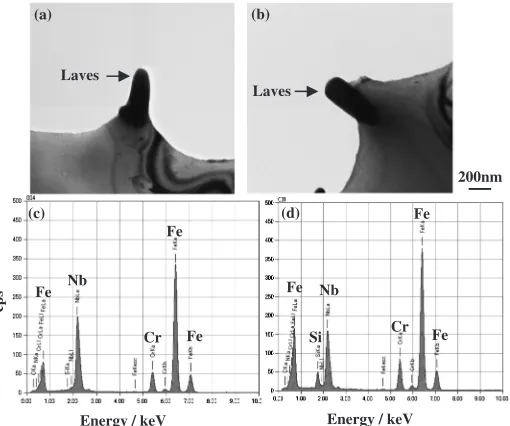
seemed to indicate that the nucleation sites of the Laves phase precipitates increased by adding Si. Figures 5(a)–(d) show the results of TEM observation of the specimens aged at 1073 K for 360 ks. The results of EDS analysis clearly revealed that the peaks corresponded to Fe, Nb and Cr in the base steels and to Fe, Nb, Cr and Si in the 0.5Si steel. Table 2 shows the amounts of each element as total precipitates, the Laves phase and carbonitrides in the specimens aged for 360 ks. The Laves phase included small amount of Cr in both steels and also much larger amount of Si than that of Cr in the 0.5Si steel.
The Laves phase, which occurs at or around a fixed stoichiometry A2B, are well known as the size compounds.
The composition range of Nb in the Fe2Nb Laves phase is
31–37 at% (AxBy:x=y¼1:7{2:2) in Fe-Nb binary system.13) It was shown by Kaloev et al.14) that in Fe-Cr-Nb ternary
system as much as 60 at% of Cr can be dissolved in the Fe2Nb
Laves phase, and formation of (Fe, Cr)2Nb as Laves phase
was confirmed by Mansour et al.15) Effects of Si on the
stability and the composition of the C14 Laves phase such as Fe2Nb were also reported for various alloy systems. It was
reported that the Laves phase does not form in the binary Nickel and Cobalt systems, such as Ni-Ti, Ni-Ta, Co-Mo and Co-W. However, in ternary systems the type of (A3Si)B2can
be formed. In (A3Si)B2 Si is substituted for 25% of the
A-component in forms of ternary systems, such as Ni-Ti-Si, Ni-Ta-Si, Co-Mo-Si and Co-W-Si.16) Goldschmidtet al.17)
(a)
(b)
(c)
(d)
[image:3.595.70.529.70.416.2]showed that the Fe2Nb Laves phase possesses a very
extensive solubility of Si in Fe-Nb-Si ternary system. It was also reported that 25 at% of Si can be dissolved into the Fe2Nb Laves phase with the temperature range of 1273 to
1573 K, and Si substitutes only Fe in the Laves phase.17–19)
The reason of Si stabilization in the C14 Laves phase appeared to be due to decrease of the effective electron concentration.16) Zhao et al.20) reported that Si could
stabilized the Laves phase at lower temperatures and its Laves phase was expressed as (Cr, Si)2Nb in Cr-Nb-Si
ternary system. Maziasz21)and Yamamoto et al.22)reported
that adding Si to the heat-resisting austenitic steel promotes the formation of the Fe2(Mo, Nb) Laves phase, but does not
change the phase equilibrium between-Fe and Laves phase. In a study of a 9Cr-2Mo-Si steel, Isedaet al.11)reported that Si occupy the A site of the Mo-Laves phase, and the Laves phase could be expressed as (Fe, Cr, Si)2Mo according to the
experimental results of analyzing the Laves phase using energy dispersive spectrometry (EDS).
Taking those previous research results into consideration, discussion on the Laves phase formation was made in this study. Since the ratios of (Fe + Cr) to Nb in the Laves phase precipitates were 2.08 at 1073 K and 1.82 at 1173 K aging, the Laves phase could be expressed as (Fe, Cr)2Nb in the
base steel. If A-sites are composed of Fe, Si and Cr, it is possible to consider that the ratios of (Fe + Si + Cr) to Nb were 2.3 at 1073 K and 2.1 at 1173 K aging, as shown in Table 2. It seems reasonable that the Laves phase of the 0.5Si steel could be expressed as (Fe, Cr, Si)2Nb.
Laves phase is a prominent precipitate in both steels. In particular, major components of Laves phase are Fe and Nb for the base steel. If small amount of Cr in Laves phase is dealt rigorously, it must be complicated for calculating the standard free energy changes for the precipitation of the Nb Laves phase. To avoid difficulty, some assumptions are set as the Fujita’s research.7)Namely, it is assumed that Laves phase is dealt as Fe2Nb, because the amount of Cr in
precipitates is small enough compare with those of Fe and
cps
(c) (d)
Fe
Cr Nb
Si Fe
Fe
Fe
Cr Nb
Fe
Fe 200nm (a)
Laves
(b)
Laves
Energy / keV Energy / keV
[image:4.595.173.428.72.285.2]Fig. 5 TEM micrographs and EDS analysis results of Laves phase of specimen aged at 1073 K for 360 ks. (a), (c): base steel, (b), (d): 0.5Si steel.
Table 2 Amount of Nb, Fe, Cr and Si as precipitates in specimens aged at 1073 K and 1173 K for 360 ks.
(mol%)
Steel Base 0.5Si
Aging condition 1073 K–360 ks 1173 K–360 ks 1073 K–360 ks 1173 K–360 ks
Total-Nb 0.18 0.10 0.24 0.16
Total-Fe 0.32 0.15 0.41 0.28
Total-Cr 0.043 0.025 0.054 0.041
Total-Si <0:004 <0:004 0.092 0.050
Nb as Laves 0.16 0.064 0.24 0.12
Fe as Laves 0.30 0.10 0.41 0.21
Cr as Laves 0.040 0.017 0.053 0.030
Si as Laves <0:004 <0:004 0.090 0.036
Nb as carbonitrides 0.017 0.032 0.004 0.046
Fe as carbonitrides 0.020 0.050 0.002 0.070
Cr as carbonitrides 0.003 0.008 0.001 0.008
[image:4.595.47.549.356.540.2]Nb. The standard free energy change for the precipitation of Fe2Nb was calculated based on the amount of Nb in the
precipitates as shown in Table 2. The precipitation reaction of Fe2Nb can be expressed as follows:
2½Fe þ ½Nb ¼Fe2Nb ð1Þ
Assuming that the activities of the other elements are equivalent to the concentrations, the solubility products of Fe2Nb in the matrix can be expressed as follows:
ðXFeÞ2ðXNbÞ ¼K0expðG0=RTÞ ð2Þ
whereXFe andXNb are the concentrations in solution in the
matrix, K0 is a constant, G0 is the standard free energy
change for the precipitation reaction,Ris a gas constant and Tis reaction temperature. Because the materials studied here are Fe base alloys, XFe is regarded as one. The solubility
product is expressed as the solubility of Nb by the following equation.
lnðXNbÞ ¼lnK0G0=RT ð3Þ
In this study, MX and M6C existed in base steel before the
aging. Not the Laves phase, but M6C was reported to be the
prominent precipitate at temperatures from 973 to 1223 K in a 19Cr-0.4Nb-0.014C-0.017N steel.7) Therefore, the
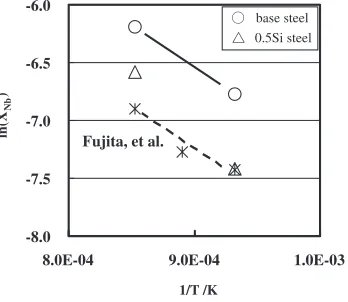
equi-librium concentration of Nb in solution was calculated by subtracting the concentration of Nb in the carbonitrides and the Laves phase from that of Nb added in the specimens aged at 360 ks. Figure 6 shows the relationship between lnðXNbÞand1=T of the base steel. In Fig. 6, natural log of
the Nb concentration in solid solution of the 0.5Si steel is plotted. The data of a 14Cr-0.3Nb-0.15Ti-0.5Mo-0.011C-0.010N steel in which the precipitation of M6C did not
occur, is also plotted as ‘‘Fujita et al.’’.7) The calculated
standard free energy change of Fe2Nb precipitation was
about 61kJ/mol at temperatures from 1073 to 1173 K. The solubility product of Fe2Nb for the base steel could be
expressed by mol% as follows:
lnðXNbÞ ¼ 7300=Tþ0:05 ð4Þ
The calculated value of solubility product of the base steel in this study differs from that of the Fujita’s research. It seems that this is because of the difference not only in
compositions of the steel studied, but also in assumptions of the calculation.
4. Conclusions
The effect of Si on the precipitation behavior of the Nb Laves phase and the solubility of Nb in high purity 17Cr-0.5Nb steels was investigated. The following conclusions were obtained.
(1) Adding Si promoted the precipitation of the Nb Laves phase and decreased the amount of Nb in solid solution at temperature range from 1073 to 1173 K in high purity 17Cr-0.5Nb steels.
(2) The Nb Laves phase was composed of Fe, Cr and Nb and could be expressed as (Fe, Cr)2Nb in the base steel. On
the other hand, in the 0.5Si steel the Nb Laves phase was composed of Fe, Si, Cr and Nb and could be expressed as (Fe, Si, Cr)2Nb.
(3) Based on calculations from the experimental results by assuming the Laves phase as Fe2Nb, the standard free energy
change of the Fe2Nb precipitation reaction was about
61k J/mol for the base steel and the solubility product could be expressed as below:
lnðXNbÞ ¼ 7300=Tþ0:05:
REFERENCES
1) M. A. Streicher: Corrosion29(1973) 337.
2) H. Abo, T. Nakazawa, S. Takamura, M. Onoyama, H. Ogawa and H. Okada: Stainless Steel ’77, Climax Molybdenum Co (1978) p. 97. 3) N. Fujita, K. Ohmura, M. Kikuchi, T. Suzuki, S. Funaki and I.
Hiroshige: Scr. Mater.35(1996) 705.
4) A. Miyazaki, K. Takao and O. Furukimi: ISIJ Int.42(2002) 916. 5) N. Fujita, K. Ohmura and A. Yamamoto: Mater. Sci. Eng. A351(2003)
272.
6) T. Tomita and M. Oku: Nissin Technical Report87(2006) p. 11. 7) N. Fujita, M. Kikuchi and K. Ohmura: ISIJ Int.43(2003) 1999. 8) A. Miyazaki, M. Gunji and K. Yoshioka: Kawasaki Steel Technical
Report31(1994) p. 21.
9) G. C. Wood, J. A. Richardson, M. G. Hobby and J. Boustead: Corros. Sci.9(1969) 659.
10) K. Ishii, A. Miyazaki and S. Satoh: Kawasaki Steel Technical Report 40(1999) p. 39.
11) A. Iseda, H. Teranishi and K. Yoshikawa: Tetsu-to-Hagane76(1990) 2190.
12) M. Inose, K. Fujimoto and Y. Kato: CAMP-ISIJ20(2007) 1355. 13) O. Kubaschewski: Iron-Binary Phase Diagrams, (Springer-Verlag
Heidelberg New York Verlag Stahleisen m.b.H. Dusseldorf, 1982) p. 40.
14) N. I. Kaloev, A. Kh. Abram’yan, S. V. Kabanov and L. K. Kulova: Izvest. Akad. Nauk SSSR Metally1(1988) 205.
15) S. Mansour, N. Boutarek, H. Aid and S. E. Amara: JEEP 00003 (2009) p. 1.
16) D. I. Bardos, K. P. Gupta and P. A. Beck: Trans. AIME221(1961) 1087.
17) H. J. Goldschmidt: J. Iron Steel Inst.194(1960) 169. 18) A. W. Denham: J. Iron Steel Inst.205(1967) 435. 19) B. N. Singh and K. P. Gupta: Metall. Trans.3(1972) 1427. 20) J.-C. Zhao, M. R. Jackson and L. A. Peluso: Acta Mater.51(2003)
6395.
21) P. J. Maziasz: J. Met.41(1989) 14.
22) Y. Yamamoto, M. Takeyama, Z. P. Lu, C. T. Liu, N. D. Evans, P. J. Maziasa and M. P. Brady: Intermetallics16(2008) 453.
-8.0 -7.5 -7.0 -6.5 -6.0
8.0E-04 9.0E-04 1.0E-03
base steel 0.5Si steel
Fujita, et al.
1/T /K
ln(X
Nb
)
[image:5.595.84.258.75.226.2]