Munich Personal RePEc Archive
Macroeconomic Effects of a Low-Carbon
Electricity Transition in Kenya and
Ghana: An Exploratory Dynamic
General Equilibrium Analysis
Willenbockel, Dirk
Institute of Development Studies
March 2017
Online at
https://mpra.ub.uni-muenchen.de/78070/
Macroeconomic Effects of a Low-Carbon Electricity Transition in Kenya
and Ghana: An Exploratory Dynamic General Equilibrium Analysis
Dirk Willenbockel
Institute of Development Studies at the University of Sussex
in collaboration with
Helen H. Osiolo
Kenya Institute for Public Policy Research and Analysis
S. Bawakyillenuo
Institute of Statistical, Social and Economic Research, University of Ghana
February 2017
1
Table of Contents
Abbreviations and Acronyms ... 3
1. Introduction ... 5
2. The Analytic Framework ... 6
2.1. Rationale for the Adoption of a CGE Approach ... 6
2.2. Specification of the Dynamic CGE Models for Kenya and Ghana ... 6
2.2.1. Domestic Production and Input Demand ... 7
2.2.2. Electricity Supply... 8
2.2.3. Primary Factor Supply ... 9
2.2.5. International Trade ... 10
2.2.6. Equilibrium Conditions and Macro Closure ... 10
3. Data Sources and Model Calibration ... 12
3.1. The Social Accounting Matrices for Kenya and Ghana: Overview ... 12
3.2. Disaggregation of the Electricity Sector ... 12
3.3. Disaggregation of the Household Accounts ... 15
3.4. SAM Dimensions ... 16
3.5. Model Calibration ... 16
4. Dynamic Scenario Analysis: Kenya ... 19
4.1. Overview ... 19
4.2. Baseline Scenario ... 20
4.2.1. Population and Labour Force Growth... 20
4.2.2. Total Factor Productivity and GDP Growth ... 20
4.2.3. Electricity Sector ... 22
4.3. Lower Carbon Scenario ... 27
2
4.3.2. Results ... 29
4.4. High Fossil Fuel Price Scenario ... 37
4.5. HFFP Lower Carbon Scenario ... 41
5. Dynamic Scenario Analysis: Ghana ... 44
5.1. Overview ... 44
5.2. Baseline Scenario ... 44
4.2.1. Population and Labour Force Growth... 45
5.2.2. Total Factor Productivity and GDP Growth ... 45
5.2.3. Electricity Sector and Domestic Natural Gas Extraction ... 46
5.3. Lower Carbon Scenario ... 48
5.3.1. Scenario Specification ... 48
5.3.2. Results ... 49
5.4. High Fossil Fuel Price Scenario ... 55
5.5. HFFP Lower Carbon Scenario ... 58
6. Conclusions ... 61
3
Abbreviations and Acronyms
AGRODEP African Growth & Development Modeling Consortium
aka Also known as
BaU Business as usual
bcf Billion cubic feet
CES Constant elasticity of substitution
CGE Computable general equilibrium
CPI Consumer price index
e.g. Exempli gratia (for example)
EnCG Energy Commission of Ghana
EPSRC Engineering and Physical Sciences Research Council
GDP Gross domestic product
GGDA Green growth diagnostics for Africa
GHG Greenhouse Gases
GLSS Ghana Living Standards Survey
GSS Ghana Statistical Service
GTAP Global Trade Analysis Project
GWh Gigawatt hours
GWS Gesellschaft für Wirtschaftliche Strukturforschung
ibid ibidem (in the same place)
i.e. id est
IFPRI International Food Policy Research Institute
IRENA International Renewable Energy Agency
ISSER Institute of Statistical, Social and Economic Research, University of Ghana
KIHBS Kenya Integrated Household Budget Survey
KIPPRA Kenya Institute for Public Policy Research and Analysis
KLEM Kapital Labour Energy Materials
KNBS Kenya National Bureau of Statistics
4 LAPSSET Lamu-Port Southern Sudan-Ethiopia Transport Corridor
LCO Light crude oil
LCOE Levelised cost of electricity
LES Linear expenditure system
LNG Liquefied natural gas
MW Megawatt
p.a. per annum
PV Photovoltaic
R2 Coefficient of determination
RAS Bi-proportional matrix balancing method
SAM Social accounting matrix
SREP Sustainable Renewable Energy Program
SUT Supply and use tables
TD Transmission and distribution
TFP Total factor productivity
UN DESA United Nations Department for Economic and Social Affairs
UNDP United Nations Development Program
UNU-WIDER United Nations University - World Institute for Development Economics Research
USc United States cents
USD United States Dollars
5
1. Introduction
This study provides a forward-looking simulation analysis of economy-wide and distributional
implications associated with alternative pathways for the development of the electricity sector
in Ghana and Kenya. It is part of a wider research project that seeks to identify the binding
constraints to economically viable investments in renewable energy and to analyse the political
feasibility of a transition to a sustainable low carbon energy path in the two countries.
From an economic perspective, significant shifts in the power mix of an economy as well as
policy measures to induce or support such shifts are bound to affect the structure of domestic
prices across the whole economy with repercussions for the growth prospects of different
production sectors and for the real income growth paths of different socio-economics groups.
Understanding these economy-wide repercussions is crucial for a study concerned with the
obstacles to - and political feasibility of - adopting a low-carbon growth strategy. The analysis
requires the adoption of a multi-sectoral general equilibrium approach that allows to capture
the input-output linkages between the electricity sector and the rest of the economy as well as
the linkages between production activity, household income and expenditure and government
policy.
Thus, the present study develops purpose-built dynamic computable general equilibrium
(CGE) models for Ghana and Kenya with a detailed country-specific representation of the
power sector to simulate the prospective medium-run growth and distributional implications
associated with a shift towards a higher share of renewables in the power mix up to 2025.
The following section explains the methodological approach and describes the key features of
the CGE models in a non-technical manner. Each model is calibrated to a social accounting
matrix (SAM) which reflects the observed input-output structure of production, the commodity
composition of demand and the pattern of income distribution for the country at a disaggregated
level at the start of the simulation horizon. Section 3 spells out the data sources for the
construction of the social accounting matrices and outlines the model calibration process.
Sections 4 and 5 present the results of the dynamic simulation analysis for Kenya and Ghana
respectively. In each case, we first develop a stylised baseline scenario that simulates the
evolution of the economy under current power sector expansion plans up to 2025 and then
contrast these baselines with alternative lower carbon energy scenarios. Furthermore, the
sensitivity of results to alternative projections for world market fossil fuel prices is explored.
6
2. The Analytic Framework
2.1. Rationale for the Adoption of a CGE Approach
Computable general equilibrium (CGE) models – aka applied general equilibrium models – are
widely used tools in energy and climate mitigation policy analysis. Applications range from
short-run impact assessments of shocks to the energy system for particular countries to global
long-run energy system scenario studies with a time horizon of multiple decades.1
The prime appeal of – and need for - adopting a general equilibrium approach to energy policy
and energy-related environmental policy analysis arises from the fact that energy is an input to virtually every economic activity. Hence, changes in the energy sector ‘will ripple through multiple markets, with far larger consequences than energy’s small share of national income might suggest’ (Sue Wing, 2009). The unique advantage of the CGE approach over partial equilibrium approaches is its ability to incorporate these ‘ripple effects’ in a systematic manner.
In contrast to partial equilibrium approaches, CGE models consider all sectors in an economy
simultaneously and take consistent account of economy-wide resource constraints,
intersectoral intermediate input-output linkages and interactions between markets for goods
and services on the one hand and primary factor markets including labour markets on the other.
CGE models simulate the full circular flow of income in an economy from (i) income
generation through productive activity, to (ii) the primary distribution of that income to
workers, owners of productive capital, and recipients of the proceeds from land and other
natural resource endowments, to (iii) the redistribution of that income through taxes and
transfers, and to (iv) the use of that income for consumption and investment (Pueyo et al, 2015).
2.2. Specification of the Dynamic CGE Models for Kenya and Ghana
In terms of theoretical pedigree, the CGE models for Kenya and Ghana employed in this study
can be characterized as modified dynamic extensions of standard comparative-static
single-country CGE models for developing countries in the tradition of Dervis, de Melo and Robinson
7 (1982), Robinson et al (1999) and Lofgren et al (2002). Models belonging to this class have
been widely used in applied development policy research. Apart from the incorporation of
capital accumulation, population growth, labor force growth and technical progress,2 the main
difference to the standard model is a more sophisticated specification of the electricity sector
as detailed below.
2.2.1. Domestic Production and Input Demand
Domestic producers in the model are price takers in output and input markets and maximize
intra-temporal profits subject to technology constraints. The technologies for the
transformation of inputs into real outputs are described by sectoral constant-returns-to scale
production functions. In line with common practice in energy-focused top-down CGE models,3
technology specifications belonging to the generic class of KLEM (Capital (K), Labour,
Energy, Materials) production functions are employed to capture substitution possibilities
among energy and-non-energy inputs and among different energy sources. In technical terms,
the sectoral KLEM production functions take the form of nested multi-level functions with a
(positive or zero) constant elasticity of substitution (CES) among inputs grouped together
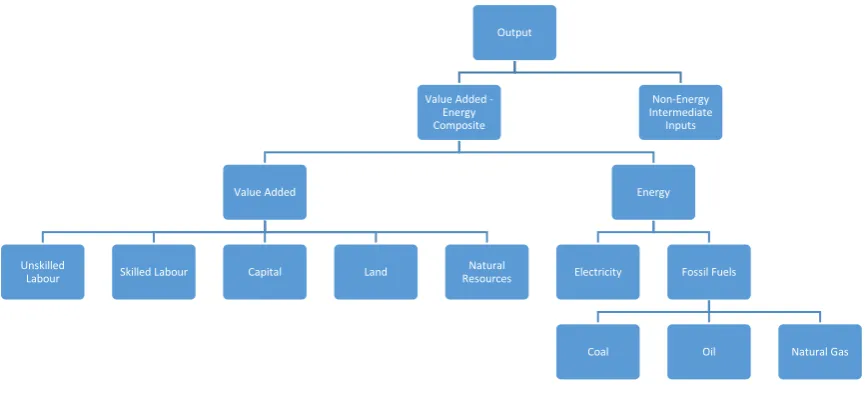
within the same nest. Figure 1 provides a schematic representation of the substitution hierarchy
between different inputs in production in the model.
In each sector, the production of a given output quantity requires non-energy inputs and a
composite value-added/energy composite in fixed proportions. The value added/energy
composite requires energy and primary factors (i.e. skilled and unskilled labour, capital, land
and natural resources) in variable proportions. Thus, when the composite price index of energy
rises relative to primary factor prices, energy inputs are replaced to some extent by additional
inputs of primary factors. In other words, the model generates a shift towards less
energy-intensive modes of production in response to an increase in energy prices. Required energy
inputs are composed of electricity purchases from the electricity sector in the model and direct
use of fossil fuels. The model allows substitution of these primary fossil energy carriers for
electricity in sectors where the input-output matrices of the GTAP database record intermediate
2 See e.g. Arndt, Robinson and Willenbockel (2011) and Robinson, Willenbockel and Strzepek (2012) for earlier recursive-dynamic extensions of the standard model.
8 purchases of fossil fuels. At the bottom of the input substitution hierarchy, the sectoral
production functions allow for imperfect substitutability between coal, refined oil and natural
[image:10.595.72.506.251.451.2]gas.
Figure 1: Production Function Nesting Structure
2.2.2. Electricity Supply
In standard energy-focused top-down CGE models, electricity generation and distribution is
typically treated as a single production activity. In these models a transition towards a higher
share of hydro, solar or wind in the power mix is represented in a highly stylized abstract form
as a substitution of fossil fuel inputs by physical capital under the assumption of a continuous
space of available technologies. The lack of explicit detail with regard to the characterization
of current and future technology options entails the danger that in the case of simulation
scenarios involving large departures from the initial benchmark equilibrium may violate
fundamental physical restrictions such as the conservation of matter and energy (Böhringer and
Rutherford, 2008) or exceed other technical feasibility limits (McFarland, Reilly and Herzog,
2004; Hourcade et al, 2006; Bibas and Mejean, 2012). Moreover, the lack of technological
explicitness limits the ability of top-down models to incorporate detailed information on cost
differentials among alternative energy technologies from engineering cost studies and to
Output
Value Added -Energy Composite
Value Added
Unskilled
Labour Skilled Labour Capital Land
Natural Resources
Energy
Electricity Fossil Fuels
Coal Oil Natural Gas
9 simulate technology-specific policy measures in a fully persuasive manner (Hourcade et al,
2006). In response to these limitations of conventional top-down CGE models, various approaches to the incorporation of detailed ‘bottom up’ information on energy technology options into a CGE modelling framework have emerged.4
The present study adopts a similar hybrid top-down bottom-up approach by treating
decomposing electricity generation according to power source and by treating electricity
transmission / distribution as a separate activity. This approach enables us to incorporate extant
information on levelised cost of electricity (LCOE) differentials by power source into the
simulation analysis and to consider exogenous policy-driven changes in the power mix that are
not necessarily driven by changes in relative market prices. The system-wide supply price of
electricity in the models is effectively determined as weighted average of the activity-specific
supply prices across the power activities. The operational aspects of the power sector
decomposition are outlined in section 3 below.
2.2.3. Primary Factor Supply
The model distinguishes skilled and unskilled labour. The dynamic labour supply paths are
exogenous and both types of labour are intersectorally mobile. The supply of agricultural land
and natural resource endowments (forests, minerals, and in the case of Ghana crude oil and
natural gas) is imperfectly elastic, i.e. the supply of these primary factors varies endogenously
in response to changes in the corresponding factor price. The productive capital stock in each
sector a evolves according to the dynamic accumulation equation K(a,t+1) = I(a,t) + (1 –δ(a))K(a,t),
where K denotes the installed real capital stock, I(a,t) is real gross investment flowing to sector a in period t and δ is the rate of physical capital depreciation. Sectoral gross investment is a positive function of a sector’s rate of return to capital relative to the economy-wide average
return to capital, i.e. the sectoral allocation of aggregate real investment is determined by return
10 differentials. Once installed, capital is sector-specific (i.e. immobile across sectors) while new
capital is intersectorally mobile.
2.2.4. Final Domestic Demand
Consumer behavior is derived from intra-temporal utility maximizing behavior subject to
within-period budget constraints. Utility functions take the Stone-Geary form, yielding a
Linear Expenditure System (LES) demand specification. The commodity composition of
investment and government demand is kept constant according to the observed shares in the
benchmark SAM while the total volumes of government and investment demand grow in line
with aggregate income and are determined by the macro closure rules detailed below.
2.2.5. International Trade
In all traded commodity groups, imports and goods of domestic origin are treated as imperfect
substitutes in both final and intermediate demand. Agents’ optimizing behaviour entails that
the expenditure-minimizing equilibrium ratio of imports to domestic goods in any traded
commodity group varies endogenously with the corresponding relative price of imports to
domestically produced output in that commodity group.
On the supply side, the model takes account of product differentiation between exports to the
rest of the world and production for the domestic market in all exporting sectors. The
technologies for conversion of output into exports are described by sectoral
constant-elasticity-of- transformation (CET) functions. This entails that the profit-maximizing equilibrium ratio
of exports to domestic goods in any exporting sector is determined by the price relation between
export and home market sales.
Both Kenya and Ghana are treated as small open economies – i.e. changes in their export supply
and import demand quantity have no influence on the structure of world market prices.
2.2.6. Equilibrium Conditions and Macro Closure
The prices for goods, services and primary factors are flexible and adjust in order to satisfy the
11 account balance follow an exogenous time path. This time path is kept fixed across the
simulation scenarios considered in subsequent sections in order to enable meaningful welfare
comparisons across the scenarios. This external sector closure entails that the real exchange
rate adjusts endogenous to maintain external balance-of-payments equilibrium. A standard
balanced macroeconomic closure rule (Lofgren et al, 2002) is adopted, according to which the
shares of government demand, investment demand and hence private household consumption
demand in total absorption remain invariant. Under this macro closure, household and
government saving rates adjust residually to establish the macroeconomic saving-investment
12
3. Data Sources and Model Calibration
3.1. The Social Accounting Matrices for Kenya and Ghana: Overview
Each model is calibrated to a SAM which reflects the input-output structure of production, the
commodity composition of demand and the pattern of income distribution for the country at a
disaggregated level at the start of the simulation horizon. Starting point for the construction of
the model-conformable SAMs are the input-output matrices for Kenya and Ghana contained in
the GTAP database version 9 (Aguiar, Narayanan and McDougall, 2016). This data set
provides a detailed and internally consistent representation the global economy-wide structure
of production, demand and international trade at a regionally and sectorally disaggregated
level. GTAP 9a – the latest available version of the database - combines detailed bilateral trade
and protection data reflecting economic linkages among 140 world regions with individual
regional input-output data, which account for intersectoral linkages among 57 production
sectors for the benchmark year 2011.5
The GTAP database treats electricity generation, transmission and distribution as a single
aggregate activity and the data on household income and household consumer expenditure are
for a single aggregate household. For the purposes of the present study, both the electricity
activity and the household sector are disaggregated as detailed below.
3.2. Disaggregation of the Electricity Sector
The decomposition of the power activity for each country essentially involves (i) splitting the
single electricity activity column vector of the original GTAP input-output matrix (which
contains the annual input cost by input type for the benchmark year) into several new columns
for the different electricity sub-sectors distinguished in the CGE model, and (ii) distributing
13 the cost figures of the original aggregate electricity cost vectors horizontally across the new
columns in line with available information about the cost composition in the electricity
sub-sectors and in such a way that the original cost totals by input type are preserved. This is a
non-trivial problem. The common procedure employed in the construction of databases for
energy-focused hybrid top-down bottom-up CGE models is to start with an informed initial estimate
for the entries in the new sub-industry column vectors and then apply a numerical matrix
balancing method to enforce the target sub-matrix totals.6
Peters (2016) constructs a satellite database for GTAP9 which disaggregates the GTAP
electricity activity for all regions in the database along these lines. However, the regional
coverage of LCOE estimates used in the construction of the Peters database is incomplete, with
country-specific estimates for Africa being notable by their virtual absence.7 In cases, where
the discrepancies between the row totals implied by the initial guesses in the absence of
country-specific data and the target GTAP row totals is large, the application of the mechanical
matrix balancing algorithm can generate seriously misleading results. The case of Kenya –
flagged up explicitly by Peters (2016:231, n12) as a problematic case – illustrates the point: In
the benchmark year 2011 Kenya generates electricity primarily from hydro, thermal (i.e. fossil
fuel) and geothermal sources8. Geothermal is not identified as a separate technology in the
Peters database, but would in principle be covered one-to-one by the residual “Other” category
in that data base. Yet, attributing the reported cost figures in this category to geothermal would
lead to seriously misleading results.9
Therefore, the decomposition of the electricity sectors for the present study uses additional
country-specific data and information from other studies. For Kenya, the electricity activity is
disaggregated into transmission and distribution (TD), hydro, geothermal, thermal and wind.
First, the cost totals for the sub-activities are determined: The TD share is based on Peters
(2016) while the total generation share is distributed across the four generation activities by
combining the 2011 electricity generation data in GWh reported in Republic of Kenya (2014:
6 See Peters and Hertel (2016a,b) for a detailed discussion of comparison of existing matrix balancing algorithms used in this context and further references to the related technical literature.
7 See Peters (2016: Appendix C). As Peters (2016:216) puts it, “(i)ncreasing the LCOE coverage is a major opportunity for subsequent versions”.
8 See Table 5 below.
14 Table 33)10 with the LCOE cost differential estimates for Kenya (Table 1) reported in Pueyo
et al (2016). Fossil fuel input are entirely allocated to the thermal electricity activity while
initial estimates for the allocation of other inputs are informed by the cost shares for the
different generation technologies in the Peters (2016) database and - for geothermal – on cost
share data from Sue Wing (2008) and Lehr et al (2011).11 Finally, to establish full consistency
of the cost entries with the GTAP cost totals by input type and the target electricity sub-activity
column sums, a standard bi-proportional RAS matrix balancing algorithm is employed.
The electricity sector decomposition for Ghana splits the sector into TD, hydro and thermal
and follows the same procedural approach. The required physical data on power generation by
technology for the benchmark year 2011 are drawn from EnCG (2016).
The resulting synthetic cost vectors capture the salient stylized facts with regard to input
intensities of the different electricity generation technologies, namely that hydro, geothermal
and wind are very capital-intensive and have moderate intermediate input requirements,
geothermal is particularly skill-intensive and fossil fuel costs are the dominant cost factor in
thermal generation (and more so in high-fossil-price periods such as in the benchmark year
2011).
Table 1 Levelised Cost of Electricity by Technology and Country
Ghana Kenya
Hydro 6.8 - 11.2 7.4 - 10.9
Wind 12.6 - 19.5 7.7 - 10.3
Geothermal Not applicable 4.7 - 7.5
Solar PV 16.0 - 26.9 9.9 - 14.8
Thermal - Oil 19.0 26.0 - 42.0
Thermal - Gas 13.0 13.3
Source: Pueyo et al (2016).
10 See Table 5 below.
15
3.3. Disaggregation of the Household Accounts
The household disaggregation for Ghana distinguishes five household groups - labelled H1
(bottom quintile) to H5 (top quintile) - by household income quintile in the benchmark year.
The available data sources do not support a consistent rural-urban split. Information on the
distribution of factor income is drawn from the Ghana Living Standards Survey (GLSS 6)
(GSS, 2014: Section 10). To establish full consistency with the economy-wide functional
household income distribution by factor type given by the GTAP database while preserving
the GLSS factor income distribution by household quintile, a bi-proportional matrix balancing
algorithm is used. In the benchmark year households in the top quintile receive 45.6 percent of
total income while the share of the bottom quintile is 5.3 percent. For H1 to H4 the main income
source is low-skilled employment (including imputed labour income from self-employment),
whereas the dominant income source for H5 is skilled employment. Top quintile households
also receive the largest shares of total capital and natural resource rent income. The
decomposition of the aggregate household consumption vector by commodity group from the
GTAP database uses household expenditure shares by quintile derived from GLSS.
For Kenya, no recent representative household income and expenditure survey is available.
The last survey is the Kenya Integrated Household Budget Survey (KIHBS) 2005/06. As the
published KIHBS results provides insufficient detail on the income distribution by income
type, the household sector decomposition for Ghana draws upon the household disaggregation
generated by Kiringai et al (2007) for the KIPPRA-IFPRI SAM, which is based on an earlier
survey for 1997 and distinguishes urban and rural households by expenditure decile.
Employing such a dated source is obviously unsatisfactory. However, Gakuro and Mathenge
(2012:Table 2) show that there is remarkably little change between the 1997 and the 2005/06
expenditure distribution, except for a marked 5 percentage-point gain for the top urban decile
primarily at the expense of the ninth and eighth decile and to a lesser extent at the expense of
the bottom two deciles. Thus, across broader household aggregates the distribution is almost
stable between 1997 and 2005/06, e.g. the share of the top 5 rural deciles remains constant at
75 percent, while the share of the top 5 urban deciles rises modestly from 77 to 79 percent.12
12 An inspection of the corresponding KIHBS and 1997 data in World Bank (2008) and in the UNU-WIDER (2017) WIID database confirms this finding. It must be noted though that over this period the urban share of
16 Correspondingly, the Kenya SAM and model uses a coarse household disaggregation with four
household groups – labelled Rural Low, Rural High, Urban Low and Urban High – which
represent respectively the bottom and top 50% rural and urban households in the benchmark
year. In short, a more detailed household disaggregation is not supported by the available data
at this point in time.
3.4. SAM Dimensions
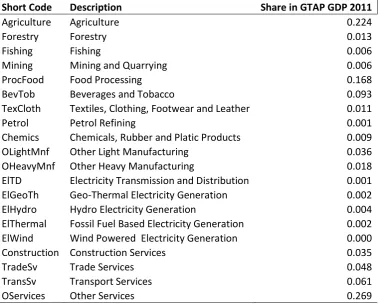
The benchmark SAM for Kenya distinguishes 19 production activities (Table 1), 7 primary
production factors including 3 sector-specific natural resource factors (forest, fish and mineral
stocks) beside skilled and unskilled labour, capital, and agricultural land and 4 household
categories. The Ghana SAM for the benchmark year contains 18 production activities (Table
2), 8 primary factors including oil / gas resource stocks in addition to the same factors as in the
Kenya SAM, and 5 household groups. Both SAMs contain 18 commodity groups (Agriculture,
Forestry, Fishing, Crude Oil, Natural Gas, Other Mining, Beverages and Tobacco, Processed
Food, Textiles and Clothing including Footwear and Leather Goods, Refined Petrol, Chemicals
including Plastic and Rubber Goods, Other Light Manufacturing, Other Heavy Manufacturing,
Electricity, Construction Services, Trade Services, Other Services).
3.5. Model Calibration
The numerical calibration process involves the determination of the initial model parameters
in such a way that the equilibrium solution for the benchmark year exactly replicates the
benchmark SAM. The selection of values for the sectoral factor elasticities of substitution, the
elasticities of substitution between imports and domestically produced output by commodity
group, and the target income elasticities of household demand is informed by available
econometric evidence from secondary sources and uses estimates provided by the GTAP
behavioral parameter database (Hertel and van der Mensbrugghe, 2016). The region-specific
income elasticity estimates reported in that source for a representative single aggregated
household are further differentiated across the lower and higher income households in the
model, e.g. for necessary goods such as food products with an observed higher budget share in
low-income households, the initial elasticities are raised vis-à-vis the central GTAP values and
17 Given the selection of these free parameters, the various share parameters of the models –
including the effective initial direct and indirect model tax rates – are then entirely identified
by the benchmark SAMs. Several of the model parameters, such as the factor productivity
parameters governing the rate of autonomous technical progress are time-variant in the
dynamic simulation analysis. The dynamic calibration of these time-variant parameters is
discussed in the context of the description of the dynamic baseline construction process in
18 Table 1: Kenya Model Production Sectors
Short Code Description Share in GTAP GDP 2011
Agriculture Agriculture 0.224
Forestry Forestry 0.013
Fishing Fishing 0.006
Mining Mining and Quarrying 0.006
ProcFood Food Processing 0.168
BevTob Beverages and Tobacco 0.093
TexCloth Textiles, Clothing, Footwear and Leather 0.011
Petrol Petrol Refining 0.001
Chemics Chemicals, Rubber and Platic Products 0.009 OLightMnf Other Light Manufacturing 0.036 OHeavyMnf Other Heavy Manufacturing 0.018 ElTD Electricity Transmission and Distribution 0.001 ElGeoTh Geo-Thermal Electricity Generation 0.002 ElHydro Hydro Electricity Generation 0.004 ElThermal Fossil Fuel Based Electricity Generation 0.002 ElWind Wind Powered Electricity Generation 0.000 Construction Construction Services 0.035
TradeSv Trade Services 0.048
TransSv Transport Services 0.061
OServices Other Services 0.269
Table 2: Ghana Model Production Sectors
Short Code Description Share in GTAP GDP 2011
Agriculture Agriculture 0.236
Forestry Forestry 0.007
Fishing Fishing 0.018
CrudeOil Crude Oil and Natural Gas 0.063
Mining Mining and Quarrying 0.008
ProcFood Food Processing 0.042
BevTob Beverages and Tobacco 0.010
TexCloth Textiles, Clothing, Footwear and Leather 0.012
Petrol Petrol Refining 0.001
Chemics Chemicals, Rubber and Platic Products 0.008 OLightMnf Other Light Manufacturing 0.018 OHeavyMnf Other Heavy Manufacturing 0.031 ElTD Electricity Transmission and Distribution 0.001 ElHydro Hydro Electricity Generation 0.008 ElThermal Fossil Fuel Based Electricity Generation 0.000 Construction Construction Services 0.138
TradeSv Trade Services 0.054
TransSv Transport Services 0.105
[image:20.595.77.452.466.757.2]19
4. Dynamic Scenario Analysis: Kenya
4.1. Overview
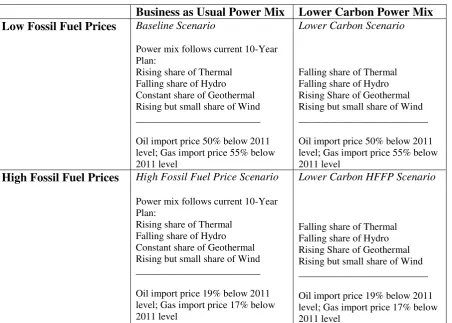
The simulation analysis for Kenya considers four dynamic scenarios up to 2025 that differ with
respect to (i) the evolution of the power mix in on-grid electricity generation and (ii) the
evolution of world market fossil fuel prices. Table 3 provides a concise outline of the alternative
scenario assumptions along these two dimensions.
The specification of the lower carbon scenarios is motivated by the results of the comparative
LCOE analysis by Pueyo et al (2016, 2017) which indicates a clear cost advantage of
geothermal over all other electricity generation technologies and by the presence of a
considerable potential for the further expansion of geothermal capacity in the country. The
consideration of alternative conceivable time paths for the evolution of international fossil fuel
prices is motivated by the strong sensitivity of the cost differences between thermal and
[image:21.595.76.529.425.748.2]renewables to fossil price projections.
Table 3: Schematic Outline of Scenarios for Kenya
Business as Usual Power Mix Lower Carbon Power Mix Low Fossil Fuel Prices Baseline Scenario
Power mix follows current 10-Year Plan:
Rising share of Thermal Falling share of Hydro Constant share of Geothermal Rising but small share of Wind _________________________
Oil import price 50% below 2011 level; Gas import price 55% below 2011 level
Lower Carbon Scenario
Falling share of Thermal Falling share of Hydro Rising Share of Geothermal Rising but small share of Wind __________________________
Oil import price 50% below 2011 level; Gas import price 55% below 2011 level
High Fossil Fuel Prices High Fossil Fuel Price Scenario
Power mix follows current 10-Year Plan:
Rising share of Thermal Falling share of Hydro Constant share of Geothermal Rising but small share of Wind _________________________
Oil import price 19% below 2011 level; Gas import price 17% below 2011 level
Lower Carbon HFFP Scenario
Falling share of Thermal Falling share of Hydro Rising Share of Geothermal Rising but small share of Wind __________________________
20
4.2. Baseline Scenario
The dynamic baseline scenario provides a projection of the evolution of Kenya’s economy up
to 2025 under the assumptions that international oil and gas prices remain at low 2015/16 levels
and that the evolution of the electricity generation capacity from hydro, geothermal and wind
follows Kenya’s 10 Year Power Sector Expansion Plan 2014-2024 (Republic of Kenya, 2014) under the Plan’s moderate load growth scenario.
The construction of the baseline scenario starts from the 2011 benchmark SAM outlined in
section 3. For the period up to 2015, the forward projection takes account of the most recent
available data observations, while the projections from 2016 to 2025 draw upon expert
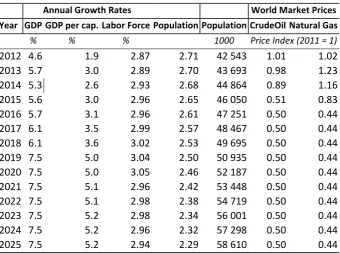
forecasts for the determination of the main model-exogenous drivers of economic growth
(Table 4). 13
4.2.1. Population and Labour Force Growth
Population and labour force growth is based on the UN DESA (2015) medium-variant
projections commonly used in contemporary long-run scenario studies. According to these
projections, the total population of Kenya rises from 42.5 million in 2012 to 58.6 million in
2025. As shown, the scenario takes into account that over this period the annual growth rate of
the working-age population – and thus the labour force growth rate in the model under the
assumption of a constant participation rate - remains considerably higher than the population
growth rate.
4.2.2. Total Factor Productivity and GDP Growth
The second exogenous driver of economic growth in the model is the economy-wide total
factor productivity (TFP) growth rate, which reflects the speed of autonomous technical
progress. In the development of the baseline scenario, the time path for the annual TFP growth
rate is determined indirectly by imposing a target growth path for Kenya’s real gross domestic
product (GDP) (see Table 4) and by calibrating the TFP parameter of the model dynamically
21 to match this target growth path. Technically, to obtain the TFP growth path the model is first
simulated in a dynamic calibration mode in which GDP is exogenized while the TFP parameter
is treated as an endogenous variable. When the model is then simulated in normal mode, with
GDP as an endogenous variable and exogenous imposition of the TFP growth path obtained in
the dynamic calibration run, the model solution exactly replicates the target GDP growth path.
The GDP baseline scenario growth rates up to 2015 are the reported actual national accounts
figure and the projections up to 2018 are taken from KIPPRA (2016). The assumed constant
growth rate of 7.5 percent per annum beyond 2018 is an optimistic compromise between the annual growth rate target of 10 percent envisaged in Kenya’s aspirational Vision 2030 development plan (Republic of Kenya, 2007) for the same period and the growth rates projected
by the CGE model under the assumption that TFP grows at a moderate pace that is more in line with the country’s actual observed growth performance over recent years: The average annual TFP growth rate for the period 2011-2015 that is required in the model to replicate Kenya’s
actual GDP growth reported in Table 4 is 0.8 percent14 and the corresponding rate for the period
2016 to 2018 is 2.8 percent. To reach the assumed 7.5 percent GDP growth rate beyond 2018,
the average annual TFP growth rate needs to rise further to reach 3.3 percent. Thus, the baseline
scenario implies a strong acceleration in the growth rate of technical progress, yet the TFP
growth rate figures are not entirely implausible, provided a significant portion of the measures
to modernize the economy envisaged in the Kenya Vision 2030 are actually implemented over
the time horizon considered here. However, GDP growth rates on the order of 10 percent per
annum would require TFP growth rates well above 5 percent. Assuming a sustained
productivity acceleration of such an order would seem to be unrealistic, given Kenya’s actual
growth performance under the Vision 2030 plan so far.15
14 This CGE-model-determined figure matches closely with the corresponding growth-accounting-based estimate of 0.8 percent TFP for Kenya in 2015 and average annual TFP growth of 0.6 percent over the period 2011 to 2015 presented in The Conference Board (2016).
15 As shown in Republic of Kenya (2013: Table 2.1), in every single year of the first five-year implementation phase (2008/9 to 2012/13) Kenya missed the Vision 2030 GDP growth targets by a wide margin (i.e. by 4.0 to 4.6 percentage points). Despite a downward revision of the target rates for 2013 to 2015 (ibid: Table 2.2), Kenya’s
22 Table 4: Key Features of Dynamic Baseline Scenario - Kenya
Annual Growth Rates World Market Prices
Year GDP GDP per cap. Labor Force Population Population CrudeOil Natural Gas
% % % 1000 Price Index (2011 = 1) 2012 4.6 1.9 2.87 2.71 42 543 1.01 1.02 2013 5.7 3.0 2.89 2.70 43 693 0.98 1.23 2014 5.3 2.6 2.93 2.68 44 864 0.89 1.16 2015 5.6 3.0 2.96 2.65 46 050 0.51 0.83 2016 5.7 3.1 2.96 2.61 47 251 0.50 0.44 2017 6.1 3.5 2.99 2.57 48 467 0.50 0.44 2018 6.1 3.6 3.02 2.53 49 695 0.50 0.44 2019 7.5 5.0 3.04 2.50 50 935 0.50 0.44 2020 7.5 5.0 3.05 2.46 52 187 0.50 0.44 2021 7.5 5.1 2.96 2.42 53 448 0.50 0.44 2022 7.5 5.1 2.98 2.38 54 719 0.50 0.44 2023 7.5 5.2 2.98 2.34 56 001 0.50 0.44 2024 7.5 5.2 2.96 2.32 57 298 0.50 0.44 2025 7.5 5.2 2.94 2.29 58 610 0.50 0.44 Sources: GDP growth: 2012, KNBS (2016); 2013-18 KIPPRA (2016); Population and labour force growth: UN DESA (2015), medium-variant projections.
4.2.3. Electricity Sector
The assumed evolution of the power mix in the baseline scenario draws upon Kenya’s 10 Year Power Sector Expansion Plan 2014-2024 (Republic of Kenya, 2014) while taking into account
that under the assumed baseline economic growth path, the electricity demand growth over the
simulation horizon endogenously generated by the CGE model is significantly lower than in
the 10-Year Plan: This plan considers a high growth scenario with a ‘fast-tracked’
implementation of a range of energy-intensive Vision 2030 flagship investment projects16 and a ‘moderate load growth scenario’with a ‘deferred’ implementation of these flagship projects.
The high growth scenario assumes that GDP growth reaches 10.1 percent p.a. by 2018 and
accelerates further to 12 percent p.a. by 2024. Effective electricity demand is projected to grow
at average annual rate of 17.4 percent between 2015 and 2024 to reach 56,447 GWh by 2024
23 (Republic of Kenya, 2014: Table 28) Based on least cost power expansion simulations17, this
scenario proposes a strong expansion in hydro capacity (+74 percent relative to 2013) and
massive expansions in geothermal (+1,200 percent), thermal (~ +2,400 percent) and wind (~
+18,600 percent from a tiny base) by 2024 to satisfy this demand growth (Republic of Kenya,
2014: Table 25). The projected domestic generation shares in 2024 under average hydrological
conditions in this scenario are 47.2 percent for geothermal, 42.5 percent for thermal, 9.5 percent
for hydro and 0.8 percent for wind. The scenario envisages that coal-fired power generation
starts in 2016 and then rapidly expands to reach a share of 17.4 percent in total generation by
2024. With respect to the plausibility and economic viability of this scenario, the Plan itself
states that
“under the fast-tracked scenario, there would be a huge power surplus if demand does not grow fast enough which could lead to stranded investments and/or high power tariffs. Additionally, the report reveals that high cost technologies such as the thermal power plants particularly those planned for commissioning in 2014 may be poorly dispatched in the medium to long term while base plants such as coal and LNG may end up being run at below optimal levels of less than 70%” (Republic of Kenya, 2014:5).
According to the latest KNBS (2016b) figures actual electricity generation in 2015 was some
30 percent below the corresponding 2015 projection under this scenario and the plans for the
construction of Kenya’s first coal-fired power plant in Lamu as well as related plans for the
exploitation of domestic coal resources detected in the Mui Basin are on hold.18 Thus, the 10-Year Plan’s high growth scenario provides no suitable basis for the development of a plausible baseline scenario for purposes of the present study.
The ‘moderate load growth’ scenario of the 10-Year plan assumes that annual GDP growth rises to 10 percent by 2020 and that the economy continues to grow at that rate up to 2024. The
aforementioned flagship investments are implemented slightly later than in the high growth
scenarios and the connection rate reaches 60 percent by 2024. Effective electricity demand is
projected to grow at average annual rate of 15.5 percent between 2015 and 2024 and reaches
38,413 GWh by 2024 (Republic of Kenya, 2014: Table 33). Hydro capacity is projected to
jump by 61 percent in 2019 relative to a constant 2014-2018 level with no further expansion
up to 2024, geothermal capacity expands by 288 percent between 2014 and 2024, thermal by
322 percent, and wind generation capacity expands by a factor of 24.5 relative to the small
2014 level (Republic of Kenya, 2014: Table 32). The projected domestic generation shares in
17 These simulations are an update of the earlier 2013 Least Cost Power Sector Development Plan (Republic of Kenya, 2013b).
24 2024 in this scenario are 48.2 percent for geothermal, 39.2 percent for thermal, 11.7 percent
for hydro and 0.8 percent for wind. Coal-fired power plants start operating from 2019 and reach
a share of 20.9 percent in total domestic electricity generation by 2024.
As discussed in section 4.2.2 above, our baseline scenario is an optimistic scenario but uses
lower GDP growth projections than the 10-Year Plan’s so-called ‘moderate load growth scenario’. Correspondingly, the electricity demand growth projected by the CGE model - which equates to an annualized average growth rate of 12.8 percent over the period 2015 to 2025 - is
significantly below the Plan’s average annual growth rate of 15.5 percent. In absolute terms,
this demand growth differential translates into a marked difference between the 2025
CGE-model-based baseline projection of 35,641 GWh (Table 5) for domestic supply and a one-year
forward projection of the Plan’s 2024 domestic supply, which amounts to nearly 44,000
GWh.19 It is noteworthy, that this difference is larger than the entire projected coal-based
generation for 2024 (7,965 GWh) according to the Plan. Thus, no coal-fired power-plants at all
are required in our baseline scenario.
Table 5: Domestic Electricity Generation by Type – Baseline Scenario
Electricity Generation (GWh)
Year Total Hydro Geothermal Thermal Wind
2011 7250 3427 1453 2352 18 2015 10675 3427 5333 1868 47 2020 22735 4466 11343 6829 97 2025 35641 4466 18331 12529 315
Shares (%)
2011 100.0 47.3 20.0 32.4 0.2 2015 100.0 32.1 50.0 17.5 0.4 2020 100.0 19.6 49.9 30.0 0.4 2025 100.0 12.5 51.4 35.2 0.9 Sources: All figures for 2011 and all GWh figures for Hydro, Geothermal and Wind: Republic of Kenya (2014: Tables 6 and 33). Domestic total generation figures are model- determined and Thermal shares beyond 2015 follow residually. Actual provisional 2015 figures in KNBS (2016b) released after the completion of the baseline construction: Total: 9456 GWh, Hydro: 3463 GWh (36.6%), Geothermal: 4521 GWh (47.8%), Thermal 1412 GWh (14.9%).
25 As shown in Table 5, the baseline scenario assumes that hydro, geothermal and wind generation
evolves in line with the moderate load growth scenario of the 10 Year Power Sector Expansion
Plan20 while thermal (gas- and oil-fired) generation fills the gap between total demand and
non-fossil-based supply. Correspondingly, the direction of the changes in the power mix over the
period 2015 to 2025 are broadly in line with the 10-Year Plan moderate scenario, in the sense
that (i) the hydro share drops markedly despite a substantial increase in absolute capacity, (ii)
the geothermal share remains roughly constant following the rapid increase over the period
2011 to 2015, which means that absolute geothermal generation grows strongly and
approximately in proportion to total electricity demand, (iii) the share of thermal rises strongly,
and (iv) the wind share roughly doubles but remains below one percent.
The main difference to the Plan scenario is that, due to the lower overall electricity demand
growth, the baseline 2025 thermal share is slightly lower (35.2 versus 39.2 percent) and greener
as it contains no coal-fired generation.
According to the moderate load growth scenario, the share of diesel within total non-coal
thermal generation, which was 100 percent in the benchmark year 2011, drops markedly to 58
percent in 2015 and further to 14 percent in 2024 as diesel-fired generation is replaced by
gas-fired generation. However, as the recent cancellation of the planned Dongu Kundu gas power
station project indicates21, such a shift appears unlikely to happen within the time horizon of
the present study. Thus the baseline scenario assumes that thermal generation continues to
remain entirely heavy-fuel-oil-fired. Nevertheless the cost disadvantage of thermal relative to
geothermal drops significantly relative to the initial 2011 differential as a result of the assumed
permanent oil price drop.
The baseline scenario captures the increase in household connectivity rates and the additional
increase in commercial electricity demand assumed in the 10-Year Plan in a stylized form
through gradual exogenous increases in the model parameters governing the shares of
electricity consumption in total household consumption22 and in intermediate consumption.
20 With a slight lag over the 2021-2025 period, so that the Plan’s generation figures for 2024 are realized in year 2025 of the baseline scenario.
21 See Okuti (2016).
26 The additional increases in commercial electricity demand due to the promotion of the said
Kenya Vision 2030 flagship projects and due to wider across-the-board shifts to more
electrified modes of production as the Kenyan economy develops are captured in the CGE
model via gradual increases in the electricity input-output coefficients for sectors where the
2011 GTAP electricity input-output coefficients are well below the average across lower
middle income countries in the GTAP database. Shifts to more electrified modes of production
reduce the need for physical labour and basic capital inputs to some extent, and so the
technology parameters governing the demand for primary factors are gradually revised
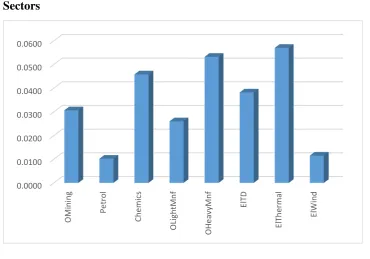
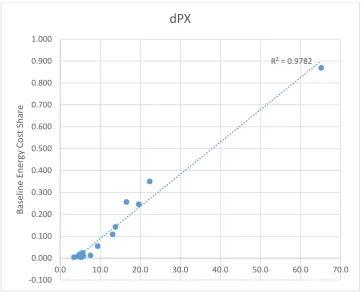
downwards accordingly in these sectors. Figure 2 displays the baseline 2025 shares of
electricity in total production cost for all sectors in which this share exceeds one percent.
Figure 2: Share of Electricity Cost in Total Baseline Production Cost 2025 – Selected Sectors
budget share parameters, as the assumed income elasticities of household demand for electricity for Kenya (see section 3 above) are well above unity across all household categories.
[image:28.595.69.440.353.612.2]27
4.3. Lower Carbon Scenario
4.3.1. Scenario Specification
Considering alternative conceivable pathways towards a less carbon-intensive power mix, the
LCOE analysis for the GGDA project by Pueyo et al (2016) identifies geothermal electricity
generation as the most promising technology option for Kenya. This assessment is in line with
Kenyan government’s own assessment in the 10 Year Power Sector Expansion Plan:
“In Kenya, more than 14 high temperature potential sites occur along Rift Valley with an estimated potential of more than 10,000 MW. Other locations include Homa Hills in Nyanza, Mwananyamala at the Coast and Nyambene Ridges in Meru. The expansion to existing geothermal operations offers the least cost, environmentally clean source of energy (green) and highest potential to the country”. (Republic of Kenya, 2014:101).
The following simulation analysis contemplates a deliberately drastic scenario in which the
geothermal share in total domestic generation increases from 2018 onwards along a steep linear
schedule to reach 75 percent in 2025, so that the 2025 geothermal share is 23.6 percentage
points higher than in the baseline. The thermal share drops correspondingly from 35.2 percent
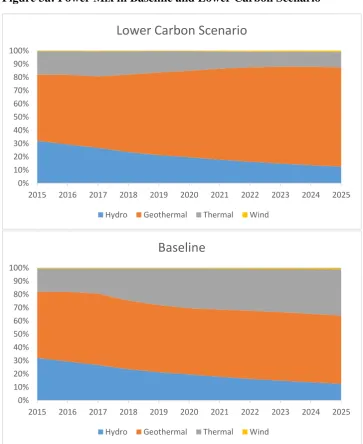
in the 2025 baseline to 11.6 percent (Table 6 and Figure 3a). The hydro and wind shares remain
unchanged. In absolute terms, this assumed expansion of geothermal electricity generation by
2025 is very close to the 10 Year Plan’s least-cost high growth scenario, in which geothermal
is projected to generate 26,000 GWh by 2024.
Table 6: Geothermal and Thermal Shares in Total Power Mix – Lower Carbon Scenario
(Percentage Shares)
Year Baseline Lower Carbon
Geothermal Thermal Geothermal Thermal
2015 50.0 17.5 50.0 17.5
2016 52.7 17.6 52.7 17.6
2017 53.9 18.9 53.9 18.9
2018 51.9 24.2 58.7 17.4
2019 50.7 27.6 62.4 15.9
2020 49.9 30.0 65.4 14.6
2021 50.8 30.8 68.7 12.9
2022 51.4 31.7 71.3 11.8
2023 51.7 32.6 73.2 11.2
2024 51.7 33.8 74.4 11.1
28 For a proper interpretation of this scenario it is important to emphasize that the falling share of
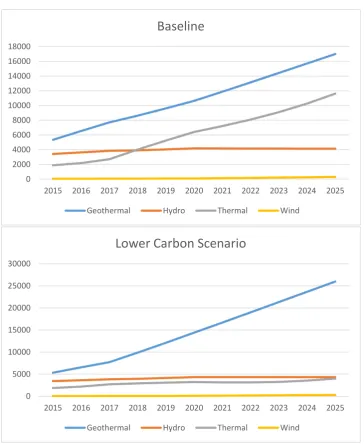
thermal does not imply an absolute contraction of thermal generation. Given the strong overall electricity demand growth, thermal generation still grows year on year, albeit at a lower rate
[image:30.595.70.434.218.663.2]than in the baseline (Figure 3b).
Figure 3a: Power Mix in Baseline and Lower Carbon Scenario
0% 10% 20% 30% 40% 50% 60% 70% 80% 90% 100%
2015 2016 2017 2018 2019 2020 2021 2022 2023 2024 2025
Lower Carbon Scenario
Hydro Geothermal Thermal Wind
0% 10% 20% 30% 40% 50% 60% 70% 80% 90% 100%
2015 2016 2017 2018 2019 2020 2021 2022 2023 2024 2025
Baseline
29 Figure 3b: Annual Electricity Generation in Baseline and Lower Carbon Scenario
(in GWh)
4.3.2. Results
The assumed gradual shift from high-cost thermal to lower-cost geothermal electricity
generation entails a notable drop in the effective average supply price relative to the baseline
scenario. As shown in Figure 4, in 2025 the domestic electricity price – here expressed relative
to the equilibrium wage of unskilled workers – is over 12 percent lower than in the baseline
scenario. The reduction in the cost of electricity affects the production costs and thus the supply
prices across all sectors and is more pronounced in sectors with a higher share of electricity in 0
2000 4000 6000 8000 10000 12000 14000 16000 18000
2015 2016 2017 2018 2019 2020 2021 2022 2023 2024 2025
Baseline
Geothermal Hydro Thermal Wind
0 5000 10000 15000 20000 25000 30000
2015 2016 2017 2018 2019 2020 2021 2022 2023 2024 2025
Lower Carbon Scenario
30 total cost (Figure 4) such as mining, the chemical industry and heavy manufacturing than in
[image:32.595.75.437.188.410.2]sectors with a low power intensity.
Figure 4: Impact on Domestic Producer Prices – Lower Carbon Scenario 2025
(Percentage deviation of price relative to unskilled wage from 2025 baseline)
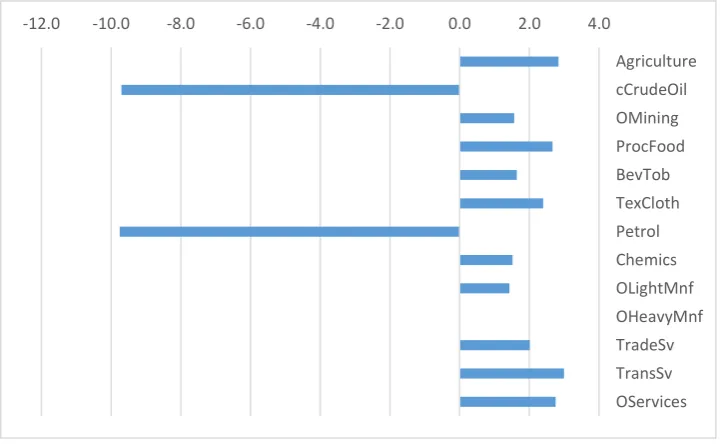
The assumed low carbon transition entails a strong reduction in fossil fuel imports. Both refined
petrol and crude oil imports drop by nearly ten percent in volume terms relative to the baseline
scenario towards 2025 (Figure 4). The indirect effect on crude oil imports arises due to the fact
that in the baseline scenario Kenya’s domestic petrol refining sector – which actually ceased
production in the second half of 2013 – is reactivated as envisaged in the 2015 National Energy
and Petroleum Policy Draft (Republic of Kenya, 2015) and as part of the aforementioned
LAPSSET flagship development. In the baseline projection this sector operates at a modest
scale using imported crude oil, with a negligible 2025 baseline contribution to GDP and total
employment.
As Kenya remains a net importer of fossil fuels in the baseline scenario, the drop in the fossil
fuel import bill is associated with a real exchange rate appreciation on the order of 0.7 percent.
The real appreciation lowers in tendency the prices of imports relative to domestically produced
goods from the perspective of domestic residents. This induces a substitution effect towards
imports for commodities in cases where the exchange rate effect dominates the simultaneous
drop in the prices of domestic output due to the electricity cost reduction in the new
equilibrium. This substitution effect affects both imports of final goods and intermediate inputs.
-14.0 -12.0 -10.0 -8.0 -6.0 -4.0 -2.0 0.0
31 A further positive effect on imports across all final goods arises due the positive aggregate real
income effects associated with the shift towards lower-cost electricity generation shown below.
Thus, Figure 5 shows moderate welfare-raising increases in the import quantities relative to
baseline levels for most traded non-fuel goods and services and these are generally more
pronounced for the commodity groups with smaller domestic supply price reductions according
[image:33.595.72.435.291.513.2]to Figure 4.
Figure 5: Impact on Real Import Volumes by Commodity Group – Lower Carbon Scenario 2025
(Percentage deviation from 2025 baseline)
Note: This figure excludes commodity groups with negligible shares in Kenya’s total imports.
On the export side, the real exchange rate appreciation effect per se reduces in tendency the
price of exports relative to the price obtained in the domestic market from the viewpoint of
domestic producers, and thus shifts the optimal profit-maximizing output mix between export
and home market production in favour of the latter. Correspondingly, Figure 6 reports moderate
drops in export quantities for most sectors. An exception is heavy manufacturing, which is the
sector with the highest electricity cost share. In this case, the cost reduction effect dominates
the exchange rate effect, so that exports expand.
The trade effects shown in Figure 5 and 6 can also be explained from a balance-of-payments
perspective: The reduction in the fossil fuel import bill relaxes the balance-of-payments
-12.0 -10.0 -8.0 -6.0 -4.0 -2.0 0.0 2.0 4.0
Agriculture
cCrudeOil
OMining
ProcFood
BevTob
TexCloth
Petrol
Chemics
OLightMnf
OHeavyMnf
TradeSv
TransSv
32 constraint as it allows domestic residents to enjoy simultaneously an increase in real imports
and a higher share in domestically produced output, as less of that output needs to be shipped
abroad to pay the import bill.
Figure 6: Impact on Real Export Volumes by Commodity Group – Lower Carbon Scenario 2025
(Percentage deviation from 2025 baseline)
Note: The figure excludes commodity groups for which both the baseline share in total export revenue is small (<2.5 percent) and the export/output share is small (<10 percent).
The equilibrium impact on real gross output by production sector for 2025 compared to the
baseline scenario is shown in Figure 7. The sectoral employment effects have the same
direction and broadly the same orders of magnitude, and are therefore not separately plotted.
Not surprisingly, in percentage terms the effect on the size of the small domestic oil refinery
sector in relation to the baseline is most pronounced as the demand growth for fuel by thermal
power plants slows down. However in relation to total employment the associated employment
reallocation effects are tiny. The domestic power sector expands as the drop in electricity prices
induces additional demand.
It is worth emphasizing that no sector contracts in absolute terms and thus no sector sheds
existing workers along the dynamic scenario time path. A negative-signed output effect in
Figure 7 merely indicates that the sector grows at a lower rate and that new workers are hired
a slower pace than in the baseline scenario. E.g., while the domestic refining sector at the 2025
-3.0 -2.5 -2.0 -1.5 -1.0 -0.5 0.0 0.5 1.0 1.5
Agriculture
Forestry
OMining
ProcFood
BevTob
TexCloth
Chemics
OLightMnf
OHeavyMnf
TransSv
33 endpoint of the simulation horizon is projected to be nearly 10 percent smaller than in the
baseline scenario for the same year, the sector is still 127 percent larger in 2025 than in 2027.
In line with economic theory, the real exchange appreciation shifts in tendency productive
resources from traded to non-traded activities. Among the non-power sectors that expand
relative to baseline are all sectors that have simultaneously negligible or small export / output
shares and negligible or little competition from imports in their domestic market, such as
construction services the fishery sector, and trade services. In contrast, the small domestic
mining sector with its baseline export-output ratio of over 75 percent and an import share of over 50 percent in Kenya’s domestic demand for mining products is squeezed noticeably as mining exports drop and mining imports rise. The sectors that expand despite relatively high
trade shares are heavy manufacturing are heavy manufacturing, which – as noted earlier – are
among the most electricity-intensive sectors and thus benefit disproportionally from the
reduction in energy input costs. However, the main message from Figure 7 is that the effects
of the assumed low carbon transition on the sectoral composition of output and employment
are very moderate.
Figure 7: Impact on Real Output by Sector – Lower Carbon Scenario 2025
(Percentage deviation from 2025 baseline)
-10.0 -8.0 -6.0 -4.0 -2.0 0.0 2.0 4.0
Agriculture
Forestry
Fishing
Mining
ProcFood
BevTob
TexCloth
Petrol
Chemics
OLightMnf
OHeavyMnf
Electricity
Construction
TradeSv
TransSv
34 The real resource savings associated with the switch to a lower-cost mode of electricity
generation is reflected in a moderately positive transitory effect on GDP growth as shown in
Figure 8. Like in a standard Solow growth model, the long-run growth rate in this multi-sectoral
dynamic CGE model is exogenously determined by the sum of the aggregate growth rate of
technical progress and the labour force growth rate. As these rates remain the same as in the
baseline, the annual GDP growth rate in a hypothetical dynamic long-run equilibrium without
further changes in exogenous parameter would eventually converge back to the baseline growth
rates, yet the positive effect on the level of GDP is of course permanent along such a steady
state path. The cumulative effect of the small annual growth rate increments reported in Figure
8 over the period 2018 to 2025 entails that the level of real GDP by 2025 is 1.1 percent higher
than in the baseline scenario.
Figure 8: Annual Growth Rate of Real GDP – Baseline and Low Carbon Scenario
(in Percent)
Turning to the effects on the functional income distribution – that is the distribution of primary
income by type of factor – Figure 9 displays the impacts on real factor prices (i.e. nominal
factor prices deflated by the consumer price index) in 2020 and 2025 relative to the baseline
level in the corresponding year. By 2025 the real returns to all factors except mineral resources
are slightly higher than in the baseline. Capital returns rise relative to labour wages and the
wage gap between skilled and unskilled increases marginally. 0.00
1.00 2.00 3.00 4.00 5.00 6.00 7.00 8.00
2018 2019 2020 2021 2022 2023 2024 2025
6.10
7.50 7.50 7.50 7.50 7.50 7.50 7.50
6.47
7.82 7.78 7.69 7.66 7.63 7.61 7.59
35 The differential factor price effect arise from factor intensity differentials between sectors that
grow quicker and sectors that grow slower than in the baseline (recall Figure 7): On balance,
the higher-growing sectors as a group are relatively skill- and capital-intensive and thus their
additional factor input demand drives up capital returns and skilled wages more than unskilled
wages.
The natural resource rent drop is due to the growth slow-down of the domestic mining sector
which is the sole user of the mineral endowment factor in the model. The reason for the reversal
of the effect on agricultural land rents is related to the fact that electricity use in agriculture is
initially very low but grows over time with technical progress and the rise in rural access rates.
Thus, agriculture initially benefits very little from the drop in electricity prices while being hit
by the exchange rate appreciation effect on agricultural exports and imports (Figure 5 and 6).
As a result, agricultural output drops marginally (by 0.1 percent) below baseline levels over
the initial period up to 2020 but then recovers subsequently (and ends up 0.1 percent above
base level by 2025) as the direct and indirect23 input cost reduction effects become more
pronounced over time.
For households with a single source of factor income, Figure 9 directly indicates the direction
of the effects on total factor income. Figure 10 shows the implications for mixed-income
households with factor income mixes equal to the income compositions of the four household
categories the benchmark SAM. Both lower and higher income households gain. However,
since the urban and rural high-income groups have higher shares of capital and skilled labour
in their total income mix than the low-income groups, the former groups gain disproportionally.
In other words, as far as this rather coarse-grained distributional analysis based on outdated
underlying raw data goes, the low-carbon transition has a pro-poor effect in an absolute or “weak” sense (namely that the poorer households are better off than in the baseline), but is not pro-poor in a relative or “strong” sense (i.e. the poorer households do not gain
disproportionally).24
23 E.g. the drop in chemical fertilizer prices.
36 Figure 9: Impact on Factor Returns – Low Carbon Scenario
(Percentage deviation of factor prices relative to CPI baseline level 2020 and 2025)
Figure 10: Impact on Real Household Income – Low Carbon Scenario
(Percentage deviation from Baseline level 2020 and 2025)
-1.5 -1.0 -0.5 0.0 0.5 1.0 1.5 2.0
Unskilled Labour
Skilled Labour
Land
Capital
Natural Resources
2020 2025
0.00 0.50 1.00 1.50 2.00
Rural_L Rural_H Urban_L Urban_H