Munich Personal RePEc Archive
Methodology Does Matter: About
Implicit Assumptions in Applied Formal
Modelling. The case of Dynamic
Stochastic General Equilibrium Models
vs Agent-Based Models
Gräbner, Claudius
19 March 2015
Online at
https://mpra.ub.uni-muenchen.de/63003/
Methodology Does Matter: About Implicit
Assumptions in Applied Formal Modelling
The case of Dynamic Stochastic General Equilibrium Models vs Agent-Based Models
Claudius Gr¨
abner
∗This article uses the functional decomposition approach to modeling (M¨aki, 2009b) to discuss
the importance of methodological considerations before choosing a modeling framework in
applied research. It considers the case of agent-based models and dynamic stochastic general
equilibrium models to illustrate the implicit epistemological and ontological statements related
to the choice of the corresponding modeling framework and highlights the important role of
the purpose and audience of a model. Special focus is put on the limited capacity for model
exploration of equilibrium models and their difficulty to model mechanisms explicitly. To model
mechanisms that have interaction effects with other mechanisms is identified as a particular
challenge that sometimes makes the explanation of phenomena by isolating the underlying
mechanisms a difficult task. Therefore I argue for a more extensive use of agent-based models
as they provide a formal tool to address this challenge. The overall conclusion is that a plurality
of models is required: single models are simply pushed to their limits if one wishes to identify
the right degree of isolation required to understand reality.
Keywords: Functional decomposition approach, general equilibrium, agent-based models, methodology,
epistemology, ontology, formal modeling, isolation
1. Introduction
In 1977 the then president of the Royal Economic Society stated that ”methodology does not matter”
(Hahn, 1977). And indeed, until today, methodological considerations have been largely absent in the
majority of applied economics research papers. It seems that most researchers focus on the application
of their models and prefer to develop and explore these models - not to justify them. According to a
widespread belief methodology would indeed not matter too much as long as models as such were good:
Models based on bad methodological considerations would turn out to be bad models in any case, no
matter if one considers economic methodology explicitly or not - and if a model would be a good model,
methodological consideration could not turn it into a bad one.
I will argue in this article that this point of view, widely accepted as it may be, is wrong. It is wrong in
a very unpleasant way, because its failure does not come up as a false derivation of a proof that can be
clearly identified as such. It is implicitly present in many state-of-the-art economic models and it does not
invalidate the models as models. But it has important consequences for the inferences from the models
to the real world and for the discourse within the scientific community about (and through) the models.
These consequences do not come clear immediately if the model is discussed in isolation, but require the
consideration of the whole modeling framework in which the model has been developed, and of the purpose
for which the model is designed and finally used.
I build upon the functional decomposition approach of models (FDM) developed by M¨aki (2009b) and
use two formal modeling frameworks as an example to illustrate the usefulness of the approach: Dynamic
stochastic general equilibrium (DSGE) models, that dominate the landscape of macroeconomic research,
and models from the framework of agent-based computational economics (ACE), that increase in popularity
especially in fields dealing with economic complexity, but are a peripheral approach in economics still. I
use these two frameworks because they are similar enough to be compared easily and DSGE models are
representative for a wider range of economic models. This article does not argue for ageneral superiority of one approach over the other, but to illustrate the consequences of the choice regarding the one modeling
approach or the other, and how this choice depends on purpose and audience of the model.
DSGE models are said to have brought a consensus about the correct way of macroeconomic modeling
and are the natural way to model macroeconomic phenomena for the vast majority of economists (Mishkin,
2007; Goodfriend, 2007). They are not chosen because of methodological considerations but because they
are the standard in their realm of application. In practice, their use does not require any further justification
any more. Comparing these models with ACE models reveals many of the implicit assumption inherit in
the technical foundations of the models. These hidden assumptions, while generally not being discussed,
are crucial if one wishes to infer from the models to reality. In this article I will illustrate how the praxis of
how DSGE models are used blurs potential pitfalls inherent to this attempt of inference and the important
epistemological and ontological consequences inherent to the use of DSGE models .
In particular, the latter have serious difficulties in modeling mechanisms explicitly, but are well suited to
simulate their consequences. This is very important from an epistemological point of view and an advantage
of ACE models that has not been discussed in the literature so far. I think that even a large part of the
discussion about the (artificial) distinction between explanatory andpredictive modelling is at its very core a discussion about whether one should model mechanisms explicitly or only replicate their consequences.
While I think that there are situations in which either of the two options is to be preferred, a clarification
leads to the conclusion that depending what purpose the modeller attaches to its model, either of the two
approaches might be the adequate choice.
This means that ACE models are not automatically superior to GE models. In particular, the existing
ACE models represent countless different approaches to economic modeling, and range from simple,
qualitative models, to extremely complex models whose parameters become estimated. Some of them are
used for prediction purposes, others to illustrate certain mechanisms. Some are very similar to certain GE
models, others represent a contrary approach. while GE models are implicitly bounded to an instrumentalist
epistemology, the ACE community has not yet developed a common approach to give epistemic meaning to
their models. This is a serious shortcoming. I argue that the FDM as developed by M¨aki (2009a,b) and
interpreted in this article is able to fill this gap.
The rest of the paper is structured as follows: I start by providing a verbal sketch about the nature
of DSGE and ACE models in section 2. I then argue that both modeling frameworks are subject to a
reasonable comparison because both constitute formal systems in which conclusions are reached deductively
and both are in principle computationally equivalent (section 3). In section 4 I introduce the FDM in
more depth and discuss the distinction of modeling mechanisms or facts and interpret the methodological
consequences in the context of ACE vs. DSGE modeling. I then point to difficulties attached to the
isolation of mechanisms in the course of modeling (section 5) and discuss two intuitive examples and
possible solutions in section 6. After a discussion of the results in section 7 I conclude in section 8.
2. Introducing DSGE and ACE models
I will not provide a technical exposition of the two modeling frameworks, but give an intuitive verbal
description. For a good introduction into DSGE models see Canova (2007), Gali (2008) or Walsh (2010),
for ACE models see Borrill and Tesfatsion (2011).
2.1. Dynamic Stochastic General Equilibrium Models
DSGE models were developed as a response to the Lucas critique that criticized Keynesian macroeconometric
models for ignoring individual rationality and to have proposed policy measures that have led to the period
of stagflation in the 60s and 70s: macroeconometric models have suggested a negative relationship between
unemployment and interest rate (the original Phillips Curve). Therefore governments were thought of
facing a trade off between unemployment and inflation. But it turned out that these models confounded
correlation with causation: If people are smart and adaptive, they anticipate the effects of an expansive
monetary policy of the state and adjust their consumption and investment decisions accordingly. In this
case, higher inflation does not yield a stimulus for the economy and the employment rate does not change.
The response of Lucas and other neoclassical economists were the real business cycle (RBC) models that
optimal expectations that are consistent with the model. The state of the art are now New Keynesian
DSGE models that address the shortcomings of the RBC literature by including market frictions and
financial markets. They generally consist of three blocks: The demand block consists of a representative
household. The supply block consists of a representative firm that acts in a perfect competitive market and
sells its goods to the household. Additionally there is a continuum of firms producing distinct intermediate
goods that are sold in a monopolistic market to the final good firm. The intermediate goods firms are owned
by the household and pay dividends to it. The third block consists of a monetary authority that pursues
a certain policy, most commonly a Taylor rule. As DSGE models normally do not have a closed form
solution, solutions can be obtained only approximately Aruoba et al. (2006). The models are designed in a
way such that the economy has a unique and semi-stable saddle state. The functions can be linearised for
the neighborhood of this steady state and one can add stochastic disturbances to the model and calibrate
or estimate it using empirical data.
While more and more aspects, including financial markets, are added to DSGE models, some mechanisms
must necessarily stay beyond their scope. There is, for example, no way to consider heterogeneity of agents
and explicit network structures simultaneously in the same model - this is particularly severe, as will be
elaborated in section 5.
2.2. Agent based computational models
The fundamental idea of agent-based modelling is to start with a number of heterogeneous agents, that can
be different in many respects but usually share the same attributes, e.g. age, wealth orhealth condition. For the collection of all agents (or a subset of them), aggregate properties can be computed, such astotal
wealth. The agents interact with each other in a specified manner, i.e. according to a graph specifying whether which agent interacts potentially with which other agent, whether they meet in a deterministic
or random manner and whether their interactive structure is static or dynamic. What the single agent
does might depend on her own state only, the state of their neighbors or on properties of the system as a
whole. All agents change their states according to their update functions which can depend on the present
state of the agent, their neighbors, specific groups of some aggregate property of the system. Because the
resulting system of equations is usually to complicated to allow for a closed form solution, the models are
solved via numerical simulation. The resulting flexibility explains why ACE models are widely used outside
economics, e.g. to forecast the weather, design traffic systems, model the mating behavior of mosquitoes
or the emergence of institutions. Formally, ACE models are usually written in a computer language and
3. Formal similarities
From the above said it becomes clear that both modeling frameworks are formal in the sense that they
represent logical systems in which any step in the model is a deductive step. The initial model configuration
with the initial conditions for the parameters, the preference structure, the network structure, etc. can be
interpreted as the axioms of the system. The rules of inference are the rules according to which variables in
the model change. Examples are the local update functions for the agents in the ACE or the monetary
policy rule of a DSGE model. Thus, in every time step fromtn−1 totn the model stateMn is deduced
from the previous model stateMn−1. This makes the two frameworks subject to a reasonable comparison.
Intuitively, the above said suggests that ACE models are a richer modeling tool than DSGE models. This
is because even a lay person can imagine that in an ACE many different agent trade with each other in
different spaces, i.e. on a complete network where everybody can reach anybody else, or in a restricted
network where some agents can trade with many others, but others have only few chances to engage in
trade. But the definite assessment of such a question is more subtle:
Asking questions about the generality of two modeling frameworks means to ask a question about the
computational foundations of these frameworks. ”Computational” in this context must not be understood
as a too technical term: What we are interested in is, whether one of the frameworks can express everything
the other framework can express, or even more.
In order to make the argument clear, I make use of a theoretical model of a machine that does
computations, i.e. takes steps in a model. One of the most famous examples is the Turing machine (TM): It
is an imaginary machine that can in principle compute any algorithm. In fact, it is used to provide a formal
definition of what an algorithm actually is. The TM consists of a writing head focused on a tape. The tape
has an end on its left side but is infinitely long to its right side. It is divided into many squares. There can
be only one symbol on a square and there is a finite number of different symbols. The writing head is in
one out of (finitely) many possible states, reads the current symbol on the square, may override the symbol
on the square and can move the tape while potentially changing its current state depending on the symbol
on the tape. This theoretical machine is useful, as it can simulate every physical computer (excluding,
maybe, quantum computers). There are other theoretical machine models that work in a different way than
the Turing machine, e.g. the register machine which intuitively resembles the functioning of the assembler
in real computers. Although the actions of the two machines are very different, they can simulate each
other in polynomial time. This means they can generate the same kind of computer languages, can finish
the same calculations and are therefore equally powerful. This is the famous Church-Turing thesis at the
heart of modern computer science. It can be shown formally that the same is true for DSGE and ACE
models: Both represent Turing-complete systems and arecomputationally equivalent.1
We skip the formal argumentation that has been outlined in greater detail in Gr¨abner (2014), but the
logic is the following: DSGE models represent differential equations with more than two degrees of freedom.
1
Such systems are called Turing-complete because they can simulate a Turing machine. The adequate computational model for ACE models is a community protocol, as the computation of the overall system
emerges from the many computations done by the individual agents. It has been shown that community
protocols have the same computational power than Turing machines (at least for situations that are of
interest for us, see Guerraoui and Ruppert (2007)). DSGE and ACE models are therefore computationally
equivalent.
4. The functional decomposition appraoch and practical differences in the
application of ACE and DSGE models
While the two modeling frameworks have theoretically the same expressive power, practically, things are
more complicated. I will use the FDM to clarify the practical relationship between the two frameworks.
The FDM allows one to consider the role of purpose and audience of a model. Both aspects are crucial
to understand the role currently played by DSGE and ACE models in economic research, but also to
understand the variety of different epistemological approaches within among ACE models (and why such a
variety is smaller in the DSGE context).
While both ACE and DSGE models usually have the the purpose of either to explain an economic
phenomenon or to provide policy advice, their audiences are quite different: DSGE models are especially
popular in the economic mainstream, while ACE models are widely used in complexity economics. I will
come back to the discussion about the role of the different audience in sections 4.2 and 7 and but first, I
first need to introduce the FDM in more depth. It allows us to understand how the formal models can
gain epistemological meaningfulness despite the unrealistic assumptions they carry. This meaningfulness is
required to make reasonable inferences from the model to reality and is thus particularly crucial for models
that aim at informing public policy.
4.1. Introducing the functional decomposition approach
R0
S0
R1
S1 Reality
Surrogate
g:R→S
Representation h:S→R
Resemblance
s:S→S
Inference of facts
r:R→R
[image:7.595.82.457.580.734.2]Inference of mechanisms
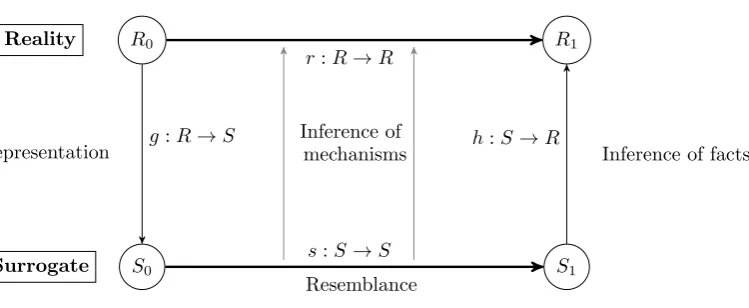
According to the functional decomposition approach models are representations. They have two aspects:
The representative aspect and the resemblance aspect. To be representative means to serve as asurrogate
for the real world. This means that the model is built as an image of the real world.
To build a model that represents the real world is considered to be a weak success, because it is only a first step to understand something about the real world. It is is a success because it is also possible to study a model for its own sake - for the beauty of its math or because one likes the story associated with
the model. If one does not even try to represent anything in the real world, one commits astrong failure. In this case the model is no surrogate, but asubstitute that is studied instead of the real world, not as a measure to get insights into it. Many theoretical models of economics are accused to commit this failure,
but ACE and DSGE models in particular are applied models that try to inform policy or public action. So
there is no case of a strong failure here. I have interpreted this part of the FDM as a mapping process
in figure 1 (Miller and Page, 2007; Moss, 2009; Gr¨abner, 2014). The process of reducing the real world
R to the model can be described by a functiong:R→S. For the state real world at time t0 (denoted
R0 in figure 1) it gives a corresponding model in stateS0. The surrogate (or the model) is always less
complex than the real world. I callgtherefore the complexity reduction function of the model. Although a
model might include several factors that are not present in the real world, these additions are generally
added to make the overall system easier: While real individuals have much less computational capacity
than their economic counterparts, the presence of such actors makes a system simpler to handle by the
modeller (M¨aki, 2009a, p. 31), i.e. theexplorationof the model gets facilitated.
Model exploration denotes the study of the behavior of a model. It means to study the transition function
of the model, denoted bysin the figure. This function transforms the state of the model at timet0, denoted
byS0, to the state att1, denoted byS1. The general idea is to learn something by the model exploration
about the behaviour of the real world, i.e. the transformation functionr, that is, in its completeness, too
complicated to be understood by the scientist. In order to get the desired epistemic meaningfulness, a
model must alsoresemble the real world, i.e. it must be useful to understandr. This means that we can learn something by applying the combination of functionsh◦s:S→R.
This explains partly why many economists react indignantly to the reproach of making unrealistic
assumptions: They want to resemble facts about the real world. They do not care too much about an
adequate representation but put the match betweenS1 andR1at center stage. This match is considered a
proof that the resemblance ofrthrough swas successful. Most audiences in and outside economics agree
to this criterion: the match and a rigorous derivation of the model results, i.e. a well-specified transition
functions, are often considered the most important aspect of the model and its exposition. But is this
criterion without problems? The answer depends mainly on the purpose of the model, as well become clear
4.2. Modelling facts or mechanisms?
Some immediate questions arise: Is there a difference between modeling facts or mechanisms? If yes, does
the distinction matter and, if it does, which option is to be preferred? The answers are ”yes”, ”yes”, and
”it depends” respectively.
Regarding the first question, is a model meant to resemble facts or mechanisms? To speak with figure 1,
is it mainly the state of the world in t+xthat the model should predict or should it describe parts of
the transition functiong most precisely? Given knowledge about R0 and a suitable surrogateS0, there
are many possible mechanisms providing the same prediction forR1. Because equifinality is common in
nature, many of these models could be ”correct”. The question of model selection would then be a matter
of abduction, if one is interested in understanding the underlying mechanisms, or a matter of applying
Ochams razor, if one is interested in gettingR1. So the distinction certainly exists. An example from the
DSGE literature is the widely used Calvo pricing due to Calvo (1983): In order to incorporate Keynes idea
of sticky prices and wages into DSGE models one assumes that firms can optimize prices and wages every
time step only with a given probability. While this is not the mechanism Keynes had originally in mind, it
has a similar effect in the model.
The distinction also matters for the process of model building: To model mechanisms explicitly, i.e.
to design the transition function of the models such that it represents the transition function of reality,
requires the inclusion of all aspects of reality that are relevant for the mechanisms to be explained during
the representation process: If we want to consider how a distribution of links among the individuals affects
the distributional effects of a specific exchange mechanism, then we need to implement a given network
structure explicitly in the model. Otherwise we could not explore the model in this direction. Exploration
therefore requires a certain degree of accuracy in the representation process. This requirement is not
without problems: Due to their technical design, DSGE models reduce the degrees of freedom for the
formulation of the complexity reduction function and thus limit the number of mechanisms to be explored
in the model. The justification for the technical design is the increased clarity associated with DSGE
models.
Many mechanisms are excluded from consideration systematically by the technical construction of DSGE
models: All mechanisms involving downward effects and mutual interdependence of the different levels
of the economy, mechanisms involving non-rational behavior of economic agents or mechanisms based on
the structured interaction of heterogeneous agents cannot be implemented as such. The consequences
of these mechanisms might be replicated in a sophisticated DSGE model, but within the DSGE model
other mechanisms bring up the results. The results are explained in the DSGE framework, i.e. as the
consequence of the choices made by rational agents and firms, acting in an environment of economic
equilibrium, perpetuated by exogeneous shocks. This means that one did not represent the mechanisms, but
only their consequences and the resulting states. This suggests that modeling mechanisms is substantially
some well defined axioms, simply because there are many potential mechanisms that bring about one fact.
A mechanism, however, is by definition unique and its identification requires substantial effort.2
Such an approach has merits and disciplines research, but it also suffers from some serious shortcomings:
To be widely applicable, insights are preferably about mechanisms: In reality, facts are always the
consequence of a specific combination of mechanisms. If one wishes to transfer the insights from one model
designed for a certain situation to another situation without building the model anew from scratch, one
is required to posses a certain toolbox for mechanisms that can be included into and excluded from the
model.3
This requires models that have a modular structure such that some mechanisms of the model can
be exchanged while the rest of the model is left unchanged. This is a feature intuitively implemented in
ACE models, but very cumbersome (if not impossible) in DSGE models. In praxis, this ”shortcoming”
is not really problematic as the most accepted form of ”explanation” in economics is the derivation of
the phenomenon to be explained from well-specified micro assumptions, i.e. preference relations and the
like. And DSGE models serve this purpose very well. This is another reason for their superior popularity
compared to ACE models: The increased flexibility of ACE models is not so much of an advantage if one
presents one’s models to an audience that favors explanation via one specific form of reduction that can
be implemented best in the (less flexible) DSGE framework. The increased flexibility of ACE models is
not a positive asset for this kind of audience, but comes up with less clarity and much more variety of the
existing models.If the audience would be a different one, that pays particular attention to the underlying
mechanisms and not so much on the correct prediction of the future, then such an audience might be much
more open minded to the applicatoin of ACE modes and more rejective towards DSGE modeling. The
institutionalist or evolutionary communities in economics might be examples for such audiences.
This brings us to the third question, namely whether it is better to model facts or mechanisms. The
answer depends on the purpose and the audience of the model, i.e. the pragmatic constraints of the model.
In this context it is important to emphasize again that both DSGE and ACE models are always unrealistic
in the sense the some of their assumptions are false. They share this property with all economic models. The
FDM allows to justify the falseness of some of the assumptions by referring to the concept of isolation. The
isolation of a mechanism and the proof that the existence of this mechanisms together with some (maybe
arbitrary) initial conditions leads certain results, can be a powerful way to understand this particular
mechanisms. But isolation can be misleading if in reality it is thecombination of different mechanisms that brings about the relevant consequences, i.e. the functionr in figure 1 is in fact a composed function where
its parts represent different mechanisms.
2
Therefore, to test whether certain mechanisms in a model resemble mechanisms in the real world is always a stronger test for the realism of a model than the test for the prediction alone.
3
5. Where isolation of mechanisms gets problematic
The common justification for the isolation of mechanisms is in the spirit of the following logic: To be clear
about the mechanism at work, one isolates it entirely from other mechanisms. One then argues that if the
mechanisms is strong enough to lead to similarities to the real world even in isolation, it will certainly do
so in the presence of other mechanism as well.4
Formally:
(H1∧M1→C1)→(H1∧M1∧M2→C1) (5.1)
withH1denoting the initial configuration,M1the mechanism under consideration,M2another mechanism
and C1 the consequences, assuming thatM2 does not work into the reversed direction thanM1.
Another way to state this is that there are no relevant interaction effects between the mechanismsM1
and M2.
But how can one be sure that such interactive effects do not exist? Empirical studies can only be of
limited help, because no mechanism operates in isolation. If the purpose of modeling is to search for such
interaction effects, then the use of ACE models can be very useful. This is because of their increased
flexibility and their modular structure: as one can add or change mechanisms to the same model, one can
elaborate on the consequences of the isolation in the original model. To study the isolation of a mechanism
is of particular importance because it can have an important ontological dimension, namely if the isolation
of a mechanism changes its functioning: If a mechanism, M1, generally occurs together with another
mechanism, M2, and their joint appearance changes the character and the consequences of both of them,
then isolating one of the other and making inferences from the models including the single mechanisms can
be interpreted as a violation of the ontological constraints of the model, at least if we interpret the joint
operation of the two mechanisms as a new mechanism. Formally:
(H1∧M1→C1)∧(H1∧M1∧M2→C2) (5.2)
Interpreting (M1∧M2) as a new mechanism is the only way to make the system coherent. They must be
understood as a new mechanism itself,M3, otherwise a contradiction within the model would result. See
the appendix for a proof. But if M3 is a new, and thus different, mechanism, isolation ofM1 orM2means
to exchangeM3 - a choice with important ontological implications. Then, if the aim of the model was to
represent mechanisms, it gets into the danger of becoming asubstitute model.
To identify such issues is possible in the agent-based framework because of the modular structure of
most ACE models.5
. This modular structure is the source for the superior exploration capacity of ACE
models. Through rigorous model exploration, isolations can be tested and enfold epistemic content. This
4
Only if the other mechanisms are working into a different direction, the consequences of the mechanisms might not be observable. But this does not mean that the mechanisms does not work at all: In its entire absence, the effect of the opposite effects would have been larger.
5
also suggests a certain complementary among the two modeling frameworks:
In place of most common economics models, DSGE models do not support such a rigorous model
exploration. ACE models do. This means that if one considers the task to explain mechanisms the choice to
model a situation with a DSGE model, one implicitly states that interaction effects do not exist and there
is no other level in the economy which deserves consideration other than an independent micro structure.
This means that the choice of using DSGE models in the context of modeling mechanisms often comes
with an at best frivolous ontological statement. A common reaction is to retreats to the area of modeling
mere facts retrenching to the area of predictions. But one could also test the assumption for the context of
explaining mechanisms if one has the the absence of interaction effects using an ACE model. Or if one has
understood the nature of the interaction and then interprets the DSGE model accordingly.
I will illustrate this point by discussing two examples where the interaction effects of different
mecha-nisms matter, and models focusing on explaining these mechamecha-nisms provide important guidelines for the
interpretation of all models involving these mechanisms.
6. Examples for interaction of mechanisms and the limited model
exploration in DSGE models
DSGE models explain by deducing their resulting time series from the behavior of utility maximizing
agents and profit maximizing firms. The central concept is economic equilibrium. The model is designed
in a way such that a stable saddle path results, of which neighborhood the model gets linearized before
stochastic shocks are added, exists. Because of this technical construction they cannot be explored in all
the dimensions which might be desirable as adding a new mechanism would require a reconsideration of all
other specifications made in the model such that the equilibrium path results anew.
I will now give two examples for mechanisms that are very likely to exhibit strong interaction effects
with other mechanisms and therefore pose a particular challenge for DSGE models. While one of the
mechanisms here might be dealt with in DSGE models of the future, the other is definitely beyond the
scope of such models. The former concerns the social interaction structure of an economy, the second the
process of how prices form in markets. But not only do these mechanisms pose a very high challenge for
DSGE modeling, they also illustrate the difficulties that sometimes come up when isolating mechanisms
in general. Both mechanisms can be assessed through ACE models and thus also serve as examples for
potential complementarities between models focused on mechanisms and those focused on predicting facts:
The latter can then designed in a way they efficiently mimic the factors identified in the mechanism based
6.1. Networks
The standard Arrow-Debreu model, still one ofthe cornerstones of modern economics, does not consider an explicit network structure. So how would the model outcome change if edges between the vertices were
distributed in a certain manner? While the original model is not suited to address this question, an ACE
model modeling the original model might help to answer the question and thus to specify and qualify the
results of the original model. This has been done for the general equilibrium framework by Albin and
Foley (1992), Axtell (2005) and Gintis (2007) who replicated the results of analytical models via agent
based simulations and then added additional features such as an explicit network structure. They were
then able to explore the model in the dimension of different network structures. The motivation therefore
is straightforward: In reality, networks are ubiquitous: In every system involving any kind of interaction,
there is a certain structure of the local interactions, which can be illustrated via a network. While the field
of network science is comparatively young, it has already provided a large number of concepts through
which interaction networks can be described and has described several key features of empirical networks.
Although the very details depend on the case considered, social networks in general were identified to have
heavy-tailed degree distributions, show high clustering and small average path lengths. It would be a logical
next step to include these information into basic economic models to consider how the introduction of these
features affects the outcomes of the model. This has been done, at least for a very simple ring structure, for
the Arrow-Debreu GE model (Albin and Foley, 1992). The authors concluded that considering the network
structure (and the absence of a central price setting mechanism, see below) affects the distributional
properties of the market. This is not only an important finding in itself, it also increases the value of the
original model as a heuristic, as we know how the results change if the situation to which the model is
applied, changes.
How did Albin and Foley (1992) reach their conclusion? They implemented an ACE version of the
Arrow-Debreu model, replicating the behavior of the original model and exploiting the modular structure
of ACE models and varied the underlying network structure everything else left equal. Such studies are particularly important as introducing networks alone has already important effects on the model outcome,
but introducing it jointly with additional heterogeneity of the agents affects this outcome even more (Page,
2012).
6.2. Central control vs. self organization
Most analytical models in economics rely on comparative statics. This means that they prove the existence
(and sometimes the stability) of equilibria, but do not consider the process of how these equilibria will be
reached. Consider the canonical general equilibrium model: While the existence of an efficient equilibrium
was shown to exist, it comes about only through the help of the imaginary Walrasian auctioneer. In reality,
markets consist of people interacting with each other. Prices form because of offers being made, accepted,
still at the heart of most modern economic models, including the most sophisticated DSGE models, even
if the models as such are dynamic: As was explained above, the praxis in DSGE models is to linearise
the models along their steady state, then to add the shocks and to conduct a policy analysis. The areas far from economic equilibrium are not considered. This is why even for these dynamic models, the same
criticism than for static models applies, simply because the way the equilibrium is reached in the first place
is not considered. Additionally, DSGE models often assume other markets not considered explicitly in the
model to be in equilibrium, e.g. the labor market. The process of how this market reaches equilibrium is
left out of the argumentation.
This means that although we can calibrate a purely equation based model to produce an output more
or less similar to that of the real world, but we do not knowhow exactly it resembles reality because we know that there is not Walrasian auctioneer. ACE models, on the other hand, are generative models (Epstein, 1999) in this respect: In the agent-based version of the Arrow-Debreu model, prices form because
of the interactions among the agents, because of the offers rejected, accepted and adjusted by them. One
clearly knowshow, i.e. following which mechanism, the model resembles the reality. This has important implications: The first welfare theorem, for example, states that all outcomes from perfect markets are
Pareto efficient. It is a mathematical theorem that is derived from the assumptions about the market and
the preference relations of the individuals, but how exactly these artificial markets produce efficiency is not entirely clear. This is particularly severe if we want to infer from the model to a situation where the
assumptions are not fully met: In what direction does a lack of rationality affects the efficiency of the
market? There is a (mathematical) result according to which the second best result can be obtained by
changing all other parameters instead of trying to meet all assumptions to the best possible degree (Lipsey
and Lancaster, 1957) but this is not a constructive contribution. It would be much more attractive to
simulate the different trajectories and to compare them directly.
This is particularly important because mechanisms that were identified to have certain effects in an
environment with a Walrasian auctioneer might have very different effects in an environment without such a
central control.Again, the problems outlined here become explicit only if one tries to represent mechanisms.
If one wished to model mere states of the world, the considerations come up only implicitly, e.g. when
interpreting the result of a perfect market or when motivating a certain design for the model. Furthermore,
the systematic neglection of a certain class of mechanisms in prediction based models, e.g. reconstitutive
downward effects, can partly explain wrong prediction of these models.
7. Discussion
I have used the case of ACE and DSGE models to clarify the epistemological and ontological dimension of
implicit assumptions in much of economic theory.
computational perspective, both frameworks are formal and purely deductive, and both models are applied,
both try to represent and resemble reality. Therefore, a clear comparison was possible.
Because the assumptions of all economic models are naturally false to a certain degree, many strategies
have been developed to give epistemological meaning to these models and to study their ”falseness”. The
FDM as interpreted here is particular useful because it helps to show how DSGE models prescribe a certain
form of representing reality, but also to understand and structure the huge variety of existing ACE models
(regarding their ontological and epistemological orientations). But most importantly, it puts the concepts
of ”purpose” and ”audience” of a model at center state, and both categories have been shown to be of
crucial importance for understanding how the two modeling frameworks currently are used, and how their
application can be improved.
and used it to show that the DSGE models prescribe a particular form of complexity reduction and
that they are not able to model many mechanisms explicitly - which can be particularly problematic if
mechanisms show important interaction effects with other mechanisms. In this case, the choice of which
mechanisms to include into one’s representation of reality has a strong ontological dimension. This is
particularly true for the cases of networks and the price building mechanisms.
Here, the choice of the modeling framework inhibits an ontological conviction, and the associated isolation
can come with an ontological reduction and carries the danger of breaking the ontological constraints
of the model. But whether this is considered a problem depends on the pragmatic constraints of the
model: Most economists use a set of pragmatic constraints for their models according to which a too
detailed representation of mechanisms would be rather harmful and confusing rather than adding additional
explanatory power to the model. As mentioned above, DSGE models perfectly fit to what is currently most
widely accepted as an economic explanation of phenomena, namely the deduction of the the explanans
from ”well-specified” micro assumptions. This is exactly what DSGE models do. Furthermore, in periods
where there are no major changes in the business environment, they are a good choice to make predictions.
To consider mechanisms involving a mutual interdependence of different levels in the economy such as
reconstitutive downward effects (Hodgson, 2002, 2011), the consideration of the meso level of the economy,
or the use of a more realistic conception of economic agents, as it is demanded by e.g. institutional
economists, is not an issue for the DSGE community. The common commentaries, another important
aspect of modeling (M¨aki, 2009a), during the model expositions seem to provide evidence for this claim:
methodological considerations do not seem to have too much importance during the model exposition in
most journals and conference presentations today. This is bad, because even if the focus of the model is
mere prediction, the interpretation of and the commentaries on the models should be clear about what
kind of inference to the real world can be made or not. Such qualifications are often imprecise, as a match
of predicted facts is too often interpreted as a proof for the complete resemblance of the real world through
Are the results obtained here also valid for other models, that try to make direct statements about
reality or is the case of ACE and DSGE models a rather special one? The praxis of explaining facts by
deducing them from the behavior of utility maximizing individuals and profit maximizing firms via the
concept of economic equilibrium is shared by most analytical models in economics. This is the main limit
for the explorative capabilities of DSGE models, and so it limits much of current models in this tradition.6
It represents a sharp reduction of mechanisms that can be considered in the associated models and is as
such a strong, but seldomly discussed, ontological, and epistemological statement, which is - implicitly or
explicitly - shared by most of the economics audience.
Does the above said mean that all models that do not potentially include any potential mechanism are
useless? Not at all. Much of the usefulness of a model always depends on its purpose and audience. From
a pluralistic perspective the coexistence of models from different frameworks is desirable. If a modeling
framework serves a good purpose for very specialized task, but excludes explorations beyond this task
by its technical construction, it must not be the only framework under use, as it is currently the case for
DSGE models in current macroeconomics. We have also seen that the question whether one should model
mechanisms instead of facts is also answered by purpose and audience of the model at hand. Sometimes,
the additional effort of modeling mechanisms explicitly might be too high. But the above said illustrated
particularly how the systematic exclusion of mechanisms can lead to misleading results concerning mere
facts as well: If markets have other distributional effects if they worked in a decentral manner than in a
centralized manner, the predictions derived from the two models differ in a very substantial sense and
only a focus on the mechanisms of the model reveal the reason for this difference. And only the focus on
mechanisms reveals the degree to which the dominant equilibrium framework creates uncertainty through
limiting the ability for model exploration.
A rather natural question to arise is whether the comparison can be extended to verbal models. The
attractive thing about the comparison between ACE and DSGE models is that they both are purely
deductive and can be be compared quite easily. Many verbal models are not entirely deductive, but
include deductive elements. But they also have inductive and abductive elements which makes it difficult
to compare them directly with ACE and DSGE models. Still, any verbal model involves a complexity
reduction of the real world that can be questioned and is to be justified, so similar arguments might be
made in this regard and the elaborations can be of some use when one considers verbal models.
The above said also illustrated the importance of what M¨aki (2009a) calls the pragmatic constraints
for modeling: A modeler always build a model for a given purpose and a given audience and frames her
work accordingly using specific comments. DSGE models fit very well the demands of most mainstream
economic journals.
What will be of particular interest in the future is how the two modeling frameworks are perceived
6
outside the mainstream economics journals, especially by practitioners. For the last decades, DSGE models
were the dominant modeling framework also for central banks and other important policy institutions such
as the IMF, the World Bank and government departments. But especially since the financial crisis, ACE
models are getting more and more popular for this kind of audience as well. To see whether economists
react to this trend by widening their portfolio of modeling tools is an exciting question and it is not clear
how it will be answered.
8. Summary and Conclusion
This article has shown the importance of explicit methodological considerations when using formal models
for applied economic research. I used the illustrative case of ACE and DSGE models to show how certain
modeling frameworks constrain the possibility of exploring models in different dimensions and to represent
real world mechanisms explicitly. This results in important epistemological end ontological statements that
should be discussed explicitly, rather then being disregarded implicitly.
To clarify these statements I have used the FDM of M¨aki (2009a,b) which is well suited to give
epistemological meaning to models whose assumptions are not entirely realistic. The FDM furthermore
helps to identify implicit differences in methodologically similar models.
It also helps to illustrate the question of whether to model mechanisms or facts. In particular, this
question renders the imprecise discussion about explanatory vs. predictive modeling superfluous.
Finally, we were able to discuss the usefulness, but also the potential difficulties associated with the
concept of isolating mechanisms, especially if mechanisms have important interaction effects with each
other.
The overall conclusion is that a plurality of models is required: if one wishes to identify the right degree
of isolation, single models are simply pushed to their limits. Only the comparison of different models and
their mutual qualification can then bring about a deeper understanding of reality. The task is, in the spirit
of Keynes, to choose the right model with the combination of mechanisms that is most relevant to the
contemporary problem at hand, and to justify and qualify it in comparison to alternative models.
In this sense, the paper also argued that both approaches to modeling can be useful and can profit from
each other: If one wishes to make mere quantitative predictions for a more or less stable system, a focus on
modeling facts is probably a good choice. But if one wished to motivate certain designs for such models
more generally, or if one wishes to derive more general statements about how the economy works, a focus
on modeling mechanisms should be the preferred option. In this case, modeling frameworks that allow for
a flexible specification of the complexity reduction function and can be explored in more dimensions are
often necessary.
The paper furthermore illustrated the usefulness of the FDM when talking about the epistemological
foundations of models and to clarify the problems such as the limited capacity for model exploration. It
also highlights the important role of the purpose and the audience of the models.
Because of this, the approach also helps to explain the dominance of DSGE models: they best fit the
current expectations of the biggest audience for economic models, the economic mainstream. Whether
the expectations of economic practitioners will be met by DSGE models in the future is an important
question and cannot be answered yet as alternatives such as ACE models are not yet developed to the same
degree as DSGE models. For economists in academia, a more extensive use of ACE models in the spirit of
Albin and Foley (1992), Axtell (2005) and Gintis (2007) in order to broaden the assessment of existing
analytical models and to consider the combination of mechanisms explicitly seems to be an important and
fruitful area of future research. In this context, the FDM can help to classify the huge variety of existing
ACE models and to reveal the enormous variety of different (and sometimes contradictory) approaches to
economic modeling within this community: a purely formal comparison of the models is not sufficient. But
interpreting an ACE model in the FDM framework helps one to carve the theoretical content out of the
models.
While there are some open questions that deserve future research, such as the question whether the
technical necessity in DSGE models to isolate and explain mechanisms through the deduction of their
consequences in the environment of economic equilibrium should be considered to be a mere pragmatic
constraint, or this in fact means a violation of the ontological constraints to models, the the abovementioned
conclusions are already sufficient to confidently contradict Prof. Hahn: Methodology matters for economists,
and its neglect brings about much confusion and serious problems if our models are confronted with reality.
Acknowledgments
The author wants to thank Kurt Dopfer, Christian Cordes, Wolfram Elsner, Uskali M¨aki, Anita Pelle and
Georg Schwesinger for the most valuable comments. All remaining errors are mine.
References
Albin, Peter and Foley, Duncan K. Decentralized, dispersed exchange without an auctioneer: A simulation
study. Journal of Economic Behavior & Organization, 18(1):27 – 51, 1992.
Aruoba, S. Boragan; Fern´andez-Villaverde, Jesus, and Rubio-Ram´ırez, Juan F. Comparing solution methods
for dynamic equilibrium economies. Journal of Economic Dynamics and Control, 30:2477–2508, 2006.
Axtell, Robert. The complexity of exchange. The Economic Journal, 115(504):F193–F210, 2005.
Borrill, Paul L and Tesfatsion, Leigh. Agent-based modeling: The right mathematics for the social sciences?
Calvo, Guillermo A. Staggered prices in a utility-maximizing framework. Journal of Monetary Economics, 12(3):383–398, 1983.
Canova, Fabio. Methods for Applied Macroeconomic Research. Princeton University Press, Princeton, 2007.
Epstein, Joshua M. Agent-based computational models and generative social science. Complexity, 4(5): 41–60, 1999.
Gali, Jordi. Introduction to Monetary Policy, Inflation, and the Business Cycle: An Introduction to the
New Keynesian Framework. Introductory Chapters. Princeton University Press, 2008.
Gintis, Herbert. The dynamics of general equilibrium. The Economic Journal, 117(523):1280–1309, 2007.
Goodfriend, Marvin. How the world achieved consensus on monetary policy. Journal of Economic Perspectives, 21(4):47–68, Fall 2007.
Gr¨abner, Claudius. Modelling frameworks in applied economics. a formal comparison of cge, dsge and ace
models. Technical report, Forthcoming, 2014.
Guerraoui, Rachid and Ruppert, Eric. Even small birds are unique: Population protocols with identifiers.
LPD Tech Report-2007-006, 2007.
Hahn, Frank. Reflections. Royal Economic Society Newsletter, 77, April 1977.
Hodgson, Geoffrey M. Reconstitutive downward causation. In Fullbrook, Edward, editor,Intersubjectivity in Economics. Agents and structures, chapter 10, pages 159–180. Routledge, London, New York, 2002.
Hodgson, Geoffrey M. Downward causation - some second thoughts. Website, March 2011. http:
//www.geoffrey-hodgson.info/downward-causation.htm; Accessed: May 21st, 2013.
Keynes, John Maynard. Letter to roy harrod, 10 july 1938.
Lipsey, Richard G. and Lancaster, Kelvin. The general theory of second best. The Review of Economic
Studies, 24(1):11–32, 1957.
Lucas, Rober Jr. Econometric policy evaluation: A critique. Carnegie-Rochester Conference Series on Public Policy., 1(1):19–46, January 1976.
M¨aki, Uskali. Missing the world. models as isolations and credible surrogate systems. Erkenntnis, 70(1): 29–43, 2009a.
M¨aki, Uskali. Models and truth: The functional decomposition approach. In Suarez, M.; Dorato, M., and
Redei, M., editors, EPSA Epistemology and Methodology of Science: Launch of the European Philosophy
Martin, John C. Introduction to Languages and The Theory of Computation. Mc Graw Hill, New York, 4 edition, 2011.
Miller, John H. and Page, Scott E. Complex Adaptive Systems. An Introduction to Computational Models of Social Life. Princeton University Press, Princeton, 2007.
Mishkin, Frederic S. Will monetary policy become more of a science? Finance and Economics Discussion
Series 2007-44, Board of Governors of the Federal Reserve System (U.S.), 2007.
Moss, Scott. Talking about abss: Functional descriptions of models. In Squazzoni, Flaminio, editor,
Epistemological Aspects of Computer Simulaton in the Social Sciences, pages 48–59. Springer, Berlin, Heidelberg, 2009.
Page, Scott E. Aggregation in agent-based models of economies. The Knowledge Engineering Review, 27: 151–162, 6 2012. ISSN 1469-8005. doi: 10.1017/S0269888912000112. URLhttp://journals.cambridge.
org/article_S0269888912000112.
A. Proof that combinations of mechanisms must be interpreted as new
mechanisms
We consider the situation in which there is
1. a given initial condition,H1
2. two potential mechanisms,M1andM2
3. two potential results,C1andC2
We assume that if M1 operates in isolation,C1will result:
1 H1∧M1→C1 A(1)
Because we are considering a closed model we can also say that:
1∗ H1∧M1↔C1 A(1)
We further assume that ifM1andM2 both operate,C2 will result:
2 H1∧M1∧M2↔C2 A(2)
Thus
3 (H1∧M1↔C1)∧(H1∧M1∧M2↔C2) ∧E(1,2)
Not considering (M1∧M2) as a new mechanism in itself,M3, would result in the following:
4 C1∨C2 A(4)
5(3,4) ¬((H1∧M1↔C1)∧(H1∧M1∧M2↔C2)) ¬((3,4)
6(5) (H1∧M1↔C1)∨(H1∧M1∧M2↔C2) ∨E(3,4)
which is a contradiction to A1 and A2. Thus, the joint appearance ofM1andM2should be considered