C O M P U T A T I O N A L C O M P L E X I T Y I N T W O - L E V E L
M O R P H O L O G Y
G. Edward Barton, Jr.
M.I.T. Artificial Intelligence L a b o r a t o r y 545 Technology Square
Cambridge, MA 02139
A B S T R A C T
Morphological analysis must take into account the
spelling-change processes of a language as well as its possi-
ble configurations of stems, affixes, and inflectional mark-
ings. T h e computational difficulty of the task can be clari-
fied by investigating specific models of morphological pro-
cessing. T h e use of finite-state machinery in the "two-
level" model by K i m m o Koskenniemi gives it the appear-
ance of computational efficiency, but closer examination
shows the model does not guarantee efficient processing.
Reductions of the satisfiability problem show that finding
the proper lexical/surface correspondence in a two-level
generation or recognition problem can be computationally
difficult. T h e difficulty increases if unrestricted deletions
(null characters) are allowed.
I N T R O D U C T I O N
The "dictionary lookup" stage in a natural-language system can involve much more than simple retrieval. In- flectional endings, prefixes, suffixes, spelling-change pro- cesses, reduplication, non-concatenative morphology, and clitics may cause familiar words to show up in heavily dis- guised form, requiring substantial morphological analysis. Superficially, it seems t h a t word recognition might poten- tially be complicated and difficult.
This paper examines the question more formally by in- vestigating the computational characteristics of the "two- level" model of morphological processes. Given the kinds of constraints t h a t can be encoded in two-level systems, how difficult could it be to translate between lexical and surface forms? Although the use of finite-state machin- ery in the two-level model gives it the appearance of com- putational efficiency, the model itself does not guarantee efficient processing. Taking the Kimmo system (Kart- tunen, 1983) for concreteness, it will be shown that the general problem of mapping between ]exical and surface forms in two-level systems is computationally difficult in the worst case; extensive backtracking is possible. If null characters are excluded, the generation and recognition problems are NP-complete in the worst case. If null charac- ters are completely unrestricted, the problems is PSPACE- complete, thus probably even harder. The fundamental
difficulty of the problems does not seem to be a precompi- lation effect.
In addition to knowing the stems, affixes, and co- occurrence restrictions of a language, a successful morpho- logical analyzer must take into account the spelling-change processes t h a t often accompany affixation. In English, the program must expect love+ing to appear as loving,
fly+s as flies, lie+ing as lying, and big+er as bigger.
Its knowledge must be sufficiently sophisticated to distin-
guish such surface forms as hopped and hoped. Cross-
linguistically, spelllng-change processes m a y span either a
limited or a more extended range of characters, and the
material that triggers a change m a y occur either before or
after the character that is affected. (Reduplication, a com-
plex copying process that m a y also be found, will not be
considered here.)
T h e K i m m o system described by Karttunen (1983} is
attractive for putting morphological knowledge to use in
processing. K i m m o is an implementation of the "two-level"
model of morphology that K i m m o Koskenniemi proposed
and developed in his Ph.D. thesis. I A system of lexicons in
the dictionary c o m p o n e n t regulates the sequence of roots and affixes at the lexical level, while several finite-state
transducers in the a u t o m a t o n c o m p o n e n t -- ~ 20 transduc- ers for Finnish, for instance -- mediate the correspondence
between lexical and surface forms. Null characters allow the automata to handle insertion and deletion processes.
T h e overall system can be used either for generation or for
recognition.
T h e finite-state transducers of the automaton compo-
nent serve to implement spelling changes, which m a y be
triggered by either left or right context and which m a y
ignore irrelevant intervening characters. As an example,
the following automaton describes a simplified "Y-change"
process that changes y to i before suffix e s :
IUniversity of Helsinki, Finland, circa Fall 1983.
"Y-Change" 5 5
y y * s = ( l e x i c a l c h a r a c t e r s )
i y = s = (surface characters)
s t a t e 1: 2 4 1 1 1 ( n o r m a l s t a t e ) s t a t e 2. 0 0 3 0 0 (require * s ) s t a t e 3. 0 0 0 1 0 (require s ) s t a t e 4: 2 4 8 1 1 ( f o r b i d + s ) s t a t e S: 2 4 1 0 1 ( f o r b i d s )
The details of this notation will not be explained here; basic familiarity with the Kimmo system is assumed. For further introduction, see Barton (1985), K a r t t u n e n (1983), and references cited therein.
T H E S E E D S
O F C O M P L E X I T Y
At first glance, the finite-state machines of the two- level model appear to promise unfailing computational ef- ficiency. Both recognition and generation are built on the simple process of stepping the machines through the input. Lexical lookup is also fast, interleaved character by charac- ter with the quick left-to-right steps of the automata. The f u n d a m e n t a l efficiency of finite-state machines promises to make the speed of Kimmo processing largely independent of the n a t u r e of the constraints that the a u t o m a t a encode:
The most important technical feature of Kosken- niemi's and our implementation of the Two-level model is that morphological rules are represented in the processor as automata, more specifically, as finite state transducers . . . . One i m p o r t a n t conse- quence of compiling [the g r a m m a r rules into au- tomata] is that the complexity of the linguistic de- scription of a language has no significant effect on the speed at which the forms of that language can be recognized or generated. This is due to the fact that finite state machines are very fast to operate because of their simplicity . . . . Although Finnish, for example, is morphologically a much more com- plicated language than English, there is no differ- ence of the same magnitude in the processing times for the two languages . . . . [This fact] has some psy- cholinguistie interest because of the common sense observation that we talk about "simple" and "com- plex" languages b u t not about "fast" and "slow" ones. ( K a r t t u n e n , 1983:166f)
For this kind of interest in the model to be sustained, it must be the model itself that wipes out processing diffi- culty, rather than some accidental property of the encoded morphological constraints.
Examined in detail, the r u n t i m e complexity of Kimmo processing can be traced to three main sources. The rec- ognizer and generator must both r u n the finite-state ma- chines of the a u t o m a t o n component; in addition, the recog- nizer must descend the letter trees t h a t make up a lexicon. The recognizer must also decide which suffix lexicon to ex- plore at the end of an entry. Finally, both the recognizer and the generator must discover the correct lexical-surface correspondence.
All these aspects of r u n t i m e processing are apparent in traces of implemented K i m m o recognition, for instance when the recognizer analyzes the English surface form s p i e l (in 61 steps) according to K a r t t u n e n and Witten- burg's (1983) analysis (Figure 1). The stepping of trans- ducers and letter-trees is ubiquitous. The search for the lexical-surface correspondence is also clearly displayed; for example, before backtracking to discover the correct lexi- cal entry s p i e l , the recognizer considers the lexical string spy+ with y surfacing as i and + as e. Finally, after finding the putative root spy the recognizer must decide whether to search the lexicon I that contains the zero verbal ending of the present indicative, the lexicon AG storing the agen- tive suffix *er, or one of several other lexicons inhabited by inflectional endings such as +ed.
The finite-state framework makes it easy to step the automata; the letter-trees are likewise computationally well-behaved. It is more troublesome to navigate through the lexicons of the dictionary component, and the cur- rent i m p l e m e n t a t i o n spends considerable time wandering about. However, changing the implementation of the dic- tionary component can sharply reduce this source of com- plexity; a merged dictionary with bit-vectors reduces the n u m b e r of choices among alternative lexicons by allowing several to be searched at once (Barton, 1985).
More ominous with respect to worst-case behavior is the backtracking that results from local ambiguity in the construction of the lexical-surface correspondence. Even if only one possibility is globally compatible with the con- straints imposed by the lexicon and the automata, there may not be enough evidence at every point in processing to choose the correct lexical-surface pair. Search behavior results.
In English examples, misguided search subtrees are necessarily shallow because the relevant spelling-change processes are local in character. Since long-distance har- mony processes are also possible, there can potentially be a long interval before the acceptability of a lexical-surfaee pair is ultimately determined. For instance, when vowel alternations within a verb stem are conditioned by the oc- currence of particular tense suffixes, the recognizer must sometimes see the end of the word before making final de- cisions about the stem.
Recognizing s u r f a c e f o r m " s p i e l " . 1 s 1 . 4 . 1 . 2 . 1 . 1 2 sp 1 . 1 . 1 . 2 . 1 . 1
3 spy 1 . 3 . 4 . 3 . 1 . 1 4 "spy" ends, new lelXlCOn N
5 "0" ends. new l e x i c o n C1
6 spy XXX e x t r a input 7 (5) spy+ 1 . 5 . 1 6 . 4 . 1 . 1
8 spy+ XXX
9 (5) spy + 1 . 8 . 1 . 4 . 1 . 1
10 spy+ XXX
11 (4) "spy" ends, new l e x t c o n 1 12 spy XXX e x t r a t n p u t 13 (4) "spy" ends, new l e x i c o n P3 14 spy+ 1 . 6 . 1 . 4 . 1 . 1
15 spy+ XXX
16 (14) spy+ 1 , 8 . 1 8 . 4 . 1 . 1
17 spy+ XXX
18 (4) "spy" ends, new l e x t c o n PS 19 spy+ 1 . 6 . 1 . 4 . 1 . 1 20 spy+e 1 . 1 . 1 . 1 . 4 . 1
Zl spy+e XXX
22 (20) spy÷e 1 . 1 . 4 . 1 . 3 . 1
23 spy+e XXX
24 (19) spy+ 1 . 8 . 1 6 . 4 . 1 . 1
25 spy+e XXX Epenthesls
26 (4) "spy" ends, new l e x i c o n PP
27 spy+ 1.6.1.4.1.1
28 spy+e 1 . 1 . 1 . 1 . 4 . 1
zg spy+e XXX
30 (28) spy+e 1 . 1 . 4 . 1 . 3 . 1
31 spy+e XXX
32 (27) spy+ 1 . 8 . 1 8 . 4 . 1 . 1
33 spy+e XXX Epenthests
34 (4) "spy" ends. new l e x i c o n PR
35 spy+ 1 . 6 . 1 . 4 , 1 , 1
36 spy+ XXX
37 (38) spy+ 1 . 8 . 1 6 . 4 . 1 . 1
38 spy+ XXX
39 (4) "spy" ends. new l e x t c o n AG
40 spy+ 1 . 6 . 1 . 4 . 1 . I 41 spy+e 1 . 1 . 1 . 1 . 4 . 1
42 spy+e XXX
43 (41) spy+e 1 . 1 . 4 , 1 . 3 , 1
44 spy+e XXX
45 (40) spy+ 1 . 8 . 1 6 . 4 . 1 . 1
46 spy+e XXX Epenthests
47 (4) "spy" ends. new l e x t c o n AB 48 spy+ 1 , 8 . 1 . 4 . 1 . 1
49 spy+ XXX
50 (48) Spy+ 1 , 5 . 1 8 . 4 . 1 . 1
51 spy÷ XXX
52 (3) spt 1 . 1 . 4 . 1 . 2 . 8
53 spte 1.1.16.1.6.1
54 spte XXX
58 (53) sple 1 . 1 . 1 6 . 1 . 5 . 6 56 s p i e l 1.1.16.2, I. I 57 " s p i e l " ends. new l e x t c o n N
58 "0" ends. new l e x i c o n Cl 59 "spiel" *** r e s u l t 60 (58) s p i e l + 1 . 1 . 1 8 . 1 . 1 . 1 61 s p i e l + XXX
" - - + - - ' + - - - + I L L + L L L + I I I +
-~-+xxx+
l
---+XXX+
L L L + ] H + I
LLL÷---+XXX÷
-~-+XXX+
LLL+---+-*-+XXX+
_l_+xxx÷
-o-+AAA+LLL+---+---+XXX+
!:i::
,x,.
LLL+---+XXX+
-!-+XXX+
LLL+---+---÷XXX+
I
---÷XlX+
- - - + - - - + X X X + I
- - - + - - - + L L L + L L L + * * - ÷ I ---+XXX+
Key to t r e e nodes:
- - - normal t r e v e r s a l
LLL new lexicon
AAA blocking by automata XXX no lexlcal-surface p a i r s
c o m p a t i b l e with s u r f a c e char and dictionary III blocking by leftover input *'* a n a l y s i s found
(("spiel" (N SG)))
F i g u r e ]: These traces show the steps t h a t the KIMMOrecognizer for English goes through while analyzing the surface form s p i e l . Each llne of the table oil the left shows the le]dcal string and a u t o m a t o n states at the end of a step. If some autoz,mton blocked, the a u t o m a t o n states axe replaced by ~ , XXI entry. An XXX entry with no autonmto,, n:une indicates t h a t the ]exical string could not bc extended becau,~e the surface c],aracter .'tnd h,xical letter tree together ruh'd out ,-dl feasible p,'drs. After xn XXX or *** entry, the recognizer backtracks and picks up from a previous choice point. indicated by t h e paxenthesized s t e p l*lU,zl)er before the lexical .~tring. The tree Ol, the right depicts the search graphically, reading from left to right and top t . ])ottoln with vertir;d b;trs linking the choices at each choice p o i n t The flhntres were generated witl, a ](IM M() hnplen*entation written i , an ;I.llgll*t,llter| version of MACI,ISI'I,t,sed initiMly on Kltrttllnel*',,¢ (1983:182ff) ;dgorithni description; the diction;n'y m . l a n t o m a t o n contpouents for E , g l i s h were taken front 1 . ; a r t t , n e , and Wittenlmrg (1983) with minor ('llikllgCS. This iJz*ple*l*Vl*tatio*) se;u'¢h(.s del.th-tlr,~t a,s K m t t u , e n ' s does, but explores the Mternatives at a giwm d e p t h in a different order from Karttttnen's.
[image:3.612.135.455.97.558.2]Ignoring the problem of choosing among alternative lexicons, it is easy to see that the use of finite-state ma- chinery helps control only one of the two remaining sources of complexity. Stepping the automata should be fast, b u t the finite-state framework does not guarantee speed in the task of guessing the correct lexical-surface correspondence. The search required to find the correspondence may pre- dominate. In fact, the Kimmo recognition and generation problems bear an uncomfortable resemblance to problems in the computational class NP. Informally, problems in NP have solutions that may be hard to guess b u t are easy to
verify - - just the situation that might hold in the discov- ery of a Kimmo lexical-surface correspondence, since the a u t o m a t a can verify an acceptable correspondence quickly b u t may need search to discover one.
T H E C O M P L E X I T Y
O F
T W O - L E V E L M O R P H O L O G Y
The Kimmo algorithms contain the seeds of complex- ity, for local evidence does not always show how to con- struct a lexical-surface correspondence that will satisfy the constraints expressed in a set of two-level automata. These seeds can be exploited in mathematical reductions to show that two-level automata can describe computa- tionally difficult problems in a very n a t u r a l way. It fol- lows that the finite-state two-level framework itself cannot guarantee computational efficiency. If the words of natural languages are easy to analyze, the efficiency of processing must result from some additional property that n a t u r a l languages have, beyond those that are captured in the two- level model. Otherwise, computationally difficult problems might t u r n up in the two-level automata for some n a t u r a l language, just as they do in the artificially constructed lan- guages here. In fact, the reductions are abstractly modeled on the Kimmo t r e a t m e n t of harmony processes and other long-distance dependencies in n a t u r a l languages.
The reductions use the computationally difficult Boolean satisfiability problems SAT and 3SAT, which in- volve deciding whether a CNF formula has a satisfying truth-assignment. It is easy to encode an arbitrary SAT problem as a Kimmo generation problem, hence the gen- eral problem of mapping from lexical to surface forms in Kimmo systems is NP-complete. 2 Given a CNF formula ~, first construct a string o by notational translation: use a minus sign for negation, a comma for conjunction, and no explicit operator for disjunction. Then the o corresponding to the formula (~ v y)&(~ v z ) & ( x v y v z) is - x y . - y z .xyz.
2Membership in NP is also required for this conclusion. A later section ("The Effect of Nulls ~) shows membership in NP by sketching how a nondeterministic machine could quickly solve Kimmo generation and recognition problems.
The notation is unambiguous without parentheses because is required to be in CNF. Second, construct a Kimmo automaton component A in three parts. (A varies from formula to formula only when the formulas involve differ- ent sets of variables.) The alphabet specification should list the variables in a together with the special characters T, F, minus sign, and comma; the equals sign should be declared as the Kimmo wildcard character, as usual. The
consistency automata, one for each variable in a, should be constructed on the following model:
"x-consistency" 3 3
x x = (lezical characters) T F = (surface characters} 1: 2 3 1 (x undecided}
2: 2 0 2 (x true}
3: 0 3 3 ( x f a l s c }
The consistency automaton for variable x constrains the mapping from variables in the lexical string to truth-values in the surface string, ensuring that whatever value is as- signed to x in one occurrence must be assigned to x in every occurrence. Finally, use the following satisfaction automaton, which does not vary from formula to formula:
"satisfaction" 3 4
= = , (lexical characters} T F , (surface characters} 1. 2 1 3 0 (no true seen in this group)
2: 2 2 2 1 (true seen in this group}
3. 1 2 0 0 (-F counts as true)
The satisfaction automaton determines whether the truth- values assigned to the variables cause the formula to come out true. Since the formula is in CNF, the requirement is that the groups between commas must all contain at least one true value.
The net result of the constraints imposed by the consis- tency and satisfaction a u t o m a t a is that some surface string can be generated from a just in case the original formula has a satisfying truth-assignment. Furthermore, A and o can be constructed in time polynomial in the length of ~; thus SAT is polynomial-time reduced to the Kimmo gener- ation problem, and the general case of Kimmo generation is at least as hard as SAT. Incidentally, note that it is local
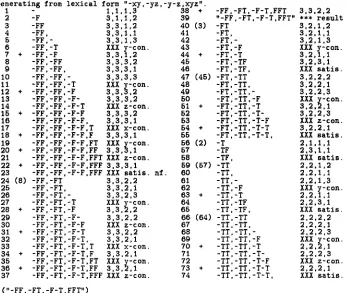
rather than global ambiguity that causes trouble; the gen- erator system in the reduction can go through quite a bit of search even when there is just one final answer. Figure 2 traces the operation of the Kimmo generation algorithm on a (uniquely) satisfiable formula.
Like the generator, the Kimmo recognizer can also be used to solve computationally difficult problems. One easy reduction treats 3SAT rather than SAT, uses negated al- phabet symbols instead of a negation sign, and replaces the satisfaction automaton with constraints from the dic- tionary component; see Barton (1985) for details.
Generating from lexical form "-xy. -yz. -y-z,xyz"
1 1 , 1 . 1 , 3 38 +
2 3 4
5 6
7 +
8 g
10 l l 12 +
13 14 15 +
16 17 18 +
l g 20 + 21 22 + 23 24 (8) 25 26 27 28 +
29 30 31 + 32 33 34 + 35 36 +
37 -F -FF -FF, -FF, - -FF, -T -FF, -F -FF, -FF -FF, -FF. -FF, -FF, -FF, -FF, -FF, -FF, -FF -FF, -FF -FF, -FF -FF, -FF -FF, -FF -FF -FF -FF -FF -FF -FF -FF -FF -FF -FF -FF -FF -FF -FF -FF -FF -FF -FF -FF -FF
3 , 1 , 1 , 2 3g 3 . 3 , 1 , 2 40 (3) 3 , 3 , 1 . 1 41 3 , 3 , 1 , 3 42
XXX y - c o n . 43
3 , 3 , 1 , 2 44 +
3 , 3 , 3 , 2 45 3 , 3 . 3 , 1 46 - 3 , 3 , 3 , 3 47 (45)
-T XXX y - c o n . 48
-F 3 , 3 , 3 , 2 49 -F- 3 , 3 , 3 , 2 50
-F-T XXX z - c o n . 51 +
- F - F 3 , 3 , 3 , 2 52
- F - F , 3 , 3 . 3 , 1 53
- F F , - F - F , T XXX x - c o n . 54 +
-FF,-F-F,F 3 , 3 , 3 , 1 55
- F F , - F - F , F T XXX y - c o n . 56 (2)
-FF, -F-F,FF 3,3,3,1 57
- F F , - F - F , F F T XXX z - c o n . 58
-FF,-F-F,FFF 3,3,3,1 5g (57)
-FF,-F-F,FFF XXX satis, nf. 60
-FT 3 , 3 , 2 , 2 61
-FT, 3 , 3 , 2 , 1 62
- F T , - 3 , 3 , 2 , 3 63 +
- F T , - T XXX y - c o n . 64
- F T , - F 3 , 3 , 2 , 2 65
- F T , - F - 3 , 3 , 2 , 2 66 (64)
- F T , - F - F XXX z - c o n . 67
- F T , - F - T 3 , 3 , 2 , 2 68
-FT,-F-T. 3 , 3 , 2 , 1 6g
- F T , - F - T , T XXX x - c o n . 70 + - F T , - F - T , F 3 , 3 , 2 , 1 71 - F T , - F - T , F T XXX y - c o n . 72 - F T , - F - T , F F 3 , 3 , 2 , 1 73 + - F T , - F - T , F F F XXX z - c o n . 74
- F F , - F T , - F - T , F F T 3,3,2,2 " - F F , - F T , - F - T , F F T " *** result -FT
-FT, -FT, - -FT, -F -FT, -T -FT -TF -FT -TF, -FT -TT -FT -TT, -FT -TT, - -FT -TT, -F -FT -TT, -T -FT -TT,-T- -FT -TT,-T-F -FT -TT,-T-T -FT -TT,-T-T, -T
-TF -TF, -TT -TT -TT - -TT -F -TT -T -TT -TF -TT -TF, -TT -TT -TT -TT. -TT -TT, - -TT -TT, -F -TT -TT, -T -TT -TT,-T- -TT -TT,-T-F -TT -TT.-T-T -TT -TT,-T-T,
3 , 2 , 1 , 2 3 , 2 , 1 , 1 3 , 2 , 1 , 3 XXX y - c o n . 3 . 2 , 1 , 1 3 , 2 , 3 , 1 XXX satis. 3 , 2 , 2 , 2 3 , 2 , 2 , 1 3 , 2 , 2 , 3 XXX y - c o n . 3 , 2 , 2 , 1 3 , 2 , 2 . 3 XXX z - c o n . 3 , 2 , 2 , 1 XXX saris. 2 , 1 , 1 , 1 2 , 3 , 1 , 1 XXX saris. 2 , 2 , 1 , 2 2 , 2 , 1 , 1 2 , 2 , 1 , 3 XXX y - c o n . 2 , 2 , 1 , 1 2 , 2 , 3 , 1 XXX s a r i s . 2 , 2 , 2 , 2 2 , 2 , 2 , 1 2 , 2 , 2 , 3 XXX y - c o n . 2 , 2 , 2 , 1 2 , 2 . 2 , 3 XXXz-eon. 2 , 2 , 2 , 1 XXX satis.
("-FF,-FT,-F-T, FFT" )
Figure 2: The generator system for deciding the satisfiability of Boolean formulas in x, y, and z goes through these steps when applied to the encoded version of the (satisfiable) formula (5 V y)&(~ V z)&(~ V ~)&(z V y V z). Though only one truth-assignment will satisfy the formula, it takes quite a bit of backtracking to find it. The notation used here for describing generator actions is similar to that used to describe recognizer actions in Figure ??, but a surface rather than a lexical string is the goal. A *-entry in the backtracking column indicates backtracking from an immediate failure in the preceding step, which does not require the full backtracking mechanism to be invoked.
T H E E F F E C T
O F
P R E C O M P I L A T I O N
Since the above reductions require b o t h t h e lan- guage description and the i n p u t string to v a r y w i t h t h e S A T / 3 S A T p r o b l e m to be solved, there arises t h e question of w h e t h e r s o m e c o m p u t a t i o n a l l y intensive form of pre- c o m p i l a t i o n could blunt the force of t h e reduction, p a y i n g a large c o m p i l a t i o n cost once and allowing K i m m o r u n - t i m e for a fixed g r a m m a r to be uniformly fast thereafter. T h i s section considers four aspects of the p r e c o m p i l a t i o n question.
First, t h e e x t e r n a l description of a K i m m o a u t o m a t o r or lexicon is n o t t h e s a m e as t h e form used at r u n t i m e . In- stead, t h e e x t e r n a l descriptions are c o n v e r t e d to internal forms: R M A C H I N E and G M A C H I N E forms for a u t o m a t a , letter trees for lexicons (Gajek et al., 1983). Hence the c o m p l e x i t y implied by t h e r e d u c t i o n m i g h t actually apply to the c o n s t r u c t i o n of these internal forms; t h e c o m p l e x i t y of the g e n e r a t i o n p r o b l e m (for instance) m i g h t be concen- t r a t e d in the c o n s t r u c t i o n of t h e "feasible-pair list" a n d
t h e G M A C H I N E . T h i s possibility can be disposed of by r e f o r m u l a t i n g t h e r e d u c t i o n so t h a t t h e formal problems a n d t h e c o n s t r u c t i o n specify machines in t e r m s of their in- ternal forms r a t h e r t h a n their external descriptions. T h e G M A C H I N E s for t h e class of machines created in t h e con- s t r u c t i o n have a regular s t r u c t u r e , and it is easy to build t h e m directly instead of building descriptions in external" f o r m a t . As traces of recognizer o p e r a t i o n suggest, it is r u n t i m e processing t h a t makes t r a n s l a t e d SAT p r o b l e m s
difficult for a K i m m o s y s t e m to solve.
Second, there is a n o t h e r kind of preprocessing t h a t m i g h t be e x p e c t e d to help. It is possible to compile a set of K i m m o a u t o m a t a into a single large a u t o m a t o n (a B I G M A C H I N E ) t h a t will run faster t h a n t h e original set. T h e s y s t e m will usually r u n faster w i t h one large a u t o m a - t o n t h a n w i t h several small ones, since it has only one m a c h i n e to step and t h e speed of s t e p p i n g a machine is largely i n d e p e n d e n t of its size. Since it can take e x p o n e n - tial t i m e to build t h e B I G M A C H I N E for a t r a n s l a t e d SAT p r o b l e m , t h e r e d u c t i o n formally allows t h e possibility t h a t B I G M A C H I N E p r e c o m p i l a t i o n could m a k e r u n t i m e pro-
[image:5.612.117.464.83.376.2]cessing uniformly efficient. However, an expensive BIG- MACH]NE precompilation step does not help runtime pro- cessing enough to change the fundamental complexity of the algorithms. Recall that the main ingredients of Kimmo r u n t i m e complexity are the mechanical operation of the automata, the difficulty of finding the right lexical-surface correspondence, and the necessity of choosing among alter- native lexicons. BIGMACHINE precompilation will speed up the mechanical operation of the automata, b u t it will not help in the difficult task of deciding which lexical- surface pair will be globally acceptable. Precompilation oils the machinery, b u t accomplishes no radical changes.
Third, BIGMACHINE precompilation also sheds light on another precompilation question. Though B]GMA- CHINE precompilation involves exponential blowup in the worst case (for example, with the SAT automata), in prac- tice the size of the BIGMACHINE varies - - thus naturally raising the question of what distinguishes the "explosive" sets of a u t o m a t a from those with more civilized behav- ior. It is sometimes suggested that the degree of inter- action among constraints determines the a m o u n t of BIG- MACHINE blowup. Since the computational difficulty of SAT problems results in large measure from their "global" character, the size of the BIGMACHINE for the SAT sys- tem comes as no surprise under the interaction theory. However, a slight change in the SAT a u t o m a t a demon- strates that BIGMACHINE size is not a good measure of interaction among constraints. Eliminate the satisfac- tion a u t o m a t o n from the generator system, leaving only the consistency a u t o m a t a for the variables. T h e n the sys- tem will not search for a satisfying truth-assignment, but merely for one that is internally consistent. This change entirely eliminates interactions among the automata; yet the BIGMACHINE must still be exponentially larger than the collection of individual automata, for its states must distinguish all the possible truth-assignments to the vari- ables in order to enforce consistency. In fact, the lack of interactions can actually increase the size of the BIGMA- CHINE, since interactions constrain the set of reachable state-combinations.
Finally, it is worth considering whether the nondeter- minism involved in constructing the lexical-surface cor- respondence can be removed by standard determiniza- tion techniques. Every nondeterministic finite-state ma- chine has a deterministic counterpart that is equivalent in the weak sense that it accepts the same language; aren't Kimmo a u t o m a t a just ordinary finite-state machines op- erating over an alphabet that consists of pairs of ordinary characters? Ignoring subtleties associated with null char- acters, Kimmo a u t o m a t a can indeed be viewed in this way when they are used to verify or reject hypothesized pairs of lexical and surface strings. However, in this use they do not
need determinizing, for each cell of an a u t o m a t o n descrip- tion already lists just one state. In the cases of primary interest - - generation and recognition - - the machines are used as genuine transducers rather t h a n acceptors.
The determinizing algorithms that apply to finite-state acceptors will not work on transducers, and in fact m a n y finite-state transducers are not determinizable at all. Upon seeing the first occurrence of a variable in a SAT problem, a deterministic transducer cannot know in general whether to o u t p u t T or F. It also cannot wait and o u t p u t a t r u t h - value later, since the variable might occur an u n b o u n d e d n u m b e r of times before there was sufficient evidence to assign the truth-value. A finite-state transducer would not be able in general to remember how many o u t p u t s had been deferred.
T H E E F F E C T O F N U L L S
Since Kimmo systems can encode NP-complete prob- lems, the general Kimmo generation and recognition prob- lems are at least as hard as the difficult problems in NP. But could they be even harder? The answer depends on whether null characters are allowed. If nulls are completely forbidden, the problems are in NP, hence (given the pre- vious result) NP-complete. If nulls are completely unre- stricted, the problems are PSPACE-complete, thus prob- ably even harder than. the problems in NP. However, the full power of unrestricted null characters is not needed for linguistically relevant processing.
If null characters are disallowed, the generation prob- lem for Kimmo systems can be solved quickly on a nonde- terministic machine. Given a set of a u t o m a t a and a lex- ical string, the basic n o n d e t e r m i n i s m of the machine can be used to guess the lexical-surface correspondence, which the a u t o m a t a can then quickly verify. Since nulls are not permitted, the size of the guess cannot get out of hand; the lexical and surface strings will have the same length. The recognition problem can be solved in the same way except that the machine must also guess a path through the dictionary.
If null characters are completely unrestricted, the above argument fails; the lexical and surface strings may differ so radically in length that the lexical-surface cor- respondence cannot be proposed or verified in time poly- nomial in input length. The problem becomes PSPACE- complete - - as hard as checking for a forced win from certain N x N Go configurations, for instance, and prob- ably even harder than NP-complete problems (cf. Garey and Johnson, 1979:171ff). The proof involves showing that Kimmo systems with unrestricted nulls can easily be in- duced to work out, in the space between two i n p u t char- acters, a solution to the difficult Finite State A u t o m a t a Intersection problem.
The PSPACE-completeness reduction shows t h a t if two-level morphology is formally characterized in a way t h a t leaves null characters completely unrestricted, it can be very hard for the recognizer to reconstruct the superfi- cially null characters t h a t may lexically intervene between two surface characters. However, unrestricted nulls surely are not needed for linguistically relevant Kimmo systems. Processing complexity can be reduced by any restriction t h a t prevents the number of nulls between surface charac- ters from getting too large. As a crude approximation to a reasonable constraint, the PSPACE-completeness reduc- tion could be ruled out by forbidding entire lexicon entries from being deleted on the surface. A suitable restriction would make the general Kimmo recognition problems only NP-complete.
Both of the reductions remind us t h a t problems involv- ing finite-state machines can be hard. Determining mem- bership in a finite-state language may be easy, but using finite-state machines for different tasks such as parsing or transduction can lead to problems t h a t are computation- ally more difficult.
R E F E R E N C E S
Barton, E. (1985). "The Computational Complexity of Two-Level Morphology," A.I. Memo No. 856, M.I.T. Artificial Intelligence Laboratory, Cambridge, Mass. Gajek, O., H. Beck, D. Elder, and G. W h i t t e m o r e (1983).
"LISP Implementation [of the KIMMO system],"
Texas
Linguistic Forum
22:187-202.Garey, M., and D. Johnson (1979).
Computers and In-
tractability.
San Francisco: W. H. Freeman and Co.K a r t t u n e n , L. (1983). "KIMMO: A Two-Level Morpho- • logical Analyzer,"
Texas Linguistic Forum
22:165-186. K a r t t u n e n , L., and K. Wittenburg (1983). "A Two-Level Morphological Analysis of English,"Texas Linguistic
Forum
22:217-228.A C K N O W L E D G E M E N T S
This report describes research done at the Artificial Intelligence Laboratory of the Massachusetts Institute of Technology. Support for the L a b o r a t o r y ' s artificial intel- ligence research has been provided in p a r t by the Ad- vanced Research Projects Agency of the Department of Defense under Office of Naval Research contract N00014- 80-C-0505. A version of this paper was presented to the Workshop on Finite-State Morphology, Center for the Study of Language and Information, Stanford University, July 29-30, 1985; the author is grateful to Lauri Kart- tunen for making t h a t presentation possible. This research has benefited from guidance and commentary from Bob Berwick, and Bonnie Dorr and Eric Grimson have also helped improve the paper.
![Figure ]: These traces show the steps that the KIMMOrecognizer for English goes through while analyzing the surface form spiel](https://thumb-us.123doks.com/thumbv2/123dok_us/280843.527564/3.612.135.455.97.558/figure-traces-steps-kimmorecognizer-english-analyzing-surface-spiel.webp)