
Word Clustering and Word Selection based Feature Reduction for MaxEnt
based Hindi NER
Sujan Kumar Saha
Indian Institute of Technology Kharagpur, West Bengal
India - 721302
Pabitra Mitra
Indian Institute of Technology Kharagpur, West Bengal
India - 721302
Sudeshna Sarkar
Indian Institute of Technology Kharagpur, West Bengal
India - 721302
Abstract
Statistical machine learning methods are em-ployed to train a Named Entity Recognizer from annotated data. Methods like Maxi-mum Entropy and Conditional Random Fields make use of features for the training purpose. These methods tend to overfit when the avail-able training corpus is limited especially if the number of features is large or the number of values for a feature is large. To overcome this we proposed two techniques for feature reduction based on word clustering and se-lection. A number of word similarity mea-sures are proposed for clustering words for the Named Entity Recognition task. A few corpus based statistical measures are used for important word selection. The feature reduc-tion techniques lead to a substantial perfor-mance improvement over baseline Maximum Entropy technique.
1 Introduction
Named Entity Recognition (NER) involves locat-ing and classifylocat-ing the names in a text. NER is an important task, having applications in informa-tion extracinforma-tion, quesinforma-tion answering, machine trans-lation and in most other Natural Language Process-ing (NLP) applications. NER systems have been de-veloped for English and few other languages with high accuracy. These belong to two main cate-gories based on machine learning (Bikel et al., 1997; Borthwick, 1999; McCallum and Li, 2003) and lan-guage or domain specific rules (Grishman, 1995; Wakao et al., 1996).
In English, the names are usually capitalized which is an important clue for identifying a name. Absence of capitalization makes the Hindi NER task difficult. Also, person names are more diverse in In-dian languages, many common words being used as names.
A pioneering work on Hindi NER is by Li and McCallum (2003) where they used Conditional Ran-dom Fields (CRF) and feature induction to auto-matically construct only the features that are impor-tant for recognition. In an effort to reduce overfit-ting, they use a combination of a Gaussian prior and early-stopping.
In their Maximum Entropy (MaxEnt) based ap-proach for Hindi NER development, Saha et al. (2008) also observed that the performance of the MaxEnt based model often decreases when huge number of features are used in the model. This is due to overfitting which is a serious problem in most of the NLP tasks in resource poor languages where annotated data is scarce.
This paper is a study on effectiveness of word clustering and selection as feature reduction tech-niques for MaxEnt based NER. For clustering we use a number of word similarities like cosine sim-ilarity among words and co-occurrence, along with the k-means clustering algorithm. The clusters are then used as features instead of words. For impor-tant word selection we use corpus based statistical measurements to find the importance of the words in the NER task. A significant performance improve-ment over baseline MaxEnt was observed after using the above feature reduction techniques.
The paper is organized as follows. The MaxEnt
based NER system is described in Section 2. Vari-ous approaches for word clustering are discussed in Section 3. Next section presents the procedure for selecting the important words. In Section 5 experi-mental results and related discussions are given. Fi-nally Section 6 concludes the paper.
2 Maximum Entropy Based Model for Hindi NER
Maximum Entropy (MaxEnt) principle is a com-monly used technique which provides probability of belongingness of a token to a class. MaxEnt com-putes the probabilityp(o|h)for anyofrom the space of all possible outcomes O, and for every h from the space of all possible historiesH. In NER, his-tory can be viewed as all information derivable from the training corpus relative to the current token. The computation of probability (p(o|h)) of an outcome for a token in MaxEnt depends on a set of features that are helpful in making predictions about the out-come. The features may be binary-valued or multi-valued. Given a set of features and a training corpus, the MaxEnt estimation process produces a model in which every feature fi has a weight αi. We can
compute the conditional probability as (Berger et al., 1996):
p(o|h) = 1
Z(h)
Y
i
αifi(h,o) (1)
Z(h) =X
o
Y
i
αifi(h,o) (2)
The conditional probability of the outcome is the product of the weights of all active features, normal-ized over the products of all the features. For our development we have used a Java based open-nlp MaxEnt toolkit1. A beam search algorithm is used to get the most probable class from the probabilities.
2.1 Training Corpus
The training data for the Hindi NER task is com-posed of about 243K words which is collected from the popular daily Hindi newspaper “Dainik Jagaran”. This corpus has been manually anno-tated and contains about 16,491 Named Entities (NEs). In this study we have considered 4 types
1
http://sourceforge.net/projects/maxent/
Type Features
Word wi,wi−1,wi−2,wi+1,wi+2
NE Tag ti−1,ti−2
Digit infor-mation
Contains digit, Only digit, Four digit, Numerical word
Affix infor-mation
Fixed length suffix, Suffix list, Fixed length prefix
POS infor-mation
[image:2.612.318.536.59.186.2]POS of words, Coarse-grained POS, POS based binary features
Table 1: Features used in the MaxEnt based Hindi NER system
of NEs, these are P erson (Per), Location (Loc), Organization(Org) andDate(Dat). To recognize entity boundaries each name class N has 4 types of labels: N Begin, N Continue, N End and N U nique. For example, Kharagpur is annotated asLoc U niqueandAtal Bihari Vajpeyiis annotated asP er Begin P er Continue P er End. Hence, there are a total of17classes including one class for not-name. The corpus contains6298 person,4696
location,3652organization and1845date entities.
2.2 Feature Description
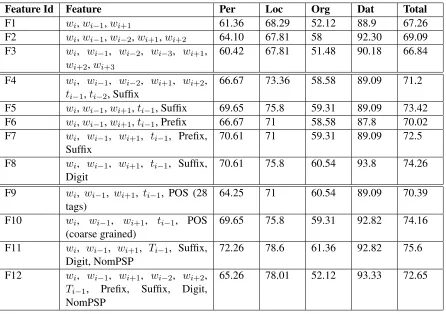
We have identified a number of candidate features for the Hindi NER task. Several experiments were conducted with the identified features, individually and in combination. Some of the features are men-tioned below. They are summarized in Table 1.
Static Word Feature: Recognition of NE is
highly dependent on contexts. So the surrounding words of a particular word (wi) are used as
fea-tures. During our experiments different combina-tions of previous 3 words (wi−3...wi−1) to next 3
words(wi+1...wi+3)are treated as features. This is
represented byLbinary features whereLis the size of lexicon.
Dynamic NE tag:NE tags of the previous words
(ti−m...ti−1)are used as features. During decoding,
the value of this feature for a word (wi) is obtained
only after the computation of the NE tag for the pre-vious word (wi−1).
Digit Information: If a word (wi) contains
Feature Id Feature Per Loc Org Dat Total
F1 wi,wi−1,wi+1 61.36 68.29 52.12 88.9 67.26
F2 wi,wi−1,wi−2,wi+1,wi+2 64.10 67.81 58 92.30 69.09
F3 wi, wi−1, wi−2, wi−3, wi+1,
wi+2,wi+3
60.42 67.81 51.48 90.18 66.84
F4 wi, wi−1, wi−2, wi+1, wi+2,
ti−1,ti−2, Suffix
66.67 73.36 58.58 89.09 71.2
F5 wi,wi−1,wi+1,ti−1, Suffix 69.65 75.8 59.31 89.09 73.42
F6 wi,wi−1,wi+1,ti−1, Prefix 66.67 71 58.58 87.8 70.02
F7 wi, wi−1, wi+1, ti−1, Prefix,
Suffix
70.61 71 59.31 89.09 72.5
F8 wi, wi−1, wi+1, ti−1, Suffix,
Digit
70.61 75.8 60.54 93.8 74.26
F9 wi, wi−1, wi+1, ti−1, POS (28
tags)
64.25 71 60.54 89.09 70.39
F10 wi, wi−1, wi+1, ti−1, POS
(coarse grained)
69.65 75.8 59.31 92.82 74.16
F11 wi, wi−1, wi+1, Ti−1, Suffix,
Digit, NomPSP
72.26 78.6 61.36 92.82 75.6
F12 wi, wi−1, wi+1, wi−2, wi+2,
Ti−1, Prefix, Suffix, Digit,
NomPSP
[image:3.612.85.531.58.372.2]65.26 78.01 52.12 93.33 72.65
Table 2: F-values for different features in the MaxEnt based Hindi NER system
only digits, 4Digit, which is set to 1 if the word contains only 4 digits, etc. are some modifications of the feature which are helpful.
Numerical Word: For a word (wi) if it is a
nu-merical word i.e. word denoting a number (e.g.eka2
(one), do (two), tina (three) etc.) then the feature N umW ordis set to 1.
Word Suffix: Word suffix information is helpful to identify the NEs. Two types of suffix features have been used. Firstly a fixed length word suffix (set of characters occurring at the end of the word) of the current and surrounding words are used as fea-tures. Secondly we compiled list of common suf-fixes of place names in Hindi. For example, pura, bAda, nagara etc. are location suffixes. We used binary feature corresponding to the list - whether a given word has a suffix from the list.
Word Prefix: Prefix information of a word may be also helpful in identifying whether it is a NE. A
2All Hindi words are written in italics using the ‘Itrans’ transliteration.
fixed length word prefix (set of characters occur-ring at the beginning of the word) of current and surrounding words are treated as features. List of important prefixes, which are used frequently in the NEs, are also effective.
Parts-of-Speech (POS) Information: The POS
of the current word and the surrounding words are used as feature for NER. We have used a Hindi POS tagger developed at IIT Kharagpur, India which has an accuracy about 90%. We have used the POS val-ues of the current and surrounding words as features. We realized that the detailed POS tagging is not very relevant. Since NEs are noun phrases, the noun tag is very relevant. Further the postposition follow-ing a name may give a clue to the NE type. So we de-cided to use a coarse-grained tagset with only three tags - nominal (Nom), postposition (PSP) and other (O).
word is a PSP.
2.3 Performance of Hindi NER using MaxEnt
Method
The performance of the MaxEnt based Hindi NER using the above mentioned features is reported here as a baseline. We have evaluated the system us-ing a blind test corpus of 25K words. The test corpus contains 521 person, 728 location, 262 or-ganization and 236 date entities. The accuracies are measured in terms of the f-measure, which is the weighted harmonic mean of precision and re-call. Precision is the fraction of the correct anno-tations and recall is the fraction of the total NEs that are successfully annotated. The general formula for measuring the f-measure or f-value is, Fβ =
(1 +β2).(precision . recall)\ (β2. precision+
recall). Here the value ofβis taken as 1. In Table 2 we have shown the accuracy values for few feature sets.
While experimenting with static word features, we have observed that a window of previous and next two words (wi−2...wi+2) gives best result
(69.09) using the word features only. But whenwi−3
and wi+3 are added with it, the f-value is reduced
to 66.84. Again whenwi−2 andwi+2 are deducted
from the feature set (i.e. onlywi−1andwi+1as
fea-ture), the f-value is reduced to 67.26. This demon-strates thatwi−2andwi+2are helpful features in NE
identification.
When suffix, prefix and digit information are added to the feature set, the f-value is increased upto 74.26. The value is obtained using the feature set F8 [wi, wi−1, wi+1, ti−1, Suffix, Digit]. It is
ob-served that whenwi−2andwi+2 are added with the
feature, the accuracy decreases by 2%. It contra-dicts the results using the word features only. An-other interesting observation is that prefix informa-tion are helpful features in NE identificainforma-tion as these increase accuracy when separately added with the word features (F6). Similarly the suffix information helps in increasing the accuracy. But when both the suffix and prefix information are used in combina-tion along with the word features, the f-value is de-creased. From Table 2, a f-value of 73.42 is obtained using F5 [wi, wi−1, wi+1, ti−1, Suffix] but when
prefix information are added with it (F7), the f-value is reduced to 72.5.
POS information are important features in NER. In general it is observed that coarse grained POS information performs better than the finer grained POS information. The best accuracy (75.6 f-value) of the baseline system is obtained using the binary NomPSP feature along with word feature (wi−1,
wi+1), suffix and digit information. It is noted that
whenwi−2, wi+2 and prefix information are added
with the best feature, the f-value is reduced to 72.65.
From the above discussion it is clear that the sys-tem suffers from overfitting if a large number of fea-tures are used to train the system. Note that the sur-rounding word (wi−2, wi−1, wi+1, wi+2 etc.)
fea-tures can take any value from the lexicon and hence are of high dimensionality. These cause the degra-dation of performance of the system. However it is obvious that few words in the lexicon are important in identification of NEs.
To solve the problem of high dimensionality we use clustering to group the words present in the cor-pus into much smaller number of clusters. Then the word clusters are used as features instead of the word features (for surrounding words). For ex-ample, our Hindi corpus contains 17,456 different words, which are grouped intoN (say 100) clusters. Then for a particular word, it is assigned to a cluster and the corresponding cluster-id is used as feature. Hence the number of features is reduced to 100 in-stead of 17,456.
Similarly, selection of important words can also solve the problem of high dimensionality. As some of the words in the lexicon play important role in the NE identification process, we aim to select these particular words. Only these important words are used in NE identification instead of all words in the corpus.
3 Word Clustering
3.1 Cosine Similarity based on Sentence Level Co-occurrence
A word is represented by a binary vector of dimen-sion same as the number of sentences in the cor-pus. A component of the vector is 1 if the word occurs in the corresponding sentence and zero oth-erwise. Then we measure cosine similarity between the word vectors. The cosine similarity between two word vectors (A~ andB~) with dimension dis mea-sured as:
CosSim(A, ~~ B) =
P
dAdBd
(P
dA2d)
1 2 ×(P
dB2d)
1 2
(3)
This measures the number of co-occurring sen-tences.
3.2 Cosine Similarity based on Proximal
Words
In this measure a word is represented by a vector having dimension same as the lexicon size. For ease of implementation we have taken a dimen-sion of2×200, where each component of the vec-tor corresponds to one of the 200 most frequent preceding and following words of a token word. List P rev containing the most frequent (top 200) previous words (wi−1orwi−2ifwi is the first word
of a NE) andList N extcontains 200 most frequent next words (wi+1orwi+2 ifwiis the last word of a
NE). A particular wordwkmay occur several times
(say n) in the corpus. For each occurrence of wk
find if its previous word (wk−1 or wk−2) matches
any element ofList P rev. If matches, then set 1 to the corresponding position of the vector and set zero to all other positions related to List P rev. Sim-ilarly check the next word (wk+1 or wk+2) in the
List N extand find the values of the corresponding positions. The final word vectorW~k is obtained by
taking the average of all occurrences of wk. Then
the cosine similarity is measured between the word vectors. This measures the similarity of the contexts of the occurrences of the word in terms of the prox-imal words.
3.3 Similarity based on Proximity to NE
Categories
Here, for each word (wi) in the corpus four binary
vectors are defined corresponding to two preceding
and two following positions (i-1, i-2, i+1, i+2). Each binary vector is of dimension five corresponding to four NE classes (Cj) and one for the not-name
class. For a particular word wk, find all the words
occur in a particular position (say, +1). Measure the fraction (Pj(wk)) of these words belonging to a
classCj. The component of the word vectorW~kfor
the position corresponding toCj isPj(wk).
Pj(wk) = N o. of times wT otal occurrence of wk+1is a N E of class Cj
kin corpus
The Euclidean distance is used to find the simi-larity between the above word vectors as a similar-ity measure. Some of the word vectors for the +1 position are given in Table 3. In this table we have given the word vectors for a few Hindi words, which are,sthita(located),shahara(city),jAkara(go), na-gara(township),gA.nva(village),nivAsI(resident),
mishrA (a surname) andlimiTeDa (ltd.). From the table we observe that the word vectors are close for
sthita [0 0.478 0 0 0.522], shahara [0 0.585 0.001 0.024 0.39], nagara [0 0.507 0.019 0 0.474] and
gA.nva[0 0.551 0 0 0.449]. So these words are con-sidered as close.
Word Per Loc Org Dat Not
sthita 0 0.478 0 0 0.522
shahara 0 0.585 0.001 0.024 0.39
jAkara 0 0.22 0 0 0.88
nagara 0 0.507 0.019 0 0.474
gA.nva 0 0.551 0 0 0.449
nivAsI 0.108 0.622 0 0 0.27
mishrA 0.889 0 0 0 0.111
limiTeDa 0 0 1 0 0
Table 3: Example of some word vectors for next (+1) position (see text for glosses)
3.4 K-means Clustering
Using the above similarity measures we have used the k-means algorithm. The seeds were randomly selected. The value ofk (number of clusters) was varied till the best result is obtained.
4 Important Word Selection
in the lexicon are typically associated with a partic-ular NE category and hence have important role to play in the classification process. We describe be-low a few statistical techniques that has been used to identify the important words.
4.1 Class Independent Important Word
Selection
We define context words as those which occur in proximity of a NE. In other words, context words are the words present in the wi−2, wi−1, wi+1
or wi+2 position if wi is a NE. Note that only a
subset of the lexicon are context words. For all the context words, its N weight is calculated as the ratio between the occurrence of the word as a context word and its total number of occurrence in the corpus. The context words having the higher N weight are considered as important words for NER. For our experiments we have considered top 500 words as important words.
N weight(wi) = Occurrence of wT otal occurrence of wias context wordiin corpus
4.2 Important Words for Each Class
Similar to the class independent important word lection from the contexts, important words are se-lected for individual classes also. This is an exten-sion of the previous context word considering only NEs of a particular class. For person, location, or-ganization and date classes we have considered top 150, 120, 50 and 50 words respectively as impor-tant words. Four binary features are also defined for these four classes. These are defined as having value 1 if any of the context words belongs to the impor-tant words list for a particular class.
4.3 Important Words for Each Position
Position based important words are also selected from the corpus. Here instead of context, particu-lar positions are considered. Four lists are compiled for two preceding and two following positions (-2, -1, +1 and +2).
5 Evaluation of NE Recognition
The following subsections contain the experimental results using word clustering and important word se-lection. The results demonstrate the effectiveness of
k Per Loc Org Dat Total
20 66.33 74.57 43.64 91.30 69.54 50 64.13 76.35 52 93.62 71.7 80 66.33 74.57 53.85 93.62 72.08 100 70.1 73.1 57.7 96.62 72.78
[image:6.612.317.538.61.172.2]120 66.15 73.43 54.9 93.62 71.52 150 66.88 74.94 53.06 95.65 72.33 200 66.09 73.82 52 92 71.13
Table 4: Variation of MaxEnt based system accuracy de-pending on number of clusters (k)
word clustering and important word selection over the baseline MaxEnt model.
5.1 Using Word Clusters
To evaluate the effectiveness of the clustering ap-proaches in Hindi NER, we have used cluster fea-tures instead of word feafea-tures. For the surrounding words, corresponding cluster-ids are used as feature.
Choice of k : We have already mentioned that, for k-means clustering number of classes (k) should be determined initially. To find suitablek we had conducted the following experiments. We have se-lected a feature F1 (mentioned in Table 2) and ap-plied the clusters with differentkas features replac-ing the word features. In Table 4 we have summa-rized the experimental results, in order to find a suit-ablekfor clustering, the word vectors obtained us-ing the procedure described in Section 3.3. From the table we observe that the best result is obtained whenkis 100. We have usedk = 100for the sub-sequent experiments for comparing the effectiveness of the features. Similarly when we deal with all the words in the corpus (17,465 words), we got best re-sults when the words are clustered into 1100 clus-ters.♦
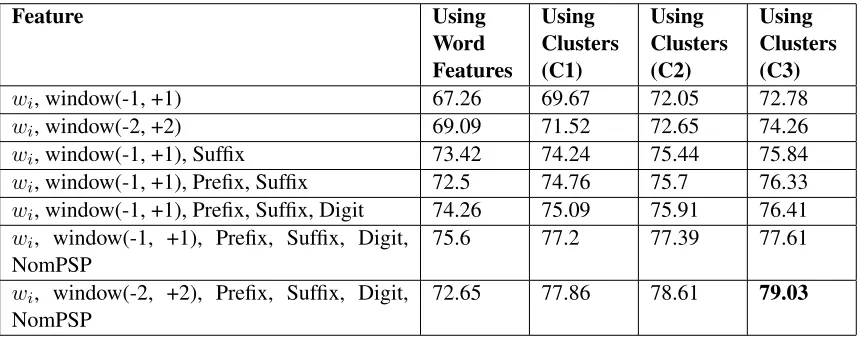
The details of the comparison between the base-line word features and the reduced features obtained using clustering are given in Table 5. In general it is observed that clustering has improved the perfor-mance over baseline features. Using only cluster features the system provides a maximum f-value of 74.26 where the corresponding word features give f-value of 69.09.
clus-Feature Using Word Features
Using Clusters (C1)
Using Clusters (C2)
Using Clusters (C3)
wi, window(-1, +1) 67.26 69.67 72.05 72.78
wi, window(-2, +2) 69.09 71.52 72.65 74.26
wi, window(-1, +1), Suffix 73.42 74.24 75.44 75.84
wi, window(-1, +1), Prefix, Suffix 72.5 74.76 75.7 76.33
wi, window(-1, +1), Prefix, Suffix, Digit 74.26 75.09 75.91 76.41
wi, window(-1, +1), Prefix, Suffix, Digit,
NomPSP
75.6 77.2 77.39 77.61
wi, window(-2, +2), Prefix, Suffix, Digit,
NomPSP
[image:7.612.92.523.59.228.2]72.65 77.86 78.61 79.03
Table 5: F-values for different features in a MaxEnt based Hindi NER with clustering based feature reduction [window(−m,+n)refers to the cluster or word features corresponding to previous mpositions and next n posi-tions; C1 is the clusters which use sentence level co-occurrence based cosine similarity (3.1), C2 denotes the clusters which use proximal word based cosine similarity (3.2), C3 denotes the clusters for each positions related to NE (3.3)]
ters which uses the similarity measurement based on proximity of the words to NE categories (defined in Section 3.3).
Using clustering features the best f-value (79.03) is obtained using clusters for previous two and next two words along with the suffix, prefix, digit and POS information.
It is observed that the prefix information increases the accuracy if applied along with suffix informa-tion when cluster features are used. More interest-ingly, addition of cluster features for positions −2
and +2 over the feature [window(-1, +1), Suffix, Prefix, Digit, NomPSP] increase the f-value from 77.61 to 79.03. But in the baseline system addition of word features (wi−2andwi+2) over the same
fea-ture decrease the f-value from 75.6 to 72.65.
5.2 Using Important Word Selection
The details of the comparison between the word fea-ture and the reduced feafea-tures based on important word selection are given in Table 6. For the sur-rounding word features, find whether the particular word (e.g. at position -1, -2 etc.) presents in the important words list (corresponding to the particu-lar position if position based important words are considered). If the word occurs in the list then the word is used as features. In general it is observed that word selection also improves performance over baseline features. Among the different approaches,
the best result is obtained when important words for two preceding and two following positions (defined in Section 4.3) are selected. Using important word based features, the highest f-value of 79.85 is ob-tained by using the important words for previous two and next two positions along with the suffix, prefix, digit and POS information.
5.3 Relative Effectiveness of Clustering and Word Selection
In most of the cases clustering based features per-form better then the important word based feature reduction. But the best f-value (79.85) of the sys-tem (using the clustering based and important word based features separately) is obtained by using im-portant word based features.
Next we have made an experiment by consider-ing both the clusters and important words combined. We have defined the combined feature as, if the word (wi) is in the corresponding important word list then
the word is used as feature otherwise the correspond-ing cluster-id (in whichwibelongs to) is considered
as feature. Using the combined feature, we have achieved further improvement. Here we are able to achieve the highest f-value of 80.01.
6 Conclusion
unan-Feature Using Word Features
Using Words (I1)
Using Words (I2)
Using Words (I3)
wi, window(-1, +1) 67.26 66.31 67.53 66.8
wi, window(-2, +2) 69.09 72.04 72.9 73.34
wi, window(-1, +1), Suffix 73.42 73.85 73.12 74.61
wi, window(-1, +1), Prefix, Suffix 72.5 73.52 73.94 74.87
wi, window(-1, +1), Prefix, Suffix, Digit 74.26 73.97 74.13 74.7
wi, window(-1, +1), Prefix, Suffix, Digit,
NomPSP
75.6 75.84 76.6 77.22
wi, window(-2, +2), Prefix, Suffix, Digit,
NomPSP
[image:8.612.92.524.59.228.2]72.65 76.69 77.42 79.85
Table 6: F-values for different features in a MaxEnt based Hindi NER with important word based feature reduction [window(−m,+n)refers to the important word or baseline word features corresponding to previousmpositions and nextnpositions; I1 is the class independent important words (4.1), I2 denotes the important words for each class (4.2), I3 denotes the important words for each positions (4.3)]
notated corpus, is used by Miller et al. (2004) for augmenting annotated training data. Note that our clustering approach is different, where the clusters are obtained using some statistics derived from the annotated corpus, and also the purpose is different as we have used the clusters for feature reduction.
In this paper we propose two feature reduction techniques for Hindi NER based on word cluster-ing and word selection. A number of word similar-ity measures are used for clustering. A few statisti-cal approaches are used for the selection of impor-tant words. It is observed that significant enhance-ment of accuracy over the baseline system which use word features is obtained. This is probably due to reduction of overfitting. This is more important for a resource poor languages like Hindi where there is scarcity in annotated training data and other NER resources (like, gazetteer lists).
7 Acknowledgement
The work is partially funded by Microsoft Research India.
References
Berger A L, Pietra S D and Pietra V D 1996. A Maxi-mum Entropy Approach to Natural Language Process-ing. Computational Linguistic, 22(1):39–71.
Bikel D M, Miller S, Schwartz R and W Ralph. 1997. Nymble: A High Performance Learning Name-finder.
InProceedings of the Fifth Conference on Applied Nat-ural Language Processing, pages 194–201.
Borthwick A. 1999. A Maximum Entropy Approach to Named Entity Recognition. Ph.D. thesis, Computer Science Department, New York University.
Grishman R. 1995. The New York University System MUC-6 or Where’s the syntax? InProceedings of the Sixth Message Understanding Conference.
Li W and McCallum A. 2003. Rapid Development of Hindi Named Entity Recognition using Conditional Random Fields and Feature Induction. ACM Trans-actions on Asian Language Information Processing (TALIP), 2(3):290–294.
McCallum A and Li W. 2003. Early Results for Named Entity Recognition with Conditional Random fields, feature induction and web-enhanced lexicons. In Pro-ceedings of the Seventh Conference on Natural Lan-guage Learning at HLT-NAACL.
Miller S, Guinness J and Zamanian A. 2004. Name Tag-ging with Word Clusters and Discriminative Training. InProceedings of the HLT-NAACL 2004, pages 337– 342.
Saha S K, Sarkar S and Mitra P. 2008. A Hybrid Fea-ture Set based Maximum Entropy Hindi Named En-tity Recognition. InProceedings of the Third Interna-tional Joint Conference on Natural Language Process-ing (IJCNLP-08), pages 343–349.


![Table 6: F-values for different features in a MaxEnt based Hindi NER with important word based feature reductionw i n d o w[ ( − m, + n ) refers to the important word or baseline word features corresponding to previous m positions andnext npositions; I1 is the class independent important words (4.1), I2 denotes the important words for each class (4.2),I3 denotes the important words for each positions (4.3)]](https://thumb-us.123doks.com/thumbv2/123dok_us/238293.523238/8.612.92.524.59.228/different-reductionw-corresponding-positions-npositions-independent-important-positions.webp)
