E V A L U A T I O N
O F A P A R A L L E L C H A R T P A R S E R
R a l p h G r i s h m a n a n d M a h e s h C h i t r a o C o m p u t e r S c i e n c e D e p a r t m e n t
N e w Y o r k U n i v e r s i t y 251 M e r c e r S t r e e t N e w Y o r k , N e w Y o r k 1 0 0 1 2
A b s t r a c t
W e d e s c r i b e a p a r a l l e l i m p l e m e n t a t i o n o f a
chart parser for a shared-memory multipro- cessor. The speed-ups obtained with this parser have been measured for a number of small natural-language grammars. For the largest of these, part of an operational question-answering system, the parser ran 5 to 7 times faster than the serial version.
1.
I n t r o d u c t i o n
We report here on a series of experiments to deter- mine whether the parsing component of a natural language analyzer can be easily converted to a par- allel program which provides significant speed-up over the serial program.
These experiments were prompted in part by the rapidly growing availability of parallel proces- sor systems. Parsing remains a relatively time- consuming component of language analysis sys- tems. This is particularly so if constraints are being systematically relaxed in order to handle ill-formed input (as suggested, for example, in (Weischedel and Sondheimer, 1983)) or if there is uncertainty regarding the input (as is the case for speech input, for example). This time could be reduced if we can take advantage of the new par- allel architectures. Such a parallel parser could be combined with parallel implementations of other components (the acoustic component of a speech system, for example) to improve overall system performance.
2.
B a c k g r o u n d
There have been a number of theoretical and algo- rithmic studies of parallel parsing, beginning well before the current availability of suitable experi- mental facilities.
For general context-free grammars, it is possi- ble to adapt the Cocke-Younger-Kasami algorithm (Aho and Ullman 1972, p. 314 if) for parallel use.
This algorithm, which takes time proportional to
rt 3 (rt -" length of input string) on a single pro- cessor, can operate in time n using n 2 proces- sors (with shared memory and allowing concur- rent writes). This algorithm, and its extension to unification grammars, has been described by Haas (1987b). T h e matrix form of this algorithm is well suited to large arrays of synchronous pro- cessors. The algorithm we describe below is basi- cally a CYK parser with top-down filtering 1, but the main control structure is an event queue rather than iteration over a matrbc. Because tile CYK matrix is large and typically sparse 2, we felt that the event-driven algorithm would be more efficient in our environment of a small number of asyn- chronous processors (<< n 2 for our longest sen- tences) and grammars augmented by conditions which must be checked on each rule application and which vary widely in compute time.
Cohen et al. (1982) present a general upper bound for speed-up in parallel parsing, based ou the number of processors and properties of the grammar. Their more detailed analysis, and the subsequent work of Sarkar and Deo (1985) focus on algorithms and speed-ups for parallel parsing of deterministic context-free grammars. Most pro- gramming language grammars are deterministic, but most natural language grammars are not, so this work (based on shift-reduce parsers) does not seem directly applicable.
Experimental data involving actual imple- mentations is more limited. Extensive measure- ments were made on a parallel version of the
1 W e also differ f r o m C Y K in t h a t we do n o t m e r g e dif- ferent a n a l y s e s of t h e s a m e s t r i n g as t h e s a m e s y m b o l . As a result, o u r p r o c e d u r e w o u l d n o t o p e r a t e in linear t i m e for g e n e r a l ( a m b i g u o u s ) g r a m m a r s .
2For g r a m m a r # 4 given below a n d a 15-word s e n t e n c e ,
H e a r s a y - I I speech understanding s y s t e m (R. Fen- nel and V. Lesser, 1977). However, the syntactic analysis was only one of m a n y knowledge sources, so it is difficult to m a k e any direct comparison be- tween their results and those presented here. Bolt Beranek and N e w m a n is currently conducting ex- periments with a parallel parser quite similar to those described below (Haas, 1987a). BBN uses a unification g r a m m a r in place of the procedural restrictions of our system. At the time of this writ- ing, we do not yet have detailed results f r o m BBN to c o m p a r e to our own.
3.
E n v i r o n m e n t
O u r p r o g r a m s were developed for the NYU Ultra- c o m p u t e r (Gottlieb et al., 1983), a s h a r e d - m e m o r y M I M D parallel processor with a special instruc- tion, fetch-and-add, for processor synchronization. T h e p r o g r a m s should be easily a d a p t a b l e to any similar shared m e m o r y architecture.
T h e p r o g r a m s have been written in ZLISP, a version of LISP for the U l t r a c o m p u t e r which has been developed by Isaac D i m i t r o v s k y (1987). Both an interpreter and a compiler are avail- able. Z L I S P s u p p o r t s several independent pro- cesses, and provides b o t h global variables (shared by all processes) and variables which are local to each process. O u r p r o g r a m s have used low-level synchronization operations, which directly access the fetch-and-add primitive. More recent versions of ZLISP also s u p p o r t higher level synchroniza- tion primitives and d a t a structures such as parallel queues and parallel stacks.
4.
A l g o r i t h m s
Our parser is intended as p a r t of the P R O T E U S s y s t e m (Ksiezyk et al. 1987). P R O T E U S uses a u g m e n t e d context-free g r a m m a r s - context-free g r a m m a r s a u g m e n t e d by procedural restrictions
which enforce syntactic and semantic constraints. T h e basic parsing algorithm we use is a chart parser ( T h o m p s o n 1981, T h o m p s o n and Ritchie, 1984). Its basic d a t a structure, the chart, consists of nodes and edges. For an n word sentence, there are n + 1 nodes, n u m b e r e d O to n. These nodes are connected by active and inactive edges which record the state of the parsing process. If A W X Y Z is a production, an active edge from node nl to n2 labeled by A -+ W X . Y Z indicates t h a t the symbols W X of this production have been m a t c h e d to words nl + 1 through n2 of the sentence. An inactive edge from nl to n2
labeled by a category Y indicates t h a t words n 1 + 1 through n2 have been analyzed as a constituent of type Y. T h e " f u n d a m e n t a l rule" for extending an active edge states t h a t if we have an active edge A ---* W X . Y Z f r o m nl to n 2 and an inactive edge of category Y from n 2 to n3, we can build a new active edgeA---* W X Y . Z f r o m n l t o n 3 . If we also have an inactive edge of t y p e Z from n 3 to n4, we can then extend once more, creating this time an inactive edge of type A (corresponding to a completed production) from nl to n4.
If we have an active edge A ---* W X . Y Z f r o m nl to n2, and this is the first time we have tried to m a t c h symbol Y s t a r t i n g at n2 (there are no edges labeled Y originating at n~), we p e r f o r m
a seek on symbol Y at n2: we create an active edge for each production which e x p a n d s Y, and try to extend these edges. In this way we generate a n y and all analyses for Y s t a r t i n g at n2. This process of seeks and extends forms the core of the parser. We begin by doing a seek for the sentence symbol S starting a node 0. Each inactive edge which we finally create for S from node 0 to node n corresponds to a parse of the sentence.
T h e serial (uniprocessor) procedure 3 uses a task queue called an agenda . W h e n e v e r a seek is required during the process of extending an edge, an entry is m a d e on the agenda. When we can extend the edge no further, we go to the agenda, pick up a seek task, create the corresponding ac- tive edge and then t r y to extend it (possibly giving rise to more seeks). This process continues until the agenda is empty.
Our initial parallel i m p l e m e n t a t i o n was straightforward: a set of processors all execute the main loop of the serial p r o g r a m (get task from agenda / create edge / extend edge), all operat- ing from a single shared agenda. T h u s the ba- sic unit of c o m p u t a t i o n being scheduled is a seek, along with all the associated edge extensions. If there are m a n y different ways of extending an edge (using the edges currently in the chart) this m a y involve substantial computation. We therefore de- veloped a second version of the parser with more- fine-grained parallelism, in which each step of ex- tending an active edge is treated as a separate task which is placed on the agenda. We present some comparisons of these two algorithms below.
T h e r e was one complication which arose in the parallel implementations: a race condition in the application of the " f u n d a m e n t a l rule". Sup- pose processor P1 is adding an active edge to the
chart from node n l to n2 with the label A W X . Y Z and, at the same time, processor P2 is adding an inactive edge from node n2 to n 3 with the label Y. Each processor, when it is finished adding its edge, will check the chart for possible application of the fundamental rule involving t h a t edge. P1 finds the inactive edge needed to further extend the active edge it j u s t created; similarly, P2 finds the active edge which can be extended using the inactive edge it j u s t created. Both pro- cessors therefore end up trying to extend the edge A ---* W X . Y Z and we create duplicate copies of the extended edge A ---* W X Y . Z. This race condition can be avoided by assigning a unique (monotonically increasing) n u m b e r to each edge and by applying the f u n d a m e n t a l rule only if the edge in the chart is older (has a smaller number) t h a n the edge j u s t added by the processor.
As we noted above, the context-free gram- m a r s are a u g m e n t e d by procedural restrictions. These restrictions are coded in P R O T E U S Re- striction Language and then compiled into LISP. A restriction either succeeds or fails, and in ad- dition m a y assign features to the edge currently being built. Restrictions m a y examine the sub- structure through which an edge was built up from other edges, and can test for features on these con- stituent edges. There is no dependence on implicit context (e.g., variables set by a n o t h e r restriction). As a result, the restrictions impose no complica- tions on the parallel scheduling; they are simply invoked as part of the process of extending an edge.
5.
G r a m m a r s
These algorithms were tested on four grammars:
1. A " b e n c h m a r k " grammar:
S ~ X X X X X X X X X X X X X ~ a l b l c l d l e l f l g l h l i l J
2. A very small English g r a m m a r , taken from (Grishman, 1986) and used for teaching pur- poses. It has 23 nonterminal symbols and 38 productions.
3. G r a m m a r # 2 , with four restrictions added.
4. T h e g r a m m a r for the P R O T E U S question- answering system, which includes yes-no and wh- questions, relative and reduced relative clauses. It has 35 non-terminal symbols and
77 productions.
6.
M e t h o d
T h e p r o g r a m s were run in two ways: on a proto- type parallel processor, and in simulated parallel mode on a s t a n d a r d uniprocessor (the uniproce- cessor version of ZLISP provides for relatively effi- cient simulation of multiple concurrent processes). T h e runs on our p r o t o t y p e multiprocessor, the NYU U l t r a c o m p u t e r , were limited by the size of the machine to 8 processors. Since we found that we could sometimes make effective use of larger numbers of processors, most of our d a t a was col- lected on the simulated parallel system. For small numbers of processors (1-4) we had good agree- m e n t (within 10%, usually within 2%) between the speed-ups obtained on the U l t r a c o m p u t e r and un- der simulation 4
7.
R e s u l t s
We consider first the results for the test g r a m m a r , # 1 , analyzing the sentence
333333333333
This g r a m m a r is so simple t h a t we can readily vi- sualize the operation of the parser and predict the general shape of the speed-up curve. At each to- ken of the sentence, there are 10 productions which can expand X, so 10 seek tasks are added to the agenda. If 10 processors are available, all 10 tasks can be executed in parallel. Additional processors produce no further speed-up; having fewer proces- sors requires some processors to p e r f o r m several tasks, reducing the speed-up. This general behav- ior is borne out by the curve shown in Figure 1. Note t h a t because the successful seek (for the pro- duction X --0 j ) leads to the creation of an inactive edge for X and extension of the active edge for S, and these operations m u s t be performed serially, the m a x i m a l parallelism is much less than 10.
T h e next two figures compare the effective- ness of the two algorithms - the one with coarse- grained parallelism (only seeks as separate tasks) and the other with finer-grain parallelism (each seek and extend as a separate task). T h e finer- grain algorithm is able to m a k e use of more par- allelism in situations where an edge can be ex- tended in several different ways. On the other
S p ' E E D U P
'2
, | |
5 , I 0 1 5
P R O C E S S O R S
IS
S I* E :
E "I0 I )
U
P
2
1
• ; 0 2'o ~0 , ,'0
P R O C E S S O R S
Figure 1: Speed-up (relative to serial parser) for g r a m m a r ~ 1 and sentence jjj.~i~_~j.
sp • 2
D
. , i i
I 0 2 0 3 0 4 0
P R O C E S S O R S
Figure 2: Speed-up (relative to serial parser) for g r a m m a r ~ 2 (small grammar without restrictions) on a 3-word sentence for the coarse-grained algo- r i t h m (1) and the fine-grained algorithm(2).
hand, it will have more scheduling overhead, since each extend operation has to be entered on and removed from the agenda. We therefore can ex- pect the finer-grained algorithm to do better on more complex sentences, for which many different extensions of an active edge will be possible. We also expect the finer-grained algorithm to do bet- ter on grammars with restrictions, since the evalu- ation of the restriction substantially increases the time required to extend an edge, and so reduces in proportion the fraction of time devoted to the scheduling overhead. T h e expectations are con- firmed by the results shown in Figures 2 and 3. Figure 2, which shows the results using a short sentence and grammar ~ 2 (without restrictions), shows that neither algorithm obtains substantial speed-up and that the fine-grained algorithm is
Figure 3: Speed-up (relative to serial parser) for grammar # 3 (small grammar with restrictions) on a 14-word sentence for the coarse-grained al- gorithm (1) and the fine-grained algorithm(2).
in fact slightly worse. Figure 3, which shows the results using a long sentence and grammar ~ 3 (with restrictions), shows that the fine-grained al- gorithm is performing much better.
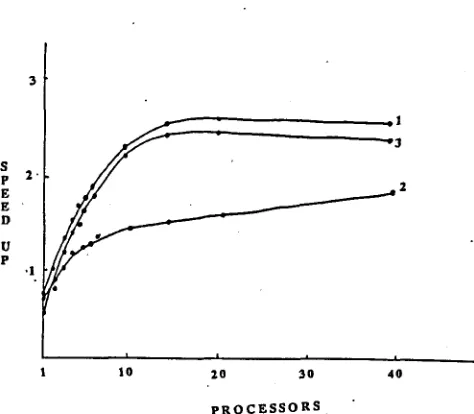
The remaining three figures show speed-up re- sults for the fine-grained algorithm for grammars 2, 3, and 4. For each figure we show the speed- " up for three sentences: a very short sentence (2-3 words), an intermediate one, and a long sentence (14-15 words). In all cases the graphs plot the number of processors vs. the true speed-up - the speed-up relative to the serial version of the parser. The value for 1 processor is therefore below 1, re- flecting the overhead in the parallel version for en- forcing mutual exclusion in access to shared d a t a and for scheduling extend tasks.
G r a m m a r s 2 and 3 are relatively small (38 productions) and have few constraints, in par- ticular on adjunct placement. For short sen- tences these grammars therefore yield a chart with few edges and little opportunity for parallelism. For longer sentences with several adjuncts, on the other hand, these grammars produce lots of parses and hence offer much greater opportunity for parallelism. G r a m m a r 4 is larger (77 produc- tions) and provides for a wide variety of sentence types (declarative, imperative, wh-question, yes- no-question), but also has tighter constraints, in- cluding constraints on adjunct placement. The number of edges in the chart and the opportu- nity for parallelism are therefore fairly large for short sentences, but grow more slowly for longer sentences than with grammars 2 and 3.
[image:4.612.326.573.47.236.2] [image:4.612.69.304.60.447.2]i5
~ 3
...,i 2
i | , i
1 0 2 0 ~ , 0 4 0
P R O C E S S O R S .
Figure 4: Speed-up (relative to serial parser) for grammar ~ 2 (small grammar without restrictions) using the fine-grained algorithm for three sen- tences: a 10 word sentence (curve 1), a 3-word sentence (curve 2) and a 14-word sentence (curve
3).
!
S I0. P E E D U p 5 S p 2" E E D U P
.I
A i
1 0 2 0 3'0 4 0
P R O C E S S O R S
Figure 5: Speed-up 'relative to serial parser) for grammar ~ 3 (small grammar with restrictions) using the fine-grained algorithm for three sen- tences: a 14-word sentence (curve 1), a 5-word sentence (curve 2), and a 3-word sentence (curve
3).
p . 6 E E
D
U 4 p
.---* I
• 1 0 2 0 3 0 " 4 0
P R O C E S S O R S "
Figure 6: Speed-up (relative to serial parser) for grammar ~ 4 (question-answering grammar) us- ing the fine-grained algorithm for three sentences: a 15-word sentence (curve 1), a 2-word sentence (curve 2), and a 8-word sentence (curve 3).
in the results shown in Figures 4-6. For the small grammar without restrictions (grammar #2), the scheduling overhead for fine-grain par- allelism largely defeats the benefits of parallelism, and the overall speed-up is small (Figure 4). For the same grammar with restrictions (grammar #3), the effect of the scheduling overhead is re- duced, a.s we explained above. The speed-up is modest for the short sentences, but high (15) for the long sentence with 15 parses (Figure 5). For the question-answering grammar (grammar ~4), the speed-up is fairly consistent for short and long sentences (Figure 6).
8.
D i s c u s s i o n
[image:5.612.73.310.58.265.2] [image:5.612.330.579.61.228.2] [image:5.612.75.305.376.563.2]tering in order to determine the balance between these two effects.
9.
A c k n o w l e d g e m e n t s
This report is based upon work supported by the Defense Advanced Research Projects Agency un- der Contract N00014-85-K-0163 from the Office of Naval Research, by the National Science Foun- dation under Grant No. DCR-8501843 and by the International Business Machines Corp. under con- tract 534816.
R e f e r e n c e s
[1] Alfred Aho and Jeffrey Ullman, 1972, The Theory of Parsing, Translation, and Compiling
- Volume I: Parsing, Prentice-Hall, Englewood
Cliffs, NJ.
[2] Jacques Cohen, Timothy Hickey, and Joel Kat- coff, 1982 Upper bounds for speedup in parallel parsing, J. Assn. Comp. Mach. 29 (2), pp. 408- 428.
[3] Isaac Dimitrovsky, 1987 ZLISP 0.7 Reference
Manual, Department of Computer Science, New
York University, New York.
[4] R. Fennel and V. Lesser, 1977, Parallelism in AI problem solving: a case study of Hearsay II,
IEEE Trans. Comp. C-26, pp. 98-111.
[5] Allan Gottlieb, Ralph Grishman, Clyde
P. Kruskal, Kevin P. McAuliffe, Lawrence Rudolph, and Marc Snir, 1983, The NYU Ultra- computer - Designing an MIMD Shared Mem- ory Parallel Computer, IEEE Trans. Comp.,
pp. 175-189.
[6] Andrew Haas, 1987a, Parallel parsing, Talk
at Workshop on JANUS and Parallel Parsing,
Feb. 24-25, Bolt Beranek and Newman, Cam- bridge, MA.
[7] Andrew Haas, 1987b, Parallel Parsing for Uni- fication Grammars. Proc. IJCAI-87, pp. 615- 618.
[8] Tomasz Ksiezyk, Ralph Grishman, and John Sterling, 1987, An equipment model and its role in the interpretation of noun phrases. Proc.
IJCAI-87, pp. 692-695.
[9] Dilip Sarkar and Narsingh Deo, 1985, Esti- mating the speedup in parsing, Report CS- 85-135, Computer Science Dept., Washington State University.
[10] Henry Thompson, 1981, Chart parsing and rule schemata in phrase structure grammar,
Proc. 19th Annl. Meeting Assn. Computational
Linguistics, Stanford, CA, 167-72.
[11] Henry Thompson and Graeme Ritchie, 1984, Implementing natural language parsers. In Ar- tificial Intelligence Tools, Techniques and Ap-
plications, T. O'Shea and M. Eisenstadt, eds.,
Harper and Row, New York.
[12] Ralph M. Weischedel and Norman K. Sond- helmet, 1983, Meta-rules as a Basis for Pro- cessing Ill-Formed Input, Am. J. Computational