Munich Personal RePEc Archive
Financial Reforms and Corruption
Jha, Chandan Kumar
June 2015
Financial Reforms and Corruption
∗
Chandan Kumar Jha
Department of Economics, Louisiana State University, Baton Rouge LA 70803.
E-mail: [email protected]
June 2015
Abstract
In this paper, I assess the impact of financial reforms on corruption using a panel
of 85 countries for 1984-2005. I find that several, but not all, of the policies targeted
towards financial liberalization reduce corruption. Specifically, the abolition of entry
barriers, credit controls, and excessive reserve requirements along with improvements
in the security markets and banking supervision are associated with lower corruption.
JEL classification codes: D73; G28; O16
Keywords: Corruption; Banks; Financial Reforms; Liberalization
∗I would like to thank Louis-Philippe Beland, Trina Biswas, Satadru Das, Sukriye Filiz, Maxwell Means,
1
Introduction
The positive effects of financial development and liberalization on economic outcomes such
as investment and economic growth are well-reported in the empirical literature (see Levine,
2005for a review of related literature). On the other hand, corruption has been found to
neg-atively impact economic growth (Mauro, 1995) and to be positively associated with poverty
and income inequality (Gupta et al.,2002). Linking these two strands of literature, Altunba¸s
and Thornton (2012) find a negative relationship between bank credit to the private sector
and corruption. And, Ahlin and Pang (2008) show that the interaction between financial
de-velopment and corruption has important implications for economic growth. Hence, looking
at the relationship between financial liberalization and corruption may provide important
insights. This paper contributes to these two strands of literature by investigating the link
between financial reforms and corruption. Using an unbalanced panel of 85 underdeveloped,
developing, and developed countries for 1984-2005, I find that reforms targeted towards
financial liberalization also reduce corruption.
There could be several channels through which financial reforms can reduce corruption.
First, corruption in the banking sector is an important obstacle to firms seeking financing
and Beck et al. (2006) find that mandating banks to disclose accurate information can be an
important tool to mitigate the severity of this problem. An appropriate degree of banking
supervision (an important dimension of financial reforms), thus, may lower corruption in the
banking sector. Second, since there is a negative association between the government
owner-ship of banks and the rate of financial development (La Porta et al., 2002), easing the entry
of private and foreign banks may also reduce corruption by increasing competition among
banks and forcing them to offer cheap (corruption-free) loans making financial markets more
efficient. Moreover, corruption in public sector banks may be greater because of differences
in the wage structure and a greater job protection compared to the private sector.1
Another important channel through which policies towards financial liberalization can
impact corruption is by making markets more competitive. Financial development has been
shown to (1) increase the probability an individual starts his own business, (2) promote the
entry of new firms, and (3) boost competition (Guiso et al., 2004). Together an increase
in the number of firms and a competitive market are likely to reduce the scope of
pay-ing bribes since paypay-ing bribes would mean a higher cost of production. Along these lines,
Ades and Di Tella (1999) have shown that corruption is lower in countries where firms face
greater competition. Additionally, several dimensions of financial liberalization may boost
market competition and, hence, help reduce corruption. For instance, the privatization of
banks is likely to enhance market competition since it increases lending (Berkowitz et al.,
2014). Also, an imposition of excessive reserve requirements and mandating banks to extend
subsidized credits to certain sectors adversely impact the amount of resources available for
entrepreneurial activities, which will limit the number of firms and discourage competition.
Consequently, financial reforms towards the abolition of excessive reserve requirements and
providing greater autonomy to banks regarding credit supply are likely to increase
competi-tion. Finally, policy reforms towards developing the securities market promote savings and
investment (Henry, 2000), which may further increase market competition.
2
Data and Empirical Specification
To investigate the effect of financial reforms on corruption, I estimate the following
specifi-cation using the fixed effects estimator
Corruptionit =αi+β∆Ref ormsit+δ1t+δ2 log(Incomeit) +δ3 log(Incomeit)2
+δ4Govt. Size+δ5Openness+εit (1)
where i and t denote country and year respectively. ∆Ref ormsit denotes the change in
policy index occurring in country i between time t and time t + 1. δ3 captures the time
trend.
The paper utilizes the International Country Risk Guide’s corruption index, which
cap-tures the extent of government corruption. It takes values in the range of 0 to 6 with a
greater value implying lower corruption. Abiad et al. (2010) have complied the data for
financial reforms that covers 91 countries over 1973-2005. The financial reforms index takes
values in the range of 0 (fully repressed) to 21 (fully liberalized). Purchasing power parity
adjusted Per capita GDP, government size, and the degree of openness are taken from the
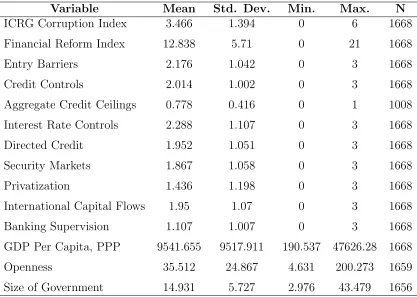
World Development Indicators. Summary statistics are reported in Table 1.
3
Results
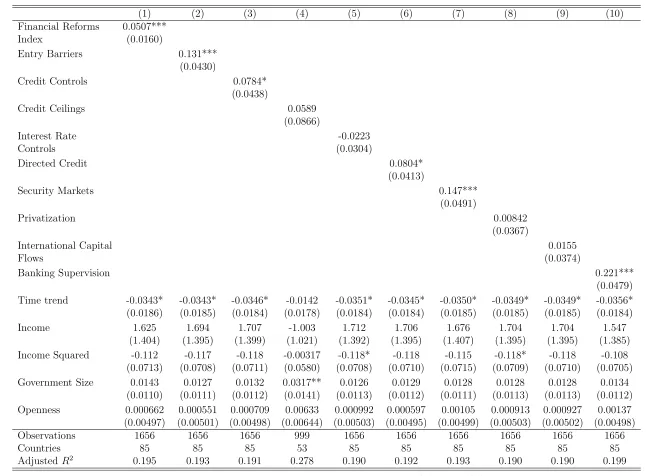
The results presented in Table 2show that, consistent with the hypothesis, a greater degree
of financial liberalization is associated with lower corruption: the coefficient of the financial
reforms index is positive and statistically significant. Abiad et al. (2010) database consists
of nine different dimensions of financial sector policy and I also investigate the relationship
between these dimensions and corruption in columns 2-10. A greater score in each dimension
implies a greater liberalization and hence a greater degree of reform.
A positive and statistically significant coefficient on entry barriers indicates a positive
relationship between the removal of entry barriers (for domestic and foreign banks) and the
absence of corruption. Positive and statistically significant coefficients in columns 3 and
6 indicate that both less stringent reserve requirements and a greater autonomy of banks
regarding credit supply are negatively associated with corruption. Finally, corruption is also
negatively associated with improvements in the securities market and banking supervision.
that holding other factors fixed corruption has been increasing over time.
On the other hand, the absence or presence of restrictions on the expansion of bank credit
and whether the government or the market determines the interest rates are not associated
with corruption. Corruption is also not significantly associated with either the privatization
of banks or the restrictions on international capital flow. The findings also suggest that
neither government spending nor openness is significantly associated with corruption.
Several studies have implied that financial liberalization may have more favorable
ef-fects on developed economies than underdeveloped and developing ones (see Blackburn and
Forgues-Puccio (2010) for a discussion). Using the classification of Abiad et al. (2010), I
look at the relationship between financial reforms and corruption for the subsets of advanced
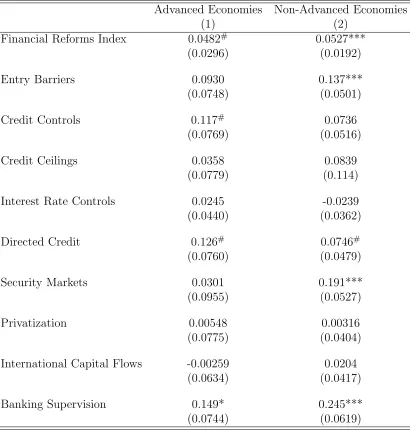
and non-advanced economies. The results presented in Table 3 suggest that while financial
reforms index, entry barriers, security market development, and banking supervision are
associated with lower corruption in non-advanced economies, only banking supervision is
associated with lower corruption in advanced economies. Though some other variables such
as financial reforms index, credit controls, and directed credit are also associated with lower
corruption in advanced economies, these are significant only at 15%. These findings suggest
that non-advanced economies may experience greater gains from financial liberalization than
advanced economies as far as corruption is concerned.
The fixed effects estimation ensures that the estimates reported in this paper are not
biased due to the omission of country-specific fixed factors such as institutional, cultural,
and democratic factors, which are among the most significant determinants of corruption
(Treisman,2000). Although the possibility of simultaneity cannot entirely be ruled out, the
evidence suggests that the status quo in the financial sector policy is disturbed by influential
events (“shocks”), and the liberalization progress depends on factors such as initial reforms,
learning, regional diffusion, global interest rate fluctuations, balance-of-payments and
the interpretation of these results warrant some caution.
4
Conclusions
The results of this study reveal an important concern for policymakers: corruption has been
increasing over time. The World Bank seems to recognize the severity of this issue and
identifies corruption as “the single greatest obstacle to economic and social development”.
This paper identifies several dimensions of financial liberalization that are negatively related
to corruption and provides a guide to policymakers as to which policies might work best if
the objective is to fight corruption. The findings of this paper suggest that the removal of
entry barriers to the financial sector, easing credit controls, developing security markets, and
supervising the banking system may help combat corruption.
Interestingly, out of the four dimensions of the financial reforms that are negatively
related to corruption, two – namely directed credit and security markets development – have
also been found to be associated with income inequality in a recent paper by Agnello et al.
(2012). The results of this paper along with the findings of Agnello et al. (2012), therefore,
suggest that while liberalizing the financial system, policymakers might want to prioritize
some dimensions over others. Also, if financial development and the absence of corruption
are substitutes for growth as suggested by Ahlin and Pang (2008), then favoring financial
reforms may be a good idea. Furthermore, in a theoretical paper Blackburn and
Forgues-Puccio (2010) hypothesize that financial liberalization may increase corruption by making
the embezzlement of public funds more attractive for bureaucrats. The empirical evidence
presented in this paper refutes their hypothesis and strengthens the case for liberalization.
Future research may be targeted to deepen our understanding of the causal mechanisms and
should explore why certain dimensions of financial liberalization are associated with factors
References
1. Abiad, Abdul and Ashoka Mody. 2005. “Financial Reform: What Shakes It? What Shapes It?” American Economic Review 95.1, 66–88.
2. Abiad, Abdul G, Enrica Detragiache, and Thierry Tressel. 2010. “A new database of financial reforms”. IMF Staff Papers 57.2, 281–302.
3. Ades, Alberto and Rafael Di Tella. 1999. “Rents, competition, and corruption”. Amer-ican Economic Review, 982–993.
4. Agnello, Luca, Sushanta K Mallick, and Ricardo M Sousa. 2012. “Financial reforms and income inequality”. Economics Letters 116.3, 583–587.
5. Ahlin, Christian and Jiaren Pang. 2008. “Are financial development and corruption control substitutes in promoting growth?” Journal of Development Economics 86.2, 414–433.
6. Altunba¸s, Yener and John Thornton. 2012. “Does financial development reduce cor-ruption?”Economics Letters 114.2, 221–223.
7. Beck, Thorsten, Aslı Demirg¨u¸c-Kunt, and Ross Levine. 2006. “Bank supervision and corruption in lending”.Journal of Monetary Economics 53.8, 2131–2163.
8. Bender, Keith A. 1998. “The central government-private sector wage differential”. Jour-nal of Economic Surveys 12.2, 177–220.
9. Berkowitz, Daniel, Mark Hoekstra, and Koen Schoors. 2014. “Bank privatization, fi-nance, and growth”.Journal of Development Economics 110, 93–106.
10. Blackburn, Keith and Gonzalo F Forgues-Puccio. 2010. “Financial liberalization, bu-reaucratic corruption and economic development”.Journal of International Money and Finance 29.7, 1321–1339.
11. Guiso, Luigi, Paola Sapienza, and Luigi Zingales. 2004. “Does local financial develop-ment matter?” Quarterly Journal of Economics 119.3, 929–969.
12. Gupta, Sanjeev, Hamid Davoodi, and Rosa Alonso-Terme. 2002. “Does corruption affect income inequality and poverty?” Economics of Governance 3.1, 23–45.
13. Henry, Peter Blair. 2000. “Do stock market liberalizations cause investment booms?”
Journal of Financial Economics 58.1, 301–334.
14. La Porta, Rafael, Florencio Lopez-de Silanes, and Andrei Shleifer. 2002. “Government ownership of banks”.Journal of Finance 57.1, 265–301.
15. Levine, Ross. 2005. “Finance and growth: theory and evidence”.Handbook of Economic Growth 1, 865–934.
17. Mauro, Paolo. 1995. “Corruption and growth”.Quarterly Journal of Economics 110.3, 681–712.
18. Svensson, Jakob. 2005. “Eight questions about corruption”.Journal of Economic Per-spectives 19.3, 19–42.
Table 1: Summary statistics
Variable Mean Std. Dev. Min. Max. N
ICRG Corruption Index 3.466 1.394 0 6 1668 Financial Reform Index 12.838 5.71 0 21 1668
Entry Barriers 2.176 1.042 0 3 1668 Credit Controls 2.014 1.002 0 3 1668
Aggregate Credit Ceilings 0.778 0.416 0 1 1008 Interest Rate Controls 2.288 1.107 0 3 1668 Directed Credit 1.952 1.051 0 3 1668
Security Markets 1.867 1.058 0 3 1668 Privatization 1.436 1.198 0 3 1668
International Capital Flows 1.95 1.07 0 3 1668 Banking Supervision 1.107 1.007 0 3 1668
GDP Per Capita, PPP 9541.655 9517.911 190.537 47626.28 1668 Openness 35.512 24.867 4.631 200.273 1659
Size of Government 14.931 5.727 2.976 43.479 1656
Table 2: Financial Reforms and (the Absence of) Corruption. Dependent Variable: ICRG Corruption Index
(1) (2) (3) (4) (5) (6) (7) (8) (9) (10)
Financial Reforms 0.0507***
Index (0.0160)
Entry Barriers 0.131***
(0.0430)
Credit Controls 0.0784*
(0.0438)
Credit Ceilings 0.0589
(0.0866)
Interest Rate -0.0223
Controls (0.0304)
Directed Credit 0.0804*
(0.0413)
Security Markets 0.147***
(0.0491)
Privatization 0.00842
(0.0367)
International Capital 0.0155
Flows (0.0374)
Banking Supervision 0.221***
(0.0479)
Time trend -0.0343* -0.0343* -0.0346* -0.0142 -0.0351* -0.0345* -0.0350* -0.0349* -0.0349* -0.0356*
(0.0186) (0.0185) (0.0184) (0.0178) (0.0184) (0.0184) (0.0185) (0.0185) (0.0185) (0.0184)
Income 1.625 1.694 1.707 -1.003 1.712 1.706 1.676 1.704 1.704 1.547
(1.404) (1.395) (1.399) (1.021) (1.392) (1.395) (1.407) (1.395) (1.395) (1.385)
Income Squared -0.112 -0.117 -0.118 -0.00317 -0.118* -0.118 -0.115 -0.118* -0.118 -0.108
(0.0713) (0.0708) (0.0711) (0.0580) (0.0708) (0.0710) (0.0715) (0.0709) (0.0710) (0.0705)
Government Size 0.0143 0.0127 0.0132 0.0317** 0.0126 0.0129 0.0128 0.0128 0.0128 0.0134
(0.0110) (0.0111) (0.0112) (0.0141) (0.0113) (0.0112) (0.0111) (0.0113) (0.0113) (0.0112)
Openness 0.000662 0.000551 0.000709 0.00633 0.000992 0.000597 0.00105 0.000913 0.000927 0.00137
(0.00497) (0.00501) (0.00498) (0.00644) (0.00503) (0.00495) (0.00499) (0.00503) (0.00502) (0.00498)
Observations 1656 1656 1656 999 1656 1656 1656 1656 1656 1656
Countries 85 85 85 53 85 85 85 85 85 85
AdjustedR2 0.195 0.193 0.191 0.278 0.190 0.192 0.193 0.190 0.190 0.199
Table 3: Financial Reforms and (the Absence of) Corruption in Advanced and Non-Advanced Economies. Dependent Variable: ICRG Corruption Index.
Advanced Economies Non-Advanced Economies
(1) (2)
Financial Reforms Index 0.0482# 0.0527***
(0.0296) (0.0192)
Entry Barriers 0.0930 0.137*** (0.0748) (0.0501)
Credit Controls 0.117# 0.0736
(0.0769) (0.0516)
Credit Ceilings 0.0358 0.0839
(0.0779) (0.114)
Interest Rate Controls 0.0245 -0.0239 (0.0440) (0.0362)
Directed Credit 0.126# 0.0746#
(0.0760) (0.0479)
Security Markets 0.0301 0.191*** (0.0955) (0.0527)
Privatization 0.00548 0.00316
(0.0775) (0.0404)
International Capital Flows -0.00259 0.0204 (0.0634) (0.0417)
Banking Supervision 0.149* 0.245*** (0.0744) (0.0619)
Fixed effects estimator. Standard errors clustered at country level in parentheses. *p <0.10, **
Appendix
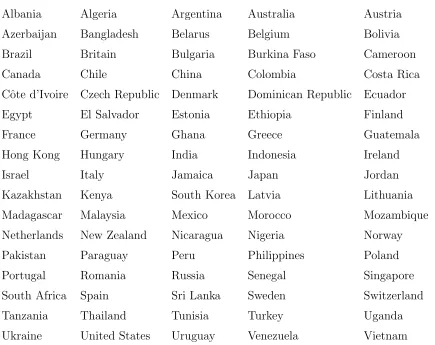
Table A.1: The list of countries used in this paper’s analysis
Albania Algeria Argentina Australia Austria Azerbaijan Bangladesh Belarus Belgium Bolivia Brazil Britain Bulgaria Burkina Faso Cameroon
Canada Chile China Colombia Costa Rica Cˆote d’Ivoire Czech Republic Denmark Dominican Republic Ecuador Egypt El Salvador Estonia Ethiopia Finland France Germany Ghana Greece Guatemala Hong Kong Hungary India Indonesia Ireland Israel Italy Jamaica Japan Jordan
Kazakhstan Kenya South Korea Latvia Lithuania Madagascar Malaysia Mexico Morocco Mozambique Netherlands New Zealand Nicaragua Nigeria Norway Pakistan Paraguay Peru Philippines Poland Portugal Romania Russia Senegal Singapore South Africa Spain Sri Lanka Sweden Switzerland