A n A u t o m a t i c E x t r a c t i o n o f K e y P a r a g r a p h s
B a s e d o n C o n t e x t D e p e n d e n c y
Fumiyo Fukumoto
Yoshimi Suzukit
Jun'ichi Fukumoto:~
Dept. of Electrical Engineering and
Kansai Lab., R & D Group
C o m p u t e r S c i e n c e , Y a m a n a s h i U n i v e r s i t y O k i E l e c t r i c I n d u s t r y C o . Ltd.,:~4 - 3 - 1 1 T a k e d a , K o f u 4 0 0 J a p a n 1 - 2 - 2 7 S h i r o m i , C h u o - k u , O s a k a 5 4 0 J a p a n
~fukumoto~skye,
ysuzuki~suwa~ }.esi.yamanashi.ac.jp fukumoto~kansai.oki.co.jpAbstract
In this paper, we propose a m e t h o d for ex- tracting key paragraphs in articles based on the degree of context dependency. Like Luhn's technique, our m e t h o d assumes t h a t the words related to theme in an arti- cle appear t h r o u g h o u t paragraphs. Our ex- traction technique of keywords is based on the degree of context dependency t h a t how strongly a word is related to a given con- text. T h e results of experiments demon- strate the applicability of our proposed method.
1
I n t r o d u c t i o n
With increasing numbers of machine readable doc- uments becoming available, automatic document summarisation has become one of the m a j o r research topics in IR and N L P studies.
In the field of an automatic summarisation, there are at least two approaches. One is knowledge-based approach with particular subject fields (Reimer, 1988), (Jacobs, 1990). This approach, based on deep knowledge of particular subject fields, is useful for restricted tasks, such as, for example, the construc-
tion of 'weather forecasts' summaries. However,
when unrestricted subject m a t t e r must be treated, as is often the case in practice, the passage retrieval and text summarisation methods proposed have not proven equal to the need, since deep knowledge of particular subject fields is required (Paice, 1990), (Zechner, 1996).
T h e other, alternative strategy is the approach t h a t relies mainly on corpus statistics (Paice, 1990), (Palce, 1993). T h e main task of this approach is
the sentence scoring process. Typically, weights
are assigned to the individual words in a text, and the complete sentence scores are then based on the occurrence characteristics of highly-weighted terms (keywords) in the respective sentences.
Term weighting technique has been widely inves- tigated in information retrieval and lots of tech- niques such as location heuristics (Baxendale, 1958),
rhetorical relations (Miike, 1994), and title informa- tion (Edmundson, 1969) have been proposed. These techniques seem to be less dependent on the domain. However, Salton claims t h a t it is difficult to pro- duce high accuracy of retrieval by using these term- weighting approaches (Salton, 1993).
T h e other t e r m weighting technique is based on
keyword frequency (Luhn, 1958). Keyword fre-
quency is further less dependent on the domain t h a n other weighting methods and therefore, well studied. Major approaches which are based on keyword fre- quency assume on the fact t h a t the keywords of the article appear frequently in the article, but appear seldom in other articles (Luhn, 1958), (Nagao, 1976), (Salton, 1993), (Zechner, 1996). These approaches seem to show the effect in entirely different articles, such as 'weather forecasts', 'medical reports', and 'computer manuals'. Because each different article is characterised by a larger number of words which appear frequently in one article, b u t a p p e a r seldom in other articles. However, in some articles from the same domain such as 'weather forecasts', one encounters quite a number of words which appear frequently over articles. Therefore, how to extract keyword from these words is a serious problem in such the restricted subject domain.
In this paper, we propose a m e t h o d for extract- ing key paragraphs in articles based on the degree of context dependency and show how the idea of con- text dependency can be used effectively to extract key paragraphs t h a n other related work.
T h e basic idea of our approach is t h a t whether a word is a key in an article or not depends on the do- main to which the article belongs. Let 'stake' be a keyword and 'today' not be a keyword in the article. If the article belongs to a restricted subject domain, such as 'Stock market', there are other articles which are related to the article. Therefore, the frequency of 'stake' and 'today' in other articles are similar with each other. Let us consider further a broad coverage domain such as newspaper articles; i.e. the article containing the words 'stake' and 'today' belongs to a newspaper which consists of different subject do- mains such as 'Stock market' news, 'International'
news, 'Weather forecasts' news. 'Today' should ap- pear frequently with every article even in such a do- main; i.e. newspaper articles, while 'stake' should not. Our technique for extraction of keywords ex- plicitly exploits this feature of context dependency of word: how strongly a word is related to a given context.
In the following sections, we first explain con- text dependency using newspaper articles, then we present our term weighting method and a method for extracting key paragraphs. Finally, we report some experiments to show the effect of our method.
2 C o n t e x t D e p e n d e n c y
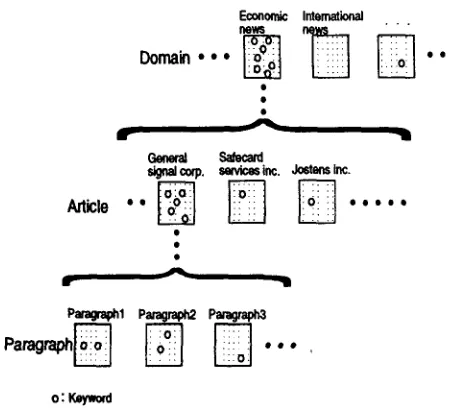
Like Luhn's assumption about keywords, our method is based on the fact t h a t a writer normally repeats certain words (keywords) as he advances or varies his arguments and as he elaborates on an as- pect of a subject (Luhn, 1958). In this paper, we focus on newspaper articles. Figure 1 shows the structure of Wall Street Journal corpus.
Article
r
Domain • • •
E e ~ n ~ ¢ I n t e m a t ~ n a l
$
m r
Paragraph1 Par~raph2 Paragraph3
1
o: K~me
Figure 1: The structure of newspaper articles
In Figure 1, one day's newspaper articles consist of several different topics such as 'Economic news', 'In- ternational news', etc. We call this Domain, and each element ('Economic news', or 'International news') a context. A particular domain, for example, 'Eco- nomic news', consists of several articles each of which has different title name. In Figure 1, 'General sig- nal corp.', 'Safecard services inc.', and 'Jostens inc.' show title names. We call this Article, and each element ('General signal corp.' etc) context. Fur- thermore, a particular article, for example, 'General signal corp.' consists of several paragraphs and key- words of the 'General signal corp.' article appear
throughout paragraphs. We call each paragraph
context in the P a r a g r a p h .
We introduce a degree of context dependency into the structure of newspaper articles shown in Figure 1 in order to extract keywords. A degree of context dependency is a measure showing how strongly each word related to a given context, a particular con- text of Paragraph, Article, or D o m a i n . In Figure 1, let ' O ' be a keyword in the article 'General signal corp.'. According to Luhn's assumption, ' O ' fre- quently appears throughout paragraphs. Therefore, the deviation value of ' O ' in the Paragraph is small. On the other hand, the deviation value of ' O ' in the Article is larger t h a n t h a t of the Paragraph, since in Article, ' O ' appears in a particular element of the Article, 'General signal corp.'. Furthermore, the de- viation value of ' O ' in the Domain is larger t h a n those of the Article and Paragraph, since in the Do- main, ' O ' appears frequently in a particular context, 'Economic news'. We extracted keywords using this feature of the degree of context dependency. In Fig- ure 1, if a word is a keyword in a given article, it satisfies the following two conditions:
1. The deviation value of a word in the
Paragraph
is smaller t h a n t h a t of the Article.2. The deviation value of a word in the Article is smaller t h a n t h a t of the
Domain.
3 T e r m W e i g h t i n g
Every sense of words in articles for extracting key paragraphs is automatically disambiguated in ad- vance. This is because to disambiguate word-senses in articles might affect the accuracy of context de- pendent (domain specific) key paragraphs retrieval, since the meaning of a word characterises the do- main in which it is used. Word-sense disambigua- tion (WSD in short) is a serious problem for N L P , and a variety of approaches have been proposed for solving it (Brown, 1991), (Yarowsky, 1992). Our disambignation method is based on Niwa's method which uses the similarity between a sentence contain- ing a polysemous noun and a sentence of dictionary-
definition (Niwa, 1994). Furthermore, we linked
nouns which are disambignated with their seman- tically similar nouns mainly in order to cope with the problem of a phrasal lexicon. A phrasal lexicon such as Atlantic Seaboard, N e w England gives a neg- ative influence for keywords retrieval, since it can not be regarded as units, i.e. each word which is the element of a phrasal lexicon is assigned to each semantic code (Fukumoto, 1996).
To the results of WSD and linking methods, we then applied a term weighting method to ex-
tract keywords. There have been several term
[image:2.612.93.318.335.540.2]abe's
X2
method for term weighting which is shown in formula (1) (Watanabe, 1996).2 = / (='i-ra*J)= m,~ if ziy > mii (i)
Xij 0 otherwise
Formula (1) shows the value of X 2 of the word i in the domain j. zij in (1) is the frequency of word i in the domain j. mij in (1) is shown in formula (2).
E~=I
O~ij k(2)
m i j = k 1
~i=l~j=a=i~
i=1
In formula (2), k is the number of different words and l is the number of the domains. A larger value of X~ means t h a t the word i appears more frequently in thJe domain j t h a n in the other.
4
A n E x t r a c t i o n o f
Keywords
The first step to extract keywords is to calculate X 2 for each word in the Paragraph, the Article, and the Domain. We used formula (1) to calculate the value of xP~j,
xAi2j,
and xD~y, where xP~i,xAi~,
and xD~; indicate which word i appears most frequently in t~e context j of Paragraph, Article, and Domain, respectively. For example, xPi2j is shown in formula (3) by using formula (1).xP,:~. =
( z i j - m o ) 2 (3)m i j
In formula (3), xlj is the frequency of word i in the context j of
Paragraph.
miy in formula (3) is shown in (2) where k is the number of different words and l is the number of contexts in Paragraph.The second step is to calculate the degree of word
/ i n Paragraph (xP~),
Article(xA~), and Domain
(xD~). We defined the degree of word i in Paragraph,Article,
and Domain as the deviation value of k con- texts in Paragraph, Article, and Domain, respectively. Here, k is the number of contexts in Paragraph, Ar- ticle, and Domain, respectively. For example, the deviation value of the word i in Paragraph is defined as follows:xP~ =
Z]i:1(_;- mi)
(4)
In formula (4), k is the number of contexts in
Para-
graph,
and mi is the mean value of the total fre- quency of word i in Paragraph which consists of k contexts.The last step to extract keywords is to calculate the context dependency of word i using formula (4). We recall t h a t if i satisfies both 1 and 2 in section 2, the word i is regarded as a keyword.
xP~
:)cA~
< 1 (5)xA~
xD ~
< 1
(6)
Formulae (5) and (6) shows
i,
and 2 in section 2, respectively. In formulae (5) and (6), xP~, xA~, and xD~ are the deviation value of a set of Paragraph, Article, and Domain, respectively.5
A n E x t r a c t i o n o f
Key Paragraphs
The procedure for extracting key paragraphs has the following three stages:
Stage One: Representing every paragraph as a vector
The goal of this stage is to represent every para- graph in an article as a vector. Using a term weight- mg method, every paragraph in an article would be represented by vector of the form
m,
=(7)
where n is the number of nouns in an article and Niy is as follows;
{o
1(Nj)
N i s = 0
where
I(Nj)
is a frequency with which the noun Nj appears in paragraph Pi.Stage Two: Clustering method
Given a vector representation of paragraphs P1, • .., P,~ as in formula (7), a similarity between two paragraphs Pi, Pj in an article would be obtained by using formula (8). The similarity of Pi and Pj is measured by the inner product of their normalised vectors and is defined as follows:
Nj
does not appear in PiNj
is a keyword and appears in Pi Nj is not a keyword and appears in P~v(P,),
v(Pj)
(8)
Sim(P,,Pj) = IV(P,)II
v(nj) l
The greater the value of
Sim(Pi, Pi)
is, the more similar these two paragraphs are. For a set of para- graphsP1, "" ", Pm
of an article, we calculate the semantic similarity value of all possible pairs of para- graphs. The clustering algorithm is applied to the sets and produces a set of semantic clusters, which are ordered in the descending order of their seman- tic similarity values. We adopted non-overlapping, group average method in our clustering technique(Jardine, 1968).
Stage Three: Extraction of key paragraphs
The sample results of clustering is shown in Table 1.
Table 1: T h e sample results of clustering
Num Cluster
1 (3,4) 2 (1,(3,4))
3 ((1,(3,4)),2)
'Num' in Table 1 shows the order of clusters which we have obtained and the n u m b e r shown under 'Cluster' shows the paragraph numbers. In Table 1, if the number of keywords which belonging to the third paragraph is larger t h a n t h a t of the fourth, the order of key paragraphs is 3 ) 4 > 1 ~ 2, otherwise, 4 > 3 ~ 1 ) 2.
6
E x p e r i m e n t s
We have conducted t h r e e experiments to examine the effect of our method. T h e first experiment, Key-
words Experiment, is concerned with the keywords
extracting technique and with verifying the effect of our m e t h o d which introduces context dependency.
T h e second experiment, Key Paragraphs Experiment,
shows how the extracted keywords can be used to e x t r a c t key paragraphs. In the third experiment, Comparison to Other Related Work, we applied Zech- ner's key sentences m e t h o d (Zechner, 1996) to key paragraphs extraction (we call this method_A), and compared it with our method.
6.1 D a t a
T h e corpus we have used is the 1988, 1989 Wall Street J~urnal (Liherman, 1991) in A C L / D C I CD- R O M which consists of a b o u t 280,000 part-of-speech tagged sentences (BriU, 1992). Wall Street Journal consists of many articles, and each article has a ti- tle name. These titles are classified into 76 different domains. We selected 10 different domains and used t h e m as Domain. As a test data, we selected 50 articles each of which belongs to one of these 10 do- mains. T h e selected domain names and the number of articles are shown in Table 2.
Table 2: T h e selected d a t a
Domain No Domain No
BBK: buybacks 6 BVG: beverages 8
DIV: dividends 5 FOD: food products 5
STK: stock market 5 RET: retailing 1
ARO: aerospace 5 ENV: environment 3
PCS: stones, gold 9 CMD: farm products 3
T h e r e are 3,802 different nouns in 50 articles. As a result of WSD and linking methods for these articles, we have obtained 3,707 different nouns.
6.2 Keywords E x p e r i m e n t
Formulae (5) and (6) are applied to 50 articles which are the results of WSD and linking methods, and as a
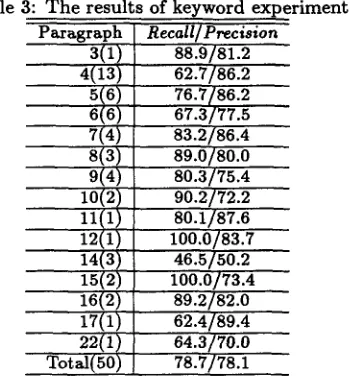
result, we have obtained 1,047 keywords in all. T h e result of keyword extraction is shown in Table 3.
Table 3: T h e results of keyword experiment Paragraph
3(1)
4(13)5(6)
6(6)
7(4)
8(3)
9(4)
lO(2)
11(1)Recall~Precision 88.9/81.2 62.7/86.2 76.7/86.2 67.3/77.5
83.2/86.4
89.0/80.0 80.3/75.4 90.2/72.2 80.1/87.6
12(1) I00.0/83.7
14(3) 46.5/50.2
15(2) 100.0/73.4
16(2) 89.2/82.0
17(1)
62.4/89.422(1) 64.3/70.0
Total(50) 78.,7/78.1
In Table 3, z in ' z ( y ) ' of ' P a r a g r a p h ' shows the num- ber of paragraphs in an article, 'y' shows the n u m b e r of articles. For example, 3(1) shows t h a t t h e r e is one article which consists of three paragraphs. Recall and Precision in Table 3 are as follows;
Number of correct keywords Recall =
Number of keywords which are se- lected by human
Number of correct keywords Precision =
Number of keywords which are se- lected in our method
Recall and Precision in Table 3 show the means in each paragraph. T h e denominator of Recall is m a d e by three h u m a n judges; i.e. when more t h a n one h u m a n judged the word as a keyword, the word is regarded as a keyword.
6.3 Key Paragraphs E x p e r i m e n t
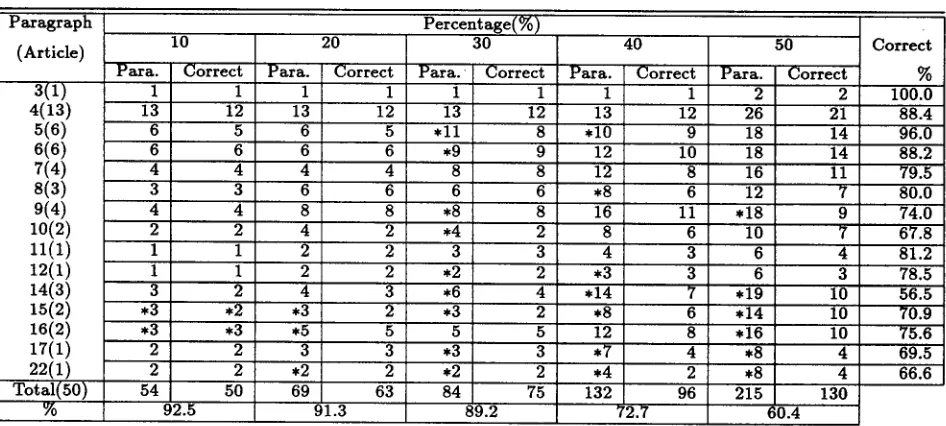
For each article, we e x t r a c t e d 10 ,~50 % of its para- graphs as key paragraphs. T h e results of key para- graphs experiment are shown in Table 4.
[image:4.612.371.546.138.328.2] [image:4.612.94.325.587.655.2]T a b l e 4: T h e r e s u l t s o f Key Paragraphs Experiment
Paragraph Percentage(%)
10 20 30
(Article)
Para. Correct Para. Correct P a r a . Correct
3(1) 1 1 1 1 1 1
4(13) 13 12 13 12 13 12
5(6) 6 5 6 5 *11 8
6(6) 6 6 6 6 *9 9
7(4) 4 4 4 4 8 8
8(3) 3 3 6 6 6 6
9(4) 4 4 8 8 *8 8
10(2) 2 2 4 2 *4 2
11(1) 1 1 2 2 3 3
12(1) 1 1 2 2 *2 2
14(3) 3 2 4 3 , 6 4
15(2) *3 *2 ,3 2 , 3 2
16(2) , 3 *3 *5 5 5 5
17(1) 2 2 3 3 *3 3
22(1) 2 2 ,2 2 *2 2
Total(50) 54 50 69 63 84 75
% 92.5 91.3 89.2
40 50 Correct
Para. Correct Para. Correct %
1 1 2 2 100.0
13 12 26 21 88.4
*10 9 18 14 96.0
12 10 18 14 88.2
12 8 16 11 79.5
*8 6 12 7 80.0
16 11 , 1 8 9 74.0
8 6 10 7 67.8
4 3 6 4 81.2
*3 3 6 3 78.5
,14 7 ,19 10 56.5
*8 6 , 1 4 10 70.9
12 8 , 1 6 10 75.6
*7 4 *8 4 69.5
*4 2 *8 4 66.6
132 96 215 130
72.7 60.4
as a k e y p a r a g r a p h was o n l y two. T h e r e f o r e , 2 is m a r k e d w i t h a '*'.
6 . 4 C o m p a r i s o n t o O t h e r R e l a t e d W o r k
Z e c h n e r p r o p o s e d a m e t h o d t o e x t r a c t k e y s e n t e n c e s in a n a r t i c l e b y u s i n g s i m p l e s t a t i s t i c a l m e t h o d ; i.e. T F * I D F t e r m w e i g h t i n g m e t h o d . I n o r d e r t o show t h e a p p l i c a b i l i t y of o u r m e t h o d , we a p p l i e d Zech- n e r ' s k e y s e n t e n c e s m e t h o d t o key p a r a g r a p h s ex- t r a c t i o n a n d c o m p a r e d i t w i t h o u r m e t h o d . I n Zech- n e r ' s m e t h o d , t h e s u m over all T F * I D F v a l u e s o f t h e c o n t e n t w o r d s for each s e n t e n c e a r e c a l c u l a t e d , a n d t h e s e n t e n c e s a r e s o r t e d a c c o r d i n g t o t h e i r weights. F i n a l l y a p a r t i c u l a r n u m b e r of s e n t e n c e s a r e ex- t r a c t e d as k e y s e n t e n c e s . T h e d a t a we u s e d con- sists o f 1.92 s e n t e n c e s p a r a p a r a g r a p h a n d was n o t so m a n y s e n t e n c e s w i t h i n a p a r a g r a p h . T h e n , in o r d e r t o a p p l y his m e t h o d t o k e y p a r a g r a p h s ex- t r a c t i o n , we c a l c u l a t e d t h e s u m over all s e n t e n c e s for e a c h p a r a g r a p h , a n d s o r t e d t h e p a r a g r a p h s ac- c o r d i n g t o t h e i r weights. F r o m t h e s e , we e x t r a c t e d a c e r t a i n n u m b e r o f p a r a g r a p h s (method_A). I n o u r m e t h o d , e v e r y sense of w o r d s in a r t i c l e s for e x t r a c t - i n g k e y p a r a g r a p h s is d i s a m b i g u a t e d in a d v a n c e a n d l i n k i n g m e t h o d is p e r f o r m e d . I n o r d e r t o e x a m i n e w h e r e t h e p e r f o r m a n c e c o m e s f r o m , we also c o m - p a r e d o u r m e t h o d t o t h e m e t h o d w h i c h W S D a n d l i n k i n g m e t h o d a r e n o t a p p l i e d . T h e r e s u l t is s h o w n in T a b l e 5.
I n T a b l e 5, ' % ' shows t h e e x t r a c t i o n r a t i o , 10 ,-~ 50% a n d ' P a r a . ' shows t h e n u m b e r of p a r a g r a p h s c o r r e - s p o n d i n g t o e a c h ' P e r c e n t a g e ' . ' O u r m e t h o d ' , ' n o t W S D ' , a n d ' m e t b o d _ h ' shows t h e r e s u l t s u s i n g o u r
T a b l e 5: T h e r e s u l t s o f c o m p a r a t i v e e x p e r i m e n t
Our % Paxa.
method(%~
10 54 50(92.5)
20 69 63(91.3)
30 84 75(89.3)
40 132 96(72.7) 50 215 130(60.4) Total 554 414(74.7)
not WSD
43(79.6)
55(79.7)
66(78.5)
80(60.6)
112(52.8)
356(64.2)
method_A
31(57.4) 35(50.7) 41(48.8) 63(47.7) 99(46.0) 269(48.6)
m e t h o d , t h e m e t h o d w h i c h W S D a n d l i n k i n g a r e n o t a p p l i e d , a n d method_A, r e s p e c t i v e l y .
7 D i s c u s s i o n
7.1 K e y w o r d s E x p e r i m e n t E f f e c t i v e n e s s o f t h e M e t h o d
A c c o r d i n g t o T a b l e 3, Recall a n d Precision v a l u e s r a n g e f r o m 4 6 . 5 / 5 0 . 2 t o 100.0/89.4, t h e m e a n b e i n g 78.7/78.6. T h i s shows t h a t o u r m e t h o d is effective even in a r e s t r i c t e d d o m a i n such as f i n a n c i a l a r t i c l e s , e.g. Wall Street Journal, a l t h o u g h t h e t e s t set was s m a l l (50 a r t i c l e s ) . F u r t h e r m o r e , t h e c o r r e c t r a t i o d o e s n o t d e p e n d on t h e n u m b e r o f p a r a g r a p h s in a n article. T h i s shows t h a t o u r c o n t e x t d e p e n d e n c y m o d e l is a p p l i c a b l e for different size o f t h e s a m p l e s .
P r o b l e m o f t h e M e t h o d
[image:5.612.95.568.115.328.2]p a r a g r a p h s was 14. As a result, t h e result of t h e extraction of key p a r a g r a p h s shown in Table 4 was also worst (56.5%). T h e possible causes of the error were s u m m a r i s e d t h e following two points:
(1) The formulae of context dependency
T h e sample results of keywords of the article, ' A b e r m i n sues Geanges in Effort to rescind Joint Gold Venture' is shown in Table 6.
Table 6: Keywords a n d their X 2 values in the article
Keyword Paragraph Article Domain
Abermin 0.582 10.835 663.605
Belzberg 1.468 1.548 94.801
flin 1.468 1.548 94.801
gold5 1.770 2.496 52.865
Granges 0.680 15.478 948.007
Manitoba 1.468 1.548 94.801 mill1 1.706 4.925 94.801 ounces 1.765 5.064 284.402
reserves 2.912 3.060 94.801
suit2 1.099 3.096 189.601
supreme1 1.468 1.548 94.801
tartan1 0.251 6.191 379.203
word237 4.633 5.132 362.887
wood238 1.468 1.548 94.801
others 15 . . .
Total average 1.772 2.383 78.161
In Table 6, each value of 'Paragraph', 'Article', a n d 'Domain', shows each X 2 value. ' T o t a l average' shows the m e a n of all keywords. 'word237' a n d 'word238'
are representative words which are t h e result of link- ing noun with their semantically similar nouns. Ac- cording to Table 6, we can observe t h a t in 'Para-
graph', for example, some words whose X 2 values
are slightly higher t h a n t h e average (1,772) exist. For example, the X 2 value of 'word237' is 4.633 a n d slightly higher t h a n 1.772. However, 'word237' satis- fies t h e formulae of context dependency. As a result, 'word237' is regarded as a keyword, while this is not. W h e n t h e e x t r a c t e d ratio was 10%, there were four articles whose correct ratio did not a t t a i n e d 100%.
Of these, three articles are classified into this t y p e of t h e error.
F r o m t h e above observation, we can e s t i m a t e t h a t the formulae of context d e p e n d e n c y are weak con- straints in some domains, while t h e y are still effec- tive even in a restricted domain. In order to get m o r e accuracy, some other constraints such as loca- tion heuristics (Baxendale, 1958) or upper-case word f e a t u r e (Kupiec, 1995) might be necessary to be in- t r o d u c e d into our framework.
(2) The error of WSD
W h e n t h e e x t r a c t e d ratio was 10%, there was one article out of four articles which could not be ex- t r a c t e d correctly because of the error of WSD. T h e t e s t article and the results of it was shown in Figure
,
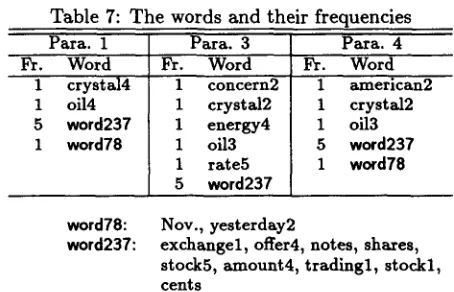
In Figure 2, the headline shows the title name. T h e n u m b e r s show the p a r a g r a p h number, and the un- derlined words are keywords which are e x t r a c t e d in our m e t h o d . T h e b o t t o m shows the result of key p a r a g r a p h s extraction. According to Figure 2, when the extraction ratio was 50%, the p a r a g r a p h s 3 and 4 were e x t r a c t e d a n d t h e p a r a g r a p h 1 was not ex- tracted, although it is a key p a r a g r a p h . T h e key- words a n d their frequencies of a p p e a r a n c e in para- g r a p h 1, 3, and 4 are shown in Table 7.
Table 7: T h e words and their frequencies Para. 1
Ft. Word
1 crystal4
1 oi14
5 word237 1 word78
Para. 3
Ft. Word
1 concern2
1 crystal2
1 energy4
1 oi13
1 rate5
5 word237
Para. 4
Ft. Word
1 american2
1 crystal2
1 oi13
5 wood237
1 word78 word78:
word237:
Nov., yesterday2
exchangel, offer4, notes, shares,
stockS, amount4, tradingl, stockl,
cents
According to Table 7, ' c r y s t a l ' and 'oil in p a r a g r a p h 1 are d i s a m b i g u a t e d incorrectly a n d were replaced by ' c r y s t a l 4 ' a n d 'oi14', respectively, while ' c r y s t a l ' should have been replaced by 'crystal2' a n d 'oi1' with 'oi13'. Therefore, t h e n u m b e r of words which a p p e a r in b o t h p a r a g r a p h 3 a n d 4 was larger t h a n any other pair of p a r a g r a p h s . As a result, p a r a g r a p h 3 a n d 4 are the m o s t semantically similar p a r a g r a p h s a n d 1 was not e x t r a c t e d as a key p a r a g r a p h .
In our m e t h o d , t h e correct ratio of key p a r a g r a p h s extraction strongly depends on t h e results of WSD. T h e correct ratio of our WSD was 78.4% (Fukumoto,
1996). In order to get higher accuracy, it is necessary to improve our WSD m e t h o d .
7.2 K e y P a r a g r a p h s E x p e r i m e n t
E f f e c t i v e n e s s o f t h e M e t h o d
In Key Paragraphs Experiment, the overall results were positive, especially when t h e ratio of extrac- tion was 10,,,30%. T h e ratios of correct j u d g e m e n t s in these cases were significantly high; i.e. 92.5%, 91.3%, and 89.2%, respectively. This d e m o n s t r a t e s the applicability of the degree of context depen- dency.
L i m i t a t i o n s o f t h e M e t h o d
[image:6.612.87.307.196.386.2] [image:6.612.325.552.218.364.2]C r y s t a l Oil Co. E x t e n d s Offer
1 Crystal4 oi1__44 co. said it extended to Nov. 17 the exchangel offer4 for all of its non-interest- ear~-ar]-~-convertible secured notes, due 1997, for shares of its common stockS.
2 The offer4 had been set to expire yesterdayl.
3 The companyl said about 65.89% of the notes outstanding have been tendered, under the
planh, the notes will be exchanged at a rate5 of 65 shares of crystal2 oil.__33 common for each $1,000 principal amount4 of the notes, the energy4 concern2 said.
4 In composite tradingl on the american2 stockl exchangel yesterday2, crystal2 oi13 shares closed
at $2.875, up 12.5 cents.
T h e results o f K e y Paragraph Extraction: 3 ---+ 4 --+ 1 ---+ 2
Figure 2: T h e sample of the article
In the field of t e x t summarisation, a vector model was often used for extracting key sentence or key p a r a g r a p h (Tokunaga, 1994), (Zechner, 1996). In this model, the sentences with t e r m weighting are sorted according to their weights and this informa- tion is used to e x t r a c t a certain ratio of highest weighted p a r a g r a p h in an article. We implemented this model a n d c o m p a r e d it with our clustering tech- nique. T h e results are shown in Table 8.
Table 8: O u r m e t h o d a n d a vector model
% Path. Our method(%) Vector model(%)
10 54 50(92.5) 48(88.9)
20 69 63(91.3) 58(84.1)
30 84 75(89.3) 68(78.6)
40 132 96(72.7) 91(69.0)
50 215 130(60.4) 128(60.6)
In Table 8, ' % ' shows the extraction ratio, 10 ~ 50% and ' P a r a . ' shows t h e m f m b e r of total p a r a g r a p h s corresponding to each '%'. ' O u r m e t h o d ' , and 'Vec- t o r model' shows the results of our method, a n d us- ing vector model, respectively.
Table 8 shows t h a t the results using our m e t h o d are highly t h a n those of using the vector model. In our method, when the extraction ratio was m o r e t h a n 30%, the correct ratio decreased. This phe- n o m e n a is also observed in the vector model. F r o m the observation, we can estimate t h a t the cause of the results was not our clustering technique. E x a m - ining the results of h u m a n judges, when the n u m b e r of p a r a g r a p h s was m o r e t h a n 14, the n u m b e r of para- graphs marked with a '*' is large. This shows t h a t it is too difficult even for a h u m a n to judge whether a p a r a g r a p h is a key p a r a g r a p h or not. From the observation, for these articles, there are limitations to our m e t h o d based on context dependency.
O t h e r H e u r i s t i c s
As we discussed in
Keywords Experiment,
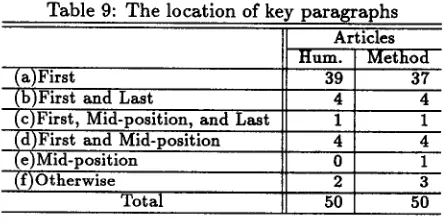
it might be considered t h a t some heuristics such as location of p a r a g r a p h s are introduced into our m e t h o d to get a higher accuracy of keywords and key p a r a g r a p h sextraction, even in these articles. Table 9 shows the location of key p a r a g r a p h s e x t r a c t e d using our m e t h o d and e x t r a c t e d by humans. T h e extraction ratio described in Table 9 is 30%.
Table 9: T h e location of key p a r a g r a p h s
Articles Hum. Method
(a)First 39 37
(b)First and Last 4 4
(c)First, Mid-position, and Last 1 1
(d)First and Mid-position 4 4
(e)Mid-position 0 1
(f) Otherwise 2 3
Total 50 50
In Table 9, each p a r a g r a p h (First, Mid-position, a n d Last p a r a g r a p h ) includes the p a r a g r a p h s around it. According to Table 9, in h u m a n judgement, 39 out of 50 articles' key p a r a g r a p h s are located in the first parts, and the ratio a t t a i n e d 78.0%. This shows t h a t using only location heuristics (the key para- g r a p h tends to be located in the first parts) is a weak constraint in itself, since the results of our m e t h o d showed t h a t the correct ratio a t t a i n e d 89.2%. How- ever, in our m e t h o d , 2 articles are not e x t r a c t e d cor- rectly, while the key p a r a g r a p h is located in the first p a r t s of these articles. From the observation, in a corpus such as Wall Street Journal, utilising a lo- cation heuristics is useful for extracting key para- graphs.
7.3 C o m p a r i s o n t o O t h e r R e l a t e d W o r k
According to Table 5, the average ratio of our m e t h o d and method_A was 74.7%, and 48.6%, re- spectively. This shows t h a t method_A is not more effective t h a n our method. This is because most of nouns do not contribute to showing the characteris- tic of each domain for given articles. In the test d a t a which consists of 3,802 different nouns, 2,171 nouns a p p e a r e d in only one article a n d the frequency of each of t h e m is one. We recall t h a t in method_A,
[image:7.612.330.552.317.429.2] [image:7.612.91.306.377.445.2]when word i appears in only one article and the fre- quency of i is one, the value of TF*IDF equals to log50. There are 2,955 out of 3,802 nouns whose TF*IDF value is less than log50, and the percentage attained at 77.7%. This causes the fact that most of nouns do not contribute to showing the characteris- tic of each domain for given articles.
Comparing the difference ratio of 'Our method' and 'not WSD' to that of 'not WSD' and method_A, the former was 10.5% and the latter was 15.6%. Therefore, our context dependency model con- tributes the extraction of key paragraphs, although
WSD and linking are still effective.
8
C o n c l u s i o n
We have reported an experimental study for extract- ing key paragraphs based on the degree of context dependency for a given article and showed how our context dependency model can use effectively to ex- tract key paragraphs, each of which belongs to the restricted subject domain. In order to cope with the remaining problems mentioned in section 7 and apply this work to practical use, we will conduct further experiments.
9
A c k n o w l e d g m e n t s
The authors would like to thank the reviewers for their valuable comments.
R e f e r e n c e s
P. B. Baxendale, "Man-made index for technical lit- erature - an experiment", IBM J. Res. Develop.,
2(1958)4, pp. 354-361, 1958
E. Brill, "A simple rule-based part of speech tag- ger", In Proc. of the 3rd conference on applied
natural language processing, pp. 152-155, 1992
P. F. Brown et al., "Word-Sense Disambiguation Using Statistical Methods", In Proc. of the 29th
Annual Meeting of the ACL, pp. 264-270, 1991
H. P. Edmundson, "New methods in automatic ab- stracting", Journal of ACM, 16(1969)2, pp. 264- 285,
1969
F. Fukumoto and Y. Suzuki, "An Automatic Clus- tering of Articles Using Dictionary Definitions",
In Proc. of the 16th COLING, pp. 406-411, 1996
N. Jardine and R. Sibson, "The construction of hi- erarchic and non-hierarchic classifications", Com-
puter Journal, pp. 177-184, 1968
P. S. Jacobs and L. F. Rau, "SCISOR: Extracting
information from on-line news", Communications
of the ACM, 33(1990)11, pp. 88-97, 1990
J. Kupiec et al., "A trainable document summa- rizer", In Proc. of SIGIR'95, pp. 68-73, 1995
M. Liberman, "CD-ROM I Association for Com- putational Linguistics Data Collection Initiative",
University of Pennsylvania, 1991
H. P. Luhn, "A statistical approach to mechanized encoding and searching of literary information",
IBM journal, 1(1957)4, pp. 307-319, 1957
H. P. Luhn, "The Automatic Creation of Literature Abstracts", IBM journal, 2(1958)1, pp. 159-165, 1958
S. Miike et al., "A full-text retrieval system with a dynamic abstract generation function", In Proc.
of SIGIR'9~, pp. 152-161, 1994
M. Nagao et al., "An Automatic Method of the Ex- traction of Important Words from Japanese Sci- entific Documents (in Japanese)", IPS Japan,
17(1976)2, pp. 110-117, 1976
Y. Niwa and Y. Nitta, "Co-occurrence vectors from corpora vs. distance vectors from dictionaries", In
Proc. of the 15th COLING, pp. 304-309, 1994
C. D. Paice, "Constructing literature abstracts by computer:Techniques and prospects", Infor-
mation Processing and Management, vol. 26, pp.
171-186, 1990
C. D. Palce and P. A. Jones, "The identification of important concepts in highly structured technical papers", In Proc. of SIGIR'93, pp. 69-78, 1993
U. Reimer and U. Hahn, "Text condensation as knowledge base abstraction", IEEE Conference on
AI Applications, pp. 338-344, 1988
G. Salton and M. J. McGill, "Introduction to Mod- ern Information Retrieval", McGraw-Hill, 1983
G. Salton et al., "Approaches to passage retrieval in full text information systems", In Proc. of SI-
GIR'93, pp. 49-58, 1993
K. J. Sparck, "A statistical interpretation of term specificity and its application in retrieval", Jour-
nal of Documentation, 28(1973)1, pp. 11-21, 1973
T. Tokunaga and M. Iwayama, "Text Categoriza- tion based on Weighted Inverse Document Fre- quency", SIG-IPSJapan, 100(1994)5, pp. 33-40, 1994
Y. Watanabe et al., "Document Classification Using Domain Specific Kanji Characters Extracted by X 2 Method", In Proc. of the 16th COLING, pp. 794-799, 1996
D. Yarowsky, "Word sense disambiguation using sta- tistical models of Roget's categories trained on large corpora", In Proc. of the 14th COLING, pp. 454-460, 1992
K. Zechner, "Fast Generation of Abstracts from General Domain Text Corpora by Extracting Rel- evant Sentences", In Proc. of the 16th COLING,
pp. 986-989, 1996