Linguistic Structured Sparsity in Text Categorization
Dani YogatamaLanguage Technologies Institute School of Computer Science
Carnegie Mellon University Pittsburgh, PA 15213, USA
Noah A. Smith
Language Technologies Institute School of Computer Science
Carnegie Mellon University Pittsburgh, PA 15213, USA
Abstract
We introduce three linguistically moti-vated structured regularizers based on parse trees, topics, and hierarchical word clusters for text categorization. These regularizers impose linguistic bias in fea-ture weights, enabling us to incorporate prior knowledge into conventional bag-of-words models. We show that our structured regularizers consistently im-prove classification accuracies compared to standard regularizers that penalize fea-tures in isolation (such as lasso, ridge, and elastic net regularizers) on a range of datasets for various text prediction prob-lems: topic classification, sentiment anal-ysis, and forecasting.
1 Introduction
What is the best way to exploit linguistic infor-mation in statistical text processing models? For tasks like text classification, sentiment analysis, and text-driven forecasting, this is an open ques-tion, as cheap “bag-of-words” models often per-form well. Much recent work in NLP has fo-cused on linguistic feature engineering (Joshi et al., 2010) or representation learning (Glorot et al., 2011; Socher et al., 2013).
In this paper, we propose a radical alternative. We embrace the conventional bag-of-words repre-sentation of text, instead bringing linguistic bias to bear onregularization. Since the seminal work of Chen and Rosenfeld (2000), the importance of regularization in discriminative models of text— including language modeling, structured predic-tion, and classification—has been widely recog-nized. The emphasis, however, has largely been on one specific kind of inductive bias: avoiding large weights (i.e., coefficients in a linear model).
Recently, structured(or composite) regulariza-tion has been introduced; simply put, it reasons
about different weights jointly. The most widely explored variant, group lasso (Yuan and Lin, 2006) seeks to avoid large `2 norms for groups of weights. Group lasso has been shown useful in a range of applications, including computational biology (Kim and Xing, 2008), signal processing (Lv et al., 2011), and NLP (Eisenstein et al., 2011; Martins et al., 2011; Nelakanti et al., 2013). For text categorization problems, Yogatama and Smith (2014) proposed groups based on sentences, an idea generalized here to take advantage of richer linguistic information.
In this paper, we show how linguistic informa-tion of various kinds—parse trees, thematic topics, and hierarchical word clusterings—can be used to construct group lasso variants that impose linguis-tic bias without introducing any new features. Our experiments demonstrate that structured regulariz-ers can squeeze higher performance out of conven-tional bag-of-words models on seven out of eight of text categorization tasks tested, in six cases with more compact models than the best-performing unstructured-regularized model.
2 Notation
We represent each document as a feature vector x∈RV, whereV is the vocabulary size.x
vis the
frequency of the vth word (i.e., this is a “bag of words” model).
Consider a linear model that predicts a binary responsey∈ {−1,+1}givenxand weight vector w ∈ RV. We denote our training data ofD
doc-uments in the corpus by{xd, yd}Dd=1. The goal of the learning procedure is to estimate wby mini-mizing the regularized training data loss:
ˆ
w= arg min
w Ω(w) + PD
d=1L(xd,w, yd),
where L(x,w, y) is the loss function for docu-mentdandΩ(w)is the regularizer.
In this work, we use the log loss:
L(xd,w, yd) =−log(1 + exp(−ydw>xd)),
Other loss functions (e.g., hinge loss, squared loss) can also be used with any of the regularizers dis-cussed in this paper.
Our focus is on the regularizer,Ω(w). For high dimensional data such as text, regularization is crucial to avoid overfitting.1
The usual starting points for regularization are the “lasso” (Tibshirani, 1996) and the “ridge” (Ho-erl and Kennard, 1970), based respectively on the
`1and squared`2norms:
Ωlas(w) =λlaskwk1 =λPj|wj|
Ωrid(w) =λridkwk22 =λPjw2j
Both methods disprefer weights of large magni-tude; smaller (relative) magnitude means a feature (here, a word) has a smaller effect on the predic-tion, and zero means a feature has no effect.2 The hyperparameterλ in each case is typically tuned on a development dataset. A linear combination of ridge and lasso is known as the elastic net (Zou and Hastie, 2005). The lasso, ridge, and elastic net are three strong baselines in our experiments.
3 Group Lasso
Structured regularizers penalize estimates ofwin which collections of weights are penalized jointly. For example, in the group lasso (Yuan and Lin, 2006), predefined groups of weights (subvectors of w) are encouraged to either go to zero (as a group) or not (as a group)—this is known as “group sparsity.”3
The variant of group lasso we explore here uses an`1,2norm. Letgindex theGpredefined groups of weights andwg denote the subvector ofw
con-taining weights for groupg:
Ωglas(w) =λglasPGg=1λgkwgk2,
1A Bayesian interpretation of regularization is as a prior
on the weight vector w; in many casesΩ can be under-stood as a log-prior representing beliefs about the model held before exposure to data. For lasso regression, the prior is a zero-mean Laplace distribution, whereas for ridge regres-sion the prior is a zero-mean Gaussian distribution. For non-overlapping group lasso, the prior is a two-level hierarchical Bayes model (Figueiredo, 2002). The Bayesian interpretation of overlapping group lasso is not yet well understood.
2The lasso leads to strongly sparse solutions, in which
many elements of the estimatedw are actually zero. This is an attractive property for efficiency and (perhaps) inter-pretability. The ridge encourages weights to go toward zero, but usually not all the waytozero; for this reason its solutions are known as “weakly” sparse.
3Other structured regularizers include the fused lasso
(Tibshirani et al., 2005) and the elitist lasso (Kowalski and Torresani, 2009).
whereλglas is a hyperparameter tuned on a
devel-opment data, and λg is a group specific weight.
Typically the groups are non-overlapping, which offers computational advantages, but this need not be the case (Jacob et al., 2009; Jenatton et al., 2011).
4 Structured Regularizers for Text
Past work applying the group lasso to NLP prob-lems has considered four ways of defining the groups. Eisenstein et al. (2011) defined groups of coefficients corresponding to the same inde-pendent variable applied to different (continuous) output variables in multi-output regression. Mar-tins et al. (2011) defined groups based on fea-ture templates used in chunking and parsing tasks. Nelakanti et al. (2013) defined groups based onn -gram histories for language modeling. In each of these cases, the groups were defined based on in-formation from featuretypesalone; given the fea-tures to be used, the groups were known.
Here we build on a fourth approach that exploits structure in the data.4Yogatama and Smith (2014) introduced the sentence regularizer, which uses patterns of word cooccurrence in the training data to define groups. We review this method, then ap-ply the idea to three more linguistically informed structure in text data.
4.1 Sentence Regularizer
The sentence regularizer exploits sentence bound-aries in each training document. The idea is to define a groupgd,s for every sentence sin every
training document d. The group contains coeffi-cients for words that occur in its sentence. This means that a word is a member of one group for every distinct (training) sentence it occurs in, and that the regularizer is based on word tokens, not types as in the approach of Martins et al. (2011) and Nelakanti et al. (2013). The regularizer is:
Ωsen(w) =PDd=1PsSd=1λd,skwd,sk2, whereSdis the number of sentences in document
d. This regularizer results in tens of thousands to millions of heavily overlapping groups, since a standard corpus typically contains thousands to millions of sentences and many words that appear in more than one sentence.
4This provides a compelling reason not to view such
c0,++
c1 c4,+
c2 c3
The actors
c5,++ c8
c6 c7,+
[image:3.595.111.251.53.181.2]are fantastic .
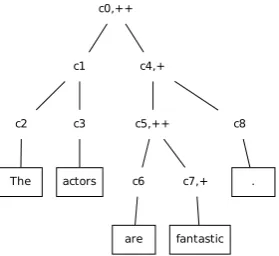
Figure 1: An example of a parse tree from the Stanford sen-timent treebank, which annotates sensen-timent at the level of every constituent (indicated here by+and++; no mark-ing indicates neutral sentiment). The sentence isThe ac-tors are fantastic.Our regularizer constructs nine groups for this sentence, corresponding toc0, c1, . . . , c8.gc0consists of
5 weights—hwthe, wactors, ware, wfantastic, w.i, exactly the same as the group in the sentence regularizer—gc1 consists
of 2 words,gc4 of 3 words, etc. Notice thatc2,c3,c6,c7,
andc8 each consist of only 1 word. The Stanford sentiment
treebank has an annotation of sentiments at the constituent level. As in this example, most constituents are annotated as neutral.
If the norm of wgd,s is driven to zero, then the
learner has deemed the corresponding sentence ir-relevant to the prediction. It is important to point out that, while the regularizer prefers to zero out the weights for all words in irrelevant sentences, it also prefers not to zero out weights for words in relevant sentences. Since the groups overlap and may work against each other, the regularizer may not be able to drive many weights to zero on its own. Yogatama and Smith (2014) used a linear combination of the sentence regularizer and the lasso (a kind of sparse group lasso; Friedman et al., 2010) to also encourage weights of irrelevant word types to go to zero.5
4.2 Parse Tree Regularizer
Sentence boundaries are a rather superficial kind of linguistic structure; syntactic parse trees pro-vide more fine-grained information. We introduce a new regularizer, the parse tree regularizer, in which groups are defined for every constituent in every parse of a training data sentence.
Figure 1 illustrates the group structures derived from an example sentence from the Stanford sen-timent treebank (Socher et al., 2013). This regu-larizer captures the idea thatphrasesmight be se-lected as relevant or (in most cases) irrelevant to a task, and is expected to be especially useful in sentence-level prediction tasks.
The parse-tree regularizer (omitting the group 5Formally, this is equivalent to including one additional
group for each word type.
coefficients andλ) for one sentence with the parse tree shown in Figure 1 is:
Ωtree(w) = p
|wthe|2+|wactors|2+|ware|2+|wfantastic|2+|w.|2
+p|ware|2+|wfantastic|2+|w2.|
+p|wthe|2+|wactors|2+ p
|ware|2+|wfantastic|2
+|wthe|+|wactors|+|ware|+|wfantastic|+|w.|
The groups have a tree structure, in that assign-ing zero values to the weights in a group corre-sponding to a higher-level constituent implies the same for those constituents that are dominated by it. This resembles the tree-guided group lasso in Kim and Xing (2008), although the leaf nodes in their tree represent tasks in multi-task regression.
Of course, in a corpus there are many parse trees (one per sentence, so the number of parse trees is the number of sentences). The parse-tree regular-izer is:
Ωtree(w) =PDd=1PSds=1PCd,sc=1 λd,s,ckwd,s,ck2,
where λd,s,c = λglas ×psize(gd,s,c), d ranges
over (training) documents andcranges over con-stituents in the parse of sentence s in docu-ment d. Similar to the sentence regularizer, the parse-tree regularizer operates on word to-kens. Note that, since each word token is it-self a constituent, the parse tree regularizer in-cludes terms just like the lasso naturally, penal-izing the absolute value of each word’s weight in isolation. For the lasso-like penalty on each word, instead of defining the group weights to be 1× the number of tokens for each word type, we tune one group weight for all word types on a de-velopment data. As a result, besidesλglas, we have
an additional hyperparameter, denoted byλlas.
To gain an intuition for this regularizer, consider the case where we apply the penalty only for a sin-gle tree (sentence), which for ease of exposition is assumed not to use the same word more than once (i.e.,kxk∞ = 1). Because it instantiates the
be understood as encouraging group behavior of syntactically grouped words, or sharing of infor-mation by syntactic neighbors.
In sentence level prediction tasks, such as sentence-level sentiment analysis, it is known that most constituents (especially those that corre-spond to shorter phrases) in a parse tree are un-informative (neutral sentiment). This was verified by Socher et al. (2013) when annotating phrases in a sentence for building the Stanford sentiment treebank. Our regularizer incorporates our prior expectation that most constituents should have no effect on prediction.
4.3 LDA Regularizer
Another type of structure to consider is topics. For example, if we want to predict whether a pa-per will be cited or not (Yogatama et al., 2011), the model can perform better if it knows before-hand the collections of words that represent certain themes (e.g., in ACL papers, these might include machine translation, parsing, etc.). As a result, the model can focus on which topics will increase the probability of getting citations, and penalize weights for words in the same topic together, in-stead of treating each word separately.
We do this by inferring topics in the training corpus by estimating the latent Dirichlet alloca-tion (LDA) model (Blei et al., 2003)). Note that LDA is an unsupervised method, so we can in-fer topical structures fromanycollection of docu-ments that are considered related to the target cor-pus (e.g., training documents, text from the web, etc.). This contrasts with typical semi-supervised learning methods for text categorization that com-bine unlabeled and labeled data within a genera-tive model, such as multinomial na¨ıve Bayes, via expectation-maximization (Nigam et al., 2000) or semi-supervised frequency estimation (Su et al., 2011). Our method does not use unlabeled data to obtain more training documents or estimate the joint distributions of words better, but it allows the use of unlabeled data to induce topics. We leave comparison with other semi-supervised methods for future work.
There are many ways to associate inferred top-ics with group structure. In our experiments, we choose the R most probable words given a topic and create a group for them.6 The LDA regular-6Another possibility is to group the smallest set of words
whose total probability given a topic amounts to P (e.g.,
0.99). mass of a topic. Preliminary experiments found this
izer can be written as:
Ωlda(w) =PKk=1λkkwkk2,
wherekranges over theK topics. Similar to our earlier notations, wk corresponds to the
subvec-tor ofwsuch that the corresponding features are present in topick. Note that in this case we can also have overlapping groups, since words can ap-pear in the topRof many topics.
k= 1 k= 2 k= 3 k= 4
soccer injury physics monday striker knee gravity tuesday midfielder ligament moon april
goal shoulder sun june
[image:4.595.326.508.211.276.2]defender cruciate relativity sunday
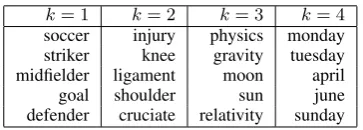
Table 1: A toy example ofK = 4topics. The topR = 5
words in each topics are displayed. The LDA regularizer will construct four groups from these topics. The first group is hwsoccer, wstriker, wmidfielder, wgoal, wdefenderi, the sec-ond group ishwinjury, wknee, wligament, wshoulder, wcruciatei, etc. In this example, there are no words occurring in the top
Rof more than one topic, but that need not be the case in general.
To gain an intuition for this regularizer, consider the toy example in Table 1. the case where we haveK = 4topics and we selectR= 5top words from each topic. Supposed that we want to clas-sify whether an article is a sports article or a sci-ence article. The regularizer might encourage the weights for the fourth topics’ words toward zero, since they are less useful for the task. Addition-ally, the regularizer will penalize words in each of the other three groups collectively. Therefore, if (for example)ligamentis deemed a useful feature for classifying an article to be about sports, then the other words in that topic will have a smaller ef-fective penalty for getting nonzero weights—even weights of the opposite sign aswligament. It is
im-portant to distinguish this from unstructured reg-ularizers such as the lasso, which penalize each word’s weight on its own without regard for re-lated word types.
Unlike the parse tree regularizer, the LDA regu-larizer is not tree structured. Since the lasso-like penalty does not occur naturally in a non tree-structured regularizer, we add an additional lasso penalty for each word type (with hyperparameter
λlas) to also encourage weights of irrelevant words
to go to zero. Our LDA regularizer is an instance of sparse group lasso (Friedman et al., 2010).
4.4 Brown Cluster Regularizer
Brown clustering is a commonly used unsuper-vised method for grouping words into a hierarchy of clusters (Brown et al., 1992). Because it uses local information, it tends to discover words with similar syntactic behavior, though semantic group-ings are often evident, especially at the more fine-grained end of the hierarchy.
We incorporate Brown clusters into a regular-izer in a similar way to the topical word groups inferred using LDA in§4.3, but here we make use of the hierarchy. Specifically, we construct tree-structured groups, one per cluster (i.e., one per node in the hierarchy). The Brown cluster regu-larizer is:
Ωbrown(w) =PNv=1λvkwvk2,
where v ranges over the N nodes in the Brown cluster tree. As a tree structured regularizer, this regularizer enforces constraints that a node v’s group is given nonzero weights only if those nodes that dominatev (i.e., are on a path fromv to the root) have their groups selected.
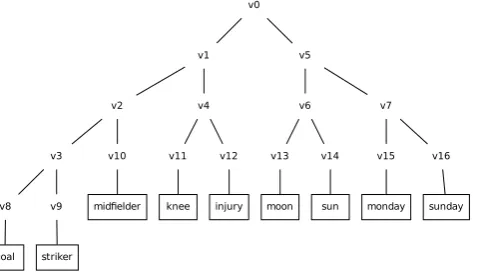
Consider a similar toy example to the LDA reg-ularizer (sports vs. science) and the hierarchical clustering of words in Figure 2. In this case, the Brown cluster regularizer will create 17 groups, one for every node in the clustering tree. The regu-larizer for this tree (omitting the group coefficients andλ) is:
Ωbrown(w) =P7i=0kwvik2+|wgoal|+|wstriker|
+|wmidfielder|+|wknee|+|winjury|
+|wgravity|+|wmoon|+|wsun|
The regularizer penalizes words in a cluster to-gether, exploiting discovered syntactic related-ness. Additionally, the regularizer can zero out weights of words corresponding to any of the in-ternal nodes, such asv7 if the wordsmondayand sundayare deemed irrelevant to prediction.
Note that the regularizer already includes terms like the lasso naturally. Similar to the parse tree regularizer, for the lasso-like penalty on each word, we tune one group weight for all word types on a development data with a hyperparameterλlas.
A key difference between the Brown cluster regularizer and the parse tree regularizer is that there is only one tree for Brown cluster regularizer, whereas the parse tree regularizer can have mil-lions (one per sentence in the training data). The
v0
v1 v5
v2 v4
v3 v10
v8 v9
goal striker
midfielder
v11 v12
knee injury
v6 v7
v13 v14
moon sun
v15 v16
[image:5.595.302.541.52.189.2]monday sunday
Figure 2: An illustrative example of Brown clusters forN = 9. The Brown cluster regularizer constructs 17 groups, one per node in for this tree,v0, v1, . . . , v16.v0contains 8 words,
v1contains 5, etc. Note that the leaves,v8, v9, . . . , v16, each
contain one word.
LDA and Brown cluster regularizers offer ways to incorporate unlabeled data, if we believe that the unlabeled data can help us infer better topics or clusters. Note that the processes of learning topics or clusters, or parsing training data sentences, are a separate stage that precedes learning our predic-tive model.
5 Learning
There are many optimization methods for learn-ing models with structured regularizers, particu-lary group lasso (Jacob et al., 2009; Jenatton et al., 2011; Chen et al., 2011; Qin and Goldfarb, 2012; Yuan et al., 2013). We choose the optimization method of Yogatama and Smith (2014) since it handles millions of overlapping groups effectively. The method is based on the alternating directions method of multipliers (ADMM; Hestenes, 1969; Powell, 1969). We review it here in brief, for com-pleteness, and show how it can be applied to tree-structured regularizers (such as the parse tree and Brown cluster regularizers in§4) in particular.
Our learning problem is, generically:
min
w Ω(w) + PD
d=1L(xd,w, yd).
Separating the lasso-like penalty for each word type from our group regularizers, we can rewrite this problem as:
min
w,vΩlas(w) + Ωglas(v) + PD
d=1L(xd,w, yd) s.t. v=Mw where v consists of copies of the elements of w. Notice that we work directly on w instead of the copies for the lasso-like penalty, since it does not have overlaps and has its own hyper-parameters λlas. For the remaining groups with
L = PGg=1size(g). M ∈ {0,1}L×V is a
ma-trix whose 1s link elements ofwto their copies.7 We now have a constrained optimization prob-lem, from which we can create an augmented La-grangian problem; letube the Lagrange variables:
Ωlas(w) + Ωglas(v) +L(w)
+u>(v−Mw) +ρ2kv−Mwk22
ADMM proceeds by iteratively updating each ofw, v, and u, amounting to the following sub-problems:
min
w Ωlas(w) +L(w)−u
>Mw+ρ
2kv−Mwk22 (1) min
v Ωglas(v) +u >v+ρ
2kv−Mwk22 (2)
u=u+ρ(v−Mw) (3)
Yogatama and Smith (2014) show that Eq. 1 can be rewritten in a form quite similar to `2 -regularized loss minimization.8
Eq. 2 is the proximal operator of 1
ρΩglas
ap-plied to Mw − u
ρ. As such, it depends on the
form of M. Note that when applied to the col-lection of “copies” of the parameters,v,Ωglas no
longer has overlapping groups. Defined Mg as
the rows ofMcorresponding to weight copies as-signed to group g. Let zg , Mgw− ugρ .
De-note λg = λglaspsize(g). The problem can be
solved by applying the proximal operator used in non-overlapping group lasso to each subvector:
vg =proxΩglas,λg ρ(zg)
=
0 ifkzgk2 ≤ λgρ
kzgk2−λgρ
kzgk2 zg otherwise.
For a tree structured regularizer, we can get speedups by working from the root node towards the leaf nodes when applying the proximal oper-ator in the second step. If g is a node in a tree which is driven to zero, all of its children h that hasλh ≤λgwill also be driven to zero.
Eq. 3 is a simple update of the dual variableu. Algorithm 1 summarizes our learning procedure.9 7For the parse tree regularizer, L is the sum, over all
training-data word tokenst, of the number of constituentst
belongs to. For the LDA regularizer,L =R×K. For the Brown cluster regularizer,L=V −1.
8The difference lies in that the squared`
2 norm in the
penalty penalizes the difference betweenwand a vector that depends on the current values ofuandv. This does not affect the algorithm or its convergence in any substantive way.
9We use relative changes in the`
2norm of the parameter
vectorw as our convergence criterion (threshold of10−3),
and set the maximum number of iterations to 100. Other cri-teria can also be used.
Algorithm 1ADMM for overlapping group lasso
Input: augmented Lagrangian variableρ, regularization strengthsλglas andλlas
whilestopping criterion not metdo w= arg min
w Ωlas(w)+L(w)+
ρ
2
PV
i=1Ni(wi−µi)2 forg= 1toGdo
vg =proxΩ
glas,λgρ (zg)
end for
u=u+ρ(v−Mw)
end while
6 Experiments
6.1 Datasets
We use publicly available datasets to evaluate our model described in more detail below.
Topic classification. We consider four binary categorization tasks from the 20 Newsgroups dataset.10 Each task involves categorizing a document according to two related categories: comp.sys: ibm.pc.hardware vs. mac.hardware; rec.sport: baseball vs. hockey; sci: med vs. space; and alt.atheism vs. soc.religion.christian.
Sentiment analysis. One task in sentiment anal-ysis is predicting the polarity of a piece of text, i.e., whether the author is favorably inclined toward a (usually known) subject of discussion or proposi-tion (Pang and Lee, 2008). Sentiment analysis, even at the coarse level of polarity we consider here, can be confused by negation, stylistic use of irony, and other linguistic phenomena. Our sen-timent analysis datasets consist of movie reviews from the Stanford sentiment treebank (Socher et al., 2013),11and floor speeches by U.S. Congress-men alongside “yea”/“nay” votes on the bill under discussion (Thomas et al., 2006).12 For the Stan-ford sentiment treebank, we only predict binary classifications (positive or negative) and exclude neutral reviews.
Text-driven forecasting. Forecasting from text requires identifying textual correlates of a re-sponse variable revealed in the future, most of which will be weak and many of which will be spurious (Kogan et al., 2009). We consider two such problems. The first one is predicting whether a scientific paper will be cited or not within three years of its publication (Yogatama et al., 2011);
10http://qwone.com/˜jason/20Newsgroups 11http://nlp.stanford.edu/sentiment/ 12
Dataset D # Dev. # Test V
20N
science 952 235 790 30,154
sports 958 239 796 20,832
relig. 870 209 717 24,528
comp. 929 239 777 20,868
[image:7.595.79.285.61.161.2]Sent. movievote 6,9201,175 872257 1,821860 17,57624,508 Fore. sciencebill 37,8503,207 7,341280 6,571539 42,70210,001 Table 2: Descriptive statistics about the datasets.
the dataset comes from the ACL Anthology and consists of research papers from the Association for Computational Linguistics and citation data (Radev et al., 2009). The second task is predicting whether a legislative bill will be recommended by a Congressional committee (Yano et al., 2012).13
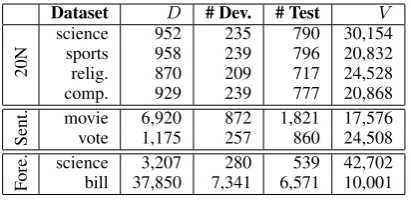
Table 2 summarizes statistics about the datasets used in our experiments. In total, we evaluate our method on eight binary classification tasks.
6.2 Setup
In all our experiments, we use unigram features plus an additional bias term which is not regu-larized. We compare our new regularizers with state-of-the-art methods for document classifica-tion: lasso, ridge, and elastic net regularization, as well as the sentence regularizer discussed in§4.1 (Yogatama and Smith, 2014).14
We parsed all corpora using the Berkeley parser (Petrov and Klein, 2007).15 For the LDA regular-izers, we ran LDA16 on training documents with
K = 1,000andR = 10. For the Brown cluster regularizers, we ran Brown clustering17 on train-ing documents with 5,000clusters for the topic classification and sentiment analysis datasets, and 1,000for the larger text forecasting datasets (since they are bigger datasets that took more time).
13http://www.ark.cs.cmu.edu/bills
14Hyperparameters are tuned on a separate
develop-ment dataset, using accuracy as the evaluation crite-rion. For lasso and ridge models, we choose λ from {10−2,10−1,1,10,102,103}. For elastic net, we perform
grid search on the same set of values as ridge and lasso experiments for λrid and λlas. For the sentence, Brown cluster, and LDA regularizers, we perform grid search on the same set of values as ridge and lasso experiments for
ρ, λglas, λlas. For the parse tree regularizer, because there are many more groups than other regularizers, we choose
λglas from{10−4,10−3,10−2,10−1,10},ρandλlas from the same set of values as ridge and lasso experiments. If there is a tie on development data we choose the model with the smallest number of nonzero weights.
15https://code.google.com/p/berkeleyparser/ 16http://www.cs.princeton.edu/˜blei/lda-c/ 17https://github.com/percyliang/brown-cluster
6.3 Results
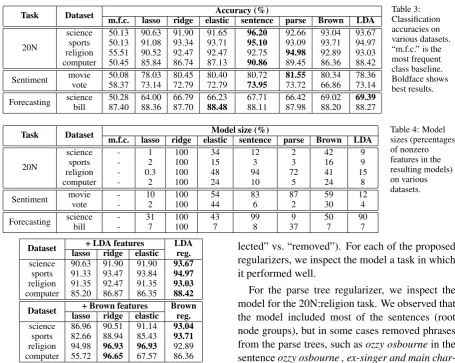
Table 3 shows the results of our experiments on the eight datasets. The results demonstrate the su-periority of structured regularizers. One of them achieved the best result on all but one dataset.18 It is also worth noting that in most cases all variants of the structured regularizers outperformed lasso, ridge, and elastic net. In four cases, the new regu-larizers in this paper outperform the sentence reg-ularizer.
We can see that the parse tree regularizer per-formed the best for the movie review dataset. The task is to predict sentence-level sentiment, so each training example is a sentence. Since constituent-level annotations are available for this dataset, we only constructed groups for neutral constituents (i.e., we drive neutral constituents to zero during training). It has been shown that syntactic in-formation is helpful for sentence-level predictions (Socher et al., 2013), so the parse tree regularizer is naturally suitable for this task.
The Brown cluster and LDA regularizers per-formed best for the forecasting scientific articles dataset. The task is to predict whether an article will be cited or not within three years after publi-cation. Regularizers that exploit the knowledge of semantic relations (e.g., topical categories), such as the Brown cluster and LDA regularizers, are therefore suitable for this type of prediction.
Table 4 shows model sizes obtained by each of the regularizers for each dataset. While lasso prunes more aggressively, it almost always per-forms worse. Our structured regularizers were able to obtain a significantly smaller model (27%, 34%, 19% as large on average for parse tree, Brown, and LDA regularizers respectively) com-pared to the ridge model.
Topic and cluster features. Another way to in-corporate LDA topics and Brown clusters into a linear model is by adding them as additional fea-tures. For the 20N datasets, we also ran lasso, ridge, and elastic net withadditional LDA topic and Brown cluster features.19 Note that these new baselines use more features than our model. We can also add these additional features to our model 18This “bill” dataset, where they offered no improvement,
is the largest by far (37,850 documents), and therefore the one where regularizers should matter the least. Note that the differences are small across regularizers for this dataset.
19For LDA, we took the top 10 words in a topic as a feature.
Task Dataset m.f.c. lasso ridge elasticAccuracy (%)sentence parse Brown LDA
20N
[image:8.595.69.525.57.420.2]science 50.13 90.63 91.90 91.65 96.20 92.66 93.04 93.67 sports 50.13 91.08 93.34 93.71 95.10 93.09 93.71 94.97 religion 55.51 90.52 92.47 92.47 92.75 94.98 92.89 93.03 computer 50.45 85.84 86.74 87.13 90.86 89.45 86.36 88.42 Sentiment movievote 50.0858.37 78.0373.14 72.7980.45 80.4072.79 80.7273.95 73.7281.55 66.8680.34 78.3673.14 Forecasting sciencebill 50.2887.40 64.0088.36 87.7066.79 66.2388.48 67.7188.11 87.9866.42 88.2069.02 69.3988.27
Table 3: Classification accuracies on various datasets. “m.f.c.” is the most frequent class baseline. Boldface shows best results.
Task Dataset m.f.c. lasso ridge elasticModel size (%)sentence parse Brown LDA
20N
science - 1 100 34 12 2 42 9
sports - 2 100 15 3 3 16 9
religion - 0.3 100 48 94 72 41 15
computer - 2 100 24 10 5 24 8
Sentiment movievote -- 102 100100 4454 836 872 3059 124 Forecasting sciencebill -- 317 100100 437 998 379 507 907
Table 4: Model sizes (percentages of nonzero features in the resulting models) on various datasets.
Dataset lasso+ LDA featuresridge elastic LDAreg. science 90.63 91.90 91.90 93.67 sports 91.33 93.47 93.84 94.97 religion 91.35 92.47 91.35 93.03 computer 85.20 86.87 86.35 88.42 Dataset lasso+ Brown featuresridge elastic Brownreg.
science 86.96 90.51 91.14 93.04 sports 82.66 88.94 85.43 93.71 religion 94.98 96.93 96.93 92.89 computer 55.72 96.65 67.57 86.36 Table 5: Classification accuracies on the 20N datasets for lasso, ridge, and elastic net models with additional LDA fea-tures (top) and Brown cluster feafea-tures (bottom). The last col-umn shows structured regularized models from Table 3.
and treat them as regular features (i.e., they do not belong to any groups and are regularized with standard regularizer such as the lasso penalty). The results in Table 5 show that for these datasets, models that incorporate this information through structured regularizers outperformed models that encode this information as additional features in 4 out 4 of cases (LDA) and 2 out of 4 cases (Brown). Sparse models with Brown clusters ap-pear to overfit badly; recall that the clusters were learned on only the training data—clusters from a larger dataset would likely give stronger re-sults. Of course, better performance might also be achieved by incorporating new features as well as using structured regularizers.
6.4 Examples
To gain an insight into the models, we inspect group sparsity patterns in the learned models by looking at the parameter copiesv. This lets us see which groups are considered important (i.e.,
“se-lected” vs. “removed”). For each of the proposed regularizers, we inspect the model a task in which it performed well.
For the parse tree regularizer, we inspect the model for the 20N:religion task. We observed that the model included most of the sentences (root node groups), but in some cases removed phrases from the parse trees, such asozzy osbournein the sentenceozzy osbourne , ex-singer and main char-acter of the black sabbath of good ole days past , is and always was a devout catholic .
For the LDA regularizer, we inspect zero and nonzero groups (topics) in the forecasting scien-tific articles task. In this task, we observed that 642 out of 1,000 topics are driven to zero by our model. Table 6 shows examples of zero and nonzero topics for the dev.-tuned hyperparameter values. We can see that in this particular case, the model kept meaningful topics such as parsing and speech processing, and discarded general topics that are not correlated with the content of the pa-pers (e.g., acknowledgment, document metadata, equation, etc.). Note that most weights for non-selected groups, even inw, are near zero.
= 0
“acknowledgment”: workshop arpa program session darpa research papers spoken technology systems “document metadata”: university references proceedings abstract work introduction new been research both
“equation”: pr w h probability wi gram context z probabilities complete
“translation”: translation target source german english length alignment hypothesis translations position
6
= 0
“translation”:koreantranslation english rules sentences parsing input evaluation machine verb
“speech processing”: speakeridentificationtopic recognition recognizer models acoustic test vocabulary independent “parsing”: parser parsingprobabilisticprediction parsepearledges chart phase theory
[image:9.595.75.531.60.145.2]“classification”: documents learning accuracybayesclassificationwt documentnaivemethod selection Table 6: Examples of LDA regularizer-removed and -selected groups (inv) in the forecasting scientific articles dataset. Words with weights (inw) of magnitude greater than10−3are highlighted inred(not cited) andblue(cited).
= 0
underwater industrial
spotted hit reaped rejuvenated destroyed stretched undertake shake run seeing developing tingles diminishing launching finding investigating receiving
maintaining
adds engage explains builds
6
= 0
failure reproductiveignitionreproduction
cyanamidplanetarynikolafertilityastronomicalgeophysical #lunarcometary supplyingastronautical
magneticatmospheric
stdunderwaterhprwordscan exclusively aneutronic industrial peoplesobsessive congenitalrare simple bowelhereditary breast
Table 7: Examples of Brown regularizer-removed and -selected groups (inv) in the 20N:science task. # denotes any numeral. Words with weights (inw) of magnitude greater than10−3are
highlighted inred(space) and blue(medical).
driven to zero, but not once it combined with other words such as hpr, std, obsessive. Note that we ran Brown clustering only on the training docu-ments; running it on a larger collection of (unla-beled) documents relevant to the prediction task (i.e., semi-supervised learning) is worth exploring in future work.
7 Related and Future Work
Overall, our results demonstrate that linguistic structure in the data can be used to improve bag-of-words models, through structured regulariza-tion. State-of-the-art approaches to some of these problems have used additional features and repre-sentations (Yessenalina et al., 2010; Socher et al., 2013). For example, for the vote sentiment analy-sis datasets, latent variable models of Yessenalina et al. (2010) achieved a superior result of 77.67%. To do so, they sacrificed convexity and had to rely on side information for initialization. Our exper-imental focus has been on a controlled compari-son between regularizers for a fixed model family (the simplest available, linear with bag-of-words features). However, the improvements offered by our regularization methods can be applied in fu-ture work to other model families with more care-fully engineered features, metadata features (espe-cially important in forecasting), latent variables, etc. In particular, note that other kinds of weights (e.g., metadata) can be penalized conventionally, or incorporated into the structured regularization where it makes sense to do so (e.g.,n-grams, as in Nelakanti et al., 2013).
8 Conclusion
We introduced three data-driven, linguistically informed structured regularizers based on parse trees, topics, and hierarchical word clusters. We empirically showed that models regularized us-ing our methods consistently outperformed stan-dard regularizers that penalize features in isolation such as lasso, ridge, and elastic net on a range of datasets for various text prediction problems: topic classification, sentiment analysis, and fore-casting.
Acknowledgments
References
David M. Blei, Andrew Y. Ng, and Michael I. Jordan. 2003. Latent Dirichlet allocation. Journal of Ma-chine Learning Research, 3:993–1022.
Peter F. Brown, Peter V. deSouza, Robert L. Mer-cer, Vincent J. Della Pietra, and Jenifer C. Lai. 1992. Class-based n-gram models of natural lan-guage. Computational Linguistics, 18:467–479. Stanley F. Chen and Ronald Rosenfeld. 2000. A
survey of smoothing techniques for me models. IEEE Transactions on Speech and Audio Process-ing, 8(1):37–50.
Xi Chen, Qihang Lin, Seyoung Kim, Jaime G. Car-bonell, and Eric P. Xing. 2011. Smoothing prox-imal gradient method for general structured sparse learning. InProc. of UAI.
Jacob Eisenstein, Noah A. Smith, and Eric P. Xing. 2011. Discovering sociolinguistic associations with structured sparsity. InProc. of ACL.
Mario A. T. Figueiredo. 2002. Adaptive sparseness using Jeffreys’ prior. InProc. of NIPS.
Jerome Friedman, Trevor Hastie, and Robert Tibshiran. 2010. A note on the group lasso and a sparse group lasso. Technical report, Stanford University. Xavier Glorot, Antoine Bordes, and Yoshua Bengio.
2011. Domain adaptation for large-scale sentiment classification: A deep learning approach. InProc. of ICML.
Magnus R. Hestenes. 1969. Multiplier and gradient methods. Journal of Optimization Theory and Ap-plications, 4:303–320.
Arthur E. Hoerl and Robert W. Kennard. 1970. Ridge regression: Biased estimation for nonorthogonal problems. Technometrics, 12(1):55–67.
Laurent Jacob, Guillaume Obozinski, and Jean-Philippe Vert. 2009. Group lasso with overlap and graph lasso. InProc. of ICML.
Rodolphe Jenatton, Jean-Yves Audibert, and Fran-cis Bach. 2011. Structured variable selection with sparsity-inducing norms. Journal of Machine Learning Research, 12:2777–2824.
Mahesh Joshi, Dipanjan Das, Kevin Gimpel, and Noah A. Smith. 2010. Movie reviews and rev-enues: An experiment in text regression. InProc. of NAACL.
Seyoung Kim and Eric P. Xing. 2008. Feature selec-tion via block-regularized regression. In Proc. of UAI.
Shimon Kogan, Dimitry Levin, Bryan R. Routledge, Jacob S. Sagi, and Noah A. Smith. 2009. Predicting risk from financial reports with regression. InProc. of HLT-NAACL.
Matthieu Kowalski and Bruno Torresani. 2009. Spar-sity and persistence: mixed norms provide simple signal models with dependent coefficients. Signal, Image and Video Processing, 3(3):251–0264.
Xiaolei Lv, Guoan Bi, and Chunru Wan. 2011. The group lasso for stable recovery of block-sparse sig-nal representations. IEEE Transactions on Signal Processing, 59(4):1371–1382.
Andre F. T. Martins, Noah A. Smith, Pedro M. Q. Aguiar, and Mario A. T. Figueiredo. 2011. Struc-tured sparsity in strucStruc-tured prediction. InProc. of EMNLP.
Anil Nelakanti, Cedric Archambeau, Julien Mairal, Francis Bach, and Guillaume Bouchard. 2013. Structured penalties for log-linear language models. InProc. of EMNLP.
Kamal Nigam, Andrew McCallum, Sebastian Thrun, and Tom Mitchell. 2000. Text classification from la-beled and unlala-beled documents using em. Machine Learning, 39(2-3):103–134.
Bo Pang and Lilian Lee. 2008. Opinion mining and sentiment analysis. Foundations and Trends in In-formation Retrieval, 2(1–2):1–135.
Slav Petrov and Dan Klein. 2007. Improved inference for unlexicalized parsing. InProc. of HLT-NAACL.
M. J. D. Powell. 1969. A method for nonlinear con-straints in minimization problems. In R. Fletcher, editor, Optimization, pages 283–298. Academic Press.
Zhiwei (Tony) Qin and Donald Goldfarb. 2012. Struc-tured sparsity via alternating direction methods. Journal of Machine Learning Research, 13:1435– 1468.
Dragomir R. Radev, Pradeep Muthukrishnan, and Va-hed Qazvinian. 2009. The ACL anthology net-work corpus. InProc. of ACL Workshop on Natural Language Processing and Information Retrieval for Digital Libraries.
Richard Socher, Alex Perelygin, Jean Wu, Jason Chuang, Chris Manning, Andrew Ng, and Chris Potts. 2013. Recursive deep models for semantic compositionality over a sentiment treebank. InProc. of EMNLP.
Jiang Su, Jelber Sayyad-Shirabad, and Stan Matwin. 2011. Large scale text classication using semi-supervised multinomial naive Bayes. In Proc. of ICML.
Robert Tibshirani, Michael Saunders, Saharon Ros-set, Ji Zhu, and Keith Knight. 2005. Sparsity and smoothness via the fused lasso. Journal of Royal Statistical Society B, 67(1):91–108.
Robert Tibshirani. 1996. Regression shrinkage and selection via the lasso. Journal of Royal Statistical Society B, 58(1):267–288.
Tae Yano, Noah A. Smith, and John D. Wilkerson. 2012. Textual predictors of bill survival in congres-sional committees. InProc. of NAACL.
Ainur Yessenalina, Yisong Yue, and Claire Cardie. 2010. Multi-level structured models for document sentiment classification. InProc. of EMNLP. Dani Yogatama and Noah A. Smith. 2014. Making the
most of bag of words: Sentence regularization with alternating direction method of multipliers. InProc. of ICML.
Dani Yogatama, Michael Heilman, Brendan O’Connor, Chris Dyer, Bryan R. Routledge, and Noah A. Smith. 2011. Predicting a scientific community’s response to an article. InProc. of EMNLP.
Ming Yuan and Yi Lin. 2006. Model selection and estimation in regression with grouped variables. Journal of the Royal Statistical Society, Series B, 68(1):49–67.
Lei Yuan, Jun Liu, and Jieping Ye. 2013. Efficient methods for overlapping group lasso. IEEE Trans-actions on Pattern Analysis and Machine Intelli-gence, 35(9):2104–2116.