Polylingual Tree-Based Topic Models for Translation Domain Adaptation
Yuening Hu† Computer Science University of Maryland
Ke Zhai† Computer Science University of Maryland
Vladimir Eidelman
FiscalNote Inc. Washington DC [email protected]
Jordan Boyd-Graber
iSchool andUMIACS
University of Maryland [email protected]
Abstract
Topic models, an unsupervised technique for inferring translation domains improve machine translation quality. However, pre-vious work uses only the source language and completely ignores the target language, which can disambiguate domains. We pro-pose new polylingual tree-based topic mod-els to extract domain knowledge that con-siders both source and target languages and derive three different inference schemes. We evaluate our model on a Chinese to En-glish translation task and obtain up to 1.2
BLEUimprovement over strong baselines.
1 Introduction
Probabilistic topic models (Blei and Lafferty,
2009), exemplified by latent Dirichlet
alloca-tion(Blei et al., 2003,LDA), are one of the most
popular statistical frameworks for navigating large unannotated document collections. Topic models discover—without any supervision—the primary themes presented in a dataset: the namesake topics. Topic models have two primary applications: to aid human exploration of corpora (Chang et al., 2009) or serve as a low-dimensional representa-tion for downstream applicarepresenta-tions. We focus on the second application, which has been fruitful for computer vision (Li Fei-Fei and Perona, 2005), computational biology (Perina et al., 2010), and information retrieval (Kataria et al., 2011).
In particular, we use topic models to aid
statisti-cal machine translation(Koehn, 2009,SMT).
Mod-ern machine translation systems use millions of examples of translations to learn translation rules. These systems work best when the training corpus has consistent genre, register, and topic. Systems that are robust to systematic variation in the
train-ing set are said to exhibitdomain adaptation.
†indicates equal contributions.
As we review in Section 2, topic models are a promising solution for automatically discover-ing domains in machine translation corpora. How-ever, past work either relies solely on monolingual source-side models (Eidelman et al., 2012; Hasler et al., 2012; Su et al., 2012), or limited modeling of the target side (Xiao et al., 2012). In contrast, machine translation uses inherently multilingual
data: anSMTsystem must translate a phrase or
sen-tence from asourcelanguage to a differenttarget
language, so existing applications of topic mod-els (Eidelman et al., 2012) are wilfully ignoring available information on the target side that could aid domain discovery.
This is not for a lack of multilingual topic mod-els. Topic models bridge the chasm between lan-guages using document connections (Mimno et al., 2009), dictionaries (Boyd-Graber and Resnik, 2010), and word alignments (Zhao and Xing, 2006). In Section 2, we review these models for discover-ing topics in multildiscover-ingual datasets and discuss how
they can improveSMT.
However, no models combine multiple bridges between languages. In Section 3, we create a model—the polylingual tree-based topic models
(ptLDA)—that uses information from both external
dictionaries and document alignments
simultane-ously. In Section 4, we derive both MCMC and
variational inference for this new topic model. In Section 5, we evaluate our model on the task
ofSMTusing aligned datasets. We show that ptLDA
offers better domain adaptation than other topic models for machine translation. Finally, in Sec-tion 6, we show how these topic models improve
SMTwith detailed examples.
2 Topic Models for Machine Translation
Before considering past approaches using topic
models to improveSMT, we briefly review lexical
weighting and domain adaptation forSMT.
2.1 Statistical Machine Translation
Statistical machine translation casts machine trans-lation as a probabilistic process (Koehn, 2009). For a parallel corpus of aligned source and target
sen-tences(F,E), a phrasef¯ ∈ F is translated to a
phrasee¯∈ E according to a distributionpw(¯e|f¯).
One popular method to estimate the probability
pw(¯e|f¯)is via lexical weighting features.
Lexical Weighting In phrase-based SMT,
lexi-cal weighting features estimate the phrase pair quality by combining lexical translation probabil-ities of words in a phrase (Koehn et al., 2003).
Lexical conditional probabilitiesp(e|f)are
maxi-mum likelihood estimates from relative lexical fre-quencies c(f, e)/Pec(f, e), wherec(f, e)is the
count of observing lexical pair(f, e)in the
train-ing dataset. The phrase pair probabilitiespw(¯e|f¯)
are the normalized product of lexical probabili-ties of the aligned word pairs within that phrase pair (Koehn et al., 2003). In Section 2.2, we create topic-specific lexical weighting features.
Cross-Domain SMT A SMT system is
usu-ally trained on documents with the same genre (e.g., sports, business) from a similar style (e.g.,
newswire, blog-posts). These are calleddomains.
Translations within one domain are better than translations across domains since they vary dra-matically in their word choices and style. A correct translation in one domain may be inappropriate in
another domain. For example, “潜水” in a
newspa-per usually means “underwater diving”. On social media, it means a non-contributing “lurker”.
Domain Adaptation for SMT Training aSMT
system using diverse data requiresdomain
adap-tation. Early efforts focus on building separate models (Foster and Kuhn, 2007) and adding fea-tures (Matsoukas et al., 2009) to model domain information. Chiang et al. (2011) combine these approaches by directly optimizing genre and col-lection features by computing separate translation tables for each domain.
However, these approaches treat domains as
hand-labeled, constant, and knowna priori. This
setup is at best expensive and at worst infeasible for large data. Topic models provide a solution where domains can be automatically induced from raw
data: treat each topic as a domain.1
1Henceforth we will use the term “topic” and “domain”
interchangeably: “topic” to refer to the concept in topic models and “domain” to refer toSMTcorpora.
2.2 Inducing Domains with Topic Models
Topic models take the number of topicsK and a
collection of documents as input, where each docu-ment is a bag of words. They output two distribu-tions: a distribution over topics for each document
d; and a distribution over words for each topic. If
each topic defines aSMTdomain, the document’s
topic distribution is a soft domain assignment for that document.
Given the soft domain assignments, Eidelman et al. (2012) extract lexical weighting features condi-tioned on the topics, optimizing feature weights
us-ing theMargin Infused Relaxed Algorithm
(Cram-mer et al., 2006, MIRA). The topics come from
source documentsonly and create topic-specific
lexical weights from the per-document topic distri-butionp(k|d). The lexical probability conditioned
on the topic is expected countek(e, f)of a word
translation pair under topick,
ˆ
ck(e, f) =Pdp(k|d)cd(e, f), (1)
wherecd(•) is the number of occurrences of the
word pair in documentd. The lexical probability
conditioned on topickis the unsmoothed
probabil-ity estimate of those expected counts
pw(e|f;k) = Pcˆk(e,f)
eˆck(e,f), (2)
from which we can compute the phrase pair proba-bilitiespw(¯e|f¯;k)by multiplying the lexical
prob-abilities and normalizing as in Koehn et al. (2003).
For a test documentd, the document topic
dis-tribution p(k|d) is inferred based on the topics
learned from training data. The feature value of a phrase pair(¯e,f¯)is
fk(¯e|f¯) =−logpw(¯e|f¯;k)·p(k|d) , (3)
a combination of the topic dependent lexical weight and the topic distribution of the document, from which we extract the phrase. Eidelman et al. (2012) compute the resulting model score by combining these features in a linear model with other standard
SMTfeatures and optimizing the weights.
Conceptually, this approach is just reweighting examples. The probability of a topic given a docu-ment is never zero. Every translation observed in the training set will contribute topk(e|f); many of
We adopt this framework in its entirety. Our
contribution are topics that capture multilingual
information and thus better capture the domains in the parallel corpus.
2.3 Beyond Vanilla Topic Models
Eidelman et al. (2012) ignore a wealth of infor-mation that could improve topic models and help machine translation. Namely, they only use mono-lingual data from the source language, ignoring all target-language data and available lexical semantic resources between source and target languages.
Different complement each other to reduce
ambi-guity. For example, “木马” in a Chinese document
can be either “hobbyhorse” in a children’s topic, or “Trojan virus” in a technology topic. A short Chinese context obscures the true topic. However, these terms are unambiguous in English, revealing the true topic.
While vanilla topic models (LDA) can only be
applied to monolingual data, there are a number of topic models for parallel corpora: Zhao and Xing (2006) assume aligned word pairs share same topics; Mimno et al. (2009) connect different lan-guages through comparable documents. These
models take advantage of word or document
align-ment informationand infer more robust topics from the aligned dataset.
On the other hand, lexical informationcan
duce topics from multilingual corpora. For in-stance, orthographic similarity connects words with the same meaning in related languages (Boyd-Graber and Blei, 2009), and dictionaries are a more general source of information on which words share meaning (Boyd-Graber and Resnik, 2010).
These two approaches are not mutually exclu-sive, however; they reveal different connections across languages. In the next section, we combine these two approaches into a polylingual tree-based topic model.
3 Polylingual Tree-based Topic Models
In this section, we bring existing tree-based topic
models (Boyd-Graber et al., 2007, tLDA) and
polylingual topic models (Mimno et al., 2009,
pLDA) together and create the polylingual
tree-based topic model (ptLDA) that incorporates both
word-level correlations and document-level align-ment information.
Word-level Correlations Tree-based topic mod-els incorporate the correlations between words by
encouraging words that appear together in a
con-cept to have similar probabilities given a topic.
These concepts can come from WordNet (Boyd-Graber and Resnik, 2010), domain experts (An-drzejewski et al., 2009), or user constrains (Hu et al., 2013). When we gather concepts from bilin-gual resources, these concepts can connect different languages. For example, if a bilingual dictionary
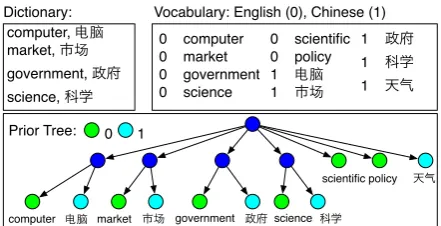
defines “电脑” as “computer”, we combine these
words in a concept.
We organize the vocabulary in a tree structure based on these concepts (Figure 1): words in the same concept share a common parent node, and then that concept becomes one of many children of the root node. Words that are not in any concept—
uncorrelated words—are directly connected to
the root node. We call this structure thetree prior.
When this tree serves as a prior for topic models, words in the same concept are correlated in topics.
For example, if “电脑” has high probability in a
topic, so will “computer”, since they share the same parent node. With the tree priors, each topic is no longer a distribution over word types, instead, it is a distribution over paths, and each path is associated with a word type. The same word could appear in multiple paths, and each path represents a unique sense of this word.
Document-level Alignments Lexical resources connect languages and help guide the topics. How-ever, these resources are sometimes brittle and may not cover the whole vocabulary. Aligned document pairs provide a more corpus-specific, flexible asso-ciation across languages.
Polylingual topic models (Mimno et al., 2009) assume that the aligned documents in different lan-guages share the same topic distribution and each language has a unique topic distribution over its word types. This level of connection between lan-guages is flexible: instead of requiring the exact matching on words and sentences, only a coarse document alignment is necessary, as long as the documents discuss the same topics.
Combine Words and Documents We propose
polylingual tree-based topic models (ptLDA),
which connect information across different lan-guages by incorporating both word correlation (as
in tLDA) and document alignment information (as
in pLDA). We initially assume a given tree
Generative Process As in LDA, each word
to-ken is associated with a topic. However, tree-based topic models introduce an additional step of select-ing a concept in a topic responsible for generatselect-ing
each word token. This is represented by a pathyd,n
through the topic’s tree.
The probability of a path in a topic depends on the transition probabilities in a topic. Each concept
iin topickhas a distribution over its children nodes
is governed by a Dirichlet prior: πk,i ∼ Dir(βi).
Each path ends in a word (i.e., a leaf node) and the probability of a path is the product of all of the transitions between topics it traverses. Topics have correlations over words because the Dirichlet parameters can encode positive or negative correla-tions (Andrzejewski et al., 2009).
With these correlated in topics in hand, the
gen-eration of documents are very similar toLDA. For
every documentd, we first sample a distribution
over topicsθdfrom a Dirichlet prior Dir(α). For
every token in the documents, we first sample a
topiczdnfrom the multinomial distributionθd, and
then sample a pathydnalong the tree according to
the transition distributions specified by topiczdn.
Because every pathydnleads to a wordwdn in
lan-guage ldn, we append the sampled word wdn to
documentdldn. Aligned documents have words in
both languages; monolingual documents only have words in a single language.
The full generative process is:
1: fortopick∈1,· · ·, K do
2: foreach internal nodenido
3: draw a distributionπki ∼Dir(βi)
4: fordocument setd∈1,· · · , Ddo
5: draw a distributionθd∼Dir(α)
6: foreach word in documentsddo
7: choose a topiczdn ∼Mult(θd)
8: Q sample a path ydn with probability
(i,j)∈ydnπzdn,i,j
9: ydnleads to wordwdnin languageldn
10: append tokenwdnto documentdldn
If we use a flat symmetric Dirichlet prior instead
of the tree prior, we recover pLDA; and if all
docu-ments are monolingual (i.e., with distinct
distribu-tions over topicsθ), we recover tLDA. ptLDA
con-nects different languages on both the word level (us-ing the word correlations) and the document level (using the document alignments). We compare these models’ machine translation performance in Section 5.
computer, market, 市 government, 政府 science, 科学
Dictionary: Vocabulary: English (0), Chinese (1)
computer market 市 government 政府science科学
天气
scientific policy
0 scientific 0 policy 1 1 市 0 computer 0 market 0 government 0 science
1 政府 1 科学 1 天气
[image:4.595.306.527.60.173.2]Prior Tree: 0 1
Figure 1: An example of constructing a prior tree from a bilingual dictionary: word pairs with the same meaning but in different languages are con-cepts; we create a common parent node to group words in a concept, and then connect to the root; un-correlated words are connected to the root directly. Each topic uses this tree structure as a prior.
Build Prior Tree Structures One remaining question is the source of the word-level connections across languages for the tree prior. We consider two resources to build trees that correlate words across languages. The first are a multilingual
dic-tionaries (dict), which match words with the same
meaning in different languages together. These re-lations between words are used as the concepts in the prior tree (Figure 1).
In addition, we extract the word alignments from aligned sentences in a parallel corpus. The word
pairs define concepts for the prior tree (align). We
use both resources for our models (denoted as
ptLDA-dictand ptLDA-align) in our experiments
(Section 5) and show that they yield comparable
performance inSMT.
4 Inference
Inference of probabilistic models discovers the pos-terior distribution over latent variables. For a
col-lection ofDdocuments, each of which contains
Ndnumber of words, the latent variables of ptLDA
are: transition distributionsπki for every topick
and internal nodeiin the prior tree structure;
multi-nomial distributions over topicsθdfor every
docu-mentd; topic assignmentszdnand pathydnfor the
nthwordw
dnin documentd. The joint distribution
of polylingual tree-based topic models is
p(w,z,y,θ,π;α, β) =QkQip(πki|βi) (4) ·Qdp(θd|α)·QdQnp(zdn|θd)
·QdQn p(ydn|zdn,π)p(wdn|ydn).
ap-proximate posterior inference to discover the latent variables that best explain our data. Two widely
used approximation approaches areMarkov chain
Monte Carlo(Neal, 2000,MCMC) andvariational
Bayesian inference(Blei et al., 2003, VB). Both
frameworks produce good approximations of the posterior mode (Asuncion et al., 2009). In addition, Mimno et al. (2012) propose hybrid inference that takes advantage of parallelizable variational infer-ence for global variables (Wolfe et al., 2008) while enjoying the sparse, efficient updates for local vari-ables (Neal, 1993). In the rest of this section, we discuss all three methods in turn.
We explore multiple inference schemes because while all of these methods optimize likelihood be-cause they might give different results on the trans-lation task.
4.1 Markov Chain Monte Carlo Inference
We use a collapsed Gibbs sampler for tree-based
topic models to sample the pathydnand topic
as-signmentzdnfor wordwdn,
p(zdn=k, ydn=s|¬zdn,¬ydn,w;α,β) ∝I[Ω(s) =wdn]·P Nk|d+α
k0(Nk0|d+α) ·Qi→j∈s Ni→j|k+βi→j
P
j0(Ni→j0|k+βi→j0),
whereΩ(s)represents the word that pathsleads
to,Nk|dis the number of tokens assigned to topick
in documentdandNi→j|kis the number of times
edgei→jin the tree assigned to topick,
exclud-ing the topic assignmentzdn and its pathydn of
current tokenwdn. In practice, we sample the
la-tent variables using efficient sparse updates (Yao et al., 2009; Hu and Boyd-Graber, 2012).
4.2 Variational Bayesian Inference
Variational Bayesian inference approximates the
posterior distribution with a simplifiedvariational
distributionqover the latent variables: document
topic proportionsθ, transition probabilitiesπ, topic
assignmentsz, and path assignmentsy.
Variational distributions typically assume a mean-field distribution over these latent variables, removing all dependencies between the latent vari-ables. We follow this assumption for the
transi-tion probabilitiesq(π|λ)and the document topic
proportionsq(θ|γ); both are variational Dirichlet distributions. However, due to the tight coupling between the path and topic variables, we must model this joint distribution as one multinomial,
q(z,y|φ). If word tokenwdn hasK topics and
Spaths, it has aK∗Slength variational
multino-mialφdnks, which represents the probability that
the word takes paths in topick. The complete
variational distribution is
q(θ,πQ,z,y|γ,λ,φ) =Qdq(θd|γd)· (5) k
Q
iq(πki|λki)· Q
d Q
nq(zdn, ydn|φdn).
Our goal is to find the variational distributionq
that is closest to the true posterior, as measured by theKullback-Leibler(KL) divergence between the
true posteriorpand variational distributionq. This
induces an “evidence lower bound” (ELBO,L) as a
function of a variational distributionq:L=
Eq[logp(w,z,y,θ,π)]−Eq[logq(θ,π,z,y)]
=PkPiEq[logp(πki|βi)]
+PdEq[logp(θd|α)]
+PdPnEq[logp(zdn, ydn|θd,π)p(wdn|ydn)]
+H[q(θ)] +H[q(π)] +H[q(z,y)], (6)
whereH[•]represents the entropy of a distribution.
OptimizingL using coordinate descent provides
the following updates:
φdnkt∝exp{Ψ(γdk)−Ψ(Pkγdk) (7)
+Pi→j∈s Ψ(λk,i→j)−Ψ(Pj0λk,i→j0)};
γdk=αk+PnPs∈Ω−1(wdn)φdnkt; (8)
λk,i→j =βi→j (9)
+PdPnPs∈Ω0(wdn)φdnktI[i→j∈s] ;
whereΩ0(wdn) is the set of all paths that lead to
wordwdnin the tree, andtrepresents one particular
path in this set. I[i→j∈s] is the indicator of
whether pathscontains an edge from nodeitoj.
4.3 Hybrid Stochastic Inference
Given the complementary strengths ofMCMCand
VB, and following hybrid inference proposed by
Mimno et al. (2012), we also derive hybrid
infer-ence for ptLDA.
The transition distributionsπare treated
identi-cally as in variational inference. We posit a
varia-tional Dirichlet distributionλand choose the one
that minimizes the KL divergence between the true posterior and the variational distribution.
For topic z and path y, instead of variational
updates, we use a Gibbs sampler within a document.
and path assignments of all other document tokens,
based on the variational expectation ofπ,
q(zdn =k, ydn =s|¬zdn,¬ydn;w)∝ (10)
(α+Pm6=nI[zdm=k])
·exp{Eq[logp(ydn|zdn,π)p(wdn|ydn)]}.
This equation embodies how this is a hybrid algo-rithm: the first term resembles the Gibbs sampling term encoding how much a document prefers a topic, while the second term encodes the expecta-tion under the variaexpecta-tional distribuexpecta-tion of how much a path is preferred by this topic,
Eq[logp(ydn|zdn,π)p(wdn|ydn)] =I[Ω(ydn)=wdn] ·Pi→j∈ydnEq[logλzdn,i→j].
For every document, we sweep over all its
to-kens and resample their topic zdn and path ydn
conditioned on all the other tokens’ topic and path
assignments¬zdn and¬ydn. To avoid bias, we
discard the first B burn-in sweeps and take the
followingM samples. We then use the empirical
average of these samples update the global
varia-tional parameterq(π|λ)based on how many times
we sampled these paths
λk,i→j = M1 PdPnPs∈Ω−1(wdn) I[i→j∈s] ·I[zdn =k, ydn =s]+βi→j. (11)
For our experiments, we use the recommended
set-tingsB = 5andM = 5from Mimno et al. (2012).
5 Experiments
We evaluate our new topic model, ptLDA, and
exist-ing topic models—LDA, pLDA, and tLDA—on their
ability to induce domains for machine translation and the resulting performance of the translations on standard machine translation metrics.
Dataset and SMT Pipeline We use theNIST MT
Chinese-English parallel corpus (NIST), excluding
non-UNand non-HKHansards portions as our
train-ing dataset. It contains1.6M sentence pairs, with
40.4M Chinese tokens and44.4M English tokens.
We replicate the SMT pipeline of Eidelman et al.
(2012): word segmentation (Tseng et al., 2005), align (Och and Ney, 2003), and symmetrize (Koehn et al., 2003) the data. We train a modified Kneser-Ney trigram language model on English (Chen and
Goodman, 1996). We useCDEC(Dyer et al., 2010)
for decoding, and MIRA (Crammer et al., 2006)
for parameter training. To optimize SMT system,
we tune the parameters onNIST MT06, and report
results on three test sets: MT02,MT03 andMT05.2
Topic Models Configuration We compare our
polylingual tree-based topic model (ptLDA) against
tree-based topic models (tLDA), polylingual topic
models (pLDA) and vanilla topic models (LDA).3
We also examine different inference algorithms—
Gibbs sampling (gibbs), variational inference
(variational) and hybrid approach ( variational-hybrid)—on the effects ofSMTperformance. In
all experiments, we set the per-document Dirichlet
parameterα = 0.01 and the number of topics to
10, as used in Eidelman et al. (2012).
Resources for Prior Tree To build the tree for
tLDA and ptLDA, we extract the word
correla-tions from a Chinese-English bilingual
dictio-nary (Denisowski, 1997).4 We filter the dictionary
using theNISTvocabulary, and keep entries
map-ping single Chinese and single English words. The
prior tree has about 1000 word pairs (dict).
We also extract the bidirectional word align-ments between Chinese and English using
GIZA++ (Och and Ney, 2003). We then remove
the word pairs appearing more than50K times or
fewer than 500 times and construct a second prior
tree with about 2500 word pairs (align).
We apply both trees to tLDAand ptLDA, denoted
as tLDA-dict, tLDA-align, ptLDA-dict, and ptLDA
-align. However, tLDA-alignand ptLDA-align do
worse than tLDA-dictand ptLDA-dict, so we omit
tLDA-alignin the results.
Domain Adaptation using Topic Models We examine the effectiveness of using topic models
for domain adaptation on standard SMT
evalua-tion metrics—BLEU (Papineni et al., 2002) and
TER (Snover et al., 2006). We report the results
on three different test sets (Figure 2), and allSMT
results are averaged over five runs.
We refer to theSMTmodel without domain
adap-tation asbaseline.5 LDAmarginally improves
ma-chine translation (less than half a BLEU point).
2TheNISTdatasets contain878,919,1082and1664
sen-tences forMT02,MT03,MT05 andMT06 respectively.
3For Gibbs sampling, we use implementations available in
Hu and Boyd-Graber (2012) for tLDA; and Mallet (McCallum,
2002) forLDAand pLDA.
4This is a two-level tree structure. However, one could
build a more sophisticated tree prior with a hierarchical dictio-nary such as multilingual WordNet.
5Our replication of Eidelman et al. (2012) yields slightly
gibbs variational variational−hybrid
34.8 +0.3 +0.6 +0.4 +1.2
+0.5
35.1 +0.1 +0.3 +0.2 +0.7 +0.4
31.4 +0.4 +0.7 +0.4 +1
+0.4
34.8 +0.4 +0.5 +0.4
+0.8 +0.5
35.1 −0.1 +0.2 −0.1 +0.2 +0.2
31.4 +0.3 +0.5 +0.3
+0.8 +0.4
34.8 +0.2 +0.4 +0.2 +0.7 +0.4
35.1 −0.1 −0.1 −0.1 +0.2 +0.2
31.4 +0.3 +0.3 +0.1 +0.6 +0.3
31 32 33 34 35 36 37
31 32 33 34 35 36 37
31 32 33 34 35 36 37
mt02
mt03
mt05
BLEU Score
model baseline LDA pLDA ptLDA−align ptLDA−dict tLDA−dict
gibbs variational variational−hybrid
61.9 −0.1
−1 −1.2 −2.5
−1.1
60.1 −0.3 −0.9 −0.8
−1.9 −0.9
63.3
−0.9 −1.3 −1.2 −2.6
−1.1
61.9 −0.4 −1 −0.6
−1.6 −1.3
60.1 −0.2 −0.5 −0.1 −1 −0.7
63.3 −0.5
−1 −0.4 −1.5 −1.2
61.9 −0.3 −0.7 −0.1
−1.6 −0.9
60.1 0 −0.2 +0.2
−1.1 −0.5
63.3 −0.4 −0.7 −0.1 −1.6 −0.8
56 58 60 62 64 66
56 58 60 62 64 66
56 58 60 62 64 66
mt02
mt03
mt05
TER Score
[image:7.595.96.504.64.369.2]model baseline LDA pLDA ptLDA−align ptLDA−dict tLDA−dict
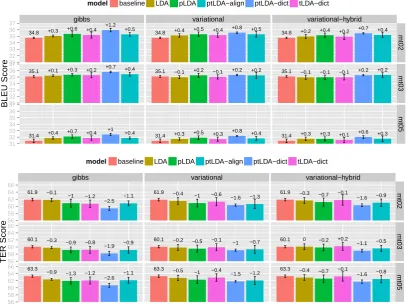
Figure 2: Machine translation performance for different models and inference algorithms against the
baseline, onBLEU(top, higher the better) andTER(bottom, lower the better) scores. Our proposed ptLDA
performs best. Results are averaged over 5 random runs. For model ptLDA-dictwith different inference
schemes, theBLEUimprovement on three test sets is mostly significant withp= 0.01, except the results
onMT03 using variational and variational-hybrid inferences.
Polylingual topic models pLDA and tree-based
topic models tLDA-dictare consistently better than
LDA, suggesting that incorporating additional
bilin-gual knowledge improves topic models. These
im-provements are not redundant: our new ptLDA-dict
model, which has aspects of both models yields the best performance among these approaches—up to a
1.2BLEUpoint gain (higher is better), and -2.6TER
improvement (lower is better). TheBLEU
improve-ment is significant (Koehn, 2004) atp = 0.01,6
except on MT03 with variational and
variational-hybrid inference.
While ptLDA-alignperforms better than
base-line SMT and LDA, it is worse than ptLDA-dict,
possibly because of errors in the word alignments, making the tree priors less effective.
Scalability While gibbs has better translation
scores thanvariationalandvariational-hybrid, it
is less scalable to larger datasets. With1.6MNIST
6Because we have multiple runs of each topic model (and
thus different translation models), we select the run closest to the averageBLEUfor the translation significance test.
training sentences,gibbs takes nearly a week to
run 1000iterations. In contrast, the parallelized
variational and variational-hybrid approaches, which we implement in MapReduce (Dean and Ghemawat, 2004; Wolfe et al., 2008; Zhai et al., 2012), take less than a day to converge.
6 Discussion
In this section, we qualitatively analyze the
trans-lation results and investigate how ptLDA and its
cousins improve SMT. We also discuss other
ap-proaches to improve unsupervised domain
adapta-tion forSMT.
6.1 How do Topic Models HelpSMT?
We present two examples of how topic models can
improveSMT. The first example shows bothLDA
and ptLDAimprove thebaseline. The second
exam-ple shows howLDAintroduce biases that mislead
SMTand how ptLDA’s bilingual constraints correct
these mistakes.
source 新力已在北美地区售出大 , 每套售价
reference sony has already sold about 570,000 units of narrowband connection kitsin north america at the price of about 39 us dollars and some 20 compatible games .
baseline LDA ptLDA
… internet linksset ... … internet links kit… … internet links kit …
… with about 20 of the game .
… , there are about 20 compatible games . … , there are about 20 compatible games . source … ... … 相容游
LDA-Topic 0 (business)
ptLDA-Topic 0 (business) reference … connection kits ... … some 20 compatible games .
, 相容游 公司(company), 中国(China), 服 (service), 市
(market), 技 (technology), 企 (industry), 提供 (provide), (develop), 年(year), (product), 上, 合作(coorporate), 中, 管理(manage), 投 (invest), (economy), 国 (international), 系 (system), (bank)
公司(company), 服 (service), 市 (market), 技 (technology), china, 企 (industry), (product), market, company, technology, services, 系 (system), year, industry, products, business,
[image:8.595.81.508.61.210.2](economy), information, 管理(manage), 投 (invest), percent, 网 (internet), companies, world, system, 信息(information), 增 (increase), (device), service, (service)
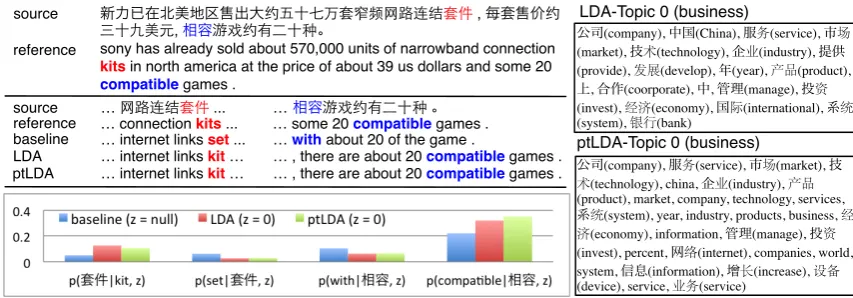
Figure 3: BetterSMTresult using topic models for domain adaptation. Top row: the source sentence and
its reference translation. Middle row: the highlighted translations from different approaches. Bottom row:
the change of relevant translation probabilities after incorporating the domain knowledge fromLDAand
ptLDA. Right: most-probable words of the topic the source sentence is assigned to underLDA(top) and
ptLDA(bottom). The Chinese translations are in parenthesis.
introducing new technology gadgets where both
LDA and ptLDAimprove translations. The
base-linetranslates “套件” to “set” (red), and “相容” to
“with” (blue), which do not capture the reference
meaning of aadd-on devicethat works with
com-patible games. BothLDAand ptLDAassign this
sentence to a business domain, which makes the translations probabilities shift toward correct
trans-lations: the probability of translating “相容” to
“compatible” and the probability of translating “套
件” to “kit” in the business domain are both
signif-icantly larger than without the domain knowledge;
and the probabilities of translating “相容” to “with”
and the probability of translating “set” to “套件”
in the business domain decrease.
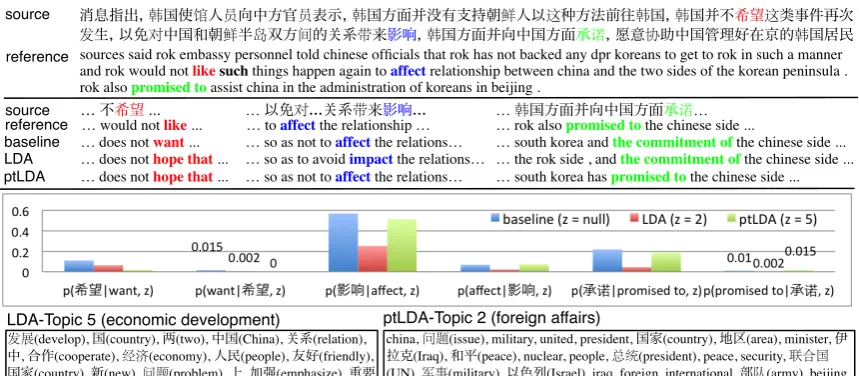
The second example (Figure 4) illustrates how
ptLDAoffers further improvements overLDA. The
source sentence discusses foreign affairs. The
baseline correctly translates the word “影响” to
“affect”. However,LDA—which only takes
mono-lingual information from the source language— assigns this sentence to economic development.
This misleads SMT to lower the probability for
the correct translation “affect”; it chooses “impact”
instead. In contrast, ptLDA—which incorporates
bilingual constraints—successfully labels this sen-tence as foreign affairs and produces a softer, more nuanced translation that better matches the
refer-ence. The translation of “承诺” is very similar,
except in this case, both the baseline and LDA
produce the incorrect translation “the commitment of”. This is possible because the probabilities of
translating “承诺” to “promised to” and
translat-ing “promised to” to “承诺” (the correct
transla-tion, in both directions) increase when conditioned
on ptLDA’s correct topic but decrease when
condi-tioned onLDA’s incorrect topic.
6.2 Other Approaches
Other approaches have used topic models for ma-chine translation. Xiao et al. (2012) present a topic
similarity model based onLDAthat produces a
fea-ture that weights grammar rules based on topic compatibility. They also model the source and tar-get side of rules and compare the tartar-get similarity during decoding by projecting the target distribu-tion into the source space. Hasler et al. (2012)
use the source-side topic assignments fromhidden
topic Markov models(Gruber et al., 2007,HTMM)
which models documents as a Markov chain and assign one topic to the whole sentence, instead of a mixture of topics. Su et al. (2012) also apply
HTMMto monolingual data and apply the results to
machine translation. To our knowledge, however,
this is the first work to usemultilingualtopic
mod-els for domain adaptation in machine translation.
6.3 Improving Language Models
informa-source 消息指出, 国使 人 向中方官 表示, 国方面并没有支持朝 人以 方法前往 国, 国并不希望 类事件再次 生, 以免 中国和朝 半 双方 的 系 来影响, 国方面并向中国方面承 , 愿意 助中国管理好在京的 国居民
reference sources said rok embassy personnel told chinese officials that rok has not backed any dpr koreans to get to rok in such a manner and rok would not likesuch things happen again to affectrelationship between china and the two sides of the korean peninsula . rok alsopromised toassist china in the administration of koreans in beijing .
baseline LDA ptLDA
… does not want... … does not hope that... … does not hope that...
source … 不希望 ...
LDA-Topic 5 (economic development) ptLDA-Topic 2 (foreign affairs)
… so as to avoid impactthe relations… … so as not to affectthe relations…
… so as not to affectthe relations… … south korea and the commitment ofthe chinese side ... … the rok side , and the commitment of the chinese side ... … south korea has promised tothe chinese side ... … 以免 ... 系 来影响... … 国方面并向中国方面承 …
reference … would not like... … to affectthe relationship … … rok also promised tothe chinese side ...
(develop), 国(country), (two), 中国(China), 系(relation), 中, 合作(cooperate), (economy), 人民(people), 友好(friendly), 国家(country), 新(new), (problem), 上, 加强(emphasize), 重要 (important), 和平(peace), 共同(together), 建 (build), 世界(world)
[image:9.595.83.513.59.247.2]china, (issue), military, united, president, 国家(country), 地区(area), minister, 伊 拉克(Iraq), 和平(peace), nuclear, people, (president), peace, security, (UN), (military), 以色列(Israel), iraq, foreign, international, 部 (army), beijing, world, defense, south, 安全(security), war, (agreement), 会 (conference)
Figure 4: BetterSMTresult using ptLDAcompared toLDAand the baseline. Top row: the source sentence
and a reference translation. Second row: the highlighted translations from different models. Third row:
the change of relevant translation probabilities after incorporating domain knowledge from LDAand
ptLDA. Bottom row: most-probable words for the topics the source sentence is assigned to underLDA
(left) and ptLDA(right). The meanings of Chinese words are in parenthesis.
tion (Wallach, 2006; Boyd-Graber and Blei, 2008) may offer further improvements.
6.4 External Data
The topic models presented here only require weak alignment between documents at the document level. Extending to larger datasets for learning topics is straightforward in principle. For
exam-ple, ptLDAcould learn domains from a much larger
corpus like Wikipedia and then apply the extracted domains to machine translation data. However, this presents further challenges, as Wikipedia’s do-mains are not representative of newswire machine translation datasets; a flexible hierarchical topic model (Teh et al., 2006) would better distinguish useful domains from extraneous ones.
7 Conclusion
Topic models generate great interest, but their use in “real world” applications still lags; this is par-ticularly true for multilingual topic models. As topic models become more integrated in common-place applications, their adoption, understanding, and robustness will improve.
This paper contributes to the deeper integration of topic models into critical applications by
present-ing a new multilpresent-ingual topic model, ptLDA,
com-paring it with other multilingual topic models on a machine translation task, and showing that these
topic models improve machine translation. ptLDA
models both source and target data to induce do-mains from both dictionaries and alignments. Fur-ther improvement is possible by incorporating topic models deeper in the decoding process and adding domain knowledge to the language model.
Acknowledgments
We would like to thank the anonymous reviewers, Doug Oard, and John Morgan for their helpful com-ments, and thank Junhui Li and Ke Wu for
insight-ful discussions. This work was supported byNSF
Grant IIS-1320538. Boyd-Graber is also supported
byNSFGrant CCF-1018625. Any opinions,
find-ings, conclusions, or recommendations expressed here are those of the authors and do not necessarily reflect the view of the sponsor.
References
David Andrzejewski, Xiaojin Zhu, and Mark Craven. 2009. Incorporating domain knowledge into topic modeling via Dirichlet forest priors. InProceedings of the International Conference of Machine Learn-ing.
Arthur Asuncion, Max Welling, Padhraic Smyth, and Yee Whye Teh. 2009. On smoothing and inference for topic models. InProceedings of Uncertainty in Artificial Intelligence.
David M. Blei and John D. Lafferty. 2009. Visualizing topics with Multi-Word expressions.arXiv.
David M. Blei, Andrew Ng, and Michael Jordan. 2003. Latent Dirichlet allocation. Journal of Machine Learning Research, 3.
Jordan Boyd-Graber and David M. Blei. 2008. Syn-tactic topic models. InProceedings of Advances in Neural Information Processing Systems.
Jordan Boyd-Graber and David M. Blei. 2009. Multi-lingual topic models for unaligned text. In Proceed-ings of Uncertainty in Artificial Intelligence. Jordan Boyd-Graber and Philip Resnik. 2010. Holistic
sentiment analysis across languages: Multilingual supervised latent Dirichlet allocation. In Proceed-ings of Emperical Methods in Natural Language Processing.
Jordan Boyd-Graber, David M. Blei, and Xiaojin Zhu. 2007. A topic model for word sense disambigua-tion. InProceedings of Emperical Methods in Natu-ral Language Processing.
Jonathan Chang, Jordan Boyd-Graber, Chong Wang, Sean Gerrish, and David M. Blei. 2009. Reading tea leaves: How humans interpret topic models. In
Proceedings of Advances in Neural Information Pro-cessing Systems.
Stanley F. Chen and Joshua Goodman. 1996. An em-pirical study of smoothing techniques for language modeling. In Proceedings of the Association for Computational Linguistics.
David Chiang, Steve DeNeefe, and Michael Pust. 2011. Two easy improvements to lexical weighting. In
Proceedings of the Human Language Technology Conference.
Koby Crammer, Ofer Dekel, Joseph Keshet, Shai Shalev-Shwartz, and Yoram Singer. 2006. Online passive-aggressive algorithms. Journal of Machine Learning Research, 7:551–585.
Jeffrey Dean and Sanjay Ghemawat. 2004. MapRe-duce: Simplified data processing on large clusters. InSymposium on Operating System Design and Im-plementation.
Paul Denisowski. 1997. CEDICT.
http://www.mdbg.net/chindict/.
Chris Dyer, Adam Lopez, Juri Ganitkevitch, Jonathan Weese, Ferhan Ture, Phil Blunsom, Hendra Seti-awan, Vladimir Eidelman, and Philip Resnik. 2010. cdec: A decoder, alignment, and learning framework for finite-state and context-free translation models. InProceedings of ACL System Demonstrations. Vladimir Eidelman, Jordan Boyd-Graber, and Philip
Resnik. 2012. Topic models for dynamic translation model adaptation. InProceedings of the Association for Computational Linguistics.
George Foster and Roland Kuhn. 2007. Mixture-model adaptation for smt. InProceedings of the Sec-ond Workshop on Statistical Machine Translation.
Amit Gruber, Michael Rosen-Zvi, and Yair Weiss. 2007. Hidden topic Markov models. In Artificial Intelligence and Statistics.
Eva Hasler, Barry Haddow, and Philipp Koehn. 2012. Sparse lexicalised features and topic adaptation for SMT. InProceedings of IWSLT.
Yuening Hu and Jordan Boyd-Graber. 2012. Efficient tree-based topic modeling. InProceedings of the As-sociation for Computational Linguistics.
Yuening Hu, Jordan Boyd-Graber, Brianna Satinoff, and Alison Smith. 2013. Interactive topic modeling.
Machine Learning Journal.
Saurabh S. Kataria, Krishnan S. Kumar, Rajeev R. Ras-togi, Prithviraj Sen, and Srinivasan H. Sengamedu. 2011. Entity disambiguation with hierarchical topic models. InKnowledge Discovery and Data Mining.
Philipp Koehn, Franz Josef Och, and Daniel Marcu. 2003. Statistical phrase-based translation. In Con-ference of the North American Chapter of the Asso-ciation for Computational Linguistics.
Philipp Koehn. 2004. Statistical significance tests for machine translation evaluation. In Proceedings of Emperical Methods in Natural Language Process-ing.
Philipp Koehn. 2009. Statistical Machine Translation. Cambridge University Press.
Li Fei-Fei and Pietro Perona. 2005. A Bayesian hier-archical model for learning natural scene categories. InComputer Vision and Pattern Recognition.
Spyros Matsoukas, Antti-Veikko I. Rosti, and Bing Zhang. 2009. Discriminative corpus weight estima-tion for machine translaestima-tion. InProceedings of Em-perical Methods in Natural Language Processing.
Andrew Kachites McCallum. 2002. Mal-let: A machine learning for language toolkit. http://www.cs.umass.edu/ mccallum/mallet.
David Mimno, Hanna Wallach, Jason Naradowsky, David Smith, and Andrew McCallum. 2009. Polylingual topic models. InProceedings of Emper-ical Methods in Natural Language Processing.
David Mimno, Matthew Hoffman, and David Blei. 2012. Sparse stochastic inference for latent Dirich-let allocation. In Proceedings of the International Conference of Machine Learning.
Radford M. Neal. 2000. Markov chain sampling meth-ods for Dirichlet process mixture models. Journal of Computational and Graphical Statistics, 9(2):249– 265.
Franz Och and Hermann Ney. 2003. A systematic comparison of various statistical alignment models. InComputational Linguistics, volume 29(21), pages 19–51.
Kishore Papineni, Salim Roukos, Todd Ward, and Wei-Jing Zhu. 2002. BLEU: a method for automatic
evaluation of machine translation. In Proceedings of the Association for Computational Linguistics, pages 311–318.
Alessandro Perina, Pietro Lovato, Vittorio Murino, and Manuele Bicego. 2010. Biologically-aware latent Dirichlet allocation (balda) for the classification of expression microarray. In Proceedings of the 5th IAPR international conference on Pattern recogni-tion in bioinformatics, PRIB’10.
Matthew Snover, Bonnie Dorr, Richard Schwartz, Lin-nea Micciulla, and John Makhoul. 2006. A study of translation edit rate with targeted human annota-tion. InIn Proceedings of Association for Machine Translation in the Americas.
Jinsong Su, Hua Wu, Haifeng Wang, Yidong Chen, Xiaodong Shi, Huailin Dong, and Qun Liu. 2012. Translation model adaptation for statistical machine translation with monolingual topic information. In
Proceedings of the Association for Computational Linguistics.
Yee Whye Teh, Michael I. Jordan, Matthew J. Beal, and David M. Blei. 2006. Hierarchical Dirichlet pro-cesses. Journal of the American Statistical Associa-tion, 101(476):1566–1581.
Huihsin Tseng, Pichuan Chang, Galen Andrew, Daniel Jurafsky, and Christopher Manning. 2005. A con-ditional random field word segmenter. InSIGHAN Workshop on Chinese Language Processing. Hanna M. Wallach. 2006. Topic modeling: Beyond
bag-of-words. In Proceedings of the International Conference of Machine Learning.
Jason Wolfe, Aria Haghighi, and Dan Klein. 2008. Fully distributed EM for very large datasets. In Pro-ceedings of the International Conference of Machine Learning, pages 1184–1191.
Frank Wood and Yee Whye Teh. 2009. A hierarchi-cal nonparametric Bayesian approach to statistihierarchi-cal language model domain adaptation. InProceedings of the International Conference on Artificial Intelli-gence and Statistics, volume 12.
Xinyan Xiao, Deyi Xiong, Min Zhang, Qun Liu, and Shouxun Lin. 2012. A topic similarity model for hi-erarchical phrase-based translation. InProceedings of the Association for Computational Linguistics.
Limin Yao, David Mimno, and Andrew McCallum. 2009. Efficient methods for topic model inference on streaming document collections. InKnowledge Discovery and Data Mining.
Ke Zhai, Jordan Boyd-Graber, Nima Asadi, and Mo-hamad Alkhouja. 2012. Mr. LDA: A flexible large scale topic modeling package using variational infer-ence in mapreduce. InProceedings of World Wide Web Conference.