Transfer Learning Based Cross-lingual
Knowledge Extraction for Wikipedia
Zhigang Wang†, Zhixing Li†, Juanzi Li†, Jie Tang†, and Jeff Z. Pan‡
†Tsinghua National Laboratory for Information Science and Technology
DCST, Tsinghua University, Beijing, China
{wzhigang,zhxli,ljz,tangjie}@keg.cs.tsinghua.edu.cn
‡Department of Computing Science, University of Aberdeen, Aberdeen, UK
Abstract
Wikipedia infoboxes are a valuable source of structured knowledge for global knowl-edge sharing. However, infobox infor-mation is very incomplete and imbal-anced among the Wikipedias in differen-t languages. Idifferen-t is a promising budifferen-t chal-lenging problem to utilize the rich struc-tured knowledge from a source language Wikipedia to help complete the missing in-foboxes for a target language.
In this paper, we formulate the prob-lem of cross-lingual knowledge extraction from multilingual Wikipedia sources, and present a novel framework, called Wiki-CiKE, to solve this problem. An instance-based transfer learning method is utilized to overcome the problems of topic drift and translation errors. Our experimen-tal results demonstrate that WikiCiKE out-performs the monolingual knowledge ex-traction method and the translation-based method.
1 Introduction
In recent years, the automatic knowledge extrac-tion using Wikipedia has attracted significant re-search interest in rere-search fields, such as the se-mantic web. As a valuable source of structured knowledge, Wikipedia infoboxes have been uti-lized to build linked open data (Suchanek et al., 2007; Bollacker et al., 2008; Bizer et al., 2008; Bizer et al., 2009), support next-generation in-formation retrieval (Hotho et al., 2006), improve question answering (Bouma et al., 2008; Fer-r´andez et al., 2009), and other aspects of data ex-ploitation (McIlraith et al., 2001; Volkel et al., 2006; Hogan et al., 2011) using semantic web s-tandards, such as RDF (Pan and Horrocks, 2007;
Heino and Pan, 2012) and OWL (Pan and Hor-rocks, 2006; Pan and Thomas, 2007; Fokoue et al., 2012), and their reasoning services.
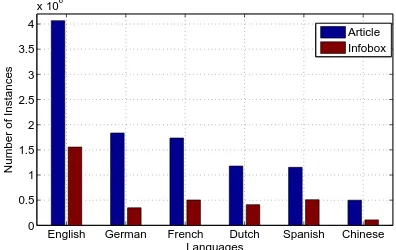
However, most infoboxes in different Wikipedi-a lWikipedi-anguWikipedi-age versions Wikipedi-are missing. Figure 1 shows the statistics of article numbers and infobox infor-mation for six major Wikipedias. Only 32.82% of the articles have infoboxes on average, and the numbers of infoboxes for these Wikipedias vary significantly. For instance, the English Wikipedi-a hWikipedi-as 13 times more infoboxes thWikipedi-an the Chinese Wikipedia and 3.5 times more infoboxes than the second largest Wikipedia of German language.
English German French Dutch Spanish Chinese 0
0.5 1 1.5 2 2.5 3 3.5 4
x 106
Languages
Number of Instances
[image:1.595.313.511.397.522.2]Article Infobox
Figure 1: Statistics for Six Major Wikipedias.
To solve this problem, KYLIN has been pro-posed to extract the missing infoboxes from un-structured article texts for the English Wikipedi-a (Wu Wikipedi-and Weld, 2007). KYLIN performs well when sufficient training data are available, and such techniques as shrinkage and retraining have been used to increase recall from English Wikipedia’s long tail of sparse infobox classes (Weld et al., 2008; Wu et al., 2008). The extraction performance of KYLIN is limited by the number of available training samples.
Due to the great imbalance between different Wikipedia language versions, it is difficult to gath-er sufficient training data from a single Wikipedia. Some translation-based cross-lingual knowledge
extraction methods have been proposed (Adar et al., 2009; Bouma et al., 2009; Adafre and de Rijke, 2006). These methods concentrate on translating existing infoboxes from a richer source language version of Wikipedia into the target language. The recall of new target infoboxes is highly limited by the number of equivalent cross-lingual arti-cles and the number of existing source infoboxes. Take Chinese-English1Wikipedias as an example: current translation-based methods only work for 87,603 Chinese Wikipedia articles, 20.43% of the total 428,777 articles. Hence, the challenge re-mains: how could we supplement the missing in-foboxes for the rest 79.57% articles?
On the other hand, the numbers of existing in-fobox attributes in different languages are high-ly imbalanced. Table 1 shows the comparison of the numbers of the articles for the attributes in template PERSON between English and Chi-nese Wikipedia. Extracting the missing value for these attributes, such as awards, weight, influences and style, inside the single Chinese Wikipedia is intractable due to the rarity of existing Chinese attribute-value pairs.
Attribute en zh Attribute en zh
name 82,099 1,486 awards 2,310 38
birth date 77,850 1,481 weight 480 12
occupation 66,768 1,279 influences 450 6
nationality 20,048 730 style 127 1
Table 1: The Numbers of Articles in TEMPLATE PERSON between English(en) and Chinese(zh).
In this paper, we have the following hypothesis: one can use the rich English (auxiliary) informa-tion to assist the Chinese (target) infobox extrac-tion. In general, we address the problem of cross-lingual knowledge extraction by using the imbal-ance between Wikipedias of different languages. For each attribute, we aim to learn an extractor to find the missing value from the unstructured arti-cle texts in the target Wikipedia by using the rich information in the source language. Specifically, we treat this cross-lingual information extraction task as a transfer learning-based binary classifica-tion problem.
The contributions of this paper are as follows:
1. We propose a transfer learning-based cross-lingual knowledge extraction framework
1Chinese-English denotes the task of Chinese Wikipedia
infobox completion using English Wikipedia
called WikiCiKE. The extraction perfor-mance for the target Wikipedia is improved by using rich infoboxes and textual informa-tion in the source language.
2. We propose the TrAdaBoost-based extractor training method to avoid the problems of top-ic drift and translation errors of the source Wikipedia. Meanwhile, some language-independent features are introduced to make WikiCiKE as general as possible.
3. Chinese-English experiments for four typ-ical attributes demonstrate that WikiCiKE outperforms both the monolingual extrac-tion method and current translaextrac-tion-based method. The increases of 12.65% for pre-cision and 12.47% for recall in the template named person are achieved when only 30 tar-get training articles are available.
The rest of this paper is organized as follows. Section 2 presents some basic concepts, the prob-lem formalization and the overview of WikiCiKE. In Section 3, we propose our detailed approaches. We present our experiments in Section 4. Some re-lated work is described in Section 5. We conclude our work and the future work in Section 6.
2 Preliminaries
In this section, we introduce some basic con-cepts regarding Wikipedia, formally defining the key problem of cross-lingual knowledge extrac-tion and providing an overview of the WikiCiKE framework.
2.1 Wiki Knowledge Base and Wiki Article
We consider each language version of Wikipedia as a wiki knowledge base, which can be represent-ed asK = {ai}pi=1, whereai is a disambiguated article inKandpis the size ofK.
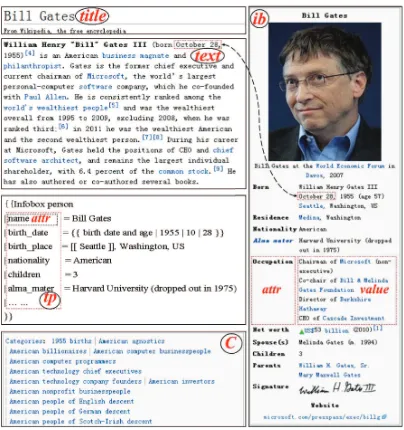
Formally we define a wiki article a ∈ K as a 5-tuplea= (title, text, ib, tp, C), where
• titledenotes the title of the articlea,
• textdenotes the unstructured text description of the articlea,
Figure 2: Simplified Article of “Bill Gates”.
• tp = {attri}ri=1 is the infobox template
as-sociated with ib, where r is the number of attributes for one specific template, and
• C denotes the set of categories to which the articleabelongs.
Figure 2 gives an example of these five impor-tant elements concerning the article named “Bill Gates”.
In what follows, we will use named subscripts, such asaBill Gates, or index subscripts, such asai, to refer to one particular instance interchangeably. We will use “name in TEMPLATE PERSON” to refer to the attribute attrname in the template tpP ERSON. In this cross-lingual task, we use the source (S) and target (T) languages to denote the languages of auxiliary and target Wikipedias, re-spectively. For example, KS indicates the source wiki knowledge base, and KT denotes the target wiki knowledge base.
2.2 Problem Formulation
Mining new infobox information from unstruc-tured article texts is actually a multi-template, multi-slot information extraction problem. In our task, each template represents an infobox template and each slot denotes an attribute. In the Wiki-CiKE framework, for each attribute attrT in an infobox templatetpT, we treat the task of missing value extraction as a binary classification prob-lem. It predicts whether a particular word (token) from the articletextis the extraction target (Finn and Kushmerick, 2004; Lafferty et al., 2001).
Given an attribute attrT and an instance (word/token) xi, XS = {xi}ni=1 and XT =
{xi}ni=+nm+1are the sets of instances (words/tokens)
in the source and the target language respectively. xican be represented as a feature vector according to its context. Usually, we haven≫min our set-ting, with much more attributes in the source that those in the target. The functiong:X7→Y maps the instance from X = XS ∪XT to the true la-bel ofY ={0, 1}, where1represents the extrac-tion target (positive) and0denotes the background information (negative). Because the number of target instances m is inadequate to train a good classifier, we combine the source and target in-stances to construct the training data set asT D =
T DS∪T DT, where T DS = {xi, g(xi)}ni=1 and
T DT = {xi, g(xi)}ni=+nm+1 represent the source and target training data, respectively.
Given the combined training data setT D, our objective is to estimate a hypothesisf : X 7→ Y that minimizes the prediction error on testing data in the target language. Our idea is to determine the useful part of T DS to improve the classification performance inT DT. We view this as a transfer learning problem.
2.3 WikiCiKE Framework
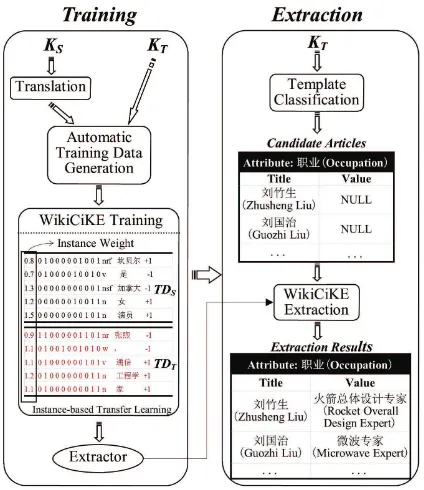
WikiCiKE learns an extractor for a given attribute attrT in the target Wikipedia. As shown in Fig-ure 3, WikiCiKE contains four key components: (1) Automatic Training Data Generation: given the target attributeattrT and two wiki knowledge bases KS and KT, WikiCiKE first generates the training data set T D = T DS ∪T DT automati-cally. (2) WikiCiKE Training: WikiCiKE uses a transfer learning-based classification method to train the classifier (extractor)f :X7→Y by using T DS∪T DT. (3) Template Classification: Wi-kiCiKE then determines proper candidate articles which are suitable to generate the missing value of attrT. (4) WikiCiKE Extraction: given a candi-date articlea, WikiCiKE uses the learned extractor f to label each word in thetextofa, and generate the extraction result in the end.
3 Our Approach
Figure 3: WikiCiKE Framework.
3.1 Automatic Training Data Generation
To generate the training data for the target at-tribute attrT, we first determine the equivalen-t cross-lingual aequivalen-tequivalen-tribuequivalen-te attrS. Fortunately, some templates in non-English Wikipedia (e.g. Chinese Wikipedia) explicitly match their attributes with their counterparts in English Wikipedia. There-fore, it is convenient to align the cross-lingual at-tributes using English Wikipedia as bridge. For attributes that can not be aligned in this way, cur-rently we manually align them. The manual align-ment is worthwhile because thousands of articles belong to the same template may benefit from it and at the same time it is not very costly. In Chi-nese Wikipedia, the top 100 templates have cov-ered nearly 80% of the articles which have been assigned a template.
Once the aligned attribute mapping attrT ↔ attrSis obtained, we collect the articles from both KS and KT containing the corresponding attr. The collected articles fromKS are translated into the target language. Then, we use a uniform au-tomatic method, which primarily consists of word labeling and feature vector generation, to generate the training data setT D={(x, g(x))}from these collected articles.
For each collected article a = {title, text, ib, tp, C} and its value of attr, we can automatically label each word x in text according to whether x and its neighbors are
contained by thevalue. Thetextand value are processed as bags of words{x}text and{x}value. Then for eachxi ∈ {x}textwe have:
g(xi) =
1 xi∈ {x}value, |{x}value|= 1
1 xi−1, xi∈ {x}valueor xi, xi+1∈ {x}value,
|{x}value|>1
0 otherwise
(1)
After the word labeling, each instance (word/token) is represented as a feature vec-tor. In this paper, we propose a general feature space that is suitable for most target languages. As shown in Table 2, we classify the features used in WikiCiKE into three categories: format features, POS tag features and token features.
Category Feature Example
Format First token of sentence `}L
feature Hello World!
In first half of sentence `}L
Hello World!
Starts with two digits 1231å
31thDec.
Starts with four digits 1999t)
1999’s summer
Contains a cash sign 10åor 10$
Contains a percentage 10%
symbol
Stop words ,0,Ù&
of, the, a, an
Pure number 365
Part of an anchor text 5qü
Movie Director
Begin of an anchor text 8¾¡
Game Designer
POS tag POS tag of current token
features POS tags of
previous 5 tokens POS tags of next 5 tokens
Token Current token
[image:4.595.306.526.270.590.2]features Previous 5 tokens Next 5 tokens Is current token contained by title Is one of previous 5 tokens contained by title
Table 2: Feature Definition.
The target training dataT DT is directly gener-ated from articles in the target language Wikipedi-a. Articles from the source language Wikipedia are translated into the target language in advance and then transformed into training data T DS. In next section, we will discuss how to train an ex-tractor fromT D=T DS∪T DT.
3.2 WikiCiKE Training
error for the testing data in the target language. Traditional machine learning approaches attempt to determinef by minimizing some loss function Lon the predictionf(x)for the training instance xand its real labelg(x), which is
ˆ
f= argmin
f∈Θ
X
L(f(x), g(x)) where(x, g(x))∈T DT
(2)
In this paper, we use TrAdaBoost (Dai et al., 2007), which is an instance-based transfer learn-ing algorithm that was first proposed by Dai to find
ˆ
f. TrAdaBoost requires that the source training instances XS and target training instancesXT be drawn from the same feature space. In WikiCiKE, the source articles are translated into the target language in advance to satisfy this requirement. Due to the topic drift problem and translation er-rors, the joint probability distributionPS(x, g(x)) is not identical toPT(x, g(x)). We must adjust the source training data T DS so that they fit the dis-tribution onT DT. TrAdaBoost iteratively updates the weights of all training instances to optimize the prediction error. Specifically, the weight-updating strategy for the source instances is decided by the loss on the target instances.
For eacht = 1 ∼ T iteration, given a weight vector pt normalized from wt(wt is the weight vector before normalization), we call a basic clas-sifier F that can address weighted instances and then find a hypothesisf that satisfies
ˆ
ft= argmin
f∈ΘF
X
L(pt, f(x), g(x))
(x, g(x))∈T DS∪T DT
(3)
Letǫtbe the prediction error offˆtat thetth iter-ation on the target training instancesT DT, which is
ǫt= Pn+m1
k=n+1wtk
×
n+mX
k=n+1
(wtk× |ftˆ(xk)−yk|) (4)
Withǫt, the weight vectorwtis updated by the
function:
wt+1=h(wt, ǫt) (5)
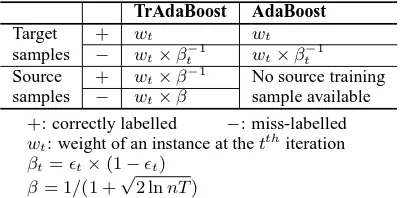
[image:5.595.317.519.62.161.2]The weight-updating strategyhis illustrated in Table 3.
Finally, a final classifier fˆcan be obtained by combiningfˆT /2∼fˆT.
TrAdaBoost has a convergence rate of O(pln(n/N)), where n and N are the number of source samples and number of maximum iterations respectively.
TrAdaBoost AdaBoost
Target + wt wt
samples − wt×β−t1 wt×βt−1
Source + wt×β−1 No source training
samples − wt×β sample available
+: correctly labelled −: miss-labelled wt: weight of an instance at thetthiteration βt=ǫt×(1−ǫt)
β= 1/(1 +√2 lnnT)
Table 3: Weight-updating Strategy of TrAd-aBoost.
3.3 Template Classification
Before using the learned classifier f to extrac-t missing infobox value for extrac-the extrac-targeextrac-t aextrac-textrac-tribuextrac-te attrT, we must select the correct articles to be pro-cessed. For example, the article aN ew Y ork is not a proper article for extracting the missing value of the attributeattrbirth day.
If a already has an incomplete infobox, it is clear that the correcttpis the template of its own infoboxib. For those articles that have no infobox-es, we use the classical 5-nearest neighbor algo-rithm to determine their templates (Roussopoulos et al., 1995) using their category labels, outlinks, inlinks as features (Wang et al., 2012). Our classi-fier achieves an average precision of 76.96% with an average recall of 63.29%, and can be improved further. In this paper, we concentrate on the Wiki-CiKE training and extraction components.
3.4 WikiCiKE Extraction
Given an article adetermined by template classi-fication, we generate the missing value of attr from the corresponding text. First, we turn the text into a word sequence and compute the fea-ture vector for each word based on the feafea-ture definition in Section 3.1. Next we usef to label each word, and we get a labeled sequencetextlas textl={xf(x1)
1 ...x
f(xi−1)
i−1 x
f(xi)
i x f(xi+1)
i+1 ...x
f(xn)
4 Experiments
In this section, we present our experiments to e-valuate the effectiveness of WikiCiKE, where we focus on the Chinese-English case; in other words, the target language is Chinese and the source lan-guage is English. It is part of our future work to try other language pairs which two Wikipedias of these languages are imbalanced in infobox infor-mation such as English-Dutch.
4.1 Experimental Setup
4.1.1 Data Sets
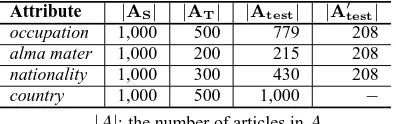
Our data sets are from Wikipedia dumps2 generat-ed on April 3, 2012. For each attribute, we collect both labeled articles (articles that contain the cor-responding attribute attr) and unlabeled articles in Chinese. We split the labeled articles into two subsetsAT and Atest(AT ∩Atest =∅), in which AT is used as target training articles andAtest is used as the first testing set. For the unlabeled arti-cles, represented asA′test, we manually label their infoboxes with their texts and use them as the sec-ond testing set. For each attribute, we also collect a set of labeled articles ASin English as the source training data. Our experiments are performed on four attributes, which are occupation, nationality, alma mater in TEMPLATE PERSON, and coun-try in TEMPLATE FILM. In particular, we extract values from the first two paragraphs of the texts because they usually contain most of the valuable information. The details of data sets on these at-tributes are given in Table 4.
Attribute |AS| |AT| |Atest| |A′test| occupation 1,000 500 779 208
alma mater 1,000 200 215 208
nationality 1,000 300 430 208
[image:6.595.84.282.514.576.2]country 1,000 500 1,000 − |A|: the number of articles inA
Table 4: Data Sets.
4.1.2 Comparison Methods
We compare our WikiCiKE method with two dif-ferent kinds of methods, the monolingual knowl-edge extraction method and the translation-based method. They are implemented as follows:
1. KE-Mon is the monolingual knowledge ex-tractor. The difference between WikiCiKE and KE-Mon is that KE-Mon only uses the Chinese training data.
2
http://dumps.wikimedia.org/
2. KE-Tr is the translation-based extractor. It obtains the values by two steps: finding their counterparts (if available) in English using Wikipedia cross-lingual links and attribute alignments, and translating them into Chi-nese.
We conduct two series of evaluation to compare WikiCiKE with KE-Mon and KE-Tr, respectively.
1. We compare WikiCiKE with KE-Mon on the first testing data set Atest, where most val-ues can be found in the articles’ texts in those labeled articles, in order to demonstrate the performance improvement by using cross-lingual knowledge transfer.
2. We compare WikiCiKE with KE-Tr on the second testing data set A′test, where the existences of values are not guaranteed in those randomly selected articles, in order to demonstrate the better recall of WikiCiKE.
For implementation details, the weighted-SVM is used as the basic learner f both in WikiCiKE and KE-Mon (Zhang et al., 2009), and Baidu Translation API3 is used as the translator both in WikiCiKE and KE-Tr. The Chinese texts are pre-processed using ICTCLAS4 for word segmenta-tion.
4.1.3 Evaluation Metrics
Following Lavelli’s research on evaluation of in-formation extraction (Lavelli et al., 2008), we per-form evaluation as follows.
1. We evaluate eachattrseparately.
2. For eachattr, there is exactly onevalue ex-tracted.
3. No alternative occurrence of real value is available.
4. The overlap ratio is used in this paper rather than “exactly matching” and “containing”.
Given an extracted value v′ = {w′} and its corresponding realvalue v={w}, two measure-ments for evaluating the overlap ratio are defined:
recall: the rate of matched tokens w.r.t. the real
value. It can be calculated using
R(v′, v) = |v∩v′| |v|
3
http://openapi.baidu.com/service
4
precision: the rate of matched tokens w.r.t. the
extractedvalue. It can be calculated using
P(v′, v) = |v∩v′| |v′|
We use the average of these two measures to evaluate the performance of our extractor as fol-lows:
R=avg(Ri(v′, v)) ai∈Atest
P =avg(Pi(v′, v)) ai∈Atestand vi′ 6=∅
The recall and precision range from 0 to 1 and are first calculated on a single instance and then averaged over the testing instances.
4.2 Comparison with KE-Mon
In these experiments, WikiCiKE trains extractors on AS ∪AT, and KE-Mon trains extractors just onAT. We incrementally increase the number of target training articles from 10 to 500 (if available) to compare WikiCiKE with KE-Mon in different situations. We use the first testing data setAtestto evaluate the results.
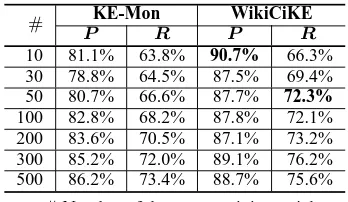
Figure 4 and Table 5 show the experimental re-sults on TEMPLATE PERSON and FILM. We can see that WikiCiKE outperforms KE-Mon on all three attributions especially when the number of target training samples is small. Although the re-call for alma mater and the precision for nation-ality of WikiCiKE are lower than KE-Mon when only 10 target training articles are available, Wi-kiCiKE performs better than KE-Mon if we take into consideration both precision and recall.
10 30 50 100 200 300 500 0
0.2 0.4 0.6 0.8
number of target training articles P(KE−Mon) P(WikiCiKE) R(KE−Mon) R(WikiCiKE)
(a) occupation
10 30 50 100 200 0.4
0.5 0.6 0.7 0.8 0.9 1
number of target training articles P(KE−Mon) P(WikiCiKE) R(KE−Mon) R(WikiCiKE)
(b) alma mater
10 30 50 100 200 300 0.5
0.6 0.7 0.8 0.9 1
number of target training articles P(KE−Mon) P(WikiCiKE) R(KE−Mon) R(WikiCiKE)
(c) nationality
10 30 50 100 200 300 500 0
5 10 15 20
percent(%)
number of target training articles performance gain
P R
[image:7.595.329.503.192.293.2](d) average improvements
Figure 4: Results for TEMPLATE PERSON.
Figure 4(d) shows the average improvements yielded by WikiCiKE w.r.t KE-Mon on TEM-PLATE PERSON. We can see that WikiCiKE yields significant improvements when only a few articles are available in target language and the im-provements tend to decrease as the number of tar-get articles is increased. In this case, the articles in the target language are sufficient to train the ex-tractors alone.
# KE-Mon WikiCiKE
P R P R
10 81.1% 63.8% 90.7% 66.3%
30 78.8% 64.5% 87.5% 69.4%
50 80.7% 66.6% 87.7% 72.3%
100 82.8% 68.2% 87.8% 72.1%
200 83.6% 70.5% 87.1% 73.2%
300 85.2% 72.0% 89.1% 76.2%
500 86.2% 73.4% 88.7% 75.6%
#Number of the target training articles.
Table 5: Results for country in TEMPLATE FILM.
4.3 Comparison with KE-Tr
We compare WikiCiKE with KE-Tr on the second testing data setA′test.
From Table 6 it can be clearly observed that Wi-kiCiKE significantly outperforms KE-Tr both in precision and recall. The reasons why the recal-l of KE-Tr is extremerecal-ly recal-low are two-forecal-ld. First, because of the limit of cross-lingual links and in-foboxes in English Wikipedia, only a very smal-l set of vasmal-lues is found by KE-Tr. Furthermore, many values obtained using the translator are in-correct because of translation errors. WikiCiKE uses translators too, but it has better tolerance to translation errors because the extracted value is from the target article texts instead of the output of translators.
Attribute KE-Tr WikiCiKE
P R P R
occupation 27.4% 3.40% 64.8% 26.4%
nationality 66.3% 4.60% 70.0% 55.0% alma mater 66.7% 0.70% 76.3% 8.20%
Table 6: Results of WikiCiKE vs. KE-Tr.
4.4 Significance Test
[image:7.595.80.289.555.737.2]WikiCiKE can be clearly observed from Table 6 so there is no need for further significance test. In this paper, we use McNemar’s significance test (Dietterich and Thomas, 1998).
Table 7 shows the results of significance test calculated for the average on all tested attributes. When the number of target training articles is less than 100, theχ is much less than 10.83 that cor-responds to a significance level 0.001. It suggests that the chance that WikiCiKE is not better than KE-Mon is less than 0.001.
# 10 30 50 100 200 300 500
χ 179.5 107.3 51.8 32.8 4.1 4.3 0.3
#Number of the target training articles.
Table 7: Results of Significance Test.
4.5 Overall Analysis
As shown in above experiments, we can see that WikiCiKE outperforms both KE-Mon and KE-Tr. When only 30 target training samples are avail-able, WikiCiKE reaches comparable performance of KE-Mon using 300-500 target training samples. Among all of the 72 attributes in TEMPLATE PERSON of Chinese Wikipedia, 39 (54.17%) and 55 (76.39%) attributes have less than 30 and 200 labeled articles respectively. We can see that Wi-kiCiKE can save considerable human labor when no sufficient target training samples are available.
We also examined the errors by WikiCiKE and they can be categorized into three classes. For at-tribute occupation when 30 target training sam-ples are used, there are 71 errors. The first cat-egory is caused by incorrect word segmentation (40.85%). In Chinese, there is no space between words so we need to segment them before extrac-tion. The result of word segmentation directly decide the performance of extraction so it caus-es most of the errors. The second category is be-cause of the incomplete infoboxes (36.62%). In evaluation of KE-Mon, we directly use the val-ues in infoboxex as golden valval-ues, some of them are incomplete so the correct predicted values will be automatically judged as the incorrect in these cases. The last category is mismatched words (22.54%). The predicted value does not match the golden value or a part of it. In the future, we can improve the performance of WikiCiKE by polish-ing the word segmentation result.
5 Related Work
Some approaches of knowledge extraction from the open Web have been proposed (Wu et al., 2012; Yates et al., 2007). Here we focus on the extraction inside Wikipedia.
5.1 Monolingual Infobox Extraction
KYLIN is the first system to autonomously ex-tract the missing infoboxes from the correspond-ing article texts by uscorrespond-ing a self-supervised learn-ing method (Wu and Weld, 2007). KYLIN per-forms well when enough training data are avail-able. Such techniques as shrinkage and retraining are proposed to increase the recall from English Wikipedia’s long tail of sparse classes (Wu et al., 2008; Wu and Weld, 2010). Different from Wu’s research, WikiCiKE is a cross-lingual knowledge extraction framework, which leverags rich knowl-edge in the other language to improve extraction performance in the target Wikipedia.
5.2 Cross-lingual Infobox Completion
Current translation based methods usually con-tain two steps: cross-lingual attribute t and value translation. The attribute alignmen-t salignmen-traalignmen-tegies can be grouped inalignmen-to alignmen-two caalignmen-tegories: cross-lingual link based methods (Bouma et al., 2009) and classification based methods (Adar et al., 2009; Nguyen et al., 2011; Aumueller et al., 2005; Adafre and de Rijke, 2006; Li et al., 2009). After the first step, the value in the source lan-guage is translated into the target lanlan-guage. E. Adar’s approach gives the overall precision of 54% and recall of 40% (Adar et al., 2009). How-ever, recall of these methods is limited by the number of equivalent cross-lingual articles and the number of infoboxes in the source language. It is also limited by the quality of the translators. Wi-kiCiKE attempts to mine the missing infoboxes directly from the article texts and thus achieves a higher recall compared with these methods as shown in Section 4.3.
5.3 Transfer Learning
tradition-al learning techniques (Dai et tradition-al., 2007). Transfer learning have been widely studied for classifica-tion, regression, and cluster problems. However, few efforts have been spent in the information extraction tasks with knowledge transfer.
6 Conclusion and Future Work
In this paper we proposed a general cross-lingual knowledge extraction framework called Wiki-CiKE, in which extraction performance in the tar-get Wikipedia is improved by using rich infobox-es in the source language. The problems of topic drift and translation error were handled by using the TrAdaBoost model. Chinese-English exper-imental results on four typical attributes showed that WikiCiKE significantly outperforms both the current translation based methods and the mono-lingual extraction methods. In theory, WikiCiKE can be applied to any two wiki knowledge based of different languages.
We have been considering some future work. Firstly, more attributes in more infobox templates should be explored to make our results much stronger. Secondly, knowledge in a minor lan-guage may also help improve extraction perfor-mance for a major language due to the cultural and religion differences. A bidirectional cross-lingual extraction approach will also be studied. Last but not least, we will try to extract multiple attr-value pairs at the same time for each article.
Furthermore, our work is part of a more ambi-tious agenda on exploitation of linked data. On the one hand, being able to extract data and knowl-edge from multilingual sources such as Wikipedi-a could help improve the coverWikipedi-age of linked dWikipedi-atWikipedi-a for applications. On the other hand, we are also investigating how to possibly integrate informa-tion, including subjective information (Sensoy et al., 2013), from multiple sources, so as to better support data exploitation in context dependent ap-plications.
Acknowledgement
The work is supported by NSFC (No. 61035004), NSFC-ANR (No. 61261130588), 863 High Tech-nology Program (2011AA01A207), FP7-288342, FP7 K-Drive project (286348), the EPSRC WhatIf project (EP/J014354/1) and THU-NUS NExT Co-Lab. Besides, we gratefully acknowledge the as-sistance of Haixun Wang (MSRA) for improving the paper work.
References
S. Fissaha Adafre and M. de Rijke. 2006. Find-ing Similar Sentences across Multiple Languages in Wikipedia. EACL 2006 Workshop on New Text:
Wikis and Blogs and Other Dynamic Text Sources.
Sisay Fissaha Adafre and Maarten de Rijke. 2005. Discovering Missing Links in Wikipedia.
Proceed-ings of the 3rd International Workshop on Link Dis-covery.
Eytan Adar, Michael Skinner and Daniel S. Weld. 2009. Information Arbitrage across Multi-lingual Wikipedia. WSDM’09.
David Aumueller, Hong Hai Do, Sabine Massmann and Erhard Rahm”. 2005. Schema and ontology match-ing with COMA++. SIGMOD Conference’05.
Christian Bizer, Jens Lehmann, Georgi Kobilarov, S¨oren Auer, Christian Becker, Richard Cyganiak and Sebastian Hellmann. 2009. DBpedia - A crys-tallization Point for the Web of Data. J. Web Sem..
Christian Bizer, Tom Heath, Kingsley Idehen and Tim Berners-Lee. 2008. Linked data on the web (L-DOW2008). WWW’08.
Kurt Bollacker, Colin Evans, Praveen Paritosh, Tim S-turge and Jamie Taylor. 2008. Freebase: a Collabo-ratively Created Graph Database for Structuring Hu-man Knowledge. SIGMOD’08.
Gosse Bouma, Geert Kloosterman, Jori Mur, Gertjan Van Noord, Lonneke Van Der Plas and Jorg Tiede-mann. 2008. Question Answering with Joost at CLEF 2007. Working Notes for the CLEF 2008 Workshop.
Gosse Bouma, Sergio Duarte and Zahurul Islam. 2009. Cross-lingual Alignment and Completion of Wikipedia Templates. CLIAWS3 ’09.
Wenyuan Dai, Qiang Yang, Gui-Rong Xue and Yong Yu. 2007. Boosting for Transfer Learning.
ICM-L’07.
Dietterich and Thomas G. 1998. Approximate Statis-tical Tests for Comparing Supervised Classification Learning Algorithms. Neural Comput..
Sergio Ferr´andez, Antonio Toral, ´ıscar Ferr´andez, An-tonio Ferr´andez and Rafael Mu ˜noz. 2009. Exploit-ing Wikipedia and EuroWordNet to Solve Cross-Lingual Question Answering. Inf. Sci..
Aidan Finn and Nicholas Kushmerick. 2004. Multi-level Boundary Classification for Information Ex-traction. ECML.
Achille Fokoue, Felipe Meneguzzi, Murat Sensoy and Jeff Z. Pan. 2012. Querying Linked Ontological Data through Distributed Summarization. Proc. of
Yoav Freund and Robert E. Schapire. 1997. A Decision-Theoretic Generalization of On-Line Learning and an Application to Boosting. J.
Com-put. Syst. Sci..
Norman Heino and Jeff Z. Pan. 2012. RDFS Rea-soning on Massively Parallel Hardware. Proc. of
the 11th International Semantic Web Conference (ISWC2012).
Aidan Hogan, Jeff Z. Pan, Axel Polleres and Yuan Ren. 2011. Scalable OWL 2 Reasoning for Linked Data.
Reasoning Web. Semantic Technologies for the Web of Data.
Andreas Hotho, Robert J¨aschke, Christoph Schmitz and Gerd Stumme. 2006. Information Retrieval in Folksonomies: Search and Ranking. ESWC’06.
John D. Lafferty, Andrew McCallum and Fernando C. N. Pereira. 2001. Conditional Random Fields: Probabilistic Models for Segmenting and Labeling Sequence Data. ICML’01.
Alberto Lavelli, MaryElaine Califf, Fabio Ciravegna, Dayne Freitag, Claudio Giuliano, Nicholas Kush-merick, Lorenza Romano and Neil Ireson. 2008. Evaluation of Machine Learning-based Information Extraction Algorithms: Criticisms and Recommen-dations. Language Resources and Evaluation.
Juanzi Li, Jie Tang, Yi Li and Qiong Luo. 2009. Ri-MOM: A Dynamic Multistrategy Ontology Align-ment Framework. IEEE Trans. Knowl. Data Eng..
Xiao Ling, Gui-Rong Xue, Wenyuan Dai, Yun Jiang, Qiang Yang and Yong Yu. 2008. Can Chinese We-b Pages We-be Classified with English Data Source?.
WWW’08.
Sheila A. McIlraith, Tran Cao Son and Honglei Zeng. 2001. Semantic Web Services. IEEE Intelligent Systems.
Thanh Hoang Nguyen, Viviane Moreira, Huong N-guyen, Hoa Nguyen and Juliana Freire. 2011. Mul-tilingual Schema Matching for Wikipedia Infoboxes.
CoRR.
Jeff Z. Pan and Edward Thomas. 2007. Approximat-ing OWL-DL Ontologies. 22nd AAAI Conference
on Artificial Intelligence (AAAI-07).
Jeff Z. Pan and Ian Horrocks. 2007. RDFS(FA): Con-necting RDF(S) and OWL DL. IEEE Transaction
on Knowledge and Data Engineering. 19(2): 192 -206.
Jeff Z. Pan and Ian Horrocks. 2006. OWL-Eu: Adding Customised Datatypes into OWL. Journal of Web
Semantics.
Sinno Jialin Pan and Qiang Yang. 2010. A Survey on Transfer Learning. IEEE Trans. Knowl. Data Eng..
Nick Roussopoulos, Stephen Kelley and Fr´ed´eric Vin-cent. 1995. Nearest Neighbor Queries. SIGMOD
Conference’95.
Murat Sensoy, Achille Fokoue, Jeff Z. Pan, Timothy Norman, Yuqing Tang, Nir Oren and Katia Sycara. 2013. Reasoning about Uncertain Information and Conflict Resolution through Trust Revision. Proc.
of the 12th International Conference on Autonomous Agents and Multiagent Systems (AAMAS2013).
Fabian M. Suchanek, Gjergji Kasneci and Gerhard Weikum. 2007. Yago: a Core of Semantic Knowl-edge. WWW’07.
Max Volkel, Markus Krotzsch, Denny Vrandecic, Heiko Haller and Rudi Studer. 2006. Semantic Wikipedia. WWW’06.
Zhichun Wang, Juanzi Li, Zhigang Wang and Jie Tang. 2012. Cross-lingual Knowledge Linking across Wi-ki Knowledge Bases. 21st International World Wide
Web Conference.
Daniel S. Weld, Fei Wu, Eytan Adar, Saleema Amer-shi, James Fogarty, Raphael Hoffmann, Kayur Pa-tel and Michael Skinner. 2008. Intelligence in Wikipedia. AAAI’08.
Fei Wu and Daniel S. Weld. 2007. Autonomously Se-mantifying Wikipedia. CIKM’07.
Fei Wu and Daniel S. Weld. 2010. Open Information Extraction Using Wikipedia. ACL’10.
Fei Wu, Raphael Hoffmann and Daniel S. Weld. 2008. Information Extraction from Wikipedia: Moving down the Long Tail. KDD’08.
Wentao Wu, Hongsong Li, Haixun Wang and Kenny Qili Zhu. 2012. Probase: a Probabilistic Taxonomy for Text Understanding. SIGMOD Conference’12.
Alexander Yates, Michael Cafarella, Michele Banko, Oren Etzioni, Matthew Broadhead and Stephen Soderland. 2007. TextRunner: Open Information Extraction on the Web. NAACL-Demonstrations’07.
Xinfeng Zhang, Xiaozhao Xu, Yiheng Cai and Yaowei Liu. 2009. A Weighted Hyper-Sphere SVM.