Word Alignment Modeling with Context Dependent Deep Neural Network
Nan Yang1, Shujie Liu2, Mu Li2, Ming Zhou2, Nenghai Yu1 1University of Science and Technology of China, Hefei, China
2Microsoft Research Asia, Beijing, China
{v-nayang,shujliu,muli,mingzhou}@microsoft.com
Abstract
In this paper, we explore a novel bilin-gual word alignment approach based on DNN (Deep Neural Network), which has been proven to be very effective in var-ious machine learning tasks (Collobert et al., 2011). We describe in detail how we adapt and extend the CD-DNN-HMM (Dahl et al., 2012) method intro-duced in speech recognition to the HMM-based word alignment model, in which bilingual word embedding is discrimina-tively learnt to capture lexical translation information, and surrounding words are leveraged to model context information in bilingual sentences. While being ca-pable to model the rich bilingual corre-spondence, our method generates a very compact model with much fewer parame-ters. Experiments on a large scale English-Chinese word alignment task show that the proposed method outperforms the HMM and IBM model 4 baselines by 2 points in F-score.
1 Introduction
Recent years research communities have seen a strong resurgent interest in modeling with deep (multi-layer) neural networks. This trending topic, usually referred under the nameDeep Learning, is started by ground-breaking papers such as (Hin-ton et al., 2006), in which innovative training pro-cedures of deep structures are proposed. Unlike shallow learning methods, such as Support Vector Machine, Conditional Random Fields, and Maxi-mum Entropy, which need hand-craft features as input, DNN can learn suitable features (represen-tations) automatically with raw input data, given a training objective.
DNN did not achieve expected success until 2006, when researchers discovered a proper way
to intialize and train the deep architectures, which contains two phases: layer-wise unsupervised training and supervised fine tuning. For pre-training, Restricted Boltzmann Machine (RBM) (Hinton et al., 2006), auto-encoding (Bengio et al., 2007) and sparse coding (Lee et al., 2007) are pro-posed and popularly used. The unsupervised pre-training trains the network one layer at a time, and helps to guide the parameters of the layer towards better regions in parameter space (Bengio, 2009). Followed by fine tuning in this region, DNN is shown to be able to achieve state-of-the-art per-formance in various area, or even better (Dahl et al., 2012) (Kavukcuoglu et al., 2010). DNN also achieved breakthrough results on the ImageNet dataset for objective recognition (Krizhevsky et al., 2012). For speech recognition, (Dahl et al., 2012) proposed context-dependent neural network with large vocabulary, which achieved 16.0% rel-ative error reduction.
DNN has also been applied in Natural Lan-guage Processing (NLP) field. Most works con-vert atomic lexical entries into a dense, low di-mensional, real-valued representation, calledword embedding; Each dimension represents a latent as-pect of a word, capturing its semantic and syntac-tic properties (Bengio et al., 2006). Word embed-ding is usually first learned from huge amount of monolingual texts, and then fine-tuned with task-specific objectives. (Collobert et al., 2011) and (Socher et al., 2011) further apply Recursive Neu-ral Networks to address the structuNeu-ral prediction tasks such as tagging and parsing, and (Socher et al., 2012) explores the compositional aspect of word representations.
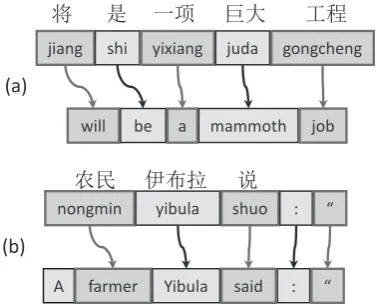
Inspired by successful previous works, we pro-pose a new DNN-based word alignment method, which exploits contextual and semantic similari-ties between words. As shown in example (a) of Figure 1, in word pair {“juda” ⇒“mammoth”}, the Chinese word “juda” is a common word, but
mammoth
will be a
jiang shi yixiang juda gongcheng
job (a)
ሶ ᱟ а亩 ᐘབྷ ᐕ〻
A farmer Yibula said :
nongmin yibula shuo : “
“
(b)
[image:2.595.71.260.64.216.2]ߌ≁ Ժᐳ 䈤
Figure 1: Two examples of word alignment
the English word “mammoth” is not, so it is very hard to align them correctly. If we know that “mammoth” has the similar meaning with “big”, or “huge”, it would be easier to find the corre-sponding word in the Chinese sentence. As we mentioned in the last paragraph,word embedding (trained with huge monolingual texts) has the abil-ity to map a word into a vector space, in which, similar words are near each other.
For example (b) in Figure 1, for the word pair {“yibula” ⇒ “Yibula”}, both the Chinese word “yibula” and English word “Yibula” are rare name entities, but the words around them are very com-mon, which are{“nongmin”, “shuo”}for Chinese side and {“farmer”, “said”}for the English side. The pattern of the context {“nongmin X shuo”
⇒ “farmerX said”}may help to align the word
pair which fill the variableX, and also, the pattern
{“yixiangXgongcheng”⇒“aXjob”}is helpful
to align the word pair{“juda”⇒“mammoth”}for example (a).
Based on the above analysis, in this paper, both the words in the source and target sides are firstly mapped to a vector via a discriminatively trained word embeddings, and word pairs are scored by a multi-layer neural network which takes rich con-texts (surrounding words on both source and target sides) into consideration; and a HMM-like distor-tion model is applied on top of the neural network to characterize structural aspect of bilingual sen-tences.
In the rest of this paper, related work about DNN and word alignment are first reviewed in Section 2, followed by a brief introduction of DNN in Section 3. We then introduce the details of leveraging DNN for word alignment, including the details of our network structure in Section 4
and the training method in Section 5. The mer-its of our approach are illustrated with the experi-ments described in Section 6, and we conclude our paper in Section 7.
2 Related Work
DNN with unsupervised pre-training was firstly introduced by (Hinton et al., 2006) for MNIST digit image classification problem, in which, RBM was introduced as the layer-wise pre-trainer. The layer-wise pre-training phase found a better local maximum for the multi-layer network, thus led to improved performance. (Krizhevsky et al., 2012) proposed to apply DNN to do object recognition task (ImageNet dataset), which brought down the state-of-the-art error rate from 26.1% to 15.3%. (Seide et al., 2011) and (Dahl et al., 2012) apply Context-Dependent Deep Neural Network with HMM (CD-DNN-HMM) to speech recognition task, which significantly outperforms traditional models.
Most methods using DNN in NLP start with a word embedding phase, which maps words into a fixed length, real valued vectors. (Bengio et al., 2006) proposed to use multi-layer neural net-work for language modeling task. (Collobert et al., 2011) applied DNN on several NLP tasks, such as part-of-speech tagging, chunking, name entity recognition, semantic labeling and syntactic pars-ing, where they got similar or even better results than the state-of-the-art on these tasks. (Niehues and Waibel, 2012) shows that machine transla-tion results can be improved by combining neural language model with n-gram traditional language. (Son et al., 2012) improves translation quality of n-gram translation model by using a bilingual neu-ral language model. (Titov et al., 2012) learns a context-free cross-lingual word embeddings to fa-cilitate cross-lingual information retrieval.
3 DNN structures for NLP
The most important and prevalent features avail-able in NLP are the words themselves. To ap-ply DNN to NLP task, the first step is to trans-form a discrete word into its word embedding, a low dimensional, dense, real-valued vector (Ben-gio et al., 2006). Word embeddings often implic-itly encode syntactic or semantic knowledge of the words. Assuming a finite sized vocabularyV,
word embeddings form a(L×|V|)-dimension em-bedding matrixWV, where L is a pre-determined
embedding length; mapping words to embed-dings is done by simply looking up their respec-tive columns in the embedding matrix WV. The
lookup process is called alookup layerLT, which
is usually the first layer after the input layer in neu-ral network.
After words have been transformed to their em-beddings, they can be fed into subsequent classi-cal network layers to model highly non-linear re-lations:
zl=fl(Mlzl−1+bl) (1)
wherezl is the output oflth layer,Mlis a|zl| × |zl−1| matrix, bl is a |zl|-length vector, and fl
is an activation function. Except for the last
layer,flmust be non-linear. Common choices for fl include sigmoid function, hyperbolic function,
“hard” hyperbolic function etc. Following (Col-lobert et al., 2011), we choose “hard” hyperbolic function as our activation function in this work:
htanh(x) =
1 ifxis greater than 1
−1 ifxis less than -1 x otherwise
(2) If probabilistic interpretation is desired, asoftmax layer (Bridle, 1990) can be used to do normaliza-tion:
zil= e zil−1
|zl|
P j=1
ezlj−1 (3)
The above layers can only handle fixed sized in-put and outin-put. If inin-put must be of variable length, convolutionlayer andmaxlayer can be used, (Col-lobert et al., 2011) which transform variable length input to fixed length vector for further processing. Multi-layer neural networks are trained with the standardback propagationalgorithm (LeCun, 1985). As the networks are non-linear and the task specific objectives usually contain many lo-cal maximums, special care must be taken in the
optimization process to obtain good parameters. Techniques such aslayerwise pre-training(Bengio et al., 2007) and many tricks(LeCun et al., 1998) have been developed to train better neural net-works. Besides that, neural network training also involves some hyperparameters such as learning rate, the number of hidden layers. We will address these issues in section 4.
4 DNN for word alignment
Our DNN word alignment model extends classic HMM word alignment model (Vogel et al., 1996). Given a sentence pair (e,f), HMM word alignment takes the following form:
P(a,e|f) =
|e| Y
i=1
Plex(ei|fai)Pd(ai−ai−1) (4)
where Plex is the lexical translation probability
andPdis the jump distance distortion probability.
One straightforward way to integrate DNN into HMM is to use neural network to compute the emission (lexical translation) probabilityPlex.
Such approach requires a softmax layer in the neu-ral network to normalize over all words in source vocabulary. As vocabulary for natural languages is usually very large, it is prohibitively expen-sive to do the normalization. Hence we give up the probabilistic interpretation and resort to a non-probabilistic, discriminative view:
sN N(a|e,f) = |e| Y
i=1
tlex(ei, fai|e,f)td(ai, ai−1|e,f)
(5) wheretlexis a lexical translation score computed
by neural network, andtdis a distortion score.
In the classic HMM word alignment model, context is not considered in the lexical translation probability. Although we can rewritePlex(ei|fai)
toPlex(ei|context offai) to model context, it
in-troduces too many additional parameters and leads to serious over-fitting problem due to data sparse-ness. As a matter of fact, even without any con-texts, the lexical translation table in HMM al-ready contains O(|Ve| ∗ |Vf|) parameters, where
|Ve|and Vf denote source and target vocabulary
sizes. In contrast, our model does not maintain a separate translation score parameters for every source-target word pair, but computestlexthrough
Input
Source window e Target window f
) (M3z2b3
)
( 2
1 2
b z
M
i
i-1 i+1 j-1 j j+1
Lookup LT
0
z
Layer f1 1
z
Layer f2
2
z
农民 伊布拉 说 farmer yibula said
)
( 0 1
1
b z
M
htanh htanh
Layer f3 t (e , f |e, f)
[image:4.595.76.292.66.232.2]j i lex
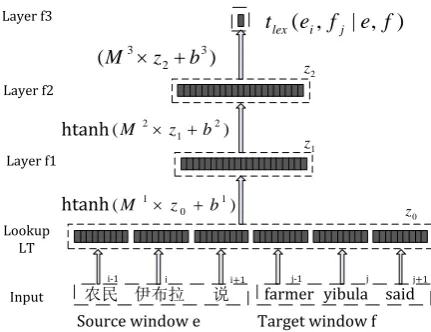
Figure 2: Network structure for computing context dependent lexical translation scores. The example computes translation score for word pair (yibula, yibulayin) given its surrounding context.
Figure 2 shows the neural network we used to compute context dependent lexical transla-tion score tlex. For word pair (ei, fj), we take
fixed length windows surrounding bothei andfj
as input: (ei−sw
2 , . . . , ei+sw2 , fj−tw2 , . . . , fj+tw2 ),
wheresw, tw stand window sizes on source and
target side respectively. Words are converted to embeddings using the lookup table LT, and the
catenation of embeddings are fed to a classic neu-ral network with two hidden-layers, and the output of the network is the our lexical translation score:
tlex(ei, fj|e,f)
=f3◦f2◦f1◦LT(window(ei), window(fj))
(6)
f1andf2layers usehtanhas activation functions, while f3 is only a linear transformation with no activation function.
For the distortiontd, we could use a lexicalized
distortion model:
td(ai, ai−1|e,f) =td(ai−ai−1|window(fai−1))
(7) which can be computed by a neural network sim-ilar to the one used to compute lexical transla-tion scores. If we map jump distance(ai−ai−1) to B buckets, we can change the length of the
output layer to B, where each dimension in the
output stands for a different bucket of jump dis-tances. But we found in our initial experiments on small scale data, lexicalized distortion does not produce better alignment over the simple jump-distance based model. So we drop the lexicalized
distortion and reverse to the simple version:
td(ai, ai−1|e,f) =td(ai−ai−1) (8)
VocabularyV of our alignment model consists
of a source vocabulary Ve and a target
vocabu-laryVf. As in (Collobert et al., 2011), in addition
to real words, each vocabulary contains a special unknown word symbol hunki to handle unseen
words; two sentence boundary symbols hsi and
h/si, which are filled into surrounding window
when necessary; furthermore, to handle null align-ment, we must also include a special null symbol hnulli. Whenfj is null word, we simply fill the
surrounding window with the identical null sym-bols.
To decode our model, the lexical translation scores are computed for each source-target word pair in the sentence pair, which requires going through the neural network (|e| × |f|) times;
af-ter that, the forward-backward algorithm can be used to find the viterbi path as in the classic HMM model.
The majority of tunable parameters in our model resides in the lookup table LT, which is
a (L ×(|Ve| +|Vf|))-dimension matrix. For a
reasonably large vocabulary, the number is much smaller than the number of parameters in classic HMM model, which is in the order of(|Ve|×|Vf|).
1
The ability to model context is not unique to our model. In fact, discriminative word alignment can model contexts by deploying arbitrary features (Moore, 2005). Different from previous discrim-inative word alignment, our model does not use manually engineered features, but learn “features” automatically from raw words by the neural net-work. (Berger et al., 1996) use a maximum en-tropy model to model the bag-of-words context for word alignment, but their model treats each word as a distinct feature, which can not leverage the similarity between words as our model.
5 Training
Although unsupervised training technique such as Contrastive Estimation as in (Smith and Eisner, 2005), (Dyer et al., 2011) can be adapted to train
1In practice, the number of non-zero parameters in
our model from raw sentence pairs, they are too computational demanding as the lexical transla-tion probabilities must be computed from neu-ral networks. Hence, we opt for a simpler su-pervised approach, which learns the model from sentence pairs with word alignment. As we do not have a large manually word aligned corpus, we use traditional word alignment models such as HMM and IBM model 4 to generate word align-ment on a large parallel corpus. We obtain bi-directional alignment by running the usual grow-diag-final heuristics (Koehn et al., 2003) on uni-directional results from both directions, and use the results as our training data. Similar approach has been taken in speech recognition task (Dahl et al., 2012), where training data for neural network model is generated by forced decoding with tradi-tional Gaussian mixture models.
Tunable parameters in neural network align-ment model include: word embeddings in lookup tableLT, parametersWl,blfor linear
transforma-tions in the hidden layers of the neural network, and distortion parameterssdof jump distance. We
take the following ranking loss with margin as our training criteria:
loss(θ) = X
every(e,f)
max{0,1−sθ(a+|e,f) +sθ(a−|e,f)}
(9) where θ denotes all tunable parameters, a+ is
the gold alignment path, a− is the highest
scor-ing incorrect alignment path under θ, and sθ is
model score for alignment path defined in Eq. 5 . One nuance here is that the gold alignment af-ter grow-diag-finalcontains many-to-many links, which cannot be generated by any path. Our solu-tion is that for each source word alignment multi-ple target, we randomly choose one link among all candidates as the golden link.
Because our multi-layer neural network is in-herently non-linear and is non-convex, directly training against the above criteria is unlikely to yield good results. Instead, we take the following steps to train our model.
5.1 Pre-training initial word embedding with monolingual data
Most parameters reside in the word embeddings. To get a good initial value, the usual approach is to pre-train the embeddings on a large monolin-gual corpus. We replicate the work in (Collobert
et al., 2011) and train word embeddings for source and target languages from their monolingual cor-pus respectively. Our vocabulariesVsandVt
con-tain the most frequent 100,000 words from each side of the parallel corpus, and all other words are treated as unknown words. We set word embed-ding length to 20, window size to 5, and the length of the only hidden layer to 40. Follow (Turian et al., 2010), we randomly initialize all parameters to [-0.1, 0.1], and use stochastic gradient descent to minimize the ranking loss with a fixed learn-ing rate 0.01. Note that embeddlearn-ing for null word in eitherVeandVf cannot be trained from
mono-lingual corpus, and we simply leave them at the initial value untouched.
Word embeddings from monolingual corpus learn strong syntactic knowledge of each word, which is not always desirable for word align-ment between some language pairs like English and Chinese. For example, many Chinese words can act as a verb, noun and adjective without any change, while their English counter parts are dis-tinct words with quite different word embeddings due to their different syntactic roles. Thus we have to modify the word embeddings in subse-quent steps according to bilingual data.
5.2 Training neural network based on local criteria
Training the network against the sentence level criteria Eq. 5 directly is not efficient. Instead, we first ignore the distortion parameters and train neu-ral networks for lexical translation scores against the following local pairwise loss:
max{0,1−tθ((e, f)+|e,f) +tθ((e, f)−|e,f)}
(10) where(e, f)+is a correct word pair, (e, f)− is a
wrong word pair in the same sentence, andtθis as
defined in Eq. 6 . This training criteria essentially means our model suffers loss unless it gives cor-rect word pairs a higher score than random pairs from the same sentence pair with some margin.
We initialize the lookup table with embed-dings obtained from monolingual training, and randomly initialize all Wl andbl in linear layers
side of the pair with another word in the sentence pair. We set learning rate to 0.01. As there is no clear stopping criteria, we simply run the stochas-tic optimizer through parallel corpus for N itera-tions. In this work, N is set to 50.
To make our model concrete, there are still hyper-parameters to be determined: the window size sw and tw, the length of each hidden layer Ll. We empirically set sw and tw to 11, L1 to 120, andL2 to 10, which achieved a minimal loss on a small held-out data among several settings we tested.
5.3 Training distortion parameters
We fix neural network parameters obtained from the last step, and tune the distortion parameters
sd with respect to the sentence level loss using
standard stochastic gradient descent. We use a separate parameter for jump distance from -7 and 7, and another two parameters for longer for-ward/backward jumps. We initialize all parame-ters insdto 0, set the learning rate for the
stochas-tic optimizer to 0.001. As there are only 17 param-eters insd, we only need to run the optimizer over
a small portion of the parallel corpus.
5.4 Tuning neural network based on sentence level criteria
Up-to-now, parameters in the lexical translation neural network have not been trained against the sentence level criteria Eq. 5. We could achieve this by re-using the same online training method used to train distortion parameters, except that we now fix the distortion parameters and let the loss back-propagate through the neural networks. Sen-tence level training does not take larger context in modeling word translations, but only to optimize the parameters regarding to the sentence level loss. This tuning is quite slow, and it did not improve alignment on an initial small scale experiment; so, we skip this step in all subsequent experiment in this work.
6 Experiments and Results
We conduct our experiment on Chinese-to-English word alignment task. We use the manually aligned Chinese-English alignment corpus (Haghighi et al., 2009) which contains 491 sentence pairs as test set. We adapt the segmentation on the Chinese side to fit our word segmentation standard.
6.1 Data
Our parallel corpus contains about 26 million unique sentence pairs in total which are mined from web.
The monolingual corpus to pre-train word em-beddings are also crawled from web, which amounts to about 1.1 billion unique sentences for English and about 300 million unique sentences for Chinese. As pre-processing, we lowercase all English words, and map all numbers to one spe-cial token; and we also map all email addresses and URLs to another special token.
6.2 Settings
We use classic HMM and IBM model 4 as our baseline, which are generated by Giza++ (Och and Ney, 2000). We train our proposed model from re-sults of classic HMM and IBM model 4 separately. Since classic HMM, IBM model 4 and our model are all uni-directional, we use the standard grow-diag-finalto generate bi-directional results for all models.
Models are evaluated on the manually aligned test set using standard metric: precision, recall and F1-score.
6.3 Alignment Result
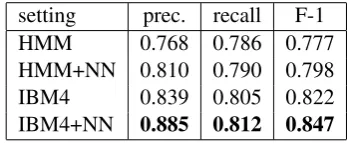
It can be seen from Table 1, the proposed model consistently outperforms its corresponding base-line whether it is trained from alignment of classic HMM or IBM model 4. It is also clear that the
setting prec. recall F-1
HMM 0.768 0.786 0.777
HMM+NN 0.810 0.790 0.798
IBM4 0.839 0.805 0.822
[image:6.595.328.502.502.574.2]IBM4+NN 0.885 0.812 0.847
Table 1: Word alignment result. The first row and third row show baseline results obtained by classic HMM and IBM4 model. The second row and fourth row show results of the proposed model trained from HMM and IBM4 respectively.
results of our model also depends on the quality of baseline results, which is used as training data of our model. In future we would like to explore whether our method can improve other word align-ment models.
hier-archical phrase model (Chiang, 2007) from dif-ferent word alignments. Despite difdif-ferent align-ment scores, we do not obtain significant differ-ence in translation performance. In our C-E exper-iment, we tuned on 03, and tested on NIST-08. Case-insensitive BLEU-4 scores on NIST-08 test are 0.305 and 0.307 for models trained from IBM-4 and NN alignment results. The result is not surprising considering our parallel corpus is quite large, and similar observations have been made in previous work as (DeNero and Macherey, 2011) that better alignment quality does not necessarily lead to better end-to-end result.
6.4 Result Analysis 6.4.1 Error Analysis
From Table 1 we can see higher F-1 score of our model mainly comes from higher precision, with recall similar to baseline. By analyzing the results, we found out that for both baseline and our model, a large part of missing alignment links involves stop words like English words “the”, “a”, “it” and Chinese words “de”. Stop words are inherently hard to align, which often requires grammatical judgment unavailable to our models; as they are also extremely frequent, our model fully learns their alignment patterns of the baseline models, including errors. On the other hand, our model performs better on low-frequency words, espe-cially proper nouns. Take person names for ex-ample. Most names are low-frequency words, on which baseline HMM and IBM4 models show the “garbage collector” phenomenon. In our model, different person names have very similar word em-beddings on both English side and Chinese side, due to monolingual pre-training; what is more, dif-ferent person names often appear in similar con-texts. As our model considers both word embed-dings and contexts, it learns that English person names should be aligned to Chinese person names, which corrects errors of baseline models and leads to better precision.
6.4.2 Effect of context
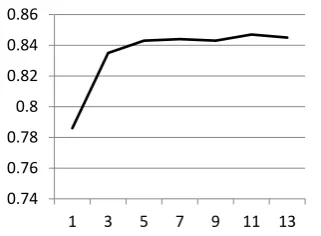
To examine how context contribute to alignment quality, we re-train our model with different win-dow size, all from result of IBM model 4. From Figure 3, we can see introducing context increase the quality of the learned alignment, but the ben-efit is diminished for window size over 5. On the other hand, the results are quite stable even with large window size 13, without noticeable
over-0.74 0.76 0.78 0.8 0.82 0.84 0.86
[image:7.595.335.496.62.180.2]1 3 5 7 9 11 13
Figure 3: Effect of different window sizes on word alignment F-score.
fitting problem. This is not surprising consider-ing that larger window size only requires slightly more parameters in the linear layers. Lastly, it is worth noticing that our model with no context (window size 1) performs much worse than set-tings with larger window size and baseline IBM4. Our explanation is as follows. Our model uses the simple jump distance based distortion, which is weaker than the more sophisticated distortions in IBM model 4; thus without context, it does not perform well compared to IBM model 4. With larger window size, our model is able to produce more accurate translation scores based on more contexts, which leads to better alignment despite the simpler distortions.
IBM4+NN F-1
[image:7.595.362.472.456.514.2]1-hidden-layer 0.834 2-hidden-layer 0.847 3-hidden-layer 0.843
Table 3: Effect of different number of hidden lay-ers. Two hidden layers outperform one hidden layer, while three hidden layers do not bring fur-ther improvement.
word good history british served labs zetian laggards
LM
bad tradition russian worked networks hongzhang underperformers great culture japanese lived technologies yaobang transferees strong practice dutch offered innovations keming megabanks
true style german delivered systems xingzhi mutuals
easy literature canadian produced industries ruihua non-starters
WA
nice historical uk offering lab hongzhang underperformers great historic britain serving laboratories qichao illiterates
best developed english serve laboratory xueqin transferees pretty record classic delivering exam fuhuan matriculants excellent recording england worked experiments bingkun megabanks
Table 2: Nearest neighbors of several words according to their embedding distance.LMshows neighbors of word embeddings trained by monolingual language model method; WA shows neighbors of word embeddings trained by our word alignment model.
improvement. Due to time constraint, we have not tuned the hyper-parameters such as length of hidden layers in 1 and 3-hidden-layer settings, nor have we tested settings with more hidden-layers. It would be wise to test more settings to verify whether more layers would help.
6.4.4 Word Embedding
Following (Collobert et al., 2011), we show some words together with its nearest neighbors using the Euclidean distance between their embeddings. As we can see from Table 2, after bilingual training, “bad” is no longer in the nearest neighborhood of “good” as they hold opposite semantic meanings; the nearest neighbor of “history” is now changed to its related adjective “historical”. Neighbors of proper nouns such as person names are relatively unchanged. For example, neighbors of word “zetian” are all Chinese names in both settings. As Chinese language lacks morphology, the single form and plural form of a noun in English often correspond to the same Chinese word, thus it is desirable that the two English words should have similar word embeddings. While this is true for relatively frequent nouns such as “lab” and “labs”, rarer nouns still remain near their monolingual embeddings as they are only modified a few times during the bilingual training. As shown in last column, neighborhood of “laggards” still consists of other plural forms even after bilingual training.
7 Conclusion
In this paper, we explores applying deep neu-ral network for word alignment task. Our model
integrates a multi-layer neural network into an HMM-like framework, where context dependent lexical translation score is computed by neural network, and distortion is modeled by a sim-ple jump-distance scheme. Our model is dis-criminatively trained on bilingual corpus, while huge monolingual data is used to pre-train word-embeddings. Experiments on large-scale Chinese-to-English task show that the proposed method produces better word alignment results, compared with both classic HMM model and IBM model 4.
For future work, we will investigate more set-tings of different hyper-parameters in our model. Secondly, we want to explore the possibility of unsupervised training of our neural word align-ment model, without reliance of alignalign-ment result of other models. Furthermore, our current model use rather simple distortions; it might be helpful to use more sophisticated model such as ITG (Wu, 1997), which can be modeled by Recursive Neural Networks (Socher et al., 2011).
Acknowledgments
We thank anonymous reviewers for insightful comments. We also thank Dongdong Zhang, Lei Cui, Chunyang Wu and Zhenyan He for fruitful discussions.
References
Yoshua Bengio, Holger Schwenk, Jean-S´ebastien Sen´ecal, Fr´ederic Morin, and Jean-Luc Gauvain.
2006. Neural probabilistic language models.
Inno-vations in Machine Learning, pages 137–186.
Hugo Larochelle. 2007. Greedy layer-wise training
of deep networks. Advances in neural information
processing systems, 19:153.
Yoshua Bengio. 2009. Learning deep architectures for ai.Foundations and TrendsR in Machine Learning,
2(1):1–127.
Adam L. Berger, Vincent J. Della Pietra, and Stephen A. Della Pietra. 1996. A maximum entropy
ap-proach to natural language processing. Comput.
Linguist., 22(1):39–71, March.
JS Bridle. 1990. Neurocomputing: Algorithms, archi-tectures and applications, chapter probabilistic inter-pretation of feedforward classification network out-puts, with relationships to statistical pattern recogni-tion.
Peter F Brown, Vincent J Della Pietra, Stephen A Della Pietra, and Robert L Mercer. 1993. The mathemat-ics of statistical machine translation: Parameter esti-mation. Computational linguistics, 19(2):263–311.
David Chiang. 2007. Hierarchical phrase-based trans-lation. computational linguistics, 33(2):201–228.
Ronan Collobert, Jason Weston, L´eon Bottou, Michael Karlen, Koray Kavukcuoglu, and Pavel Kuksa. 2011. Natural language processing (almost) from
scratch. The Journal of Machine Learning
Re-search, 12:2493–2537.
George E Dahl, Dong Yu, Li Deng, and Alex Acero. 2012. Context-dependent pre-trained deep neural networks for large-vocabulary speech recognition. Audio, Speech, and Language Processing, IEEE Transactions on, 20(1):30–42.
John DeNero and Klaus Macherey. 2011. Model-based aligner combination using dual decomposi-tion. InProc. ACL.
Chris Dyer, Jonathan Clark, Alon Lavie, and Noah A Smith. 2011. Unsupervised word alignment with ar-bitrary features. InProceedings of the 49th Annual Meeting of the Association for Computational Lin-guistics: Human Language Technologies-Volume 1, pages 409–419. Association for Computational Lin-guistics.
Aria Haghighi, John Blitzer, John DeNero, and Dan Klein. 2009. Better word alignments with
su-pervised itg models. In Proceedings of the Joint
Conference of the 47th Annual Meeting of the ACL and the 4th International Joint Conference on Natu-ral Language Processing of the AFNLP: Volume 2-Volume 2, pages 923–931. Association for Compu-tational Linguistics.
Geoffrey E Hinton, Simon Osindero, and Yee-Whye Teh. 2006. A fast learning algorithm for deep be-lief nets. Neural computation, 18(7):1527–1554.
Koray Kavukcuoglu, Pierre Sermanet, Y-Lan Boureau, Karol Gregor, Micha¨el Mathieu, and Yann LeCun. 2010. Learning convolutional feature hierarchies for
visual recognition. Advances in Neural Information
Processing Systems, pages 1090–1098.
Philipp Koehn, Franz Josef Och, and Daniel Marcu.
2003. Statistical phrase-based translation. In
Proceedings of the 2003 Conference of the North American Chapter of the Association for Computa-tional Linguistics on Human Language Technology-Volume 1, pages 48–54. Association for Computa-tional Linguistics.
Alex Krizhevsky, Ilya Sutskever, and Geoff Hinton. 2012. Imagenet classification with deep convolu-tional neural networks. InAdvances in Neural Infor-mation Processing Systems 25, pages 1106–1114.
Yann LeCun, L´eon Bottou, Yoshua Bengio, and Patrick Haffner. 1998. Gradient-based learning applied to
document recognition. Proceedings of the IEEE,
86(11):2278–2324.
Yann LeCun. 1985. A learning scheme for
asymmet-ric threshold networks. Proceedings of Cognitiva,
85:599–604.
Honglak Lee, Alexis Battle, Rajat Raina, and An-drew Y Ng. 2007. Efficient sparse coding
algo-rithms. Advances in neural information processing
systems, 19:801.
Shujie Liu, Chi-Ho Li, and Ming Zhou. 2010. Dis-criminative pruning for disDis-criminative itg alignment. InProceedings of the 48th Annual Meeting of the As-sociation for Computational Linguistics, ACL, vol-ume 10, pages 316–324.
Y MarcAurelio Ranzato, Lan Boureau, and Yann Le-Cun. 2007. Sparse feature learning for deep belief
networks. Advances in neural information
process-ing systems, 20:1185–1192.
Robert C Moore. 2005. A discriminative framework
for bilingual word alignment. In Proceedings of
the conference on Human Language Technology and Empirical Methods in Natural Language
Process-ing, pages 81–88. Association for Computational
Linguistics.
Jan Niehues and Alex Waibel. 2012. Continuous space language models using restricted boltzmann
machines. In Proceedings of the nineth
Interna-tional Workshop on Spoken Language Translation (IWSLT).
Franz Josef Och and Hermann Ney. 2000. Giza++: Training of statistical translation models.
Frank Seide, Gang Li, and Dong Yu. 2011. Conversa-tional speech transcription using context-dependent
deep neural networks. In Proc. Interspeech, pages
Noah A Smith and Jason Eisner. 2005. Contrastive estimation: Training log-linear models on unlabeled
data. In Proceedings of the 43rd Annual Meeting
on Association for Computational Linguistics, pages 354–362. Association for Computational Linguis-tics.
Richard Socher, Cliff C Lin, Andrew Y Ng, and Christopher D Manning. 2011. Parsing natural scenes and natural language with recursive
neu-ral networks. In Proceedings of the 26th
Inter-national Conference on Machine Learning (ICML), volume 2, page 7.
Richard Socher, Brody Huval, Christopher D Manning, and Andrew Y Ng. 2012. Semantic compositional-ity through recursive matrix-vector spaces. In Pro-ceedings of the 2012 Joint Conference on Empiri-cal Methods in Natural Language Processing and Computational Natural Language Learning, pages 1201–1211. Association for Computational Linguis-tics.
Le Hai Son, Alexandre Allauzen, and Franc¸ois Yvon. 2012. Continuous space translation models with neural networks. InProceedings of the 2012 confer-ence of the north american chapter of the associa-tion for computaassocia-tional linguistics: Human language technologies, pages 39–48. Association for Compu-tational Linguistics.
Ivan Titov, Alexandre Klementiev, and Binod Bhat-tarai. 2012. Inducing crosslingual distributed rep-resentations of words.
Joseph Turian, Lev Ratinov, and Yoshua Bengio. 2010. Word representations: a simple and general method for semi-supervised learning.Urbana, 51:61801.
Stephan Vogel, Hermann Ney, and Christoph Tillmann. 1996. Hmm-based word alignment in statistical
translation. In Proceedings of the 16th conference
on Computational linguistics-Volume 2, pages 836– 841. Association for Computational Linguistics.