Bachelor Thesis |
Supervisor: Dr. Peter Stegmaier
Franziska Raspe
|
Co-reader: Prof. Dr. Robert Hoppe
U n i v e r s i t y o f T w e n t e | F a c u l t y o f M a n a g e m e n t a n d G o v e r n a n c e
B S C E u r o p e a n S t u d i e s | D a t e o f D e l i v e r y : 0 7 / 0 6 / 2 0 1 1
The Official Positions of the AKP and CHP on
Turkey’s EU Accession Process
2
I.
Abstract
The study analyses the positions of the two most important Turkish parties on Turkey’s accession process to the European Union by means of constructing empirically grounded typologies based on an in-depth text interpretation and the grounded theory approach by Strauss (1996). This approach is taken in order to, by means of closely looking at semantics and lines of argumentation, reconstruct the parties’ position from a constructivist perspective.
One party from the centre-right with an Islamic orientation, the Justice and Development Party (AKP), as well as the Republican People’s Party (CHP), which is a secular party from the centre-left, are the objects of scrutiny. With a detailed analysis of the party programmes and other official docu-mentations of the parties’ positions this study explores where the party stands today with regards to Turkey’s ambition to accede to the EU. The leading research question is: What is the AKP’s and CHP’s position on Turkey’s accession process to the European Union as it is expressed in the official documents of the parties in 2007-2011?
3
Table of Contents
I. Abstract ... 2
II. List of Network Views ... 4
III. List of Tables ... 4
IV. List of Abbreviations ... 4
1)Introduction to the topic and research question ... 5
2) Assessing party positions on accession processes ... 7
3) Methodology ... 10
3.1) Research Design: Case study ... 10
3.2) Case Selection: AKP and CHP ... 10
3.3) Data Collection ... 11
3.3.1) Material: Party documents ... 11
3.3.2) Method: Grounded Theory ... 12
3.4) Data analysis ... 15
3.4.1) Analytical process according to the grounded theory method ... 15
3.4.2) Coding with ATLAS.ti ... 15
3.4.3) The analytical process of the party documents in ATLAS.ti ... 16
4)Comparative analysis of the parties’ position on the EU ... 18
4.1) Reconstructed positions along categories ... 18
4.1.1) Turkey ... 18
4.1.2) European Union ... 20
4.1.3) Accession ... 21
4.1.4) Motives ... 22
4.1.5) Willingness ... 23
4.1.6) Efforts ... 24
4.1.7) Conditions ... 25
4.1.8) Final Goal ... 26
4.1.9) Central core-category ... 27
4.2) Euroscepticism revisited ... 31
5)Discussion and Conclusion ... 32
5.1) Putting findings into perspective ... 32
5.2) Contribution of this study and implications for future research ... 33
6)Appendix ... 35
Appendix 1: Table presenting findings ... 35
Appendix 2: Table of official party documents ... 43
4
II.
List of Network Views
Network view 1: AKP's (core-) categories with central core-category ... 28
Network view 2: CHP's (core-) categories with central core-category ... 29
III.
List of Tables
Table 1: Core-category: Turkey ... 19Table 2: Core-category: European Union ... 20
Table 3: Core-category: Accession ... 21
Table 4: Core-category: Motives ... 22
Table 5: Core-category: Willingness ... 23
Table 6: Core-category: Efforts ... 24
Table 7: Core-category: Conditions ... 25
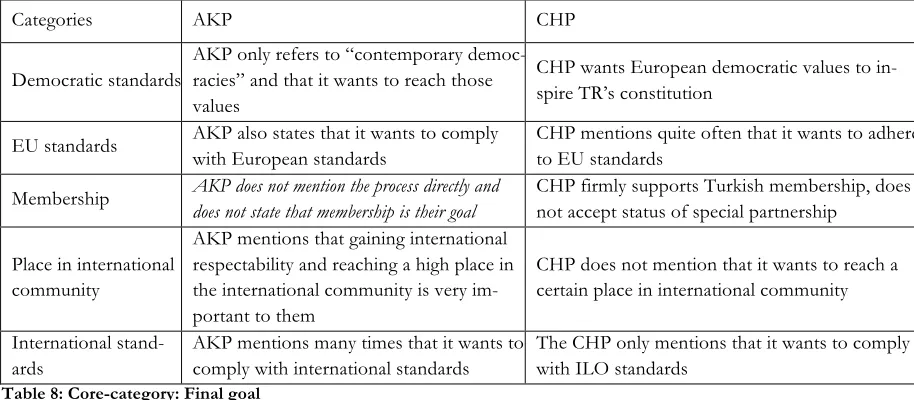
Table 8: Core-category: Final goal ... 26
Table 9: Central core-category: What are the parties' motives to reach their final goal? ... 30
Table 10: Defining euroscepticism (Taggart & Szczerbiak 2004) ... 31
Table 11: Defining positions on European accession processes (Kopecky & Mudde 2002) ... 31
IV.
List of Abbreviations
AKP: Adalet ve Kalkinma Partisi, English name: Justice and Development Party (English abbr.: JDP)
CHP: Cumhuriyet Halk Partisi, English name: Republican People’s Party (English abbr.: RPP)
COM: European Commission
ECJ: European Court of Justice
EI: European Integration
EP: European Parliament
EU: European Union
FP: Fazilet Partisi, English name: Virtue Party
GT: Grounded theory
GTM: Grounded theory method
QDA: Qualitative Data Analysis
CAQDA: Computer Assisted Qualitative Data Analysis
RP: Refah Partisi, English name: Welfare Party
SP: Saadet Partisi, English name: Felicity Party
TAP: Turkish accession process
TESEV: Türkiye Ekonomik ve Sosyal Etüdler Vakfi, English name: The Turkish Economic and So-cial Studies Foundation
TFP: Turkish Foreign Policy
5
1)
Introduction to the topic and research question
The European Union and Turkey share a long common history of association and cooperation - in fact the longest history an accession country has ever shared with the EU. In September 1959 Turkey first applied for associate Membership of the European Economic Community (European Commission, 2011). This fact would be reason enough to justify giving special attention to Turkeys still enduring ac-cession process to the European Union. The acac-cession agreement, also called Ankara agreement be-tween the EU and Turkey was signed in 1963 (Secretariat General for EU affairs, 1963). Due to the military coup in 1980, the relations between the two partners came to a virtual freeze and were only assuming their old momentum after Turkey newly applied for Membership in 1987. The relations reached a new height with Turkey entering the Customs Union in 1995, and four years later the Hel-sinki summit where Turkey was granted candidate status (Müftüler Bac, 2005, p. 20). The beginning of the new millennium was coined by many reform packages and constitutional changes on the side of Turkey (Özbudun & Yazici, 2004, p. 13). Yet, with the Commissions decisions to momentarily stop negotiations due to a lack of progress on Turkey’s side regarding the Cyprus issue, the accession pro-cess became increasingly slow and tedious (Euractiv, 2010). At the moment the two seem to be stuck in a process characterised by slow progress and frustration on both sides. The European Union is discon-tent with Turkey’s development and sometimes lack of commitment (Avci, 2003, p. 150-1). Turkey criticises the fact that certain EU countries are strictly against Turkey becoming a member and there-fore doubts that even if it would fulfil all the criteria it would not be able to become a member- it hence misses strong incentives for reforms (European Council on Foreign Relations, 2011, p. 70). Coming to that, the situation has recently become especially difficult with the Commissions decision in 2006 to put the negotiations on hold until the Cyprus issue is resolved (Euractiv, 2010).
The research question summarises the aim of the study, namely to reconstruct the position of two Turkish parties, the AKP and CHP, on their country’s accession process to the European Union. The question reads as follows:
What is the AKP’s and CHP’s position on Turkey’s accession process to the European Union as it is expressed in the official documents of the parties in 2007-2011?
For Turkey’s accession process to the European Union as just described is not an easy or self-acting one, there is much debate both within the EU, as well as within Turkey, whether it should still be pur-sued. The focus of the following paper lies on the Turkish position on the accession process, which is essentially shaped by the political parties in the country.
6
civil society and losing elections. Kalaycioglu (2002) argues that because the Turkish state is actually a weak state for example in terms of its “regulatory, extractive and distributive capacity” and it therefore needs to use executive power to suppress potential or actual challenges (Kalaycioglu, 2002, p. 260). This weakness leads to considerable intolerance towards any form of party or group opposing the gov-ernment policies.
Having an influence on policies is hence rather difficult for the opposition parties, as well as interest groups, which are not incorporated into but rather excluded from the policy making process. Kalaycioglu (2002) describes the nature of the state in dealing with associations as “passive exclusive” and if associations demand recognition through protests or demonstrations, the Turkish state turns to an “aggressive exclusive” behaviour (Kalaycioglu, 2002, p. 261). In the field of foreign policy this pat-tern however declined throughout the last 10-15 years: more influence is possible, and more domestic organisation get involved in shaping Turkey’s foreign policy (TFP). The Ministry of Foreign Affairs is thus challenged in its role as single organ responsible for TFP (Tayfur & Göymen, 2002, p. 119). De-spite these recent developments, the Turkish party system is still described as a “democracy of the ruling party, in which rights are not shared by all” (European Council on Foreign Relations, 2011, p. 43). In line with this, the recent statements by Recep Erdogan of wanting to transform the parliamen-tary democracy into a presidential one in order to give the president even more power, can be seen as an example to support what has been said above (Taspinar, Cook, & Barkey, 2011)
The two most important parties in the Turkish party system, which, because of their recent success during the 2011 general elections, have the biggest influence on creating and implementing policies, are the AKP and CHP.
For the first 25 years of the Republic, Atatürk’s party, the CHP (Eng.: Republican People’s Party) was the only one existing, as a multi-party system was only introduced in 1946. Islamist parties were only coming into existence in the 1970s with the foundation of the National order party (MNP) (Özbudun, 2006, p. 544). Coming to that, they were kept “at bay” through the military, which forced several par-ties out of government for four times: two times through a military coup (1960 and 1980), one time through an unofficial coup in 1971 and again in 1996, when it forced the Islamist Welfare Party to re-sign. Circumstances like the economic crises in 2000 and 2001 and a general shift to conservatism led to the rise of the AKP in 2002, which has been in power ever since, and has again won the elections in June 2011(cf. Carkoglu & Kalaycioglu, 2009).
Through the emergence of Islamist (or sometimes called neo-Ottomanist) parties there is an increasing division of the Turkish Party system along secular-Islamist lines. The parties left to the centre, such as the CHP are secular, and the parties right to the centre, such as the AKP, are Islam-oriented (Secor, 2001, p. 544). The secular parties have traditionally supported Turkeys Membership of the European Union. On the contrary, the Islamist parties have traditionally been at odds with the European Union integration process. Scholars, such as Kubicek (2010) and Dagi (2005) state that the AKP is currently the most supportive of Turkey’s accession process, whether the CHP has rather adopted a Euro-sceptic position (cf. Gülmez 2006 & 2008 and Patterson 2008).
7
The parties’ positions will be reconstructed by means of an in-depth analysis of the semantics and lines of reasoning of the parties’ statements in official party documents, such as party programmes and elec-tion manifestos.
These documents provide an overview over the parties’ positions on a broad range of issues, such as the parties’ view on the Turkish accession process. They are carefully prepared and written to give the voters an impression of the party’s issue priorities and are usually ratified by a party convention (cf. Cole 2005).
2) Assessing party positions on accession processes
Before coming to the parties’ positions on the EU as they are described and classified by scholars to-day, a short overview over the parties’ background is given in order to understand where the parties come from and in how far their EU position is significant.
This chapter aims at establishing a theoretical and conceptual framework for the analysis. The first part is dedicated at presenting the parties’ positions on the Turkish accession process today as they are pre-sented in scholarly literature. This step is particularly relevant to be able to put the findings from the hermeneutic analysis into perspective, and to be able to appreciate their significance. Whether the find-ings from the analysis are in line with the positions represented in scholarly literature will be assessed in chapter 5. The second part presents two models on how parties’ positions on accession processes to the EU can be classified. It mainly aims at clarifying the concept “position towards accession processes to the European Union”, which is central to this study.
Today’s AKP is a successor of the FP (Virtue Party), which was banned in June 2001. The FP itself was a successor of the RP (Welfare Party). The AKP is hence a part of Necmittin Erbakan’s (leading figure of RP) political legacy. The current leading official of the AKP, Recep Tayyip Erdogan and Abdullah Gül have both been affiliated with the party(s) for a long time and were close colleagues of Erbakan. The former Prime Minister Erbakan, who surprisingly won the elections in 1996, was very Islamist and hostile towards the European Union or anything that would threaten ‘Turkey’s integrity’. Because the Military saw his rule as a threat to the secularity of the state, it pressured him and accordingly the party was “ousted from power in June 1997 and was outlawed by the Constitutional Court in March 1998” (Taniyici, 2003, p. 464). After the RP’s ban, the party elites founded the FP with the same institutional structure but different position on the EU. The FP however was also outlawed by the Constitutional Court in June 2001, as it was still, despite some change in policies, seen as a threat to the Republic. The court’s decision split the party in two groups: the ‘innovationists’ and the ‘traditionalists’. The AKP was founded by the former group: the SP (Felicity party) by the latter. The greater part of the AKP’s history was hence characterised by their aversion to the EU. The AKP won the elections in 2002 and 2007 with a landslide victory and is, according to Kubicek (as well as many other scholars), the biggest advo-cate of Turkey’s EU Membership today (cf. Kubicek, 2010).
8
newly emerging republic” (Gülmez, 2006, p. 1). The party continued to be in parliament in the years to come and was for a long time lead by Ismet Inönü, who carried out Atatürk’s legacy. However, the party was banned together with all other parties after the military coup in 1980. As all leaders and the name of the party were banned, it was founded as SHP (Social Democratic Populist Party) under the leadership of Ismet Inönü’s son Erdal Inönü. The CHP was reopened as such under the leadership of Deniz Baykal in 1992, but did not manage reach the level of its old success (Gülmez, 2006, p. 4). In contradiction to the AKP’s predecessors, which have been in opposition to the EU, the CHP has since its foundation been in favour of Turkey’s EU accession process.
Secor (2001) classified the CHP as a left of centre, secular and pro-European party, and the AKP as a right of centre, Islamist and anti-European party (Secor, 2001, p. 547). Yet, “it is now the Justice and Development Party (AKP), with its Islamist roots, that is the country’s strongest advocate for Euro-peanization while those with more secularist or nationalist orientations fear both the AKP and what its push for political liberalisation portends for Turkey” (Kubicek, 2010, p. 2). Dagi describes the same phenomenon: “The ruling JDP’s enthusiastic efforts for Turkey’s EU membership […] in con-trast to the hesitations of the Kemalists, is indicative of the changing positions of political forces in Turkish politics” (Dagi, 2005, p. 34). This means that in the years from 2001 until 2010, both parties, according to Kubickek and Dagi, have changed their position on Turkey’s EU accession process. Several reasons are mentioned in the literature to explain this change. The AKP is for example said to have turned towards the EU, because of the external shock they received after having been outlawed by the Constitutional Court (cf. Taniyici, 2003; Özbudun, 2006) and the leaders “realised that relying essentially on hard-core Islamist votes would condemn the party forever to a minority status” (Özbudun, 2006, 555).
In contrast to the opinions of the authors mentioned above, there are some recently published articles from think tanks, which do not support the view that the AKP currently is the most enthusiastic sup-porter of the EU in Turkey and that the CHP has become increasingly Euro-sceptic. A series of articles under the heading “What does Turkey think?”, published by the European Council on Foreign Rela-tions (ECFR), suggests that the AKP by all means wants to be successful and elevate Turkey to a suc-cessful country internationally, but that this aim does not include becoming a member of the EU (European Council on Foreign Relations, 2011). It is also stated that Erdogan is becoming increasingly fond of power and authoritarianism and loses his interest in Turkey’s accession process, whereas the CHP under its new leader is supporting EU membership (European Council on Foreign Relations, 2011, p. 42). As to the reason why the perception of articles published in scientific journals (such as those of Taniyici, Özbudun, Dagi and Kubicek) differ considerably from those published very recently by think tanks one can only speculate. It moreover seems that other think tanks, such as one of the most important Turkish ones, the “Turkish Economic and Social Studies Foundation” (TESEV), are in their latest reports from 20111 more in line with the journal articles. It can hence be concluded that the
opinion toned by the ECFR is not very widely supported in the literature.
9
In the following, second, part of this chapter, two models often referred to in the literature are present-ed in order to set up a conceptual framework for classifying party positions on accession processes. For that purpose, literature on all, European, party-based positions2 on accession processes to the
Europe-an Union was taken into account.
The first model, by Taggart and Szczerbiak attempts to label only the negative or euroscepticist posi-tions on accession processes, whereas the second model by Kopecky and Mudde takes into account both pro-and anti-European sentiments. The initial definition of euroscepticism stems from Taggart, who thought euroscepticism to be an “encompassing term”, which includes modest, as well as total opposition to the process of European integration (Taggart, 1998, p. 366).
Taggart and Szczerbiak later clarified further what euroscepticism means in their eyes and came up with a two-fold definition of the term: “we can distinguish between those who are broadly opposed to euro-scepticism on principle and those who oppose European integration because of the form it takes” (Taggart & Szczerbiak, 2002, 27). Their model was primarily developed for the Central and Eastern European countries, where there is a relatively high degree of consensus that European integration it-self is a good thing. Therefore, one can in these cases differentiate between those who “are outside the consensus and express hostility to the idea of European integration” or those “expressing limited ob-jections to the nature of the accession process” (Taggart & Szczerbiak, 2004, 4). These two positions are called “hard” and “soft” euroscepticism. Hard euroscepticism is the total and outright rejection of European integration (EI), both in political and economic terms. Soft euroscepticism “involves contin-gent or qualified“ opposition to European Integration (EI) and can be related to scepticism towards either policies or national-interest (Taggart & Szczerbiak, 2004, 4).
Kopecky and Mudde developed another scheme of party-based Euro-scepticism and criticised the widely acknowledged model of Taggart and Szczerbiak, for they think the conceptualisation of the terms hard and soft euroscepticism are too “broad”, “blurred” and “unclear” (Kopecky & Mudde, 2002, 300). Their model is somewhat more differentiated and does not only include euroscepticism, but also Euro-optimist standpoints and differentiates between the two dimensions “Support for the ideas of European Integration” and “Support for the European Union” (Kopecky & Mudde, 2002, 301). The former includes and is further broken down into “Europhiles”, who “believe in the key ideas of European integration underlying the EU”, both of political and economic nature (“institutionalised cooperation on the basis of pooled sovereignty”, and “an integrated liberal market economy”) and “Europhobes”, who are against a part of or even the whole idea of EI (Kopecky & Mudde, 2002, 301). The latter dimension is split up in “EU-optimists”, who are satisfied with the EU and the direction it is heading at, and “EU-pessimists”, who are not satisfied with the EU and its prospective future.
The respective combinations of the two dimensions are also given names, which refer to “four ideal-type categories of party positions on Europe”: Euroenthusiasts (Europhile and EU-optimist); Euro-pragmatists (Europhobe and EU-optimist); Eurosceptics (Europhile and EU-pessimist); Eurorejects (Europhobe and EU-pessimist) (Kopecky & Mudde, 2002, 302).
2 The wording “position on accession processes” is widely used in the literature when it comes to looking at party
10
In Chapter 4.2 it is concluded that the models can to some extend present the parties’ positions on the Turkish accession process, but need refinement in order to grasp all crucial points for the Turkish case.
3) Methodology
3.1) Research Design: Case study
The design chosen for this study is a comparative case study. A case study “allows the investigators to retain the holistic and meaningful characteristics of real-life events” and thus be able to explain the cir-cumstances of the phenomenon under study (Yin, 2009, p. 4). This in-depth and holistic approach is suitable for this study, as the circumstances and context of the parties are very relevant for understand-ing their position. Another characteristic of a case study, that “phenomenon and context” cannot be separated from each other, as would be possible within an experiment (Yin, 2009, p. 18). In the present case, one cannot separate Turkey and its accession process from the two parties, and respectively their programmes, under scrutiny.
3.2) Case Selection: AKP and CHP
Official party documents were analysed from two chosen parties, which were mainly selected for two reasons: Firstly, it was important to chose parties which have considerable support from the Turkish society and are presently in the Turkish Grand National Assembly (TGNA). The two biggest parties at the moment are the AKP and the CHP. The size of the party as expressed in the percentage of seats in the TGNA is closely interwoven with their influence on the actual policies. The AKP is the only party in government and managed to get 49.91% of the votes in 2011, which translated into roughly 59% of the seats in the parliament (Dimpool, 2011). The CHP is the biggest opposition party with 25.91% of the votes (Dimpool, 2011).
A new law can be enacted in the TGNA by a majority of the members present at the specific meeting (but no less than a quarter of all members), which means that the AKP (if voting cohesively) can pass or reject laws in the TGNA and can thus determine the policies made in the country to a great extend (Office of the Prime Minister, 2008). However, the governing AKP does not have the power to single-handedly change the constitution, as a two-thirds majority is needed for that.
Secondly, the two parties chosen present different positions in the Turkish party landscape and are able to illustrate the polarised nature of the Party system (with very secular parties on the one hand and reli-gious/Islamist parties on the other). As the two parties are located on opposite ends of the left-/right and secular-Islamist cleavages, it is interesting to see on which ends the parties are located on the pro-/anti-EU cleavage.
11
was translated to English, the latest version on the Turkish official website is also from 2007 – obvi-ously, a newer version from 2011 has not yet been published.
As the CHP’s EU representation in Brussels was only opened in 2008, the earliest relevant documents were published on the website in 2009, and not later than 2010. Only after the actual analysis was al-ready finished, the current election manifesto of the CHP was published online on the English version of the party’s official website. It was analysed with focus only on whether the results of the analysis could be confirmed or new aspects would have to be taken into account.
3.3) Data Collection
3.3.1) Material: Party documents
In order to identify a party’s position and political standpoint several kinds of documents could be ana-lysed. These are on the one hand primary sources such as party programmes, opinion papers or other official party documents. Moreover, interviews with leading party officials could constitute a possible source. On the other hand, secondary sources such as scientific articles and/or EU documents (e.g. progress reports) could be used.
12
Turkey’s accession process were taken from this website3. One has to be aware of the fact that the
AKP’s party programme was only translated into English, whereas the CHP documents were published in English originally. However, this does not necessarily imply that the AKP document is less well thought about than the CHP documents. It however means that the AKP document was written for the Turkish public, whereas the CHP documents were meant to present the party in Brussels. This could mean that the CHP attempts to write more positively about the EU in the documents dedicated for the EU public in order to make a good impression, but it could also be possible that the Brussels representation just summarises the Turkish documents and publishes them in English in order to make them accessible for the EU public.
Only very recently, a new document was published by the CHP, which was indeed written for the Turkish public and only translated into English: the election manifesto for the general elections in June 2011, which finally went into the sample of analysed documents, too. It did not contradict the opinion as reconstructed from the other documents, but only provided some more information on explanations on the party’s views, showing that the CHP’s documents from the EU representation website are in-deed comparable to the AKP party programme.
Even if the range of documents and sources for this study is generally restricted, this limitation is of an advantage for the analytical depth of the study, as it aims at studying documents of the same genre thoroughly and comprehensively. Hence, instead of studying a broad range of topics and documents, thorough analysis is at the centre of this Bachelor study. Analysing party documents furthermore fills a gap in the current state of scientific research. The results from the analysis confirm that this gap indeed exists, by showing that the parties’ positions as reconstructed from the party programmes differ from the opinion scholars have attested to the parties.
3.3.2) Method: Grounded Theory
To start with, a quick introduction to the logic of interpretative methods, as used in this study, is given. Yanow, in her book “Conducting interpretative policy analysis”, explains that “interpretative methods are based on the presupposition that we live in a social world characterised by the possibilities of mul-tiple interactions” and that there are no “brute data, whose meaning is beyond dispute”, but that all data require interpretation (Yanow, 2000, p. 5). It is also important to mention the concept of “local knowledge”, which is necessary to understand the consequences of a policy for the “broad range of people it will affect” (Yanow, 2000, p. 4). Local knowledge is defined as the “expert understanding of and practical reasoning about local conditions derived from lived experience” (Yanow, 2000, p. 5). Par-ty documents can be in this sense seen as local knowledge or the result of local actions, because of what it took to write them: a multitude of actors and their interactions and not only a “cost-benefit analysis, decisions analysis”, but also “human meaning, including beliefs and feeling” (Yanow, 2000, p. 4). What is hence aimed at with interpretatively reconstructing party positions, is to make sense of the way positions on the accession process are phrased in the documents, why they were formulated in that
13
specific way and what the party possibly wanted to achieve with formulating their views the way they did.
The critical point of what Yanow said about interpretation is that making sense and interpreting always includes a subjective element, as the researcher who is interpreting the data does so with a certain mind-set. Interpretation, in grounded theory, is necessarily present from the first until the last step, be-cause generating and evaluating data happens at the same time (Brüsemeister, 2000, p. 195). In this Bachelor study in-depth text interpretation, based on hermeneutical principles, aims at the construction of two typologies of party positions towards Turkey’s accession process to the EU. In grounded theo-ry, the aim is furthermore not to reach reproducible or representative conclusions, but to arrive at con-clusions, which are bound to the researchers perspective (Strübing, 2002, p. 322).
As interpreting always includes subjective interpretation, there are measures to ensure a "good" analyti-cal process. Firstly, constant comparison of data within the categories and categories helps to generate internally coherent categories. For that purpose, asking questions and setting up ad-hoc hypothesis, which are immediately proven right or wrong is helpful (Strübing, 2002, p. 330). Also comparison of the analysed documents to find differences and similarities is important. Secondly, the three-step pro-cess of open, axial and selective coding common in grounded theory method (GTM) helps to make sure that the concepts, categories and theoretical formulations are firmly based in the data and that the categories reach a certain degree of saturation (Strübing, 2002, p. 331), meaning “that no additional da-ta are being found whereby the sociologist can develop properties of the category” (Glaser und Strauss 1967, 61). Thirdly, theoretical sampling leads to further improve the generated theory by means of find-ing more data, which is used to either further prove or reject (parts of) the theory (cf. Strübfind-ing, 2002, p. 333 and Böhm, 2003, p. 476). Theoretical sampling is only possible if the parties are publishing new documents; otherwise the sample of material is constrained. A new CHP document, as mentioned above, was published at a later stage of the analysis and was used to check whether the findings of the analysis could be confirmed, or whether new aspects have to be taken into account. Fourthly, giving a very detailed account of the process of data analysis, development of categories and theoretical formu-lations is not only important for external validation, but very generally for making the process under-standable, transparent and traceable, which is also supported by using the programme ATLAS.ti. In the following, the method chosen to analyse the documents is outlined. The grounded theory (GT) approach is an interpretative approach, which aims at developing theoretical models from studying cas-es in-depth and thereby explaining social proccas-esscas-es (Brüsemeister, 2000, p. 190). Unlike other qualita-tive and quantitaqualita-tive methods, the data is not used as proof for a theory, but a theory or theoretical formulations are being developed from the data.
14
A main advantage of the approach is that the distance between data and theory is minimised through the fact that the theory is firmly based in data. That is because in the process of developing concepts and categories, one always returns to the data for so-called “feedback loops” to check whether they are really based on and supported by the data.
Theory in GT differs in at least two ways from how it is defined in other methods. Firstly, the defini-tion of what the nature of a theory is, and secondly the process of how to arrive at a theory differs. How these two features are understood and defined within GT is briefly discussed in the following. Taking up general definitions by for example Earl Babbie, theories are “systemic sets of interrelated statements intended to explain some aspect of social life” as opposed to paradigms which are “general frameworks”, “viewpoints” and “offer a way of looking”, whereas “a theory aims at explaining what we see” (Babbie, 2004, p. 43). In contrast to the “more abstract and formalised theories in academia”, the-ories in GT follow a processual understanding. They “embrace the interaction of multiple actors, and because they emphasise temporality and process, they […] have a striking fluidity” (Strübing, 2007, Sp 557). The process of generating a theory from the data hence does not stop after the study has come to an end, but is merely a pause in the process of theory-building. Moreover, theory in grounded theory does not have to have a great level of sophistication and abstraction, but is based on the notion “that all knowledge is theoretical to its core” and starts with the “active transformation of experienced as-pects of the ‘world out there’ into conceptual objects and their interrelation” (Strübing, 2007, p. 558). Abstraction is thus only present to the extent needed for the individual study. Strübing (2007) even warns beginners of grounded theory to not approach the analysis with the ‘conventional’ expectations of theories that are being generated.
When speaking about theory derivation in GT, there are two main strands, which have been described by Reichertz: the inductive and the theoretical strand (Reichertz, 2010, p. 27). The inductive approach advocated by Glaser claims that categories and categories emerge directly from data without any prior theoretical knowledge. The theoretical approach advocated by Strauss argues that “theoretical pre-knowledge flows into the data’s interpretation” and that observation and development of theory are necessarily always already theory guided” (Reichertz, 2010, p. 2-3). Reichertz in his article comes to the conclusion, that the theoretical approach, which was mainly taken up by Strauss and Corbin (and oth-ers such as Strübing), contains an abductive research logic, although Strauss never went as far as to la-bel his approach thus. As the conducted analysis is based, consciously and unconsciously, on existing theories and assumptions about the topic studied, it can be said that the logic of analysis rather follows the abductive approach as described by Reichertz.
In the following the constraints of my study in terms of the grounded theory method are pointed out. One the one hand one could argue that this study does not fulfil the expectations of generating a theo-ry in the conventional sense, namely one that has a causal relationship at its core and can be tested and generalised. On the other hand, as I have shown above, in grounded theory the understanding of theo-ry is processual. Therefore any criticism regarding the outcome of the study, which is a rather network of concepts and some theoretical formulations, can be somewhat confined and limited.
pro-15
grammes (cf. Volkens, 2007). The problem with these methods however is that there is not enough data available for the purpose of this study that would justify computerised coding. Another reason is that the Comparative Manifesto Project and other computerised programmes all assume that the doc-uments analysed are of the same category and type, which is unfortunately not the case with the availa-ble documents for the study. The main reason however is that the discovery of concepts is the main purpose of this study and not the confirmation of already existing ones.
3.4) Data analysis
3.4.1) Analytical process according to the grounded theory method
Data analysis by means of GTM involves the construction of meaningful entities and quote-groups, which build the basis for typologies of the parties’ positions. Consequently, the process of coding is not understood as a primarily technical process executed by the researcher, but as an analytical process, which is based on the researchers interpretation of the text (cf Brüsemeister, 2000; Corbin & Strauss, 1990; Soeffner & Hitzler, 1994). The term coding has hence to be treated with care, and when used in the following always refers to an action, which firstly involves interpretation of the coder and following on that creation of a new category, etc.
Coding, according to the grounded theory method in principle, consists of three steps (cf. Corbin & Strauss, 1990) including “open coding”, “axial coding” and in the end “selective coding”, which step by step lead to a typology of a party position. The steps taken in this study will be outlined in section 3.4.3. “Open coding” is a process, in which data “are broken down analytically”: First categories and con-cepts are thought of and compared (Corbin & Strauss, 1990, 12). “Axial coding” consists of relating categories to their sub-categories and test these relationships against the data. The goal of “selective coding” is to find one central core-category around which the other categories and subcategories can be arranged.
3.4.2) Coding with ATLAS.ti
ATLAS.ti is a scientific software programme, which makes many tasks easier, which would have oth-erwise been done manually, such as “integrating all material in one place, attaching notes and finding them again, counting the numbers of coded incidences, offering overviews at various stages of a pro-ject” and others (Friese, 2011, p. 3). It can also contribute to increasing the validity of results at the conceptual stage, as it is very easy to get back to the raw data behind the concepts (Friese, 2011, p. 3). Coming to that, the research process can be easily reconstructed and made visible.
16
“more or less explicit alter ego of CAQDAS [computer assisted qualitative data analysis software]” (Konopasek, 2007, p. 15).
3.4.3) The analytical process of the party documents in ATLAS.ti
In this section the analytical process is briefly outlined. It was conducted in several steps, as presented by the subheadings below4.
In line with the understanding of the term “coding” as explained above, the terms “category ” and “core-category” presuppose the same interpretative effort. A category is hence not primarily a technical term for a group of quotes, but the outcome of the analysis and interpretation of a certain part of the text. However, there is a certain hierarchy of the two terms: a category is a rather descriptive term for a group of quotes and is more the result of the first steps in GTM, whereas core-categories, being more differentiated and conceptual headings for several categories, are the result of a more advanced stage in the analytical process and one step closer to reconstructing a typology for the two parties’ positions on the accession process.
Getting an overview: Open coding
The coding process was started in one document with firstly trying to get an overview over the whole document and identifying the most relevant paragraphs and sections. The party programme of the AKP was chosen for that, as it was the longest and most comprehensive document, covering the broadest range of issues, due to which one could assume that a broad basis for building categories was given. More relevant sections were considered to be those dealing directly with the EU, those less rele-vant are the ones which deal for example with domestic politics, such as the Turkish health or educa-tional system, because the analysis showed, that these parts could not be brought in direct or indirect connection with the topic of the accession process. Those indirectly relevant, such as the parties’ per-ception of their own country, or relations to other international entities were taken into account, too in order to understand the ways in which positions on EU accession are contextualised.
Finding topics and seeking internal homogeneity of categories (in-depth analysis of relevant parts)
The more relevant sections were then closely interpreted and every phrase, or word (if necessary) was assigned to a newly introduced category, or to a category already existing after the first text parts were interpreted. From this first round of open coding, a first draft coding-scheme was developed. The cod-ing scheme grouped quotes together under descriptive category names, such as for example all catego-ries linking to the accession process were grouped under the category “accession”. This draft coding-scheme was then applied to the other documents, in so far as the interpretation of new text parts didn’t make new categories necessary. As more and more quotes were grouped under the categories, some of the categories had to be split up or rearranged in order to ensure greatest possible internal homogeneity of the categories, meaning that the most similar quotes were grouped together.
17
Having a fresh look at the data
As a an intermediate step, which was also repeated several times at different stages of the coding pro-cess, the party programmes were read without any comments or categories to try to objectively look at the texts again. Looking at the data with as few presuppositions as possible and fading out the already gained knowledge about the data enables the researcher to discover things, which would otherwise be overlooked, because one is too preoccupied with finding quotes that fit to already existing categories.
Grouping categories into categories: axial coding
After a relatively coherent coding scheme had been developed, meaning that through further analysis no new or stronger aspects could be found, the scheme was structured and the categories sorted into core-categories. Thereby, the categories, which were most alike were grouped and given a less descrip-tive and more conceptual-level name, building a new category. Internal homogeneity within core-categories and external heterogeneity towards other core-core-categories was best possible arranged. Several network views5 were created to illustrate the (core-) categories and give an overview over the scheme.
To ensure internal cohesion of the (core-) categories, the previous step of having a fresh look at the data was repeated.
Revising categories
A set of questions (a measure also proposed by Strübing (2002), see section 3.3.2) was developed. One question for each core-category was formulated, to again ensure coherence of the core-categories and also raise attention to parts of the questions, which could not be answered by the material.
Finding a central core-category and relationships between categories: selective coding
When the coding scheme seemed to be coherent and well-developed, meaning that no new aspects and quotes could be found in the material, networks were created including the core-categories and subor-dinated categories. The analysis showed that the categories and core-categories could be arranged around one central core-category and that there was only one core-category, which could appropriately be put at the centre. Coming to that, a table6 was created including all findings and definitions of
cate-gories and core-catecate-gories. This was useful to force oneself to get a clearer picture on which findings are the most important and where the parties differ.
Reviewing the central core-category
To prevent, after having gotten to a conclusion on the most relevant findings and central core-category, the documents were read once again and last adjustments made (including changes on quote names and unlinking and relinking quotes). The chance of finding new aspects in the material was min-imised, which does not mean that a stage where nothing new or worth to rearrange can be found was reached –the perfect coding scheme does probably not exist.
5 The network views were created by means of the relevant function in ATLAS.ti and another programme, called
Omnigraffle.
18
4)
Comparative analysis of the parties’ position on the EU
The findings of the analysis are presented in two parts. The first part (4.1.1-4.1.8) gives a broad picture of the reconstructed positions of the parties by means of a set of questions, which at the same time present the categories and core-categories. The part aims at giving an overview and insight into the range of statements, which are relevant to arrive at the central core-category. In the second part (4.1.9), the central core-category is presented and explained. On the whole, the findings are presented in the order they were ‘developed’, meaning that the first part presented was the result of the “open” and “ax-ial coding” process, whereas the central core-category was the result of the “selective coding” step (as much as these three steps can be divided up like that), in order to be able to understand how the analy-sis and interpretation of the material and data lead to the central core-category.
4.1) Reconstructed positions along categories
The questions target at presenting the findings in a coherent and ordered manner – the answers to the-se questions include quotes which are reprethe-sentative for the party, as it is impossible to include all quotes of each core-category. The first three questions generally present findings concerning the par-ties’ pictures of their own country, the EU and the accession process. The questions following on that ask for the parties’ motives, willingness and conditions to further the accession process or implement reforms. The last question aims at presenting the parties’ long-term, and final goals. Tables shortly summarising the content of the categories per core-category are inserted in every chapter78. In general,
it should be noted, that, as the parties have different core areas and focuses in their programmes and therefore certain issues one party covers are not covered by the other party, not all categories include quotes from both parties.
4.1.1) Turkey
How do the parties depict their own country?
This core-category includes all statements that the parties give to describe their own country. The par-ties’ perception of Turkey is important, as self-perception is bound to influence external actions and relations with other entities, such as the EU. One could imagine that the parties would give a clear de-scription of its vision of the countries past (wider past and last few years), and current situation, includ-ing important norms and values. However, both parties seem to be rather oriented towards the future with the programme and not assessing where the country stands now, but rather focusing on what they want to achieve. The categories in this core-category include statements the parties made about their country in relationship to other entities, such as the EU or the international community. However,
7 The italic table-entries signify that no quote was attached to the category for the specific party.
8 A complete table of the core-categories and categories, including the specific definitions and content, as well as the
19
se statements have not always been made in direct reference to another entity, but enumerating Tur-key’s advantages and things that Turkey deserves always presupposes the existence of an “other”.
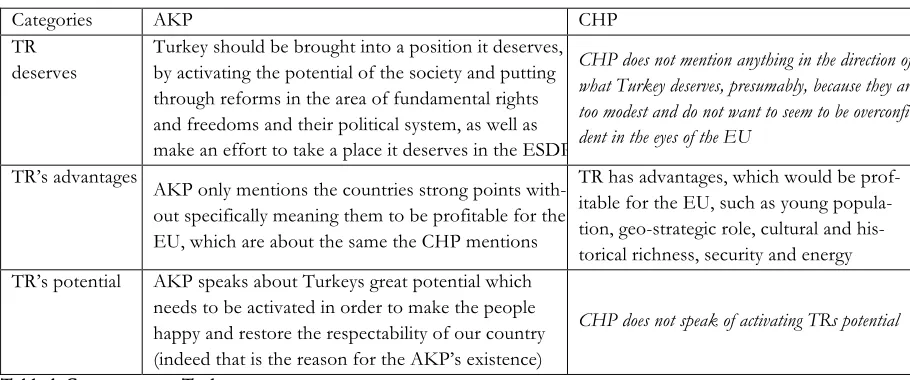
Categories AKP CHP
TR deserves
Turkey should be brought into a position it deserves, by activating the potential of the society and putting through reforms in the area of fundamental rights and freedoms and their political system, as well as make an effort to take a place it deserves in the ESDP
CHP does not mention anything in the direction of what Turkey deserves, presumably, because they are too modest and do not want to seem to be overconfi-dent in the eyes of the EU
TR’s advantages
AKP only mentions the countries strong points with-out specifically meaning them to be profitable for the EU, which are about the same the CHP mentions
TR has advantages, which would be prof-itable for the EU, such as young popula-tion, geo-strategic role, cultural and his-torical richness, security and energy TR’s potential AKP speaks about Turkeys great potential which
needs to be activated in order to make the people happy and restore the respectability of our country (indeed that is the reason for the AKP’s existence)
[image:19.595.71.526.102.292.2]CHP does not speak of activating TRs potential
Table 1: Core-category: Turkey
What is most conspicuous when looking at the AKP’s statements is that the party seems to be very confident of their countries qualities and attaching much national pride to it. Firstly, the AKP states that “efforts shall be maintained for Turkey to take the place it deserves within the new European Se-curity and Defence Concept” (AK Party, 2007, p. 6)9. The AKP also in other places states that Turkey
deserves to have a better position in the “civilised world”, although it is never mentioned why it de-serves these positions (AK Party, 2007, p. 2.1). Secondly, the AKP often mentions the great potential Turkey has, which needs to be activated: “We are determined to mobilise the large potential of Turkey, in order to make our people happy and restore the respectability of our country” (AK Party, 2007, p. 1). Potential is elsewhere defined as human, physical and economic potential, which needs to be acti-vated, meaning that Turkey is now less successful than it could actually be and in the view of the AKP also deserves to be. Saying that the respectability of the country needs to be “restored” brings up the question what or who actually destroyed it: two possibilities are previous governments, or the Treaties of Sevres and Lausanne. This remains subject to speculation, as the AKP does not elaborate on that point.
AKP and CHP both speak about certain advantages the country has, which are for both parties roughly the same: young population, strategic geographical position, rich cultural and historical heritage, and others. However, whereas the AKP only generally enumerates these advantages, the CHP directly re-lates them to the EU saying that these advantages would be beneficial for the EU.
Summing up, the analysis of the statements for this core-category leads to thinking that the CHP is more EU-related and focused than the AKP, which is rather Turkey-focused and concentrates on im-proving its own country in order to be successful.
9 Technical note: As there are no page or paragraph numbers in the AKP programme, the chapter the quote stems
20
4.1.2) European Union
How do the parties depict the EU?
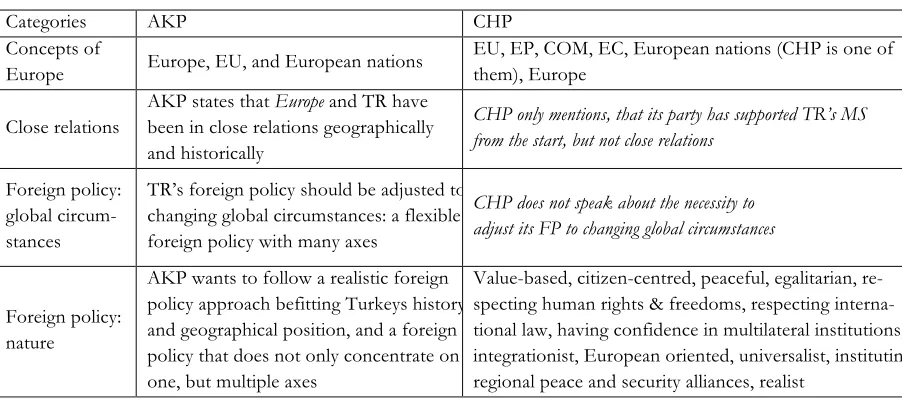
[image:20.595.74.525.187.387.2]The parties’ perception of the EU is important for the issue of the accession process: if the party has an entirely negative picture of the EU one can assume that it would not want to become a part of it. This core-category includes categories, which describe how the parties depict the EU (and Europe or European nations) and Turkey’s relation with the EU in their texts.
Table 2: Core-category: European Union
The AKP refers in its programme to Europe, European nations or European Union, whereas the CHP uses a wider range of terms, including specifically addressing European institutions, and the European public, which could on the one hand mean that the CHP deals with the subject in a more differentiated way than the AKP. On the other hand, this impression could also stem from the fact that the CHP’s documents (apart from the 2011 election manifesto) are only dedicated to the accession issue and the party hence wants to explain its position in more detail, whereas the AKP in its programme gives a ra-ther general overview without going too much into detail.
The CHP defines Europe as “whole of values based on a foundation of democracy, human rights and a social state” (Republican People's Party, 2011, p. 122). The CHP also counts Turkey as a European country: “Turkey was among the first countries of Europe”, which one could say clarifies the CHP’s view that Turkey has always been a part of Europe, even if only a very small part of Turkey geograph-ically belongs to Europe (Republican People's Party, 2009b, p. 3).
The AKP does not specify what it means, when speaking about “Europe”. Yet, one can from the con-text assume that a geographic entity, rather than a political or economic one is referred to: “Turkey has been in close relations with Europe both geographically and historically” (AK Party, 2007, p. 6). When stating that Turkey and Europe have been in close historical relations, one can think of relations which are going back as far as for example the time of the Roman empire, as far as WWI, or only a couple of decades back with the signing of the Ankara agreement. Turkey’s geographical position is a given fac-tor, which puts Turkey in the middle of several regions. Thus, whereas the CHP clearly states that Tur-key belongs to Europe, the AKP wants to make use of its geographical positions, which is also appar-ent in their foreign policy.
Categories AKP CHP
Concepts of
Europe Europe, EU, and European nations
EU, EP, COM, EC, European nations (CHP is one of them), Europe
Close relations
AKP states that Europe and TR have been in close relations geographically and historically
CHP only mentions, that its party has supported TR’s MS from the start, but not close relations
Foreign policy: global circum-stances
TR’s foreign policy should be adjusted to changing global circumstances: a flexible foreign policy with many axes
CHP does not speak about the necessity to adjust its FP to changing global circumstances
Foreign policy: nature
AKP wants to follow a realistic foreign policy approach befitting Turkeys history and geographical position, and a foreign policy that does not only concentrate on one, but multiple axes
21
Turkey’s foreign policy, in the eyes of the AKP should be flexible and addressing multiple axes, rather than only concentrating on one entity, meaning that the focus should not only lie on for example fur-thering relations with the EU or European countries, but also with its neighbours in the Caucasus, Central Asia and the Middle East. The foreign policy described in the party programme very closely resembles the foreign policy as propagated by the current foreign minister, Davutoglu. His “strategic depth”10 approach brings Turkey’s geographic position (“geographical depth”) and historical richness
(“historical depth”) to the centre of attention and takes these characteristics of Turkey as the basis for his multi-dimensional, and often called neo-Ottomanist foreign policy. The out of this ‘strategic depth’ doctrine resulting “zero problem policy toward Turkey’s neighbours” (Davutoglu, 2008, p. 4) has im-proved Turkey’s relations with its neighbours significantly. However, the West is no longer the centre of attention, and as Davutoglu emphasised, “Turkey cannot wait forever at the EU door, and needs to develop a genuinely multi-directional foreign” (Murinson, 2006, p. 9).
4.1.3) Accession
How is the (current state of the) accession process described?
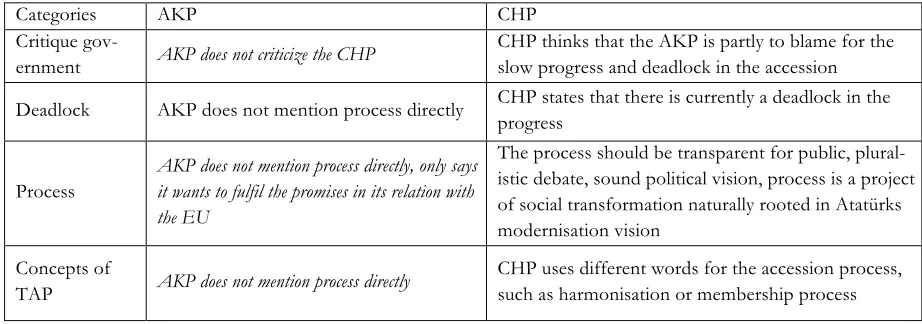
This core-category encompasses what the parties say about Turkey’s accession process, both concern-ing Turkey’s domestic political scene (critique government), and the process itself (deadlock, concepts of TAP and process). The analysis showed, that the parties focus on the future of the accession pro-cess, rather than how the process has been so far.
Categories AKP CHP
Critique
gov-ernment AKP does not criticize the CHP
CHP thinks that the AKP is partly to blame for the slow progress and deadlock in the accession
Deadlock AKP does not mention process directly CHP states that there is currently a deadlock in the progress
Process
AKP does not mention process directly, only says it wants to fulfil the promises in its relation with the EU
The process should be transparent for public, plural-istic debate, sound political vision, process is a project of social transformation naturally rooted in Atatürks modernisation vision
Concepts of
TAP AKP does not mention process directly
[image:21.595.69.530.421.583.2]CHP uses different words for the accession process, such as harmonisation or membership process
Table 3: Core-category: Accession
Very significant in terms of the parties’ statements on the accession process is that the AKP does not with one word mention the process directly, as one would have assumed that a party which wants to become a member would discuss the accession process in its party programme. Only a statement ex-pressing that it wants to “rapidly fulfil its promises in its relations with the European Union, and the conditions, which the union demands of other candidate nations as well” hints at the accession process (AK Party, 2007, p. 6). But other than that, the topic is not mentioned. The question is why the AKP would want to rapidly fulfil the promises, if they are not openly stating that they support the accession
22
process and want to become a member. This crucial point is discussed in section 4.1.9 in connection with the central core-category. The CHP on the other hand makes it very clear, that it “regard’s Tur-key’s membership to the EU as a project of social transformation, naturally rooted in the vision for modernisation of Mustafa Kemal Atatürk” (Republican People's Party, 2010, p. 2). It repeatedly states that it firmly supports the Turkish accession process and that it wants to fulfil the promises as quickly as possible. Moreover, the CHP makes the government partly responsible for the slow progress made in the accession process: “Despite the CHP’s clear demands […] the government preferred not to pass the social legislation and consequently the relevant chapter of negotiations was not opened with the EU” (Republican People's Party, 2009a, p. 4). It is questionable, whether the CHP, in criticising the AKP, acts in its role as the opposition party, trying to build its own profile, or whether it would really act differently than the AKP when being in government. Apart from making the AKP responsible for the slow progress, the CHP also mentions that the deadlock in the accession process was also caused by “the attitudes of conservative parties in Europe” (Republican People's Party, 2011, p. 122). The CHP (as well as the AKP) does not on the other hand name any parties, which would indeed help the party to further their accession process, but the CHP mentions that it is an associate member of the Party of European Socialists (PES) and the Socialists International.
The CHP expresses a clear vision as to how the process should look like: “transparent”, “involving the Turkish public”, built on a “sound political vision”, and coined by a “pluralistic debate to which the CHP contributes as the main opposition party” (Republican People's Party, 2009a and b, p. 2 and 1-2). All in all, the evaluation of this core-category has shown that the CHP has a very clear perception of how the accession process is currently and should be going, and where the problems lie currently. Coming to that it very clearly states that it supports Turkey’s accession process, whereas the AKP seems to be very hesitant in making any clear statements on the process, and only mentioning it indi-rectly.
4.1.4) Motives
What are the parties’ motives to change and reform Turkey?
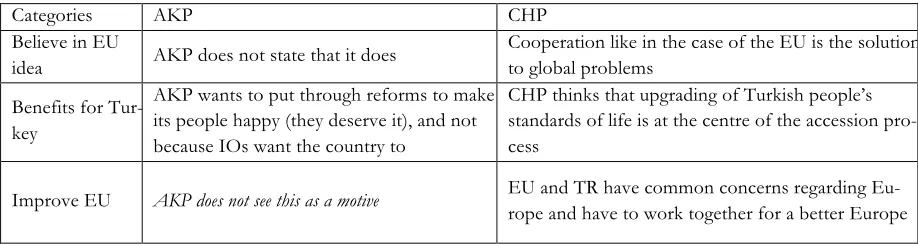
This core-category includes everything that is said about why the parties want to put through reforms in their country or why they want to change in a way that they said (e.g. why they want to comply with EU criteria or international standards). The parties mention things both in the domestic sphere, and also external reasons for wanting to reform the country.
Categories AKP CHP
Believe in EU
idea AKP does not state that it does
Cooperation like in the case of the EU is the solution to global problems
Benefits for Tur-key
AKP wants to put through reforms to make its people happy (they deserve it), and not because IOs want the country to
CHP thinks that upgrading of Turkish people’s standards of life is at the centre of the accession pro-cess
Improve EU AKP does not see this as a motive EU and TR have common concerns regarding
[image:22.595.71.530.633.756.2]Eu-rope and have to work together for a better EuEu-rope
23
Both parties say that they want to reform their country to upgrade the living standards of the Turkish citizens. The CHP is convinced, that Turkey’s accession process will lead to the desired improvement in living standards: “In all fields of social and economic life, the upgrading of the Turkish people’s standards of life is at the core of the EU harmonisation process” (Republican People's Party, 2009a, p. 2). The AKP however does not relate the well being of its citizens to the EU accession process. On the contrary, it says, “steps must be taken because our people deserve these rights and freedoms, rather than because international institutions want them to be taken” (AK Party, 2007, p. 2.1). Hence, the CHP mostly relates its statements to the EU, whereas the AKP rather seems to distance itself from it. What furthermore differentiates the CHP from the AKP in terms of their motives to change is the CHP’s conviction that “ integration between countries, as seen in the EU example, goes beyond classic cooperation and gives more long-lasting and more effective results” (Republican People's Party, 2011, p. 122). The party thereby states that it supports the high level of cooperation in the EU and in order to be a part of it wants to fulfil the EU criteria as fast as possible. The AKP does not mention any such believe in the European idea.
Apart from both parties wanting to put through reforms for the benefit of its citizens, the CHP also states that it wants to work together with the EU and put through changes in order to enable a better future for Europe, as the EU and Turkey share common concerns. This can be summarised as a will to put through reforms to improve the EU.
4.1.5) Willingness
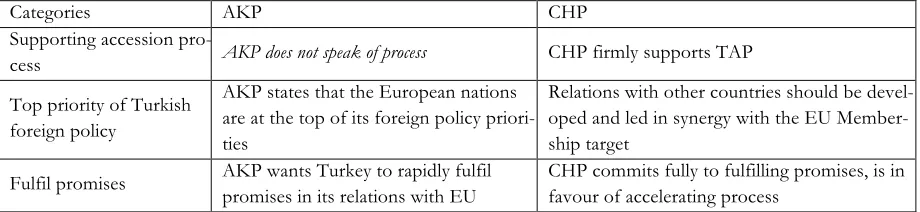
How willing does the party seem to change in order to further the Turkish accession process?
This core-category summarises all statements, which describe how willing the parties are to change. Change in this respect is not as generally defined, as in the last core-category, but targeted directly at the EU.
Categories AKP CHP
Supporting accession
pro-cess AKP does not speak of process CHP firmly supports TAP
Top priority of Turkish foreign policy
AKP states that the European nations are at the top of its foreign policy priori-ties
Relations with other countries should be devel-oped and led in synergy with the EU Member-ship target
Fulfil promises AKP wants Turkey to rapidly fulfil promises in its relations with EU
[image:23.595.72.532.508.614.2]CHP commits fully to fulfilling promises, is in favour of accelerating process
Table 5: Core-category: Willingness
A precondition for being willing to change in order to further the accession process is to support it. As the AKP does not openly mention that it is supporting the TAP, it is rather difficult to know whether they actually would want to put trough reforms in order to further the accession process. The CHP, as already said above, repeatedly confirms its strong support for the accession process.
24
the top of the list in Turkey’s foreign policy agenda” (AK Party, 2007, p. 6). As the party does not real-ly clarify why the European nations are top priority or which targets should be reached by putting them on top of the list, one can only speculate. It could for example mean that in order to become a member of the EU, Turkey needs to improve relations with certain countries, such as France and Germany (European Council on Foreign Relations, 2011, p. 70), because these countries are currently against Turkey becoming a member. It could also mean, that the AKP is not really interested in improving its relations with the EU on the whole and is rather interested in good (economic, political or other kind of) relations with the countries, because it hopes that the good relations would lead to for example in-creased trade and exchange of best practices in order to come closer to being a ‘contemporary democ-racy’ and increase European and international competitiveness. The second possibility seems to fit bet-ter to the impression the AKP gives in its programme, as will also be explained in the next section (4.1.9).
To give an answer to the question of how willing the parties seem to change ‘for’ the EU, it is likely that the CHP is very willing to do so, whereas the AKP does not show such signs of willingness as was reconstructed from their programme.
4.1.6) Efforts
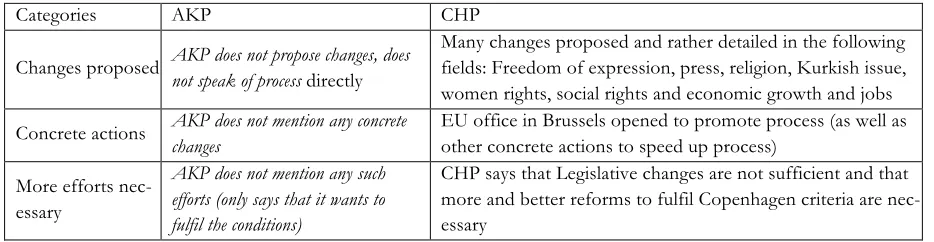
What efforts does that party make to fulfil the accession conditions?
[image:24.595.69.536.475.596.2]This core-category is also specifically targeted at the Turkish accession process. It summarises all quotes regarding any changes the party says it has already implemented to further the process or has planned in order to further the process. Whether it really did put through these changes or planned them in order to further the process can of course not been proven.
Table 6: Core-category: Efforts
As already evaluated above, the AKP does not mention the accession process in its programme; neither does it state that it is willing to change in order to further the accession process. Following from that, it is not surprising, that the party also does not talk about any efforts it has put into effect or planned in order to fulfil the accession conditions.
The CHP mentions many changes it either put through, or which are planned in order to further the TAP. It can’t of course been proven whether these efforts were really put through for the EU or whether they are only declared as such. One of those concrete actions was the opening of the CHP EU representation office in Brussels, lead by Kader Sevinc the EU representative of the CHP. The office was opened in 2008 to “promote Turkey’s EU membership process and better inform the EU public
Categories AKP CHP
Changes proposed AKP does not propose changes, does
not speak of process directly
Many changes proposed and rather detailed in the following fields: Freedom of expression, press, religion, Kurkish issue, women rights, social rights and economic growth and jobs
Concrete actions AKP does not mention any concrete
changes
EU office in Brussels opened to promote process (as well as other concrete actions to speed up process)
More efforts nec-essary
AKP does not mention any such efforts (only says that it wants to fulfil the conditions)
25
on the CHP’s social democratic policies” (Republican People's Party, 2009b, p. 1). Furthermore, the CHP criticises the current efforts, which are in their eyes “not sufficient for bringing Turkish democra-cy in line with those of the EU countries” (Republican People's Party, 2010, p. 8) and asks for a better fulfilment of the EU criteria. In sum, the CHP shows that it already undertook, as well as proposed many changes in order to further the EU accession process and is of the opinion, that the efforts cur-rently undertaken are not sufficient.
4.1.7) Conditions
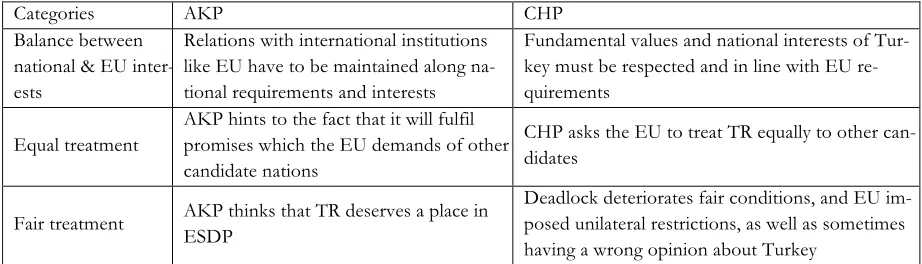
What conditions does the party attach to fulfilling the membership conditions?
The Cocategory includes all statements on any conditions the party attaches to fulfilling EU re-quirements. These are on the one hand national (preserving national interests) and on the other hand external requirements.
Categories AKP CHP
Balance between national & EU inter-ests
Relations with international institutions like EU have to be maintained along na-tional requirements and interests
Fundamental values and national interests of Tur-key must be respected and in line with EU re-quirements
Equal treatment
AKP hints to the fact that it will fulfil promises which the EU demands of other candidate nations
CHP asks the EU to treat TR equally to other can-didates
Fair treatment AKP thinks that TR deserves a place in ESDP
[image:25.595.70.531.301.433.2]Deadlock deteriorates fair conditions, and EU im-posed unilateral restrictions, as well as sometimes having a wrong opinion about Turkey
Table 7: Core-category: Conditions
Both parties attach conditions to fulfilling the membership conditions, or as the AKP put it “the prom-ises in its relations with the European Union” (AK Party, 2007, p. 6). Both parties ask to be treated equal to other candidate states. It seems as if there is a hidden criticism, namely that the parties have the feeling that they are not treated equally, because otherwise there would not be the need put this down as a condition for fulfilling the conditions. Furthermore, both parties want to preserve their tional interests and are keen to keep a balance between the European membership conditions and na-tional priorities. The AKP states for example that “our relations with the European Union, World Bank, IMF, and other international institutions must be maintained along the lines of the requirements of our economy and our national interests” (AK Party, 2007, p. 3.1). In the eyes of the CHP, national interests for example also include Turkey’s standpoint on the Cyprus issue (Republican People's Party, 2011, p. 125). Coming to that, the CHP asks for fair treatment at the hands of the EU. The party states that the EU has imposed unilateral restrictions on the country, that “the EP is of contradictory, even wrong opinions about Turkey” (Republican People's Party, 2010, p. 8), that the deadlock in the process deteriorates fair conditions and that the “CHP is dedicated to reverse this situation [deadlock] in view of accelerating Turkey’s EU membership process under fair conditions accordingly with the European values and national priorities” (Republican People's Party, 2009a, p. 2).