Structure-Preserving Pipelines for Digital Libraries
Massimo Poesio University of Essex, UK and
Università di Trento, Italy
Eduard Barbu Egon W. Stemle Università di Trento, Italy
{massimo.poesio,eduard.barbu,egon.stemle} @unitn.it
Christian Girardi FBK-irst, Trento, Italy
Abstract
Most existingHLTpipelines assume the input is pure text or, at most, HTML and either ig-nore (logical) document structure or remove it. We argue that identifying the structure of documents is essential in digital library and other types of applications, and show that it is relatively straightforward to extend existing pipelines to achieve ones in which the struc-ture of a document is preserved.
1 Introduction
Many off-the-shelf Human Language Technology (HLT) pipelines are now freely available (examples include LingPipe,1 OpenNLP,2 GATE3 (Cunning-ham et al., 2002), TextPro4 (Pianta et al., 2008)), and although they support a variety of document for-mats as input, actual processing (mostly) takes no advantage of structural information, i.e. structural information is not used, or stripped off during pre-processing. Such processing can be considered safe, e.g. in case of news wire snippets, when processing does not need to be aware of sentence or paragraph boundaries, or of text being part of a table or a fig-ure caption. However, when processing large doc-uments, section or chapter boundaries may be con-sidered an important segmentation to use, and when working with the type of data typically found in dig-ital libraries or historical archives, such as whole
1http://alias-i.com/lingpipe/
2http://incubator.apache.org/opennlp/ 3http://http://gate.ac.uk/
4http://textpro.fbk.eu/
books, exhibition catalogs, scientific articles, con-tracts we should keep the structure. At least three types of problems can be observed when trying to use a standard HLT pipeline for documents whose structure cannot be easily ignored:
• techniques for extracting content from plain text do not work on, say, bibliographic refer-ences, or lists;
• simply removing the parts of a document that do not contain plain text may not be the right thing to do for all applications, as sometimes the information contained in them may also be useful (e.g., keywords are often useful for clas-sification, bibliographic references are useful in a variety of applications) or even the most im-portant parts of a text (e.g., in topic classifica-tion informaclassifica-tion provided by titles and other types of document structure is often the most important part of a document);
• even for parts of a document that still can be considered as containing basically text—e.g., titles—knowing that we are dealing with what we will call here non-paragraph text can be useful to achieve good - or improve - perfor-mance as e.g., the syntactic conventions used in those type of document elements may be dif-ferent - e.g., the syntax of NPs in titles can be pretty different from that in other sections of text.
In this paper we summarize several years of work on developing structure-preserving pipelines for dif-ferent applications. We discuss the incorporation of
document structure parsers both in pipelines which the information is passed in BOI format (Ramshaw and Marcus, 1995), such as the TEXTPRO pipeline
(Pianta et al., 2008), and in pipelines based on a standoff XML (Ide, 1998). We also present sev-eral distinct applications that require preserving doc-ument structure.
The structure of the paper is as follows. We first discuss the notion of document structure and previ-ous work in extracting it. We then introduce our ar-chitecture for a structure-preserving pipeline. Next, we discuss two pipelines based on this general archi-tecture. A discussion follows.
2 The Logical Structure of a Document
Documents have at least two types of structure5. The term geometrical, or layout, structure, refers to the structuring of a document according to its vi-sual appearance, its graphical representation (pages, columns, etc). Thelogical structure (Luong et al., 2011) refers instead to the content’s organization to fulfill an intended overall communicative purpose (title, author list, chapter, section, bibliography, etc). Both of these structures can be represented as trees; however, these two tree structures may not be mu-tually compatible (i.e. representable within a single tree structure with non-overlapping structural ele-ments): e.g. a single page may contain the end of one section and the beginning of the next, or a para-graph may just span part of a page or column. In this paper we will be exclusively concerned with logical structure.
2.1 Proposals concerning logical structure
Early on the separation of presentation and content, i.e. of layout and logical structure, was promoted by the early adopters of computers within the typeset-ting community; well-known, still widely used, sys-tems include the LATEXmeta-package for electronic typesetting. The importance of separating document logical structure from document content for elec-tronic document processing and for the document creators lead to the ISO 8613-1:1989(E) specifica-tion wherelogical structureis defined as the result of dividing and subdividing the content of a
docu-5other structure types include e.g. (hyper)links,
cross-references, citations, temporal and spatial relationships
ment into increasingly smaller parts, on the basis of the human-perceptible meaning of the content, for example, into chapters, sections, subsections, and paragraphs. The influential ISO 8879:1986 Stan-dard Generalized Markup Language (SGML) spec-ification fostered document format definitions like the Open Document Architecture (ODA) and inter-change format, CCITT T.411-T.424 / ISO 8613.
Even though the latter format never gained wide-spread support, its technological ideas influ-enced many of today’s formats, like HTML and CSS as well as, the Extensible Markup Language (XML), today’s successor of SGML. Today, the ISO 26300:2006 Open Document Format for Office Ap-plications (ODF), and the ISO 29500:2008 Office Open XML (OOXML) format are the important XML-based document file formats.
For the work on digital libraries the Text Encod-ing Initiative (TEI)6,most notably, developed guide-lines specifying encoding methods for machine-readable texts. They have been widely used, e.g. by libraries, museums, and publishers.
The most common logical elements in such proposals—chapters, sections, paragraphs, foot-notes, etc.—can all be found in HTML, LATEX, or any other modern text processor. It should be pointed out however that many modern types of doc-uments found on the Web do not fit this pattern: e.g. blog posts with comments, and the structure of reply threads and inner-linkings to other comments cannot be captured; or much of wikipedia’s non-paragraph text. (For an in depth comparison and discussion of logical formats, and formal characteri-zations thereof we suggest (Power et al., 2003; Sum-mers, 1998).)
2.2 Extracting logical structure
Two families of methods have been developed to ex-tract document structure. Older systems tend to fol-low the template-matching paradigm. In this ap-proach the assignment of the categories to parts of the string is done by matching a sequence of hand crafted templates against the input string S. An instance of this kind of systems is DeLos (Deriva-tion of Logical Structure) (Niyogi and Srihari, 1995) which uses control rules, strategy rules and
edge rules to derive the logical document structure from a scanned image of the document. A more elab-orate procedure for the same task is employed by Ishitani (Ishitani, 1999). He uses rules to classify the text lines derived from scanned document image and then employs a set of heuristics to assign the classi-fied lines to logical document components. The tem-plate based approach is also used by the ParaTools, a set of Perl modules for parsing reference strings (Jewell, 2000). The drawback of the template based approaches is that they are usually not portable to new domains and are not flexible enough to accom-modate errors. Domain adaptation requires the de-vising of new rules many of them from scratch. Fur-ther the scanned documents or the text content ex-tracted from PDF have errors which are not easily dealt with by template based systems.
Newer systems use supervised machine learning techniques which are much more flexible but re-quire training data. Extracting document structure is an instance of (hierarchical) sequence labeling, a well known problem which naturally arises in di-verse fields like speech recognition, digital signal processing or bioinformatics. Two kinds of machine learning techniques are most commonly used for this problem: Hidden Markov Models (HMM) and Con-ditional Random Fields (CRF). A system for pars-ing reference strpars-ings based on HMMs was developed in (Hetzner, 2008) for the California Digital Library. The system implements a first order HMM where the set of states of the model are represented by the cat-egories inC; the alphabet is hand built and tailored for the task and the probabilities in the probability matrix are derived empirically. The system obtains an average F1 measure of 93 for the Cora dataset. A better performance for sequence labeling is ob-tained if CRF replaces the traditional HMM. The reason for this is that CRF systems better tolerate errors and they have good performance even when richer features are not available. A system which uses CRF and a series of post-processing rules for both document logical structure identification and reference string parsing is ParsCit (Councill et al., 2008). ParsCit comprises three sub-modules: Sect-Label and ParseHead for document logical structure identification and ParsCit for reference string pars-ing. The system is built on top of the well known CRF++ package.
The linguistic surface level, i.e. the linear order of words, sentences, and paragraphs, and the hi-erarchical, tree-like, logical structure also lends it-self to parsing-like methods for the structure analy-sis. However, the complexity of fostering, maintain-ing, and augmenting document structure grammars is challenging, and the notorious uncertainty of the input demands for the whole set of stochastic tech-niques the field has to offer – this comes at a high computing price; cf. e.g.,(Lee et al., 2003; Mao et al., 2003). It is therefore not surprising that high-throughput internet sites like CiteSeerX7 use a flat text classifier (Day et al., 2007).8
3 Digital Libraries and Document Structure Preservation
Our first example of application in which document structure preservation is essential are digital libraries (Witten et al., 2003). In a digital library setting,HLT
techniques can be used for a variety of purposes, ranging from indexing the documents in the library for search to classifying them to automatically ex-tracting metadata. It is therefore becoming more and more common forHLTtechniques to be incorporated in document management platforms and used to sup-port a librarian when he / she enters a new document in the library. Clearly, it would be beneficial if such a pipeline could identify the logical structure of the documents being entered, and preserve it: this infor-mation could be used by the document management platform to, for instance, suggest the librarian the most important keywords, find the text to be indexed or even summarized, and produce citations lists, pos-sibly to be compared with the digital library’s list of citations to decide whether to add them.
We are in the process of developing a Portal for Research in the Humanities (Portale Ricerca Umanistica-PRU). This digital library will eventu-ally include research articles about the Trentino re-gion from Archeology, History, and History of Art. So far, the pipeline to be discussed next has been used to include in the library texts from the Italian archeology journal Preistoria Alpina. One of our goals was to develop a pipeline that could be used
7http://citeseerx.ist.psu.edu/
8Still, especially multimedia documents with their possible
whenever a librarian uploads an article in this digital library, to identify title, authors, abstract, keywords, content, and bibliographic references from the arti-cle. The implemented portal already incorporates in-formation extraction techniques that are used to iden-tify in the ’content’ part of the output of the pipeline temporal expressions, locations, and entities such as archeological sites, cultures, and artifacts. This information is used to allow spatial, temporal, and entity-based access to articles.
We are in the process of enriching the portal so that title and author information are also used to au-tomatically produce a bibliographical card for the ar-ticle that will be entered in the PRU Library Catalog, and bibliographical references are processed in or-der to link the article to related articles and to the catalog as well. The next step will be to modify the pipeline (in particular, to modify the Named Entity Recognition component) to include in the library ar-ticles from other areas of research in the Humanities, starting with History. There are also plans to make it possible for authors themselves to insert their re-search articles and books in the Portal, as done e.g., in the Semantics Archive.9.
We believe the functionalities offered by this por-tal are or will become pretty standard in digipor-tal li-braries, and therefore that the proposals discussed in this paper could find an application beyond the use in our Portal. We will also see below that a docu-ment structure-sensitive pipeline can find other ap-plications.
4 Turning an Existing Pipeline into One that Extracts and Preserves Document Structure
Most freely available HLT pipelines simply elimi-nate markup during the initial phases of processing in order to eliminate parts of the document struc-ture that cannot be easily processed by their mod-ules (e.g., bibliographic references), but this is not appropriate for the Portal described in the previous section, where different parts of the output of the pipeline need to be processed in different ways. On the other end, it was not really feasible to develop a completely new pipeline from scratch. The ap-proach we pursued in this work was to take an
exist-9http://semanticsarchive.net/
ing pipeline and turn it into one which extracts and outputs document structure. In this Section we dis-cuss the approach we followed. In the next Section we discuss the first pipeline we developed according to this approach; then we discuss how the approach was adopted for other purposes, as well.
Incorporating a document structure extractor in a pipeline requires the solution of two basic problems: where to insert the module, and how to pass on doc-ument structure information. Concerning the first issue, we decided to insert the document structure parser after tokenization but before sentence process-ing. In regards to the second issue, there are at present three main formats for exchanging informa-tion between elements of anHLTpipeline:
• inline, where each module inserts information in a pre-defined fashion into the file received as input;
• tabular format as done in CONLL, where to-kens occupy the first column and each new layer of information is annotated in a separate new column, using the so-called IOB format to represent bracketing (Ramshaw and Marcus, 1995);
• standoff format, where new layers of informa-tion are stored in separate files.
The two main formats used by modernHLTpipelines are tabular format, and inline or standoff XML for-mat. Even though we will illustrate the problem of preserving document structure in a pipeline of the former type the PRU pipeline itself supports tabular format and inline XML (TEI compliant).
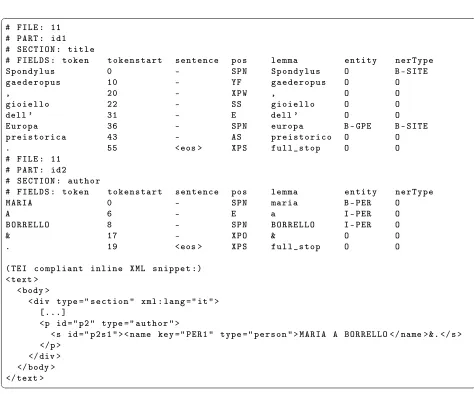
The solution we adopted, illustrated in Figure 1, involves usingsentence headers to preserve docu-ment structure information. In most pipelines using a tabular interchange information, the output of a module consists of a number of sentences each of which consists of
• aheader: a series of lines with a hash character # at the beginning;
• a set of tab-delimited lines representing tokens and token annotations;
# FILE : 11 # PART : id1 # SECTION : title
# FIELDS : token tokenstart sentence pos lemma entity nerType
Spondylus 0 - SPN Spondylus O B- SITE
gaederopus 10 - YF gaederopus O O
, 20 - XPW , O O
gioiello 22 - SS gioiello O O
dell ' 31 - E dell ' O O
Europa 36 - SPN europa B- GPE B- SITE
preistorica 43 - AS preistorico O O
. 55 <eos > XPS full_stop O O
# FILE : 11 # PART : id2
# SECTION : author
# FIELDS : token tokenstart sentence pos lemma entity nerType
MARIA 0 - SPN maria B- PER O
A 6 - E a I- PER O
BORRELLO 8 - SPN BORRELLO I- PER O
& 17 - XPO & O O
. 19 <eos > XPS full_stop O O
( TEI compliant inline XML snippet :) <text >
<body >
<div type =" section " xml : lang =" it"> [...]
<p id =" p2" type =" author ">
<s id =" p2s1 ">< name key =" PER1 " type =" person "> MARIA A BORRELLO </ name >&. </s> </p>
</div > </body > </text >
[image:5.612.67.541.157.551.2]
The header in such pipelines normally specifies only the file id (constant through the file), the number of the sentence within the file, and the columns (see Figure 1). This format however can also be used to pass on document structure information provided that the pipeline modules ignore all lines beginning with a hash, as these lines can then be used to pro-vide additional meta information. We introduce an additional tag, SECTION, with the following mean-ing: a line beginning with# SECTION:specifies the position in the document structure of the following sentence. Thus for instance, in Figure 1, the line
# SECTION: title
specifies that the following sentence is a title.
5 An Pipeline for Research Articles in Archeology
The pipeline currently in use in the PRU Portal we are developing is based on the strategy just dis-cussed. In this Section We discuss the pipeline in more detail.
5.1 Modules
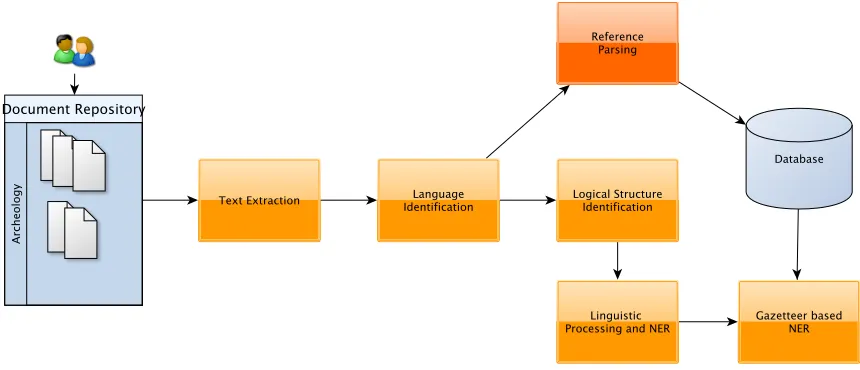
The pipeline for processing archaeological articles integrates three main modules: a module for recov-ering the logical structure of the documents, a mod-ule for Italian and English POS tagging and a gen-eral Name Entity Recognizer and finally, a Gazetteer Based Name Entity Recognizer. The architecture of the system is presented in figure 2. Each module except the first one takes as input the output of the previous module in the sequence.
1. Text Extraction. This module extracts the text from PDF documents. Text extraction from PDF is a notoriously challenging task. We ex-perimented with many software packages and obtained the best results withpdftotext. This is a component of XPDF, an open source viewer for PDF documents.pdftotextallows the extrac-tion of the text content of PDF documents in a variety of encodings. The main drawback of the text extractor is that it does not always preserve the original text order.
2. Language Identification. The archeology repository contains articles written in one of
the two languages: Italian or English. This module uses the TextCat language guesser10for guessing the language of sentences. The lan-guage identification task is complicated by the fact that some articles contain text in both lan-guages: for example, an article written in En-glish may have an Italian abstract and/or an Ital-ian conclusion.
3. Logical Structure Identification. This mod-ule extracts the logical structure of a document. For example, it identifies important parts like the title, the authors, the main headers, tables or figures. For this task we train the SectLa-bel component of ParsCit on the articles in the archeology repository. Details on the training process, the tag set and the performance of the module are provided in section 5.2.
4. Linguistic Processing. A set of modules in the pipeline then perform linguistic processing on specific parts of the document (the Bibliogra-phy Section is excluded for example). First En-glish or Italian POS is carried out as appropri-ate, followed by English or Italian NER. NER adaptation techniques have been developed to identify non-standard types entities that are im-portant in the domain, such as Archeological
Sites and Archeological Cultures. (This work
is discussed elsewhere.)
5. Reference Parsing. This module relies on the output of ParsCit software to update the Archeology Database Bibliography table with the parsed references for each article. First, each parsed reference is corrected in an auto-matic post processing step. Then, the module checks, using a simple heuristic, if the entry al-ready exists in the table and updates the table, if appropriate, with the new record.
Finally, the documents processed by the pipeline are indexed using the Lucene search engine.
5.2 Training the Logical Document Structure Identifier
As mentioned in Section 5, we use ParsCit to find the logical structure of the documents in the archeology
Figure 2: The pipeline of the system for PDF article processing in the Archeology Domain
domain. ParsCit comes with general CRF trained models; unfortunately, they do not perform well on archeology documents. There are some particulari-ties of archeology repository articles that require the retraining of the models. First, as said before, the text extracted from PDF is not perfect. Second, the archeology articles contain many figures with bilin-gual captions. Third, the articles have portions of the texts in both languages: Italian and English. To improve the parsing performance two models are trained: the first model should capture the logical documents structure for those documents that have Italian as main language but might contain portions in English (like the abstract or summary). The sec-ond model is trained with documents that have En-glish as main language but might contain fragments in Italian (like abstract or summary).
The document structure annotation was per-formed by a student in the archeology department, and was checked by one of the authors. In total 55 documents have been annotated (35 with Italian as main language, 20 with English as main Language). The tagset used for the annotation was specifically devised for archeology articles. However, as it can be seen below most of the devised tags can also be found in general scientific articles. In Table 1 we present the tag set used for annotation. The column "Tag Count" gives the number of each tag in the an-notated documents.
In general the meaning of the tags is self-explanatory with the possible exception of the
tag VolumeInfo, which reports information for
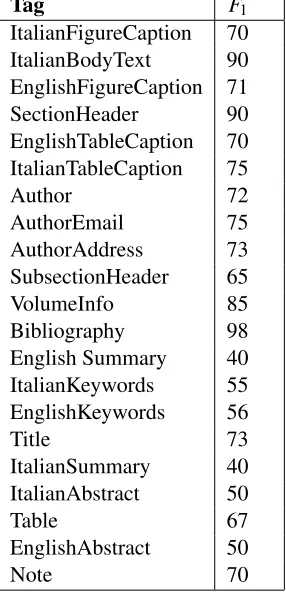
vol-ume the article is part of. An annotation exam-ple using this tag is: "<VolumeInfo> Preistoria Alpina v. 38 (2002) Trento 2002 ISSN 0393-0157 </VolumeInfo>". The volume information can be further processed by extracting the volume number, the year of the issue and the International Standard Serial Number (ISSN). To asses the performance of the trained models we performed a five fold cross-validation. The results are reported in the table 2 and are obtained for each tag using theF1measure (1):
F1=
2×P×R
P+R (1)
Tag Tag Count
ItalianFigureCaption 456
ItalianBodyText 347
EnglishFigureCaption 313
SectionHeader 248
EnglishTableCaption 58 ItalianTableCaption 58
Author 71
AuthorEmail 71
AuthorAddress 65
SubsectionHeader 50
VolumeInfo 57
Bibliography 55
English Summary 31
ItalianKeywords 35
EnglishKeywords 35
Title 55
ItalianSummary 29
ItalianAbstract 10
Table 25
EnglishAbstract 13
Note 18
Table 1: The tag set used for Archeology Article Annota-tion.
6 Additional Applications for Structure-Sensitive Pipelines
The pipeline discussed above can be used for a va-riety of other types of documents–archeology doc-uments from other collections, or docdoc-uments from other domains–by simply replacing the document structure extractor. We also found however that the pipeline is useful for a variety of other text-analysis tasks. We briefly discuss these in turn.
6.1 Blogs and Microblogging platforms
Content creation platforms like blogs, microblogs, community QA sites, forums, etc., contain user gen-erated data. This data may be emotional, opin-ionated, personal, and sentimental, and as such, makes it interesting for sentiment analysis, opinion retrieval, and mood detection. In their survey on opinion mining and sentiment analysis Pang and Lee (2008) report that logical structure can be used to uti-lize the relationships between different units of con-tent, in order to achieve a more accurate labeling;
Tag F1
ItalianFigureCaption 70 ItalianBodyText 90 EnglishFigureCaption 71
SectionHeader 90
EnglishTableCaption 70 ItalianTableCaption 75
Author 72
AuthorEmail 75
AuthorAddress 73
SubsectionHeader 65
VolumeInfo 85
Bibliography 98
English Summary 40 ItalianKeywords 55 EnglishKeywords 56
Title 73
ItalianSummary 40 ItalianAbstract 50
Table 67
EnglishAbstract 50
[image:8.612.356.499.59.356.2]Note 70
Table 2: The Precision and Recall for the trained models.
e.g. the relationships between discourse participants in discussions on controversial topics when respond-ing are more likely to be antagonistic than to be re-inforcing, or the way of quoting–a user can refer to another post by quoting part of it or by addressing the other user by name or user ID–in posts on politi-cal debates hints at the perceived opposite end of the political spectrum of the quoted user.
We are in the process of creating an annotated cor-pus of blogs; the pipeline discussed in this paper was easily adapted to pre-process this type of data as well.
6.2 HTML pages
experi-ence for browsing the document collection. He uses term counts in differentmarkup contextslike non-paragraph text and running text, and markups like bold, italic, underline to identify concepts and the corresponding shallow trees. However, this domain-independent method is suited for all types of data with logical structure annotation and similar data sources can be found in many places, e.g. corporate intranets, electronic archives, etc.
6.3 Processing Wikipedia pages
Wikipedia, as a publicly available web knowledge base, has been leveraged for semantic information in much work, including from our lab. Wikipedia articles consist mostly of free text, but also con-tain different types of structured information, e.g. in-foboxes, categorization and geo information, links to other articles, to other wiki projects, and to exter-nal Web pages. Preserving this information is there-fore useful for a variety of projects.
7 Discussion and Conclusions
The main point of this paper is to argue that the field should switch to structure-sensitive pipelines. These are particularly crucial in digital library applications, but novel type of documents require them as well. We showed that such extension can be achieved rather painlessly even in tabular-based pipelines pro-vided they allow for meta-lines.
References
Isaac G. Councill, C. Lee Giles, and Min-Yen Kan. 2008. Parscit: An open-source crf reference string parsing package. InProceedings of the Language Resources and Evaluation Conference (LREC 08), May.
Hamish Cunningham, Diana Maynard, Kalina Bontcheva, and Valentin Tablan. 2002. GATE: A framework and graphical development environment for robust NLP tools and applications. In Proceedings of the 40th Anniversary Meeting of the Association for Computa-tional Linguistics.
Min-Yuh Day, Richard Tzong-Han Tsai, Cheng-Lung Sung, Chiu-Chen Hsieh, Cheng-Wei Lee, Shih-Hung Wu, Kun-Pin Wu, Chorng-Shyong Ong, and Wen-Lian Hsu. 2007. Reference metadata extraction using a hi-erarchical knowledge representation framework. Deci-sion Support Systems, 43(1):152–167, February.
Erik Hetzner. 2008. A simple method for citation meta-data extraction using hidden markov models. In Pro-ceedings of the 8th ACM/IEEE-CS joint conference on Digital libraries, JCDL ’08, pages 280–284, New York, NY, USA. ACM.
Nancy Ide. 1998. Corpus encoding standard: SGML guidelines for encoding linguistic corpora. In Proceed-ings of LREC, pages 463–70, Granada.
Yasuto Ishitani. 1999. Logical structure analysis of doc-ument images based on emergent computation. In Proceedings of International Conference on Document Analysis and Recognition.
Michael Jewell. 2000. Paracite: An overview.
Udo Kruschwitz. 2003. An Adaptable Search System for Collections of Partially Structured Documents. IEEE Intelligent Systems, 18(4):44–52, July.
Kyong-Ho Lee, Yoon-Chul Choy, and Sung-Bae Cho. 2003. Logical structure analysis and generation for structured documents: a syntactic approach. IEEE transactions on knowledge and data engineering, 15(5):1277–1294, September.
Minh-Thang Luong, Thuy Dung Nguyen, and Min-Yen Kan. 2011. Logical structure recovery in scholarly articles with rich document feature. Journal of Digital Library Systems. Forthcoming.
Song Mao, Azriel Rosenfeld, and Tapas Kanungo. 2003. Document Structure Analysis Algorithms: A Litera-ture Survey.
Debashish Niyogi and Sargur N. Srihari. 1995. Knowledge-based derivation of document logical structure. InProceedings of International Conference on Document Analysis and Recognition, pages 472– 475.
Bo Pang and Lillian Lee. 2008. Opinion Mining and Sentiment Analysis. Foundations and Trends in Infor-mation Retrieval, 2(1-2):1–135, January.
Emanuele Pianta, Christian Girardi, and Roberto Zanoli. 2008. The TextPro tool suite. InLREC, 6th edition of the Language Resources and Evaluation Conference, Marrakech (Marocco).
Richard Power, Donia Scott, and Nadjet Bouayad-Agha. 2003. Document Structure. Computational Linguis-tics, 29(2):211–260, June.
Lance A. Ramshaw and Mitchell P. Marcus. 1995. Text chunking using tranformation-based learning. In Pro-ceedings of Third ACL Workshop on Very Large Cor-pora, pages 82–94.
Kristen M. Summers. 1998. Automatic discovery of log-ical document structure. Ph.D. thesis, Cornell Univer-sity.