Munich Personal RePEc Archive
Do Changes in Weather Patterns and the
Environment Lead to Migration in the
MENA Region?
Adoho, Franck and Wodon, Quentin
World Bank
June 2014
1
Do Changes in Weather Patterns and the Environment Lead to Migration
in the MENA Region?
Franck Adoho and Quentin Wodon
June 2014
This paper is forthcoming in:
Wodon, Q., A. Liverani, G. Joseph and N. Bougnoux, 2014 editors, Climate Change and Migration: Evidence from the Middle East and North Africa, Washington, DC: The World Bank.
Abstract
2
1. Introduction
There is a consensus that adverse weather events are likely to lead to migration as individuals and households migrate under climate pressures in order to improve their livelihoods. Such population movements have been taking place for thousands of years (Gupta et al., 2006), and today the resulting pressures are accelerating the process of urbanization, given that those most affected by climate change tend to be involved in agriculture in rural areas. With the climate expected to worsen in many parts of the world, including the MENA region, there is substantial concern that migration may accelerate, whether one refers to tye4rms such as environmental migration, forced environmental migration, environmentally motivated migration, climate refugees, environmental displaced persons, disaster refugees, environmental displaced persons, or eco-migrants to refer to this reality. Some estimates suggest that hundreds of millions of people may have to migrate in the next thirty to fifty years (Jakobeit and Methmann, 2007; Stern Review 2006; Christian Aid 2007; Foresight, 2011), but there is considerable uncertainty about when and even whether such migration will take place.
Of course, climate change is not the only factor that may lead to migration. Most migrants today migrate in search of economic opportunities, and this search is only partially related to the increasing occurrence of extreme weather events such as droughts or floods in rural areas. Said differently, there is probably no such thing as a ‘pure’ climate migrant. In fact, the empirical evidence on the effect of climate patterns on migration remains limited, and different patterns may yield very difference responses. While fast onset disasters may induce only temporary displacement (e.g., Paul, 2005; Findley; 1994, Haug, 2002), longer terms trends towards desertification or sea level rise may have slower but more definitive impacts on the ability of households to remain in certain areas. Because of the many ways in which climate patterns may affect migration, and because migration is itself affected by many other dimensions apart from climate patterns, estimating the impact of weather or environmental conditions on migration is not easy. Ideally, it would be best to have data on changes in climate, as well as changes in migration patterns, and to correlate both while taking also into account data on many other factors that may affect migration. But such datasets are scarce, especially in the Middle East and North Africa where household surveys are few and often not publicly available.
This chapter is based on new household survey data collected in 2011 in five countries - Algeria, Egypt, Morocco, Syria, and Yemen (on data collection and the choice of focus countries, see Burger et al., 2014a, 2014b). For a brief review of the literature which informed the data collection and this chapter, see the introduction of chapter 2 by Wodon et al. (2014) and chapter 3 on the five countries of focus for this work by Burger et al. (2014a), both in this study.
One of the objectives of the surveys was to assess whether perceptions of climate change on the part of households affect migration decisions on the part of household members. The same household survey was implemented in two climate-affected areas in each country with only slight modifications in the survey instrument based on country-specific context. The survey elicited data on household perceptions of climate change and environmental degradation, and measured whether household members have migrated either temporarily (this is referred to as resident migration because the member still resides in the household), or permanently (this is referred to as non-resident migration).
3
are not meant to be representative of the five countries in which the work was carried, since only a few areas were surveyed in each country. Third, it must be recognized that it is difficult to distinguish the separate effects of climate change, environmental change, and weather shocks on households, and to separate short-term versus long-term household responses. As we are working with cross-sectional household surveys and subjective perceptions of households regarding their environment, it could be that household perceptions of climate change are wrong – even if households declare that rainfalls are becoming more erratic, this may not be the case in reality. At the same time, one could argue that decisions such as that of migrating are influenced at least as much by the perceptions of households of the reality as by the reality itself.
These caveats being clear, the chapter is organized as follows. Section 2 introduces the data used for the analysis, and some of the questions in the surveys which are the focus of the discussion. Section 3 provides estimates of migration rates according to both household and individual-level characteristics. That section also discusses results on the subjective reasons mentioned by households as to why some of their members have migrated. Section 4 provides an analysis of the correlates of migration. A brief conclusion follows.
2. Data
As was the case for chapters 5 and 7 in this study, this chapter is based on the analysis of new household surveys implemented by Rand under contract with the World Bank and the
Agence Franҫaise de Développement in five countries: Algeria, Egypt, Morocco, Syria, and Yemen. The same household survey instrument was used in all countries with minor adjustments to reflect country context. In each country, approximately 800 households were interviewed in two regions that tend to be affected by extreme weather events ranging from droughts to floods. For a discussion of the areas where the survey was implemented in each of the five countries, the reader is referred to chapter 4 which provides the necessary details.
While the data from all five countries were used without substantial problems in chapters 5 and 7, an important caveat must be noted for this chapter. Unfortunately, the quality of the migration data for one of the countries – Algeria, is not as good as that for the other four countries. There are two different issues that must be acknowledged for the analysis conducted in this chapter. First, the Algeria survey turned out to have been implemented without proper and systematic identification of individuals within households, so that it is not clear that an individual coded, say, 5 in one section of the questionnaire is the same individual as the individual coded 5 in another section of the questionnaire. This means that individual level regressions cannot be implemented with the Algeria data set.
This problem does not affect household level regression analysis in other parts of the study as long as the household level analysis includes variables for the household as a whole or the household head (who is the first individual on which data is collected in the various sections). But it does affect regressions that require information on each of the individuals in the household, which is the case for migration. Thus, neither statistics nor regression results will be provided for Algeria at the level of individuals, although we will provide some basic statistics at the level of households for that country as well as for the four other countries. In addition, the resident migration rates obtained for Algeria appear to be far too low. Thus, even though we will provide basic migration statistics for that country at the level of households, the results may not be as valid as those for the other countries, and again the detailed individual level statistics and the regression analysis will be conducted only with the sample for the other four countries.
4
members who are still considered as members of the households, while permanent migration refers to migration by household members who have left the household. It must be emphasized that because the surveys are not nationally representative and were implemented only in two sending areas affected by extreme weather events, we are not able to provide estimates of migration by entire households away from the sending areas – we only record the migration of household members. As noted in the introduction, this is however not too much of a problem given that most migration is undertaken by household members, instead of entire households.
The survey questionnaires provide information on the migration of both resident and non-resident household members. While many surveys do have information on non-resident members, relatively few surveys also have a special module asking questions about non-resident migrants, but our surveys do. In addition, the surveys include a detailed module on household perceptions regarding changes in weather patterns and the environment. The perceptions of these changes can then be related to the decision by some household members to migrate temporarily or permanently. It could be that household perceptions about the changes in weather patterns and their environment are mistaken, but even if this were the case, perceptions probably matter as much as real events in how household members make decisions regarding migration.
Apart from basic statistics, we rely on regression analysis of the correlates of migration decisions in order to assess the impact on migration at the margin (controlling for a range of household and individual characteristics) of differences in perceptions about changes in weather patterns and the environment. But we will also use a direct question asked to households about the main reasons for the migration of some of their members. The question was asked for resident migrants as follows: “What were the two most important reasons why [NAME] moved here? Please state in order of importance: a – First reason; b – Second reason.” The potential answers for respondents listed in the survey questionnaire were as follows: (1) Better employment opportunity (seasonal jobs) in the destination; (2) Divorce/Separation/Death of spouse; (3) Better employment opportunity (non-seasonal jobs) in the destination; (4) Delivery; (5) Lack of employment opportunity in place of origin; (6) Family problems; (7) To accumulate savings; (8) Accompany patient; (9) Transferred (job); (10) Escape flood; (11) Schooling; (12) Escape drought; (13) Better infrastructure; (14) Poor quality of land or depleted soils; (15) Join family; (16) Civil conflict/War; (17) Marriage; and finally (18) Other.
Of those answers, the options related to droughts and floods are directly related to extreme weather events, and some of the other options, such as the poor quality of land or depleted soils may be indirectly related to change in weather patterns and the environment. A similar question is asked to non-resident migrants, although with only one main reason for migration provided instead of two for non-resident migrants. Comparing the information obtained from those subjective perceptions of migration with the results from the regression analysis provides a way to check if the order of magnitude of the coefficient estimates obtained from the regression analysis appear to make sense or not.
3. Basic Statistics
5
migrants leave the household to marry, which is a normal demographic process, but most non-resident migrants actually leave for other reasons, as will be discussed in more details below.
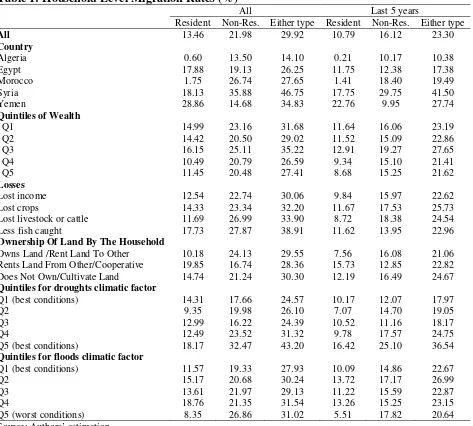
There are large differences between countries in the likelihood of migration, especially among resident members. Migration rates are highest in Syria where almost half of the households have migrants and Yemen where a third of households have migrants. By contrast, migration rates are lowest in Algeria. In that country, while the non-resident migration rate may be realistic, the resident migration late appears to be very low, so one could wonder if there is not a data issue here, although a very low non-resident migration rate is also observed for Morocco. What is clear is that migration rates depend substantially on the particular features and history of each country, and indeed each region within the five countries. While there are differences in migration rates between quintiles of wealth, these do not appear to be very large, even if resident migration rates tend to be lower in higher quintiles. More differences will emerge when looking at the characteristics of individual migrants. There are also differences in migration rates according to whether households suffered from losses due to adverse weather events, but again they tend for the most part not to be very large.
The most important finding from table 1 for our purpose is the fact that there are differences in migration rates according to perceptions of changes in the climate of the areas in which households live. In chapter 3 of this study, Adoho and Wodon (2014) construct through a multiple correspondence analysis (MCA) two indices or factors that summarize household perceptions regarding changes in weather patterns and the environment. The first factor mostly captures the extent to which households perceive that the climate is becoming dryer and warmer, and it is associated with droughts and the lack of rain. The second factor mostly captures the extent to which households suffer from excess water, and it is associated with floods. Both factors are normalized and take a value between zero and one.
6
Table 1: Household Level Migration Rates (%)
All Last 5 years
Resident Non-Res. Either type Resident Non-Res. Either type
All 13.46 21.98 29.92 10.79 16.12 23.30
Country
Algeria 0.60 13.50 14.10 0.21 10.17 10.38
Egypt 17.88 19.13 26.25 11.75 12.38 17.38
Morocco 1.75 26.74 27.65 1.41 18.40 19.49
Syria 18.13 35.88 46.75 17.75 29.75 41.50
Yemen 28.86 14.68 34.83 22.76 9.95 27.74
Quintiles of Wealth
Q1 14.99 23.16 31.68 11.64 16.06 23.19
Q2 14.42 20.50 29.02 11.52 15.09 22.86
Q3 16.15 25.11 35.22 12.91 19.27 27.65
Q4 10.49 20.79 26.59 9.34 15.10 21.41
Q5 11.45 20.48 27.41 8.68 15.25 21.62
Losses
Lost income 12.54 22.74 30.06 9.84 15.97 22.62
Lost crops 14.33 23.34 32.20 11.67 17.53 25.73
Lost livestock or cattle 11.69 26.99 33.90 8.72 18.38 24.54
Less fish caught 17.73 27.87 38.91 11.62 13.95 22.96
Ownership Of Land By The Household
Owns Land /Rent Land To Other 10.18 24.13 29.55 7.56 16.08 21.06
Rents Land From Other/Cooperative 19.85 16.74 28.36 15.73 12.85 22.82
Does Not Own/Cultivate Land 14.74 21.24 30.30 12.19 16.49 24.67
Quintiles for droughts climatic factor
Q1 (best conditions) 14.31 17.66 24.57 10.17 12.07 17.97
Q2 9.35 19.98 26.10 7.07 14.70 19.05
Q3 12.99 16.22 24.39 10.52 11.16 18.17
Q4 12.49 23.52 31.32 9.78 17.57 24.75
Q5 (best conditions) 18.17 32.47 43.20 16.42 25.10 36.54
Quintiles for floods climatic factor
Q1 (best conditions) 11.57 19.33 27.93 10.09 14.86 22.67
Q2 15.17 20.68 30.24 13.72 17.17 26.99
Q3 13.61 21.97 29.13 11.22 15.59 22.87
Q4 18.76 21.35 31.54 13.26 15.25 23.15
Q5 (worst conditions) 8.35 26.86 31.02 5.51 17.82 20.64
Source: Authors’ estimation.
7
more household members can migrate temporarily than permanently. There are some differences in migration rates by quintiles of wealth, land ownership status and according to the types of losses suffered due to adverse weather events, but these tend not to be systematic.
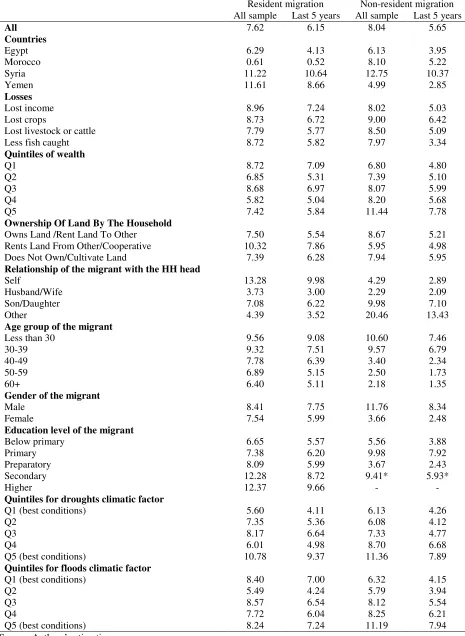
Differences tend to be much more systematic when looking at the characteristics of the migrants. First, migration rates tend to be higher among heads of household for resident migration (heads tend to be those going away temporarily to find work), while they are lower for household heads among non-residents (who have a household to take care of and cannot leave other household members behind permanently). The likelihood of migrating is clearly higher for younger individuals (those below the age of 30) than for older individuals (for example those aged 40 or above). Migration rates are higher for men than for women, and this is especially the case for non-resident migration. Finally, migration rates are higher when the individuals are more educated, probably because the opportunities for the more educated to find better employment opportunities elsewhere tend to be higher (for non-resident migrants, the top two categories of education have been merged in the statistics as is done for the regressions).
8
Table 2: Individual Level Migration Rates by Selected Characteristics (%)
Resident migration Non-resident migration
All sample Last 5 years All sample Last 5 years
All 7.62 6.15 8.04 5.65
Countries
Egypt 6.29 4.13 6.13 3.95
Morocco 0.61 0.52 8.10 5.22
Syria 11.22 10.64 12.75 10.37
Yemen 11.61 8.66 4.99 2.85
Losses
Lost income 8.96 7.24 8.02 5.03
Lost crops 8.73 6.72 9.00 6.42
Lost livestock or cattle 7.79 5.77 8.50 5.09
Less fish caught 8.72 5.82 7.97 3.34
Quintiles of wealth
Q1 8.72 7.09 6.80 4.80
Q2 6.85 5.31 7.39 5.10
Q3 8.68 6.97 8.07 5.99
Q4 5.82 5.04 8.20 5.68
Q5 7.42 5.84 11.44 7.78
Ownership Of Land By The Household
Owns Land /Rent Land To Other 7.50 5.54 8.67 5.21
Rents Land From Other/Cooperative 10.32 7.86 5.95 4.98
Does Not Own/Cultivate Land 7.39 6.28 7.94 5.95
Relationship of the migrant with the HH head
Self 13.28 9.98 4.29 2.89
Husband/Wife 3.73 3.00 2.29 2.09
Son/Daughter 7.08 6.22 9.98 7.10
Other 4.39 3.52 20.46 13.43
Age group of the migrant
Less than 30 9.56 9.08 10.60 7.46
30-39 9.32 7.51 9.57 6.79
40-49 7.78 6.39 3.40 2.34
50-59 6.89 5.15 2.50 1.73
60+ 6.40 5.11 2.18 1.35
Gender of the migrant
Male 8.41 7.75 11.76 8.34
Female 7.54 5.99 3.66 2.48
Education level of the migrant
Below primary 6.65 5.57 5.56 3.88
Primary 7.38 6.20 9.98 7.92
Preparatory 8.09 5.99 3.67 2.43
Secondary 12.28 8.72 9.41* 5.93*
Higher 12.37 9.66 - -
Quintiles for droughts climatic factor
Q1 (best conditions) 5.60 4.11 6.13 4.26
Q2 7.35 5.36 6.08 4.12
Q3 8.17 6.64 7.33 4.77
Q4 6.01 4.98 8.70 6.68
Q5 (best conditions) 10.78 9.37 11.36 7.89
Quintiles for floods climatic factor
Q1 (best conditions) 8.40 7.00 6.32 4.15
Q2 5.49 4.24 5.79 3.94
Q3 8.57 6.54 8.12 5.54
Q4 7.72 6.04 8.25 6.21
Q5 (best conditions) 8.24 7.24 11.19 7.94
9
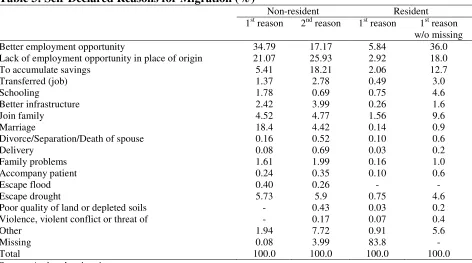
[image:10.612.73.545.219.482.2]To what extent are climate factors key determinants of migration? While this question is best answered using multivariate regression analysis, as mentioned in section 2 indicative information can also be obtained from direct responses given by respondents in the survey (typically household heads) about the reasons for migrating. The statistics on the self-declared reasons for migration are provided in table 3. In the case of non-resident migration, up to two reasons for migration could be provided, while only the main reason could be provided in the case of resident migration. Note that the data appears to be of better quality in the case of non-resident migration, where missing values are rare. In the case of non-resident migration by contrast many responses are missing, but the available responses are still instructive.
Table 3: Self-Declared Reasons for Migration (%)
Non-resident Resident
1st reason 2nd reason 1st reason 1st reason
w/o missing
Better employment opportunity 34.79 17.17 5.84 36.0
Lack of employment opportunity in place of origin 21.07 25.93 2.92 18.0
To accumulate savings 5.41 18.21 2.06 12.7
Transferred (job) 1.37 2.78 0.49 3.0
Schooling 1.78 0.69 0.75 4.6
Better infrastructure 2.42 3.99 0.26 1.6
Join family 4.52 4.77 1.56 9.6
Marriage 18.4 4.42 0.14 0.9
Divorce/Separation/Death of spouse 0.16 0.52 0.10 0.6
Delivery 0.08 0.69 0.03 0.2
Family problems 1.61 1.99 0.16 1.0
Accompany patient 0.24 0.35 0.10 0.6
Escape flood 0.40 0.26 - -
Escape drought 5.73 5.9 0.75 4.6
Poor quality of land or depleted soils - 0.43 0.03 0.2
Violence, violent conflict or threat of - 0.17 0.07 0.4
Other 1.94 7.72 0.91 5.6
Missing 0.08 3.99 83.8 -
Total 100.0 100.0 100.0 100.0
Source: Authors’ estimation.
10
In the case of resident migration, the data is not very good due to a large number of missing values, but when those missing values are eliminated, droughts are also mentioned as the first reason to migrate by around five percent of migrants. Furthermore, it is likely that the search for better employment opportunities and the lack of employment at the places of origin are also related in part to poor climatic conditions in the places of origin. Thus, as is the case for permanent migration, even if climatic factors may not be the main factor at play for the current patterns of temporary migration, they do appear to have a significant role.
4. Correlates of Resident and non-Resident Migration
While the basic statistics reviewed so far provide useful information on self-declared reasons to migrate (as seen from the point of view of the main respondent to the survey, which is typically the household head), a more robust and detailed analysis can be conducted using multivariate regression analysis. Recall in the discussion of the basic statistics the emphasis placed on comparing migration rates according to the level of climatic stress of households using the synthesis variables created by the multiple correspondence analysis. The basic statistics suggested higher rates of migration in areas with higher climatic stress. The question for the regression analysis is whether this apparent relationship between climatic factors and migration remains after controlling for a range of household and individual characteristics.
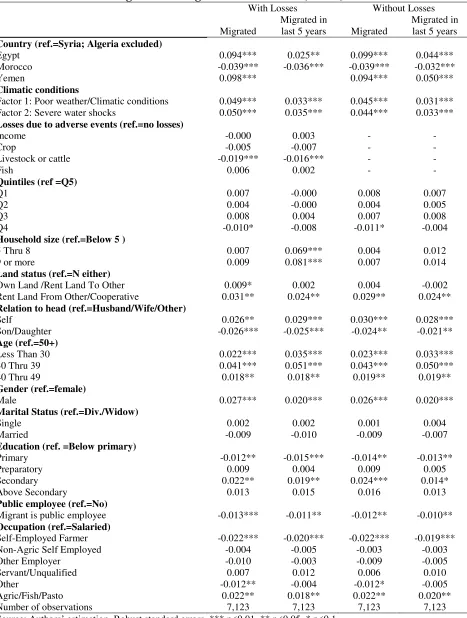
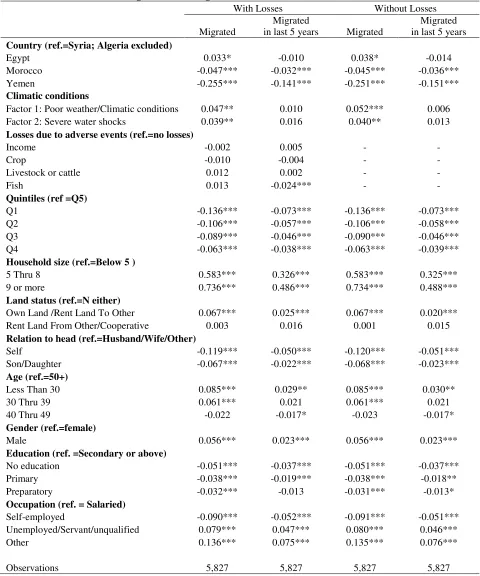
Tables 4 and 5 give the results from probit regression on the correlates of resident and non-resident migration. Resident migrants are still considered to be part of the household, while non-resident migrants have left the household. The estimations are done for the sample as a whole and for those who migrated over the last five years. In each case two alternative specifications are provided. In the first specification, the losses incurred by households due to adverse weather events are included in the set of independent variables. In the second specification this is not done, given that these losses themselves are a result of adverse weather events, so that including them in the set of independent variables may take away some of the impact of weather events on migration. This does however not appear to be the case as most of the results are not very sensitive to the difference in specification (with or without losses from adverse climate), but testing for the possibility that this could have happened was important.
11
in the specification without losses. For non-resident migration, the effects are smaller, but still of a similar order of magnitude, especially for the full period estimation.
Are these estimates likely to be of the right order of magnitude? This is of course a very difficult question to answer with limited data, but a comparison between the results suggested by the regression analysis and the data on subjectively declared reasons for migration mentioned in the previous section helps in provide at least a partial cross-check. Consider a large increase in the value of the MCA indices of 0.30 (those indices are scaled to take a value between zero and one, so that an increase in the value of any one of the two indices of 0.30 is large). If we look at the probabilities of migration in the last five years, this would generate an increase in the probability of resident migration of about one percentage point, while the impact on non-resident migration is not statistically significant. If we look at the data on migration for a longer period, the increase in migration is statistically significant for both resident and non-resident migration, and it would be at about 1.5 percentage point for both types of migration. Given that the overall migration rate in the sample is at about 7 to 8 percentage points, this increase would not be negligible by any means, and it would represent between one tenth and one fifth of the overall level of migration observed. This proportion is a bit higher than the share of migrants who declared that droughts and floods were the main reasons to migrate, but this is what we would have expected given that poor climate may also be in part responsible for some of the migrants leaving the households temporarily or permanently in search of better employment opportunities or because of a lack of employment opportunity in their place of origin. Said differently, the findings obtained with the subjective perceptions of the reasons to migrate and the regression analysis of the impact of climate perceptions on migration tend to be broadly coherent.
What about the impact of losses incurred from adverse weather events? The marginal impact of most losses on migration are not statistically significant, with the exception of losses in assets or livestock, which are associated with a decrease in migration rates of just under two percentage points. This might be related to the fact that the resources needed to facilitate migration by household members may have been weakened (migration, even on a temporary basis, is costly when sending the migrant away, even if it generates additional resources later).
A number of other variables have statistically significant effects. In comparison to the reference country (Syria), resident migration rates are higher in Egypt and Yemen, and lower in Morocco. For non-resident migration, the rates are again higher in Egypt than in Syria, and lower in Morocco, but Yemen rates are also below those observed in Syria.
12
Table 4: Correlates of Migration among Resident Members (dF/dX)
With Losses Without Losses
Migrated
Migrated in
last 5 years Migrated
Migrated in last 5 years
Country (ref.=Syria; Algeria excluded)
Egypt 0.094*** 0.025** 0.099*** 0.044***
Morocco -0.039*** -0.036*** -0.039*** -0.032***
Yemen 0.098*** 0.094*** 0.050***
Climatic conditions
Factor 1: Poor weather/Climatic conditions 0.049*** 0.033*** 0.045*** 0.031***
Factor 2: Severe water shocks 0.050*** 0.035*** 0.044*** 0.033***
Losses due to adverse events (ref.=no losses)
Income -0.000 0.003 - -
Crop -0.005 -0.007 - -
Livestock or cattle -0.019*** -0.016*** - -
Fish 0.006 0.002 - -
Quintiles (ref =Q5)
Q1 0.007 -0.000 0.008 0.007
Q2 0.004 -0.000 0.004 0.005
Q3 0.008 0.004 0.007 0.008
Q4 -0.010* -0.008 -0.011* -0.004
Household size (ref.=Below 5 )
5 Thru 8 0.007 0.069*** 0.004 0.012
9 or more 0.009 0.081*** 0.007 0.014
Land status (ref.=N either)
Own Land /Rent Land To Other 0.009* 0.002 0.004 -0.002
Rent Land From Other/Cooperative 0.031** 0.024** 0.029** 0.024**
Relation to head (ref.=Husband/Wife/Other)
Self 0.026** 0.029*** 0.030*** 0.028***
Son/Daughter -0.026*** -0.025*** -0.024** -0.021**
Age (ref.=50+)
Less Than 30 0.022*** 0.035*** 0.023*** 0.033***
30 Thru 39 0.041*** 0.051*** 0.043*** 0.050***
40 Thru 49 0.018** 0.018** 0.019** 0.019**
Gender (ref.=female)
Male 0.027*** 0.020*** 0.026*** 0.020***
Marital Status (ref.=Div./Widow)
Single 0.002 0.002 0.001 0.004
Married -0.009 -0.010 -0.009 -0.007
Education (ref. =Below primary)
Primary -0.012** -0.015*** -0.014** -0.013**
Preparatory 0.009 0.004 0.009 0.005
Secondary 0.022** 0.019** 0.024*** 0.014*
Above Secondary 0.013 0.015 0.016 0.013
Public employee (ref.=No)
Migrant is public employee -0.013*** -0.011** -0.012** -0.010**
Occupation (ref.=Salaried)
Self-Employed Farmer -0.022*** -0.020*** -0.022*** -0.019***
Non-Agric Self Employed -0.004 -0.005 -0.003 -0.003
Other Employer -0.010 -0.003 -0.009 -0.005
Servant/Unqualified 0.007 0.012 0.006 0.010
Other -0.012** -0.004 -0.012* -0.005
Agric/Fish/Pasto 0.022** 0.018** 0.022** 0.020**
Number of observations 7,123 7,123 7,123 7,123
13
Table 5: Correlates of Migration among non-Resident Members (dF/dX)
With Losses Without Losses
Migrated
Migrated
in last 5 years Migrated
Migrated in last 5 years
Country (ref.=Syria; Algeria excluded)
Egypt 0.033* -0.010 0.038* -0.014
Morocco -0.047*** -0.032*** -0.045*** -0.036***
Yemen -0.255*** -0.141*** -0.251*** -0.151***
Climatic conditions
Factor 1: Poor weather/Climatic conditions 0.047** 0.010 0.052*** 0.006
Factor 2: Severe water shocks 0.039** 0.016 0.040** 0.013
Losses due to adverse events (ref.=no losses)
Income -0.002 0.005 - -
Crop -0.010 -0.004 - -
Livestock or cattle 0.012 0.002 - -
Fish 0.013 -0.024*** - -
Quintiles (ref =Q5)
Q1 -0.136*** -0.073*** -0.136*** -0.073***
Q2 -0.106*** -0.057*** -0.106*** -0.058***
Q3 -0.089*** -0.046*** -0.090*** -0.046***
Q4 -0.063*** -0.038*** -0.063*** -0.039***
Household size (ref.=Below 5 )
5 Thru 8 0.583*** 0.326*** 0.583*** 0.325***
9 or more 0.736*** 0.486*** 0.734*** 0.488***
Land status (ref.=N either)
Own Land /Rent Land To Other 0.067*** 0.025*** 0.067*** 0.020***
Rent Land From Other/Cooperative 0.003 0.016 0.001 0.015
Relation to head (ref.=Husband/Wife/Other)
Self -0.119*** -0.050*** -0.120*** -0.051***
Son/Daughter -0.067*** -0.022*** -0.068*** -0.023***
Age (ref.=50+)
Less Than 30 0.085*** 0.029** 0.085*** 0.030**
30 Thru 39 0.061*** 0.021 0.061*** 0.021
40 Thru 49 -0.022 -0.017* -0.023 -0.017*
Gender (ref.=female)
Male 0.056*** 0.023*** 0.056*** 0.023***
Education (ref. =Secondary or above)
No education -0.051*** -0.037*** -0.051*** -0.037***
Primary -0.038*** -0.019*** -0.038*** -0.018**
Preparatory -0.032*** -0.013 -0.031*** -0.013*
Occupation (ref. = Salaried)
Self-employed -0.090*** -0.052*** -0.091*** -0.051***
Unemployed/Servant/unqualified 0.079*** 0.047*** 0.080*** 0.046***
Other 0.136*** 0.075*** 0.135*** 0.076***
Observations 5,827 5,827 5,827 5,827
14
In terms of demographic variables, the effects are as expected as well. Individuals from larger households are more likely to migrate permanently (their labor is likely to be less needed at their place of origin given the presence of other household members), while the effect is smaller and less often statistically significant for resident migration. Another important difference between resident and non-resident migration is that the likelihood of resident migration is higher for household heads, while for non-resident migration it is higher for other household members, as expected. Both resident and non-resident migration rates are much higher for younger individuals, with the effects being especially large for non-resident migration.
5. Conclusion
Migration is one of several strategies used by households to respond to changes in climate and environmental conditions as well as extreme weather events. The objective of this chapter was to use new household survey data collected in 2011 in two climate affected areas of five MENA countries (Algeria, Egypt, Morocco, Syria, and Yemen) in order to assess whether perceptions of changes in weather patterns and the environment are correlated with the decision to migrate by some household members. Both resident (temporary) and non-resident (permanent) migration were considered. Statistical as well as regression analysis was implemented.
Overall, the findings from both the statistical analysis and the regression estimates suggest that socio-economic and demographic factors today probably play a larger role than climatic factors in the temporary and permanent migration decisions of household members. This is a finding that is coherent with other chapters in this study, some of which use similar analytical methods while others are based on different types of data and approaches.
15
Appendix: Reasons for Migration by Country, Five Countries Sample (%)
Algeria Egypt Morocco Syria Yemen All First reason
Better employment opportunity at destination 1.0 5.7 8.9 15.5 3.6 34.8
Lack of employment in place of origin 2.7 2.7 3.2 10.1 2.3 21.1
Accumulating savings 0.6 1.5 0.0 1.9 1.3 5.4
Transferred (Job) 0.0 0.3 0.2 0.2 0.7 1.4
Schooling 0.0 0.2 0.4 0.4 0.7 1.8
Better infrastructure 0.5 0.0 0.9 0.4 0.6 2.4
Join family 0.0 0.4 0.6 2.7 0.8 4.5
Marriage 5.9 1.5 8.0 0.2 2.8 18.4
Divorce/separation/death of spouse 0.0 0.1 0.0 0.0 0.1 0.2
Delivery 0.0 0.1 0.0 0.0 0.0 0.1
Family problems 0.0 0.4 0.2 0.2 0.8 1.6
Accompany patient 0.0 0.0 0.2 0.0 0.0 0.2
Escape flood 0.0 0.0 0.3 0.1 0.0 0.4
Escape drought 0.0 0.0 0.2 5.6 0.0 5.7
Other 0.0 0.6 0.0 0.1 1.3 1.9
Missing 0.0 0.1 0.0 0.0 0.0 0.1
Total 10.8 13.7 23.0 37.4 15.1 100.0
Second reason
Better employment opportunity at destination 1.4 3.0 4.3 6.1 1.2 16.0
Lack of employment in place of origin 0.2 2.2 5.4 15.5 0.8 24.1
Accumulating savings 2.4 5.2 0.4 5.4 3.5 16.9
Transferred (Job) 0.0 0.3 1.0 0.6 0.6 2.6
Schooling 0.0 0.0 0.2 0.2 0.2 0.6
Better infrastructure 1.5 0.2 1.0 0.5 0.5 3.7
Join family 0.6 0.4 1.4 0.2 1.9 4.4
Marriage 1.1 0.2 1.6 0.2 0.9 4.1
Divorce/separation/death of spouse 0.0 0.2 0.0 0.1 0.2 0.5
Delivery 0.0 0.4 0.0 0.0 0.2 0.6
Family problems 0.1 0.1 0.1 0.5 1.1 1.9
Accompany patient 0.0 0.1 0.0 0.1 0.2 0.3
Escape flood 0.0 0.1 0.2 0.0 0.0 0.2
Escape drought 0.0 0.0 0.6 4.9 0.0 5.5
Poor quality of land or depleted soils 0.0 0.0 0.2 0.1 0.2 0.4
Violence, conflict or threat of violence 0.0 0.0 0.0 0.0 0.2 0.2
Other 3.2 0.2 0.0 0.3 3.4 7.2
Missing 0.0 1.0 0.0 2.7 0.0 3.7
Total 10.6 13.6 16.4 37.4 15.1 93.1
16
References
Barrios, S., L. Bertinelli, and E. Strobl (2006). Climatic change and rural–urban migration: The case of sub-Saharan Africa, Journal of Urban Economics 60(3): 357–371.
Burger, N., A. Grant, S. Kups, Y. Rana, and Q. Wodon, 2014a, Focus Countries, in Q. Wodon, A. Liverani, G. Joseph, and N. Bougnoux, editors, Climate Change and Migration: Evidence from the Middle East and North Africa, World Bank Study, Washington, DC. Burger, N., B. Ghosh-Dastidar, A. Grant, T. Ruder, O. Tchakeva, and Q. Wodon, 2014b, Data
Collection, in Q. Wodon, A. Liverani, G. Joseph, and N. Bougnoux, editors, Climate Change and Migration: Evidence from the Middle East and North Africa, World Bank Study, Washington, DC.
Christian Aid (2007). Human Tide: The Real Migration Crisis – A Christian Aid Report. Christian Aid. London
Elasha, Balgis Osman, 2010. “Mapping of Climate Change Threats and Human Development Impacts in the Arab Region,” mimeo, New York: United Nations Development Program. Findley, Sally E., 1994. “Does Drought Increase Migration? A Study of Migration from Rural
Mali During the 1983–1985 Drought,” International Migration Review, 28(3): 539–553. Foresight, 2011. Migration and Global Environmental Change, London: The Government Office
for Science.
Gupta, A. K., D. M. Anderson, D. N. Pandey (2006). Adaptation and human migration, and evidence of agriculture coincident with changes in the Indian summer monsoon during the Holocene, Current Science 90(8): 1082-1090.
Haug, R. (2002). Forced migration, processes of return and livelihood construction among Pastoralists in Northern Sudan, Disasters 26(1): 70-84.
Jakobeit, C., and C. Methmann (2007). Klimaflüchtlinge – Die verleugnete Katastrophe, Greenpeace, Hamburg.
Paul, Bimal Kanti, 2005. “Evidence Against Disaster-Induced Migration: the 2004 Tornado in North-Central Bangladesh,” Disasters, 29(4): 370--385.
Stern, N. (2006). The Economics of Climate Change – The Stern Review, Cambridge, Cambridge University Press.
Wodon, Q,, N. Burger, A. Grant, and A. Liverani, 2014, Climate change, migration, and adaptation in the MENA Region, in Q. Wodon, A. Liverani, G. Joseph, and N. Bougnoux, editors, Climate Change and Migration: Evidence from the Middle East and North Africa, World Bank Study, Washington, DC.