What’s in a Message?
Stergos D. Afantenos
and
Nicolas Hernandez
LINA, (UMR CNRS 6241)
Université de Nantes, France
Abstract
In this paper we present the first step in a larger series of experiments for the induction of pred-icate/argument structures. The structures that we are inducing are very similar to the con-ceptual structures that are used in Frame Se-mantics (such as FrameNet). Those structures are called messages and they were previously used in the context of a multi-document sum-marization system of evolving events. The se-ries of experiments that we are proposing are essentially composed from two stages. In the first stage we are trying to extract a represen-tative vocabulary of words. This vocabulary is later used in the second stage, during which we apply to it various clustering approaches in order to identify the clusters of predicates and arguments—or frames and semantic roles, to use the jargon of Frame Semantics. This paper presents in detail and evaluates the first stage.
1
Introduction
Take a sentence, any sentence for that matter; step back for a while and try to perceive that sentence in its most abstract form. What you will notice is that once you try to abstract away sentences, several regularities be-tween them will start to emerge. To start with, there is almost always anactionthat is performed.1 Then, there
is most of the times anagentthat is performing this ac-tion and apatientor abenefactorthat is receiving this action, and it could be the case that this action is per-formed with the aid of a certaininstrument. In other words, within a sentence—and in respect to its action-denoting word, or predicate in linguistic terms—there will be several entities that are associated with the pred-icate, playing each time a specificsemantic role.
The notion of semantic roles can be traced back to Fillmore’s (1976) theory of Frame Semantics. Accord-ing to this theory then, aframeis a conceptual structure which tries to describe a stereotypical situation, event or object along with its participants and props. Each frame takes a name (e.g. COMMERCIAL TRANSAC -TION) and contains a list ofLexical Units (LUs)which
1In linguistic terms, an action-denoting word is also known as apredicate.
actually evoke this frame. An LU is nothing else than a specific word or a specific meaning of a word in the case of polysemous words. To continue the previous example, some LUs that evoke the frame of COMMER -CIAL TRANSACTIONcould be the verbs buy,sell, etc. Finally, the frames contain several frame elements or semantic roles which actually denote the abstract conceptual entities that are involved with the particu-lar frame.
Research in semantic roles can be distinguished into two major branches. The first branch of research con-sists in defining an ontology of semantic roles, the frames in which the semantic roles are found as well as defining the LUs that evoke those frames. The second branch of research, on the other hand, stipulates the existence of a set of frames, including semantic roles and LUs; its goal then, is the creation of an algorithm that given such a set of frames containing the semantic roles, will be able to label the appropriate portions of a sentence with the corresponding semantic roles. This second branch of research is known assemantic role labeling.
Most of the research concerning the definition of the semantic roles has been carried out by linguists who are manuallyexamining a certain amount of frames before finally defining the semantic roles and the frames that contain those semantic roles. Two such projects that are widely known are the FrameNet (Baker et al., 1998; Ruppenhofer et al., 2006) and PropBank/NomBank2 (Palmer et al., 2005; Meyers et al., 2004). Due to the fact that the aforementioned projects are accompanied by a large amount of annotated data, computer scien-tists have started creating algorithms, mostly based on statistics (Gildea and Jurafsky, 2002; Xue, 2008) in or-der to automatically label the semantic roles in a sen-tence. Those algorithms take as input the frame that
2
contains the roles as well as the predicate3 of the
sen-tence.
Despite the fact that during the last years we have seen an increasing interest concerning semantic role labeling,4 we have not seen many advancements
con-cerning the issue ofautomatically inducing semantic roles from raw textual corpora. Such a process of in-duction would involve, firstly the identification of the words that would serve as predicates and secondly the creation of the appropriate clusters of word sequences, within the limits of a sentence, that behave similarly in relation to the given predicates. Although those clusters of word sequences could not actually be said to serve in themselves as the semantic roles,5 they can nevertheless be viewed as containing characteris-tic word sequences of specific semancharacteris-tic roles. The last point has the implication that if one is looking for a human intuitive naming of the semantic role that is im-plied by the cluster then one should look elsewhere. This is actually reminiscent of the approach that is car-ried out by PropBank/NomBank in which each seman-tic role is labeled asArg1throughArg5 with the se-mantics given aside in a human readable natural lan-guage sentence.
Our goal in this paper is to contribute to the research problem of frame induction, that is of the creation of frames, including their associated semantic roles, given as input only a set of textual documents. More specifi-cally we propose a general methodology to accomplish this task, and we test its first stage which includes the use of corpus statistics for the creation of a subset of words, from the initial universe of initial words that are present in the corpus. This subset will later be used for the identification of the predicates as well as the semantic roles. Knowing that the problem of frame in-duction is very difficult in the general case, we limit ourselves to a specific genre and domain trying to ex-ploit the characteristics that exist in that domain. The domain that we have chosen is that of the terroristic in-cidents which involve hostages. Nevertheless, the same methodology could be applied to other domains.
The rest of the paper is structured as follows. In sec-tion 2 we describe the data on which we have applied our methodology, which itself is described in detail in section 3. Section 4 describes the actual experiments that we have performed and the results obtained, while a discussion of those results follows in section 5. Fi-nally, section 6 contains a description of the related work while we present our future work and conclusions in section 7.
3
In the case of FrameNet the predicate corresponds to a “Linguistic Unit”, while in the case of PropBank/NomBank it corresponds to what is named “Relation”.
4
Cf, for example, the August 2008 issue of the journal Computational Linguistics(34:2).
5At least as the notion of semantic roles is proposed and used by FrameNet.
2
The Annotated Data
The annotated data that we have used in order to perform our experiments come from a previous work on automatic multi-document summarization of events that evolve through time (Afantenos et al., 2008; Afan-tenos et al., 2005; AfanAfan-tenos et al., 2004). The method-ology that is followed is based on the identification of similarities and differences—between documents that describe the evolution of an event—synchronically as well as diachronically. In order to do so, the notion of Synchronic and Diachroniccross document Relations (SDRs),6 was introduced. SDRs connect not the doc-uments themselves but some semantic structures that were calledmessages. The connection of the messages with the SDRs resulted in the creation of a semantic graph that was then fed to a Natural Language Gener-ation (NLG) system in order to produce the final sum-mary. Although the notion of messages was originally inspired by the notion of messages as used in the area of NLG, for example during the stage ofContent Determi-nationas described in (Reiter and Dale, 1997), and in general they do follow the spirit of the initial definition by Reiter & Dale, in the following section we would like to make it clear what the notion of messages rep-resents for us. In the rest of the paper, when we refer to the notion of messages, it will be in the context of the discussion that follows.
2.1 Messages
The intuition behind messages, is the fact that during the evolution of an event we have several activities that take place and each activity is further decomposed into a series ofactions. Messages were created in order to capture this abstract notion of actions. Of course, ac-tions usually implicate several entities. In this case, en-tities were represented with the aid of a domain ontol-ogy. Thus, in more formal terms a messagemcan be defined as follows:
m = message_type (arg1, . . . , argn) whereargi∈Topic Ontology,i∈ {1, . . . , n} In order to give a simple example, let us take for in-stance the case of the hijacking of an airplane by ter-rorists. In such a case, we are interested in knowing if the airplane has arrived to its destination, or even to another place. This action can be captured by a mes-sage of typearrivewhose arguments can be the en-tity that arrives (the airplane in our case, or a vehicle, in general) and the location that it arrives. The specifi-cations of such a message can be expressed as follows:
6
arrive (what, place) what : Vehicle place : Location
The conceptsVehicleandLocationbelong to the ontology of the topic; the conceptAirplaneis a sub-concept of theVehicle. A sentence that might in-stantiate this message is the following:
The Boeing 747 arrived at the airport of Stanstend.
The above sentence instantiates the following message:
arrive ("Boeing 747", "airport of Stanstend")
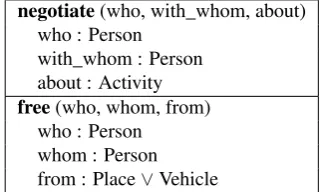
The domain which was chosen was that of terroris-tic incidents that involve hostages. An empirical study, by three people, of 163 journalistic articles—written in Greek—that fell in the above category, resulted in the definition of 48 different message types that represent the most important information in the domain. At this point we would like to stress that what we mean by “most important information” is the information that one would normally expect to see in a typical summary of such kinds of events. Some of the messages that have been created are shown in Table 1; figure 1 pro-vides full specifications for two messages.
free explode
kill kidnap
enter arrest
negotiate encircle
[image:3.595.97.265.403.468.2]escape_from block_the_way give_deadline
Table 1: Some of the message types defined.
negotiate(who, with_whom, about) who : Person
with_whom : Person about : Activity free(who, whom, from)
who : Person whom : Person from : Place∨Vehicle
Figure 1: An example of message specifications
Although in an abstract way the notion of messages, as presented in this paper approaches the notion of frame semantics—after all, both messages and frame semantics are concerned with “who did what, to whom, when, where and how”—it is our hope that our ap-proach could ultimately be used for the problem of frame induction. Nevertheless, the two structures have several points in which they differ. In the following section we would like to clarify those points in which the two differ.
2.2 How Messages differ from Frame Semantics
As it might have been evident until now, the notions of messages and frame semantics are quite similar, at least from an abstract point of view. In practical terms though, the two notions exhibit several differences.
To start with, the notion of messages has been used until now only in the context of automatic text summa-rization of multiple documents. Thus, the aim of mes-sages is to capture the essential information that one would expect to see in a typical summary of this do-main.7 In contrast, semantic roles and the frames in
which they exist do not have this limitation.
Another differentiating characteristic of frame se-mantics and messages is the fact that semantic roles al-ways get instantiated within the boundaries of the sen-tence in which the predicate exists. By contrast, in mes-sages although in the vast majority of the cases there is a one-to-one mapping from sentences to messages, in some of the cases the arguments of a message, which correspond to the semantic roles, are found in neigh-boring sentences. The overwhelming majority of those cases (which in any case were but a few) concern re-ferring expressions. Due to the nature of the machine learning experiments that were performed, the actual entities were annotated as arguments of the messages, instead of the referring expressions that might exist in the sentence in which the message’s predicate resided. A final difference that exists between messages and frame semantics is the fact that messages were meant to exist within a certain domain, while the definition of semantic roles is usually independent of a domain.8
3
The Approach Followed
A schematic representation of our approach is shown in Figure 2. As it can be seen from this figure, our ap-proach comprises two stages. The first stage concerns the creation of a lexicon which will contain as most as possible—and, of course, as accurately as possible— candidates that are characteristic either of the predi-cates (message types) or of the semantic roles (argu-ments of the messages). This stage can be thought of as a filtering stage. The second stage involves the use of unsupervised clustering techniques in order to create the final clusters of words that are characteristic either of the predicates or of the semantic roles that are
asso-7
In this sense then, the notion of messages is reminiscent of Schank & Abelson’s (1977) notion ofscripts, with the dif-ference that messages are not meant to exist inside a struc-ture similar to Schank & Abelson’s “scenario”. We would like also to note that the notion of messages shares certain similarities with the notion oftemplatesof Information Ex-traction, as those structures are used in conferences such as MUC. Incidentally, it is not by chance that the “M” in MUC stands for Message (Understanding Conference).
8
[image:3.595.100.262.515.611.2]ciated with those predicates. The focus of this paper is on the first stage.
As we have said, our aim in this paper is the use of statistical measures in order to extract from a given corpus a set of words that are most characteristicof the messages that exist in this corpus. In the context of this paper, a word will be considered as being char-acteristic of a message if this word is employed in a sentence that has been annotated with that message. If a particular word does not appear in any message an-notated sentence, then this word will not be considered as being characteristic of this message. In more formal terms then, we can define our task as follows. If byU
we designate the set of all the words that exist in our corpus, then we are looking for a setMsuch that:
M ⊂ U ∧
w∈ M ⇔mappears at least once
in a message instance (1)
In order to extract the set Mwe have employed the following four statistical measures:
Collection Frequency: The set that results from the union of then%most frequent words that appear in the corpus.
Document Frequency: The set that results from the union of then%most frequent words of each doc-ument in the corpus.
tf.idf: For each word in the corpus we calculate its tf.idf. Then we create a set which is the union of words with the highestn% tf.idf score in each document.
Inter-document Frequency: A word has inter-docu-ment frequencynif it appears in at leastn docu-ments in the corpus. The set with inter-document frequencynis the set that results from the union of all the words that have inter-document fre-quencyn.
As we have previously said in this paper, our goal is the exploitation of the characteristic vocabulary that exists in a specific genre and domain in order to ulti-mately achieve our goal of message induction, some-thing which justifies the use of the above statistical measures. The first three measures are known to be used in context of Information retrieval to capture top-ical informations. The latter measure has been pro-posed by (Hernandez and Grau, 2003) in order to ex-tract rhetorical indicator phrases from a genre depen-dant corpus.
In order to calculate the aforementioned statistics, and create the appropriate set of words, we ignored all the stop-words. In addition we worked only with the verbsandnouns. The intuition behind this decision lies in the fact that the created set will later be used for the identification of the predicates and the induction of the
semantic roles. As Gildea & Jurafsky (2002)—among others—have mentioned, predicates, or action denot-ing words, are mostly represented by verbs or nouns.9
Thus, in this series of experiments we are mostly focus-ing in the extraction of a set of words that approaches the set that is obtained by the union of all the verbs and nouns found in the annotated sentences.
4
Experiments and Results
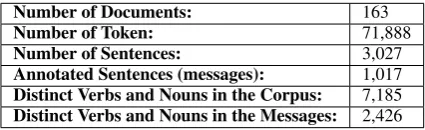
The corpus that we have consists of 163 journalistic articles which describe the evolution of five different terroristic incidents that involved hostages. The cor-pus was initially used in the context of training a multi-document summarization system. Out of the 3,027 sen-tences that the corpus contains, about one third (1,017 sentences) were annotated with the 48 message types that were mentioned in section 2.1.
Number of Documents: 163
Number of Token: 71,888
Number of Sentences: 3,027
Annotated Sentences (messages): 1,017
Distinct Verbs and Nouns in the Corpus: 7,185
[image:4.595.310.523.280.345.2]Distinct Verbs and Nouns in the Messages: 2,426
Table 2: Corpus Statistics.
The corpus contained 7,185 distinct verbs and nouns, which actually constitute the U of the formula (1) above. Out of those 7,185 distinct verbs and nouns 2,426 appear in the sentences that have been annotated with the messages. Our goal was to create this set that approached as much as possible to the set of 2,426 dis-tinct verbs and nouns that are found in the messages.
Using the four different statistical measures pre-sented in the previous section, we tried to reconstruct that set. In order to understand how the statistical mea-sures behaved, we varied for each one of them the value of the threshold used. For each statistical measure used, the threshold represents something different. For the Collection Frequency measure the threshold represents the n% most frequent words that appear in the cor-pus. For the Document Frequency it represents then%
most frequent words that appear in each document sep-arately. Fortf.idf it represents the words with the high-estn% tf.idf score in each document. Finally for the Inter-document Frequency the threshold represents the verbs and nouns that appear in at leastn documents. Since for the first three measures the threshold repre-sents a percentage, we varied it from 1 to 100 in order to study how this measure behaves. For the case of the Inter-document Frequency, we varied the threshold from 1 to 73 which represents the maximum number of documents in which a word appeared.
In order to measure the performance of the statistical measures employed, we used four different evaluation measures, often employed in the information retrieval
Lexicon Extraction
(initial predicate filtering) Unsupervised Clustering
[image:5.595.76.454.67.150.2]Clusters of predicates and semantic roles
Figure 2: Two different stages in the process of predicate clustering
field. Those measures are the Precision, Recall, F-measureandFallout. Precision represents the percent-age of the correctly obtained verbs and nouns over the total number of obtained verbs and nouns. Recall rep-resents the percentage of the obtained verbs and nouns over the target set of verbs and nouns. The F-measure is the harmonic mean of Precision and Recall. Finally, fallout represents the number of verbs and nouns that were wrongly classified by the statistical measures as belonging to a message, over the total number of verbs and nouns that do not belong to a message. In an ideal situation one expects a very high precision and recall (and by consequence F-measure) and a very low Fall-out.
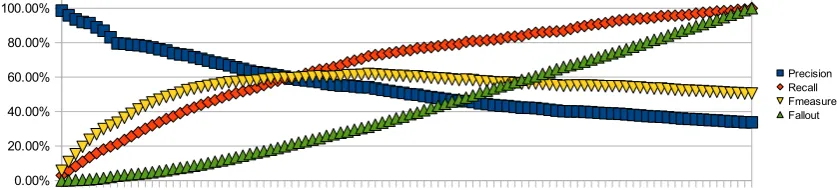
The obtained graphs that combine the evaluation re-sults for the four statistical measures presented in sec-tion 3 are shown in Figures 3 through 6. A first remark that we can make in respect to those graphs is that con-cerning the collection frequency, document frequency and tf.idf measures, for small threshold numbers we have more or less high precision values while the recall and fallout values are low. This implies that for smaller threshold values the obtained sets are rather small, in relation toM(and by consequence toU as well). As the threshold increases we have the opposite situation, that is the precision falls while the recall and the fall-out increases, implying that we get much bigger sets of verbs and nouns.
In terms of absolute numbers now, the best F-measure is given by the Collection Frequency F-measure with a threshold value of 46%. In other words, the best results—in terms of F-measure—is given by the union of the 46% most frequent verbs and nouns that appear in the corpus. For this threshold the Precision is 54.14%, the Recall is 72.18% and the F-measure is 61,87%. This high F-measure though comes at a cer-tain cost since the Fallout is at 31.16%. This implies that although we get a rather satisfying score in terms of precision and recall, the number of false positives that we get is rather high in relation to our universe. As we have earlier said, a motivating factor of this pa-per is the automatic induction of the structures that we have called messages; the extracted lexicon of verbs and messages will later be used by an unsupervised clustering algorithm in order to create the classes of
words which will correspond to the message types. For this reason, although we prefer to have an F-measure as high as possible, we also want to have a fallout measure as low as possible, so that the number of false positives will not perturb the clustering algorithm.
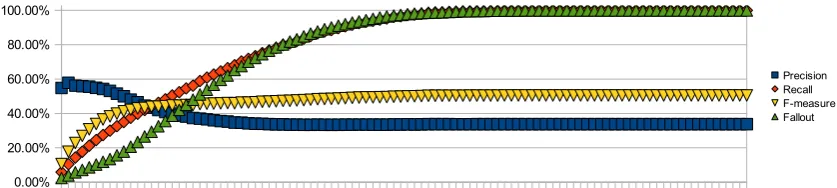
If, on the other hand, we examine the relation be-tween the F-measure and Fallout, we notice that for the Inter-document Frequency with a threshold value of 4 we obtain a Precision of 71.60%, a recall of 43.86% and an F-measure of 54.40%. Most importantly though we get a fallout measure of 8.86% which implies that the percentage of wrongly classified verbs and nouns compose a small percentage of the total universe of verbs and nouns. This combination of high F-measure and very low Fallout is very important for later stages during the process of message induction.
5
Discussion
As we have claimed in the introduction of this paper, although we have applied our series of experiments in a single domain, that of terroristic incidents which in-volve hostages, we believe that the proposed procedure can be viewed as a “general” one. In the section we would like to clarify what exactly we mean by this statement.
In order to proceed, we would like to suggest that one can view two different kinds of generalization for the proposed procedure:
1. The proposed procedure is a general one in the sense that it can be applied in a large corpus of het-erogeneousdocuments incorporating various do-mains and genres, in order to yield “general”,i.e. domain-independent, frames that can later be used for any kind of domain.
1 35 79111315171921232527293133353739414345474951535557596163656769717375777981838587899193959799 0.00%
20.00% 40.00% 60.00% 80.00% 100.00% 120.00%
[image:6.595.83.502.65.160.2]Precision Recall Fmeasure Fallout
Figure 3: Collection Frequency statistics
13 579111315171921232527293133353739414345474951535557596163656769717375777981838587899193959799 0.00%
20.00% 40.00% 60.00% 80.00% 100.00% 120.00%
[image:6.595.90.499.223.312.2]Precision Recall Fmeasure Fallout
Figure 4: Document Frequency statistics
Given the above two definitions of generality, we could say that the procedure proposed in this paper falls rather in the second category than in the first one. Ignoring for the moment the second stage of the procedure—clustering of word sequences characteris-tic of specific semancharacteris-tic roles—and focusing on the ac-tual work described in this paper, that is the use of statistical methods for the identification of candidate predicates, it becomes clear that the use of an hetero-geneous, non-balanced corpus is prone to skewing the results. By consequence, we believe that the proposed procedure is general in the sense that we can use it for any kind of domain which is described by an homoge-neous corpus of documents.
6
Related Work
Teufel and Moens (2002) and Saggion and Lapalme (2002) have shown that templates based on domain concepts and relations descriptions can be used for the task of automatic text summarization. The drawback of their work is that they rely on manual acquisition of lexical resources and semantic classes’ definition. Consequently, they do not avoid the time-consuming task of elaborating linguistic resources. It is actually for this kind of reason—that is, the laborious manual work—that automatic induction of various structures is a recurrent theme in different research areas of Natural Language Processing.
An example of an inductive Information Extraction algorithm is the one presented by Fabio Ciravegna
(2001). The algorithm is called (LP)2. The goal of the algorithm is to induce several symbolic rules given as input previous SGML tagged information by the user. The induced rules will later be applied in new texts in order to tag it with the appropriate SGML tags. The induced rules by (LP)2fall into two distinct categories. In the first we have a bottom up procedure which gen-eralizes the tag instances found in the training corpus which uses shallow NLP knowledge. A second set of rules is also created which have a corrective character; that is, the application of this second set of rules aims at correcting several of the mistakes that are performed by the first set of rules.
On the other hand several researchers have pioneered the automatic acquisition of lexical and semantic re-sources (such as verb classes). Some approaches are based on Harris’s (1951) distribution hypothesis: syn-tactic structures with high occurrences can be used for identifying word clusters with common contexts (Lin and Pantel, 2001). Some others perform analysis from semantic networks (Green et al., 2004). Poibeau and Dutoit (2002) showed that both can be used in a com-plementary way.
1 357 9111315171921232527293133353739414345474951535557596163656769717375777981838587899193959799 0.00%
20.00% 40.00% 60.00% 80.00% 100.00% 120.00%
[image:7.595.83.502.60.154.2]Precision Recall F-measure Fallout
Figure 5: Tf.idf statistics
12345678910111213141516171819202122232425262728293031323334353637383940414243444546474849505152535455565758596061626364656667686970717273 0.00%
20.00% 40.00% 60.00% 80.00% 100.00% 120.00%
[image:7.595.86.498.220.317.2]Precision Recall Fmeasure Fallout
Figure 6: Inter-document frequency statistics
7
Conclusions and Future Work
In this paper we have presented a statistical approach for the extraction of a lexicon which contains the verbs and nouns that can be considered as candidates for use as predicates for the induction of predicate/argument structures that we call messages. Actually, the research presented here can be considered as the first step in a two-stages approach. The next step involves the use of clustering algorithms on the extracted lexicon which will provide the final clusters that will contain the pred-icates and arguments for the messages. This process is itself part of a larger process for the induction of predicate/argument structures. Apart from messages, such structures could as well be the structures that are associated with frame semantics, that is the frames and their associated semantic roles. Despite the great resemblances that messages and frames have, one of their great differences is the fact that messages were firstly introduced in the context of automatic multi-document summarization. By consequence they are meant to capture the most important information in a domain. Frames and semantic roles on the other hand, do not have this restriction and thus are more general. Nonetheless, it is our hope that the current research could ultimately be useful for the induction of frame se-mantics. In fact it is in our plans for the immediate fu-ture work to apply the same procedure in FrameNet an-notated data10in order to extract a vocabulary of verbs
10See http://framenet.icsi.berkeley.edu/ index.php?option=com_wrapper&Itemid=84
and nouns which will be characteristic of the different Linguistic Units (LUs) for the frames of FrameNet.
The proposed statistical measures are meant to be a first step towards a fully automated process of mes-sage induction. The immediate next step in the pro-cess involves the application of various unsupervised clustering techniques on the obtained lexicon in order to create the 48 different classes each one of which will represent a distinct vocabulary for the 48 differ-ent message types. We are currdiffer-ently experimdiffer-enting with several algorithms such K-means, Expectation-Minimization (EM), CobwebandFarthest First. In ad-dition to those clustering algorithms, we are also exam-ining the use of various lexical association measures such asMutual Information, Dice coefficient,χ2, etc. Although this approach will provide us with clusters of predicates and candidate arguments, still the problem of linking the predicates with their arguments remains. Undoubtedly, the use of more linguistically oriented techniques, such as syntactic analysis, is inevitable. We are currently experimenting with the use of a shallow parser (chunker) in order to identify the chunks that behave similarly in respect to a given cluster of pred-icates.
possible the false positives. By consequence we have opted in using the Inter-document Frequency measure which presents an F-measure of 54.40% and a much more limited Fallout of 8.86%.
Acknowledgments
The authors would like to thank Konstantina Liontou and Maria Salapata for their help on the annotation of the mes-sages, as well as the anonymous reviewers for their insightful and constructive comments.
References
Stergos D. Afantenos, Irene Doura, Eleni Kapel-lou, and Vangelis Karkaletsis. 2004. Exploit-ing cross-document relations for multi-document evolving summarization. In G. A. Vouros and T. Panayiotopoulos, editors,Methods and Applica-tions of Artificial Intelligence: Third Hellenic Con-ference on AI, SETN 2004, volume 3025 ofLecture Notes in Computer Science, pages 410–419, Samos, Greece, May. Springer-Verlag Heidelberg.
Stergos D. Afantenos, Konstantina Liontou, Maria Salapata, and Vangelis Karkaletsis. 2005. An in-troduction to the summarization of evolving events: Linear and non-linear evolution. In Bernadette Sharp, editor,Proceedings of the 2nd International Workshop on Natural Language Understanding and Cognitive Science, NLUCS 2005, pages 91–99, Ma-iami, Florida, USA, May. INSTICC Press.
Stergos D. Afantenos, Vangelis Karkaletsis, Panagio-tis Stamatopoulos, and Constantin Halatsis. 2008. Using synchronic and diachronic relations for sum-marizing multiple documents describing evolving events. Journal of Intelligent Information Systems, 30(3):183–226, June.
Collin F. Baker, Charles J. Fillmore, and John B. Lowe. 1998. The berkeley framenet project. In Proceed-ings of the COLING-ACL, Montreal, Canada.
Fabio Ciravegna. 2001. Adaptive information extrac-tion from text by rule inducextrac-tion and generalisaextrac-tion. In17th International Joint Conference on Artificial Intelligence (IJCAI 2001), pages 1251–1256, Seat-tle, USA, August.
C. J. Fillmore. 1976. Frame semantics and the na-ture of language. Annals of the New York Academy of Sciences: Conference on the Origin and Develop-ment of Language and Speech, 280:20–32.
Daniel Gildea and Daniel Jurafsky. 2002. Automatic labeling of semantic roles. Computational Linguis-tics, 28(3):245–288.
Rebecca Green, Bonnie J. Dorr, and Philip Resnik. 2004. Inducing frame semantic verb classes from wordnet and ldoce. In Proceedings of the 42nd Meeting of the Association for Computational Lin-guistics (ACL’04), Main Volume, pages 375–382, Barcelona, Spain, July.
Zelig Harris. 1951. Structural Linguistics. University of Chicago Press.
Nicolas Hernandez and Brigitte Grau. 2003. Auto-matic extraction of meta-descriptors for text descrip-tion. In International Conference on Recent Ad-vances In Natural Language Processing (RANLP), Borovets, Bulgaria, 10-12 September.
Nicolas Hernandez. 2004. Détection et Description Automatique de Structures de Texte. Ph.D. thesis, Université de Paris-Sud XI.
Dekang Lin and Patrick Pantel. 2001. Induction of semantic classes from natural language text. In Pro-ceedings of ACM Conference on Knowledge Discov-ery and Data Mining (KDD-01), pages 317–322, San Francisco, CA.
Adam Meyers, Ruth Reeves, Catherine Macleod, Rachel Szekely, Veronika Zielinska, Brian Young, and Ralph Grishman. 2004. The nombank project: An interim report. In Adam Meyers, editor, HLT-NAACL 2004 Workshop: Frontiers in Corpus Anno-tation, pages 24–31, Boston, Massachusetts, USA, May. Association for Computational Linguistics.
Martha Palmer, Daniel Gildea, and Paul Kingsbury. 2005. The proposition bank: An annotated cor-pus of semantic roles. Computational Linguistics, 31(1):71–106.
Thierry Poibeau and Dominique Dutoit. 2002. In-ferring knowledge from a large semantic network. In Proceeding of the Semantic networks workshop, during the Computational Linguistics Conference (COLING 2002), Taipei, Taiwan.
Ehud Reiter and Robert Dale. 1997. Building applied natural language generation systems. Natural Lan-guage Engineering, 3(1):57–87.
Josef Ruppenhofer, Michael Ellsworth, Miriam R. L. Petruck, Christopher R. Johnson, and Jan Schef-fczyk. 2006. Framenet ii: Extended theory and practice. Unpublished manuscript; accessible at
http://framenet.icsi.berkeley.edu.
Horacio Saggion and Guy Lapalme. 2002. Generat-ing indicative-informative summaries with sumum. Computational Linguistics, 28(4):497–526.
Roger C. Schank and Robert P. Abelson. 1977.Scripts, Plans, Goals and Understanding: an Inquiry into Human Knowledge Structures. L. Erlbaum, Hills-dale, NJ.
Maite Taboada and William C. Mann. 2006. Rhetor-ical structure theory: Looking back and moving ahead.Discourse Studies, 8(3):423–459, June.
Simone Teufel and Marc Moens. 2002. Summariz-ing scientific articles: Experiments with relevance and rhetorical status. Computational Linguistics, 28:409–445.