Discourse-constrained Temporal Annotation
Yuping Zhou
Brandeis University Waltham, MA 02452
Nianwen Xue
Brandeis University Waltham, MA 02452
Abstract
We describe an experiment on a temporal or-dering task in this paper. We show that by se-lecting event pairs based on discourse struc-ture and by modifying the pre-existent tem-poral classification scheme to fit the data bet-ter, we significantly improve inter-annotator agreement, as well as broaden the coverage of the task. We also present analysis of the cur-rent temporal classification scheme and pro-pose ways to improve it in future work.
1 Introduction
Event-based temporal inference is a fundamental natural language technology aimed at determining the temporal anchoring and relative temporal or-dering between events in text. It supports a wide range of natural language applications such as In-formation Extraction (Ji, 2010), Question Answer-ing (Harabagiu and Bejan, 2005; Harabagiu and Bejan, 2006) and Text Summarization (Lin and Hovy, 2001; Barzilay et al., 2002). Creating con-sistently annotated domain-independent data suffi-cient to train automatic systems has been the bot-tleneck. While low-level temporal annotation tasks such as identifying events and time expressions are relatively straightforward and can be done with high consistency, high-level tasks necessary to eventually arrange events in a document in a temporal order have proved to be much more challenging.
Among these high-level tasks, the task of annotat-ing the temporal relation between main events stands out as probably the most challenging. This task was
the only task in the TempEval campaigns (Verha-gen et al., 2009; Verha(Verha-gen et al., 2010) to deal with inter-sentential temporal relations, and also the only one to directly tackle event ordering. The idea is that events covered in an article are scattered in dif-ferent sentences, with some, presumably important ones, expressed as predicates in prominent positions of a sentence (i.e. the “main event” of the sentence). By relating main events from different sentences of an article temporally, one could get something of a chain of important events from the article.
This task, in both previously reported attempts, one for English (Verhagen et al., 2009) and the other for Chinese (Xue and Zhou, 2010), has the lowest inter-annotator agreement (at 65%) among all tasks focusing on annotating temporal relations. Verha-gen et al. (2009) attribute the difficulty, shared by all tasks annotating temporal relations, mainly to two factors: rampant temporal vagueness in natural lan-guage and the fact that annotators are not allowed to skip hard-to-classify cases.
Xue and Zhou (2010) take a closer look at this task specifically. They report that part of the diffi-culty comes from “wrong” main events (in the sense that they are not main events in theintendedsense) being selected in the preparation step. This step is a separate task upstream of the temporal relation task. The “wrong” main events produced in this step be-come part of event pairs whose temporal relation it makes no sense to annotate, and often is hard-to-classify. The reason “wrong” main events get se-lected is because the selection is based on syntactic criteria. In fact, these syntactic criteria produce re-sults so counter-intuitive that this seemingly simple
preparation task only achieves 74% inter-annotator agreement.
Another part of the difficulty comes from me-chanical pairing of main events for temporal relation annotation. Simply pairing up main events from ad-jacent sentences oversimplifies the structure within an article and is prone to produce hard-to-classify cases for temporal relation annotation. Both causes point to the need for a deeper level of text analysis to inform temporal annotation. For this, Xue and Zhou (2010) suggest introduction of discourse structure as annotated in the Penn Discourse Treebank (PDTB) into temporal relation annotation.
So the previous two reports, taken together, seem to suggest that the reason this task is especially chal-lenging is because the difficulty associated with tem-poral vagueness in natural language, which is shared by all tasks dealing with temporal relation, is com-pounded by the problem of having to annotate far-fetched pairs that should not be annotated, which is unique for the only task dealing with inter-sentential temporal relations. These two problems are the foci of our experiment done on Chinese data.
The paper is organized as follows: In Section 2, we describe the annotation scheme; in Section 3, we describe the annotation procedure; in Section 4 we report and discuss the experiment results. And fi-nally we conclude the paper.
2 Annotation Scheme
As stated in the introduction, there are two prob-lems to be addressed in our experiment. The first problem is that “wrong” main events get identified and main events that do not bear any relation are paired up for temporal annotation. To address this problem, we follow the suggestion by Xue and Zhou (2010), namely using a PDTB-style discourse struc-ture to pick out and pair up main events. We be-lieve that adopting a discourse-constrained approach to temporal annotation will not only improve anno-tation consistency but also increase the Informative-ness Valueof the annotated data, under the assump-tion that temporal relaassump-tions that accord with the dis-course structure are more valuable in conveying the overall information of a document. Since there is no Chinese data annotated with PDTB-style discourse structure available, we have to develop our own. The
scheme for this step is described in Section 2.1. The second problem is that there is too much tem-poral vagueness in natural language with respect to the temporal classification scheme. Since we can-not change the way natural language works, we try to model the classification scheme after the data it is supposed to classify. The scheme for the temporal annotation is covered in Sections 2.2 and 2.3.
2.1 Discourse-constrained selection of main events and their pairs
2.1.1 Discourse annotation scheme
The PDTB adopts a lexically grounded approach to discourse relation annotation (Prasad et al., 2008). Based on discourse connectives like “since”, “and”, and “however”, discourse relation is treated as a predicate taking two abstract objects(AO’s) (such as events, states, and propositions) as arguments. For example, in the sentence below, “since” is the lexical anchor of the relation between Arg1 and Arg2 (example from Prasad et al. (2007)).
(1) Since [Arg2 McDonald’s menu prices rose this year], [Arg1 the actual decline may have been more].
This notion is generalized to cover discourse rela-tions that do not have a lexical anchor, i.e. im-plicit discourse relations. For example, in the two-sentence sequence below, although no discourse connective is present, a discourse relation similar to the one in (1) is present between Arg1 and Arg2 (ex-ample from Prasad et al. (2007)).
(2) [Arg1 Some have raised their cash positions to record levels]. [Arg2 High cash positions help buffer a fund when the market falls].
Based on this insight, we have fashioned a scheme tailored to linguistic characteristics of Chinese text. The linguistic characteristics of Chinese text rele-vant to discussion here can be illustrated with the following sentence.
(3) 据悉
according to reports , ,
[AO1东莞 Dongguan
海关 Customs 共
in total
接受e1 accept
企业 company
合同 contract
备案 record 八千四百多
8400 plus 份] CL
,[AO2 ,
比 compare
试点 pilot
略 slight
有e2 EXIST
上升] increase
, ,
[AO3企业 company 反应e3
respond/response 良好] well/good
, ,
[AO4普遍 generally 表示e4
acknowledge
接受]
accept/acceptance
。
“According to reports, [AO1 Dongguan District Customs acceptede1 more than 8400 records of company contracts], [AO2 (showinge2) a slight increase from before the pilot]. [AO3 Companies respondede3 well], [AO4 generally acknowledginge4acceptance].”
One feature is that it is customary to have complex ideas packed into one sentence in Chinese. The sen-tence above reports on how a pilot program worked in Dongguan City. Because all that is said is about the pilot program, it is perfectly natural to include it all in a single sentence in Chinese. Intuitively though, there are two different aspects of how the pilot program worked: the number of records and the response from the affected companies. To report the same facts in English, it is probably more natural to break them down into two sentences, but in Chi-nese,not only are they merely separated by comma, but also there is no connective relating them.
Another feature is that grammatical relation be-tween comma-separated chunks within a sentence is not always clear. In the above sentence, for in-stance, although the grammatical relations between
AO1 and AO2, and betweenAO3 andAO4 are clear in the English translation (i.e. the first in each pair is the main clause and the second an adjunct), it is not at all clear in the original. This is the result of sev-eral characteristics of Chinese, for example, there is no inflectional clues on the verb to indicate its gram-matical function in the sentence.
Based on these features of Chinese text1, we have decided to use punctuation as the main potential indicator for discourse relations: the annotator is asked to judge, at every instance of comma, pe-riod, colon and semi-colon, if it is an indicator for discourse relation; if both chunks separated by the punctuation are projections of a predicate, then there is a discourse relation between them. Applying this scheme to the sentence in (3), we have four abstract objects as marked up in the example.
1
A more detailed justification for this scheme is presented in Zhou and Xue (2011).
To determine the exact text span of each argu-ment of a relation, we adopt theMinimality Princi-pleformulated in Prasad et al. (2007): only as many clauses and/or sentences should be included in an ar-gument selection as are minimally required and suf-ficient for the interpretation of the relation. Apply-ing this principle to the sentence in (3), we can de-limit the three sets of discourse relations as follows:
AO1–AO2, (AO1,AO2)–(AO3,AO4), andAO3–AO4.
2.1.2 Selection and pairing-up of main events
Selection of main events is done on the level of the
simplexabstract object, with one main event per sim-plex AO. The main event corresponds to the predi-cate heading the simplex AO. In (3), there are four simplex AO’s,AO1-4 ( which further form two com-plex AO’s, (AO1,AO2) and (AO3,AO4)). The
an-chors for the four main events are the underlined verbs labeled as “e1-4”.
Pairing up the main events is done on the level of discourse relation. In the case of a relation only involving simplex AO’s, the main events of the two AO’s pair up; in the case of a relation involving complex AO’s, the discourse relation is distributed among the simplex AO’s to form main event pairs. For example, with the discourse relation (AO1,AO2)–(AO3,AO4), four pairs of main events are formed: e1–e3, e1–e4, e2–e3, ande2–e4. This gets tedious fast as the number of simplex AO’s in a complex AO increases; in this experiment, the an-notator relies on her discretion in such cases. This problem should be addressed in a more elegant way in the future.
It is worth noting that in addition to picking out right main events and event pairs for temporal anno-tation, this scheme also broadens the coverage of the task. In the old scheme based on syntactic criteria, there is a stipulation: one main event per sentence. Because the new discourse-constrained scheme is tailored to the characteristics of Chinese text, it is able to expose more main events (in the intended sense) to temporal annotation.
2.2 Classification scheme for temporal relation annotation
classifica-tion scheme has seven values in it: before, overlap, after,not-before,not-after,groupie,andirrelevant.
2.2.1 The values “not-before” and “not-after”
The values “not-before” and “not-after” are equivalent to “overlap-or-after” and “ before-or-overlap” in the TempEval scheme. The reason we made this seemingly vacuous change is because we found that the old values were used for two different purposes by annotators. In addition to their intended use, i.e. to capture indeterminacy between the two simplex values, they were also used to label a spe-cific case of “overlap”. An example of such misuse of the value ”before-or-overlap” is presented below:
(4) 一九九六 1996
年 year
, ,
[e1产生] generate
了 ASP
第一 first
位 CL 本地
local 华人 Chinese
法官 judge
, ,
到 until
目前 at present
, , 已
already 有 EXIST
近 close
二十 20
位 CL
本地 local
华人 Chinese
[e2
担任] hold the post
司法 judicial
官员 official
。
.
“The first local ethnic Chinese judge [e1 assumed] the office in 1996; up until now, there have been close to 20 ethnic Chinese locals [e2 holding] the posts of judicial officials.”
The reason for such use is probably because it repre-sents two alternative ways of looking at the temporal relation between the two events : eithere1isbefore
the later bulk ofe2ore1 overlapsthe beginning tip ofe2. To avoid such mis-uses, we made the above change.
2.2.2 The value “groupie”
This value is set up for two events whose tempo-ral relation to each other is unclear, but are known to happen within the same temporal range. For exam-ple, the temporal relation between the events repre-sented by the underlined verbs should be classified as “groupie”.
(5) 今
today 昨 yesterday
两 two
天 day
, ,
香港
Hong Kong 特区 SAR 全国政协
CPPCC 委员 member
还 also
[e1视察] inspect
了 ASP
宁波 Ningbo 开发区
development district
、
, 宁波 Ningbo
西田信 Xitianxin
染织 Textile
有限公司 Ltd.
, ,
[e2游览] tour
了 ASP
天一阁 Tianyi Pavilion
、
, 蒋氏
Chiang 祖居
ancestral home
。
.
“Yesterday and today, CPPCC members from Hong Kong SAR also [e1 visited] Ningbo Development District and Ningbo Xitianxin Textile Ltd., and [e2 toured] Tianyi Pavilion and the ancestral home of Chiang Kai-shek.”
In this example, the common range shared by the two events is expressed in the form of a time ex-pression, “今昨两天” (“yesterday and today”), but it does not have to be the case. It can be in the form of another event (e.g., “工程建设过程中” (“during the process of project construction”)), or another en-tity with a time stamp (e.g., “八五期间” (“in the Eighth Five-year Plan period”)).
It should be noted that the linguistic phenomenon captured by this value can occur in a situation where the internal temporal relation between two events can be classified with another value. So ideally, this value should be set up as a feature parallel to the existent classification scheme. But due to technical restrictions imposed on our experiment, we grouped it with all the others and instructed the annotators to use it only when none of the five more specific values applies.
2.2.3 The value “irrelevant”
We substituted this value for the old one “vague” because it is too vague. Anything that cannot fit into the classification scheme would be labeled “vague”, but in fact, some cases are temporally relevant and probably should be characterized in the classifica-tion scheme. Case in point are those we now label “groupie”.
This change reflects our guiding principle for de-signing the classification scheme. If the relation be-tween two events is temporally relevant, we should try to characterize it in some way; if too many rela-tions are temporally relevant but too vague to fit into the classification scheme (comfortably), then the ad-equacy of the scheme is questionable.
2.3 An additional specification: which event?
never been clearly addressed, probably because it seems self-evident: the event in question is the one expressed by the event anchor (usually a verb). This intuitive answer actually accounts for some too-vague-to-classify cases. In some cases, the event that is easily annotated (and should be the one being annotated in our opinion) is not the event expressed by the verb, as is the case in (6).
(6) 在 PREP
吸收 absorb
外商
foreign business 投资 invest
方面 aspect
, , 中国
China 现 now
已 already
成为 become
世界 world
上 POSTP
利用 utilize 外资
foreign fund 最多 most
的 DE
发展中 developing
国家。
country.
“With regard to attracting foreign business invest-ments, China has now become the developing coun-try that utilizes the most foreign funds in the world.”
This sentence is taken from an article summarizing China’s economic progress during the “Eighth Five-Year Plan” period (from 1991 to 1995). The an-chor for the main event of the sentence is clearly “成为” (“become”), but should the event it repre-sents, the process of China becoming the develop-ing country that utilizes the most foreign funds, be considered for the temporal relation annotation? It is both counter-intuitive and impractical.
Intuitively, the sentence is a statement of the cur-rentstate with regard to attracting foreign business investments, not of the process leading up to that state. If we were to consider the process of “be-coming” in relation to other events temporally, we would have to ask,when are the starting and ending points of this process?How does one decide when it is not made clear in the article? One could conceiv-ably go as far back as to when China did not use one cent of foreign funds. Should it be restricted to the “Eighth Five-Year Plan” period since it is the target period of the whole article? But why use the five-year period, when there are more specific, syntac-tically explicit aspectual/temporal modifiers in the sentence, i.e. “现已” (“now already”), to restrict it? To make use of these in-sentence aspectual/temporal modifiers, we have to go with our intuition that the event is the current state of China with regard to uti-lizing foreign investments, i.e. the temporal location of the event isat present.
So the event that should be considered for tem-poral annotation is not the one represented by the event anchor itself, but rather the onedescribed by the whole clause/sentence headed by the event an-chor. This allows all sorts of temporal clues in the same clause/sentence to help decide the temporal lo-cation of the event, hence makes the annotation task easier in many cases.
3 Annotation procedure
The annotation process consists of two separate stages, with a different annotation procedure in place for each. The first stage involves only one annotator, and it deals with picking out pairs of event anchors based on the discourse relation as described in Sec-tion 2.1. The output of this stage defines the targets for the next stage of annotation: temporal relation annotation. Temporal relation annotation is a two-phase process, including double-blind annotation by two annotators and then adjudication by a judge.
With this procedure in place, the results we re-port in Section 4 are all from the second stage. Two annotators go through ten weeks of training, which includes annotating 10 files each week, submitting them to adjudication, and then attending a training session at the end of each week. In the training ses-sion, the judge discusses with the annotators her ad-judication notes from the previous week, as well as specific questions the annotators raise.
The data set consists of 100 files taken from the Chinese Treebank (Xue et al., 2005). The source of these files is Xinhua newswire. The annotation is carried out within the confines of the Brandeis An-notation Tool (BAT)2(Verhagen, 2010).
4 Evaluation and discussion
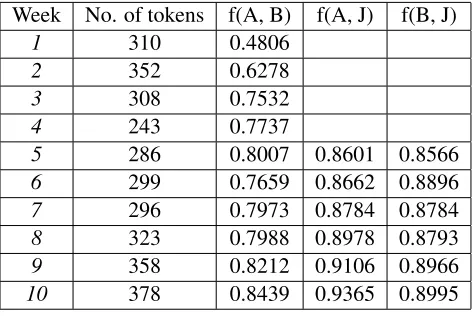
Table 1 reports the inter-annotator agreement of tem-poral annotation, both between the two annotators (A and B) and between each annotator and the judge (J), over a training period of ten weeks. Each week, 10 files are assigned, averaging about 315 event pairs for annotation.
Table 1 shows that annotators have taken up the temporal annotation scheme fairly quickly, reaching 75% agreement within three weeks. After several
Week No. of tokens f(A, B) f(A, J) f(B, J)
1 310 0.4806
2 352 0.6278
3 308 0.7532
4 243 0.7737
5 286 0.8007 0.8601 0.8566
6 299 0.7659 0.8662 0.8896
7 296 0.7973 0.8784 0.8784
8 323 0.7988 0.8978 0.8793
9 358 0.8212 0.9106 0.8966
[image:6.612.72.308.54.212.2]10 378 0.8439 0.9365 0.8995
Table 1: Inter-annotator agreement over 10 weeks of training.
[image:6.612.78.293.409.527.2]weeks of consolidation and fine-tuning, the agree-ment slowly reaches the lower 80% towards the end of the 10-week training period. This level of agree-ment is a substantial improveagree-ment over the previ-ously reported results, at 65%, for both English and Chinese data (Verhagen et al., 2009; Xue and Zhou, 2010). This indicates that the general direction of our experiment is on the right track.
Table 2 below is the confusion matrix based on the annotation data from the final 4 weeks:
a b o na nb g i
a 148 3 19 0 1 0 1
b 0 344 29 1 0 0 7
o 14 10 1354 3 3 2 82
na 0 0 3 3 0 0 0
nb 0 0 1 0 1 0 0
g 2 1 9 0 0 13 1
i 3 7 67 0 0 1 572
Table 2: Confusion matrix on annotation from Weeks 7-10: a=after; b=before; o=overlap; na=not-after; nb=not-before; g=groupie; i=irrelevant.
The matrix is fairly clean except when the value “overlap” is concerned. This value really stands out in more than one way. It is the most nebulous one in the whole scheme, prone to be confused with all six other values. In particular, it is most likely to be con-fused with the value “irrelevant”. It is also the most used value among all seven values, covering roughly half of the tokens. We will discuss this value in more detail in Section 4.2 below.
The value “groupie” may also seem troublesome if we look at mis-classification as a percentage of its total occurrences, however, it may not be as bad as it seems. As pointed out in Section 2.2.2, despite the fact that the linguistic phenomenon this value cap-tures can, and does, co-occur with temporal relations represented by other values, we had to set it up as an opposing value to the rest due to technical restric-tions. If/when this value is set up as a stand-alone feature to capture the linguistic phenomenon fully, the percentage of mis-classification should drop sig-nificantly because the number of total occurrences will increase dramatically.
The overall distribution of values shown in Table 2 is very skewed. At one end of the distribution spectrum is the value “overlap”, covering half of the data; at the other end are the values “not-before” and “not-after”, covering less than 0.3% of the token combined. It raises the question if such a classifica-tion scheme is well-designed to produce data useful for machine learning.
To shed light on what is behind the numbers and to uncover trends that numbers do not show, we also take a closer look at the annotation data. Three is-sues stand out.
4.1 Event anchor
In our current scheme, effort is made to pick out the predicate from a clause as the event anchor for tem-poral annotation. Our experiment suggests maybe this step should be skipped since it, in practice, un-dermines a specification of the scheme. The specifi-cation is that the event to be considered for temporal annotation is the one being described bythe whole clause, but the practice of displaying a mere word to the annotator in effect instructs the annotator to con-centrate on the word itself, rather than the clause. Despite repeated reminder during training sessions, the suggestive power of the display still sometimes gets the upper hand. (7) presents such an example concerninge1ande2.
(7) 在 PREP
此 this
期间 period
, ,
西非 West Africa
维和
peacekeeping 部队
force 曾 once
[e1出动] dispatch
战斗机 fighter jet
轰炸 bomb
叛军 rebel 阵地
position , ,
[e2炸死] bomb-dead
叛军 rebel
约 about
人。
CL
“During this period, West African Peacekeeping Force [e1dispatched] fighter jets and bombed rebel positions, [e2killing] about 50 rebel troops.”
One annotator classified the relation as “before”, ob-viously thinking of the event of dispatching fighter jets ase1; had he considered the event of dispatch-ing fighter jetsandbombing the rebel positions, the event being described by the clause, the value would have easily been “overlap”.
Since displaying the single-word event anchor sometimes leads annotators astray, this step proba-bly should be skipped. Doing so also simplifies the annotation process.
4.2 The value “overlap”
As pointed out above, the value “overlap” is quite a troubling character in the classification scheme: it is both the most-used and probably the least well-defined. Annotation data show that when it is con-fused with“after”, “before”, “not-after”, and “not-before”, it usually involves a perceptually punc-tual event (“pp-event” henceforth) and a perceptu-ally lasting event (“pl-event” henceforth), and the is-sue is whether the pp-event coincides with one of the temporal edges of the pl-event. If it does, then the value is “overlap”; otherwise, it is“after”/“before”. And on top of it is the factor of how sure one is of the issue: if one is sure, either way, the value is “overlap”/“after”/“before”; otherwise, it is “not-after”/“not-before”. Below is an example on which the two annotators disagree as to whether the rela-tion betweene1ande2should be classified as “be-fore”or“overlap”.
(8) 此外
in addition , ,
巴西 Brazil
女子 woman
国家队 national team
在 PREP 南美
S. America 足球赛 soccer match
上 POSTP
, ,
[e1横扫] sweep 千军
thousand-troop 如 like
卷 roll
席 mat
, ,
[e2登上] ascend
了 ASP 冠军
champion 宝座 throne
。
.
“In addition, in the South America Cup, Brazil-ian Women’s national team totally [e1 annihilated] all their opponents and [e2ascended] the throne of champion.”
In this example,e2is the pp-event ande1is the pl-event. Depending on when one thinkse2happened, either as soon as the last match ended or at the later medal ceremony, (and if the former, whether there is temporal overlap betweene1ande2), it is classified as either “before” or “overlap; and if one is unsure, it can be classified as “not-after”.
Such cases again raise the same question as the drastically uneven distribution of values shown in Table 2:Does the current classification scheme slice the temporal pie the right way?Let us make a poster child out of“overlap”: it seems to both impose too stringent a condition and not make enough distinc-tion. It imposes too stringent a condition on those cases like (8) to which whether there is temporal overlap seems beside the point. At the same time, it does not make enough distinction for cases like (4), in which an event does share one edge of an-other event temporally: once such cases are classi-fied as “overlap”, the specific information regard-ing the edge is lost. Such information could be very useful in temporal inference. Since it is infeasible to annotate the temporal relation between all events in an article, temporal inference is needed to expand the scope of temporal annotation. For example, if it is known from annotation thate1 is beforee2 and
e2is beforee3, then it can be inferred e1is before
e3. In the case of “overlap”, whenever it is one of the premises, no inference can be made, but if the “edge” information is supplied, some inferences are possible.
To make finer-grained distinctions in the classifi-cation scheme runs counter to the conventional wis-dom that a coarser-grained scheme would do a bet-ter job handling vagueness. But our experiment has proven the conventional wisdom wrong: our seven-value system achieved much higher agreement than the old six-value system. So the key is notfewer, but
“not-after”should be discarded since they obviously do not carry weight.
4.3 Objective vs. subjective temporal reference
A major contributor to uncertainty and disagreement in annotation is subjective temporal reference. Sub-jective temporal reference is made based on the au-thor’s perspective of the temporal axis, for example, “今天” (“today”), “目前” (“at present), and “过去” (”past”). In this group, references with a fixed span do not constitute a problem once the point of utter-ance is determined (e.g. literal use of “today”, “this month”); it is those with an elastic temporal span that cause disagreement. For example,“at present”can have a span of a second, or several minutes, or a cou-ple of hours, or even years depending on the context. When an event modified with this type of tempo-ral expression is paired with another event modified with direct reference to a point/span on the tempo-ral axis (i.e. with an objective reference), annotation becomes tricky. The event pair e1-e2 in the two-sentence sequence below is such an example.
(9) 过去 past
, ,
在 PREP
长江
Yangtze River 上 POSTP
建 build
大桥 bridge 是
be 件 CL
国家大事 national affair
, ,
现今 nowadays
几乎 almost
[e1
成为] become
平常事。
common scene.
一九九二年, 1992-year,
江苏 Jiangsu 扬中县
Yangzhong County 农民 farmer
[e2集资] raise funds 建成
build-finish 了 ASP
扬中 Yangzhong
长江 Yangtze
大桥 Bridge
, ,
而 and
湖北
Hubei 的 DE
赤壁 Chibi
长江 Yangtze
大桥 Bridge
总 total
投资 invest 三亿多
300 million plus 元 Yuan
, ,
全部 all
靠 depend
民间 private 集资
raise funds 建成 build-finish
。
.
“In the past, building a bridge on Yangtze River was a national affair, nowadays it almost [e1becomes] a common scene. In 1992, farmers in Yangzhong County, Jiangsu Province [e2raised] funds and com-pleted Yangzhong Yangtze Bridge, while Chibi Yangtze Bridge in Hubei Province cost more than 300 million Yuan, all from private fund-raising.”
This is taken from a piece written in 1997. In the context, it is clear that the contrast is between the situation before the opening-up of China and the
sit-uation about 20 years later. So it is reasonable to as-sume that the year 1992 falls inside the span of what the author considerednowadays; at the same time, it seems also reasonable to assume a narrow interpre-tation of “现今” (“nowadays”) that does not include the year 1992 in the span. These two interpretations would result in “overlap” and “after” respectively, and actually did so in our experiment.
There are also extreme cases in which objective and subjective temporal references come in direct conflict. For example,
(10) 当
while 记者 reporter
[e1问及] ask about
中 China
俄 Russia 关系
relationship 的 DE
现状 status
和 and
合作 cooperation
前景 prospect 时
when , ,
江泽民 Jiang Zemin
主席 President
[e2说] say
,... , ...
“When a reporter [e1 asked] about the status of China-Russia relationship and the prospects for co-operation, President Jiang Zemin [e2said], ...”
The relation between e1 and e2 is before based on objective reference, but overlap according to the subjective reference, indicated by “当..时” (“when”). This problem should be factored in when a new classification scheme is designed.
5 Conclusions
In this paper, we have described an experiment that focuses on two aspects of the task of annotating temporal relation of main events: annotation tar-get selection and a better-fitting temporal classifica-tion scheme. Experiment results show that selecting main event pairs based on discourse structure and modeling the classification scheme after the data im-proves inter-annotator agreement dramatically. Re-sults also show weakness of the current temporal classification scheme. For that, we propose a re-structuring along the lines of what this experiment has proven working: making more intuitive and in-sightful distinctions that characterize the data bet-ter. This direction can be taken to improve other high-level temporal annotation tasks that have been plagued by the same “vagueness” problem.
Acknowledgments
in Chinese”. All views expressed in this paper are those of the authors and do not necessarily represent the view of the National Science Foundation.
References
Regina Barzilay, Noemie Elhadad, and Kathleen McKe-own. 2002. Inferring strategies for sentence ordering in multidocument news summarization.Journal of Ar-tificial Intelligence Research, 17:35–55.
Sanda Harabagiu and Cosmin Adrian Bejan. 2005. Question Answering Based on Temporal Inference. In Proceedings of the AAAI-2005 Workshop on Inference for Textual Question Answering, Pittsburgh, Pennsyl-vania.
Sanda Harabagiu and Cosmin Adrian Bejan. 2006. An Answer Bank for Temporal Inference. InProceedings of LREC 2006, Genoa, Italy.
Heng Ji. 2010. Challenges from information extrac-tion to informaextrac-tion fusion. InProceedings of COLING 2010, pages 507–515, Beijing, China, August. Chin-Yew Lin and Eduard Hovy. 2001. Neats: A
mul-tidocument summarizer. InProceedings of the Docu-ment Understanding Workshop.
Rashmi Prasad, Eleni Miltsakaki, Nikhil Dinesh, Alan Lee, Aravind Joshi, Livio Robaldo, and Bonnie Web-ber, 2007. The Penn Discourse Treebank 2.0 Annota-tion Manual. The PDTB Research Group, December. Rashmi Prasad, Nikhil Dinesh, Alan Lee, Eleni
Milt-sakaki, Livio Robaldo, Aravind Joshi, and Bonnie Webber. 2008. The Penn Discourse Treebank 2.0. InProceedings of the 6th International Conference on Language Resources and Evaluation (LREC 2008). Marc Verhagen, Robert Gaizauskas, Frank Schilder,
Mark Hepple, Jessica Moszkowicz, and James Puste-jovsky. 2009. The TempEval Challenge: Identifying Temporal Relation in Text. Language Resources and Evaluation, 43(1):161–179.
Marc Verhagen, Roser Sauri, Tommaso Caselli, and James Pustejovsky. 2010. Semeval-2010 task 13: Tempeval-2. In Proceedings of the 5th International Workshop on Semantic Evaluation, pages 57–62, Up-psala, Sweden, July. Association for Computational Linguistics.
Marc Verhagen. 2010. The Brandeis Annotation Tool. In Language Resources and Evaluation Conference, LREC 2010, pages 3638–3643, Malta.
Nianwen Xue and Yuping Zhou. 2010. Applying Syn-tactic, Semantic and Discourse Constraints to Chinese Temporal Annotation. In Proceedings of COLING 2010, pages 1363–1372, Beijing, China, August. Nianwen Xue, Fei Xia, Fu dong Chiou, and Martha
Palmer. 2005. The Penn Chinese TreeBank: Phrase
Structure Annotation of a Large Corpus. Natural Lan-guage Engineering, 11(2):207–238.