Extended Generative Lexicon
Sumiyo Nishiguchi
School of Management, Tokyo University of Science 500 Shimokiyoku, Kuki-city, Saitama 346-8512, Japan
Abstract
This paper proposes an elaboration of the Generative Lexicon (GL) in Puste-jovsky (1995) based on a survey of BC-CWJ (2009). I manually classified the Japanese NP1-no NP2 “NP1’s NP2” con-struction in accordance with semantic lations between the two nominals. The re-sult indicates the need for the expansion of GL for computing the meaning of the NP1 -no NP2 construction by incorporating ref-erential module, as I call, that predicates temporary location, time, and manner of the referent. For example, in ima-no nihon “the present Japan,” ima-no modifies the time of the event argument in the referen-tial module.
1 Generative Lexicon Theory
Generative Lexicon (GL) is a theory proposed in Pustejovsky (1995). GL reduces lexical ambigu-ity and avoids multiple lexical entries by allowing semantic type-shifts based on the detailed lexical information. For example, instead of considering book as lexically ambiguous, the Qualia Structure enables semantic type-shifting of book; this pro-vides means for solving a type-mismatch between finish and a book in (1b).
(1) a. Sue finished reading a book.
b. Sue finished a book.
Most likely, the meanings of (1a) and (1b) are alike; (1a) expresses the action more explicitly than (1b), that is, Sue finished reading a book ac-cording to a highly probable reading. The correct interpretation of (1b) that Sue finished reading a book, rather than swallowing a book or something else, is obtained by means of the lexical knowl-edge that books are made to be read—the purpose
or the telic role of the book is to have its readers. The reading activity contains an event argument inside and the agent of the event argument is real-ized as the sentential subject Sue.
Such “purpose” or TELIC role is encoded in the lexical knowledge in GL (Pustejovsky 1995). Ac-cording to Pustejovsky who based his theory on Moravcsik (1975), the following four qualia that originate from Aristotle’s concept of matters rep-resent four inherent properties of the referent.
(2) CONSTITUTIVE part-whole relation, ma-terial, weight
FORMAL orientation, magnitude, shape,
dimensionality, color, position, ontolog-ical category
TELIC purpose, function
AGENTIVE origin, creator, artifact, natural
kind, causal chain
2 Problems with Deriving Possessive Relations
In formal semantics, Pustevjosky’s qualia struc-ture has been applied for deriving possessive re-lations by means of the type-shifting mechanism. Vikner and Jensen (2002) type-shift the possessor noun using one of the qualia roles to explain the meaning of the genitive phrases following Partee (1997).
Possessive relations are ambiguous in both English and Japanese. For example, there is more than one interpretation for Tanaka-no hon “Tanaka’s book.” Tanaka’s book may refer to the book that Tanaka owns or the book that Tanaka wrote (Barker 1995, 87).
2
whether or not the following noun is inherently re-lational.
According to Partee, if the following noun is a non-relational common noun (CN) such as car, John’s composes with car which is a regular(e, t) type predicate, namely, a function from individu-als to truth-values (Montague 1973), and the rela-tion between John and car is contextually supplied as shown in (3a).
On the contrary, when John is followed by in-herently relational nouns such as brother, em-ployee, and enemy, which are(e,(e, t))type with an extra argument slot (a function from individu-als to another function from individuindividu-als to truth-values), the relation between John and his brother in John’s brother inherits kinship from the two-place predicate brother in (3b). (4) exemplifies the computation related to another relational noun, friend.
(3) a. Free R type:
Syntax: [John’s]N P/CN
Semantics: λQλP[NP’(λz [∃x[∀y[[Q(y)
∧R(y)(z)]↔y = x]∧P(x)]])]
b. Inherent relation type: inherited from re-lational nouns:
Syntax: [John’s]N P/T CN (TCN:
transi-tive common noun)
Semantics:λRλP[NP’(λz [∃x[∀y[R(z)(y)
↔y = x]∧P(x)]])]
(4) Syntax: [[John’s]N P/T CN[friend]T CN]N P
Semantics: λRλP[John’(λz.∃x[∀y[R(z)(y)
↔y = x]∧P(x)]](friend-of’)
= λP[John’s(λz.∃x[∀y[friend-of’(z)(y) ↔ y = x]∧P(x)]]
If we apply Partee’s theory to Japanese exam-ples, most of the possessive relations are unpre-dictable, and there is no way to disambiguate the contextually supplied relation R.
Vikner and Jensen (2002) apply the qualia struc-ture of the possessee noun and type-shift the pos-sessee noun into a relational noun. For example, John’s poem, that is, a possessive + CN, can be interpreted as the poem that John composed be-cause the internal semantic structure of poem con-tains an author-of relation, which is the agentive role. According to Vikner and Jensen (2002), the meaning-shifting operator QA raises a one-place
holder poem in (5a) into a two-place holder as in (5b). The type-shifted poem can now combine with the possessive NP, which has a uniform type ((e,(e, t)),((e, t), t)), so that the authorship rela-tion is inherited from NP poem, and R is no longer a free variable.
(5) a. [[poem]]=λx.[poem’(x)]
b. QA(poem) = λxλy[poem’(x) ∧
com-pose’(x)(y)]
Similarly, the girl’s teacher can be explained by their mechanism. The purpose of teachers is to teach; therefore, the TELIC role of teachers is to teach someone. Now, the telic quale in the qualia structure of teacher raises the semantic type of a common noun teacher into the one of a relational noun as given in (6). Teacher is always someone’s teacher so that teacher is a function from individ-uals to another function from individindivid-uals to truth-values.
(6) a. [[teacher]]=λx.teacher’(x)
b. QT(teacher) = λxλy[teacher’(x) ∧
teach’(y)(x)]
Such a mechanism has dramatically reduced the ambiguity of possessive relations.
3 Limit to GL
Table 1 manually classifies the 3030 examples containing the NP1-no NP2“NP1-GEN NP2” con-struction in Japanese, such as Fuji-no rendora “a soap opera by Fuji TV,” according to the seman-tic relations between the two noun phrases. The examples were sorted out of the core data of the Yahoo! Chiebukuro portion of BCCWJ (2009) by using ChaKi.NET 1.2β.
3
Table 1: Distribution of Semantic Patterns of NP1-no NP2Construction selective binding of qualia in NP2 886 0.292409241
NP2is a relational noun 777 0.256435644 NP2is a deverbal noun 445 0.146864686 NP1is adjectival property 395 0.130363036 referential module modification of NP2 244 0.080528053 NP1is a quantifier 152 0.050165017
possession 45 0.014851485
demonstratives 32 0.010561056
NP1is a deverbal noun 24 0.007590759 NP1is theme of deadjectival NP2 23 0.007306226
adverb 6 0.001980198
selective binding of qualia in NP1 1 0.000330033
total 3030 1
face of Gundam,” the face is part of the Gundam robot (constitutive quale). Shikaku in shikaku-no katachi “square shape” describes the shape (for-mal role modification).
(7) a. Fuji-no rendora Fuji TV-GENsoap
“the soap opera by Fuji TV”
b. [[F uji−no rendora]] = λe,x[soap(x) & AGENTIVE = [make act(e) & agent(e) = FujiTV & theme(e) = x]]
Crucially, the survey demonstrated that the GL needs to be expanded to include not only inher-ent properties but also referinher-ential descriptions, be-cause 8% of the data involved the modification of the temporary elements, such as location, time, and manner of the referent of NP2(e.g., Operaza-no Kaijin “Phantom of the Opera”, that is, Phan-tom in the Opera) (Nishiguchi 2012) . As the re-lation between the Phantom and the Opera does not involve any of the inherent qualia structure— Phantom of the Opera was not born in the Opera (agentive), the Phantom is not made for the Opera (telic), the Phantom is not any part of the Opera (constitutive), or does not form any shape of the Opera (formal), none of the relations among the qualia structure Pustejovsky (1995) cannot substi-tute for the relation between the two.
4 Extended GL
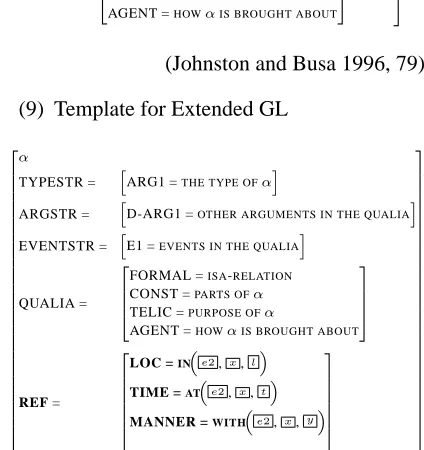
Even though Pustejovsky’s four qualia express in-herent properties of referents, I propose supple-menting lexical semantics with information about the referents. Besides type, argument, event, and
qualia structures in GL (cf. Johnston and Busa 1996, 79), the referential module (REF) has sub-categories of TIME, LOC, and MANNER roles.
(8) Original GL Template
2 6 6 6 6 6 6 6 6 6 6 6 6 6 6 6 6 6 4
α
TYPESTR = hARG1 =THE TYPE OFαi
ARGSTR = hD-ARG1 =OTHER ARGUMENTS IN THE QUALIA i
EVENTSTR = hE1 =EVENTS IN THE QUALIA i
QUALIA =
2 6 6 6 4
FORMAL =ISA-RELATION
CONST =PARTS OFα
TELIC =PURPOSE OFα
AGENT =HOWαIS BROUGHT ABOUT 3 7 7 7 5
3 7 7 7 7 7 7 7 7 7 7 7 7 7 7 7 7 7 5
(Johnston and Busa 1996, 79)
(9) Template for Extended GL
2 6 6 6 6 6 6 6 6 6 6 6 6 6 6 6 6 6 6 6 6 6 6 6 6 6 6 6 6 6 6 6 4
α
TYPESTR = hARG1 =THE TYPE OFαi
ARGSTR = hD-ARG1 =OTHER ARGUMENTS IN THE QUALIA i
EVENTSTR =
h
E1 =EVENTS IN THE QUALIA i
QUALIA =
2 6 6 6 4
FORMAL =ISA-RELATION
CONST =PARTS OFα
TELIC =PURPOSE OFα
AGENT =HOWαIS BROUGHT ABOUT 3 7 7 7 5
REF =
2 6 6 6 6 6 6 4
LOC =IN
“
e2,x,l
”
TIME =AT
“
e2,x,t
”
MANNER =WITH
“
e2,x,y”
3 7 7 7 7 7 7 5
3 7 7 7 7 7 7 7 7 7 7 7 7 7 7 7 7 7 7 7 7 7 7 7 7 7 7 7 7 7 7 7 5
4
on scooters” in (12a), scooter-riding is one of the temporary properties of the referents, so that it is MANNER role modification.
As a result, selective binding not only applies to qualia structure but also to a referential mod-ule, which enables the computation of the mean-ing of the NP1-no NP2construction. For example, Operaza-no “of the Opera” specifies the location of the Phantom as the Opera, mayonaka-no “mid-night” modifies time and baiku-no “on scooters” fills the manner role as shown in (10b), (11b) and (12b).
(10) a. Operaza-no kaijin The Opera-GENphantom “The Phantom of the Opera
b. [[T he P hantom of the Opera]] =
λx[phantom(x) ∧ [REF = ∃ e[be-phantom(e) & theme(e) = x ∧ location(e) = The Opera]]]
(11) a. Mayonaka-no midnight-GEN
kaigan-e beach-GOAL
it-te go-and sakende-kudasai.
shout-IMP.HON
“Go to beach during midnight and shout there.”
(BCCWJ 2011, oc 104343)
b. [[midnight beach]] = λx[beach(x) & [REF =∃e[be-beach(e)∧theme(e) = x
∧time(e) = midnight]]]
(12) a. Baiku-no scooter-GEN
karera-mo they-also kekkona
high
ritsu-de freuency-by
te-o hand-ACC
agete-kure-ta raise-BENEF-PAST
“Those on scooters also raised their hands often.”
(BCCWJ 2011, oc 56711)
b. [[those on scooters]]g =λx[g(1) = x
& [REF = ∃e[born(e) & manner(e) = with-scooter]]]
(13) a. kinjo-no
neighborhood-GEN
seikeigeka-ni-wa orthopidics-DAT-TOP
iki-mashi-ta go-HON-PAST
“I visited the orthopedics in neighbor-hood.”
(BCCWJ 2011, oc 97196)
b. [[neighborhood−GEN orthopedics]] = λx[orthopedics(x) ∧ [REF =
∃e[location(e) = neighborhood ∧ theme(e) = x]]]
Kinjo-no “in the neighborhood” in (13a) and mayonaka-no “midnight” in (11a) represent the temporary location and time of the referents of seikeigeka “orthopedic clinic” and kaigan “beach.”
Therefore, I propose the addition of a referen-tial module to the lexical meaning in GL, for in-corporating temporary location, time, manner and others of referents, in addition to the qualia struc-ture. The possessive or genitive phrases NP1-no in these examples modify the referential modules of NP2 which cannot be captured within the frame-work of the already existing GL.
5 EGL Database
I have made a small database of fifty lexical items taken from BCCWJ (2009) in the format of the Extended GL.
6 Conclusion
A quantitative survey of the meaning of the NP1 -no NP2construction in Japanese revealed the need for the expansion of the GL for the computation of the meaning, although many examples were of the qualia structure modification in GL.
References
Barker, C. (1995). Possessive Descriptions. Stan-ford: CSLI Publications.
BCCWJ (2009). Balanced Corpus of Contem-porary Written Japanese, BCCWJ2009 edition. The National Institute of Japanese Language.
BCCWJ (2011). Balanced Corpus of Contempo-rary Written Japanese. The National Institute of Japanese Language.
5 2 6 6 6 6 6 6 6 6 6 6 6 6 6 6 6 6 6 6 6 6 6 6 6 6 6 6 6 6 6 6 6 6 6 6 6 6 6 6 6 6 6 6 6 6 6 6 6 6 6 6 6 6 6 6 6 6 6 6 6 4
ASA-NO KOEN“PARK”
TYPESTR = hARG1 = yOUTDOOR’S LOCATION i ARGSTR = 2 6 6 6 6 6 6 6 6 6 6 6 6 4
D-ARG1 =wHUMAN
D-ARG2 =zHUMAN
D-ARG3 =lLOCATION
D-ARG4 =tTIME
D-E1 = e1TRANSITION
D-E2 = e2STATE
D-E3 = e3PROCESS 3 7 7 7 7 7 7 7 7 7 7 7 7 5 QUALIA = 2 6 6 6 6 6 6 4
FORMAL =x
CONST =
n
LAWN,BENCH,FOUNTAIN,...o TELIC =RECREATIONAL ACTIVITY
“
e3,w, y”
AGENTIVE =MAKE ACT “
e1,z,y
” 3 7 7 7 7 7 7 5 EXT = 2 6 6 6 6 6 6 6 6 6 6 6 6 6 6 6 6 6 6 4
LOCATION =IN “
e2, y,l
”
TIME =AT 0 B B B B B B B B B B B B B B @
e2,x,
2 6 6 6 6 6 6 6 6 6 6 6 6 6 4
ASA“MORNING” TYPESTR =
h
ARG1 =xTIME i
ARGSTR =
2
4D-ARG1 =tDATE
D-ARG2 =t1TIME 3 5
QUALIA =
2 4FORMAL =
x
CONST =PART-OF “
t,x”∧PART-OF “
t1, x”
3 5 3 7 7 7 7 7 7 7 7 7 7 7 7 7 5 1 C C C C C C C C C C C C C C A 3 7 7 7 7 7 7 7 7 7 7 7 7 7 7 7 7 7 7 5 3 7 7 7 7 7 7 7 7 7 7 7 7 7 7 7 7 7 7 7 7 7 7 7 7 7 7 7 7 7 7 7 7 7 7 7 7 7 7 7 7 7 7 7 7 7 7 7 7 7 7 7 7 7 7 7 7 7 7 7 5
Langacker, R. W. (1993). Reference-point con-structions. Cognitive Linguistics 4:1, 1–38.
Montague, R. (1973). The proper treatment of quantification in ordinary english. In K. J. J. Hintikka, J. M. E. Moravcsik, and P. Suppes (Eds.), Approaches to Natural Language : Pro-ceedings of the 1970 Stanford Workshop on Grammar and Semantics, pp. 221–242. Dor-drecht: Reidel.
Moravcsik, J. M. (1975). Aitia as generative factor in aristotle’s philosophy. Dialogue 14, 622–636.
Nishiguchi, S. (2012). Disambiguation of Pos-sessives: The Extended Generative Lexicon. Saarbr¨ucken: Lambert Academic Publishing.
Partee, B. H. (1983, 1997). Genitives: A case study. In J. van Benthem and A. ter Meulen (Eds.), Handbook of Logic and Language, pp. 464–470. Amsterdam: Elsevier.
Pustejovsky, J. (1995). The Generative Lexicon. Cambridge: MIT Press.