Active Learning for Phenotyping Tasks
Dmitriy Dligach Timothy A. Miller Guergana K. Savova
Boston Children’s Hospital and Harvard Medical School [email protected]
Abstract
Active learning is a popular research area in machine learning and general domain natural language processing (NLP) com-munities. However, its applications to the clinical domain have been studied very lit-tle and no work has been done on using active learning for phenotyping tasks. In this paper we experiment with a specific kind of active learning known as uncer-tainty sampling in the context of four phe-notyping tasks. We demonstrate that it can lead to drastic reductions in the amount of manual labeling when compared to its pas-sive counterpart.
1 Introduction
Several multi-year, multi-institutional transla-tional science initiatives focus on combining large repositories of biological specimens and Elec-tronic Health Records (EHR) data for high-throughput genetic research with the ultimate goal of transferring the knowledge to the point of care. Among them are Electronic Medical Records and Genomics (eMERGE)(McCarty et al., 2011), Pharmacogenomics Network (PGRN)(Long and Berg, 2011), Informatics for Integrating Biology and the Bedside (i2b2)(Kohane et al., 2012). In each of these initiatives there are a number of dis-eases or driving biology projects that are studied such as Rheumatoid Arthritis, Multiple Sclerosis, Inflammatory Bowel Disease, Autism Spectrum Disorder, Early Childhood Obesity, each defined as the phenotype of interest. To enable large co-hort identification, phenotype-specific algorithms are developed, evaluated and run against multi-million-patient EHRs which are then matched against the biobanks for further genetic analysis. Efficient and accurate large-scale automated phe-notyping is a key component of these efforts.
Supervised machine learning is widely used for phenotype cohort identification (Ananthakrishnan et al., 2012; Ananthakrishnan et al., 2013b; Anan-thakrishnan et al., 2013a; Lin et al., 2012b; Lin et al., 2012a; Xia et al., 2012). However, the supervised learning approach is expensive due to the costs associated with gold standard creation. While large amounts of unlabeled data are avail-able to the researchers in the form of EHRs, a sig-nificant manual effort is required to label them. In a typical phenotype creation project (Lin et al., 2012b; Lin et al., 2012a), a pool of patients is identified using some filtering criteria and a set of patients is selected from that pool for sub-sequent expert annotation. During annotation, a domain expert examines the notes associated with a patient, assigning either the positive label (i.e. relevant for the given phenotype) or the negative one. A model is subsequently trained using the annotated data. This scenario is known aspassive learning.
On the other hand, active learning (Settles, 2009; Olsson, 2009) is an efficient alternative to the traditionally used passive learning as it has the potential to reduce the amount of annotation that is required for training highly accurate machine learning models. Multiple studies have demon-strated that when active learning is used, machine learning models require significantly less training data and can still perform without any loss of accu-racy. Active Learning is a popular research area in machine learning and general domain natural lan-guage processing (NLP) communities. However, its applications to the clinical domain have been little studied and no work has been done on using active learning for phenotyping tasks. In this paper we experiment with a specific kind of active learn-ing known asuncertainty samplingin the context of four phenotyping tasks. We demonstrate that active learning can lead to drastic reductions in the amount of manual labeling without any loss of
curacy when compared to passive learning.
2 Background
2.1 Phenotyping as Document Classification
Phenotyping can be viewed as a document classi-fication task in which a document consists of all EHR documents and other associated data (labs, ordered medications, etc.) for the given patient. Initial filtering is usually performed based on a set of inclusion and exclusion criteria (ICD-9 codes, CPT codes, laboratory results, medication orders). Within the eMERGE and PGRN, flowcharts out-lining each phenotyping criterion and logical oper-ators (AND, OR) are defined to constitute the phe-notyping algorithm (Pacheco et al., 2009; Waudby et al., 2011; Kho et al., 2011; Kullo et al., 2010; Kho et al., 2012; Denny et al., 2010). The phe-notyping within i2b2 takes a different approach – that of a machine learning patient-level classi-fication task (Ananthakrishnan et al., 2012; Anan-thakrishnan et al., 2013b; AnanAnan-thakrishnan et al., 2013a; Lin et al., 2012b; Lin et al., 2012a; Xia et al., 2012). Each patient is represented as a set of variables derived from the structured and unstruc-tured part of the EHR (ICD-9 codes, lab results, relevant mentions in the clinical narrative along with their attributes) which are then passed to a machine learning algorithm. Whether the choice is a rule-based or machine learning approach, a fairly big sample of data needs to be labeled by experts which will then be used to derive the rules/train a classifier and to evaluate the performance.
2.2 Active Learning
Active learning is an approach to selecting unla-beled data for annotation that can potentially lead to large reductions in the amount of manual label-ing that is necessary for trainlabel-ing an accurate clas-sifier. Unlike passive learning, where the data is sampled for annotation randomly, active learning delegates the data selection to the classifier. Ac-tive learning succeeds if it reaches the same per-formance as its passive counterpart but with fewer training examples.
Seung et. al. (Seung et al., 1992) present an active learning algorithm known as query by com-mittee. In this algorithm, two classifiers are de-rived from the labeled data and used to label new examples. The instances where the two classifiers disagree are returned to a human annotator for la-beling. Lewis and Gale (Lewis and Gale, 1994)
pioneered the use of active learning for text cate-gorization. Their scenario, known as pool-based active learning, corresponds to a setting where an abundant supply of text documents is available but only a small sample can be economically anno-tated by a human labeler. Pool-based active learn-ing has since been explored for many problem do-mains such as text classification (McCallum and Nigam, 1998; Tong and Chang, 2001; Tong and Koller, 2002), word-sense disambiguation (Chen et al., 2006; Zhu and Hovy, 2007; Dligach and Palmer, 2011), information extraction (Thompson et al., 1999; Settles et al., 2008), and image classi-fication (Tong and Chang, 2001; Hoi et al., 2006).
The pool-based scenario matches the setting in our phenotyping tasks where large supplies of un-labeled EHRs are available but only a small set can be manually reviewed at a reasonable cost. Pool-based active learning is typically an iterative pro-cess that operates by first training a classifier on a small sample of the data known as the seed set. The classifier is subsequently applied to a pool of unlabeled data with the purpose of selecting addi-tional examples the classifier views as informative. The selected data is annotated and the cycle is re-peated, allowing the learner to quickly refine the decision boundary between classes.
method to a passive learning baseline, so no con-clusion about the effectiveness of active learning can be made. To the best of our knowledge, no work has been done on using active learning for phenotyping. In this work, we experiment with multi-class pool-based active learning in the con-text of four phenotyping tasks.
3 Methods
3.1 Data Representation
In a phenotyping task, the unit of classification is the patient chart. We represent each chart as a set of Unified Medical Language System (UMLS) (Bodenreider and McCray, 2003) con-cept identifiers (CUIs) which we extract from the patient records using Apache Clinical Text Analy-sis and Knowledge Extraction System1(cTAKES) (Savova et al., 2010). CUIs aim at abstracting our representations from the lexical variability of medical terminology and capturing the clinically relevant terms in a document leaving out the non-essential and potentially noisy lexical items. Each CUI can be either asserted or negated, as deter-mined by the cTAKES negation module.
Although cTAKES is capable of extracting most CUIs that exist in the UMLS, we only include the CUIs that are listed in phenotype-specific dictio-naries. The dictionaries are created manually by domain experts and define the terms that are rel-evant for each phenotype. Thus, we model each patient~xas a vector of CUIs where each element nindicates the frequency of occurrence of the re-spectiveCU Inin the records for this patient.
3.2 Models
To perform the classification and to estimate the informativeness of an instance during active learn-ing, we need to evaluate the posterior probability p(ci|~x), where ci is the class indicating the rele-vance of the patient ~x for the given phenotype. For that purpose, we utilize a multinomial Naive Bayes model, which is widely used in document classification.
Naive Bayes classifiers possess several useful properties that make them particularly appropriate for active learning: (1) training and classification speed, (2) ability to produce a probability distri-bution over the target classes, and (3) ability to perform multi-class classification. Because active
1http://incubator.apache.org/ctakes/
learning requires many rounds of retraining (po-tentially as many as the number of training exam-ples), the first property is crucial for using active learning in practice. The second property is desir-able for evaluating the level of uncertainty of the learner over the class predictions. Finally, the third property is important since some of our datasets include more than two classes.
We model the posterior probability as follows:
p(ci|~x) =
1
Zp(ci) N
Y
n=1
p(CU In|ci)xn (1)
Wherep(ci) is the prior probability of classci, Nis the number of CUIs in the phenotype-specific dictionary, CU In is the nth CUI in that dictio-nary, xn is the frequency of CU In in ~x, and Z (evidence) is the scaling factor. We determine the model parameters,p(ci)andp(CU In|ci), us-ing maximum likelihood estimation with Laplace smoothing from the training data. For classifica-tion we predict the labelcas:
c= arg max
i p(ci|~x) (2) For active learning, we utilize a framework known asuncertainty sampling(Lewis and Gale, 1994; Schein and Ungar, 2007). In this frame-work, the learner requests a label for the instance it is most uncertain how to label. We evaluate the level of uncertainty using the prediction margin metric (Schein and Ungar, 2007) which is defined as:
prediction margin=|p(c1|~x)−p(c2|~x)| (3)
Where c1 and c2 are the two most probable
classes for the patient~xaccording to the model.
3.3 Datasets
Each patient chart was reviewed by a domain ex-pert and labeled at the patient level for CASE or NON-CASE (2-way labeling) for Ulcerative Col-itis and Crohn’s Disease; CASE, NON-CASE, or UNKNOWN (3-way labeling) for Type II Di-abetes; CASE, NON-CASE, PROBABLE, UN-KNOWN, or IRRELEVANT (5-way labeling) for Multiple Sclerosis. In our experiments, we used only the clinical narrative data, not a combination of structured and unstructured data. The predomi-nant class for each phenotype was CASE.
3.4 Experimental Setup
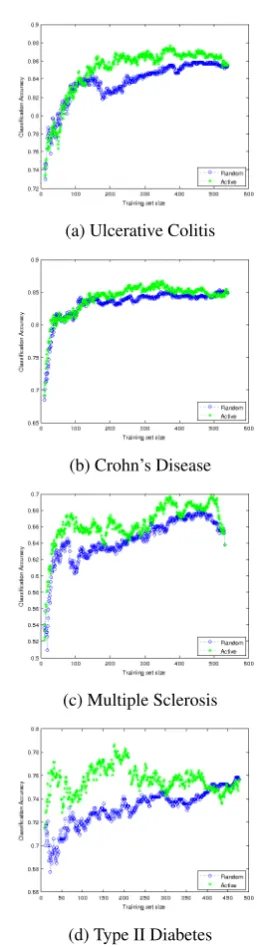
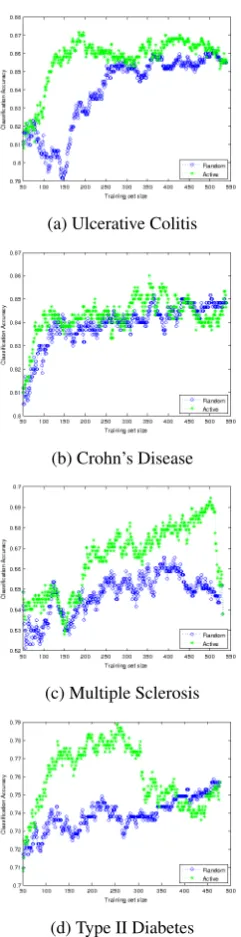
Active learning is typically evaluated by com-paring the learning curves for passive and active learning-based data selection methods. We gener-ated the learning curves in the style of N fold cross validation (N = 10). Within each fold, we have a held out test set and a pool of unlabeled exam-ples. We begin by randomly selecting the seed set of sizeS, removing it from the pool, and training a model. To produce a point of the active learning curve, we apply the model to the pool of remaining unlabeled data and select the most informative ex-ample using the prediction margin metric defined in Equation 3. We move the selected example to the training set, retrain the model, and evaluate its performance on the held out test set. In parallel, to produce a point of the passive learning curve, we select a single example from the pool randomly. We continue this process in an iterative fashion un-til the pool is exhausted. We repeat this for each of the ten folds and average the resulting learning curves.
In addition, we conduct a series of experiments for each phenotype in which we vary the size of the seed set S. Our motivation is to explore the sensitivity of active learning to the size of the ini-tial seed set. We only try several relatively small seed set sizes. Larger seed sets may erase the gains that could otherwise be obtained by active learn-ing.
In this work, we do not compare the perfor-mance of the models accross different phenotypes. Instead, we focus on comparing the performance of active learning against the passive learning baseline.
In practice, active learning is used for selecting examples for subsequent labeling from the pool of unlabeled data. This scenario is simulated in our experiments – we utilize the gold standard data,
but we hide the labels from the model. The label is revealed only after the instance is selected and is ready to be added to the training set. This is a common practice used in most published studies of active learning.
4 Results
For each phenotype, we construct the learning curves for different sizes of the seed set. The re-sults are shown in Figures 1, 2, and 3, which in-clude the learning curves for seed sizesS = 10, S= 30, andS= 50respectively.
(a) Ulcerative Colitis
(b) Crohn’s Disease
(c) Multiple Sclerosis
[image:4.595.346.475.239.714.2](d) Type II Diabetes
Phenotype Total Instances Number of Classes Proportion of Predominant Class
Ulcerative Colitis 600 2 0.630
Crohn’s Disease 600 2 0.665
Multiple Sclerosis 595 5 0.395
[image:5.595.120.239.178.650.2]Type II Diabetes 600 3 0.583
Table 1: Dataset Characteristics
(a) Ulcerative Colitis
(b) Crohn’s Disease
(c) Multiple Sclerosis
(d) Type II Diabetes
Figure 2: Passive vs. active learning performance on held-out data (S= 30)
For each plot we also compute the area under the active learning and passive learning curves. We report the difference between the two curves in Table 2.
(a) Ulcerative Colitis
(b) Crohn’s Disease
(c) Multiple Sclerosis
(d) Type II Diabetes
Figure 3: Passive vs. active learning performance on held-out data (S= 50)
5 Discussion and Conclusion
[image:5.595.355.476.179.649.2]Seed Size Ulcerative Colitis Crohn’s Disease Multiple Sclerosis Type II Diabetes
10 6.90 4.17 10.50 11.05
30 6.64 2.21 15.43 7.49
[image:6.595.97.502.64.121.2]50 8.63 1.75 8.61 8.90
Table 2: Difference between areas under the curve (Active - Passive)
learning curves for most sizes of the training sets. This means that the models trained on the data se-lected via active learning typically perform better than the models trained using random sampling. This result is also supported by the fact that the difference between the areas under the active and passive learning curves in Table 2 was positive for all of our experiments.
For most models, active learning reaches the level of the best random sampling performance with fewer than 200 examples, or about 1/3 of the data. This potentially translates into manual anno-tation savings of about 2/3. Moreover, the best ac-tive learning performance is oftenabovethat of the random sampling baseline. For example, consider Figure 3d. The sizes of the training set in the range between approximately 150 and 350 produce bet-ter performance than the best performance of the model trained on the randomly sampled data. At about 260 training examples, the performance of active learning approaches 0.79, which is at least 3 percentage points higher than the performance of the passive learning baseline that it achieves with theentiretraining set.
Although active learning consistently outper-formed the passive learning baseline in most of our experiments, occasionally active learning per-formed worse at certain training set sizes. Con-sider Figure 2b. During early stages of learn-ing (trainlearn-ing set sizes of about 50-130), the pas-sive curve lies above the active learning curve (al-though active learning recovers later on). We hy-pothesize that the reason for this behavior lies in outlier selection. Because outliers often do not fit into one of the predefined classes, the classifier is often uncertain about their labels, recommend-ing their selection durrecommend-ing active learnrecommend-ing. At the same time, the outliers do not help to clarify the decision boundary, negatively affecting the perfor-mance. We leave a further investigation into the nature of this behavior for future work.
In other cases, the active learning briefly dips below the passive learning curve at the very end of the selection process. Although this behavior
is observed in several cases (e.g. 1d, 2b, 3d), it is unlikely to be of consequence in practice. Ac-tive learning would typically be stopped at a much earlier stage, e.g. when 1/3 or 1/2 of the data has been annotated. Nevertheless, it would still be in-teresting to uncover the conditions leading to this behavior and we leave this investigation for future work.
Both of these scenarios, where active learning performed worse than random sampling, highlight the need for developing stopping criteria for ac-tive learning such as (Laws and Sch¨atze, 2008; Bloodgood and Vijay-Shanker, 2009). In a prac-tical application of active learning, a held-out test set is unlikely to be available and some automated means of tracking the progress of active learning is needed. We plan to pursue this avenue of research in the future. In addition to that, we plan to ex-plore the portability of the models trained via ac-tive learning. It would also be interesting to inves-tigate the effect of swapping the base classifier: in this work we collect the data for annotation using a multinomial Naive Bayes model. It is still not clear whether the gains obtained by active learn-ing would be preserved if a model was trained on the selected data using a different classifier (e.g. SVM).
Finally, in addition to investigating the perfor-mance of active learning across different pheno-types, we also looked at the effects of varying the size of the seed setS. We did not find a clear cor-relation between the size of the seed set and active learning performance. However, the relationship may exist and could potentially be uncovered if a larger set of seed set sizes was used. We leave the further investigation in this area for future work.
the unlabeled examples it views as informative, thus eliminating the need to annotate the examples that do not contribute to determining the decision boundary. We demonstrated that active learning outperforms the traditionally used passive learn-ing baseline, potentially produclearn-ing annotation cost savings of up to two-thirds of what is required by the passive baseline.
Acknowledgements
The work described was supported by Tempo-ral History of Your Medical Events (THYME) NLM R01LM010090 and Integrating Informat-ics and Biology to the Bedside (i2b2) NCBO U54LM008748. Thanks to the anonymous re-viewers for thorough and insightful comments. Guergana K. Savova is on the Advisory Board of Wired Informatics, LLC which provides services and products for clinical NLP applications.
References
A.N. Ananthakrishnan, T. Cai, S. Cheng, P.J. Chen, G. Savova, R.G. Perez, V.S. Gainer, S.N. Murphy, P. Szolovits, K. Liao, et al. 2012. Improving case definition of crohn’s disease and ulcerative colitis in electronic medical records using natural language processing: a novel informatics approach. Gas-troenterology, 142(5):S–791.
A. Ananthakrishnan, V. Gainer, T. Cai, Guzman P.R., S. Cheng, G. Savova, P. Chen, P. Szolovits, Z. Xia, P. De Jager, S. Shaw, S. Churchill, E. Karlson, and I. Kohane. 2013a. Similar risk of depression and anxiety following surgery or hospitalization for crohn’s disease and ulcerative colitis. Am J Gas-troenterol.
A.N. Ananthakrishnan, V.S. Gainer, R.G. Perez, T. Cai, S.C. Cheng, G. Savova, P. Chen, P. Szolovits, Z. Xia, P.L. Jager, et al. 2013b. Psychiatric co-morbidity is associated with increased risk of surgery in crohn’s disease. Alimentary pharmacology & therapeutics, 37(4):445–454.
M. Bloodgood and K. Vijay-Shanker. 2009. A method for stopping active learning based on stabilizing pre-dictions and the need for user-adjustable stopping. In Proceedings of the Thirteenth Conference on Computational Natural Language Learning, pages 39–47. Association for Computational Linguistics.
O. Bodenreider and A.T. McCray. 2003. Exploring semantic groups through visual approaches. Journal of biomedical informatics, 36(6):414.
J. Chen, A. Schein, L. Ungar, and M. Palmer. 2006. An empirical study of the behavior of active learn-ing for word sense disambiguation. InProceedings
of the main conference on Human Language Tech-nology Conference of the North American Chap-ter of the Association of Computational Linguistics, pages 120–127, Morristown, NJ, USA. Association for Computational Linguistics.
Y. Chen, S. Mani, and H. Xu. 2011. Applying ac-tive learning to assertion classification of concepts in clinical text. Journal of Biomedical Informatics.
J.C. Denny, M.D. Ritchie, M.A. Basford, J.M. Pul-ley, L. Bastarache, K. Brown-Gentry, D. Wang, D.R. Masys, D.M. Roden, and D.C. Crawford. 2010. Phewas: demonstrating the feasibility of a phenome-wide scan to discover gene–disease associations.
Bioinformatics, 26(9):1205–1210.
D. Dligach and M. Palmer. 2011. Good seed makes a good crop: accelerating active learning using lan-guage modeling. InProceedings of the 49th Annual Meeting of the Association for Computational Lin-guistics: Human Language Technologies, volume 2. Association for Computational Linguistics.
R.L. Figueroa, Q. Zeng-Treitler, L.H. Ngo, S. Gory-achev, and E.P. Wiechmann. 2012. Active learning for clinical text classification: is it better than ran-dom sampling? Journal of the American Medical Informatics Association, 19(5):809–816.
U. Hahn, E. Beisswanger, E. Buyko, and E. Faessler. 2012. Active learning-based corpus annotation¨aˆıthe pathojen experience. In AMIA Annual Symposium Proceedings, volume 2012, page 301. American Medical Informatics Association.
S.C.H. Hoi, R. Jin, J. Zhu, and M.R. Lyu. 2006. Batch mode active learning and its application to medical image classification. InProceedings of the 23rd in-ternational conference on Machine learning, pages 417–424. ACM.
A.N. Kho, J.A. Pacheco, P.L. Peissig, L. Rasmussen, K.M. Newton, N. Weston, P.K. Crane, J. Pathak, C.G. Chute, S.J. Bielinski, et al. 2011. Electronic medical records for genetic research: results of the emerge consortium. Sci Transl Med, 3(79):79rel.
A.N. Kho, M.G. Hayes, L. Rasmussen-Torvik, J.A Pacheco, W.K. Thompson, L.L. Armstrong, J.C. Denny, P.L Peissig, A.W. Miller, W. Wei, et al. 2012. Use of diverse electronic medical record systems to identify genetic risk for type 2 diabetes within a genome-wide association study. Journal of the American Medical Informatics Association, 19(2):212–218.
I.S. Kohane, S.E. Churchill, and S.N. Murphy. 2012. A translational engine at the national scale: infor-matics for integrating biology and the bedside. Jour-nal of the American Medical Informatics Associa-tion, 19(2):181–185.
enable a genome-wide association study of periph-eral arterial disease. Journal of the American Medi-cal Informatics Association, 17(5):568–574.
F. Laws and H. Sch¨atze. 2008. Stopping criteria for active learning of named entity recognition. In Pro-ceedings of the 22nd International Conference on Computational Linguistics, volume 1, pages 465– 472. Association for Computational Linguistics.
D.D. Lewis and W.A. Gale. 1994. A sequential al-gorithm for training text classifiers. InSIGIR ’94: Proceedings of the 17th annual international ACM SIGIR conference on Research and development in information retrieval, pages 3–12, New York, NY, USA. Springer-Verlag New York, Inc.
C. Lin, H. Canhao, T. Miller, D. Dligach, R.M. Plenge, E.W. Karlson, and G. Savova. 2012a. Maximal in-formation coefficient for feature selection for clini-cal document classification. InICML Workshop on Machine Learningfor Clinical Data.
C. Lin, H. Canhao, T. Miller, D. Dligach, R.M. Plenge, E.W. Karlson, and G.K. Savova. 2012b. Feature en-gineering and selection for rheumatoid arthritis dis-ease activity classification using electronic medical records. In ICML Workshop on Machine Learning for Clinical Data Analysis.
R.M. Long and J.M. Berg. 2011. What to expect from the pharmacogenomics research network. Clinical Pharmacology & Therapeutics, 89(3):339–341.
A. McCallum and K. Nigam. 1998. Employing em and pool-based active learning for text classification. InICML ’98: Proceedings of the Fifteenth Interna-tional Conference on Machine Learning, pages 350– 358, San Francisco, CA, USA. Morgan Kaufmann Publishers Inc.
C.A. McCarty, R.L. Chisholm, C.G. Chute, I.J. Kullo, G.P. Jarvik, E.B. Larson, R. Li, D.R. Masys, M.D. Ritchie, D.M. Roden, et al. 2011. The emerge network: A consortium of biorepositories linked to electronic medical records data for conducting ge-nomic studies. BMC medical genomics, 4(1):13.
T. Miller, D. Dligach, and G Savova. 2012. Ac-tive learning for coreference resolution. InBioNLP: Proceedings of the 2012 Workshop on Biomedi-cal Natural Language Processing, pages 73–81, Montr´eal, Canada, June. Association for Computa-tional Linguistics.
F. Olsson. 2009. A literature survey of active machine learning in the context of natural language process-ing. InTechnical Report, Swedish Institute of Com-puter Science.
J.A. Pacheco, P.C. Avila, J.A. Thompson, M. Law, J.A. Quraishi, Alyssa K. Greiman, E.M. Just, and A. Kho. 2009. A highly specific algorithm for identifying asthma cases and controls for genome-wide association studies. In AMIA Annual Sympo-sium Proceedings, volume 2009, page 497. Ameri-can Medical Informatics Association.
G.K. Savova, J.J. Masanz, P.V. Ogren, J. Zheng, S. Sohn, K.C. Kipper-Schuler, and C.G. Chute. 2010. Mayo clinical text analysis and knowledge extraction system (ctakes): architecture, component evaluation and applications. Journal of the Amer-ican Medical Informatics Association, 17(5):507– 513.
A.I. Schein and L.H. Ungar. 2007. Active learning for logistic regression: an evaluation. Machine Learn-ing, 68(3):235–265.
B. Settles, M. Craven, and S. Ray. 2008. Multiple-instance active learning. Advances in Neural Infor-mation Processing Systems (NIPS), 20:1289–1296.
B. Settles. 2009. Active learning literature survey. In
Computer Sciences Technical Report 1648 Univer-sity of Wisconsin-Madison.
H. S. Seung, M. Opper, and H. Sompolinsky. 1992. Query by committee. InCOLT ’92: Proceedings of the fifth annual workshop on Computational learn-ing theory, pages 287–294, New York, NY, USA. ACM.
C.A. Thompson, M.E. Califf, and R.J. Mooney. 1999. Active learning for natural language pars-ing and information extraction. In Proceedings of the Sixteenth International Conference on Machine Learnin, pages 406–414. Citeseer.
S. Tong and E. Chang. 2001. Support vector machine active learning for image retrieval. InProceedings of the ninth ACM international conference on Multi-media, pages 107–118. ACM New York, NY, USA.
S. Tong and D. Koller. 2002. Support vector machine active learning with applications to text classifica-tion. The Journal of Machine Learning Research, 2:45–66.
C. Waudby, R. Berg, J. Linneman, L. Rasmussen, P. Peissig, L. Chen, and C. McCarty. 2011. Cataract research using electronic health records. BMC oph-thalmology, 11(1):32.
Z. Xia, R. Bove, T. Cai, S. Cheng, R.N.G. Perez, V.S. Gainer, S.N. Murphy, P. Chen, G.K. Savova, K. Liao, E.W. Karlson, S. Shaw, S. Ananthakrish-nan, P. Szolovits, S. Churchill, I.S. Kohane, R.M. Plenge, and Philip L.D. 2012. Leveraging elec-tronic health records for research in multiple sclero-sis. InEuropean Committee for Treatment and Re-search in Multiple Sclerosis (ECTRIMS).