On Enterprise Social Responsibility Comprehensive
Evaluation Based on Two-Step Fuzzy Evaluation Method
Dongsheng Li, Qiulin Yang, Deqiang Yu
School of Economics and Management, University of South China, Hengyang, China Email: [email protected]
Received November 17, 2012; revised December 18, 2012; accepted January 12, 2013
ABSTRACT
In order to evaluate the enterprise social responsibility scientifically, this paper constructed an enterprise social respon- sibility evaluation indexes system composed by five first class indexes (environmental protection, resources utilization, economic benefit, human resources and social contribution and so on) and 18 second indexes. The two-step fuzzy evaluation method was adopted to evaluate comprehensive effect and Wuhan Iron and Steel (Group) Corporation (WISCO) was given for example.
Keywords: Two-Oriented Society; Enterprise Social Responsibility; Two-Step Fuzzy Evaluation Method
1. Introduction
The “Two-oriented society” construction plan was put forward by the National Development and Reform Commission in December of 2007, and “Wuhan city cir- cle” and “Changsha-Zhuzhou-Xiangtan city cluster” were conducted as the reform testing districts. It is of great significance to propel the sustainable development of city cluster as well as the solution of problem accompanying urbanization in the areas of resource and energy, eco- logical environment, and economic development model.
The “Two-oriented society” construction demands that the enterprise should utilize the limited resources rea- sonably, efficiently and circularly, at the same time cor- responding environmental protection measures should be made to reduce the discharge of wastes pollution, to minimize the damage to the environment and to achieve harmonious coexistence of natural environment and economical society. The essence is that the enterprise should undertake social responsibilities more actively [1]. So, it is significance to scientifically evaluate the social responsibility fulfillment of enterprise.
Nowadays, the social responsibility standards have a broad impact on the society, which include of SA8000 social responsibility standard, the Dow Jones Sustain- ability Indexes (DJSI), G3 international sustainable de- velopment report guide and so on [2]. In our country, the famous ones are the social responsibility standard system of Chinese enterprise (HM3000), the top 100 enterprises social responsibility development indexes issued by the academy Chinese Academy of Social Sciences and the golden bee enterprise social responsibility list [3]. How-
ever, all these evaluation systems do not set meticulous regulations to environment and resources responsibility, and the enterprise’ qualitative evaluation basis can only be obtained from its incomplete information disclosure, which will induce the fulfillment of enterprise social re- sponsibility can’t be measured effectively. This paper mainly focuses on constructing the enterprise social re- sponsibility evaluation indexes system based on “Two- oriented society” by analyzing of the stakeholder theory, HM3000 and SA8000. The two-step fuzzy evaluation method is adopted to evaluate the fulfillment of enter- prise social responsibility.
2. The Construction of the Enterprise Social
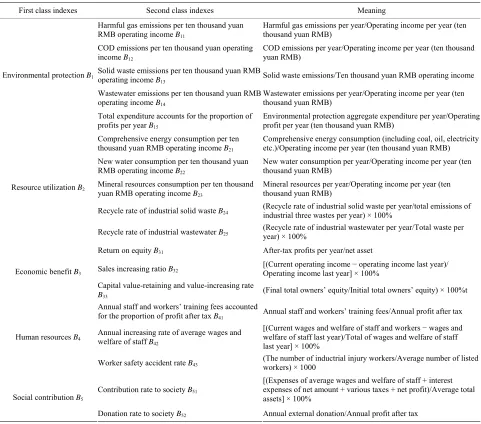
Responsibility Evaluation Indexes System
Based on “Two-Oriented Society”
tion. And the second class indexes consist of 18 ones, such as harmful gas emissions per ten thousand yuan RMB operating income (see Table 1).
3. Two-Step Fuzzy Evaluation Method of
Enterprise Social Responsibility
This paper will use the modified analytic hierarchy proc- ess (MAHP) to calculate the index weight after the en- terprise social responsibility evaluation indexes system has been established. Then, the composite score of enter- prise social responsibility was calculated using two-step fuzzy evaluation method.
3.1. Calculating Index Weight Based on the Modified Analytic Hierarchy Process
After enterprise social responsibility evaluation indexes
system was determined, it needs to calculate the weight of each index. There are many methods to ascertain the weight, of which analytic hierarchy process is an impor- tant one. Analytic hierarchy process is an evaluating method combined qualitative with quantitative analysis, which was put forward in the 1970’s by A. L. Saaty [4]. This method decomposes the complex problem into sev- eral levels and several factors. Then, it will compare and calculate the factors simply to draw their weights and get the evaluation result. But this method has the defect in texting non consistency judgment matrix, for it needs artificial estimate adjustment and carrying on the multi- ple times if necessary.
[image:2.595.58.539.315.739.2]In order to overcome this problem, amodified method of analytical hierarchy process is adopted. Its main char- acteristics are to introduce the quasi-optimal matrix, which can meet the consistency naturally and doesn’t
Table 1. Enterprise social responsibility evaluation indexes system.
First class indexes Second class indexes Meaning
Harmful gas emissions per ten thousand yuan RMB operating income B11
Harmful gas emissions per year/Operating income per year (ten thousand yuan RMB)
COD emissions per ten thousand yuan operating income B12
COD emissions per year/Operating income per year (ten thousand yuan RMB)
Solid waste emissions per ten thousand yuan RMB
operating income B13 Solid waste emissions/Ten thousand yuan RMB operating income Wastewater emissions per ten thousand yuan RMB
operating income B14
Wastewater emissions per year/Operating income per year (ten thousand yuan RMB)
Environmental protection B1
Total expenditure accounts for the proportion of profits per year B15
Environmental protection aggregate expenditure per year/Operating profit per year (ten thousand yuan RMB)
Comprehensive energy consumption per ten thousand yuan RMB operating income B21
Comprehensive energy consumption (including coal, oil, electricity etc.)/Operating income per year (ten thousand yuan RMB) New water consumption per ten thousand yuan
RMB operating income B22
New water consumption per year/Operating income per year (ten thousand yuan RMB)
Mineral resources consumption per ten thousand yuan RMB operating income B23
Mineral resources per year/Operating income per year (ten thousand yuan RMB)
Recycle rate of industrial solid waste B24 (Recycle rate of industrial solid waste per year/total emissions of industrial three wastes per year) × 100% Resource utilization B2
Recycle rate of industrial wastewater B25 (Recycle rate of industrial wastewater per year/Total waste per year) × 100% Return on equity B31 After-tax profits per year/net asset
Sales increasing ratio B32 [(Current operating income Operating income last year] × 100% − operating income last year)/ Economic benefit B3
Capital value-retaining and value-increasing rate
B33 (Final total owners’ equity/Initial total owners’ equity) × 100%t Annual staff and workers’ training fees accounted
for the proportion of profit after tax B41 Annual staff and workers’ training fees/Annual profit after tax Annual increasing rate of average wages and
welfare of staff B42
[(Current wages and welfare of staff and workers − wages and welfare of staff last year)/Total of wages and welfare of staff last year] × 100%
Human resources B4
Worker safety accident rate B43 (The number of inductrial injury workers/Average number of listed workers) × 1000
Contribution rate to society B51
[(Expenses of average wages and welfare of staff + interest expenses of net amount + various taxes + net profit)/Average total assets] × 100%
Social contribution B5
need consistent test [5,6]. The process of the modified analytic hierarchy process is as follows:
Firstly, it will construct judgment matrix, the method is the same of the one of analytic hierarchy process. Let the judgment matrix be A, then, A can be represented as
in (1).
ij n, ij 1 ji, ii 1, , , 1, 2, ,A a a a a i j i j
n (1)
Secondly, it will calculate the anti-symmetric matrix of judgment matrix A, and let it be L, it can be obtained
by (2).
ij n,ij ln
ij , , , 1, 2, ,L l l a i j i j n
(2)
Thirdly, it will construct quasi-optimal matrix of this judgment matrix A, let it be M, it can be shown as in (3).
1
e ,
, , 1, 2, ,
ij
f ij n n
n
ij ik jk
k
M m
f l l n i j n
(3)
The end, it will calculate eigenvector of M by square
root method. Let the eigenvector be W. And the
compo-nent of W (let to be Wi) is the weight of corresponding
index, it can be gotten by (4).
1
1, 2, ,
n i i n i i M W i M
n
2) Weight set
et of enterprise social responsibility ev
(4)
3.2. Two-Step Fuzzy Evaluation Method
Fuzzy evaluation method is a decision-making one for some objective under fuzzy environment, which consid- ers the influence of many factors and can solve the prob- lem of indexes system better. It can reduce the influence of the artificial factor to the smallest extent, and has the advantage over reflecting the nature of problem. The enterprise social responsibility evaluation indexes system is divided into three levels in this paper based on “Two- oriented society”, so, two-step fuzzy evaluation method was adopted.
3.2.1. Elements 1) Factors set
The factor set of enterprise social responsibility eva- luation indexes system consists of the first class indexes set and the second class indexes set, as are showed in
Table 1. The first class indexes set is B = (B1, B2, B3, B4, B5), and B1, B2, B3, B4, B5 represent five first class in-
dexes in the Table 1. Bi= (Bi1, Bi2,···, Bim), i = 1, 2,···, 5.
Bi1, Bi2,···, Bim are the second indexes corresponding with
the first class index Bi, which can also be seen in Table 1.
The weight s
aluation indexes system includes the first class indexes weight set (let be WB) and the second class indexes
weight set (let be Wi = (i = 1, 2,···, 5)). Let WB = (wB1, wB2,
···, wB5), Wi = (wi1, wi2,···, wim). WB and Wi are both
deter-mined by modified analytic hierarchy process.
3) Comment set
Let
,V5
five grades, su1 2
, ,
V V V to be a comment set, which
st
3.2.2. Fuzzy Relation from Membership Matrix to
Memb is constructed to determine the ands by ch as excellent, good, medium, poor and very poor.
Comment Set
ership matrix R
fuzzy relation from B to V. R
R R1, 2, , R5
T, and Riis shown as in (5).
11
r 12 13 14 15
21 22 23 24 25
1 2 3 4 5
... ... ... ... ...
i i i i i
i i i i i
i
im im im im im
r r r r
r r r r r
R
r r r r r
(5)
In the equation, R ii
1, 2, ,5
rst class index,
is the membership matrix of the ith fi and m is its index number, while rilj
i1, 2, ,5; j1, 2, ,5
representthe membership ,5 cor-
responding its lth second index. T imj is
divided into positive index (the bigger, the better) and reverse index (the smaller, the better) according to its property. They are calculated as follows:
1) The calculation of membership degr
degree of grade
of r 1, 2,j j
he value
ee of positive in
ive indexes are ranked in the order from big to sm
f the actual value of the second index
dex
Posit
all, the bigger the index value, the better the member- ship, which indicates the enterprise complete well. The calculation of membership degree of positive index is as follows:
Firstly, i lth
il
X is greater than its corresponding xcellent” grade
dard value, then the membership to “excellent” is 1, and the ones to the other four is 0. That is, if il il
“e stan
X V ,
then ril11,ril2ril3ril4 ril50
Secondly, if the actual value of the lth second index
il
X is between the jth grade and th
j1
th one,is, Vil j 1 Xil lj
e
that Vi , then the membership to
j1
th grade is shown as in (6).
1
1
, 0,1, 2,3, 4
ilj il il j
ilj il j
V X
r j
V V
(6)
The membership to the jth grade is shown as in (7).
1
imj 1 im j , 0,1, 2,3, 4
r r j (7)
Thirdly, if the actual value of the lth second index
il
X is less than its corresponding “v y poor” grade
dard value, then the membership to “very poor” for is 1, and the ones to others are 0. That is, when il il
er stan
X V ,
5 1; 1 2 3 4 0
il il il il il
r r r r r
2) The calculation of membership degree of reverse in
rse indexes are ranked in the order from small to bi
3.3. Hierarchical Fuzzy Evaluation Method
ation
aluation matrix of second class index la
is shown as in (8).
(8) The fuzzy evaluation of the first class ith
(9) In (2.9), 5 is the comp
fo
dex
Reve
g, the smaller the index value, the better the member-ship. The calculation of membership degree of reverse index is similar to positive ones.
The enterprise social responsibility indexes evalu system based on “Two-oriented society” is divided into three layers, such as the target layer, the first class index layer and the second class one. So, it can be evaluated by two-step fuzzy evaluating method. The first step is the evaluation of second class index layer to the first class one, and the second step is the first class index layer to the target layer.
The fuzzy ev
yer to the first class one is
T
1, 2, , 5
C C C C
1, 2, ,5
iC i
1, 2, W R C C ,i i i i i im
C C
ndex layer to e target layer is S, S can be obtained by (9).
1, , , ,2 3 4 5
BSW C S S S S S
, 1, 2, ,
j
S j
he membership
rehensive per- rmance of t degree to the jth grade. If
5 1 1 j j S
normalization process will be necessary. Let the new matrix after normalization process is P = (P1, P2, P3, P4, P5). Pi(i = 1, 2, 3, 4, 5) is shown as in (10).
5
1
i i i
i
P S S
(10)According to the maximum membership degree prin- ciple, max
1 j 5 Pj is chosen to refer as evaluation result
of the ith first class index.
4. Case Study
d how to use the two-steps fuzzy syn-
4.1. Data Source
e from the social responsibility re-
4.2. The Evaluation Standard Value
cond index is
4.3. The Weights of Indexes System
ity professors,
In order to expoun
thesize evaluation method to estimate the enterprise so- cial responsibility, an example is given. It will take Wu-
han Iron and Steel (Group) Corp. (WISCO) for example.
The data mainly com
port in 2008 and the annual report in 2007 of WISCO. The secondary indexes were calculated as Table 2.
The evaluation standard value for each se
shown in Table 3 according to the published standards
and the actual situation.
By virtue of survey results of eight univers
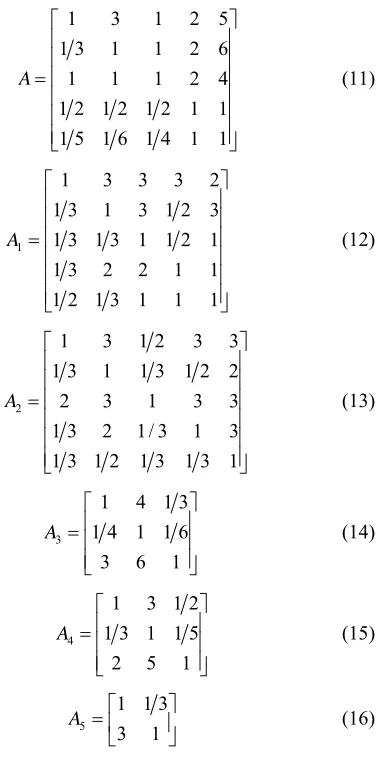
six enterprise executives and six experts of government environmental protection department, the judgment ma-trix of the first class indexes and the second class ones are shown as (11)-(16). A is the judgment matrix of the
first class index B, B
B B B B B1, 2, 3, 4, 5
, and Ai (i = 1,2,···, 5) is the judg = (Bi1, Bi2,···, Bim).
ment matrix of Bi, Bi
1 3 1 2 5
1 3 1 1 2 6
1 1 1 2 4
1 2 1 2 1 2 1 1 1 5 1 6 1 4 1 1
A (11) 1
1 3 3 3 2
1 3 1 3 1 2 3
1 3 1 3 1 1 2 1
1 3 2 2 1 1
1 2 1 3 1 1 1
A (12) 2
1 3 1 2 3 3
1 3 1 1 3 1 2 2
2 3 1 3 3
1 3 2 1/ 3 1 3
1 3 1 2 1 3 1 3 1
A (13) 3
1 4 1 3
1 4 1 1 6
3 6 1
A (14) 4
1 3 1 2
1 3 1 1 5
2 5 1
A (15) 5
1 1 3 3 1
A
[image:4.595.351.542.360.749.2]Table 2. The a e ponsibility indexes of WISCO.
Second class indexes code Actual value code Unit Actual value
ctual value of social r s
B11 X11 Kilogram/ten thousand yuan RMB 2.3573
B12 X12 Kilogram/ten thousand yuan RMB
ton/ten thous yuan RMB 7.
ton/ten thous yuan RMB
1
c
0.1164
B13 X13 ton/ten thousand yuan RMB 0.7304
B14 X14 ton/ten thousand yuan RMB 2.3275
B15 X15 % 5.3
B21 X21 % 10.08
B22 X22 and 5792
B23 X23 and 1.61
B24 X24 % 22.67
B25 X25 % 97
B31 X31 % 14.37
B32 X32 % 7.97
B33 X33 % 8.88
B41 X41 lass 102
B42 X42 % 20.2
B43 X43 % 0.5
B51 X51 % 19.86
B52 X52 % 0.47
Table 3. The evaluation standard value of se nd indexes.
Evaluation level co
Second class indexes code U
dium Poor Very poor nit and standard value code
Excellence Good Me
B11 Kilogram/ten thousand yuan RMB, V11 <2.0 2.0 - 2.5 2.5 - 3 3 - 3.5 >3.5
B12 Kilogr V12 0 0.
ton/ten thou B, V22
ton/ten thou B, V23 0 1. 1.
1 1
C
B52 %, V52 3 2 - 3 1 - 2 0.5 - 1 >0.5
am/ten thousand yuan RMB, <0.1 .1 - 0.2 0.2 - 0.3 3 - 0.4 >0.4
B13 ton/ten thousand yuan RMB, V13 <0.3 0.3 - 0.5 0.5 - 0.7 0.7 - 0.9 >0.9
B14 ton/ten thousand yuan RMB, V14 <0.5 0.5 - 1.0 1.0 - 1.5 1.5 - 2 >2.0
B15 %, V15 >5 4 - 5 3 - 4 2 - 3 <2.0
B21 %, V21 >10 8 - 10 6 - 8 4 - 6 <4.0
B22 sand yuan RM <5 5 - 7 7 - 9 9 - 11 >11
B23 sand yuan RM <0.5 .5 - 1.0 0 - 1.5 5 - 2.0 >2.0
B24 %, V24 >20 5 - 20 0 - 15 5 - 10 <5.0
B25 %, V25 >80 60 - 80 40 - 60 20 - 40 <20
B31 %, V31 >30 20 - 30 10 - 20 5 - 10 <5.0
B32 %, V32 >20 15 - 20 10 - 15 5 - 10 <5.0
B33 %, V33 >20 15 - 20 10 - 15 5 - 10 <5.0
B41 lass, V41 >50 40 - 50 30 - 40 20 - 30 <20
B42 %, V42 >20 15 - 20 10 - 15 5 - 10 <5.0
B43 %, V43 <0.3 0.3 - 0.4 0.4 - 0.5 0.5 - 0.6 >0.6
[image:5.595.56.540.422.738.2]The wei he first class indexes and the second class ones are obtained by modified
process, wh are shown as in (17) and ght sets of
analytic hierarchy (18).
ich
0.3949 0.1929 0.0996 0.1884 0.1243
W W W W W W
1 2 3 4 5
1 11 12 13 14 15
0.3373 0.2254 0.2590 0.1127 0.0656
B B B B B B
W W W W W W
(17)
2 21 22 23 24 25
3 31 32 33
4 41 42 43
5 51 52
0.2843 0.1088 0.3751 0.1558 0.0761 0.2706 0.0852 0.6442 0.3090 0.1095 0.5816 0.2500 0.7500
W W W W W W
W W W W
W W W W
W W W
(18)
4.4. The Results
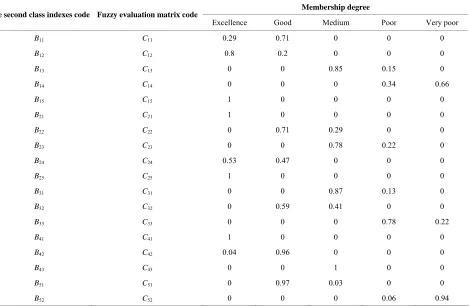
Membership degrees to the second class indexes are cal-
c as s Tab tion of
fi lass in s sho Tabl cordin he
two-step fuzzy uation od.
[image:6.595.70.540.355.661.2]The fu ent o seco ss ind of
Table 4 The membership degree
ulated hown in le 4. And the evalua result
rst c dexes i eval
wn in meth
e 5, ac g to t
1) lfillm f the nd cla exes WISCO
From Table 4, what can be seen that the fulfillment of
the second class indexes of WISCO in 2008 was well. “Total expenditure accounts for the proportion of profits per year”, “Comprehensive energy consumption per ten thousand yuan RMB operating income”, “Recycle rate of industrial wastewater” and “Annual staff and workers’ training classes” are “excellence”. “COD emissions per ten thousand yuan RMB operating income” and “Recycle rate of industrial solid waste” are also very well. The fulfillment of “Wastewater emissions per ten thousand yuan RMB operating income”, “Capital value-retaining and value-increasing rate” and “Donation rate to society” are not good enough.
2) The fulfillment of the first class indexes
It can be seen from Table 5 that the fulfillment of “En-
of the second class indexes. Membership degree The second class indexes code Fuzzy evaluation matrix code
Ex ec llence Good Medium Poor Very poor
B11 C11 0.29 0.71 0 0 0
B12 C12 0.8 0.2 0 0
0. 0.
0 0.
0.
0 0.
0.
0. 0.
0
0 0.
0. 0.
0
B13 C13 0 0 0.85 0.15 0
B14 C14 0 0 0 34 66
B15 C15 1 0 0 0 0
B21 C21 1 0 0 0 0
B22 C22 0 .71 29 0 0
B23 C23 0 0 0.78 22 0
B24 C24 .53 47 0 0 0
B25 C25 1 0 0 0 0
B31 C31 0 0 0.87 0.13 0
B32 C32 0 0.59 41 0 0
B33 C33 0 0 0 78 22
B41 C41 1 0 0 0 0
B42 C42 .04 0.96 0 0 0
B43 C43 0 0 1 0 0
B51 C51 0 .97 03 0 0
B52 C52 0 0 0 06 94
Tabl e evaluation res of the first ass indexes
[image:6.595.64.540.690.736.2]The first class indexes Environmental pr Resources utilization Econo fit an resource Social contribution
e 5. Th ult cl .
otection mic bene Hum
Comprehensive score 0.1478 0.1665 0.2021 0.2186 0.2650
vir n” a exc c benefit” is poor, “Human res ce” is me ont is very poor for
ISCO , according to um membe
sources utilization, economic be hu
5).
EF
[1] Q. Y D. Chen, Responsibi ount- ing Criterion,” Audit & Research No. 2, 2008 . 56-59.
[2] A. Geva, “Thr ocial Responsibili-
y, “The Analytic Hierarchy Process,” McGraw
ensive Evaluation on Econo-
onmental protectio and “Resources utiliz tion” are
ellence, “Economi our-
dium and “Social c in 2008
ribution”
the maxim rship W
degree principle.
In a word, this paper constructed a set of enterprise so- cial responsibility evaluation indexes system based on “Two-oriented society”, which included of environmen-
tal protection, re nefit, [3] X. Li, “Construction of Index System of Enterprise Social Responsibility Performance in Chinese,” Finance and Accounting Monthly, No. 24, 2008, pp. 11-12.
[4] T. L. Saat
man resources and social contribution. And more sec- ond indexes were designed to reflect the characteristics of environmental protection and resources utilization, which can prominent the theme of “Two-oriented soci- ety”. In the part of case analysis, WISCO was taken for example, and two-step fuzzy evaluation method was used to evaluate the social responsibility performance of in 2008.
5. Acknowledgements
This research is supported by NSSF of China (Grant No. 09BJY01
R
ERENCES
ang and “Society lity Acc Economy , Vol. 23, , pp
ee Model of Corporate S
ty: Interrelationships between Theory, Research, and Prac- tice,” Business and Society Review, Vol. 113, No. 1, 2008, pp. 1-41.
Hill Inc., New York, 1980.
[5] J. Xu, “Comprehensive Evaluation of Casting Quality Ba- sed on the Modified Fuzzy Analysis,” Foundry Technolo- gy, Vol. 28, No. 5, 2007, pp. 690-693.
[6] D. Li and P. Li, “Compreh