Characterization of the role of Smu1 in nuclear localization
of splicing factors in the mammalian temperature-sensitive
mutant
Kimihiko Sugaya, Yoshie Ishihara, Keiko Sugaya, Sonoe Inoue
Research Center for Radiation Protection, National Institute of Radiological Sciences, Chiba, Japan Email: [email protected]
Received 16 October 2012; revised 16 November 2012; accepted 24 November 2012
ABSTRACT
A temperature-sensitive (ts) mutant of the CHO-K1 cell line, tsTM18, grows at 34˚C but not at 39˚C.
Smu1 is the gene responsible for ts defects of tsTM18 cells. Previously, we found that the Smu1 ts defect altered the localization (as indicated by enlargement of speckles) of SRSF1 (SF2/ASF) in tsTM18 cells cul- tured at 39˚C, suggesting a functional association between Smu1 and SRSF1. Speckles are subnuclear structures that may function as storage/assembly/ modification compartments to supply splicing factors to active transcription sites. The effect of the ts defect of Smu1 on the localization of other factors related to splicing has not been characterized yet. The mecha- nisms underlying the enlargement of speckles of SRSF1 remain unclear. In the present study, we found that the ts defect of Smu1 affected the nuclear localization of a splicing factor, SRSF2 (SC35), and factors in-volved in the exon-exon junction complex, Y14 and ALY. Reverse transcription-polymerase chain reac- tion (RT-PCR) analysis revealed that the ts defect of Smu1 affected alternative splicing of endogenous Clk1/
Sty and SRSF2 genes. Mammalian Clk family kinases are shown to phosphorylate serine/arginine (SR) pro- teins in vitro and SRSF1 in vivo. RT-PCR analysis of
Clk1/Sty showed an accumulation of the truncated form lacking kinase activity in tsTM18 cells incu- bated at 39˚C. These data indicate that an accumula- tion of kinase-negative Clk1/Sty may lead to altera- tion of the localization of factors related to splicing resulting in the enlargement of speckles.
Keywords:Alternative Splicing; Phosphorylation; Speckle; Splicing; Temperature-Sensitive Mutation
1. INTRODUCTION
Splice site selection in higher eukaryotes is determined by multiple factors involving cis-acting regulatory ele-
ments and their binding proteins. Serine/arginine-rich (SR) splicing factors, which also have characteristic RNA- binding domains, are necessary for an early step in the spliceosome assembly and can influence the selection of alternative splice sites [1-3]. SR proteins often bind to exonic splicing enhancers, whereas heterogeneous nu- clear ribonucleoproteins typically bind to exonic splicing silencers. During splicing, factors required for translation, quality control, and export are recruited to the mRNA. These proteins are deposited on 20 - 24 nucleotides up- stream of the mRNA exon-exon junction and are referred to as the exon-exon junction complex (EJC) [4,5].
“Speckles” are subnuclear structures that are visual- ized by immunofluorescence microscopy, typically using antibodies raised against factors essential for splicing [6]. Usually 25 - 50 speckles, which range in size from one to several micrometers in diameter, are observed per inter- phase mammalian nucleus. It is suggested that speckles are dynamic structures and may function as storage/as- sembly/modification compartments to supply splicing factors to active transcription sites. When transcription or pre-mRNA splicing is inhibited, splicing factors accu- mulate predominantly in enlarged, rounded speckles [6].
speckles by the ts defect of Smu1 was independent of the activity of transcription [9]. We also revealed that incu- bation at 39˚C resulted in a significant decrease in Smu1 in tsTM18 cells [9]. Judging from our previous results, Smu1 may function in the proper localization of SRSF1 at the sites of mRNA processing. However, the mecha- nisms underlying the enlargement of speckles of SRSF1 remain unclear. In the present study, we found that the accumulation of transcript that encodes kinase-negative form of Clk1. We also identified the altered localization in a Smu1-dependent manner of proteins involved in mRNA processing, SRSF2, ALY, and Y14.
2. MATERIALS AND METHODS
2.1. Cells
The Chinese hamster cell line, CHO-K1, and its ts-mu- tant cell, tsTM18, were grown in Ham’s F-12 medium (Sigma-Aldrich, St. Louis, MO, USA) containing 10% fetal calf serum, 2 mM L-glutamine, and antibiotics (Gi- bco/Invitrogen, Carlsbad, CA, USA).
2.2. Indirect Immunolabeling and Microscopy
Procedures for the indirect immunolabeling and micros- copy of immunolabeled cells have been described previ- ously [13]. Primary antibodies used in this study were mouse anti-SRSF2 (clone SC35; 1:500 immunofluores- cence [IF]; PharMingen/BD, San Diego, CA, USA), anti- ALY (clone 11G5; 1:200 IF; Santa Cruz Biotechnology, Santa Cruz, CA, USA), and anti-Y14 (clone 4C4; 1:200 IF; Santa Cruz Biotechnology). The size and number of fluorescently labeled speckles per nucleus was deter-mined with ImageJ 1.42q (http://rsb.info.nih.gov/ij/;
http://www.macbiophotonics.ca/imagej/). This analysis was performed by applying a threshold intensity limit to produce binary images that could be measured and counted.
2.3. RT-PCR
Procedures for RT-PCR have been described previously [14]. RT-PCR of the hamster Clk1/Sty, SRSF2, Bcl-X, and
CD44 genes was carried out with the following primer pairs: Clk1/Sty,
5’-GCATAGTAGCAAGTCCTCTG-3’and 5’-TACTGCTACACGTCTACCTC-3’; SRSF2, 5’-CAAGTCTCCAGAAGAAGAGG-3’and 5’-GCATTACTCAACTGCTACAC-3’; Bcl-X, 5’-ATGTCTCAGAGCAACCGGGA-3’ and 5’-TCACTTCCGACTGAAGAGTG-3’; CD44, 5’-CTATTGTCAACCGTGATGGTAC-3’ and 5’-GCCAGGAGAGATGCCAAGATG-3’. Band intensities were measured with ImageJ 1.34S (http://rsbweb.nih.gov/ij/docs/menus/analyze.html).
3. RESULTS
3.1. Temperature-Sensitive Defect of Smu1 Alters the Nuclear Localization of Splicing Factors
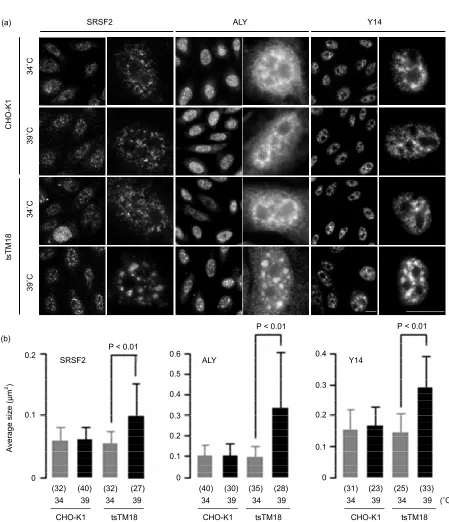
The effect of the ts defect of Smu1 on the localization of other factors related to splicing has not been character- ized yet. We examined the localization of proteins related to splicing with antibodies raised against them. SRSF2 (SC35) is involved in pre-mRNA splicing and is found in speckles [15]. “Splicing speckles” are major nuclear do- mains rich in components of the splicing machinery [6]. We found enlarged signals of anti-SRSF2 in the tsTM18 cells at 39˚C (Figure 1(a)). However, changes in speck- les containing SRSF2 caused by incubation at 39˚C ap- peared to be less significant than those in speckles con- taining SRSF1. According to our previous study [9], the average size of enlarged speckles of SRSF1 was larger than 0.3 µm2, but that of SRSF2 was approximately 0.1 µm2 (Figure 1(b)).
We also obtained similar results to those of anti- SRSF1 with two other antibodies raised against compo- nents of the EJC, anti-ALY and anti-Y14 (Figure 1(a)). Studies addressing the structure of the EJC/RNA com- plex suggest that Y14 and ALY are involved in the EJC as a component of a stable tetrameric inner core and as one of the outer shell proteins, respectively [16-18]. In both CHO-K1 and tsTM18 cells grown at 34˚C, anti-Y14 yielded many small bright foci in discrete nucleoplasmic sites but few in the nucleoli or the cytoplasm. At the same temperature, anti-ALY yielded more diffuse nu- clear staining than did anti-Y14 and some diffuse stain- ing in the cytoplasm (Figure 1(a)). In tsTM18 cells, in- cubation at 39˚C resulted in the greater accumulation of ALY or Y-14 than at 34˚C, and both antibodies showed obviously enlarged nuclear speckles after 8 hours of in- cubation. Growth at 39˚C also induced more cytoplasmic labeling of ALY (Figure 1(a)).
3.2. Temperature-Sensitive Defect of Smu1 Affects Alternative Splicing
SRSF2 ALY Y14
3
9
˚
C
34
˚
C
3
9
˚
C
3
4
˚
C
t
sT
M
18
C
H
O
-K
1
(a)
A
ve
rage
si
ze
(
μ
m
2 )
(32) (40) (32) (27) (40) (30) (35) (28) (31) (23) (25) (33)
34 39 34 39 34 39 34 39 34 39 34 39 (˚C)
CHO-K1 tsTM18 CHO-K1 tsTM18 CHO-K1 tsTM18
0.2
0.1
0
0.6
0.5
0.4
0.3
0.2
0.1
0
0.4
0.3
0.2
0.1
0 P < 0.01
SRSF2 ALY Y14
P < 0.01
P < 0.01 (b)
[image:3.595.69.518.68.590.2]
Figure 1. Temperature-sensitive (ts) defect of Smu1 alters the nuclear localization of SRSF2, ALY, and Y14. (a) Wild-type CHO-K1 or ts mutant tsTM18 cells were grown at 34˚C or incubated at 39˚C for 8 hours and fixed. Next, SRSF2, ALY, and Y14 were indirectly immunolabeled with Alexa 568. Scale bar, 10 m. Higher magnification views are shown right of each low-power image. The distributions of splicing factors in wild-type and mutant cells are similar at 34˚C, but growth at 39˚C induced some larger nuclear bodies in mutant cells. (b) Quantitative analyses of speckles for SRSF2, ALY, and Y14. Pixel size of speckles in the equatorial section of each nucleus, such as those shown in the images (a), were analyzed and repre-sented as the average size with standard deviation in each nucleus. P values were calculated by Student’s t-test. Numbers of nuclei measured are shown in parentheses. Under- and overestimates are included in the results of ALY because cells con-tained significant labeling in cytoplasm. In mutant cells, incubation at 39˚C resulted in accumulation of SRSF2, ALY, and Y14.
because alteration of the splicing patterns of these genes has been reported [24,25]. Reverse transcription-poly-
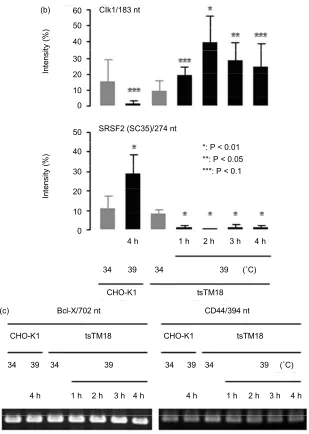
Clk1/Sty and SRSF2 genes during the culture at 39˚C but no change in the splicing profiles of the Bcl-X and CD44 genes (Figure 2).
Mouse Clk1/Sty isoforms are translated from two al- ternatively spliced transcripts encoding either a full- length catalytically active protein, 274 nucleotide (nt), Clk1/Sty or a truncated protein lacking the catalytic do- main, 183 nt, Clk1/StyT [19]. In CHO-K1 cells, PCR product corresponding to the short form corresponding with Clk1/StyT was observed in addition to the long form corresponding with Clk1/Sty, showing good con- servation of gene structure (Figure 2(a)). It is reported that Clk1/Sty regulates splicing of its own pre-mRNA according to its kinase activity; increased expression of the catalytically active Clk1/Sty influences splicing to generate the splicing variant that lacks exon 2 and thus encodes the kinase-negative Clk1/StyT [19]. We assessed the effect of the ts defect of Smu1 on the kinase activity- mediated exon skipping of Clk1/Sty pre-mRNA by RT- PCR. Incubation at 39˚C induced exon skipping and in- creased the levels of the truncated form (183 nt) in ts- TM18 cells, as shown in Figure 2(b).
A subtle change of the SRSF2 splicing profile was also observed (Figure 2(b)). In CHO-K1 cells, PCR pro- ducts corresponding to the long-form (668 nt) and the short-form (274 and 170 nt) transcripts for SRSF2 were detected. Incubation at 39˚C increased the band intensity of the 274 nt in CHO-K1 cells and decreased that of the
274 nt in tsTM18 cells. Variation of splicing isoforms of SRSF2 detected by RT-PCR corresponds to the alteration of the 3’ untranslated region, which is responsible for SRSF2 mRNA destabilization [26]. We have not ob- tained any results showing significant changes in the amount of SRSF2 protein in tsTM18 cells cultured at 39˚C. Further analysis is needed to clarify the physio- logical role of alternative splicing of SRSF2 with the ts defect of Smu1 in tsTM18 cells at 39˚C.
4. DISCUSSION
We found altered localization in a Smu1-dependent man- ner of proteins involved in mRNA processing, SRSF2, ALY, and Y14 (Figure 1). These proteins appeared as enlarged speckles in tsTM18 cells at the nonpermissive temperature, although morphological and quantitative changes in the speckles appeared to be less significant in comparison with those of SRSF1 [9]. The involvement of two EJC proteins, ALY and Y14, in the altered localiza- tion may be consistent with a role of mRNA surveillance. The EJC is a multi-protein complex that is involved in mRNA export, cytoplasmic localization, and nonsense- mediated mRNA decay. Recently, in vivo analysis with different fluorescence fluctuation microscopy techniques revealed that ALY and Y14 showed a reduction in their nuclear mobility when they complexed with RNA and interacted with nuclear speckles [27]. Our immunofluo- rescence analysis of ALY and Y14 may suggest that ac-
1.35 1.08 0.87 0.60
0.31 0.28 0.27 0.23 0.19 0.12 0.07
CIk1/Sty
CIk1 SRSF2 (SC35)
CHO-K1 tsTM18 CHO-K1 tsTM18
34 39 34 39 34 39 34 39 (˚C)
4 h 1 h 2 h 3 h 4 h 4 h 1 h 2 h 3 h 4 h
(Kb) (a)
668 nt 274 nt 170 nt 274 nt
In
te
ns
ity
(
%
)
I
nt
en
si
ty
(
%
)
CIk1/183 nt
SRSF2 (SC35)/274 nt
*: P < 0.01 **: P < 0.05 ***: P < 0.1
4 h 1 h 2 h 3 h 4 h
CHO-K1 tsTM18
34 39 34 39 (˚C)
60
50
40
30
20
10
0
50
40
30
20
10
0 (b)
(c) Bcl-X/702 nt CD44/394 nt
CHO-K1 tsTM18 CHO-K1 tsTM18
34 39 34 39 34 39 34 39 (˚C)
[image:5.595.142.451.80.514.2]4 h 1 h 2 h 3 h 4 h 4 h 1 h 2 h 3 h 4 h
cumulation of immature pre-mRNA led to the formation of enlarged speckles with proteins involved in the EJC because an accumulation of splice variants caused by alternative splicing and intron retention was found in tsTM18 cells at 39˚C [14]. However, we have no clear evidence showing a relation between EJC proteins and immature mRNA. The effect of ts defects of Smu1 on the localization of other EJC constituents is not still clear. It is also possible that the loss of nonsense-mediated mRNA decay may cause the accumulation of splicing variants in tsTM18 cells at the nonpermissive temperature. Thus, further analysis is needed to clarify the properties of EJC proteins in tsTM18 cells at 39˚C.
For SRSF2, the relation between its phosphorylation state and the change in speckles is considerable. The antibody used in this study recognizes a phosphorylated epitope within the SR domain of SRSF2 [15]. The phos- phorylation of SR proteins affects their protein-protein and protein-RNA interaction [28], intracellular localiza- tion and trafficking [29-33], and protein stability [23]. Mammalian Clk family kinases are demonstrated to phos- phorylate SR proteins in vitro and SRSF1 in vivo. RT- PCR analysis of Clk1/Sty showed an accumulation of the truncated form lacking kinase activity in tsTM18 cells incubated at 39˚C (Figure 2), suggesting that the mecha- nism of enlargement of speckles may be mediated by the phosphorylation of SR proteins. In addition, because phos- phorylation is required for their recruitment from speckle to transcription site [30], the accumulation of kinase- negative Clk1/StyT may be expected to lead to pro- nounced changes in alternative splicing. This is consis- tent with our finding of a ts defect in splicing of the
unc52/perlecan [14], Clk1/Sty, and SRSF2 genes (Fig-
ure 2). Judging from our findings, in which ts defects of Smu1 in splicing were found in only several genes in tsTM18 cells, ts defects of Smu1 appeared to be re- stricted in splicing regulated by a few splicing factors. We conclude that ts defects of Smu1 gives rise to an ac- cumulation of kinase-negative Clk1/Sty and may lead to alteration of the localization of factors related to splicing resulting in the enlargement of speckles. However, we have no clear evidence showing reduced kinase activity of Clk1/Sty in tsTM18 cells at 39˚C. Thus, further analy- sis is needed to clarify altered phosphorylation of SR proteins in a Smu1-dependent manner.
5. ACKNOWLEDGEMENTS
This work was supported by a Grant-in-Aid from the Ministry of Edu-cation, Culture, Sport, Science and Technology of Japan (No. 235 70012).
REFERENCES
[1] Fu, X.D. (1995) The superfamily of arginine/serine-rich
splicing factors. RNA, 1, 663-680.
[2] Manley, J.L. and Tacke, R. (1996) SR proteins and splic- ing control. Genes and Development, 10, 1569-1579.
doi:10.1101/gad.10.13.1569
[3] Graveley, B.R. (2000) Sorting out the complexity of SR protein functions. RNA, 6, 1197-1211.
doi:10.1017/S1355838200000960
[4] Le Hir, H., Izaurralde, E., Maquat, L.E. and Moore, M.J. (2000) The spliceosome deposits multiple proteins 20-24 nucleotides upstream of mRNA exon-exon junctions. EMBO Journal, 19, 6860-6869.
doi:10.1093/emboj/19.24.6860
[5] Le Hir, H., Moore, M.J. and Maquat, L.E. (2000) Pre- mRNA splicing alters mRNP composition: Evidence for stable association of proteins at exon-exon junctions. Ge- nes and Development, 14, 1098-1108.
doi:10.1101/gad.14.9.1098
[6] Lamond, A.I. and Spector, D.L. (2003) Nuclear speckles: A model for nuclear organelles. Nature Reviews Molecu- lar Cell Biology, 4, 605-612. doi:10.1038/nrm1172 [7] Tsuji, H., Matsudo, Y., Tsuji, S., Hanaoka, F., Hyodo, M.
and Hori, T. (1990) Isolation of temperature-sensitive CHO-K1 cell mutants exhibiting chromosomal instability and reduced DNA synthesis at nonpermissive tempera- ture. Somatic Cell and Molecular Genetics, 16, 461-476.
doi:10.1007/BF01233196
[8] Sugaya, K., Hongo, E. and Tsuji, H. (2005) A tempera- ture-sensitive mutation in the WD repeat-containing pro- tein Smu1 is related to maintenance of chromosome in- tegrity. Experimental Cell Research, 306, 242-251.
doi:10.1016/j.yexcr.2005.02.017
[9] Sugaya, K., Ishihara, Y. and Sugaya, K. (2011) Enlarge- ment of speckles of SF2/ASF due to loss of function of Smu1 is characterized in the mammalian temperature- sensitive mutant. RNA Biology, 8, 488-495.
doi:10.4161/rna.8.3.14656
[10] Ge, H. and Manley, J.L. (1990) A protein factor, ASF, controls cell-specific alternative splicing of SV40 early pre-mRNA in vitro. Cell, 62, 25-34.
doi:10.1016/0092-8674(90)90236-8
[11] Krainer, A.R., Conway, G.C. and Kozak, D. (1990) The essential pre-mRNA splicing factor SF2 influences 5’ splice site selection by activating proximal sites. Cell, 62, 35-42. doi:10.1016/0092-8674(90)90237-9
[12] Li, X. and Manley, J.L. (2005) Inactivation of the SR pro- tein splicing factor ASF/SF2 results in genomic instabil- ity. Cell, 122, 365-378. doi:10.1016/j.cell.2005.06.008 [13] Hongo, E., Ishihara, Y., Sugaya, K. and Sugaya, K. (2008)
Characterization of cells expressing RNA polymerase II tagged with green fluorescent protein: Effect of ionizing irradiation on RNA synthesis. International Journal of Radiation Biology, 84, 778-787.
doi:10.1080/09553000802345936
malian spliceosome assembly is localized to discrete re- gions in the nucleus. Nature, 343, 437-441.
doi:10.1038/343437a0
[16] Ballut, L., Marchadier, B., Baguet, A., Tomasetto, C., Seraphin, B. and Le Hir, H. (2005) The exon junction core complex is locked onto RNA by inhibition of eIF4- AIII ATPase activity. Nature Structural & Molecular Bi- ology, 12, 861-869. doi:10.1038/nsmb990
[17] Tange, T.O., Shibuya, T., Jurica, M.S. and Moore, M.J. (2005) Biochemical analysis of the EJC reveals two new factors and a stable tetrameric protein core. RNA, 11, 1869-1883. doi:10.1261/rna.2155905
[18] Le Hir, H. and Andersen, G.R. (2008) Structural insights into the exon junction complex. Current Opinion in Structural Biology, 18, 112-119.
doi:10.1016/j.sbi.2007.11.002
[19] Duncan, P.I., Stojdl, D.F., Marius, R.M. and Bell, J.C. (1997) In Vivo regulation of alternative pre-mRNA splic- ing by the Clk1 protein kinase. Molecular and Cellular Biology, 17, 5996-6001.
[20] Colwill, K., Pawson, T., Andrews, B., Prasad, J., Manley, J.L., Bell, J.C. and Duncan, P.I. (1996) The Clk/Sty pro- tein kinase phosphorylates SR splicing factors and reg- ulates their intranuclear distribution. EMBO Journal, 15, 265-275.
[21] Nayler, O., Stamm, S. and Ullrich, A. (1997) Characteri- zation and comparison of four serine- and arginine-rich (SR) protein kinases. Biochemical Journal, 326, 693-700. [22] Caceres, J.F., Screaton, G.R. and Krainer, A.R. (1998) A
specific subset of SR proteins shuttles continuously be- tween the nucleus and the cytoplasm. Genes and Devel- opment, 12, 55-66. doi:10.1101/gad.12.1.55
[23] Lai, M.C., Lin, R.I. and Tarn, W.Y. (2003) Differential effects of hyperphosphorylation on splicing factor SRp55. Biochemical Journal, 371, 937-945.
doi:10.1042/BJ20021827
[24] Pilch, B., Allemand, E., Facompre, M., Bailly, C., Riou, J.F., Soret, J. and Tazi, J. (2001) Specific Inhibition of Serine- and Arginine-rich Splicing Factors Phosphoryla- tion, Spliceosome Assembly, and Splicing by the Antit- umor Drug NB-506. Cancer Research, 61, 6876-6884. [25] Soret, J., Gabut, M., Dupon, C., Kohlhagen, G., Stevenin,
J., Pommier, Y. and Tazi, J. (2003) Altered Serine/Ar- ginine-Rich Protein Phosphorylation and Exonic Enhan-cer-Dependent Splicing in Mammalian Cells Lacking To- poisomerase I. Cancer Research, 63, 8203-8211. [26] Sureau, A., Gattoni, R., Dooghe, Y., Stevenin, J. and So-
ret, J. (2001) SC35 autoregulates its expression by pro- moting splicing events that destabilize its mRNAs. EMBO Journal, 20, 1785-1796.
doi:10.1093/emboj/20.7.1785
[27] Schmidt, U., Im, K.B., Benzing, C., Janjetovic, S., Rippe, K., Lichter, P. and Wachsmuth, M. (2009) Assembly and mobility of exon-exon junction complexes in living cells. RNA, 15, 862-876. doi:10.1261/rna.1387009
[28] Xiao, S.H. and Manley, J.L. (1997) Phosphorylation of the ASF/SF2 RS domain affects both protein-protein and protein-RNA interactions and is necessary for splicing. Genes and Development, 11, 334-344.
doi:10.1101/gad.11.3.334
[29] Caceres, J.F., Misteli, T., Screaton, G.R., Spector, D.L. and Krainer, A.R. (1997) Role of the modular domains of SR proteins in subnuclear localization and alternative splicing specificity. Journal of Cell Biology, 138, 225- 238. doi:10.1083/jcb.138.2.225
[30] Misteli, T., Cáceres, J.F., Clement, J.Q., Krainer, A.R., Wilkinson, M.F. and Spector, D.L. (1998) Serine phos- phorylation of SR proteins is required for their recruit- ment to sites of transcription in vivo. Journal of Cell Biology, 143, 297-307. doi:10.1083/jcb.143.2.297 [31] Lai, M.C., Lin, R.I., Huang, S.Y., Tsai, C.W. and Tarn,
W.Y. (2000) A human importin-β family protein, trans- portin-SR2, interacts with the phosphorylated RS domain of SR proteins. Journal of Biological Chemistry, 275, 7950-7957. doi:10.1074/jbc.275.11.7950
[32] Lai, M.C., Lin, R.I. and Tarn, W.Y. (2001) Transportin- SR2 mediates nuclear import of phosphorylated SR pro- teins. Proceedings of the National Academy of Sciences of the United States of America, 98, 10154-10159.
doi:10.1073/pnas.181354098