Automatic Named Entity Pre-Annotation
for Out-of-Domain Human Annotation
Sophie Rossetα, Cyril Grouinα, Thomas Lavergneα,β, Mohamed Ben Jannetα,β,γ,δ J´er´emy Leixa, Olivier Galibertγ, Pierre Zweigenbaumα.
αLIMSI–CNRS βUniversit´e Paris-Sud γLNE
δLPP, Universit´e Sorbonne Nouvelle ELDA
{rosset,grouin,lavergne,ben-jannet,pz}@limsi.fr
[email protected], [email protected]
Abstract
Automatic pre-annotation is often used to improve human annotation speed and
ac-curacy. We address here out-of-domain
named entity annotation, and examine whether automatic pre-annotation is still beneficial in this setting. Our study de-sign includes two different corpora, three pre-annotation schemes linked to two notation levels, both expert and novice an-notators, a questionnaire-based subjective assessment and a corpus-based
quantita-tive assessment. We observe that
pre-annotation helps in all cases, both for speed and for accuracy, and that the sub-jective assessment of the annotators does not always match the actual benefits mea-sured in the annotation outcome.
1 Introduction
Human corpus annotation is a difficult, time-consuming, and hence costly process. This mo-tivates research into methods which reduce this cost (Leech, 1997). One such method consists of automatically pre-annotating the corpus (Marcus et al., 1993; Dandapat et al., 2009) using an ex-isting system, e.g., a POS tagger, syntactic parser, named entity recognizer, according to the task for which the annotations aim to provide a gold stan-dard. The pre-annotations are then corrected by the human annotators. The underlying hypothe-sis is that this should reduce annotation time while possibly at the same time increasing annotation completeness and consistency.
We study here corpus pre-annotation in a
spe-cific setting, out-of-domain named entity
annota-tion, in which we examine specific questions that
we present below. We produced corpora and an-notation guidelines for named entities which are both hierarchical and compositional (Grouin et al.,
2011),1 and which we used in contrastive
stud-ies of news texts in French (Rosset et al., 2012). We want to rely on the same named entity def-initions for studies on two types of data we did
not cover: parliament debates (Europarl corpus)
and regional, contemporary written news (L’Est
R´epublicain), both in French. To help the annota-tion process we could reuse our system (Dinarelli and Rosset, 2011), but needed first to examine whether a system trained on one type of text (our first Broadcast News data) could be used to pro-duce a useful pre-annotation for different types of text (our two corpora).
We therefore set up the present study in which we aim to answer the following questions linked to this point and to related annotation issues:
• can a system trained on data from one
spe-cific domain be useful on data from another domain in a pre-annotation task?
• does this pre-annotation help human
annota-tors or bias them?
• what importance can we give to the
annota-tors’ subjective assessment of the usefulness of the pre-annotation?
• can we observe differences in the use of
pre-annotation depending on the level of exper-tise of human annotators?
Moreover, as the aforementioned annotation
scheme is based on two annotation levels (entities
andcomponents), we want to answer these ques-tions taking into account these two levels.
We first examine related work on pre-annotation (Section 2), then present our corpora and annota-tion task (Secannota-tion 3). We describe and discuss ex-periments in Section 4, and make subjective and
1Corpora, guidelines and tools are available through
ELRA under references ELRA-S0349 and ELRA-W0073.
quantitative observations in Sections 5 and 6. Fi-nally, we conclude and present some perspectives in Section 7.
2 Related Work
Facilitating human annotations has been the topic
of a large amount of research. Two different
approaches can be distinguished: active learn-ing (Rlearn-ingger et al., 2007; Settles et al., 2008) and pre-annotation (Marcus et al., 1993; Dandapat et al., 2009). Our work falls into the latter type.
Pre-annotation can be used in several ways. The first is to provide annotations to be corrected by human annotators (Fort and Sagot, 2010). A vari-ant consists of merging multiple automatic anno-tations before having them corrected by human curators to produce a gold-standard (Rebholz-Schuhmann et al., 2011). The second type con-sists of providing clues to help human annotators perform the annotation task (Mihaila et al., 2013). This work addresses the first type, a single-system pre-annotation with human correction. An objective is to examine whether a system trained on one type of text can be useful to pre-annotate texts of a different type. Most previous studies have been performed on well-behaved tasks such as part-of-speech tagging on in-domain data, i.e., the model used for pre-annotating the target data had been trained on similar data. For instance, Fort and Sagot (2010) provide a precise evaluation of the usefulness of pre-annotation and compare the impact of different quality levels in POS taggers on the Penn TreeBank corpus. They first trained different models on the training part of the cor-pus and applied them to the test corcor-pus. The pre-annotated test corpus was then corrected by hu-mans. They reported gains in accuracy and inter-annotator agreement. The study focused on the minimal quality (accuracy threshold) of automatic annotation that would prove useful for human an-notation. They reported a gain for human annota-tion when accuracy ranged from 66.5% to 81.6%. On the contrary, for a semantic-frame annotation task, Rehbein et al. (2009) observed no significant gain in quality and speed of annotation even when using a state-of-the-art system.
Generally speaking, annotators find the pre-annotation stage useful (Rehbein et al., 2009; South et al., 2011; Huang et al., 2011). Anno-tation managers consider that a bias may occur depending on how much human annotators trust
the pre-annotation (Rehbein et al., 2009; Fort and Sagot, 2010; South et al., 2011). In their frame-semantic argument structure annotation, Rehbein et al. (2009) addressed a specific question consid-ering a two-level annotation scheme: is the pre-annotation of frame assignment (low-level anno-tation) useful for annotating semantic roles (high-level annotation)? Although for the low-(high-level an-notation task they observed a significant difference in quality of final annotation, for the high-level task they found no difference.
Most of these studies used a pre-annotation sys-tem trained on the same kind of data as those which were to be annotated manually. Neverthe-less some system-oriented studies have focused on the results obtained by systems trained on one type of corpus and applied to another type of corpus, e.g., for a Latin POS tagger (Poudat and Longr´ee, 2009; Skjærholt, 2011) or for a CoNLL named en-tity tagger for German (Faruqui and Pad´o, 2010) for which the authors noticed noticed a reduc-tion of the F-measure when going from in-domain (newswire data, F=0.782 for their best system) to out-of-domain (Europarl data, F=0.656).
One of our objectives is then to examine whether a system trained on one type of text can be useful to pre-annotate texts of a different type. We set up experiments to study precisely the pos-sible induced bias and whether the level of experi-ence of the annotators would make a differexperi-ence in such a context. In this study, we used two different kinds of corpora, which were both different from the corpus used to train the pre-annotation system.
3 Task and corpus description
3.1 Task
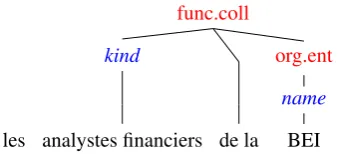
In this work, we used the structured named entity definition we proposed in a previous study (Grouin et al., 2011): entities are both hierarchical (types have subtypes) and compositional (types and com-ponents are included in entities) as in Figure 1.
func.coll
org.ent
name
BEI de la
kind
[image:2.595.331.502.638.715.2]analystes financiers les
Figure 1: Multi-level annotation of entity
sub-types (red tags) and components (blue tags): the
This taxonomy of entity types is composed of
7 types (person, location, organization, amount,
time, production and function) and 32 sub-types
(individual person pers.ind vs. group of persons
pers.coll; administrative organizationorg.admvs.
servicesorg.ent; etc.). Types and subtypes
consti-tute the first level of annotation.
Within these categories, components are
second-level elements (kind, name, first.name,
etc.), and can never be used outside the scope of a type or subtype element.
3.2 Corpora
Two French corpora were sampled from larger ones:
Europarl: Prepared speech (Parliament
Debates—Europarl): 15,306 word extract;
Press: Local, contemporary written news (L’Est
R´epublicain): 11,146 word extract.
These corpora were automatically annotated us-ing the system described in (Dinarelli and Rosset, 2011). This system relies on a Conditional Ran-dom Field (CRF) model for the detection of com-ponents and on a probabilistic context-free gram-mar (PCFG) model for types and sub-types. These models have been trained on Broadcast News data. This system achieved a Slot Error Rate (Makhoul et al., 1999) of 37.0% on Broadcast conversation and 29.7% on Broadcast news, and ranked first in the Quaero evaluation campaign (Galibert et al., 2011).
4 Experiments
In this section we present the protocol we designed to study the usefulness of pre-annotation under different conditions, and its overall results.
4.1 Protocol
We defined the following protocol, similar to the one used in Rehbein et al. (2009).
Corpora. Four versions of our two corpora were
prepared: (i) raw text, (ii) pre-annotation of
types, (iii) pre-annotation of components, and
(iv)full pre-annotation of both types and
compo-nents. Each of these four versions was split into four quarters.
Annotators. Eight human annotators were
in-volved in this task. Among them, four are con-sidered as expert annotators (they annotated cor-pora in the previous years) while the four re-maining ones are novice annotators (this was the first time they annotated such corpora; they were given training sessions before starting actual anno-tation). We defined four pairs of annotators, where each pair was composed of an expert and a novice annotator.
Quarter allocation. We allocated each corpus
quarter in such a way that each pair of annotators processed, in each corpus, material from each one of the four pre-annotated versions (see Table 3). The same allocation was made in both corpora.
4.2 Results
For each corpus part, a reference was built based on a majority vote by confronting all annotations. The resulting reference corpus is presented in Ta-ble 1.
Corpus # comp. # types # entities # words
Press
Q1 481 310 791 3047
Q2 367 246 673 2628
Q3 495 327 822 2971
Q4 413 282 695 2600
Europarl
Q1 362 259 621 3926
Q2 309 221 530 3809
Q3 378 247 625 3604
Q4 413 299 712 3967
Table 1: General description of the reference an-notations: number of components, types, entities (the sum of components and types), and words
Table 2 presents the performance of the au-tomatic pre-annotation system against the refer-ence corpus. We used the well known F-measure and in addition the Slot Error Rate as it allows to weight different error classes (deletions,
inser-tions, type or frontier errors). Fort and Sagot
(2010) reported a gain in human annotation when pre-annotation accuracy ranged from 66.5% to 81.6%. Given their results we can hope for a gain in both accuracy and annotation time when using pre-annotation.
Corpus # Raw text Components Types Full
R P F R P F R P F R P F
Press
Q1 0.874 0.777 0.823 0.876 0.741 0.803 0.824 0.8700.846 0.852 0.800 0.825
0.810 0.766 0.788 0.815 0.777 0.796 0.645 0.724 0.683 0.844 0.7850.813
Q2 0.765 0.796 0.780 0.870 0.773 0.819 0.822 0.801 0.812 0.917 0.7730.839
0.558 0.654 0.602 0.826 0.7750.800 0.815 0.777 0.795 0.816 0.752 0.783
Q3 0.835 0.715 0.771 0.888 0.809 0.847 0.884 0.796 0.837 0.887 0.8590.873
0.792 0.689 0.736 0.904 0.7800.837 0.876 0.771 0.820 0.780 0.827 0.803
Q4 0.802 0.757 0.779 0.845 0.876 0.860 0.900 0.702 0.789 0.914 0.8400.876
0.794 0.727 0.759 0.696 0.715 0.705 0.812 0.701 0.752 0.802 0.7570.779
Europarl
Q1 0.809 0.728 0.766 0.800 0.568 0.665 0.776 0.8620.817 0.754 0.720 0.736
0.754 0.7200.736 0.720 0.609 0.660 0.687 0.607 0.644 0.736 0.638 0.683
Q2 0.776 0.7920.784 0.782 0.617 0.690 0.797 0.645 0.713 0.821 0.526 0.641
0.563 0.498 0.529 0.802 0.6190.699 0.698 0.553 0.617 0.769 0.566 0.652
Q3 0.747 0.459 0.569 0.749 0.624 0.681 0.805 0.8000.803 0.735 0.744 0.739
0.732 0.598 0.658 0.736 0.717 0.726 0.822 0.7380.777 0.808 0.734 0.769
Q4 0.742 0.624 0.678 0.874 0.7600.813 0.732 0.480 0.580 0.743 0.608 0.669
[image:4.595.79.521.62.314.2]0.721 0.566 0.634 0.695 0.6520.672 0.707 0.600 0.649 0.738 0.603 0.664
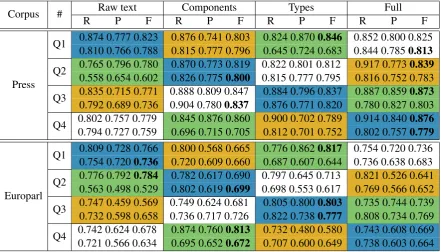
Table 3: Overall recall, precision and F-measure for each pair of annotators(blue: pair #1, ocre: pair
#2, green: pair #3, white: pair #4)on each corpus quarter(Q1, Q2, Q3, Q4), depending on the kind of
pre-annotation(raw text, only components, only types, full pre-annotation). Expert annotator is on the
upper line of each quarter, novice annotator is on the lower line. Boldface indicates the best F-measure for each novice and expert annotator among all pre-annotation tasks in a given corpus quarter
Corpus Components Types Full
F SER F SER F SER
Press
Q1 72.4 37.9 63.5 46.3 68.9 41.0
Q2 77.2 32.2 66.8 43.5 73.1 36.6
Q3 76.1 34.1 68.3 41.7 73.1 36.9
Q4 76.1 33.3 63.3 45.7 71.0 38.2
Europarl
Q1 61.9 49.9 57.5 55.4 60.1 52.2
Q2 61.2 51.3 54.6 54.3 58.5 52.5
Q3 61.6 50.1 53.3 55.7 58.2 52.2
Q4 57.1 57.0 48.1 59.7 53.3 58.1
Broad. 88.3 29.1 73.1 39.1 73.2 33.1
Table 2: F-measure and Slot Error Rate achieved by the automatic system on each kind of annota-tion and on in-domain broadcast data
We also computed inter-annotator agreement (IAA) for each corpus considering two groups of
annotators,expertsandnovices. We consider that
the inter-annotator agreement is somewhere be-tween the F-measure and the standard IAA
con-sidering asmarkablesall the units annotated by at
least one of the annotators (Grouin et al., 2011). We computed Scott’s Pi (Scott, 1955), and Co-hen’s Kappa (Cohen, 1960). The former considers
one model for all annotators while the latter con-siders one model per annotator. In our case, these two values are almost the same, which means that the proportions and kinds of annotations are very similar across experts and novices. Figure 2 shows the IAA (Cohen’s Kappa and F-measure) obtained on the two corpora given the four pre-annotation conditions (no pre-annotation, components, types, and full pre-annotation). As we can see, IAA is
systematically higher for the Press corpus than
for the Europarl corpus, which can be linked
to the higher performance of the automatic pre-annotation system on this corpus. We also can see that pre-annotation always improves agreement and that full pre-annotation yields the best result. We observe that, as expected, pre-annotation leads human annotators to obtain higher consistency.
5 Subjective assessment
An important piece of information in any anno-tation campaign is the feelings of the annotators
about the task. This can give interesting clues
[image:4.595.74.290.407.564.2]0.5 0.6 0.7 0.8 0.9 1
raw comp types full Press: Cohen's kappa
[image:5.595.81.284.64.192.2]Press: F-measure Europarl: Cohen's kappa Europarl: F-measure
Figure 2: Cohen’s Kappa (red and blue) and F-measure (green and pink) measuring agreement of experts and novices on Press and Europarl corpora in four pre-annotation conditions. Each measure compares the concatenated annotations of the four experts with the four novices.
manual, or how they assessed the benefits of pre-annotation in the different corpora (Section 5.1). Another important point is the experience of the annotators, which we also examine in the light of theirs answers to the questionnaire (Section 5.2).
5.1 Questionnaire
The questionnaire submitted to the annotators con-tained 4 questions, dealing with their feedback on the annotation process:
1. According to you, which level of pre-annotation has been the most helpful during the annotation process? Types, components, or both?
2. To what extent would you say that pre-annotation helped you in terms of precision and speed? Did it produce many errors you had to correct?
3. If you had to choose between the Europarl corpus and the Press corpus, could you say that one has been easier to annotate than the other?
4. Concerning the annotation manual, are there topics that you would like to change, or cor-rect? In the same way, which named entities caused you the most difficulties to deal with?
All 8 annotators answered these questions. We summarize below what we found in their answers.
5.1.1 Level of pre-annotation
Most of the annotators preferred the corpora that were pre-annotated with types only. The reason, for the most part, is that a pre-annotation of types allows the annotator to work faster on their files, because guessing the components from the types
is easier than guessing types from components.2
Indeed, the different types of entities defined in the manual always imply the same components, be they specific (to one entity type) or transverse (common to several entity types). On the contrary, a transverse component, such as<kind>, can be part of any type of named entity. The other rea-son for this choice of pre-annotation concerns the readability brought to the corpora. An annotation with types only is easier to read than an annotation with components, and less exhausting after many hours of work on the texts.
5.1.2 Gain in precision and speed
What motivated the answers to the second ques-tion mainly concerns the accuracy of the different annotation methods. While all of them sented errors that needed to be corrected, the annotation of types was the one that they felt pre-sented the smaller number of errors. Thus, annota-tors spent less time reviewing the corpora in search of errors, compared to the other pre-annotated cor-pora (with components, and with both types and components), where more errors had to be spot-ted and correcspot-ted. This search for incorrect pre-annotations impacted the time spent on each cor-pus. Indeed, most annotators declared that pre-annotation with types was quicker to deal with than other pre-annotation schemes.
5.1.3 Corpus differences
About one half of the annotators agreed that the Europarl corpus had been more difficult to anno-tate. Despite obvious differences in register, sen-tence structure and vocabulary between the two corpora, Europarl seemed more redundant and complex than the other corpus. For instance, one of the annotators declared:
The Europarl corpus is more difficult to annotate in the sense that the exist-ing types and components do not al-ways match the realities found in the corpus, either because their definitions
2This feeling is supported by results about ambiguity
cannot apply exactly, or because the re-quired types and components are miss-ing (mainly for frequencies: “five times per year”).
The other half of the annotators did not feel any specific difficulties in annotating one corpus or the other. According to them, both corpora are the same in terms of register and sentence structure.
5.1.4 Improvements in guidelines
All of the annotators were unanimous in think-ing that two points need to be modified in the manual. First of all, the distinction between the
<org.adm>and<org.ent>subtypes is too diffi-cult to apprehend, above all in the Europarl corpus where these entities are too ambiguous to be anno-tated correctly. Secondly, the distinction between the<pers>and<func>types has also been diffi-cult to deal with. The other remarks about poten-tial changes mainly concerned the introduction of explicit rules for frequencies, which are recurrent in the Europarl corpus.
5.2 Experience
As mentioned earlier in Section 4.1, we will now see if the differences in experience between an-notators impacted their difficulty in annotating the corpora. First of all, when we look at the answers given to question 3, we notice that both novice and expert annotators consider the Europarl corpus the most difficult to annotate. Most of their answers deal with the redundancy and the formal register of the data. Moreover, as everyone answered in question 4, both<func>and<org>entities have to be modified to be easier to understand and to use. This unanimous opinion about what needs to be reviewed in the manual allows us to think that the annotators’ level of experience has a low impact on their apprehension of the corpora, both
EuroparlandPress. To confirm this, we can look at the answers given to questions 1 and 2, as indi-cated in the previous paragraph. As has been ex-plained, every annotator correctly pointed at the many errors found in pre-annotation, regardless of their experience. Besides, the assessment of the benefits of pre-annotation is the same for al-most everyone, regardless of their experience too: both novice and expert annotators agree that pre-annotation with type adds efficiency and speed to annotation.
To conclude, according to our observations based on the questionnaire, we cannot assert that
there has been a difference between novice and ex-pert annotators. Both groups agreed on the same difficulties, pointed at the same errors, and crit-icized the same entities, saying that their defini-tions needed to be clarified.
6 Quantitative observations
In this section we provide results of quantitative observations in order to support, or not, the anno-tators’ subjective assessment.
6.1 Corpus statistics
The annotators reported different feelings depend-ing on the corpora. Some of them reported that the Europarl corpus was more difficult to annotate, with more complex sentence structures, or usage of fewer proper nouns.
To explore these differences, we computed some statistics over the two original, un-annotated corpora (which are much larger than the samples annotated in this experiment) as well as over the original broadcast news corpus used to train the pre-annotation system. Each of these corpora con-tains several million words.
Table 4 reports simple statistics about sentences in the three corpora. Based on these statistics,
while theEuroparl(Euro) corpus is very similar to
the originalBroadcast News(BN), thePress
cor-pus shows differences: sentences are 20% shorter, with fewer but larger chunks, confirming the im-pression of simpler, less convoluted sentences.
BN Press Euro
Mean sentence length 30.2 23.9 29.7
Mean chunk count 10.9 6.7 10.4
Mean chunk length 2.7 3.6 2.8
Table 4: Sentence summary of the three corpora
Looking more closely at the contents of these sentences, Figure 3 summarizes the proportions of grammatical word classes. The sentiment of
ex-tensive naming of entities in the Press corpus is
confirmed by the four times higher rate of proper nouns. On the other hand, entities are more often referred to using nouns with an optional adjective
in theEuroparlcorpus, leading to a more frequent
Figure 3: Frequency of word classes in the three corpora (BN = Broadcast News, Est = Press, Euro
= Europarl). TOOL= grammatical words,PCT/NB
= punctuation and numbers,ADJ/ADV= adjectives
and adverbs, NAM = proper name, NOM = noun,
VER= verb.
6.2 Influence of pre-annotation on the
behaviour of annotators
As already mentioned, it is often reported that a bias may occur depending on human confidence in the pre-annotation (Fort and Sagot, 2010; Re-hbein et al., 2009; South et al., 2011). An im-portant unknown is always the influence of pre-annotation on the behaviour of annotators, and at which point pre-annotation induces more errors than it helps. This may obviously depend on pre-annotation quality. Table 5 summarizes the er-ror rates of the automatic annotator in the
stud-ied data (Press+Europarl) and in comparison to
in-domain data. Insertions (Ins) are extra
anno-tations, deletions (Del) missing annotations, and
substitutions(Subs) are annotations that are incor-rect in type, boundaries, or both. We can see that
Domain Pre-annotation Ins Del Subs
Components 4.4% 33.6% 7.8%
Out Types 7.0% 36.2% 12.7%
Full 5.5% 34.6% 9.7%
In Full 3.7% 23.4% 10.6%
Table 5: Pre-annotation errors and comparison with in-domain (Broadcast News) data
going out-of-domain increased deletions, proba-bly through a lack of knowledge of domain vo-cabulary. But it did not influence the other error rates significantly. It is also noticeable that dele-tion is the type of error most produced by the
sys-tem, with every third entity missed. Automatic,
full pre-annotation ofPress+ Europarl obtains a
precision of 0.79 and a recall of 0.56.
Human annotator performance can then be mea-sured over the same three error types (Table 6). We
Pre-annotation Ins Del Subs
Raw 8.9% 18.9% 12.8%
Components 5.9% 16.7% 11.3%
Types 7.1% 16.5% 12.0%
Full 7.1% 16.5% 10.1%
Table 6: Mean human annotation error levels for each pre-annotation scheme
can see that annotation quality was systematically improved by pre-annotation, with the best global result obtained by full pre-annotation. In addition there was no increase in deletions (had the human stopped looking at the unannotated text) or inser-tions (had the human always trusted the system) as might have been feared. This may be a side effect of the high deletion rate, making it obvious to the human that the system was missing things. In any case, the annotation was clearly beneficial in our experiment with no ill effects seen in error rates compared to the gold standard.
6.3 Is pre-annotation useful and to whom?
All annotators asserted that pre-annotation is use-ful, specifically with types. In this section, we pro-vide observations concerning variations in annota-tion both in terms of accuracy (F-measure is used) and duration.
Raw Comp. Types Full
Experts 0.748 0.786 0.778 0.791
[image:7.595.318.517.142.213.2]Novices 0.682 0.737 0.721 0.742
Table 7: Mean F-measure of experts and novices, for each pre-annotation scheme
Raw Comp. Types Full
Experts 109.0 52.5 64.0 39.13
Novices 151.7 135.5 117.9 103.88
Table 8: Mean duration (in minutes) of annotation for experts and novices, for each pre-annotation scheme (two corpus quarters)
[image:7.595.74.287.574.648.2]faster and to be more efficient. All pre-annotation levels (components, types and both) seem to be
helpful for both experts and novices. Experts
reached a higher accuracy (F=0.791) and they were more than twice faster with components or full pre-annotation. Similarly, novices performed better when working on a full pre-annotation (F=0.742) and reached a faster working time (48mn less than with no pre-annotation). This last observation contradicts the annotators’ reported experience: the annotators felt more comfortable and faster with a types-only pre-annotation than with full pre-annotation (see Section 5.1.2). The results show that full pre-annotation was the best choice for both quality and speed.
These results confirm that pre-annotation is use-ful, even with a moderate level of performance of the system. Does it help to annotate components and types equally? To answer this question, we computed the F-measure of novices and experts for both components and types separately (see Fig-ure 4).
60 65 70 75 80 85 90
raw comp types full
[image:8.595.80.285.376.503.2]types/novices components/novices types/experts components/experts
Figure 4: Mean F-measure on each pre-annotation level for expert and novice annotators
For experts we can see that all pre-annotation levels allow them to improve their performance on both types and components. However for novices, pre-annotation with types does not improve their performance in labeling components. We also no-tice that pre-annotation in both types and compo-nents allows experts and novices to reach their best performance for both types and components.
7 Conclusion and Perspectives
Conclusion. In this paper, we studied the
inter-est of a pre-annotation process for a complex an-notation task with only an out-of-domain annota-tion system available. We also designed our exper-iments to check whether the level of experience of
the annotators made a difference in such a context. The experiment produced in the end a high-quality gold standard (8-way merge including 2 versions without pre-annotation) which enabled us to mea-sure quantitatively the performance of every pre-annotation scheme.
We noticed that the pre-annotation system proved relatively precise for such a complex task, with 79% correct pre-annotations, but with a poor recall at 56%. This may be a good operating point for a pre-annotation system to reduce bias though.
In our quantitative experiments we found that the fullest pre-annotation helped most, both in terms of quality and annotation speed, even though the quality of the pre-annotation system varied de-pending on the annotation layer. This contradicted the feelings of the annotators who thought that a type-only pre-annotation was the most efficient. This shows that in such a setting self-evaluation cannot be trusted. On the other hand their remarks about the problems in the annotation guide itself seemed rather pertinent.
When it comes to experts vs. novices, we noted that their behaviour and remarks were essentially
identical. Experts were both better and faster
at annotating, but had similar reactions to pre-annotation and essentially the same feelings.
In conclusion, even with an out-of-domain sys-tem, a pre-annotation step proves extremely useful in both annotation speed and annotation quality, and at least in our setting, with a reasonably pre-cise system (at the expense of recall) no bias was detectable. In addition, no matter what the anno-tators feel, as long as precision is good enough, the more pre-annotations the better. Pre-filtering either of our two levels did not help.
Perspectives. Based upon this conclusion, we
plan to use automatic pre-annotation in further an-notation work, beginning with the present corpora. As a first use, we plan to propose a few changes to the annotation principles in the guidelines we
used. To annotate existing corpora with these
changes, automatic pre-annotation will be useful.
Acknowledgments
This work has been partially funded by OSEO un-der the Quaero program and by the French ANR VERA project.
References
Jacob Cohen. 1960. A coefficient of agreement for nominal scales. Educational and Psychological Measurement, 20(1):37–46.
Sandipan Dandapat, Priyanka Biswas, Monojit Choud-hury, and Kalika Bali. 2009. Complex linguistic an-notation – no easy way out! A case from Bangla and Hindi POS labeling tasks. InProc of 3rd Linguistic Annotation Workshop (LAW-III), pages 10–18, Sun-tec, Singapore, August. ACL.
Marco Dinarelli and Sophie Rosset. 2011. Models cascade for tree-structured named entity detection. InProc of IJCNLP, pages 1269–1278, Chiang Mai, Thailand.
Manaal Faruqui and Sebastian Pad´o. 2010. Training and evaluating a German named entity recognizer with semantic generalization. In Proc of Konvens, Saarbr¨ucken, Germany.
Kar¨en Fort and Benoˆıt Sagot. 2010. Influence of pre-annotation on POS-tagged corpus development. In
Proc of 4th Linguistic Annotation Workshop (LAW-IV), pages 56–63, Uppsala, Sweden. ACL.
Kar¨en Fort, Adeline Nazarenko, and Sophie Rosset. 2012. Modeling the complexity of manual anno-tation tasks: a grid of analysis. InProceedings of COLING 2012, pages 895–910, Mumbai, India, De-cember. The COLING 2012 Organizing Committee.
Olivier Galibert, Sophie Rosset, Cyril Grouin, Pierre Zweigenbaum, and Ludovic Quintard. 2011. Struc-tured and extended named entity evaluation in au-tomatic speech transcriptions. InProc of IJCNLP, Chiang Mai, Thailand.
Cyril Grouin, Sophie Rosset, Pierre Zweigenbaum, Kar¨en Fort, Olivier Galibert, and Ludovic Quin-tard. 2011. Proposal for an extension of tradi-tional named entities: From guidelines to evalua-tion, an overview. InProc of 5th Linguistic Anno-tation Workshop (LAW-V), pages 92–100, Portland, OR. ACL.
Minlie Huang, Aur´elie N´ev´eol, and Zhiyong Lu. 2011. Recommending MeSH terms for annotating biomedical articles. Journal of the American Medi-cal Informatics Association, 18(5):660–7.
Geoffrey Leech. 1997. Introducing corpus annota-tion. In Roger Garside, Geoffrey Leech, and Tony McEnery, editors,Corpus annotation: Linguistic in-formation from computer text corpora, pages 1–18. Longman, London.
John Makhoul, Francis Kubala, Richard Schwartz, and Ralph Weischedel. 1999. Performance measures for information extraction. In Proc. of DARPA Broad-cast News Workshop, pages 249–252.
Mitchell P Marcus, Mary Ann Marcinkiewicz, and Beatrice Santorini. 1993. Building a large anno-tated corpus of English: the Penn TreeBank. Com-putational Linguistics, 19(2):313–330.
Claudiu Mihaila, Tomoko Ohta, Sampo Pyysalo, and Sophia Ananiadou. 2013. Biocause: Annotating and analysing causality in the biomedical domain.
BMC Bioinformatics, 14:2.
C´eline Poudat and Doninique Longr´ee. 2009. Vari-ations langagi`eres et annotation morphosyntaxique du latin classique. Traitement Automatique des Langues, 50(2):129–148.
Dietrich Rebholz-Schuhmann, Antonio Jimeno, Chen Li, Senay Kafkas, Ian Lewin, Ning Kang, Peter Cor-bett, David Milward, Ekaterina Buyko, Elena Beiss-wanger, Kerstin Hornbostel, Alexandre Kouznetsov, Ren´e Witte, Jonas B Laurila, Christopher JO Baker, Cheng-Ju Kuo, Simone Clematide, Fabio Rinaldi, Rich´ard Farkas, Gy¨orgy M´ora, Kazuo Hara, Laura I Furlong, Michael Rautschka, Mariana Lara Neves, Alberto Pascual-Montano, Qi Wei, Nigel Collier, Md Faisal Mahbub Chowdhury, Alberto Lavelli, Rafael Berlanga, Roser Morante, Vincent Van Asch, Walter Daelemans, Jos´e L Marina, Erik van Mulli-gen, Jan Kors, and Udo Hahn. 2011. Assessment of NER solutions against the first and second CALBC silver standard corpus.J Biomed Semantics, 2.
Ines Rehbein, Josef Ruppenhofer, and Caroline Sporleder. 2009. Assessing the benefits of partial automatic pre-labeling for frame-semantic annota-tion. InProc of 3rd Linguistic Annotation Workshop (LAW-III), pages 19–26, Suntec, Singapore. ACL.
Eric Ringger, Peter McClanahan, Robbie Haertel, George Busby, Marc Carmen, James Carroll, Kevin Seppi, and Deryle Lonsdale. 2007. Active learning for part-of-speech tagging: Accelerating corpus an-notation. InProc of Linguistic Annotation Workshop (LAW), pages 101–108. ACL.
Sophie Rosset, Cyril Grouin, Kar¨en Fort, Olivier Gal-ibert, Juliette Kahn, and Pierre Zweigenbaum. 2012. Structured named entities in two distinct press cor-pora: Contemporary broadcast news and old news-papers. InProc of 6th Linguistic Annotation Work-shop (LAW-VI), pages 40–48, Jeju, South Korea. ACL.
William A Scott. 1955. Reliability of content analysis: The case of nominal scale coding. Public Opinion Quaterly, 19(3):321–325.
Arne Skjærholt. 2011. More, faster: Accelerated cor-pus annotation with statistical taggers. Journal for Language Technology and Computational Linguis-tics, 26(2):151–163.