Hyper-parameter Optimisation of Gaussian Process Reinforcement
Learning for Statistical Dialogue Management
Lu Chen1, Pei-Hao Su2 and Milica Gaˇsi´c2∗
1Key Lab. of Shanghai Education Commission for Intelligent Interaction and Cognitive Eng. SpeechLab, Department of Computer Science and Engineering
Shanghai Jiao Tong University, Shanghai, China
2Department of Engineering, University of Cambridge, Cambridge, UK
[email protected], [email protected], [email protected]
Abstract
Gaussian processes reinforcement learn-ing provides an appeallearn-ing framework for training the dialogue policy as it takes into account correlations of the objec-tive function given different dialogue be-lief states, which can significantly speed up the learning. These correlations are modelled by the kernel function which may depend onhyper-parameters. So far, for real-world dialogue systems the hyper-parameters have been hand-tuned, relying on the designer to adjust the correlations, or simple non-parametrised kernel func-tions have been used instead. Here, we ex-amine different kernel structures and show that it is possible to optimise the hyper-parameters from data yielding improved performance of the resulting dialogue pol-icy. We confirm this in a real user trial. 1 Introduction
Spoken dialogue systems enable human-computer interaction via speech. The dialogue management component has two aims: to maintain the dialogue
statebased on the current spoken language under-standing input and the conversation history, and choose a response according to its dialogue pol-icy. To provide robustness to the input errors, a number of statistical approaches are proposed to track a distribution over all dialogue states at ev-ery dialogue turn, called thebelief state(Young et al., 2013; Thomson and Young, 2010; Williams et al., 2013; Henderson et al., 2014; Sun et al., 2014). The system response is then based on the belief state, rather than an inaccurate estimate of the most likely dialogue state.
∗
Lu Chen was supported by the NICaiA project (the EU FP7 No. 247619). Pei-Hao Su is supported by Cambridge Trust and the Ministry of Education, Taiwan.
The state-of-art statistical methods for policy learning are based on reinforcement learning (RL) (Young et al., 2013), which makes it possible to learn from interaction with the users. How-ever, most RL methods take too many dialogues for policy training. In Gaussian process rein-forcement learning (GPRL) thekernel function de-fines prior correlations of the objective function given different belief states, which can signifi-cantly speeds up the policy optimisation (Gaˇsi´c and Young, 2014). Alternative methods include Kalman temporal difference (KTD) reinforcement learning (Pietquin et al., 2011). Typically, statis-tical approaches to dialogue management rely on the belief state space compression into a form of a
summary space, where the policy learning can be tractably performed (Williams and Young, 2007; Pinault et al., 2009; Thomson and Young, 2010; Crook and Lemon, 2011). GPRL allows the learn-ing to be performed directly on the full belief state. However, only non-parametrised kernel functions have been considered for this purpose (Gaˇsi´c and Young, 2014).
Here we address the important problem of how to define the structure of the kernel function for a real-world dialogue task and learn the hyper-parameters from data for a policy that operates on the full belief state. Using only a small-size dataset for hyper-parameter optimisation, we show that the policy with the optimised kernel function outperforms both the policy with hand specified kernel parameters and the one with a standard non-parametrised kernel function. This is particularly beneficial for policy training with real users.
This paper is organised as follows. In sec-tion 2, we briefly review GP-Sarsa and the hyper-parameter optimisation. Section 3 introduces the kernel functions examined here. The experimental results are shown in section 4, followed by conclu-sions and future work directions in section 5.
2 GP-Sarsa and hyper-parameter optimisation
The expected cumulative reward given belief state
band actionais defined by theQ-function as:
Qπ(b, a) =Eπ
( T ∑
τ=t+1
γτ−t−1r
τ|bt=b, at=a
) ,
where rτ is the immediate reward at τ-th dia-logue turn,T is the number of dialogue turns and
γ ∈[0,1]is a discount factor. GP-Sarsa is an on-line RL algorithm that models the Q-function as a Gaussian process (Engel et al., 2005). It makes the learning tractable by utilising the kernel span spar-cification algorithm and constructing a set of rep-resentative belief state and action called the dictio-nary. The computational complexity of GP-Sarsa isO(T m2)wherem is the size of the dictionary andT is the number of turns of all interactions.
In the case of Gaussian process regression, the kernel function parameters can be estimated by ev-idence maximisationin such a way that they cap-ture the correlations that occur in the data (Ras-mussen and Williams, 2005). This approach has been extended for the case of GP-Sarsa, however its benefits have so far only been shown for a toy dialogue problem (Gaˇsi´c et al., 2010).
Using a data corpus of belief state-action pairs and rewards, the hyper-parameters can be found by minimising the negative log marginal likeli-hood via a conjugate gradient method (Rasmussen and Nickisch, 2010) to find the optimal hyper-parameters. The computational complexity of the gradient calculation is O(nT3), where n is the number of hyper-parameters and T is the total number of dialogue turns in the corpus (see ap-pendix A).
3 Kernel functions
In Gaussian process regression, the kernel func-tion k(·,·) must be positive definite (Rasmussen and Williams, 2005). The kernel functions have some interesting properties (Duvenaud et al., 2013). Ifk1andk2are kernels,
• k1 +k2 is kernel. Adding two kernels can be thought of as an OR-like operation, as the resulting kernel will have high value if either of the two base kernels have a high value.
• k1·k2 is kernel. Multiplying two kernels can be thought of as an AND-like operation, as
the function value is only expected to be sim-ilar to some other function value if both ker-nels have a high value.
3.1 Standard kernel functions
There are many valid kernel functions (Rasmussen and Williams, 2005). The following three ones are the basic kernels used in our experiments.
• Gaussian kernel: k(xi,xj) =
p2exp(−||xi−xj||22
2l2 ), where p and l are
the hyper-parameters. If the distance be-tweenxiandxj is more than the lengthscale
l, the outputs are uncorrelated. The output variancep2 determines the average distance of the function from its mean.
• Linear kernel:k(xi,xj) =⟨xi,xj⟩
• δ-kernel: k(xi,xj) = δ(xi,xj), where the function values are correlated if and only if the inputs are the same.
3.2 Kernels for dialogue management
The kernel for two belief-action pairs is normally decomposed as the product of separate kernels over belief states and actions,kB(·,·)andkA(·,·). The elements of the dialogue state areconcepts
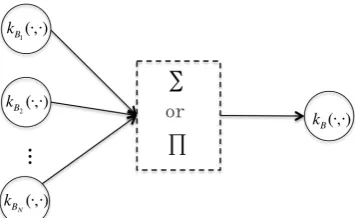
that occur in the dialogue and are described by the underlyingontology. For instance, in a restaurant information domain, these usually include goal-food,goal-area,history-food,history-areaand so on. The belief tracker maintains a probability dis-tribution for each of them. We first define kernel function on each conceptkBi(·,·), then combine them to form the kernel function for the whole be-lief statekB(·,·), as illustrated in Figure 1.
The Gaussian kernel and the linear kernel were used as basic kernel functions for each concept in the belief state. In the case of Gaussian kernels, if they share the same hyper-parameters across dif-ferent concepts, we refer to them asconcept inde-pendent, otherwise, they are calledconcept depen-dent. While the linear kernel is used for problems involving distributions (Jebara et al., 2004), Gaus-sian kernel is a more natural choice here as the
Q-function for belief states is a non-linear smooth function. Additionally, we investigated two inte-gration methods: one is to sum up the kernels for all concepts, thesum kernel; another is to multiply kernels for all concepts, theproduct kernel.
Figure 1: Kernel structure for belief state
4 Experiments and results
The training data for hyper-parameter optimisa-tion was generated using an agenda-based user simulator (Schatzmann et al., 2007). The dialogue policy training and evaluation is performed both on the user simulator and human users. The sys-tem operates on the TopTable dialogue domain which consists of about 150 restaurants in Cam-bridge, UK (TopTable, 2012). Each restaurant has 9 slots, e.g. food, area, phone, address and so on. The state decomposes into 21 concepts. Each concept takes from 4 to 150 values. Each value is given a belief in[0,1]by the BUDS state tracker (Thomson and Young, 2010). The sum-mary action space consists of 20 sumsum-mary actions.
4.1 Experimental procedure
The hyper-parameter are optimised as follows.
1. Training data generation: We used a
ran-dom policy to generate simulated dialogues out of which a small number ofsuccessful di-alogues were used as training data.1
2. Interval estimation: We estimated
appropri-ateintervals for concept independent hyper-parameters according to the properties of Gaussian kernel as described in section 3.1. In our experiments, we only restricted the range of lengthscalel. For the sum Gaussian kernel, the belief state for each concept is a probability distribution, so the lengthscale l
is in interval(0,√2]. For product Gaussian kernel, the product of Gaussian kernels is still a Gaussian kernel, therefore the lengthscale
lshould be less than the maximum distance between two whole belief states (5.29 in the TopTable domain).
1We used 73 dialogues for concept independent and 147
dialogues for concept dependent hyper-parameter optimisa-tion, with respectively 505 and 1004 dialogue turns. We found that the smaller data set was not sufficient to capture correlations for the concept dependent kernels.
Name Kernel Learnt Combine Concept dep.
GHSI Gaussian N Sum N
GLSI Gaussian Y Sum N
GLSD Gaussian Y Sum Y
LS Linear / Sum /
GHPI Gaussian N Prod N
GLPI Gaussian Y Prod N
GLPD Gaussian Y Prod Y
LP Linear / Prod /
Table 1: Summary of kernels
3. Concept independent hyper-parameter
optimisation: We sampled initial concept
independent hyper-parameters from the estimated intervals and then minimised the negative log likelihood to find the concept independent optimised hyper-parameters. We repeated this N times, and the hyper-parameters with the overall smallest negative log likelihood was chosen as the final concept independent hyper-parameters.
4. Concept dependent hyper-parameter
opti-misation: We initialised them as concept
in-dependent hyper-parameters, then minimised the negative log likelihood to get the concept dependent optimised hyper-parameters.
After the hyper-parameters are obtained, we trained and evaluated the policies with these op-timised kernels. For comparison, the policies with hand-tuned Gaussian kernel hyper-parameters and linear kernel were also trained and evaluated.
4.2 The results on the user simulator
During training, intermediate policies were recorded at every 1000 dialogues. Each policy was then evaluated using 1000 dialogues when testing. The reward was calculated as 20for a successful dialogue, deducted for the number of turns.
We compared four different sum and product kernels (Table 1) and the results are given in Fig-ure 2. The results in FigFig-ure 2(a) show that the poli-cies with optimised sum Gaussian kernels perform significantly better than the policy using hand-tuned hyper-parameters (GHSI) and the linear ker-nel (LS). Also, in the later learning stages, the policy with concept dependent kernel (GLSD) ap-pears to have reached a better performance than the one with concept independent kernel (GLSI).
[image:3.595.305.536.62.159.2]bet-(a) Sum kernels.
[image:4.595.86.285.67.322.2](b) Product kernels.
Figure 2: Comparison of policies with two ker-nels. Vertical bars denote standard errors. The average success rates for GHSI and GHPI are re-spectively 91.8% and 92.9% at the end of training.
ter than other kernels at the initial stages of train-ing (Figure 2(b)).2 The best performing product (GLPD) and sum (GLSD) kernel converge to sim-ilar performance, with the product kernel perform-ing better in the early stages of trainperform-ing, at the ex-pense of a larger dictionary.
4.3 Human experiments
In order to further evaluate the effect of the opti-mised kernels, policies were trained using crowd-sourcing via the Amazon Mechanical Turk service in a set-up similar to (Jurˇc´ıˇcek et al., 2011; Su et al., 2015). At the end of each dialogue, a recur-rent neural network (RNN) model was used to pre-dict the dialogue success used as the reinforcement feedback (Su et al., 2015).
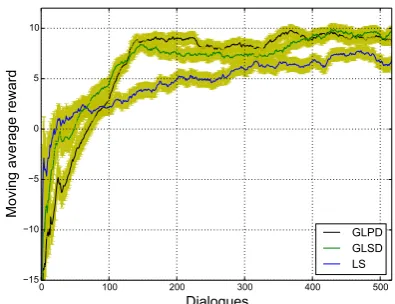
The GLSD kernel and the GLPD kernel were selected for on-line policy training and compared to the LS kernel. Figure 3 shows the learning curve of the reward during training, demonstrating the advantage of Gaussian kernels over the simple lin-ear kernel.
2The result of the product linear kernel (LP) is not
re-ported due to poor performance. In the TopTable domain two belief states forhistoryconcepts are typically very different, so the linear kernel for these concepts is often close to 0. This results in a very small overall kernel value that leads to slow convergence.
To confirm this result, all optimised policies were evaluated after 500 training dialogues. The results are given in Table 2. It can be seen that the policies with optimised kernels, especially the GLPD kernel, perform much better than the policy with linear kernel.3
0 100 200 300 400 500
Dialogues
15 10 5 0 5 10
Moving average reward
[image:4.595.315.513.157.309.2]GLPD GLSD LS
Figure 3: Learning curve of reward during on-line policy optimisation. For both plots, the moving average was calculated using a window of 100 di-alogues. Yellow lines are standard errors.
Kernel #Diags Reward Success(%)
LS 347 8.46±0.57 77.2±2.3 GLSD 336 9.56±0.56 79.5±2.2 GLPD 423 10.52±0.47 82.3±1.9
Table 2: Evaluation of policies with three kernels.
5 Conclusions and Future work
This paper has investigated the problem of ker-nel structure and hyper-parameter optimisation of Gaussian process reinforcement learning for sta-tistical dialogue management. We have demon-strated that the optimised kernels yield signifi-cant improvements in the policy performance both when training with a simulated user and real users. The work in this paper has focused on optimis-ing the kernel function for the belief state space off-line. The future work will consider joint op-timisation of the hyper-parameters and the policy. This will rely on finding a less computationally ex-pensive method for hyper-parameter optimisation, also allowing more complex actions kernels to be investigated.
3In (Gaˇsi´c and Young, 2014), summary space-based
[image:4.595.309.529.392.450.2]References
Paul A Crook and Oliver Lemon. 2011. Lossless value directed compression of complex user goal states
for statistical spoken dialogue systems. In
INTER-SPEECH, pages 1029–1032.
David Duvenaud, James Robert Lloyd, Roger Grosse, Joshua B. Tenenbaum, and Zoubin Ghahramani. 2013. Structure discovery in nonparametric
regres-sion through compositional kernel search. In
Pro-ceedings of the 30th International Conference on Machine Learning, pages 1166–1174.
Y Engel, S Mannor, and R Meir. 2005. Reinforcement
learning with Gaussian processes. In ICML ’05:
Proceedings of the 22nd international conference on Machine learning, pages 201–208, New York, NY. Milica Gaˇsi´c and Steve Young. 2014. Gaussian
pro-cesses for pomdp-based dialogue manager
optimiza-tion. IEEE/ACM Transactions on Audio, Speech,
and Language Processing, 22(1):28–40.
M Gaˇsi´c, F Jurˇc´ıˇcek, S Keizer, F Mairesse, J Schatz-mann, B Thomson, K Yu, and S Young. 2010. Gaussian processes for fast policy optimisation of
pomdp-based dialogue managers. InProceedings of
SIGDIAL.
Matthew Henderson, Blaise Thomson, and Steve Young. 2014. Word-based dialog state tracking
with recurrent neural networks. InProceedings of
15th Annual Meeting of the Special Interest Group on Discourse and Dialogue.
T Jebara, R Kondor, and A Howard. 2004. Probability
product kernels. J. Mach. Learn. Res., 5:819–844,
December.
Filip Jurˇc´ıˇcek, Simon Keizer, Milica Gaˇsi´c, Franois Mairesse, Blaise Thomson, Kai Yu, and Steve Young. 2011. Real user evaluation of spoken di-alogue systems using amazon mechanical turk. In
Proceedings of Interspeech, pages 3061–3064. Olivier Pietquin, Matthieu Geist, and Senthilkumar
Chandramohan. 2011. Sample Efficient On-line Learning of Optimal Dialogue Policies with Kalman
Temporal Differences. InIJCAI 2011, pages 1878–
1883, Barcelona, Spain, July.
Florian Pinault, Fabrice Lef`evre, and Renato de Mori. 2009. Feature-based summary space for stochas-tic dialogue modeling with hierarchical semanstochas-tic
frames. InINTERSPEECH.
Carl Edward Rasmussen and Hannes Nickisch. 2010. Gaussian processes for machine learning (gpml)
toolbox. The Journal of Machine Learning
Re-search, 11:3011–3015.
Carl Edward Rasmussen and Christopher K. I.
Williams. 2005. Gaussian processes for machine
learning. MIT Press.
J Schatzmann, B Thomson, K Weilhammer, H Ye, and SJ Young. 2007. Agenda-Based User Simulation
for Bootstrapping a POMDP Dialogue System. In
HLT/NAACL, Rochester, NY.
Pei-Hao Su, David Vandyke, Milica Gaˇsi´c, Dongho Kim, Nikola Mrksic, Tsung-Hsien Wen, and Steve Young. 2015. Learning from real users: Rating di-alogue success with neural networks for
reinforce-ment learning in spoken dialogue systems.
Submit-ted to Interspeech.
Kai Sun, Lu Chen, Su Zhu, and Kai Yu. 2014. A gener-alized rule based tracker for dialogue state tracking. InProceedings of IEEE Spoken Language Technol-ogy Workshop (SLT).
Blaise Thomson and Steve Young. 2010. Bayesian update of dialogue state: A pomdp framework for spoken dialogue systems. Computer Speech & Lan-guage, 24(4):562–588.
TopTable. 2012. Toptable. https://www.
toptable.com.
JD Williams and SJ Young. 2007. Scaling POMDPs
for Spoken Dialog Management. IEEE
Transac-tions on Audio, Speech, and Language Processing, 15(7):2116–2129.
Jason Williams, Antoine Raux, Deepak Ramachan-dran, and Alan Black. 2013. The dialog state
track-ing challenge. InProceedings of the SIGDIAL
Con-ference, pages 404–413.
Steve Young, Milica Gaˇsi´c, Blaise Thomson, and Ja-son D Williams. 2013. Pomdp-based statistical
spo-ken dialog systems: A review. Proceedings of the
IEEE, 101(5):1160–1179.
A Marginal log likelihood for GPRL
Algorithm 1Log likelihood and gradient
Require:
rewards r, belief state-action pairs B, Gram matrix:K(θθθ), ∂
∂θj(K(θθθ) +σ
2I),Θ ={θθθ, σ},
∀i,H[i, i] = 1,H[i, i+ 1] = −γ,H[i, j] = 0, j̸=i, j̸=i+ 1
1: Findαααso thatLLTααα=r
2: L(Θ) = 12rTααα+∑Ti=1Lii+ T2 log 2π 3: FindWso thatLLTW=I
4: For j= 0todim(Θ)−1 do
Dj = ∂
∂θj(K(θθθ) +σ 2I)
∂
∂θjL=− 1
2tr((ααααααT−W)HDjHT)
5: end for