Multilingual Single-Document Summarization with MUSE
Marina Litvak
Department of Software Engineering Shamoon College of Engineering
Beer Sheva, Israel [email protected]
Mark Last
Department of Information Systems Engineering, Ben Gurion University
Beer Sheva, Israel [email protected]
Abstract
MUltilingual Sentence Extractor (MUSE) is aimed at multilingual single-document
summarization. MUSE implements a
supervised language-independent summa-rization approach based on optimization of multiple sentence ranking methods using a Genetic Algorithm. The main advantage of MUSE is its language-independency – it is using statistical sentence features, which can be calculated for sentences in any language.
In our previous work, the performance of MUSE was found to be significantly bet-ter than the best known state-of-the-art extractive summarization approaches and tools in three different languages: English, Hebrew, and Arabic. Moreover, our ex-perimental results in the cross-lingual do-main suggest that MUSE does not need to be retrained on a summarization corpus in each new language, and the same weight-ing model can be used across several lan-guages (Last and Litvak, 2012).
MUSE participated in the MultiLing2013
single document summarization task on
three languages: English, Hebrew and
Arabic. Due to a very limited time that was given to the participants to run their
systems on the MultiLing2013 data, the
results submitted to evaluation were ob-tained by summarizing the documents us-ing models pre-trained on different cor-pora. As such, no training has been
per-formed on the MultiLing2013corpus.
1 MUltilingual Sentence Extractor (MUSE): Overview
1.1 Methodology
MUSE implements a supervised learning ap-proach to language-independent extractive sum-marization where the best set of weights for a lin-ear combination of sentence scoring methods is found by a genetic algorithm trained on a col-lection of documents and their summaries. The weighting vector thus obtained is used for
sen-tence scoring in future summarizations. Since
most sentence scoring methods have a linear com-putational complexity, only the training phase of our approach is time-consuming.
Using MUSE, the user can choose the subset of
totally 31 sentence metrics that will be included
in the linear combination. The available metrics are based on various text representation models and are language-independent since they do not
rely on any language-specific knowledge.
Fig-ure 1 demonstrates the taxonomy of all 31
met-rics. We divided them into three main categories— structure-, vector-, and graph-based—according to their text representation model, where each sub-category contains group of metrics using the same scoring method.
A detailed description of sentence metrics used by MUSE can be found in (Last and Litvak, 2012). The best linear combination of the metrics de-picted in Figure 1 can be found using a Genetic Algorithm (GA). GAs are categorized as global search heuristics. Figure 2 shows a simplified GA flowchart.
A typical genetic algorithm requires (1) a ge-netic representation of the solution domain, (2) a fitness function to evaluate the solution domain, and (3) some basic parameter settings like selec-tion and reproducselec-tion rules.
We represent each solution as a vector of weights for a linear combination of sentence
Multilingual sentence scoring metrics
Structure-based
Vector-based
Graph-based
Position Length Frequency Similarity Degree Pagerank Similarity
Title Document
POS_F POS_L POS_B
LEN_W LEN_CH
LUHN† KEY† COV † TF TFIISF
SVD
TITLE_O TITLE_J TITLE_C
D_COV_O D_COV_J D_COV_C
LUHN_DEG † KEY_DEG † COV_DEG † DEG GRASE
LUHN_PR † KEY_PR † COV_PR † PR ML_TR
Title Document
TITLE_E_O TITLE_E_J
[image:2.595.123.475.64.244.2]D_COV_E_O D_COV_E_J
Figure 1: Taxonomy of language-independent sentence scoring metrics (Litvak et al., 2010b)
Selection Mating Crossover
Mutation
Terminate?
Best gene
yes no Initialization
Mating
Crossover
Mutation
R
e
p
ro
d
u
c
ti
o
n
Figure 2: Simplified flowchart of GA
ing metrics—real-valued numbers in the unlimited range normalized in such a way that they sum up
to1. The vector size is fixed and it equals to the
number of metrics used in the combination. Defined over the genetic representation, the fit-ness function measures the quality of the
rep-resented solution. We can use ROUGE-1 and
ROUGE-2, Recall (Lin and Hovy, 2003) as a
fitness functions for measuring summarization quality—similarity with gold standard summaries, which should be maximized during the train-ing (optimization procedure). We use an anno-tated corpus of summarized documents, where each document is accompanied by several human-generated summaries—abstracts or extracts, as a training set.
The reader is referred to (Litvak et al., 2010b) for a detailed description of the optimization
pro-Algorithm 1 Step 1: Training
Require: Gold Standard - a corpus of summarized
docu-mentsD,Nchosen metrics
Ensure: A weighted modelW - vector of weights for each
ofNmetrics
Step 1.1: ComputeM- sentence-score matrix for alld∈Ddo
LetR1,R2, andR3aredrepresentations
for all sentencess∈ddo
CalculateNmetrics usingR1,R2, andR3
Add metrics row forsintoM
end for end for
Step 1.2: Compute a vectorW of metrics weights
Run a Genetic Algorithm onM, givenD:
Initialize a populationP
repeat
for all solutiong∈Pdo
Generate a summarya
Evaluateaby ROUGE on summaries ofD
end for
Select the best solutionsG
P- a new population generated byG
until convergence - no better solutions are found return a vectorW of weights - output of a GA
cedure implemented by MUSE.
Algorithms 1 and 2 contain the pseudo-code for two independent phases of MUSE: training and summarization, respectively. Assuming efficient implementation, all metrics have a linear compu-tational complexity relative to the total number of
words in a document - O(n). As a result, the
summary extraction time, given a trained model, is also linear (in the number of metrics in a com-bination). The training time is proportional to the number of GA iterations multiplied by the num-ber of individuals in a population times the fitness evaluation (ROUGE) time. On average, in our
[image:2.595.142.221.293.466.2]Algorithm 2 Step 2: Summarizing a new
docu-ment
Require: A document d, maximal summary length L, a
trained weighted modelW
Ensure: A set ofnsentences, which were top-ranked by the algorithm as the most important.
Step 2.1: Compute a score of each sentence
LetR1,R2, andR3aredrepresentations
for all sentenses∈ddo
CalculateNmetrics usingR1,R2, andR3
Calculate a score as a linear combination according to
W
end for
Step 2.2: Compile the document summary
LetS=∅be a summary ofd
repeat
get the top ranked sentencesi
S=SSsi
untilSexceeds max lengthL
return S
selection and reproduction—before reaching con-vergence.
1.2 Architecture
The current version of MUSE tool can be ap-plied only to text documents or textual content of HTML pages. It consists of two main modules: the training module activated in offline, and the real-time summarization module. Both modules utilize two different representations of documents described in (Litvak et al., 2010b): vector- and graph-based. The preprocessing module is respon-sible for constructing each representation, and it is embedded in both modules.
The training module receives as input a corpus of documents, each accompanied by one or several gold-standard summaries—abstracts or extracts— compiled by human assessors. The set of docu-ments may be either monolingual or multilingual and their summaries have to be in the same lan-guage as the original text. The training module applies a genetic algorithm to a document-feature matrix of precomputed sentence scores with the purpose of finding the best linear combination of features using any ROUGE metric as a fitness function. ROUGE-1 Recall is used as a default unless specified otherwise by the end-user. The output/model of the training module is a vector of weights for user-specified sentence ranking fea-tures. In the current version of the tool, the user
can choose from31vector-based and graph-based
features. The recommendation for the best10
fea-tures can be found in (Litvak et al., 2010a). The summarization module performs summa-rization of input text/texts in real time. Each
sen-tence of an input text obtains a relevance score ac-cording to the trained model, and the top ranked sentences are extracted to the summary in their original order. The length of resulting summaries is limited by a user-specified value (maximum number of words, maximum number of sentences or a compression ratio). Being activated in real-time, the summarization module is expected to use the model trained on the same language as in-put texts. However, if such model is not avail-able (no annotated corpus in the text language), the user can choose one of the following options: (1) a model trained on some other language/corpus (in (Litvak et al., 2010b) we show that the same model can be efficiently used across different lan-guages), or (2) user-specified weights for each
sentence feature (from31provided in the system)
in the linear combination.
The preprocessing module performs the follow-ing tasks: (1) sentence segmentation, (2) word segmentation, (3) vector space model construction using tf and/or tf-idf weights, (4) a word-based graph representation construction, (5) a sentence-based graph representation construction, and (6) document metadata construction, including such information like frequency (tf and tf-idf) for each unique term, its location inside the document, etc. The outputs of this submodule are: sentence seg-mented text (SST), vector space model (VSM), the document graphs, and the metadata stored in the xml files. Steps (1) and (2) are performed by the text processor submodule, which consists of three elements: filter, reader and sentence segmenter. The filter works on the Unicode character level and performs such operations like identification of characters, digits, punctuations and normalization (optional for some languages). The reader invokes the filter, constructs word chunks from the input stream and identifies the following states: words, special characters, white spaces, numbers, URL links and punctuation marks. The sentence seg-menter invokes reader and divides the input space into sentences. By implementing different filters, the reader can work either with a specific language (taking into account its intricacies) or with docu-ments written in arbitrary language (in this case, a general filtering according to UTF-8 encoding is performed).
Scoring and Ranking Scoring GA User-specified parameters and settings Summaries Text documents Preprocessing Summarized documents T RA IN IN G S U M M A RI Z A T IO N ROUGE Preprocessing Document Representation Models Document-Feature Scores Matrix Document Representation Models Weighting Model
Figure 3: MUSE architecture
2 Training of MUSE
Since a very limited time was given to partici-pants to run their summarizers on the MultiLing
2013dataset, we did not perform training on a new
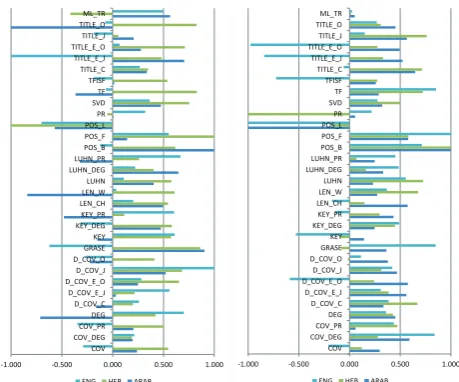
data. The models obtained from training MUSE on monolingual corpora of English, Hebrew, and Arabic texts in 2011 (Last and Litvak, 2012), have been used for summarization in three languages. Both ROUGE-1 and ROUGE-2 have beed used for building the models. In the current settings, ROUGE-1-based models were utilized.
The English text material used in the ex-periments comprised the corpus of summa-rized documents available for the summarization task at the Document Understanding Conference 2002 (DUC, 2002). This benchmark dataset
con-tains533news articles, each accompanied by two
to three human-generated abstracts of
approxi-mately100words each.
For the Arabic language, we used a corpus
com-piled from90news articles. Each article was
sum-marized by three native Arabic speakers select-ing the most important sentences into an extractive
summary of approximately100words each.
For the Hebrew language, we used a corpus
where120news articles of250to830words are
summarized by five human assessors each. The documents from all corpora have a title as the first sentence.
ROUGE-1 and ROUGE-2 metrics (Lin, 2004)
have been used as a fitness function during the training of MUSE. The same metrics have been used for evaluation of generated summaries in
three languages. In order to use the ROUGE
toolkit on Hebrew and Arabic, it was adapted to these languages by specifying the regular expres-sions for a single “word” using Hebrew and Arabic
-1.000 -0.500 0.000 0.500 1.000 COV COV_DEG COV_PR DEG D_COV_C D_COV_E_J D_COV_E_O D_COV_J D_COV_O GRASE KEY KEY_DEG KEY_PR LEN_CH LEN_W LUHN LUHN_DEG LUHN_PR POS_B POS_F POS_L PR SVD TF TFISF TITLE_C TITLE_E_J TITLE_E_O TITLE_J TITLE_O ML_TR
ENG HEB ARAB
-1.000 -0.500 0.000 0.500 1.000 COV COV_DEG COV_PR DEG D_COV_C D_COV_E_J D_COV_E_O D_COV_J D_COV_O GRASE KEY KEY_DEG KEY_PR LEN_CH LEN_W LUHN LUHN_DEG LUHN_PR POS_B POS_F POS_L PR SVD TF TFISF TITLE_C TITLE_E_J TITLE_E_O TITLE_J TITLE_O ML_TR
ENG HEB ARAB
Figure 4: Models trained on monolingual corpora:
ROUGE-1(left) and ROUGE-2(right)
characters.
Figure 4 present models learned by MUSE on different monolingual corpora using ROUGE-1 and ROUGE-2, respectively. The actual results in the trained models include some negative values.
The evaluation results of MUSE on three
monolingual corpora using 10-fold cross
valida-tion showed its significant superiority over Tex-tRank (Mihalcea, 2005), the best known language-independent unsupervised approach.
3 Experimental Results
According to the results of automated evaluation in MultiLing 2013 (N-gram graph methods: Au-toSummENG, MeMoG, NPowER), MUSE took
fourth place in English corpus (out of 7 systems), third place in Hebrew (out of 5 summarizers), and
the first place in Arabic (out of 6 participants). We believe, that training MUSE on the original
data and using correct titles1(by parsing xml
doc-uments) may significantly improve its results.
1Due to the time constraints of the single-document
[image:4.595.310.540.60.251.2]References
DUC. 2002. Document Understanding Conference. http://duc.nist.gov.
M. Last and M. Litvak. 2012. Cross-lingual training of summarization systems using annotated corpora in a foreign language. Information Retrieval, pages 1–28, September.
Chin-Yew Lin and Eduard Hovy. 2003. Auto-matic evaluation of summaries using N-gram co-occurrence statistics. In NAACL ’03: Proceedings of
the 2003 Conference of the North American Chapter of the Association for Computational Linguistics on Human Language Technology, pages 71–78.
Chin-Yew Lin. 2004. ROUGE: A Package for Auto-matic Evaluation of summaries. In Proceedings of
the Workshop on Text Summarization Branches Out (WAS 2004), pages 25–26.
M. Litvak, S. Kisilevich, D. Keim, H. Lipman, A. Ben-Gur, and M. Last. 2010a. Towards language-independent summarization: A comparative analysis of sentence extraction methods on english and he-brew corpora. In Proceedings of the CLIA/COLING
2010.
Marina Litvak, Mark Last, and Menahem Friedman. 2010b. A new approach to improving multilingual summarization using a Genetic Algorithm. In ACL
’10: Proceedings of the 48th Annual Meeting of the Association for Computational Linguistics, pages
927–936.
Rada Mihalcea. 2005. Language independent extrac-tive summarization. In AAAI’05: Proceedings of the
20th National Conference on Artificial Intelligence,