Workshop on Semantic Interpretation in an Actionable Context, NAACL-HLT 2012, pages 7–14,
Toward Learning Perceptually Grounded Word Meanings from Unaligned
Parallel Data
Stefanie Tellex and Pratiksha Thaker and Josh Joseph and Matthew R. Walter and Nicholas Roy
MIT Computer Science and Artificial Intelligence Laboratory
Abstract
In order for robots to effectively understand natural language commands, they must be able to acquire a large vocabulary of meaning rep-resentations that can be mapped to perceptual features in the external world. Previous ap-proaches to learning thesegroundedmeaning representations require detailed annotations at training time. In this paper, we present an approach which is capable of jointly learning a policy for following natural language com-mands such as “Pick up the tire pallet,” as well as a mapping between specific phrases in the language and aspects of the external world; for example the mapping between the words “the tire pallet” and a specific object in the environment. We assume the action policy takes a parametric form that factors based on the structure of the language, based on the G3 framework and use stochastic gradient ascent to optimize policy parameters. Our prelimi-nary evaluation demonstrates the effectiveness of the model on a corpus of “pick up” com-mands given to a robotic forklift by untrained users.
1 Introduction
In order for robots to robustly understand human language, they must have access to meaning rep-resentations capable of mapping between symbols in the language and aspects of the external world which are accessible via the robot’s perception sys-tem. Previous approaches have represented word meanings as symbols in some specific symbolic language, either programmed by hand [Winograd,
1971, MacMahon et al., 2006] or learned [Matuszek et al., 2010, Chen and Mooney, 2011, Liang et al., 2011, Branavan et al., 2009]. Because word mean-ings are represented as symbols, rather than percep-tually grounded features, the mapping between these symbols and the external world must still be de-fined. Furthermore, the uncertainty of the mapping between constituents in the language and aspects of the external world cannot be explicitly represented by the model.
pointing from each linguistic constituent to a corre-sponding grounding.
Our approach in this paper relaxes these annota-tion requirements and learns perceptually grounded word meanings from an unaligned parallel corpus that only provides supervision for the top-level ac-tion that corresponds to a natural language com-mand. Our system takes as input a state/action space for the robot defining a space of possible groundings and available actions in the external world. In addi-tion it requires a corpus of natural language com-mands paired with the correct action executed in the environment. For example, an entry in the cor-pus consists of a natural language command such as “Pick up the tire pallet” given to a robotic forklift, paired with an action sequence of the robot as drives to the tire pallet, inserts its forks, and raises it off the ground, drives to the truck, and sets it down.
To learn from an unaligned corpus, we derive a new training algorithm that combines the Gen-eralized Grounding Graph (G3) framework intro-duced by Tellex et al. [2011] with the policy gra-dient method described by Branavan et al. [2009]. We assume a specific parametric form for the action policy that is defined by the linguistic structure of the natural language command. The system learns a policy parameters that maximize expected reward using stochastic gradient ascent. By factoring the policy according to the structure of language, we can propagate the error signal to each term, allowing the system to infer groundings for each linguistic con-stituent even without direct supervision. We eval-uate our model using a corpus of natural language commands collected from untrained users on the in-ternet, commanding the robot to pick up objects or drive to locations in the environment. The evalua-tion demonstrates that the model is able to predict both robot actions and noun phrase groundings with high accuracy, despite having no direct supervision for noun phrase groundings.
2 Background
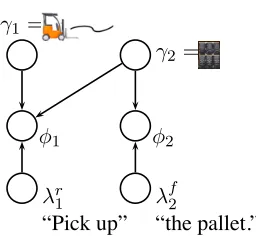
[image:2.612.313.540.140.245.2]We briefly review the G3framework, introduced by Tellex et al. [2011]. In order for a robot to un-derstand natural language, it must be able to map between words in the language and corresponding groundings in the external world. The aim is to find
Figure 1: Sample entry from an aligned corpus, where mappings between phrases in the language and groundings in the external world are explicitly specified as arrows. Learning the meaning of “the truck” and “the pallet” is challenging when align-ment annotations are not known.
λr1
“Pick up”
γ1=
φ1
λf2
“the pallet.”
φ2
γ2 =
[image:2.612.366.494.486.604.2]the most probable groundings γ1. . . γN given the
language Λ and the robot’s model of the environ-mentM:
argmax γ1...γN
p(γ1. . . γN|Λ, M) (1)
M consists of the robot’s location, the loca-tions, geometries, and perceptual tags of objects, and available actions the robot can take. For brevity, we omitM from future equations in this section.
To learn this distribution, one standard approach is to factor it based on certain independence assump-tions, then train models for each factor. Natural language has a well-known compositional, hierar-chical argument structure [Jackendoff, 1983], and a promising approach is to exploit this structure in or-der to factor the model. However, if we define a di-rected model over these variables, we must assume a possibly arbitrary order to the conditionalγi
fac-tors. For example, for a phrase such as “the tire pal-let near the other skid,” we could factorize in either of the following ways:
p(γtires, γskid|Λ) =p(γskid|γtires,Λ)×p(γtires|Λ) (2) p(γtires, γskid|Λ) =p(γtires|γskid,Λ)×p(γskid|Λ) (3)
Depending on the order of factorization, we will need different conditional probability tables that cor-respond to the meanings of words in the language. To resolve this issue, another approach is to use Bayes’ Rule to estimate thep(Λ|γ1. . . γN), but this
approach would require normalizing over all possi-ble words in the language Λ. Another alternative is to use an undirected model, but this approach is intractable because it requires normalizing over all possible values of allγi variables in the model,
in-cluding continuous attributes such as location and size.
To address these problems, the G3framework in-troduced a correspondence vectorΦ to capture the dependency between γ1. . . γN and Λ. Each entry
in φi ∈ Φ corresponds to whether linguistic
con-stituent λi ∈ Λ corresponds to grounding γi. We
assume thatγ1. . . γN are independent of Λ unless Φis known. IntroducingΦenables factorization ac-cording to the structure of language with local nor-malization at each factor over a space of just the two possible values forφi.
2.1 Inference
In order to use the G3 framework for inference, we want to infer the groundings γ1. . . γN that
maxi-mize the distribution
argmax γ1...γN
p(γ1. . . γN|Φ,Λ) (4)
which is equivalent to maximizing the joint distribu-tion of all groundingsγ1. . . γN,ΦandΛ,
argmax γ1...γN
p(γ1. . . γN,Φ,Λ). (5)
We assume thatΛandγ1. . . γN are independent
whenΦis not known, yielding:
argmax γ1...γN
p(Φ|Λ, γ1. . . γN)p(Λ)p(γ1. . . γN) (6)
This independence assumption may seem unintu-itive, but it is justified because the correspondence variable Φ breaks the dependency between Λ and
γ1. . . γN. If we do not know whetherγ1. . . γN
cor-respond toΛ, we assume that the language does not tell us anything about the groundings.
Finally, for simplicity, we assume that any object in the environment is equally likely to be referenced by the language, which amounts to a constant prior on γ1. . . γN. In the future, we plan to incorporate
models of attention and salience into this prior. We ignorep(Λ) since it does not depend onγ1. . . γN,
leading to:
argmax γ1...γN
p(Φ|Λ, γ1. . . γN) (7)
To compute the maximum value of the objective in Equation 7, the system performs beam search over γ1. . . γN, computing the probability of each
assignment from Equation 7 to find the maximum probability assignment. Although we are using
p(Φ|Λ, γ1. . . γN) as the objective function, Φ is
fixed, and theγ1. . . γN are unknown. This approach
is valid because, given our independence assump-tions,p(Φ|Λ, γ1. . . γN)corresponds to the joint
dis-tribution over all the variables given in Equation 5. In order to perform beam search, we factor the model according to the hierarchical, compositional linguistic structure of the command:
p(Φ|Λ, γ1. . . γN) = �
i
This factorization can be represented graphically; we call the resulting graphical model thegrounding graphfor a natural language command. The directed model for the command “Pick up the pallet” appears in Figure 2. Theλvariables correspond to language; theγ variables correspond to groundings in the ex-ternal world, and the φ variables are T rue if the groundings correspond to the language, andF alse
otherwise.
In the fully supervised case, we fit model param-etersΘ using an aligned parallel corpus of labeled positive and negative examples for each linguistic constituent. The G3framework assumes a log-linear parametrization with feature functions fj and
fea-ture weightsθj:
p(Φ|Λ, γ1. . . γN) = (9) �
i 1 Z exp(
�
j
θjfj(φi, λi, γi1. . . γik)) (10)
This function is convex and can be optimized with gradient-based methods [McCallum, 2002].
Features correspond to the degree to which each
Γcorrectly groundsλi. For a relation such as “on,”
a natural feature is whether the grounding corre-sponding to the head noun phrase is supported by the grounding corresponding to the argument noun phrases. However, the feature supports(γi, γj)
alone is not enough to enable the model to learn that “on” corresponds to supports(γi, γj). Instead we
need a feature that also takes into account the word “on:”
supports(γi, γj)∧(“on”∈λi) (11)
3 Approach
Our goal is to learn model parameters for the G3 framework from an unaligned corpus of natural lan-guage commands paired with robot actions. Previ-ously, the system learned model parametersΘusing an aligned corpus in which values for all ground-ing variables are known at trainground-ing time, and anno-tators provided both positive and negative examples for each factor. In this paper we describe how to relax this annotation requirement so that only the top-level action needs to be observed in order to train the model. It is easy and fast to collect data
with these annotations, whereas annotating the val-ues of all the variables, including negative examples is time-consuming and error prone. Once we know the model parameters we can use existing inference to find groundings corresponding to word meanings, as in Equation 4.
We are given a corpus of D training examples. Each exampledconsists of a natural language com-mand Λd with an associated grounding graph with grounding variables Γd. Values for the grounding variables are not known, except for an observed valuegdafor the top-level action random variable,γad. Finally, an example has an associated environmental context or semantic map Md. Each environmental
context will have a different set of objects and avail-able actions for the robot. For example, one training example might contain a command given in an envi-ronment with a single tire pallet; another might con-tain a command given in an environment with two box pallets and a truck.
We define a sampling distribution to choose val-ues for the Γ variables in the model using the G3 framework with parametersΘ:
p(Γd|Φd,Λd, Md,Θ) (12)
Next, we define a reward function for choosing the correct groundinggafor a training example:
r(Γd, gda) = �
1 ifγad=gda
−1 otherwise (13)
Hereγais a grounding variable for the top-level
ac-tion corresponding to the command; it is one of the variables in the vectorΓ. Our aim is to find model parameters that maximize expected reward when drawing values for Γd from p(Γd|Φd,Λd, Md,Θ)
over the training set:
argmax
Θ
�
d
Ep(Γd|Φd,Λd,Md,Θ)r(Γd, gda) (14)
Expanding the expectation we have:
argmax
Θ
�
d d �
Γ
r(Γd, gda)p(Γd|Φd,Λd, Md,Θ)
(15)
derivative of the expectation with respect toΘ. (We drop thedsubscripts for brevity.)
∂ ∂θk
Ep(Γ|Φ,Λ,M,Θ)r(Γ, ga) = �
Γ
r(Γ, ga) ∂ ∂θk
p(Γ|Φ,Λ, M,Θ) (16)
Focusing on the inner term, we expand it with Bayes’ rule:
∂ ∂θk
p(Γ|Φ,Λ, M,Θ) =
∂ ∂θk
p(Φ|Γ,Λ, M,Θ)p(Γ|Λ, M,Θ)
p(Φ|Λ, M,Θ) (17)
We assume the priors do not depend onΘ:
p(Γ|M) p(Φ|Λ)
∂ ∂θk
p(Φ|Γ,Λ, M,Θ) (18)
For brevity, we compress Γ, Λ, and M in the vari-able X. Next, we take the partial derivative of the likelihood ofΦ. First we assume each factor is inde-pendent.
∂ ∂θk
p(Φ|X,Θ) = ∂ ∂θk
�
i
p(φi|X,Θ) (19)
=�
i
p(φi|X,Θ)×
�
j ∂
∂θkp(φj|X,Θ) p(φj|X,Θ)
(20)
Finally, we assume the distribution over φj takes a
log-linear form with feature functionsfkand
param-etersθk, as in the G3framework.
∂ ∂θk
p(φj|X,Θ) = (21)
p(φ|X,Θ)× �
fk(φ, X)−Ep(φ�|X,Θ)�fk(φ�, X) ��
We substitute back into the overall expression for the partial derivative of the expectation:
∂ ∂θk
Ep(Γ|X,Θ)r(Γ, ga) =
Ep(Γ|X,Θ)r(Γ, ga)×
�
j
fk(φj, X)−Ep(φ�|X,Θ) �
fk(φ�, X)� (22)
Input:
1: Initial values for parameters,Θ0. 2: Training dataset,D.
3: Number of iterations,T.
4: Step size,α. 5:
6: Θ←Θ0
7: fort∈T do
8: ford∈Ddo
9: ∇Θ ← ∂θk∂ Ep(Γd|Φd,Λd,Md,Θ)r(Γd, gda)
10: end for
11: Θ←Θ +α∇Θ
12: end for
[image:5.612.314.548.70.266.2]Output: Estimate of parametersΘ
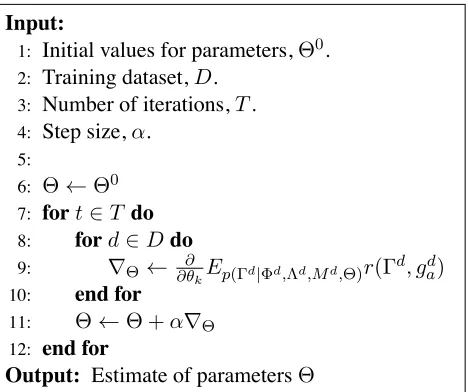
Figure 3: Training algorithm.
We approximate the expectation over Γ with highly probable bindings for theΓ and update the gradient incrementally for each example. The train-ing algorithm is given in Figure 3.
4 Results
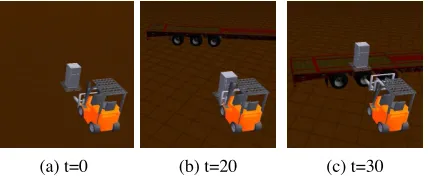
We present preliminary results for the learning algo-rithm using a corpus of natural language commands given to a robotic forklift. We collected a corpus of natural language commands paired with robot ac-tions by showing annotators on Amazon Mechani-cal Turk a video of the robot executing an action and asking them to describe in words they would use to command an expert human operator to carry out the commands in the video. Frames from a video in our corpus, together with commands for that video ap-pear in Figure 4. Since commands often spanned multiple parts of the video, we annotated the align-ment between each top-level clause in the command and the robot’s motion in the video. Our initial eval-uation uses only commands from the corpus that contain the words “pick up” due to scaling issues when running on the entire corpus.
(a) t=0 (b) t=20 (c) t=30
Pick up pallet with refridgerator [sic] and place on truck to the left.
A distance away you should see a rectangular box. Approach it slowly and load it up onto your forklift. Slowly proceed to back out and then make a sharp turn and approach the truck. Raise your forklift and drop the rectangular box on the back of the truck.
Go to the pallet with the refrigerator on it and pick it up. Move the pallet to the truck trailer. Place the pallet on the trailer.
Pick up the pallet with the refrigerator and place it on the trailer.
[image:6.612.312.543.70.222.2](d) Commands
Figure 4: Frames from a video in our dataset, paired with natural language commands.
As expected, on the training set the system learns a good policy, since it is directly rewarded for act-ing correctly. Because the environments are small, the chance of correctly grounding concrete noun phrases with a random cost function is high. How-ever after training performance at grounding noun phrases increases to 92% even though the system had no access to alignment annotations for noun phrases at training time; it only observes reward based on whether it has acted correctly.
Next, we report performance on a test set to assess generalization to novel commands given in novel vironments. Since the test set includes larger en-vironments with up to six objects, baseline perfor-mance is lower. However the trained system is able to achieve high performance at both inferring cor-rect actions as well as corcor-rect object groundings, de-spite having no access to a reward signal of any kind during inference. This result shows the system has learned general word meanings that apply in novel contexts not seen at training time.
5 Related Work
Beginning with SHRDLU [Winograd, 1971], many systems have exploited the compositional structure of language to statically generate a plan
correspond-% Correct
Actions Concrete Noun Phrases
Before Training 31% 61%
After Training 100% 92%
(a) Training (small environments)
% Correct
Actions Concrete Noun Phrases
Before Training 3% 26%
After Training 84% 77%
[image:6.612.80.294.82.170.2](b) Testing (small and large environments)
Table 1: Results on the training set and test set.
ing to a natural language command [Hsiao et al., 2008, MacMahon et al., 2006, Skubic et al., 2004, Dzifcak et al., 2009]. Our work moves beyond this framework by defining a probabilistic graphical model according to the structure of the natural lan-guage command, inducing a distribution over plans and groundings.
Models that learned word meanings [Tellex et al., 2011, Kollar et al., 2010] require detailed align-ment annotations between constituents in the lan-guage and objects, places, paths, or events in the ex-ternal world. Previous approaches capable of learn-ing from unaligned data [Vogel and Jurafsky, 2010, Branavan et al., 2009] used sequential models that could not capture the hierarchical structure of lan-guage. Matuszek et al. [2010], Liang et al. [2011] and Chen and Mooney [2011] describe models that learn compositional semantics, but word meanings are symbolic structures rather than patterns of fea-tures in the external world.
per-form an action. The system is trained off-line, and the task of the robot is to respond on-line to the nat-ural language command.
6 Conclusion
In this paper we described an approach for learning perceptually grounded word meanings from an un-aligned parallel corpus of language paired with robot actions. The training algorithm jointly infers poli-cies that correspond to natural language commands as well as alignments between noun phrases in the command and groundings in the external world. In addition, our approach learns grounded word mean-ings or distributions corresponding to words in the language, that the system can use to follow novel commands that it may have never encountered dur-ing traindur-ing. We presented a preliminary evaluation on a small corpus, demonstrating that the system is able to infer meanings for concrete noun phrases de-spite having no direct supervision for these values.
There are many directions for improvement. We plan to train our system using a large dataset of lan-guage paired with robot actions in more complex en-vironments, and on more than one robotic platform. Our approach points the way towards a framework that can learn a large vocabulary of general grounded word meanings, enabling systems that flexibly re-spond to a wide variety of natural language com-mands given by untrained users.
References
S. R. K. Branavan, H. Chen, L. S. Zettlemoyer, and R. Barzilay. Reinforcement learning for mapping instructions to actions. In Proceedings of ACL, page 82–90, 2009.
D. L. Chen and R. J. Mooney. Learning to interpret natural language navigation instructions from ob-servations. InProc. AAAI, 2011.
S. Chernova and M. Veloso. Interactive policy learn-ing through confidence-based autonomy.JAIR, 34 (1):1–25, 2009.
J. Dzifcak, M. Scheutz, C. Baral, and P. Schermer-horn. What to do and how to do it: Translating natural language directives into temporal and dy-namic logic representation for goal management and action execution. In Proc. IEEE Int’l Conf.
on Robotics and Automation (ICRA), pages 4163– 4168, 2009.
S. Ekvall and D. Kragic. Robot learning from demonstration: a task-level planning approach.
International Journal of Advanced Robotic Sys-tems, 5(3), 2008.
S. Harnad. The symbol grounding problem.Physica D, 43:335–346, 1990.
K. Hsiao, S. Tellex, S. Vosoughi, R. Kubat, and D. Roy. Object schemas for grounding language in a responsive robot. Connection Science, 20(4): 253–276, 2008.
R. S. Jackendoff. Semantics and Cognition, pages 161–187. MIT Press, 1983.
T. Kollar, S. Tellex, D. Roy, and N. Roy. Toward un-derstanding natural language directions. InProc. ACM/IEEE Int’l Conf. on Human-Robot Interac-tion (HRI), pages 259–266, 2010.
V. Kruger, D. Kragic, A. Ude, and C. Geib. The meaning of action: A review on action recogni-tion and mapping. Advanced Robotics, 21(13), 2007.
P. Liang, M. I. Jordan, and D. Klein. Learning dependency-based compositional semantics. In
Proc. Association for Computational Linguistics (ACL), 2011.
M. MacMahon, B. Stankiewicz, and B. Kuipers. Walk the talk: Connecting language, knowledge, and action in route instructions. In Proc. Nat’l Conf. on Artificial Intelligence (AAAI), pages 1475–1482, 2006.
C. Matuszek, D. Fox, and K. Koscher. Following directions using statistical machine translation. In
Proc. ACM/IEEE Int’l Conf. on Human-Robot In-teraction (HRI), pages 251–258, 2010.
N. Mavridis and D. Roy. Grounded situation models for robots: Where words and percepts meet. In
2006 IEEE/RSJ International Conference on In-telligent Robots and Systems, pages 4690–4697. IEEE, Oct. 2006. ISBN 1-4244-0258-1.
A. K. McCallum. MALLET: A machine learning for language toolkit. http://mallet.cs.umass.edu, 2002.
demonstration. In Proceedings of HRI, page 56. ACM, 2007.
S. Schaal, A. Ijspeert, and A. Billard. Computational approaches to motor learning by imitation. Phil. Trans. R. Soc. Lond. B, (358), 2003.
M. Skubic, D. Perzanowski, S. Blisard, A. Schultz, W. Adams, M. Bugajska, and D. Brock. Spatial language for human-robot dialogs. IEEE Trans. on Systems, Man, and Cybernetics, Part C: Appli-cations and Reviews, 34(2):154–167, 2004. ISSN 1094-6977.
S. Tellex, T. Kollar, S. Dickerson, M. Walter, A. Banerjee, S. Teller, and N. Roy. Understand-ing natural language commands for robotic navi-gation and mobile manipulation. InProc. AAAI, 2011.