Toward a Virtual Assistant for Vulnerable Users:
Designing Careful Interaction
Ramin Yaghoubzadeh Sociable Agents Group, CITEC Bielefeld University; PO Box 100131
33501 Bielefeld, Germany
Stefan Kopp
Sociable Agents Group, CITEC Bielefeld University; PO Box 100131
33501 Bielefeld, Germany [email protected]
Abstract
The VASA project develops a multimodal as-sistive system mediated by a virtual agent that is intended to foster autonomy of communica-tion and activity management in older people and people with disabilities. Assistive systems intended for these user groups have to take their individual vulnerabilities into account. A variety of psychic, emotional as well as behav-ioral conditions can manifest at the same time. Systems that fail to take them into account might not only fail at joint tasks, but also risk damage to their interlocutors. We identify im-portant conditions and disorders and analyze their immediate consequences for the design of careful assistive systems.
1 Introduction
In 2001, the World Health Organization consoli-dated previous taxonomies of somatic and mental functions and the everyday needs of human beings into the comprehensive International Classification of Functioning, Disability and Health ICF (WHO, 2001). Older people, as well as people with im-pairments, often need support from others to satisfy those basic needs, among which are activities related to self-care, to mobility, but also to communication and management of the daily activities and the so-cial environment. For many older people, a catas-trophic event, most often either a fall or the passing of their spouse, leads to their sudden loss of auton-omy and subsequent submission into stationary care. In the latter case, the loss of their day structure is frequently the intermediate cause. The same effect
can be observed for many disabled people of all ages who must make a transition from assisted living to stationary care. Here, specialized systems that assist in preserving autonomy in a spectrum of daily need fulfillment can potentially be of great benefit.
The present paper introduces the VASA project (“Virtual Assistants and their Social Acceptability”), which in cooperation with a health-care foundation examines how both older patients and people with various impediments, congenital or acquired, both in stationary and assisted living, can be provided with technical assistance to maintain autonomy for as long as possible. Importantly, we are not focus-ing on physical assistance, but on supportfocus-ing a per-son’s capability for organizing a social environment (WHO ICF d9205: ‘Socializing’) and managing the day structure generally (d230: ‘Carrying out daily routine’). These two tasks turned out to be crucial in our analysis with the health care personnel. We thus aim to develop an assistive system for (1) managing daily routine and weekly appointments with the user, and (2) accessing a video call interface for contact-ing acquaintances or care personnel (d360: ‘Uscontact-ing communication devices and techniques’).
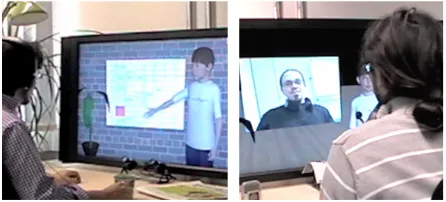
But how should such a system meet its user, and what criteria should guide the system interface de-sign? Research has shown that older users are far more likely to employ a ‘social’ conversation style with a system (Wolters et al., 2009). The VASA project explores the use of a ”virtual assis-tant”, an humanoid conversational agent that fea-tures natural-language and touchscreen input and human-like communicative behavior (speech, ges-ture; see Fig. 1 for the current running prototype).
Figure 1: The VASA system. Left side: natural-language calendar management; right side: video call interface.
In this paper we review work on related systems for older people and people with disabilities. We then argue that beside the general goal of maximizing us-ability for this specific user group, there is an en-hancedvulnerabilityof these users that calls for spe-cial care in interaction design; we substantiate this view by an analysis of potential mental conditions of the prospective users along with discussions of what requirements arise from them.
2 Related work
Generally, assistive systems are driven by task rea-soning systems as well as components for human-computer interaction, which can be specialized for older or disabled persons. Modern systems that attempt to provide a “natural” interaction are be-ing developed and evaluated, includbe-ing touch-screen and haptic interfaces and interfaces capable of un-derstanding and generating natural language, all of them providing an immediacy between communica-tive intentions and their execution that makes them suitable especially for users without technical exper-tise, with reduced sensorimotor skills or reduced ca-pability for learning new interaction paradigms, as is frequently the case with older or impaired persons.
The performance of such systems in terms of suit-able operation in interaction, successful task com-pletion, and user-reported satisfaction, has been subject to systematic evaluation under controlled conditions: The performance of speech recogni-tion systems has been compared between base-line users and people with varying degrees of dysarthria (breathiness, dysfluencies, involuntary noises). Off-the-shelf speech recognition systems have higher failure rates with dysarthric speakers (Raghaven-dra et al., 2001). Mildly and moderately dysarthric
speakers can attain a recognition accuracy of 80% in dictation systems, breath exercises and phonation training improve performance (Young and Mihai-lidis, 2010). Vipperla et al. (2009) compared speech recognition for younger and older users, reporting an 11% baseline increase in word error rates for the latter group, attributed to both acoustic and linguis-tic causes. The Stardust project succeeded in very high single-word recognition rates on small dictio-naries in patients with severe dysarthria, enabling them to control their environment by voice (Hawley et al., 2007). Fager et al. (2010) implemented a mul-timodal prototype system that combined ASR with a word prediction model and a capability to enter an initial letter, leading to an accuracy of>80%; not-ing that other conditions, such as a reduced visual field or ataxia, had to be addressed with technical solutions for each individual. Jian et al. (2011) de-signed a system for direction giving for seniors, sug-gesting specific design guidelines addressing typi-cal perceptive, motor, attentive and cognitive impair-ments of older users. The evaluation of their multi-modal system (speech and touch/image) led to posi-tive results with respect to effectivity, efficiency and user-reported satisfaction.
3 Careful Interaction with Vulnerable People: Analysis
Frail or potentially unstable users are arguably among those who can derive the greatest benefits from easily accessible assistive systems, enabling them to perform tasks which they might else not, or no longer, perform, thus preserving their auton-omy. However, they are at the same time affected by a multitude of possible cognitive, psychic and emo-tional conditions and behavioral anomalies that can occur simultaneously. Each of these conditions en-tails special constraints for interactive systems, ei-ther for the interaction channels, for the contents, or for both. Several factors have been accounted for in existing systems: Reduced perceptive faculty (vision, hearing), reduced motor abilities (ataxia), and attention and memory impairments, mitigated by best-practice rules (Jian et al., 2011). Attempts to account for users with mild dementia have been made, such as in the ISISEMD project. Avoiding a deep hierarchy of dialogue structures and provid-ing extra information (repetition, paraphrase) rather than maximum parsimony are paramount in cases of impaired memory and abstraction faculty, whereas people with learning difficulties need a system that operates without extensive training (of the user).
For systems that strive to provide long-term sup-port to a specific person, adaptation to that per-son is of vital importance – by employing user models that are adapted either manually or using learning algorithms. System behavior should be adapted both in the content provided as well as the form it is provided in, to enable a working rela-tionship that is both effective and pleasant for the user (Yaghoubzadeh and Kopp, 2011). This alone however is insufficient; since the vulnerability of the actual clientele in VASA is considerable, each of the encountered mental conditions has to be an-alyzed and additional dialogue constraints be en-forced before autonomous interactions can be per-mitted. There is a variety of such factors that have not yet been comprehensively addressed, but might cause critical damage to some interactants if not considered. The following section captures the most frequently encountered phenomena, which were identified in dialogue with care personnel:
• Depression and Bipolar Disorder: Roughly ten percent of the population suffer from de-pression at some point in their lives.
Depres-sion increases the risk for suicide ten- to twen-tyfold (Sadock et al., 2007). Bipolar disor-der manifests in episodic effects, where sen-sations of racing thoughts and heightened ac-tivity (mania) and listlessness and social pas-sivity (severe depression) alternate or occur si-multaneously; depressive relapses in particular are points of vulnerability (Hill and Shepherd, 2009). There are successes in detecting depres-sive states from facial and voice cues at>80%
rate (Cohn et al., 2009). A good practice is to employ mitigation strategies when breaking bad news to the user (Brown and Levinson, 1987; Fraser, 1980), e.g. by presenting obliga-tions as opobliga-tions (Williams, 2011), or present-ing the “bad news” simultaneously with “good news”. We provide for discussion another re-quirement for interactive systems in this case:
The system must not produce ambiguously in-terpretable answers – consider a catastrophic answer of “okay” as an affirmative response to a wrongly parsed utterance that was actually an expression of intent for suicide, a frequent phe-nomenon with risk patients (Kelly, 2009).
• Borderline Personality Disorder: This type of disorders, characterized by emotional insta-bility, can lead to anxiety, social insecurity and depression, but also inappropriate outbursts of anger. Anger management techniques are em-ployed to inhibit the expression of such anger (Swaffer and Hollin, 2009). An assistive sys-tem should be able to cope with impulses of anger, and as a bare minimum interrupt the in-teraction and offer to resume it at a later point. The EmoVoice system, for instance, can clas-sify emotional features in natural language with good rates (Vogt et al., 2008), and could be used to identify anger.
the course of conversation, and fill the user in again, abort the conversation, or call for help.
• Panic: Proneness to panic attacks can result from a multitude of afflictions and is hard to predict. In the event of a panicking interactant, the system should not take steps that could fur-ther exacerbate the situation. According to lit-erature (Gournay and Denford, 2009), panic at-tacks are generally unable to do any real harm and subside quickly. Therefore, passivity from the system’s side, in a neutral mode, is the mini-mal appropriate behavior. Panicking people are most likely not able to perform in interaction as successfully as usual – systems that should still be operable by a user in this situation must pro-vide minimalistic shortcuts to essential features (i.e. a “panic button” for emergencies).
• Anxiety:Special care must be taken in the de-sign of systems aimed at people with social anxiety. Interactants might be hesitant to open a conversation even with an artificial system. The system could take the initiative by simply opening with a short utterance about the task domain (Williams, 2011).
• Phobias and Impulse Control Disorders:
Phobic disorders and obsessive-compulsive disorders can be triggered by environmental cues (Gournay and Denford, 2009). User inter-faces have to take this into account, andavoid presenting stimuli that could act as potential triggers (e.g. people with an insect phobia should neither be presented with pictures of in-sects, nor their verbal mention). The same pre-cautions are valid in the case of addictions.
Any interactive system, and in particular systems that do not only provide information but can also be made to perform tasks autonomously on behalf of the user, must be designed with all possible afflic-tions of all possible users in mind, not only as a wise legal precaution, but also as an ethical obligation to the designer. We argue that, quite unlike the ‘best practices’ of user interface design, there is no degree of optionality to the implementation of the above constraints and countermeasures, but that it must be performed with all musterable diligence. Some con-straints are especially hard to meet in open-world
systems (e.g. with free Internet access), since the contents presented are harder to predict.
Note that the set of conditions presented above is by no means comprehensive. For instance, we have, for now, altogether omitted an incorporation of autism-spectrum disorders or of functional psy-choses such as schizophrenia, paraphrenia and para-noia – which are not uncommon in the older popu-lation (Ashton and Keady, 2009).
4 Summary
The VASA project is developing a multimodal natural-language agent-mediated assistance system for older people and patients with disabilities for enhancing their autonomy in the everyday tasks of communication and activity management. The clientele is afflicted with a variety of cognitive, psy-chic, and emotional conditions that have to be dealt with with extreme care and entail a necessity for spe-cific safety mechanisms which will be implemented for VASA in coordination with the care person-nel. We attempted to identify common conditions of older and impaired patients that should be con-sidered and resolved in any assistive system (or in-deed any autonomous interactive system) that might communicate with them. Factors that could lead to a detrimental outcome of such an interaction in-clude depression, emotional instability, disorienta-tion, panic, anxiety and phobia. Some constraints on the design rationale for such systems can pro-vide a mitigation of those risks: avoiding ambigu-ity in the system’s utterances, coping with anger, ir-rationality and panic by employing appropriate sys-tem responses, capability for syssys-tem-side initiative, and preventing inadvertent stimulation of disorders. Since the field of potential interactants for generic assistive systems is vast, as any inspection of a larger health-care institution will show, more discussion in the research community should aim at establishing a stable ontology of their special needs and the rami-fications for the design of careful assistive systems.
Acknowledgments
References
American Psychiatric Association. 2000. Diagnostic and Statistical Manual of Mental Disorders DSM-IV-TR, Fourth Edition. American Psychiatric Publishing, Inc., Arlington, VA.
Peter Ashton and John Keady. 2009. Mental disorders of older people. Newell & Gournay (eds.), Mental Health Nursing: an Evidence-Based Approach, 341– 370. Churchill Livingstone, Philadelphia, PA.
Paul Brown and Stephen Levinson. 1987. Politeness. Some Universals in Language Usage.Cambridge Uni-versity Press, Cambridge.
Jeffrey F. Cohn, Tomas Simon Kruez, Iain Matthews,
Ying Yang, Minh Hoai Nguyen, Margara
Tejera Padilla, Feng Zhou, and Fernando de la Torre. 2009. Detecting Depression from Facial Actions and Vocal Prosody. Proceedings of the 3rd International Conference on Affective Computing and Intelligent Interaction and Workshops (ACII 2009), 1–7. IEEE, Amsterdam.
Susan K. Fager, David R. Beukelman, Tom Jakobs, and John-Paul Hosom. 2010. Evaluation of a Speech Recognition Prototype for Speakers with Moderate and Severe Dysarthria: A Preliminary Report Aug-mentative and Alternative Communication, 26(4):267-277.
Bruce Fraser. 1980. Conversational mitigation. Journal of Pragmatics, 4:341–350.
Kevin Gournay and Lindsay Denford. 2009. Pho-bias and Rituals. Newell & Gournay (eds.), Mental Health Nursing: an Evidence-Based Approach, 207– 224. Churchill Livingstone, Philadelphia, PA.
Mark S. Hawley, Pam Enderby, Phil Green, Stuart Cun-ningham, Simon Brownsell, James Carmichael, Mark Parker, Athanassios Hatzis, Peter ONeill, and Rebecca Palmer. 2007. A speech-controlled environmental control system for people with severe dysarthria. Med-ical Engineering & Physics, 29(5):586–593.
Robert Gareth Hill and Geoff Shepherd. 2009. Disorders of Mood: Depression and Mania. Newell & Gournay (eds.), Mental Health Nursing: an Evidence-Based Approach, 165–185. Churchill Livingstone, Philadel-phia, PA.
Cui Jian, Nadine Sasse, Nicole von Steinb¨uchel-Rheinwall, Frank Schafmeister, Hui Shi, Carsten Rachuy, and Holger Schmidt. 2011. Towards effec-tive, efficient and elderly-friendly multimodal interac-tion. Proceedings of the 4th International Conference on Pervasive Technologies Related to Assistive Envi-ronments (PETRA 2011), article 45, 1–8. ACM, New York, NY.
Sarah Kelly. 2009. Suicide and Self-Harm. Newell & Gournay (eds.),Mental Health Nursing: an
Evidence-Based Approach, 187–206. Churchill Livingstone, Philadelphia, PA.
Parimala Raghavendra, Elisabet Rosengren, and Sheri Hunnicutt. 2001. An investigation of different de-grees of dysarthric speech as input to speaker-adaptive and speaker-dependent recognition systems. Augmen-tative and Alternative Communication, 17(4):265-275. Benjamin J. Sadock, Harold I. Kaplan, and Virginia A. Sadock. 2007. Kaplan & Sadock’s Synopsis of Psychi-atry: Behavioral Sciences/Clinical Psychiatry. Lip-pincott Williams & Wilkins, Philadelphia.
Tracey Swaffer and Clive R. Hollin. 2009. Anger and Impulse Control. Newell & Gournay (eds.), Mental Health Nursing: an Evidence-Based Approach, 267– 289. Churchill Livingstone, Philadelphia, PA.
Ravichander Vipperla, Maria Wolters, Kallirroi Georgila, and Steve Renals. 2009. Speech input from older users in smart environments: Challenges and perspec-tives. HCI (6): Universal Access in Human-Computer Interaction, Intelligent and Ubiquitous Interaction En-vironments, LNCS 5615:117–126. Springer, Heidel-berg.
Thurid Vogt, Elisabeth Andr´e, and Nikolaus Bee. 2008. EmoVoice - A framework for online recognition of emotions from voice. Proceedings of the 4th IEEE tutorial and research workshop on Perception and In-teractive Technologies for Speech-Based Systems (PIT 2008), 188–199. Springer, Heidelberg.
Val Williams. 2011.Disability and discourse : analysing inclusive conversation with people with intellectual disabilities. Wiley-Blackwell, Chichester, West Sus-sex / Malden, MA.
World Health Organization. 2001. International Clas-sification of Functioning, Disability and Health: ICF, WHO, Geneva, Switzerland.
Maria Wolters, Kallirroi Georgila, Johanna D. Moore, and Sarah E. MacPherson. 2009. Being Old Doesn’t Mean Acting Old: How Older Users Interact with Spo-ken Dialog Systems. ACM Transactions on Accessible Computing (TACCESS), 2(1):1–39.
Ramin Yaghoubzadeh and Stefan Kopp. 2011. Creat-ing familiarity through adaptive behavior generation in human-agent interaction. Proceedings of the 11th International Conference on Intelligent Virtual Agents (IVA 2011), LNCS(LNAI) 6895:195–201. Springer, Heidelberg.