Exploring linguistically-rich patterns for question generation
S´ergio Curto L2F/INESC-ID Lisbon [email protected]
Ana Cristina Mendes L2F/INESC-ID Lisbon IST, Tech. Univ. Lisbon
Lu´ısa Coheur L2F/INESC-ID Lisbon IST, Tech. Univ. Lisbon
Abstract
Linguistic patterns reflect the regularities of Natural Language and their applicability is acknowledged in several Natural Language Processing tasks. Particularly, in the task of Question Generation, many systems depend on patterns to generate questions from text. The approach we follow relies on patterns that convey lexical, syntactic and semantic in-formation, automatically learned from large-scale corpora.
In this paper we discuss the impact of varying several parameters during pattern learning and matching in the Question Generation task. In particular, we introduce semantics (by means of named entities) in our lexico-syntactic pat-terns. We evaluate and compare the number and quality of the learned patterns and the matched text segments. Also, we detail the influence of the patterns in the generation of natural language questions.
1 Introduction
Natural Language (NL) is known for its variability and expressiveness. There are hundreds of ways to express an idea, to describe a fact. But language also comprises several regularities, or patterns, that de-note the presence of certain information. For exam-ple,Paris is located in Franceis a common way to say that Paris is in France, indicated by the words located in.
The use of patterns is a widely accepted as an ef-fective approach in the field of Natural Language Processing (NLP), in tasks like Question-Answering (QA) (Soubbotin, 2001; Ravichandran and Hovy, 2002) or Question Generation (QG) (Wyse and Pi-wek, 2009; Mendes et al., 2011).
Particularly, QG aims at generating questions from text and has became a vibrant line of re-search. Generating questions (and answers), on one hand, allows QA or Dialogue Systems to be easily ported to different domains, by quickly providing new questions to train the systems. On the other hand, it is useful for knowledge assessment-related tasks, by reducing the amount of time allocated for the creation of tests by teachers (a time consuming and tedious task if done manually), or by allowing the self evaluation of knowledge acquired by learn-ers.
Most systems dedicated to QG are based on hand-crafted rules and rely on pattern matching to gener-ate questions. For example, in (Chen et al., 2009), after the identification of key points, a situation model is built and question templates are used to generate questions. The Ceist system (Wyse and Pi-wek, 2009) uses syntactic patterns and the Tregex tool (Levy and Andrew, 2006) that receives a set of hand-crafted rules and matches the rules against parsed text, generating, in this way, questions (and answers). Kalady et al.(2010) bases the QG task in Up-keys (significant phrases in documents), parse tree manipulation and named entity recognition.
Our approach to QG also relies on linguistic pat-terns, defined as a sequence of symbols that convey lexical, syntactic and semantic information, reflect-ing and expressreflect-ing a regularity of the language. The patterns associate a question to its answer and are automatically learned from a set of seeds, based on large-scale information corpora, shallow parsing and named entities recognition. The generation of ques-tions uses the learned patterns, as quesques-tions are cre-ated from text segments found in free text after being matched against the patterns.
This paper studies the impact on QG of vary-ing lvary-inguistic parameters durvary-ing pattern learnvary-ing and matching. It is organized as follows: in Sec. 2 we introduce our pattern-based approach to QG; in Sec. 3 we show the experiments and discuss results; in Sec. 4 we conclude and point to future work.
2 Linguistically-Rich Patterns for Question Generation
The generation of questions involves two phases: a first offline phase – pattern learning – where pat-terns are learned from a set of seeds; and a sec-ond online phase – pattern matching and question generation– where the learned patterns are matched against a target document and the questions are gen-erated. Next we describe these phases.
Pattern Learning Our approach to pattern learn-ing is inspired by the work of Ravichandran and Hovy (2002), who propose a method to learn pat-terns based on a two-step technique: the first ac-quires patterns from the Web given a set of seeds and the second validates the patterns. Despite the sim-ilarities, ours and Ravichandran and Hovy’s work have some differences: our patterns also contain syntactic and semantic information and are not vali-dated. Moreover, our seeds are well formulated NL questions and their respective correct answers (in-stead of two entities), which allows to directly take advantage of the test sets already built and made available in evaluation campaigns for QA systems (like Text REtrieval Conference (TREC) or Cross Language Evaluation Forum (CLEF)).
We use a set of seeds, each composed by a NL question and its correct answer. We start by classi-fying each seed question into a semantic category, in order to discover the type of information these are seeking after: for example, the question “Who painted the Birth of Venus ?” asks for a person’s name. Afterwards, we extract the phrase nodes of each seed question (excluding the Wh-phrase), en-close each in double quotes and submit them as a query to a search engine. For instance, given the seed“Who painted the Birth of Venus ?”/Botticelli and the syntactic structure of its question [WHNP Who] [VBD painted] [NP the Birth of Venus]1, we
1The Penn Treebank II Tags (Bies et al., 1995) are used.
build the query: "painted" "the Birth of Venus" "Botticelli".
We build patterns that associate the entities in the question to the answer from the top re-trieved documents. From the sentence The Birth of Venus was painted around 1486 by Botti-celli, retrieved as result to the above query, we learn the pattern“NP VBD[was] VBN PP[around 1486]:[Date] IN:[by] NP{ANSWER}”2. The syntactic labels without lexical information are re-lated with the constituents of the question, while those with“{ANSWER}”mark the answer.
By creating queries with the inflected forms of the main verb of the question, we learn patterns where the surface form of the verb is different to that of the verb in the seed question (e.g., “NP{ANSWER} VBD[began] VBG NP” is learned from the sen-tenceBotticelli began painting the Birth of Venus). The patterns generated by verb inflection are IN-FLECTED; the others areSTRONGpatterns.
Our patterns convey linguistic information ex-tracted from the sentences in the documents where all the constituents of the query exist. The pat-tern is built with the words, their syntactic and se-mantic classes, that constitute the segments where those constituents are found. For that, we per-form syntactic analysis and named entity recog-nition in each sentence. In this paper, we ad-dress the impact of adding semantic information to the patterns, that is, the difference in hav-ing a pattern “NP VBD[was] VBN PP[around 1486]:[Date] IN:[by] NP{ANSWER}” with or without the named entity of type DATE, for instance.
Pattern Matching and Question Generation The match of the patterns against a given free text is done at the lexical, syntactic and semantic lev-els. We have implemented a (recursive) algorithm that explores the parsed tree of the text sentences in a top-down, left-to-right, depth-first search, unifying the text with the linguistic information in the pattern. Also, we discard all matched segments in which the answer does not agree with the semantic cate-gory expected by the question.
The generation of questions from the matched text
2The patterns are more complex than the ones presented:
segments is straightforward, since we keep track of the syntactic structure of the questions and the sen-tences on the origin of the patterns. There is a di-rect unification of all components of the text seg-ment with the constituents of the pattern. In the INFLECTED patterns, the verb is inflected with the tense and person of the seed question and the auxil-iary verb is also used.
3 Experiments
3.1 Experimental Setup
We used the 6 seeds shown in Table 1, chosen be-cause the questions contain regular verbs and they focus on known entities – being so, it is probable that there will be several texts in the Web referring to them. However, understanding the characteristics of a pair that makes it a good seed is an important and pertinent question and a direction for future work.
GId:1
Syntactic Structure:WHNP VBD NP Semantic Category:HUMAN:INDIVIDUAL “Who wrote Hamlet?”/Shakespeare
“Who painted Guernica?”/Picasso
“Who painted The Starry Night?”/Van Gogh
GId: 2
Syntactic Structure:WHADVP VBD NP VBN Semantic Category:NUMERIC:DATE “When was Hamlet written?”/1601 “When was Guernica painted?”/1937 “When was The Starry Night painted?”/1889
Table 1: Seeds used in the experiments.
The syntactic analysis of the questions was done by the Berkeley Parser (Petrov and Klein, 2007) trained on the QuestionBank (Judge et al., 2006). For question classification, we used Li and Roth (2002) taxonomy and a machine learning-based classifier fed with features derived from a rule-based classifier (Silva et al., 2011).
For the learning of patterns we used the top 64 documents retrieved by Google and to recog-nize the named entities in the pattern we apply several strategies, namely: 1) the Stanford’s Con-ditional Random-Field-based named entity recog-nizer (Finkel et al., 2005) to detect entities of type HUMAN; 2) regular expressions to detect NUMERIC
and DATEtype entities; 3) gazetteers to detect enti-ties of type LOCATION.
For the generation of questions we used the top 16 documents retrieved by the Google for 9 personali-ties from several domains, like literature (e.g., Jane Austen) and politics (e.g., Adolf Hitler). We do not have influence on the content of the retrieved doc-uments, nor perform any pre-processing (like text simplification or anaphora resolution). The Berkeley Parser (Petrov and Klein, 2007) was used to parse the sentences, trained with the Wall Street Journal.
3.2 Pattern Learning Results
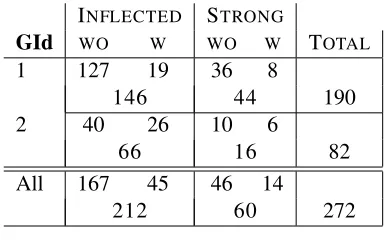
A total of 272 patterns was learned, from which 212 are INFLECTEDand the remaining are STRONG. On average, each seed led to 46 patterns.
Table 2 shows the number of learned patterns of types INFLECTED and STRONG according to each group of seed questions. It indicates the number of patterns in which at least one named entity was rec-ognized (W) and the number of patterns which do not contain any named entity (WO). Three main results of the pattern learning phase are shown: 1) the num-ber of learned INFLECTED patterns is much higher than the number of learned STRONGpatterns: nearly 80% of the patterns are INFLECTED; 2) most of the patterns do not have named entities; and 3) the num-ber of patterns learned from the questions of group 1 are nearly 70% of the total number of patterns.
INFLECTED STRONG
GId WO W WO W TOTAL
1 127 19 36 8
146 44 190
2 40 26 10 6
66 16 82
All 167 45 46 14
[image:3.612.330.524.463.584.2]212 60 272
Table 2: Number of learned patterns.
The following are examples of patterns and the actual sentences from where they were learned: – “NP{ANSWER} VBZ NP”: an INFLECTED pattern learned from group 1, from the sentence 1601 William Shakespeare writes Hamlet in London., without named entities;
STRONG pattern learned from group 2, from the sentence (Guernica was painted in 1937.), without named entities;
– “NNP VBZ[is] NP[a tragedy] ,[,]
VBN[believed] VBN IN[between]
NP[1599]:[NUMERIC COUNT,NUMERIC DATE]
CC[and] NP{ANSWER}”: an INFLECTED pattern learned from group 2, from the sentence William Shakespeare’s Hamlet is a tragedy , believed written between 1599 and 1601, with 1599 being recog-nized as named entity of type NUMERIC COUNT and NUMERIC DATE.
3.3 Pattern Matching and Question Generation Results
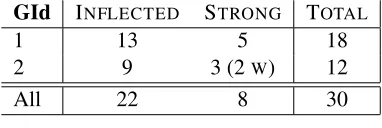
Regarding the number of text segments matched in the texts retrieved for the 9 personalities, Table 3 shows that, from the 272 learned patterns, only 30 (11%) were in fact effective (an effective pattern matches at least one text segment). The most effec-tive patterns were those from group 2, as 12 from 82 (14.6%) matched at least one instance in the text.
GId INFLECTED STRONG TOTAL
1 13 5 18
2 9 3 (2W) 12
[image:4.612.317.537.215.343.2]All 22 8 30
Table 3: Matched patterns.
Regarding the patterns with named entities, only those from group 2 matched instances in the texts. The pattern that matched the most instances was
“NP{ANSWER} VBD NP”, learned from group 1. In the evaluation of the questions, we use the guidelines of Chen et al. (2009), who classify ques-tions asplausible– if they are grammatically correct and if they make sense regarding the text from where they were extracted – andimplausible(otherwise).
However, we split plausible questions in three cat-egories: 1) Pa for plausible, anaphoric questions, e.g.,When was she awarded the Nobel Peace Prize?; 2) Pcfor plausible questions that need a context to
be answered, e.g., When was the manuscript pub-lished?; and 3) Pp, a plausible perfect question. If
a question can be marked both as PLaand PLc, we
mark it as PLa. Also, we split implausible questions
in: 1)IPi: for implausible questions due to
incom-pleteness,e.g.,When was Bob Marley invited?; and 2)IP: for questions that make no sense,e.g., When was December 1926 Agatha identified?.
A total of 447 questions was generated: 31 by STRONGpatterns, 269 by INFLECTED patterns and 147 by both STRONGand INFLECTEDpatterns. We manually evaluated 100 questions, randomly se-lected. Results are in Table 4, shown according to the type (INFLECTED/STRONG) and presence of named entities (W/WO) in the pattern that generated them.
Pa Pc Pp IPi IP Total
INFLECTED 57
WO 2 0 27 23 5
STRONG 13
W 1 0 1 0 1
WO 1 2 3 3 1
INFL/STR 30
WO 0 0 9 18 3
[image:4.612.90.281.369.433.2]All 4 2 40 44 10 100
Table 4: Evaluation of the generated questions.
46 of the evaluated questions were considered plausible and, from these, 40 can be used without modifications. From the 54 implausible questions, 44 were due to lack of information in the question. 69% (9 in 13) of the questions originated in STRONG patterns were plausible. This value is smaller for questions generated by INFLECTEDpatterns: 50.8% (29 in 57). Questions that had in their origin both a STRONGand a INFLECTEDpattern were mostly im-plausible, only 9 in 30 were plausible (30%). The presence of named entities led to an increase of questions of only 3 (2 plausible and 1 implausible).
3.4 Discussion
PP[in 1937]:textit[Date] WHADVP[when] NP[he] VBD NP” requires the words responded, whenandhe.)
From a small set of seeds, our approach learned patterns that were later used to generate 447 ques-tions from previously unseen text. In a sample of 100 questions, 46% were judged as plausible. Two plausible questions are: “Who had no real interest in the former German African colonies?”, “When was The Road to Resurgence published?”and“Who launched a massive naval and land campaign de-signed to seize New York?”.
The presence of syntactic information (a differ-ence between ours and Ravichandran and Hovy’s work) allows to relax the patterns and to gener-ate questions of various topics: e.g., the questions “Who invented the telegraph?” and “Who di-rected the Titanic?” can be generated from match-ing the pattern “NP VBD[was] VBN IN:[by] NP{ANSWER}”with the sentencesThe telegraph was invented by Samuel MorseandThe Titanic was di-rected by James Cameron, respectively.
4 Conclusions and Future Work
We presented an approach to generating questions based on linguistic patterns, automatically learned from the Web from a set of seeds. We addressed the impact of adding semantics to patterns in matching text segments and generating new NL questions.
We did not detect any improvement when adding semantics to the patterns, mostly because the pat-terns with named entities did not match too many text segments. Nevertheless, from a small set of 6 seeds, we generated 447 NL questions. From these, we evaluated 100 and 46% were considered correct at the lexical, syntactic and semantic levels.
In the future, we intend to pre-process the texts against which the patterns are matched and from which the questions are generated. Also, we are experimenting this approach in another language. We aim at using more complex questions as seeds, studying its influence on the generation of questions.
Acknowledgements
This work was supported by FCT (INESC-ID mul-tiannual funding) through the PIDDAC Program funds, and also through the project FALACOMIGO
(ProjectoVII em co-promoc¸˜ao, QREN n 13449). Ana Cristina Mendes is supported by a PhD fel-lowship from Fundac¸˜ao para a Ciˆencia e a Tecnolo-gia (SFRH/BD/43487/2008).
References
Ann Bies, Mark Ferguson, Karen Katz, and Robert Mac-intyre. 1995. Bracketing Guidelines for Treebank II Style Penn Treebank Project.
Wei Chen, Gregory Aist, , and Jack Mostow. 2009. Gen-erating questions automatically from informational text. InThe 2nd Workshop on Question Generation. Jenny Rose Finkel, Trond Grenager, and Christopher
Manning. 2005. Incorporating non-local informa-tion into informainforma-tion extracinforma-tion systems by gibbs sam-pling. InProc. 43rd Annual Meeting on Association
for Computational Linguistics, ACL ’05, pages 363–
370. ACL.
John Judge, Aoife Cahill, and Josef van Genabith. 2006. Questionbank: creating a corpus of parse-annotated questions. InACL-44: Proc. 21st Int. Conf. on
Com-putational Linguistics and the 44thAnnual Meeting of
the Association for Computational Linguistics, pages 497–504. ACL.
Saidalavi Kalady, Ajeesh Elikkottil, and Rajarshi Das. 2010. Natural language question generation using syntax and keywords. InThe 3rdWorkshop on Ques-tion GeneraQues-tion.
Roger Levy and Galen Andrew. 2006. Tregex and tsur-geon: tools for querying and manipulating tree data structures. InLREC 2006.
Xin Li and Dan Roth. 2002. Learning question classi-fiers. InProc. 19thInt. Conf. on Computational Lin-guistics, pages 1–7. ACL.
Ana Cristina Mendes, S´ergio Curto, and Lu´ısa Coheur. 2011. Bootstrapping multiple-choice tests with the-mentor. In CICLing, 12th International Conference on Intelligent Text Processing and Computational Lin-guistics.
Slav Petrov and Dan Klein. 2007. Improved inference for unlexicalized parsing. InHuman Language Tech-nologies 2007: The Conference of the North American Chapter of the Association for Computational
Linguis-tics; Proc. Main Conference, pages 404–411. ACL.
Deepak Ravichandran and Eduard Hovy. 2002. Learn-ing surface text patterns for a question answerLearn-ing sys-tem. InACL ’02: Proc. 40thAnnual Meeting on As-sociation for Computational Linguistics, pages 41–47. ACL.
in-formation in question classification. Artificial
Intelli-gence Review, 35:137–154.
M. M. Soubbotin. 2001. Patterns of potential answer expressions as clues to the right answers. InProc. 10th
Text REtrieval Conference (TREC), pages 293–302.
Brendan Wyse and Paul Piwek. 2009. Generating ques-tions from openlearn study units. InThe 2ndWorkshop