The Semi-Automatic Construction of Part-Of-Speech Taggers
for Specific Languages by Statistical Methods
Tomohiro YAMASAKI Hiromi WAKAKI
Toshiba Corp., Corporate Research & Development Center, Knowledge Media Laboratory 1. Komukai Toshiba-cho, Saiwai-ku, Kawasaki, JAPAN
{tomohiro2.yamasaki, hiromi.wakaki, masaru1.suzuki}@toshiba.co.jp
Masaru SUZUKI
Abstract
Economic activities now keep being globalized more and more. Thus we are driven to deal with not only the documents written in English but also those written in other languages. In order to enable us to develop proces-sors of any language quickly, we have been making a framework based on sta-tistical processing and machine learn-ing. At present, we confirmed that part-of-speech (POS) taggers of some target languages can be built by us-ing this framework and the information of source languages. In this paper, we describe the method of acquiring POS lexicons and that of generating supervi-sors of POS sequences, which are used to learn grammatical models of target languages. We also explain the experi-mental results of building POS taggers of Portuguese and Indonesian by using some source languages.
1 Introduction
The natural language processing, for example, part-of-speech (POS) tagging, syntactic pars-ing, and named entity extraction, is the fun-damental technology for information extrac-tion from text documents. This means that the preparation of processors of a specific lan-guage enables us to develop various applica-tions for that language such as keyword ex-traction, document classification, and machine translation. However, most parts of the pro-cessors we have already built are dependent on the characteristics of each language since we have developed lexicons and grammars man-ually according to those of target languages such as Japanese and English. This means that we have to spend much time and effort
when we try to prepare processors of a new language in the similar way before.
On the other hand, economic activities keep being globalized and thus we should provide people all over the world with appropriate ser-vices and products. In particular, the follow-ing needs are increasfollow-ing:
• to estimate customers’ concerns and in-tentions in order to provide the best ser-vice,
• to grasp customers’ reputations and com-plaints in order to avoid troubles,
• and to analyze the documents written in local languages in order to achieve two above-mentioned statements.
We have mainly worked on processing of English until now, since many people tend to consider to be international as to use English much. After now, however, we must work on not only English but also other languages all over the world in order to be truly interna-tional.
Therefore, we have been working on the es-tablishment of the framework that enables us to develop processors of any language quickly. Concretely speaking, we aim to build lexicons and grammatical models semi-automatically by using statistical processing. We also aim to achieve processors for POS tagging and more advanced language processing by using only the combination of surface and statistical in-formation of documents given. However, we make it a condition that the documents writ-ten in target languages have many translations with source languages because it is difficult to build processors without any clue at all.
Roughly speaking, the technical points of our research are divided into the development of lexicons and that of grammatical models. In
this paper, we choose POS taggers as an ex-ample of processors and describe the method of the following processes:
• to acquire POS lexicons that are com-posed of [word, POS] pairs,
• to generate supervisors of POS sequences,
• and to learn grammatical models by using the above-mentioned lexicons and super-visors.
As a result of these processes, we can obtain the POS tagger of the target language semi-automatically. Finally, we do the experiment of building POS taggers by using some source languages and evaluate the accuracy of those taggers.
1.1 Related Work
Recently, it has been found that various prob-lems of tasks in the natural language pro-cessing can often be solved easily by machine learning if we can prepare a large amount of tagged corpora. However, it is a large problem to prepare tagged corpora that can be used as supervisors of each task.
On the other hand, it is easy to obtain raw corpora from the Internet and so on. There-fore, there are some studies about the meth-ods for building processors by using not tagged corpora but only raw ones. (Goldsmith, 2001) acquires the inflections of each word on the basis of Minimum Description Length (MDL) model. However, in order to use the method of (Goldsmith, 2001), we first have to generate probabilistic grammars manually, because this method is to distinguish the ones acceptable and the ones not acceptable. This means that we have to know the characteristics of the tar-get language well to some degree, and that it is difficult to build processors of the language we hardly know by this method.
In addition, semi-supervised learning is re-ceiving much attention as the method for solv-ing the problem of preparsolv-ing a large amount of tagged corpora in these days. This is a method aiming to obtain the same effect as the case where we prepare a large amount of tagged corpora by giving only a small amount of tagged data to a large amount of raw cor-pora. (Niu et al., 2003) learns the extraction rules from the seed words given first, gener-ates the corpora of named entities by those
rules, and finally builds a named entity ex-tractor. As to semi-supervised learning, how-ever, it is known that if tagged data include errors even a little, errors increase rapidly in the phase of automatic generation of supervi-sors and thus it is difficult to achieve enough accuracy. It is also difficult to give data with accurate tags when we hardly know the target language. Therefore, we have to do trial and error so as not to cause the error propagation.
1.2 Policy
When we use translations with some specific languages, the degree of difficulty of obtain-ing them has a big influence on us. Generally speaking, major news websites often deliver not only articles written in local languages but also those written in English. In other words, there is a large probability that the documents written in local languages have the English translations, which we can use as parallel cor-pora. However, we note that even if we can obtain the translations with languages X and Y, the sentences within the translations do not always have one-to-one relations. Generally speaking, it is difficult to associate the sen-tences of language X with the sensen-tences of lan-guage Y with high accuracy when we hardly know the relations of words of both languages. Much less, it is almost impossible when we hardly know the target languages.
Therefore, we decided to use the transla-tions of the Bible as our experimental corpora. The Bible is one of the most familiar docu-ments that are read all over the world and the translations with many languages are open to the public on the Internet ((The Unbound Bible, )). In addition, the number of chap-ters and sections are the same in any language though each translation of the Bible is parti-tioned into many chapters and sections. This means that the sentences have almost one-to-one relations because each section has few sen-tences.
On the other hand, as we described above, we aim to achieve processors for advanced lan-guage processing by using only the combina-tion of surface and statistical informacombina-tion of documents given. As the first approach, we decided not to target the languages as follows:
• the languages whose words are not writ-ten with a space between them,
• and the languages whose orthographies do not distinguish common nouns and proper nouns.
Not only the languages that have very few users but also some of those that are used in India are known that their character sys-tems have not been digitalized yet. We can-not disregard those Indian languages because they have many users, but we cannot perform the computer statistics if there is no digital-ized corpora. Next, Thai, Cambodian, and Laotian languages are known that their words are not written with a space between them. These languages, similar to Japanese, have a large problem that it is very difficult for com-puters to divide a sentence into words. Then, Arabic, Hebrew, and Hindi languages have no case sensitivity. These languages, similar to German whose nouns always start with capi-tal letters, have difficulties to extract the rela-tions of words of other languages because it is not easy to determine proper nouns.
For these reasons, we mainly target the lan-guages that use Latin characters. Particu-larly in this paper, we consider Portuguese and Indonesian as major targets. However, our method can be applied also to other languages like French and Italian.
2 Extracting the relations of words
Our method for acquiring POS lexicons is composed of two processes. One is a process of extracting useful words by using statistics of only one language. The other is a process of extracting the relations of words of two lan-guages by using statistics of both lanlan-guages. In this section, we describe both processes.
2.1 Extracting useful words on the basis of statistical information of a single language
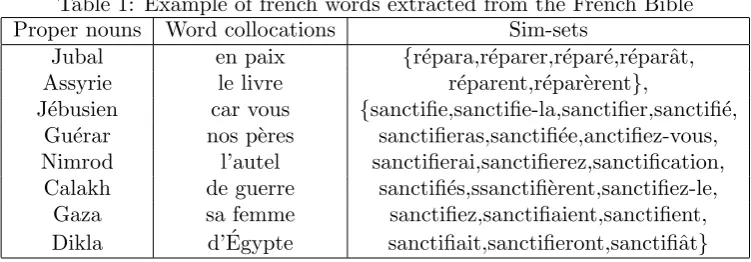
Here, we describe the process of extracting the words whose surfaces are similar to one an-other (say sim-set), proper nouns, and word collocations on the basis of statistical infor-mation of a single language. The purpose of extracting sim-sets is to presume the inflec-tions/derivations of each word at the next pro-cess.
As we described in Section 1.2, we con-sider Portuguese and Indonesian as major tar-gets. This means that the words that al-ways start with capital letters must be proper nouns, though we have to take into account the words that appear at the beginning of sen-tences. Therefore, we partition all sentences with spaces and symbols into words and ex-tract each word w that satisfies the following conditions from them:
• csmall(w), which is the count that w has
only small letters, is equal to 0.
• ccapital(w), which is the count that w
starts with capital letters, is greater than or equal to 5.
The probability that a word that is not a proper noun satisfies the conditioncsmall(w) =
0 and ccapital(w) ≥ 5, is less than (1/2)5 =
1/32 even if we assume that the probability that it appears at the beginning of sentences is 1/2. It follows that we can decide whether a word is a proper noun with significance level of 5%.
Next, C-value (Frantzi and Ananiadou, 1996) is known well as a method for extracting word collocations from the text documents. This method calculates the connectivity be-tween the words, defined as C−value(w) = (l −1)(n−t/c), where w is a word colloca-tion w1. . . wl,t and c are the total count and
the distinct count of word collocations that in-clude wand that are longer thanw.
When the connectivity between some words is strong, these words often appear composing a group and C-value tends to be large because
ttend to be small in comparison withn. How-ever, when the word collocations is short, C-value tends to be unreasonably large because
ctends to be very large in comparison withn. Therefore, we use not only C-value but also C’-value (Yamasaki, 2008) in order to extract word collocations. In other words, we extract the word collocations whose C-value and C’-value are larger than a threshold given.
Table 1: Example of french words extracted from the French Bible Proper nouns Word collocations Sim-sets
Jubal en paix {r´epara,r´eparer,r´epar´e,r´eparˆat, Assyrie le livre r´eparent,r´epar`erent},
J´ebusien car vous {sanctifie,sanctifie-la,sanctifier,sanctifi´e, Gu´erar nos p`eres sanctifieras,sanctifi´ee,anctifiez-vous, Nimrod l’autel sanctifierai,sanctifierez,sanctification,
Calakh de guerre sanctifi´es,ssanctifi`erent,sanctifiez-le, Gaza sa femme sanctifiez,sanctifiaient,sanctifient, Dikla d’´Egypte sanctifiait,sanctifieront,sanctifiˆat}
by which we can determine inflection forms of each word. Indonesian is classified into the ag-glutinative language as well as Japanese. The agglutinative languages have the property that most words are formed with the joint of the el-ements of grammatical functions. This means that we must have the means by which we can determine the stem of derivation words.
In most languages, it is known that the be-ginning or the end of each word change its form, though the middle does in Arabic and Hebrew. Therefore, we formally define a sim-set as the words whose common affix is longer than a threshold given. Now, we partition all sentences with spaces and symbols into words and perform the following process for each pair of words (w1, w2):
• letL, lbe max,min of (|w1|,|w2|), respec-tively.
• define w1 ∼ w2 if and only if l ≥
L/2 and the length of common prefix
pre(w1, w2) ≥ L/2 or the length of com-mon suffix suf(w1, w2)≥L/2.
• partition all words into equivalence class based on ∼∗, which is defined as the re-flexive transitive closure of ∼.
We note that the definition of∼∗ does not depend on the definition of ∼. This means that if we define ∼ by using common subse-quence instead of common affix, we may apply the same method to the languages where the middle of each word changes.
2.2 Extracting the relations of words on the basis of statistical
information of two languages
Here, we describe the process of extracting the relations of words of two languages on the basis of statistical information of both languages.
We expect that when a wordwxof language
X corresponds to a wordwyof language Y, the positions ofwx in corpora are related to those of wy. Here, we note that it is not easy to
de-cide whether the positions have any relations because the sentences within the translations do not always have one-to-one relations. How-ever, it is easy to do it when we use the trans-lations of the Bible because the sentences are almost parallel. Assume that an X–Y paral-lel corpus has n corresponding sentences and that the numbers of sentences where wx and
wy appear are shown in Table 2. For example, both appear in asentences, onlywx (wy) in b
(c), and neither ind.
For such a table, it is known that χ2-value, defined asχ2 =n(ad−bc)2/ef gh, follows aχ2
sta-Table 2: The number of sentences where wx and wy appear
wy appears wy does not appear sum
wx appears a b e=a+b
wx does not appear c d f =c+d
sum g=a+c h=b+d n=a+b+c+d
tistical information. From here, on the as-sumption that we know language X well (= we have a POS tagger of language X), we describe the method of extracting the inflec-tions/derivations of words of language Y we hardly know.
As we described in the previous sec-tion, a sim-set includes candidates of inflec-tion/derivation forms of a word. Because we have a POS tagger of language X, we can de-cide whether some different words are in truth the same by restoring each word to its stan-dard form. In other words, we can extract inflection/derivation forms of language Y that correspond to a standard form of language X by finding the subset that is contained in a sim-set of language Y and is the most relevant to the standard form of language X. Therefore, we perform the following processes:
• choose a standard form of language X
wx and a sim-set of language Y simy =
{wy1, wy2, . . .}.
• calculate χ2-value for each subset simy, which is contained insimy.
• find the subset whose χ2-value is maxi-mum.
3 Acquiring POS lexicons and
generating supervisors of POS sequences
In the previous section, we explained the method of extracting the relations of words of languages X and Y on the basis of statis-tical information obtained from X–Y parallel corpora. In order to acquire POS lexicons of language Y finally, it is necessary to estimate the POS of each word wy of language Y.
Be-cause we can know the POS of each word wx
of language X on the assumption that we have a POS tagger of language X, we consider the POS ofwx corresponding towy as that ofwy.
Here, we note that we may not be able to decide the unique POS ofwx. For example, it is known that many English words are used as
Table 3: List of part-of-speeches A ADJECTIVE P PRONOUN C CONJUNCTION R ADVERB D DETERMINER S PREPOSITION
I INTERJECTION V VERB
M NUMERAL 0 DIGIT
N NOUN SYMBOL
a NOUN and a VERB. In other words, most of English words have two or more POSes. While the English word “name” can be used as a NOUN and a VERB, the Portuguese word “nome” is used as a NOUN only. Therefore, from the viewpoint of the relevance ratio, it is thought to be better that we estimate POSes on the basis of the context. However, in order to make our method simple, we consider all possible POSes ofwx as those ofwy.
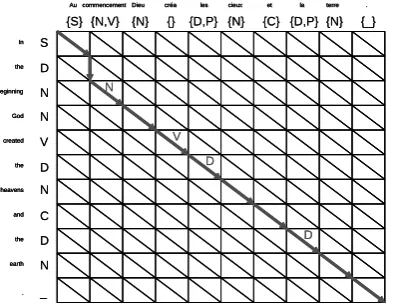
It is known well that most of European languages belong to Indo-European languages and there are few differences in the fun-damental grammars between them. Con-versely speaking, this means that the differ-ence of languages does not affect so much the POS sequences of the corresponding sentences. Though Indonesian does not belong to Indo-European languages, we generate the supervi-sors of POS sequences of language Y on the basis of POS sequences of language X by solv-ing the Minimum Cost Matchsolv-ing Problem that has the following conditions:
• the POSes of D, P, S, 0 and can match the same POSes only, which is because these POSes are thought to be the same POSes for other languages,
• the skip cost iscskip,
• the match cost is 0 if cand(wy) = ∅ or pos(wx)∈cand(wy), otherwisecdiff,
wherepos(wx) is the POS of a wordwx of lan-guage X andcand(wy) is the POS candidates of a word wy of language Y.
Au commencementDieu créa les cieux et la terre . In the beginning God created the heavens and the earth . S D N N V D N C D N _
{S} {N,V} {N} {} {D,P} {N} {C} {D,P}{N} {_}
N
V
D
D
Au commencementDieu créa les cieux et la terre .
In the beginning God created the heavens and the earth .
Au commencementDieu créa les cieux et la terre .
In the beginning God created the heavens and the earth . S D N N V D N C D N _
{S} {N,V} {N} {} {D,P} {N} {C} {D,P}{N} {_}
N
V
D
[image:6.595.311.523.60.188.2]D
Figure 1: A solution of Minimum Cost Match-ing Problem solved by Dynamic ProgramMatch-ing
be a NOUN. It also shows that “cr´ea” matches “created” and thus is estimated to be a VERB. In order to make our method simple, we do not use the relations of words this time. However, we may make the condition that the match cost reflects the relations of words.
4 Experimental results
We have already built the POS taggers of En-glish, Spanish and Esperanto manually. In this section, we explain the experimental results of building POS taggers of some target lan-guages semi-automatically on the assumption that English, Spanish and Esperanto are used as the source languages. While there are some versions of the Bible by different translators in some languages, we used the following versions shown in Table 4 on this experiment.
First, we show the covering ratios in Figure 2. The total and distinct covering ratios are defined as the ratios of total and distinct words with one or more estimated POSes by using our method, respectively. Though there are a few differences, as you can see, the covering ratios in Figure 2 are almost the same degree even if the source language is English, Spanish or Esperanto.
This means that our method is stable and is independent of the characteristics of source languages. In addition, we confirmed that we acquired the POSes to almost all words by us-ing statistical processus-ing because the total cov-ering ratio exceeds 0.8. However, the distinct covering ratio of Indonesian is about 0.25 and is lower than expected. There is still room for improvement.
Next, we generated the supervisors of POS
㪇 㪇㪅㪈 㪇㪅㪉 㪇㪅㪊 㪇㪅㪋 㪇㪅㪌 㪇㪅㪍 㪇㪅㪎 㪇㪅㪏 㪇㪅㪐 㪈
㪜㫅㪾㫃㫀㫊㪿 㪪㫇㪸㫅㫀㫊㪿 㪜㫊㫇㪼㫉㪸㫅㫋㫆
㪧㫆㫉㫋㫌㪾㫌㪼㫊㪼㩷㩿㫋㫆㫋㪸㫃㪀 㪧㫆㫉㫋㫌㪾㫌㪼㫊㪼㩷㩿㪻㫀㫊㫋㫀㫅㪺㫋㪀 㪠㫅㪻㫆㫅㪼㫊㫀㪸㫅㩷㩿㫋㫆㫋㪸㫃㪀 㪠㫅㪻㫆㫅㪼㫊㫀㪸㫅㩷㩿㪻㫀㫊㫋㫀㫅㪺㫋㪀
Figure 2: Total and distinct covering ratios
sequences based on the above-mentioned POS lexicons and performed the machine learning of grammatical models by using CRF (Laf-fert, 2001). After that, we obtained the POS taggers of the target languages semi-automatically. We show the accuracy ratio in Figure 3. The accuracy ratio is defined as the ratio of correct POSes that the tag-gers tagged onto words of sentences given. As you can see, POS information is not attached to the Bible. In order to evaluate the accu-racy ratio, we extracted about 60 sentences (about 900 words) from the Bible and made the POS answers manually. Figure 3 shows that the Portuguese tagger achieved high ac-curacy of about 0.9 even though they are built semi-automatically. Figure 3 also shows that the accuracy of the Indonesian tagger is about 0.6. This is probably because the differences between Indonesian and source languages are large.
On the other hand, we analyzed failure cases and confirmed that one of the causes of incor-rect POSes that the taggers tagged is to reflect grammatical features of source languages. For one example, the word “there” in English is ADVERB but is often expletive. For this
rea-㪇 㪇㪅㪈 㪇㪅㪉 㪇㪅㪊 㪇㪅㪋 㪇㪅㪌 㪇㪅㪍 㪇㪅㪎 㪇㪅㪏 㪇㪅㪐 㪈
㪜㫅㪾㫃㫀㫊㪿 㪪㫇㪸㫅㫀㫊㪿 㪜㫊㫇㪼㫉㪸㫅㫋㫆
[image:6.595.86.283.63.215.2]㪧㫆㫉㫋㫌㪾㫌㪼㫊㪼 㪠㫅㪻㫆㫅㪼㫊㫀㪸㫅
[image:6.595.310.524.611.737.2]Table 4: List of languages and versions of the Bible
Language Version Sections Total words Distinct words
English American Standard 31103 918287 13256
Spanish Reina-Valera 31103 824760 28874
Esperanto British and Foreign Bible Society 31103 796700 30760 Portuguese Jo˜ao Ferreira de Almeida 31103 828352 29306 Indonesian Bahasa Indonesia Sehari-hari 31103 765810 47947
son, our taggers sometimes predicted by mis-take some words as ADVERB, though those words should be NOUN in Portuguese and In-donesian. For another example, ADJECTIVE comes ahead of NOUN in English although ADJECTIVE comes behind NOUN in Por-tuguese and Indonesian. For this reason, at the sequences of words with the possibility of being ADJECTIVE and NOUN, our taggers sometimes predicted the previous word as AD-JECTIVE as if the English tagger does.
Well, as you can easily see, many words that do not appear in the Bible appear in modern documents. This brings us a worry that the accuracy ratio might drop in proportion to the drop of the covering ratios, because as to the words that do not appear in the POS lexicons, our taggers must predict POSes from only pe-ripheral words. Therefore, it will be important to develop the method of extracting modern words and estimating their POSes from large corpora such as Wikipedia documents, for ex-ample, by using grammatical knowledge of tar-get languages given by hand at the minimum.
5 Conclusion
In this paper, we described our method that is composed of two following processes. One is the process of acquiring POS lexicons that are composed of [word, POS] pairs by using par-allel corpora of source languages and target languages. The other is the process of gen-erating supervisors that are used for machine learning of grammatical models. And we con-firmed that Portuguese and Indonesian POS taggers are built semi-automatically by using the Bible as parallel corpora and by using En-glish, Spanish and Esperanto as the source lan-guages. In addition, we confirmed that the Portuguese tagger achieved high accuracy of about 0.9 while the accuracy of the Indone-sian tagger is about 0.6.
Although we did not target the languages that use Cyrillic characters and Greek
charac-ters in this paper, we have a mind to expand the coverage of our method to such languages as Russian, Ukrainian and Greek in the fu-ture. On the other hand, a method (Mochi-hashi et al., 2009) has attracted a great deal of attention from many researchers in these years. This method partitions each sentence into words by using only statistical informa-tion of the documents given. We will work on word segmentation and will expand the cover-age of our method to the langucover-ages which are not written with a space between words.
References
Biora University. 2005. The Unbound Bible.
http://unbound.biola.edu/.
C. Niu, W. Li, J. Ding, R.K. Srihari. 2003. A boot-strapping approach to named entity classification using successive learners. Proc. of 41st Annual Meeting of ACL, pp.335–342, July 2003.
J. Goldsmith. 2001. Unsupervised learning of the morphology of a natural language. Journal of Computational Linguistics (2001), vol.27, no.2, pp.153–198.
K.T. Frantzi and S. Ananiadou. 1996. Extracting nested collocations. COLING-96, pp.41–46.
T. Yamasaki. 2008. Topic extraction from Elec-tronic Program Guides by using decomposition of the co-occurrence graph into strongly con-nected components. Journal of Computational Linguistics (2001), vol.27, no.2, pp.153–198.
J. Laffert. 2001. Conditional random fields: Prob-abilistic models for segmenting and labeling se-quence data. Proc. of Machine Learning (2001), pp.282–289.