Guided Self Training for Sentiment Classification
Brett Drury LIAAD-INESC
Portugal
Lu´ıs Torgo Fac. Sciences LIAAD-INESC, Portugal
J.J Almedia Dept. of Engineering University of Minho, Portugal
Abstract
The application of machine learning tech-niques to classify text documents into sen-timent categories has become an increas-ingly popular area of research. These tech-niques rely upon the availability of la-belled data, but in certain circumstances the availability of pre-classified docu-ments may be limited. Limited labelled data can impact the performance of the model induced from it. There are a num-ber of strategies which can compensate for the lack of labelled data, however these techniques may be suboptimal if the ini-tial labelled data selection does not con-tain a sufficient cross section of the total document collection. This paper proposes a variant of self-training as a strategy to this problem. The proposed technique uses a high precision classifier (linguistic rules) to influence the selection of training candidates which are labelled by the base learner in an iterative self-training pro-cess. The linguistic knowledge encoded in the high precision classifier corrects high-confidence errors made by the base clas-sifier in a preprocessing step. This step is followed by a standard self training cycle. The technique was evaluated in three do-mains: user generated reviews for (1) air-line meals, (2) university professors and (3) music against: (1) constrained learning strategies (voting and veto), (2) induction and (3) standard self-training. The evalua-tion measure was by estimated F-Measure. The results demonstrate clear advantage for the proposed method for classifying text documents into sentiment categories in domains where there is limited amounts of training data.
1 Introduction
The application of machine learning techniques to classify text into sentiment categories has become an increasingly popular area of research. Models induced from data can be very accurate(Halevy et al., 2009), but a learner may require a significant amount of data to induce a model which can accu-rately classify a text collection. Large volumes of labelled documents may not be readily available or may be expensive to obtain. Models induced from small volumes of labelled data may be sub-optimal because the pre-classified data may not contain a sufficient cross-section of the document collection. The field of Semi-Supervised Learn-ing (SSL) offers a number of possible strategies to compensate for the lack of labelled data. These techniques may not be effective if the model in-duced from the initial set of labelled data is biased or ineffective because these strategies can exacer-bate the weaknesses in the initial model. This pa-per describes a SSL strategy that is a variant of Self-Training (ST). ST is an iterative process that obtains models with increasingly larger samples of labelled data. At each iteration the current model is used to classify the unlabelled data. The ob-servations which the model has a high confidence in the classification are added to the next training sample with the classification of the model as the label.
The evaluation of the effectiveness of our pro-posal involved the experimental comparison with the following types of methods: (1) constrained, (2) inductive and (3) standard self- training. Train-ing data was randomly selected from the total doc-ument collection and ranged from 1% of the total collection to 5%. The F-Measure was estimated by testing the model against the total document col-lection with the training data removed. The exper-iments were run 20 times for each training inter-vals with two separate learners: Naive Bayes and
Language Models. The domains which were eval-uated were:(1) airline meals, (2) university teach-ers and (3) music reviews. The results demonstrate clear advantage for the proposed method for clas-sifying text documents in domains where the mod-els induced from the training data were weak.
1.1 Related Work
There are a number of approaches which use words (Hatzivassiloglou and McKeown, 1997)(Riloff and Weibe, 2003), phrases (Liu, 2007) and grammars (Drury and Almeida, 2011) to classify documents into sentiment categories. Linguistic rules may not be sufficient in domains which have non-standard linguistic features and lexicons. Another approach is to use labelled samples of the domain as training data to con-struct a classifier. Labelled data can be expen-sive to obtain. Semi-supervised learning can as-sist by adding labels to unlabelled data and us-ing them as trainus-ing data. A sub-field of semi-supervised learning uses constraints to limit the documents selected (Abney, 2007a). For example: co-training uses different views of the same data to train individual classifiers and restraining the documents selected to the documents which are labelled equally by the separate classifiers. The notion of ”hard” constraints has been extended to with the idea of ”soft” constraints (Druck et al., 2008). Druck (Druck et al., 2008) provides an example of using the Noun, ”puck” to identify hockey documents. This type of soft constraint may not be successful with sentiment classifica-tion because separate classes can share features because a sentiment word can be negated. For ex-ample: the Noun, ”recession” could be associated with a negative class, but with the addition of the word ”v-shaped” transforms ”recession” to a pos-itive feature because the phrase ”v-shaped reces-sion” is positive, consequently the addition of the feature ”recession” for the negative class would be an error. Chang (wei Chang et al., 2007) proposed the use of constraints to label a pool of unlabelled data and then use that pool of newly labelled data to update the model. Chang’s approach would be insufficient for sentiment classification because of shared features where any individual unigram con-straints could be negated and the pool of sentiment indicators are very large and that constraining the learner may produce a biased learner.
2 Proposed Strategy
The proposed ST variant - Guided Self-Training (GST) - differs from standard ST in the selection of the examples to add in each iteration. The variation is the use of a high precision classi-fier (linguistic rules) to select a small number of high confidence candidates (”the high confidence pool”). These rules are used to test the learner against the high confidence pool, and if the learner makes a high confidence erroneous classification of a member of this pool then the member is added to the correct class by the linguistic rules.
This training data is supplemented with extra data which the learner selects with high confidence from both non-members and members of the high confidence pool. The assumption of this pro-posed method is that the correction of erroneous high confidence classifications improves the per-formance of a learner and that the amount of im-provement is directly related to the number of cor-rections. The learner is not explicitly constrained and is allowed to learn features from documents which are not in the high confidence pool, but the learner is ”guided” to make correct selections when it makes serious errors.
2.1 Motivation
The principal motivation for this work was to identify a strategy which could construct a ro-bust model which could classify documents into sentiment categories. Documents which are used for sentiment classification are often linguistically complex because they can contain: 1. multi word expressions which have semantic idiomaticity and 2. non standard spelling and grammar. These types of domains are difficult to classify because of the aforementioned features and because of the large volume of available documents to classify, for example Twitter claims that there are 50 mil-lions tweets posted in a day1. It is not feasible to manually label or construct rules to label a signif-icant number of these tweets. Learners which are constructed from a small subset of data are likely to be weak and traditional SSL techniques may not be suitable.
2.2 Problem Definition
GST is designed to improve the performance of a classifier in domains with the following character-istics:
Method Avg. Precision Method 1 57% (±3) Method 2 75% (±3)
Table 1: Precision of Classifiers Induced from Rule Selected Data
• Limited amount of labelled data
• Labelling of large amounts of data is not fea-sible
• External resources such as general sentiment dictionaries (Esuli and Sebastiani, 2006) does not aid sentiment classification
2.3 Selection of high precision rule classifier
There are a number of methodologies to create a rule classifier. The rule classifier for GST must have a high precision and therefore recall was a secondary consideration. Two methodolo-gies were considered: one which considered a se-quence of POS tags to create bigrams (method 1) and the other which used manually selected fea-tures from training data and expanded them with Wordnet (Fellbaum, 1998) (method 2). These methodologies are described in detail by Liu (Liu, 2007). The competing methods selected and la-belled data from reviews for airline food. Method 1 labels a document as according to the average opinion orientation (Liu, 2007). Method 2 labels a document as positive or negative if it has at least a difference of three unigrams from a given class. The difference of three unigrams produces an ac-curate classifier, but at the expense of recall (Riloff and Weibe, 2003).
The selection of the high precision classifier was by precision score of Language Models in-duced from the data selected by each competing methodology. A mean average precision score was calculated from a 2 X 5 cross validation process. The results are described in Table 1.
In this context, the GST method will use Method 22 to construct a dictionary for the high precision classifier because it has a higher preci-sion than method 1. The rule classifier for GST will classify documents in the same manner as the rule selection test, i.e. review must have at least a difference of three unigrams from a given class. The proposed GST method is not dependent
2Method 2 recorded an average precision of 95% and
re-call of 20% when the rules directly classified candidate data and were allowed to abdicate.
on this rule construction methodology, but any al-ternative rule classifier must have high precision which is normally at the cost of low recall.
2.4 GST Algorithm
The proposed GST method is described in Algo-rithm 1. GST takes two main inputs: the labelled (LD) and unlabelled (UD) data sets. The outer loop (lines 3-26) represent the typical self-training iterations. The uniqueness of the proposal are the following:
• Documents classified by the base learner with a high confidence which are contrary to the high precision classification (the pool of high confidence candidates) are assigned to the high precision classification. These docu-ments are assigned to the labelled data for training in the next iteration.
• The high precision classifier can abdicate (i.e no decision) and therefore high confidence candidates can be selected by the base learner with out the explicit agreement of the high precision classifier.
A model is induced from the selected data. At each iteration, weaknesses in the model are cor-rected, but the document selection is not con-strained to the pool of high confidence candidates (high precision classifier classifications), and con-sequently the learner reaches its optimum per-formance with less training data than competing methods.
3 Experimental Evaluation
Three domains were chosen for the evaluation of the proposed technique: (1) user gener-ated reviews of airline meals (airlinemeals.net, 2010), (2) user generated reviews of university lecturers (ratemyprofessors.com, 2010) and (3) user generated reviews of music concerts and records (reviewcentre.com, 2010) [11]3. The do-mains demonstrated the following linguistic char-acteristics: (1) invented words, (2) slang, (3) pro-fanity, (4) non standard spelling and grammar, (5) multi-word expressions (MWE) and (6) non stan-dard punctuation.
3Data and dictionaries can be found at
Algorithm 1Description of GST Candidate Selection Cycle
1: procedureGST(LD, U D, sT hr, Rules, Learner)
LDandU D- The collections of labelled an unlabelled documents, respectively;sT hr- The min-imum classification confidence for a document to be considered for addition to the labelled training set;Rules- A series of linguistic rules which return a classification for a document;Learner- the classification algorithm that is to be self-trained. CD - a container for a corrected documents - i.e. errors made by the base classifierADA container for documents where the base and high precision classifier don’t disagreeT D- a container for documents in CD which are not selected for training
2: M odel←Learner(LD) .Learn a classifier
3: repeat
4: lClass←M odel.classif y(U D) 5: rClass←Rules.classif y(U D)
6: CD← {}
7: AD← {}
Check agreement between Learner and Rules
8: for alld∈U Ddo
9: iflClass.conf idence[d]≥sT hrthen
10: U D←U D\d
11: ifrClass[d]6=N U LLandrClass[d]6=lClass[d]then 12: CD←CD∪ {< d, rClass[d]>}
13: else
14: AD←AD∪ {< d, lClass[d]>}
15: end if
16: end if
17: end for
18: count←Count(CD)
19: ifcount== 0then
20: count←Count(AD)
21: end if
22: T D←ReturnRandomDocs(AD, count) 23: U D←U D∪(AD\T D)
24: LD←LD∪CD∪T D
25: M odel←Learner(LD) .Get a new model
26: untilterminationCriterion
27: returnM odel
28: end procedure
3.1 Experimental Setup
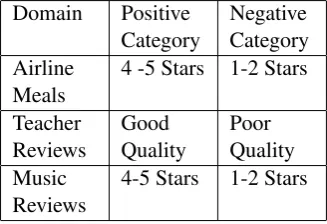
Each document contained: the text and a form of rating. The rating was taken as an indication of the polarity of the review. The criteria for class as-signment is described in Table 2. Documents not satisfying the criteria for class assignment were re-moved from our experiments.
These resulting labelled data sets were used to compare:
• Two separate base learners (Naive Bayes and Language Models)
Domain Positive Category
Negative Category Airline
Meals
4 -5 Stars 1-2 Stars
Teacher Reviews
Good Quality
Poor Quality Music
Reviews
[image:4.595.307.471.610.722.2]4-5 Stars 1-2 Stars
• Alternative strategies
The evaluation was by means of an estimated F-Measure. The experiments used increasing larger random selection of documents as training data. The smallest selection of data was 1% of the total and the largest 5%. The increments were in steps of 1%, for example the second iteration of the ex-periment was 2%, the third 3% etc. At each itera-tion the experiment was repeated 20 times, for ex-ample the 1st iteration there would be 20 random samples of 1% and 20 estimations of F-Measure. An overview of the process is the following: 1. randomly select training data (the LD set in Algo-rithm 1) and 2. ”artificially unlabel” the remaining documents to create the UD.
The experiments were repeated using Language Models and Naive Bayes Classifier as the baseline classifiers within the GST algorithm.
We have compared our proposed method against three alternative strategies:
(1) inductive, (2) self-training and (3) con-strained learning.
• Inductive: An inductive strategy induces a classification model using only the labelled data (Abney, 2007b).
• Self-Training: An iterative process where at each step a model is induced from the current labelled data and it is used to classify the un-labelled data set. The model assigns a ”confi-dence measure” to each classification. If the classification confidence measure is greater than a predefined threshold then the respec-tive unlabelled cases are added to the new iteration training data with the classifier as-signed label. At the end of the cycle the learner is trained on the ”new labelled data set”. This cycle continues until a stopping condition is met (Abney, 2007b). To ensure an equitable comparison the stopping condi-tion for both self-training and GST was 5 it-erations.
• Constrained Learning: The alternate con-strained learning strategies were Voting and Veto.
– Voting strategy: Selects documents if both the classifiers agree on the classi-fication of the document
[image:5.595.312.537.58.252.2]– Veto strategy: The base learner selects the data, but high precision classifier
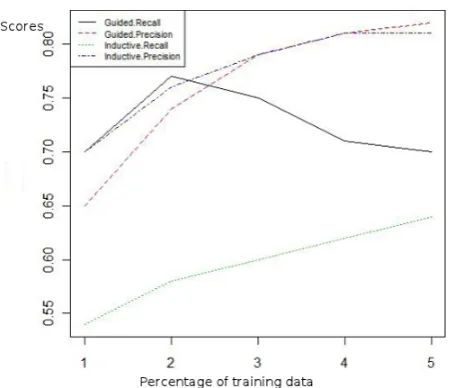
[image:5.595.309.533.292.486.2]Figure 1: Language Models: Comparative Recall and Precision for Teacher Domain
Figure 2: Naive Bayes: Comparative Recall and Precision for Airline Meals Domain
adds the label, consequently the high precision classifier vetoes a dissenting leaner classification. The high precision classifier is not allowed to abdicate.
4 Experimental Results
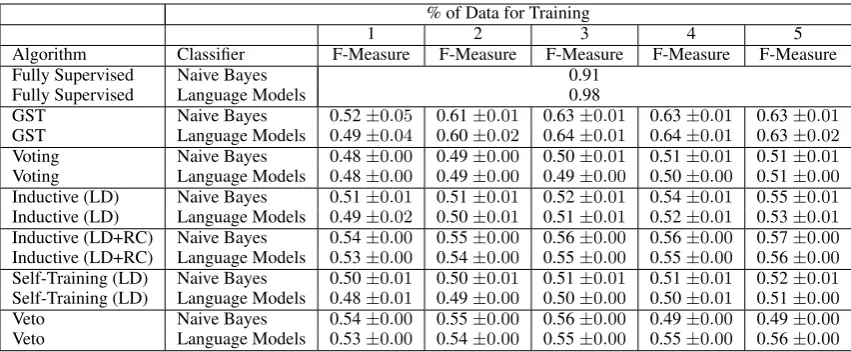
TheAirline Food Domainresults are presented in Table 3. The results demonstrate a clear advan-tage for the proposed strategy for both classifiers. The results demonstrate a significant gain in F-Measure at the 2% of domain for training for both classifiers. The gain in F-Measure halts at the 3% of domain for training. The two inductive strate-gies gain F-Measure as training data increases.
% of Data for Training
1 2 3 4 5
Algorithm Classifier F-Measure F-Measure F-Measure F-Measure F-Measure
Fully Supervised Naive Bayes 0.91
Fully Supervised Language Models 0.98
GST Naive Bayes 0.52±0.05 0.61±0.01 0.63±0.01 0.63±0.01 0.63±0.01
GST Language Models 0.49±0.04 0.60±0.02 0.64±0.01 0.64±0.01 0.63±0.02
Voting Naive Bayes 0.48±0.00 0.49±0.00 0.50±0.01 0.51±0.01 0.51±0.01
Voting Language Models 0.48±0.00 0.49±0.00 0.49±0.00 0.50±0.00 0.51±0.00
Inductive (LD) Naive Bayes 0.51±0.01 0.51±0.01 0.52±0.01 0.54±0.01 0.55±0.01
Inductive (LD) Language Models 0.49±0.02 0.50±0.01 0.51±0.01 0.52±0.01 0.53±0.01
Inductive (LD+RC) Naive Bayes 0.54±0.00 0.55±0.00 0.56±0.00 0.56±0.00 0.57±0.00
Inductive (LD+RC) Language Models 0.53±0.00 0.54±0.00 0.55±0.00 0.55±0.00 0.56±0.00
Self-Training (LD) Naive Bayes 0.50±0.01 0.50±0.01 0.51±0.01 0.51±0.01 0.52±0.01
Self-Training (LD) Language Models 0.48±0.01 0.49±0.00 0.50±0.00 0.50±0.01 0.51±0.00
Veto Naive Bayes 0.54±0.00 0.55±0.00 0.56±0.00 0.49±0.00 0.49±0.00
[image:6.595.72.498.61.237.2]Veto Language Models 0.53±0.00 0.54±0.00 0.55±0.00 0.55±0.00 0.56±0.00
Table 3: Airline Meals Experimental Results
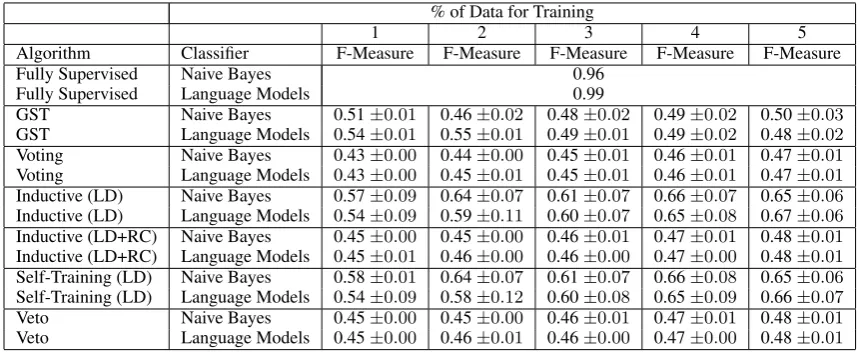
for the proposed strategy. In common with the air-line food domain the Guided Self-Training(GST) shows a large gain in F-Measure at 2% of domain for training. The gain in F-Measure is more pro-nounced for language models. GST demonstrates a reduction in F-Measure with further increases in training data. The reduction in F-Measure is within the mean standard deviation. The inductive strategists in common with the airline food domain gains F-Measure with increases in training data. The self-training strategy gains in F-Measure in-crease with training data, but at a faster rate than the inductive strategies. The voting schemes also demonstrate a gain in F-Measure, but at a lower rate than the inductive and self-training strategies. TheMusic Review Domainresults are presented in Table 4. The results demonstrates that the pro-posed strategy does not show any distinct advan-tage over the competing strategies. The models in-duced from the labelled data seem robust and the various SSL strategies fail to improve this strategy.
4.1 Discussion of Results
Strategies which have access to rule selected data frequently have a higher precision measure, but this improvement is frequently at the cost of lower recall. For example the mean average recall and precision for the voting strategy in the Airline Food domain was 0.5 and 0.7, where as the in-ductive strategy yielded recall and precision of: 0.51 and 0.62. A possible explanation for this phe-nomenon is that fact that the high precision clas-sifier may only classify a very specific sample of documents. The addition of these documents la-belled by the high precision classifier to the initial data set of the models we could be biasing the
clas-sifier towards learning very specific rules, which may negatively impact on recall, but may boost precision. The GST method does not suffer from a decrease in recall. A possible explanation could be the high precision classifier is being used with a different purpose within GST when compared to the (LD+RC) learners. In GST high precision classifier are used to supervise the classifications of a standard base learner with the goal of avoid-ing very obvious mistakes. In the (LD+RC) learn-ers the rules are used to add more labelled data to the training set available to the learners. These are two different uses of the high precision classi-fier and our experiments clearly provide evidence towards the advantage of our proposal. In effect, GST improvement in precision is not offset by a drop in recall.
The graphs illustrated in Figure 2 and Figure 1 provide a comparative analysis of the precision and recall for the inductive and proposed strategy in the airline and teacher domains respectively. These graphs provide some evidence for the asser-tion that the F-Measure gains are at not at the ex-pense of a drop in recall because until 2% domain training data there are gains in precision and no drop in recall. The airline domain demonstrates a gain in recall. The recall drops from 2% onwards, however recall is always significantly higher than the recall for the inductive strategy. The GST strat-egy continues to gain precision with increases in training data.
4.2 Discussion of Methodology
% of Data for Training
1 2 3 4 5
Algorithm Classifier F-Measure F-Measure F-Measure F-Measure F-Measure
Fully Supervised Naive Bayes 0.96
Fully Supervised Language Models 0.99
GST Naive Bayes 0.67±0.04 0.71±0.02 0.67±0.03 0.66±0.02 0.65±0.02
GST Language Models 0.58±0.01 0.75±0.01 0.76±0.01 0.74±0.02 0.73±0.02
Voting Naive Bayes 0.47±0.01 0.48±0.01 0.51±0.01 0.52±0.01 0.54±0.01
Voting Language Models 0.45±0.01 0.48±0.01 0.49±0.01 0.51±0.01 0.53±0.01
Inductive (LD) Naive Bayes 0.56±0.03 0.60±0.02 0.63±0.03 0.65±0.02 0.66±0.02
Inductive (LD) Language Models 0.52±0.02 0.59±0.03 0.61±0.02 0.64±0.02 0.66±0.02
Inductive (LD+RC) Naive Bayes 0.53±0.00 0.54±0.00 0.54±0.05 0.57±0.00 0.58±0.00
Inductive (LD+RC) Language Models 0.52±0.00 0.53±0.00 0.55±0.00 0.56±0.00 0.57±0.00
Self-Training (LD) Naive Bayes 0.53±0.03 0.56±0.02 0.60±0.02 0.62±0.03 0.64±0.02
Self-Training (LD) Language Models 0.49±0.02 0.55±0.03 0.57±0.02 0.60±0.02 0.62±0.02
Veto Naive Bayes 0.52±0.00 0.54±0.00 0.55±0.00 0.57±0.00 0.58±0.00
[image:7.595.72.498.61.237.2]Veto Language Models 0.52±0.00 0.53±0.00 0.55±0.00 0.56±0.00 0.57±0.00
Table 4: Teacher Review Experimental Results
% of Data for Training
1 2 3 4 5
Algorithm Classifier F-Measure F-Measure F-Measure F-Measure F-Measure
Fully Supervised Naive Bayes 0.96
Fully Supervised Language Models 0.99
GST Naive Bayes 0.51±0.01 0.46±0.02 0.48±0.02 0.49±0.02 0.50±0.03
GST Language Models 0.54±0.01 0.55±0.01 0.49±0.01 0.49±0.02 0.48±0.02
Voting Naive Bayes 0.43±0.00 0.44±0.00 0.45±0.01 0.46±0.01 0.47±0.01
Voting Language Models 0.43±0.00 0.45±0.01 0.45±0.01 0.46±0.01 0.47±0.01
Inductive (LD) Naive Bayes 0.57±0.09 0.64±0.07 0.61±0.07 0.66±0.07 0.65±0.06
Inductive (LD) Language Models 0.54±0.09 0.59±0.11 0.60±0.07 0.65±0.08 0.67±0.06
Inductive (LD+RC) Naive Bayes 0.45±0.00 0.45±0.00 0.46±0.01 0.47±0.01 0.48±0.01
Inductive (LD+RC) Language Models 0.45±0.01 0.46±0.00 0.46±0.00 0.47±0.00 0.48±0.01
Self-Training (LD) Naive Bayes 0.58±0.01 0.64±0.07 0.61±0.07 0.66±0.08 0.65±0.06
Self-Training (LD) Language Models 0.54±0.09 0.58±0.12 0.60±0.08 0.65±0.09 0.66±0.07
Veto Naive Bayes 0.45±0.00 0.45±0.00 0.46±0.01 0.47±0.01 0.48±0.01
Veto Language Models 0.45±0.00 0.46±0.01 0.46±0.00 0.47±0.00 0.48±0.01
Table 5: Music Reviews Experimental Results
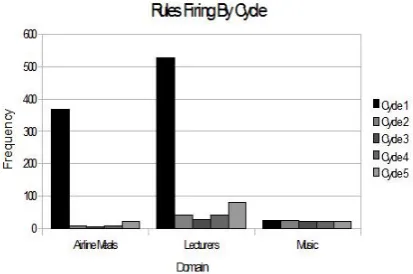
data will improve the performance of the induced model. An experiment was conducted where the number of documents corrected was recorded per training cycle. The experiment was conducted for the 1% of domain for training. The results are de-scribed in Figure 3. The two domains in which GST gained the highest F-Measure there is a high level of corrections in the first training cycle. The remaining cycles show a small number of correc-tions. The music domain demonstrates a small number of corrections and may account for the rel-atively poor performance of GST in this domain.
The second assumption of this methodology is that the classifier which corrects the erroneous classifications must be accurate and that classifiers with lower precision will effect the performance of the GST strategy. A further experiment was conducted with a high precision classifier which was constructed with a lower precision methodol-ogy (method 1). The experiment was conducted
on the airline meals domain data. The results are presented in Table 6. The results were the worst of all of the strategies tested. The lower preci-sion classifier ”modified” correct high confidence classifications made by the base learner rather than the high confidence erroneous classifications. The ”erroneous corrections” inhibited the base learner and induced a weak model. Although the afore-mentioned methodology had an inferior precision than the classifier used for the proposed strategy its overall performance was slightly better. Ta-ble 6 shows the inductive(RD+LC) strategy which used rule selected data gained a slightly higher F-Measure than for the inductive(RD+LC) strategy in the main experiments (Table 3).
5 Conclusion
[image:7.595.70.500.268.445.2]clas-% of Data for Training
1 2 3 4 5
Algorithm Classifier F-Measure F-Measure F-Measure F-Measure F-Measure GST Language Models 0.13±0.00 0.15±0.00 0.17±0.00 0.21±0.00 0.25±0.00
[image:8.595.73.501.61.116.2]Inductive (RD+LC) Language Models 0.58±0.00 0.58±0.00 0.59±0.00 0.59±0.00 0.59±0.00
Table 6: GST Strategy with lower precision classifier
sification tasks where there are limited labelled documents. The proposed technique can perform well in circumstances where more mature strate-gies may perform poorly. The characteristics of the domains where it is thought that this strategy will offer a clear advantage are the following: (1) model induced from labelled data makes obvious mistakes, (2) adding more data (either manually or by rules) does not improve performance, and (3) it is possible to construct a high precision rule based classifier. GST uses linguistic information encoded into a high precision classifier. This in-formation is not added on mass where the learner may be biased towards information captured by the high precision classifier, but it is added in ar-eas where the learner is weak. GST also selects a larger variety of documents than the high precision classifier because the base learner self-selects high confidence candidates from the unlabelled data. The constant testing of the learner prevents drift which may occur in classical self-training. The proposed technique provides a viable alternative to current semi-supervised classification strategies, as our experimental results demonstrate.
Figure 3: No. Corrected Documents Per Training Cycle.
References
S. Abney. 2007a. Semisupervised Learning for
Computational Linguistics. Chapman & Hall/CRC. Chapter 9: Agreement Constraints.
S. Abney. 2007b. Semisupervised Learning for
Computational Linguistics. Chapman & Hall/CRC. Chapter two: Self Training and Co-Training.
airlinemeals.net. 2010. Airlinemeals. http://
www.airlinemeals.net/, consulted in 2010.
Gregory Druck, Gideon S. Mann, and Andrew Mccal-lum. 2008. Learning from labeled features using
generalized expectation criteria. In Research and
Development in Information Retrieval, pages 595– 602.
Brett Drury and Jos´e Jo˜ao Almeida. 2011. Identifi-cation of fine grained feature based event and
senti-ment phrases from business news stories. InWIMS,
page 27.
A. Esuli and F. Sebastiani. 2006. Sentiwordnet: A publicly available lexical resource for opinion min-ing. InIn Proceedings of the 5th Conference on Lan-guage Resources and Evaluation (LREC 06, pages 417 – 422.
C. Fellbaum. 1998. WordNet: An Electronical Lexical
Database. The MIT Press, Cambridge, MA.
Alon Halevy, Peter Norvig, and Fernando Pereira.
2009. The unreasonable effectiveness of data. IEEE
Intelligent Systems, 2:8–12.
Vasileios Hatzivassiloglou and Kathleen R. McKeown. 1997. Predicting the semantic orientation of
adjec-tives. In Proceedings of the eighth conference on
European chapter of the Association for Computa-tional Linguistics, pages 174–181.
Bing Liu. 2007. Web Data Mining: chapter(Opinion
Mining). Springer.
ratemyprofessors.com. 2010.
Ratemyprofes-sors. http://www.ratemyprofessors.
com/, consulted in 2010.
reviewcentre.com. 2010. Reviewcentre. http://
www.reviewcentre.com/, consulted in 2010.
E. Riloff and J. Weibe. 2003. Learning extraction
patterns for subjective expressions. InIn Proceed-ings of the 2003 Conference on Empirical Methods in Natural Language Processing, pages 105–112.
Ming wei Chang, Lev Ratinov, and Dan Roth. 2007. Guiding semi-supervision with constraint-driven
learning. InIn Proc. of the Annual Meeting of the
[image:8.595.77.284.495.632.2]