JHEP04(2014)002
Published for SISSA by SpringerReceived: January 30, 2014 Accepted: March 4, 2014 Published: April 1, 2014
S-matrix for strings on
η
-deformed
AdS
5×
S
5Gleb Arutyunov,a,1 Riccardo Borsatoa and Sergey Frolovb,c,1,2
aInstitute for Theoretical Physics and Spinoza Institute, Utrecht University,
Leuvenlaan 4, 3584 CE Utrecht, The Netherlands
bInstitut f¨ur Mathematik und Institut f¨ur Physik, Humboldt-Universit¨at zu Berlin,
IRIS Adlershof, Zum Großen Windkanal 6, 12489 Berlin, Germany
cHamilton Mathematics Institute and School of Mathematics,
Trinity College, Dublin 2, Ireland
E-mail: [email protected],[email protected],[email protected]
Abstract: We determine the bosonic part of the superstring sigma model Lagrangian
on η-deformed AdS5×S5, and use it to compute the perturbative world-sheet scattering matrix of bosonic particles of the model. We then compare it with the large string tension limit of the q-deformed S-matrix and find exact agreement.
Keywords: AdS-CFT Correspondence, Bosonic Strings, Exact S-Matrix, Integrable Field
Theories
ArXiv ePrint: 1312.3542
JHEP04(2014)002
Contents1 Introduction 1
2 Superstrings on η-deformed AdS5×S5 3
3 Perturbative bosonic world-sheet S-matrix 6
3.1 Light-cone gauge and quartic Hamiltonian 6
3.2 Tree level bosonic S-matrix 9
3.3 Comparison with the q-deformed S-matrix 11
4 Conclusions 13
A The inverse operator and bosonic Lagrangian 14
B The psu(2|2)q-invariant S-matrix 17
C Expansion of the q-deformed Gamma-function 19
1 Introduction
In recent years significant progress has been made towards understanding the excitation spectrum of strings moving in five-dimensional anti-de Sitter space-time and, accordingly, the spectrum of scaling dimensions of composite operators in planarN = 4 supersymmetric gauge theory. This progress became possible due to the fundamental insight that strings propagating in AdS space can be described by an integrable model. In certain aspects, however, the deep origin of this exact solvability has not yet been unraveled, mainly be-cause of tremendous complexity of the corresponding model. A related question concerns robustness of integrability in the context of the gauge-string correspondence [1], as well as the relationship between integrability and the amount of global (super)symmetries pre-served by the target space-time in which strings propagate. To shed further light on these important issues, one may attempt to search for new examples of integrable string back-grounds that can be solved by similar techniques. One such instance, where this program is largely promising to succeed, is to study various deformations of the string target space that preserve the integrability of the two-dimensional quantum field theory on the world sheet. Simultaneously, this should provide interesting new information about integrable string models and their dual gauge theories.
JHEP04(2014)002
giving a string theory on a TsT-transformed background [4,5]. Eventually all deformations of this class can be conveniently described in terms of the original string theory, where the deformations result into quasi-periodic but still integrable boundary conditions for the world-sheet fields.
The second class of deformations affects the AdS5 ×S5 model on a much more fun-damental level and is related to deformations of the underlying symmetry algebra. In the light-cone gauge this symmetry algebra constitutes two copies of the centrally extended Lie superalgebrapsu(2|2) with the same central extension for each copy. It appears that this centrally extended psu(2|2), or more precisely its universal enveloping algebra, admits a natural deformation psuq(2|2) in the sense of quantum groups [6,7]. This algebraic struc-ture is the starting point for the construction of apsuq(2|2)⊕psuq(2|2)-invariant S-matrix, giving a quantum deformation of the AdS5×S5 world-sheet S-matrix [6,8,9]. The defor-mation parameter q can be an arbitrary complex number, but in physical applications is typically taken to be either real or a root of unity.
Since these quantum group deformations modify the dispersion relation and the scat-tering matrix, to solve the corresponding model by means of the mirror Thermodynamic Bethe Ansatz (TBA), for a recent review see [10], one has to go through the entire procedure of first deriving the TBA equations for the ground state and then extending them to include excited states. While this program has been successfully carried out for deformations with
q being a root of unity [11, 12], the corresponding string background remains unknown. There is a conjecture that in the limit of infinite ’t Hooft coupling the q-deformed S-matrix tends to that of the Pohlmeyer-reduced version of the AdS5×S5 superstring [13,14]. It is not straightforward, however, to identify the S-matrix of the latter theory as one has to un-derstand whether the elementary excitations that scatter in that model are solitons or kinks. The case of real deformation parameter considered in this paper is not less compelling. Recently there was an interesting proposal on how to deform the sigma-model for strings on AdS5×S5 with a real deformation parameter η [15]. Deformations of this type con-stitute a general class of deformations governed by solutions of the classical Yang-Baxter equation [16,17]. This class is not solely restricted to the string model in question but can be applied to a large variety of two-dimensional integrable models based on (super)groups or their cosets [18]–[21].
The aim of the present work is to compute the 2 → 2 scattering matrix for the η -deformed model in the limit of large string tension g and to compare the corresponding result with the known q-deformed S-matrix found from quantum group symmetries, uni-tarity and crossing [6, 8]. In the context of the undeformed model a computation of this type has been carried out in [22].
JHEP04(2014)002
Let us summarize the results of this paper. Coming back to the bosonic action, we find that it corresponds to a string background which in addition to the metric also supports a non-vanishingB-field. The deformation breaks AdS5×S5isometries down to U(1)3×U(1)3, where the first and second factors refer to the deformed AdS and five-sphere, respectively. Thus, only isometries corresponding to the Cartan elements of the isometry algebra of the AdS5×S5 survive, very similar to the case of genericγ-deformations. As for the metric, its AdS part exhibits a singularity whose nature is currently unclear. Computed in a string frame the metric includes the contribution of a dilaton, and to extract the latter one needs to know the RR-fields which requires considering fermions.
With the bosonic action at hand it is straightforward to compute the corresponding tree-level S-matrix. We then show that it matches perfectly with the q-deformed S-matrix taken in the large tension limit and restricted to the scattering of bosons, provided we identify the deformation parameters as
q =e−ν/g, ν= 2η 1 +η2 .
This is the main result of our work which makes it quite credible that the η-deformed model indeed may enjoy hidden psuq(2|2)⊕psuq(2|2) symmetry for finite values of the coupling constantg. If true, this implies that despite the singular behaviour of the metric the quantum string sigma model would be well defined. In particular it would be possible to compute its exact spectrum by means of the mirror TBA.
The paper is organized as follows. In the next section we recall the general form of the action for the η-deformed model and use it to derive an explicit form of the Lagrangian for bosonic degrees of freedom. In section 3, upon fixing the uniform light-cone gauge, the corresponding Hamiltonian is derived up to quartic order in fields and further used to compute the tree-level S-matrix. This result is subsequently compared to the one arising from the q-deformed S-matrix (which includes the dressing phase) in the large g limit. We conclude by outlining interesting open problems. Finally some technical details on the derivation of the bosonic Lagrangian, the perturbative expansion of the q-deformed dressing phase and the form of the q-deformed S-matrix are collected in three appendices.
2 Superstrings on η-deformed AdS5×S5
According to [15], the action for superstrings on the deformed AdS5×S5 is
S = Z
dσdτL ,
where the Lagrangian density depending on a real deformation parameterη is given by1
L =−g 4(1 +η
2) γαβ −αβ str
˜
d(Aα) 1 1−ηRg◦d
(Aβ)
. (2.1)
1Note that ourη-dependent prefactor differs from the one in [15]. Our choice is necessary to match the
JHEP04(2014)002
Here and in what follows we use the notations and conventions from [24], in particularτ σ = 1 andγαβ =hαβ√−hthat is the Weyl invariant combination of the world-sheet metrichαβ; the component γτ τ <0. The coupling constant g is the effective string tension. Further,
Aα = −g−1∂αg, where g ≡ g(τ, σ) is a coset representative from PSU(2,2|4)/SO(4,1)×
SO(5). To define the operators dand ˜dacting on the currents Aα, we need to recall that the Lie superalgebra G =psu(2,2|4) admits aZ4-graded decomposition
G =G(0)⊕G(1)⊕G(2)⊕G(3).
Here G(0) coincides with so(4,1)×so(5). Denoting by Pi, i = 0,1,2,3, projections on the corresponding components of the graded decomposition above, operators dand ˜dare defined as
d= P1+ 2
1−η2P2−P3,
˜
d= −P1+ 2
1−η2P2+P3.
Finally, the action of the operatorRg onM ∈G is given by
Rg(M) =g−1R(gMg−1)g, (2.2)
where R is a linear operator onG satisfying the modified classical Yang-Baxter equation. In the following we define the action ofR on an arbitrary 8×8 matrix M as
R(M)ij =−i ijMij, ij =
1 if i < j
0 if i=j
−1 if i > j
, (2.3)
In the limit η → 0 one recovers from (2.1) the Lagrangian density of the AdS5×S5 superstring.
Our goal now is to obtain an explicit form for the corresponding bosonic action. With fermionic degrees of freedom switched off, formula (2.1) simplifies to
L =−g 2(1 +κ
2)12 γαβ−αβ str
A(2)α 1
1−κRg◦P2 (Aβ)
, (2.4)
where we have introduced
κ= 2η
1−η2 ,
which as we see in a moment is a convenient deformation parameter.
To proceed, we need to choose a representative g of a bosonic coset SU(2,2|4)× SU(4)/SO(4,1)×SO(5) and invert the operator 1−ηRg◦d. A convenient choice of a coset
representative and the inverse of 1−ηRg◦dare discussed in appendix A. Making use of
the inverse operator, one can easily compute the corresponding bosonic Lagrangian. It is given by the sum of the AdS and sphere parts
JHEP04(2014)002
where we further split each part into the contribution of the metric and Wess-Zumino pieces. Accordingly, for the metric pieces we obtain
LG
a =−
g
2(1 +κ 2)1
2 γαβ
−∂αt∂βt 1 +ρ
2
1−κ2ρ2 +
∂αρ∂βρ
(1 +ρ2) (1−κ2ρ2) +
∂αζ∂βζρ2
1 +κ2ρ4sin2ζ
+∂αψ1∂βψ1ρ 2cos2ζ
1 +κ2ρ4sin2ζ
+∂αψ2∂βψ2ρ2sin2ζ
, (2.6)
LG
s =−
g
2(1 +κ
2)12 γαβ∂αφ∂βφ 1−r2
1 +κ2r2 +
∂αr∂βr
(1−r2) (1 +
κ2r2)
+ ∂αξ∂βξr 2
1 +κ2r4sin2ξ
+∂αφ1∂βφ1r 2cos2ξ
1 +κ2r4sin2ξ +∂αφ2∂βφ2r
2sin2ξ, (2.7)
while the Wess-Zumino partsLaW Z and LsW Z read
LW Z
a =
g
2κ(1 +κ 2)1
2 αβ ρ 4sin 2ζ
1 +κ2ρ4sin2ζ∂αψ1∂βζ , (2.8)
LW Z
s =−
g
2κ(1 +κ
2)12 αβ r4sin 2ξ
1 +κ2r4sin2ξ∂αφ1∂βξ .
(2.9)
Here the coordinates t , ψ1, ψ2, ζ , ρ parametrize the deformed AdS space, while the co-ordinates φ , φ1, φ2, ξ , r parametrize the deformed five-sphere. Switching off the defor-mation, one finds that the AdS5 coordinates are related to the embedding coordinatesZA, A= 0,1, . . . ,5 obeying the constraint ηABZAZB=−1 where ηAB = (−1,1,1,1,1,−1) as
Z1+iZ2 =ρcosζ eiψ1, Z3+iZ4 =ρsinζ eiψ2, Z0+iZ5 = q
1 +ρ2eit, (2.10)
while theS5coordinates are related to the embedding coordinatesYA, A= 1, . . . ,6 obeying YA2 = 1 as
Y1+iY2 =rcosξ eiφ1, Y3+iY4=rsinξ eiφ2, Y5+iY6 = p
1−r2eiφ. (2.11)
It is obvious that the deformed action is invariant under U(1)3×U(1)3 corresponding to the shifts of t,ψk, φ, φk. One also finds the ranges ofρ and r: 0 ≤ρ ≤ κ1 and 0≤r ≤1.
The (string frame) metric of the deformed AdS is singular at ρ = 1/κ. Since we do not know the dilaton it is unclear if the Einstein frame metric exhibits the same singularity. The bosonic Wess-Zumino terms signify the presence of a non-trivial background B-field which is absent in the undeformed case.
In the next section we are going to impose the light-cone gauge, take the decompact-ification limit and compute the bosonic part of the four-particle world-sheet scattering matrix. To this end, we first expand the Lagrangian (2.5) up to quartic order inρ,r and their derivatives, and then make the shifts ofρandras described in appendixA, cf. (A.18). Since we are interested in the perturbative expansion in powers of fields aroundρ= 0, the final step consists in changing the spherical coordinates to (zi, yi)i=1,...,4 as
z1+iz2 1−1
4z2
=ρcosζeiψ1, z3+iz4 1− 1
4z2
=ρsinζeiψ2, z2≡z2
i , (2.12)
y1+iy2
1 +14y2 =rcosξe
iφ1, y3+iy4
1 +14y2 =rsinξe
JHEP04(2014)002
with further expanding the resulting action up to the quartic order in z and y fields. In this way we find the following quartic Lagrangian
La=−
g
2(1 +κ
2)12 γαβ−1 + (1 +
κ2)z2+ 1 2(1 +κ
2)2(z2)2∂ αt∂βt
+
1 + (1−κ2)z
2
2
∂αzi∂βzi
+ 2gκ(1 +κ2)
1 2(z2
3 +z24)αβ∂αz1∂βz2,
Ls=−
g
2(1 +κ
2)12 γαβ 1−(1 +
κ2)y2+ 1 2(1 +κ
2)2(y2)2∂αφ∂ βφ
+
1−1 2(1−κ
2)y2
∂αyi∂βyi
−2gκ(1 +κ2)
1 2(y2
3+y42)αβ∂αy1∂βy2.
(2.13)
We point out that the metric part of this Lagrangian has a manifest SO(4)×SO(4) sym-metry which is however broken by the Wess-Zumino terms.
3 Perturbative bosonic world-sheet S-matrix
3.1 Light-cone gauge and quartic Hamiltonian
To fix the light-cone gauge and compute the scattering matrix, it is advantageous to use the Hamiltonian formalism. For the reader’s convenience we start with a general discussion on how to construct the Hamiltonian for the world-sheet action of the form
S=−g 2
Z r
−r
dσdτγαβ∂αXM∂βXNGM N −αβ∂αXM∂βXNBM N
, (3.1)
where GM N and BM N are the background metric and B-field respectively. In the first order formalism we introduce conjugate momenta
pM = δS
δX˙M =−gγ 0β∂
βXNGM N+gX
0N
BM N. (3.2)
The action can be rewritten as
S = Z r
−r
dσdτ pMX˙M + γ01 γ00C1+
1 2gγ00C2
!
, (3.3)
whereC1, C2 are the Virasoro constraints. They are given by
C1 = pMX0M, (3.4)
C2 = GM NpMpN −2gpMX0QGM NBN Q+g2X0PX0QBM PBN QGM N +g2X0MX0NGM N.
The first Virasoro constraint has the same form as in the undeformed case. In particular, the solution for x0− in terms of pµ, xµ will still be the same. When expressed in terms of
the conjugate momenta, the second constraint gets an explicit dependence on the B-field. To impose light-cone gauge, one first introduces light-cone coordinates
JHEP04(2014)002
The second Virasoro constraint can be written as
C2=G−−p2−+ 2G+−p+p−+G++p2+
+g2G++x0−2+ 2g2G+−x+0 x0−+g2G−−x0+2+Hx,
(3.6)
where
G−−=a2G−φφ1−(a−1)2G−tt1, G+−=aGφφ−1−(a−1)G−tt1, G++=G−φφ1−G−tt1,
G++= (a−1)2Gφφ−a2Gtt, G+−=−(a−1)Gφφ+aGtt, G−−=Gφφ−Gtt,
and Hx is the part that depends on the transverse fields only
Hx=Gµνpµpν +g2X0µX0νGµν−2gpµX0ρGµνBνρ+g2X0λX0ρBµλBνρGµν. (3.7)
Notice that the B-field is contained only in Hx, since in the action it does not couple to
the derivatives ofx±. We impose the uniform light-cone gauge
x+=τ, p+= 1. (3.8)
Solving C2 = 0 for p− gives the Hamiltonian
H=−p−(pµ, xµ, x0µ). (3.9)
Formally the solution for the Hamiltonian is still given by eq. (2.16) of the review [24], with the only difference that now the components of the metric are deformed and thatHx has also theB-field contribution. Rescaling the fields with powers ofgand expanding in g
one can findHn, namely the part of the Hamiltonian that is of order nin the fields. Then
the action acquires the form
S = Z
dτdσ
pµx˙µ− H2− 1
gH4− · · ·
, (3.10)
where the quadratic Hamiltonian is given by
H2 = 1 2p
2 µ+
1 2(1 +κ
2)x2 µ+
1 2(1 +κ
2)x02
µ. (3.11)
The quartic Hamiltonian in a general a-gauge is
H4= 1 4
(2κ2z2−(1 +κ2)y2)p2z−(2κ2y2−(1 +κ2)z2)p2y
+1 +κ2 2z2−
1 +κ2
y2z02+1 +κ2
z2−2y2y02
−2κ1 +κ2 1 2
z32+z24 pz1z
0
2−pz2z
0
1
−y32+y42 py1y
0
2−py2y
0
1
+(2a−1) 8
(p2y+p2z)2−(1 +κ2)2(y2+z2)2
+ 2(1 +κ2)(p2y +p2z)(y
02+z02) + (1 +
κ2)2(y02+z02)2−4(1 +κ2)(x0−)2
.
(3.12)
Here we use the notation p2
z ≡p2zi, p
2
JHEP04(2014)002
To simplify the quartic piece, we can remove the terms of the form p2
zy2 and p2yz2 by
performing a canonical transformation generated by
V = (1 +κ 2)
4 Z
dσpyyz2−pzzy2
, (3.13)
where the shorthand notation pyy ≡ pyiyi, pzz ≡ pzizi was used. After this is done the quartic Hamiltonian is
H4 = (1 +κ 2)
2 (z
2z02−y2y02) +(1 +κ2)2 2 (z
2y02−y2z02) +κ2 2 (z
2p2
z−y2p2y)
−2κ(1 +κ2)12 h
z32+z24 pz1z
0
2−pz2z
0
1
−y32+y42 py1y
0
2−py2y
0
1 i
+(2a−1) 8
(p2y+p2z)2−(1 +κ2)2(y2+z2)2 (3.14)
+2(1 +κ2)(p2y+p2z)(y02+z02) + (1 +κ2)2(y02+z02)2−4(1 +κ2)(x0−)2
.
We recall that in the undeformed case the corresponding theory is invariant with respect to the two copies of the centrally extended superalgebrapsu(2|2), each containing two su(2) subalgebras. To render invariance under su(2) subalgebras manifest, one can introduce two-index notation for the world-sheet fields. It is also convenient to adopt the same notation for the deformed case2
Z3 ˙4= 12(z3−iz4), Z3 ˙3= 12(z1−iz2),
Z4 ˙3=−1
2(z3+iz4), Z 4 ˙4= 1
2(z1+iz2),
(3.15)
Y1 ˙2= 12(y3−iy4), Y1 ˙1= 12(y1+iy2),
Y2 ˙1=−1
2(y3+iy4), Y 2 ˙2= 1
2(y1−iy2).
(3.16)
In terms of two-index fields the quartic Hamiltonian becomesH4 =HG
4 +HW Z4 , whereHG4 is the contribution coming from the spacetime metric andHW Z
4 from the B-field
HG
4 = 2(1 +κ2)
Zαα˙Zαα˙Zβ0β˙Z0β ˙ β−Y
aa˙Yaa˙Yb0b˙Y0b ˙ b
+2(1 +κ2)2Zαα˙Zαα˙Yb0b˙Y0b ˙ b−Y
aa˙Yaa˙Zβ0β˙Z0β ˙ β
+κ 2
2
Zαα˙Zαα˙Pββ˙Pβ ˙ β−Y
aa˙Yaa˙Pbb˙Pb ˙ b
+(2a−1) 8
1
4(Paa˙P
aa˙ +P
αα˙Pαα˙)2−4(1 +κ2)2(Yaa˙Yaa˙ +Zαα˙Zαα˙)2 (3.17)
+2(1+κ2)(Paa˙Paa˙+Pαα˙Pαα˙)(Ya0a˙Y0aa˙+Zα0α˙Z0αα˙)+4(1+κ2)2(Ya0a˙Y0aa˙+Zα0α˙Z0αα˙)2
−4(1 +κ2)(Paa˙Y0aa˙+Pαα˙Z0αα˙)2
,
HW Z4 = 8iκ(1 +κ2)
1 2
Z3 ˙4Z4 ˙3(P3 ˙3Z03 ˙3−P4 ˙4Z04 ˙4) +Y1 ˙2Y2 ˙1(P1 ˙1Y01 ˙1−P2 ˙2Y02 ˙2).
2This parameterisation is different from the one used in [24] and the difference is the exchange of the
definitions forY1 ˙1 andY2 ˙2. This does not matter in the undeformed case but is needed here in order to
JHEP04(2014)002
Note that we have used the Virasoro constraint C1 in order to express x0− in terms of
the two index fields. The gauge dependent terms multiplying (2a−1) are invariant under SO(8) as in the underformed case.
3.2 Tree level bosonic S-matrix
The computation of the tree level bosonic S-matrix follows the route reviewed in [24], and we also use the same notations. It is convenient to rewrite the tree-level S-matrix as a sum of two terms T=TG+TW Z, coming from HG
4 and H4W Z respectevely. The reason is that TG preserves the so(4)⊕so(4) symmetry, while TW Z breaks it. To write the results we always assume that p > p0. Then, one finds that the action of TG on the two-particle states is given by
TG |YacY˙ b0d˙i= "
1−2a
2 (pω
0−
p0ω) + 1 2
(p−p0)2+ν2(ω−ω0)2
pω0−p0ω
#
|YacY˙ b0d˙i
+pp
0+ν2ωω0
pω0−p0ω
|Yad˙Yb0c˙i+|Ybc˙Ya0d˙i
,
TG |ZαγZ˙ β0δ˙i= "
1−2a
2 (pω
0−
p0ω)− 1 2
(p−p0)2+ν2(ω−ω0)2
pω0−p0ω
#
|ZαγZ˙ β0δ˙i
−pp
0+ν2ωω0
pω0−p0ω
|Zαδ˙Zβ0γ˙i+|Zβγ˙Zα0δ˙i
,
TG |Yab˙Zα0β˙i= "
1−2a
2 (pω
0−
p0ω)− ω
2−ω02
pω0−p0ω
#
|Yab˙Zα0β˙i,
TG |Zαβ˙Ya0b˙i= "
1−2a
2 (pω
0−p0ω
) + ω 2−ω02
pω0−p0ω #
|Zαβ˙Ya0˙bi,
(3.18)
and the action of TW Z on the two-particle states is
TW Z |Yac˙Yb0d˙i=iν
ab|Ybc˙Ya0d˙i+c˙d˙|Yad˙Y
0
bc˙i
,
TW Z |Zαγ˙Zβ0δ˙i=iν
αβ|Zβγ˙Zα0δ˙i+γ˙δ˙|Zαδ˙Z
0
βγ˙i
,
(3.19)
where on the r.h.s. we obviously do not sum over the repeated indices. In the formulae the frequencyω is related to the momentum pas
ω = (1 +κ2)
1 2
q
1 +p2= s
1 +p2
1−ν2, (3.20)
and we have introduced the parameter
ν = κ (1 +κ2)
1 2
= 2η
1 +η2, (3.21)
JHEP04(2014)002
The S-matrix Scomputed in perturbation theory is related to the T-matrix as
S=1+ i
gT. (3.22)
In the undeformed case, as a consequence of invariance of S with respect to two copies of the centrally extended superalgebrapsu(2|2), the correspondingT-matrix admits a factor-ization
TP
˙ P ,QQ˙
MM ,N˙ N˙ = (−1)
M˙(N+Q)TP Q
M Nδ ˙ P ˙ Mδ
˙ Q ˙
N+ (−1)
Q(M˙+P˙)δP Mδ
Q NT
˙ PQ˙
˙
MN˙ . (3.23)
Here M = (a, α) and M˙ = ( ˙a,α˙), and dotted and undotted indices are referred to two copies of psu(2|2), respectively, while M and M˙ describe statistics of the corresponding indices, i.e. they are zero for bosonic (Latin) indices and equal to one for fermionic (Greek) ones. The factorT can be regarded as 16×16 matrix.
It is not difficult to see that the same type of factorization persists in the deformed case as well. Indeed, from the formulae (3.18) we extract the following elements for the T-matrix
Tabcd=A δacδbd+B δadδcb+W abδdaδcb,
Tαβγδ =D δαγδβδ+E δδαδβγ+W αβδαδδ γ β,
Tcδ
aβ =G δacδδβ, T γd αb =L δ
γ αδbd,
(3.24)
where the coefficients are given by
A(p, p0) = 1−2a 4 (pω
0−p0ω) +1
4
(p−p0)2+ν2(ω−ω0)2
pω0−p0ω ,
B(p, p0) =−E(p, p0) = pp
0+ν2ωω0
pω0−p0ω ,
D(p, p0) = 1−2a 4 (pω
0−p0ω)−1
4
(p−p0)2+ν2(ω−ω0)2
pω0−p0ω ,
G(p, p0) =−L(p0, p) = 1−2a 4 (pω
0−p0ω)−1
4
ω2−ω02 pω0−p0ω, W(p, p0) =iν .
(3.25)
HereW corresponds to the contribution of the Wess-Zumino term and it does not actually depend on the particle momenta. All the four remaining coefficients Tabγδ,Tcd
αβ,T γd aβ,T
γd αb
vanish in the bosonic case but will be switched on once fermions are taken into account. The matrix T is recovered from its matrix elements as follows
T =TM NP QEPM ⊗EQN =TabcdEca⊗Edb+TαβγδEγα⊗Eβδ +TaβcδEca⊗Eδβ+TαbγdEαγ ⊗Edb,
JHEP04(2014)002
explicit 16×16 matrix3
T ≡
A1 0 0 0 | 0 0 0 0 | 0 0 0 0 | 0 0 0 0
0 A2 0 0 | A4 0 0 0 | 0 0 0 0 | 0 0 0 0 0 0 A3 0 | 0 0 0 0 | 0 0 0 0 | 0 0 0 0 0 0 0 A3 | 0 0 0 0 | 0 0 0 0 | 0 0 0 0
− − − − − − − − − − − − − − − − − − −
0 A5 0 0 | A2 0 0 0 | 0 0 0 0 | 0 0 0 0 0 0 0 0 | 0 A1 0 0 | 0 0 0 0 | 0 0 0 0 0 0 0 0 | 0 0 A3 0 | 0 0 0 0 | 0 0 0 0 0 0 0 0 | 0 0 0 A3 | 0 0 0 0 | 0 0 0 0
− − − − − − − − − − − − − − − − − − −
0 0 0 0 | 0 0 0 0 | A8 0 0 0 | 0 0 0 0 0 0 0 0 | 0 0 0 0 | 0 A8 0 0 | 0 0 0 0 0 0 0 0 | 0 0 0 0 | 0 0 A6 0 | 0 0 0 0 0 0 0 0 | 0 0 0 0 | 0 0 0 A7 | 0 0 A9 0
− − − − − − − − − − − − − − − − − − −
0 0 0 0 | 0 0 0 0 | 0 0 0 0 | A8 0 0 0 0 0 0 0 | 0 0 0 0 | 0 0 0 0 | 0 A8 0 0 0 0 0 0 | 0 0 0 0 | 0 0 0 A10 | 0 0 A7 0 0 0 0 0 | 0 0 0 0 | 0 0 0 0 | 0 0 0 A6
.
Here the non-trivial matrix elements ofT are given by
A1 =A+B, A2=A, A4 =B−W, A5=B+W, A6 =D+E, (3.26)
A6 =D+E, A7=D, A8 =L, A9=E−W =−A5, A10=E+W =−A4.
We conclude this section by pointing out that the found matrixT satisfies the classical Yang-Baxter equation
[T12(p1, p2),T13(p1, p3) +T23(p2, p3)] + [T13(p1, p3),T23(p2, p3)] = 0 (3.27)
for any value of the deformation parameter ν.
3.3 Comparison with the q-deformed S-matrix
In this subsection we show that the perturbative bosonic world-sheet S-matrix coincides with the first nontrivial term in the largegexpansion of the q-deformed AdS5×S5S-matrix, in other words with the corresponding classicalr-matrix.4
Let us recall that up to an overall factor the q-deformed AdS5×S5 S-matrix is given by a tensor product of two copies of thepsu(2|2)q-invariant S-matrix [6] which is reviewed in
appendix B. Including the overall factorSsu(2) which is the scattering matrix in the su(2) sector, the complete S-matrix can be written in the form [8]
S=Ssu(2)S⊗ˆS , Ssu(2)=
eia(p2E1−p1E2) σ2
12
x+1 +ξ x−1 +ξ
x−2 +ξ x+2 +ξ ·
x−1 −x+2 x+1 −x−2
1− 1
x−1x+2
1− 1 x+1x−2
, (3.28)
whereS is thepsu(2|2)q-invariant S-matrix (B.3), ˆ⊗stands for the graded tensor product,
a is the parameter of the light-cone gauge (3.5), σ is the dressing factor, and E is the
3See appendix 8.5 of [25] for the corresponding matrix in the undeformed case.
4The difference with the expansion performed in [13] is that we include the dressing factor in the definition
JHEP04(2014)002
q-deformed dispersion relation (B.9) whose large g expansion starts withω. The dressing factor can be found by solving the corresponding crossing equation, and it is given by [8]
σ12=eiθ12, θ12=χ(x+1, x+2) +χ(x
−
1, x
−
2)−χ(x+1, x
−
2)−χ(x
−
1, x+2), (3.29)
where
χ(x1, x2) =i I dz
2πi
1
z−x1 I dz0
2πi
1
z0−x
2 log
Γq2
1 +ig2(u(z)−u(z0))
Γq2
1−ig2(u(z)−u(z0))
. (3.30)
Here Γq(x) is the q-deformed Gamma function which for complex q admits an integral representation (C.1) [8].
To develop the large g expansion of the q-deformed AdS5×S5 S-matrix, one has to assume thatq =e−υ/g whereυis a deformation parameter which is kept fixed in the limit g → ∞, and should be related to ν. Then, due to the factorisation of the perturbative bosonic world-sheet S-matrix and the q-deformed AdS5 ×S5 S-matrix, it is sufficient to compare theT-matrix (3.24) with theT-matrix appearing in the expansion of the “square root” ofS
Ssu1/(2)2 1gS =1+ i
gT, (3.31)
where 1g is the graded identity which is introduced so that the expansion starts with 1. The only term which is not straightforward to expand is the Ssu(2) scalar factor because it contains the dressing phase θ12. The scalar factor obviously can contribute only to the part of the T-matrix proportional to the identity matrix. Since in the expansion of the psu(2|2)q-invariant S-matrix (B.3), 1gS =1+ gir, the element r1111 is equal to 0 (because a1 = 1) it is convenient to subtract T11111 = A11 from the T-matrix and compare the resulting matrix with the classicalr-matrix. One should obviously remove the off-diagonal terms from the classical r-matrix which appear due to the presence of fermions in the full superstring action (2.1). With this done, one finds that they are equal to each other provided υ = ν, and therefore q = e−ν/g is real. Thus, to show that T = T one should demonstrate that A1 is equal to the 1/g term in the expansion of Ssu1/(2)2 . To this end one should find the largegexpansion of the dressing phaseθ12which is done by first expanding the ratio of Γq2-functions in (3.30) with u(z) and u(z0) being kept fixed. This is done in appendix C, see (C.9). Next, one combines it with the expansion of the 1
z−x±1 1 z0−x±
2
terms
which appear in the integrand of (3.29). As a result one finds that the dressing phase is of order 1/gjust as it was in the undeformed case [26]. We have not tried to compute the resulting double integrals analytically but we have checked numerically that the element A1is indeed equal to the 1/gterm in the expansion ofSsu1/(2)2 if the deformation parameterν
satisfiesν <1/√2. At ν= 1/√2 the integral representation for the dressing factor breaks down but it is unclear to us if it is a signal of a genuine problem with the q-deformed S-matrix. In fact it is not difficult to extract from A1 the leading term in the large g
expansion of the dressing phase which appears to be very simple
θ12=
ν2(ω1−ω2) +p22(ω1−1)−p21(ω2−1) 2g(p1+p2)
JHEP04(2014)002
It would be curious to derive this expression from the double integral representation. Note that doing this double integral one also could get the full AFS order of the phase.
4 Conclusions
In this work we successfully matched in the large tension limit the tree-level bosonic S-matrix arising from the sigma-model on the deformed AdS5 × S5 space with the q-deformed S-matrix obtained from symmetries. There are many other important issues to be addressed.
We identified NSNS background fields in the string frame. More studies are needed however to extract RR fields since the latter couple directly to fermionic degrees of freedom. Rather intricate field redefinitions should be performed to bring the deformed action to the standard one for Type IIB superstring in an arbitrary supergravity background, thus allowing the identification of the full bosonic background. It might be easier in fact just to use the NSNS background fields and the type IIB supergravity equations of motion to find the full supergravity background [23].
Next, the matching of S-matrices, successful at tree level, can be further extended by computing admittedly more complicated loop corrections to the tree-level scattering matrix of the light-cone sigma-model; this also requires taking fermions into account. It is natural to expect that the deformation parameter ν undergoes a non-trivial renormalization to fit the parameterq entering the exact, i.e. all-loop, q-deformed S-matrix.
We also showed that in the large tension limit the conjectured dispersion relation (B.9) turns into the perturbative one (3.20). It would be interesting to find an η-deformed giant magnon solution [27] which would provide additional evidence in favour of (B.9). In the case of the finite angular momentum the corresponding solution would also provide important information about the structure of the finite size corrections [28] in theη-deformed theory. It is also interesting to find explicit spinning string solutions of theη-deformed bosonic sigma-model. Due to the singularity of the η-deformed AdS a particularly interesting solution to analyse would be the GKP string and its generalisation [29, 30]. Then, in the case of AdS, substituting the spinning Ansatz in the sigma-model equations of motion leads to the emergence [31] of the Neumann model, a famous finite-dimensional integrable system. One may hope that studies of the η-deformed sigma-model in this context may reveal new integrable finite-dimensional systems which can be described as deformations of the Neumann model. Furthermore, known finite-gap integration techniques can be applied to obtain a wider class of solutions that generalize the solutions of the Neumann system. Normally they are described by a certain algebraic curve which is supposed to emerge from the Bethe Ansatz based on the exact q-deformed S-matrix in the semi-classical limit. This would serve as another non-trivial check that the two models, one based on the explicitly known deformed action and the other based on the exact quantum group symmetry, have a good chance to describe the same physics.
JHEP04(2014)002
With the knowledge of a complete supergravity background and its symmetries for the deformed case, one can approach perhaps the most interesting question about the dual gauge theory. Since the deformation affects the isometries of the AdS space, the theory will be neither conformal nor Lorentz invariant. Since there is a B-field on the string theory side, one may expect that this theory is a non-commutative deformation of N = 4 super Yang-Mills in the sense of the Moyal star product with a hidden quantum group symmetry which would include the two copies of the psuq(2|2) algebra. It would be fascinating to construct such a theory explicitly.
Acknowledgments
We thank Marius de Leeuw, Stijn van Tongeren and Benoit Vicedo for useful discussions. G.A. and R.B. acknowledge support by the Netherlands Organization for Scientific Re-search (NWO) under the VICI grant 680-47-602. The work by G.A. and R.B. is also a part of the ERC Advanced grant research programme No. 246974, “Supersymmetry: a window to non-perturbative physics” and of the D-ITP consortium, a program of the NWO that is funded by the Dutch Ministry of Education, Culture and Science (OCW). S.F. is supported by a DFG grant in the framework of the SFB 647 “Raum - Zeit - Materie. Analytische und Geometrische Strukturen” and by the Science Foundation Ireland under Grant 09/RFP/PHY2142.
A The inverse operator and bosonic Lagrangian
To find the bosonic part of the deformed Lagrangian one needs to choose a coset represen-tativeg, and invert the operator 1−ηRg◦d. We find useful the following parametrisation
of a bosonic coset element
gb= g
a 0
0 gs
, ga= Λ(ψk) Ξ(ζ)ˇgρ(ρ), gs= Λ(φk) Ξ(ξ)ˇgr(r). (A.1)
Here the matrix functions Λ, Ξ and ˇg are defined as
Λ(ϕk) = exp 3 X
k=1 i
2ϕkhk !
, Ξ(ϕ) =
cosϕ2 sinϕ2 0 0 −sinϕ2 cosϕ2 0 0
0 0 cosϕ2 −sinϕ2 0 0 sinϕ2 cosϕ2
, (A.2)
ˇ gρ(ρ) =
ρ+ 0 0 ρ−
0 ρ+ −ρ− 0
0 −ρ− ρ+ 0 ρ− 0 0 ρ+
, ρ±=
q p
ρ2+ 1±1
√
2 , (A.3)
ˇ gr(r) =
r+ 0 0 i r−
0 r+ −i r− 0
0 −i r− r+ 0 i r− 0 0 r+
, r±=
q
1±√1−r2
√
JHEP04(2014)002
where the diagonal matrices hi are given by
h1 = diag(−1,1,−1,1), h2= diag(−1,1,1,−1), h3 = diag(1,1,−1,−1). (A.5)
In the undeformed case the AdS5 coordinates t ≡ ψ3, ψ1, ψ2, ζ , ρ are related to the embedding coordinatesZA, A= 0,1, . . . ,5 obeying the constraint ηABZAZB =−1 where ηAB = (−1,1,1,1,1,−1) as follows
Z1+iZ2 =ρcosζ eiψ1, Z3+iZ4 =ρsinζ eiψ2, Z0+iZ5 = q
1 +ρ2eit, (A.6)
while the S5 coordinates φ ≡ φ3, φ1, φ2, ξ , r are related to the embedding coordinates YA, A= 1, . . . ,6 obeying Y2
A= 1 as
Y1+iY2 =rcosξ eiφ1, Y3+iY4=rsinξ eiφ2, Y5+iY6 = p
1−r2eiφ. (A.7)
An important property of the coset representative (A.1) is that the Rg operator is
inde-pendent of the angles ψk andφk:
Rgb(M) =Rˇg(M), ˇg=
ˇ
ga 0
0 ˇgs
, ˇga= Ξ(ζ)ˇgρ(ρ), ˇgs= Ξ(ξ)ˇgr(r). (A.8)
To compute the Lagrangian one needs to know the action of the operator 1/(1−ηRg◦d)
on the projection M(2) and Modd of an su(2|2) element M. This action on odd elements appears to be ˇg-independent
1 1−ηRˇg◦d
(Modd) = 1
+ηR◦d
1−η2 (Modd). (A.9)
This action onM(2) factorizes into a sum of actions onMa and Ms whereMa is the upper
left 4×4 block ofM(2), andMs is the lower right 4×4 block ofM(2). One can check that
the inverse operator is given by
1 1−ηRˇg◦d
(Ma) =
1+η 3fa
31+η4f42a +η5ha53 (1−caη2)(1−daη2)
+ ηRˇg◦d+η 2R
ˇ
g◦d◦Rˇg◦d
1−caη2
Ma,(A.10)
1 1−ηRˇg◦d
(Ms) =
1+η 3fs
31+η4f42s +η5hs53 (1−csη2)(1−dsη2)
+ ηRˇg◦d+η 2R
ˇ
g◦d◦Rˇg◦d
1−csη2
Ms
.(A.11)
Here
ca=
4ρ2
(1−η2)2, da = −
4ρ4sin2ζ
(1−η2)2 , cs=− 4r2
(1−η2)2, ds=−
4r4sin2ξ
(1−η2)2, (A.12)
fk,ka −2(Ma) =
Rˇg◦d
k
−ca Rˇg◦d
k−2
(Ma), (A.13)
fk,ks −2(Ms) =
Rˇg◦d
k
−cs Rˇg◦d
k−2
(Ms), (A.14)
da and ds appear in the identities
JHEP04(2014)002
and ha
53 and hs53 appear in
ha53=f53a −daf31a , hs53=f53s −dsf31s . (A.16)
The bosonic Lagrangian can then be easily computed and is given by (2.5)–(2.9). To find the quartic Lagrangian used for computing the bosonic part of the four-particle world-sheet scattering matrix, we first expand the Lagrangian (2.5) up to quartic order in ρ, r
and their derivatives
La=−
g
2(1 +κ 2)12
γαβh−∂αt∂βt(1 + (1 +κ2)ρ2(1 +κ2ρ2)) +∂αρ∂βρ(1 + (κ2−1)ρ2)
+∂αψ1∂βψ1ρ2cos2ζ+∂αψ2∂βψ2ρ2sin2ζ+∂αζ∂βζρ2 i
−καβρ4sin 2ζ∂αψ1∂βζ
,
(A.17)
Ls=−
g
2(1 +κ 2)1
2
γαβh∂αφ∂βφ(1−(1 +κ2)r2(1−κ2r2)) +∂αr∂βr(1 + (1−κ2)r2)
+∂αφ1∂βφ1r2cos2ξ+∂αφ2∂βφ2r2sin2ξ+∂αξ∂βξr2 i
+καβr4sin 2ξ∂αφ1∂βξ
.
Further, we make a shift
ρ→ρ−κ
2
4 ρ
3, r→r+ κ2 4 r
3 (A.18)
so that the quartic action acquires the form
La = −
g
2(1 +κ
2)12γαβh−∂αt∂βt1 + (1 +
κ2)ρ2+12κ2(1 +κ2)ρ4
+
+∂αρ∂βρ1−ρ2−κ2 2 ρ
4+ρ2−κ2 2 ρ
4∂αψ
1∂βψ1cos2ζ+∂αψ2∂βψ2sin2ζ+∂αζ∂βζ i
+g
2κ(1 +κ
2)12αβρ4sin 2ζ∂
αψ1∂βζ , (A.19)
Ls = −
g
2(1 +κ
2)12γαβh∂ αφ∂βφ
1−(1 +κ2)r2+21κ2(1 +κ2)r4+
+∂αr∂βr
1 +r2+κ2 2 r
4+r2+κ2 2 r
4∂
αφ1∂βφ1cos2ξ+∂αφ2∂βφ2sin2ξ+∂αξ∂βξ i
−g
2κ(1 +κ 2)1
2αβr4sin 2ξ∂αφ1∂βξ . (A.20)
Changing the spherical coordinates to (zi, yi), see (2.12), and expanding the resulting action
up to the quartic order inzand y fields we get the quartic Lagrangian (2.13). Notice that the shifts of ρ and r in (A.18) were chosen so that the deformed metric expanded up to quadratic order in the fields would be diagonal.
It is also possible to choose a coset representative precisely in the same way as is done in the undeformed case, see [24] for details. Accordingly, for the metric pieces we obtain
LG
a = −
g
2(1 +κ
2)12γαβh−G
tt∂αt∂βt+Gzz∂αzi∂βzi+G(1)a zi∂αzizj∂βzj+
+G(2)a (z3∂αz4−z4∂αz3)(z3∂βz4−z4∂βz3) i
, (A.21)
LG
s = −
g
2(1 +κ
2)12γαβh
Gφφ∂αφ∂βφ+Gyy∂αyi∂βyi+G (1)
s yi∂αyiyj∂βyj+
+G(2)s (y3∂αy4−y4∂αy3)(y3∂βy4−y4∂βy3) i
JHEP04(2014)002
Here the coordinateszi,i= 1, . . . ,4, andtparametrize the deformed AdS space, while the
coordinates yi, i = 1, . . . ,4, and the angle φ parametrize the deformed five-sphere. The components of the deformed AdS metric in (A.21) are5
Gtt =
(1 +z2/4)2
(1−z2/4)2−κ2z2, Gzz =
(1−z2/4)2 (1−z2/4)4+κ2z2(z2
3+z42) ,
G(1)a =κ2GttGzz z
2
3+z42+ (1−z2/4)2 (1−z2/4)2(1 +z2/4)2 , G
(2)
a =κ2Gzz z
2
(1−z2/4)4.
(A.23)
For the sphere part the corresponding expressions read
Gφφ =
(1−y2/4)2
(1 +y2/4)2+κ2y2 , Gyy =
(1 +y2/4)2 (1 +y2/4)4+κ2y2(y2
3+y42) ,
G(1)s =κ2GφφGyy
y23+y42−(1 +y2/4)2 (1−y2/4)2(1 +y2/4)2 , G
(2)
s =κ2Gyy y
2
(1 +y2/4)4.
(A.24)
Obviously, in the limit κ → 0 the components G(ai) and G(si) vanish, and one obtains the
metric of the AdS5 ×S5, cf. fomulae (1.145) and (1.146) in [24]. Finally, for the Wess-Zumino terms the results (up to total derivative terms which do not contribute to the action) are
LW Z
a = 2gκ(1 +κ2)
1
2 αβ (z 2
3+z42)∂αz1∂βz2 (1−z2/4)4+κ2z2(z2
3+z42)
LW Z
s =−2gκ(1 +κ2)
1 2 αβ
(y2
3+y42)∂αy1∂βy2 (1 +y2/4)4+
κ2y2(y32+y42) .
(A.25)
To complete our discussion of the bosonic Lagrangian of the deformed theory, let us note that in the undeformed case the action is invariant with respect to two copies of SO(4) acting linearly onzi and yi respectively. As is seen from the expressions above, this symmetry is broken down to four copies of SO(2) ∼ U(1). Thus, together with the two U(1) isometries acting ontand φthe deformed action is invariant under U(1)3×U(1)3.
B The psu(2|2)q-invariant S-matrix
The S-matrix compatible with psu(2|2)q symmetry [6] has been studied in detail in the
recent papers [8, 11, 12, 14]. To make the present paper self-contained, in this appendix we recall its explicit form following the same notation as in [11].
Let Eij ≡Eij stand for the standard matrix unities, i, j= 1, . . . ,4. We introduce the
following definition
Ekilj = (−1)(l)(k)Eki⊗Elj, (B.1)
where (i) denotes the parity of the index, equal to 0 for i = 1,2 (bosons) and to 1 for
i= 3,4 (fermions). The matricesEkilj are convenient to write down invariants with respect
5Note that the coordinatesy
JHEP04(2014)002
to the action of copies of suq(2)⊂psuq(2|2). If we introduce
Λ1 = E1111+ q
2E1122+ 1 2(2−q
2)E 1221+
1
2E2112+
q
2E2211+E2222,
Λ2 = 1
2E1122−
q
2E1221− 1
2qE2112+
1 2E2211,
Λ3 = E3333+ q
2E3344+ 1 2(2−q
2)E 3443+
1
2E4334+
q
2E4433+E4444,
Λ4 = 1
2E3344−
q
2E3443− 1
2qE4334+
1 2E4433,
Λ5 = E1133+E1144+E2233+E2244, (B.2)
Λ6 = E3311+E3322+E4411+E4422,
Λ7 = E1324−qE1423− 1
qE2314+E2413,
Λ8 = E3142−qE3214− 1
qE4132+E4231,
Λ9 = E1331+E1441+E2332+E2442,
Λ10 = E3113+E3223+E4114+E4224,
the S-matrix of the q-deformed model is given by
S12(p1, p2) = 10 X
k=1
ak(p1, p2)Λk, (B.3)
where the coefficients are
a1 = 1,
a2 = −q+ 2
q
x−1(1−x−2x1+)(x+1 −x+2)
x+1(1−x−1x2−)(x−1 −x+2)
a3 = U2V2 U1V1
x+1 −x−2 x−1 −x+2
a4 = −q U2V2 U1V1
x+1 −x−2 x−1 −x+2 +
2
q U2V2 U1V1
x−2(x+1 −x2+)(1−x−1x+2)
x+2(x−1 −x2+)(1−x−1x−2)
a5 =
x+1 −x+2
√
q U1V1(x−1 −x+2)
a6 =
√
q U2V2(x−1 −x
−
2)
x−1 −x+2 (B.4)
a7 = ig
2
(x+1 −x−1)(x+1 −x+2)(x+2 −x−2) √
q U1V1(x−1 −x+2)(1−x
−
1x
−
2)γ1γ2
a8 = 2i
g
U2V2x−1x
−
2(x + 1 −x
+ 2)γ1γ2 q32x+
1x + 2(x
−
1 −x + 2)(x
−
1x
−
2 −1)
a9 =
(x−1 −x+1)γ2 (x−1 −x+2)γ1
a10 =
U2V2(x−2 −x+2)γ1 U1V1(x−1 −x
+ 2)γ2
JHEP04(2014)002
Here the basic variables x± parametrizing a fundamental representation of the centrally extended superalgebra psuq(2|2) satisfy the following constraint [6]
1
q
x++ 1
x+
−q
x−+ 1
x−
=
q−1
q ξ+
1
ξ
, (B.5)
where the parameter ξ is related the coupling constant g as
ξ=−i 2
g(q−q−1) q
1−g42(q−q−1)2
. (B.6)
The (squares of) central charges are given by
Ui2 = 1
q
x+i +ξ x−i +ξ =e
ipi, V2
i =q x+i x−i
x−i +ξ
x+i +ξ, (B.7)
and the parameters γi are
γi=q 1 4
s ig
2(x
−
i −x +
i )UiVi. (B.8)
The q-deformed dispersion relationE takes the form
1−g
2
4(q−q
−1)2 !
qE/2−q−E/2 q−1/q
!2
−g2sin2 p 2 =
q1/2−q−1/2 q−1/q
!2
. (B.9)
Finally, we point out that in the q-deformed dressing phase the variableu appears which is given by
u(x) = 1
υlog "
−x+
1 x +ξ+
1 ξ ξ−1
ξ #
. (B.10)
C Expansion of the q-deformed Gamma-function
We take q =eiυ/g, keep x fixed and send g → ∞. We are interested in the leading term only. At the end we analytically continue to imaginaryυ. We have [8]
logΓq2(1+gx) Γq2(1−gx)
=−iυx+ Z ∞
0 dt
t
2 e−υxt−eυxt
eυtg −1(eπt−1)
−gπ e
−υxt−eυxt
υ(eπt−1)2 −
υ e−υxt−eυxt
gπeυtg −1
2
+gπ e
−υxt−eυxt
υ(eπt−1)2 −
υ e−υxt−eυxt
gπeυtg −1
2 + 2gxeυtg
eπt−1 +
2gxet π+υg
eπt−1 +
e−υxt−eυxt
eυtg −1 +e
−υxt−eυxt
eπt−1 !
.
(C.1)
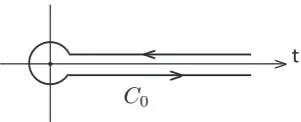
We understand integrals of the formR∞
0 dtF(t) as in [33]
Z ∞
0
dt F(t)≡
Z
C0 dt
JHEP04(2014)002
C0
[image:21.595.222.373.82.143.2]t
Figure 1. The integration contourC0 in the integral
R
C0 dt
2πiF(t) ln(−t).
where the integration contourC0 goes from +∞+i0 above the real axis, then around zero, and finally below the real axis to +∞ −i0, see figure1. Then the terms on the second line of (C.1) can be easily computed by using the functions introduced in [34]6
F2(z, a) ≡ Z ∞
0 dt
t
ezat
(eat−1)2 = 13 12 +
z2 2 −
3z
2 −γ
z2 2 −z+
15 12
!
+ (z−1)logΓ(2−z)
+ψ(−2)(2−z)−log(A)−1
2log(2π)−
z2
2 −z+ 15 12
! loga ,
F1(z, a) ≡ Z ∞
0 dt
t ezat
eat−1 =F2(z+ 1, a)−F2(z, a)
=−γ
z−1 2
+ logΓ(1−z)−zloga+1 2log
a
2π
, (C.3)
F0(z) ≡ Z ∞
0 dt
t e zt=F
1(z+ 1,1)−F1(z,1) =−γ−log(−z),
whereψ(−2)(z) is given by
ψ(−2)(z) = Z z
0
dtlogΓ (t), (C.4)
and A is Glaisher’s constant which satisfies log(A) = 1/12−ζ0(−1) and ζ is the Riemann zeta function.
Thus, the terms on the second line of (C.1) are equal to
i2 = gπ υ F2 −υx
π , π
−F2 υx
π , π + υ gπ F2
−gx,υ g
−F2
gx,υ g
+2gxF1 υ
πg, π
+ 2gxF1
1− υ
πg, π
+F1
−gx,υ g
−F1
gx,υ g
+F1
−υx
π , π
−F1 υx
π , π
. (C.5)
The integral on the first line of (C.1) is convergent at t = 0, and one can expand the integrand in powers of 1/g. One gets for the leading term
i1 =g Z ∞
0 dt
t
2 sinh(υxt)
πυt2 +
4 sinh(υxt)
υt(1−eπt) +
2πsinh(υxt)
υ(eπt−1)2
. (C.6)