Crowdsourcing High-Quality Parallel Data Extraction from Twitter
∗ Wang Ling123 Luís Marujo123 Chris Dyer2 Alan Black2 Isabel Trancoso13(1)L2F Spoken Systems Lab, INESC-ID, Lisbon, Portugal
(2)Language Technologies Institute, Carnegie Mellon University, Pittsburgh, PA, USA (3)Instituto Superior Técnico, Lisbon, Portugal
{lingwang,lmarujo,cdyer,awb}@cs.cmu.edu [email protected]
Abstract
High-quality parallel data is crucial for a range of multilingual applications, from tuning and evaluating machine translation systems to cross-lingual annotation pro-jection. Unfortunately, automatically ob-tained parallel data (which is available in relative abundance) tends to be quite noisy. To obtain high-quality parallel data, we introduce a crowdsourcing paradigm in which workers with only basic bilin-gual proficiency identify translations from an automatically extracted corpus of par-allel microblog messages. For less than $350, we obtained over 5000 parallel seg-ments in five language pairs. Evaluated against expert annotations, the quality of the crowdsourced corpus is significantly better than existing automatic methods: it obtains an performance comparable to expert annotations when used in MERT tuning of a microblog MT system; and training a parallel sentence classifier with it leads also to improved results. The crowdsourced corpora will be made avail-able in http://www.cs.cmu.edu/ ~lingwang/microtopia/.
1 Introduction
High-quality parallel data is essential for tun-ing and evaluattun-ing statistical MT systems, and it plays a role in a wide range of multilingual NLP applications, such as word sense disambigua-tion (Gale et al., 1992; Ng et al., 2003; Specia et al., 2005), paraphrasing (Bannard and Callison-burch, 2005; Ganitkevitch et al., 2012), annota-tion projecannota-tion (Das and Petrov, 2011), and other language-specific applications (Schwarck et al., ∗A sample of the crowdsourced corpora and the inter-faces used are available as supplementary material.
2010; Liu et al., 2011). While large amounts of parallel data can be easily obtained by mining the web (Resnik and Smith, 2003), comparable corpora (Munteanu and Marcu, 2005), and even social media sites (Ling et al., 2013), automati-cally extracted parallel tends to be noisy, and, as a result, “evaluation-quality” parallel corpora have generally been produced at considerable expense by targeted translation efforts (Bojar et al., 2013,
inter alia). Unfortunately, in some domains such as microblogs, theonly corpora that are available are automatically extracted and noisy.
While phrase-based translation models can ef-fectively learn translation rules from noisy parallel data (Goutte et al., 2012), having a subset of high-quality parallel segments is nevertheless crucial. Firstly, the automatic parallel data extraction sys-tem’s parameters can be tuned by optimizing on the gold standard data. Secondly, even though the parallel data used to train MT systems can contain a considerable amount of noise, it is conventional to use human annotated parallel data to tune and evaluate the system. Finally, other NLP applica-tions may not be as noise-robust as MT.
We introduce a new crowdsourcing protocol for obtaining high-quality parallel data from noisy, automatically extracted parallel data (§3), focus-ing on the challengfocus-ing case of identifyfocus-ing par-allel data in microblog messages (Ling et al., 2013). In contrast to previous attempts to use crowdsourcing to obtain parallel data, in which workers performed translation (Ambati and Vo-gel, 2010; Zaidan and Callison-Burch, 2011; Post et al., 2012; Ambati et al., 2012), our approach only requires that they identify whether a candi-date message contains a translation, and if so, what the spans of the translated segments are. This is a much simpler task than translation, and one that can often be completed by workers with only a ba-sic proficiency in the source and target languages. For evaluation (§4), we use our protocol to build
parallel datasets on a Chinese-English corpus orig-inally extracted from Sina Weibo and for which we have expert annotations. This lets us quantify the effectiveness of our method under different task variations. We also show that the crowdsourced corpus performs as well as expert annotation (and better than the automatically extracted corpus) for tuning an MT system with MERT. We next apply our method on a corpus of five language pairs (en-ar, en-ja, en-ko, en-ru, en-zh) extracted from Twit-ter (§5), for which we have no gold-standard data. Using this data in a cross-validation setup, we train and evaluate a maxent classifier for detecting par-allel data (§6), and then we conclude (§7).
2 Related Work
Our work crosses crowdsourcing techniques and automatic parallel data extraction from mi-croblogs. In this section, we shall provide back-ground information and analysis of the work per-formed in these two fields.
2.1 Parallel Data Extraction from Microblogs
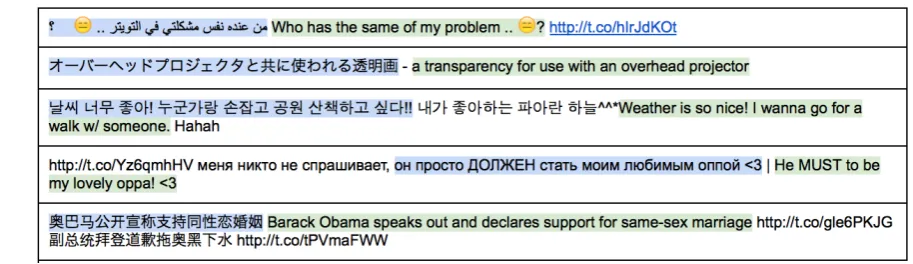
Many sources of parallel data exist on the web. The most popular choice are parallel web pages (Resnik and Smith, 2003), while other work have looked at specific domains with large amounts of data, such as Wikipedia (Smith et al., 2010). Microblogs, such as Twitter and Sina Weibo, represent a subdomain of the Web. Some of its characteristics is the informal language used and the short nature of the messages that are posted. Due to its large size and growing pop-ularity, work has been done on parallel data ex-traction from this domain. Ling et al. (2013) at-tempt to find naturally occurring parallel data from Sina Weibo and Twitter. Some examples of what is found are illustrated in Figure 1. The extrac-tion process starts by finding the parallel segments within the same message and the word alignments between those segments that maximize a hand-tuned model score.
Another method (Jehl et al., 2012) leverages CLIR (Cross Lingual Information Retrieval) tech-niques to find pairs of tweets that are translations. The main challenge in this approach is the large amount of pairs of tweets that must be considered, which raises some scalability issues when process-ing billions of tweets.
Our crowdsourcing method can be applied to annotate data from any naturally occurring source.
In this paper, we will use the corpus developed by Ling et al. (2013), since it is publicly available and has parallel data for 6 languages from Twitter, and for 10 languages from Sina Weibo.
2.2 Parallel Data using Crowdsourcing
Most of the work done in building parallel data using crowdsourcing (Ambati and Vogel, 2010; Zaidan and Callison-Burch, 2011; Post et al., 2012; Ambati et al., 2012) relies on using crowd-sourcing workers to translate. These methods must address the fact that workers may produce poor and sometimes incorrect translations. Thus, in order to find good translations, subsequent postediting and/or ranking is generally necessary.
In contrast, in our work, crowdsourcing is used for data extraction rather than translation, a sub-stantially simpler task than translation (in particu-lar, translation of informal text) that requires less expertise in the language pair (basic proficiency in the two languages is generally sufficient to suc-cessfully complete the task). Furthermore, assess-ing whether a worker performed the task correctly and combining the outputs of different workers is simpler. The time spent per item is also reduced: our annotation interface only requires the worker to make a few clicks on the tweet to complete each annotation, meaning that tasks are completed faster and with less effort, allowing us to obtain translations at lower cost. On the other hand, the main drawback of our method is that it can only obtain parallel data from translations that ex-ist, which corresponds to the amount of posts that have been translated and posted. This limits the potential coverage of our method. Furthermore, the resulting datasets may not be fully representa-tive of the Twitter domain, since not all types of content are translated and follow the same distri-bution as the data in Twitter.
and missed the translated wordWeather. At a high level, the task faced by annotators will be to iden-tify and resolve such errors.
3.1 Overview
We separate the tasks of identifying the parallel posts, which we shall denote by identification, and of locating the parallel segments, which we will calllocation. The justification for this is that the majority of the tweets are not parallel, as re-ported by Ling et al. (2013), and the location of the parallel data is only applicable if the tweet actually contains parallel data. This is also de-sirable because the identification task is simpler than the location task. Firstly, identifying whether a tweet contains translations requires much less proficiency in the respective languages than locat-ing the parallel segments, since it only requires the worker to understand parts of the message. This means we can have more potential workers capable of performing this task. Secondly, the first task is a binary decision, and each annota-tion can be completed with only one acannota-tion, which means that the average required time for this task is much lower than the second task and the pay-ment required for each hit will naturally be lower as well. Finally, combining worker results for a binary decision is simpler than combining transla-tions, since the space of possible answers is sev-eral orders of magnitude lower.
As crowdsourcing platform, we use Amazon’s Mechanical Turk. In this platform, the requesters can submittasks, where one can define the num-ber of workersnthat will complete each task and what is the payment p for each task submission, henceforth denoted asjob. In our work, we had to consider the following components:
• Interface - To submit a task, an interface must be provided, which workers will be us-ing to complete the job.
• Worker Quality Prediction- After submit-ting a job, the requester can accept and pay the agreed fee or reject the task. It is cru-cial to have a method to automatically pre-dict whether workers have performed the job properly, and reject them otherwise.
• Result Combination- It is common for mul-tiple workers to complete the same task with different results. Thus, a method must be
im-plemented to combine multiple responses for correctly predicting the desired response.
We structured each of our tasks as a series ofq questions, which include a small number of refer-ences r, for which we know the answers. Thus, the amount of answers we obtain for each dollar is given by qnp−r, where nis the number of workers per task andpis the payment for each task. In or-der to maximize this quotient, we can either reduce the number of reference questionr, the number of workers per taskn, or the payment p. However, reducing r will also limit our capability of esti-mating the quality of the worker results, since we will have less data to make such prediction. For the same reason, reducing n will limit our abil-ity to combine results properly. As for the pay-mentp, while there is no direct effect on our task, it has been noted that workers will perform the task faster for higher payments (Post et al., 2012). In our work, we will propose methods to predict quality and combine results that will minimize the requirements for nand r, while maximizing the quality of the final results.
3.2 Parallel Post Identification
In the identification task, for each question, we will show a post, and solicit the worker to detect if it contains translations in a given language pair.
Interface The interface for this task is straight-forward. We present to the worker each tweet in-dividually, together with a checkbox to be checked in case the tweet contains parallel data. The navi-gation between tweets is done by adding next and previous buttons, allowing the user to go back and review previous answers. Finally, the worker can only submit the HIT after traversing all 25 ques-tions. Unlike the work in crowdsourcing transla-tion (Zaidan and Callison-Burch, 2011), where au-tomatic translation systems are discouraged, since it produces poor output, we allow its usage as long as this leads to correct annotations. In fact, we add a button to automatically translate the tweet into English from the non-English language.
Figure 1: Parallel microblog posts in 5 language pairs. Shaded backgrounds mark the parallel segments (annotated manually), non shaded parts do not have translations.
accept(rand, c, r)a setup where the worker’s job is accepted if cout ofr randomly sampled refer-ences are correctly answered. Likewise, acceptor accept(bal, c, r)denotes the same setup using bal-anced reference questions.
Result Combination Givennjobs with answers for a question that can be either positive or nega-tive, we calculate the weighted ratio of positive an-swers, given byPi=1..nδp(i)w(i)
P
i=1..nw(i) , whereδpis one if answer iis positive and 0 otherwise, and w(i)is the weight of the worker. w(i) is defined as the ratio of correct answers from jobiin the reference set. If the weighted ratio is higher than 0.5, we la-bel the tweet as positive and otherwise as negative.
3.3 Parallel Data Location
In the location task, we also present one tweet per question, where the worker will be asked to iden-tify the parallel segments. The worker can also define that there are no translations in the tweet.
Interface The interface for this task presents the user with one tweet at a time, and allows the user to break the tweet into segments, by clicking be-tween characters. Each segment can then be clas-sified as English, the non-English language (Ex: Mandarin), or non-parallel, which is the default option. To understand the concept of non-parallel segments, notice that when we are locating par-allel data in tweets, we are essentially breaking the tweet into the structure “Nleft Pleft Nmiddle
PrightNright", wherePleftandPrightare the
par-allel segments andNleft,Nmiddle andNrightare
textual segments that are non-parallel. These may not exist, for instance, the Arabic tweet in Fig-ure 1 (line 1) does not contain any non-parallel text and does not require any non-parallel segments
to delineate the parallel data. The Korean tweet (line 2), on the other hand, has anNmiddle
corre-sponding to내가좋아하는파아란하늘ˆˆ*and an Nright corresponding to Hahahand requires two
non-parallel segments to locate the parallel data. Thus, if the worker does not commit any errors, each question can be answered with at most four clicks, when all five segments exist, and two op-tion choices for identifying the parallel segments. In the easiest case, when only the parallel seg-ments exist, only one click and two option choices are needed. If there are no translations, the button
no translationscan be clicked.
For instance, to annotate the Korean tweet in Figure 1, the worker must click immediately be-fore내가, then beforeWeatherand finally before
Hahah. Then on the drop-down box of the first and and third segments, the worker must choose Korean and English, respectively. The interface after these operations is show in Figure 2.
Work Quality Prediction To score the worker’s jobs, we use the scoring function devised in (Ling et al., 2013), which measures the word overlap between the reference parallel segments segments and the predicted segments. However, setting the score threshold to accept a job is a challenge, since scores are bound to change for different language-pairs and domains. Moreover, some tweets are harder to annotate than others. Learning this threshold automatically requires annotated data, which we do not have for all language pairs and domains. Thus, we propose a method to generate thresholds specifically for each sample.
Figure 2: Location Interface (After the annotation is performed)
since he knows the reference annotation, and “lazy" because he will only define a new non-parallel segment if it is significant, otherwise it will just be left in the parallel segments. By sig-nificant, we will define whether it is at least 20% larger (in number of characters) than the parallel segments. For instance, in the Korean example in Figure 1,Hahahwould be left in the English par-allel segment, while ᅢᄀ나좋아한느파아란하 ᄂ
ᅳ
ᆯ ˆˆ* would not be in the Korean segment. We will accept a job if the average of the scores in the reference set is higher or equal than the pseudo worker’s scores. This acceptor shall be denoted as accept(lazy, a), where ais the number of refer-ences used.
Another option is to use the automatic system’s output as a baseline that workers must improve to be accepted. We will also test this option and call this acceptoraccept(auto, a).
Result Combination Unlike the identification task, where the result is binary and combining multiple decisions is straightforward, the range of results from this task is larger and combining them is a challenge. Thus, we score each job based on the WER on the reference set and use annotations of the highest scoring job.
4 Experiments
To obtain results on the effectiveness of the meth-ods described in Section 3, we will first perform experiments using pre-annotated data. We use the annotated dataset with tweets in Mandarin-English from Sina Weibo created in (Ling et al., 2013). It consists of approximately 4000 tweets crawled from Sina Weibo that were annotated on whether they contained parallel data and the location of the parallel segments. In our experiment, we sample 1000 tweets from this dataset, where 602 tweets were parallel and 398 were not.1
Acceptor avg(a) avg(r) d accept(rand,2,2) 0.44 0.00 0.44
accept(rand,3,4) 0.44 0.00 0.44
accept(rand,4,4) 0.55 0.04 0.51
accept(bal,2,2) 0.69 0.09 0.60
accept(bal,3,4) 0.64 0.03 0.61
accept(bal,4,4) 0.76 0.15 0.61
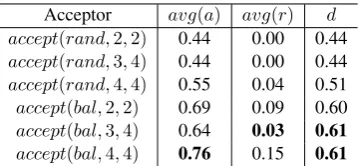
Table 1: Agreement with the expert annotations for different acceptors.
4.1 Identification Task
The 1000 tweets were distributed into 40 tasks with 25 questions each (q = 25). Each task is to be performed by 5 workers (n = 5) and upon acceptance, a worker would be rewarded with 6 cents (p = 0.06). As we know the answers for all the questions in this case, we will calculate the Cohen’s Kappa between the responses of each job and the expert annotator, and accept a job if it is higher than 0.5. We decided to use Cohen’s kappa to evaluate a job, rather than accuracy, since each set of 25 questions does not contain the same num-ber of positive and negative samples. For instance, in a set of 20 negative samples, a worker would achieve an accuracy of 80% if he simply answers negatively to all questions, which is not an ade-quate assessment of the job’s quality. On the other hand, the Cohen’s Kappa balances the positive and negative question in each task by using their prior probabilities. In total, there were 566 jobs, where 200 where accepted and 366 were rejected.
Next, we pretended that we only have access to 4 references, which will be used for quality es-timation and simulate the acceptances and rejec-tions for each strategy. Table 1 shows the aver-ages of the real Kappa values of accepted (col-umn avg(a)) and rejected jobs (column avg(r)) using different acceptors. Our goal is to maximize the number of acceptances with high Kappa ues and minimize those that have low Kappa val-ues. Thus, we definedas the difference between avg(a)andavg(r). From the results, we observe that using a balanced reference yields a much bet-ter estimation of the jobs quality using our metric d. Similar conclusions can be reached by compar-ingaccept(rand,3,4)withaccept(bal,3,4)and accept(rand,4,4)withaccept(bal,4,4). Quality predictors that use balanced reference sets achieve 1We wished to annotate a sample where the number of parallel posts is high, so that we would have enough samples to perform the location task.
Acceptor prec recall F1 acc κ
Automatic 0.87 0.69 0.77 0.75 0.51 All jobs 0.75 0.84 0.8 0.74 0.44
accept(rand,2,2) 0.85 0.92 0.88 0.86 0.69
accept(rand,3,4) 0.84 0.93 0.88 0.85 0.68
accept(rand,4,4) 0.91 0.95 0.93 0.92 0.82
accept(bal,2,2) 0.94 0.94 0.94 0.92 0.84
accept(bal,3,4) 0.93 0.95 0.94 0.93 0.85
[image:6.595.92.273.61.144.2]accept(bal,4,4) 0.94 0.93 0.93 0.92 0.84
Table 2: Parallel post prediction scores using dif-ferent acceptors.
approximately the same results for d. However, the setupaccept(bal,3,4)has a lower Kappas for both avg(a) and avg(r), which means that it is less likely to reject good jobs at the cost of accept-ing more bad jobs. This is desirable from an ethi-cal perspective, since workers are not responsible for errors in our quality prediction. Furthermore, rejecting good jobs has a negative impact on the progress of the task, since good workers may be discouraged to perform more tasks.
Results on the identification task, obtained for n = 3, are shown in Table 2. Naturally, us-ing a balanced reference set yields better results, since these have a higher d value. We can also see the importance of quality prediction, since not performing quality estimation (rowAll jobs) will yield worse results than the automatic system.
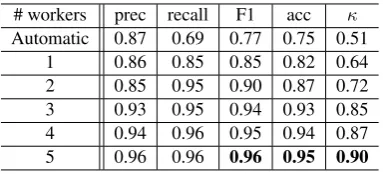
Next, we will compare results using different numbers of workers. We fix the quality predic-tion methodology toaccept(bal,3,4)and results are shown in Table 3. We observe that in gen-eral, using more workers will generate better re-sults, but score gains from adding another worker becomes lower as n increases. One problem for n= 2is the fact that there are many cases where two workers with the same weight chose a posi-tive and a negaposi-tive answer, in which case, no de-cision can be made, and we simply choose false by default. This explains the high recall and low precision values. However, this problem seems to occur much less with higher values ofn.
4.2 Location Task
[image:6.595.311.528.61.169.2]# workers prec recall F1 acc κ
[image:7.595.314.518.60.123.2]Automatic 0.87 0.69 0.77 0.75 0.51 1 0.86 0.85 0.85 0.82 0.64 2 0.85 0.95 0.90 0.87 0.72 3 0.93 0.95 0.94 0.93 0.85 4 0.94 0.96 0.95 0.94 0.87 5 0.96 0.96 0.96 0.95 0.90
Table 3: Identification scores for differentn.
the 607 identified positive samples. This makes 20 tasks in total, with 25 questions (q = 25), and each task would be run until 5 jobs are accepted (n = 5). For this task, we set a payment of 30 cents (p = 0.3), since it is a more complex task. Again, since we have the expert annotations for all questions, we calculated the average WER on all answers and rejected jobs scoring less than 0.62.
This task is mainly focused on the quality pre-diction of the workers, as the result combination is done by finding the job with the highest score in the reference set. This means, for an arbitrary large n, all quality estimation methods will pro-duce the same result, since we will find the best job on the references eventually. However, bet-ter quality estimation will allow us to find the best jobs with lowern, which makes the task less ex-pensive. Table 4 shows results using different se-tups. In these results, we set aside 4 questions to be used as references. We can see that for low n (1 or 2), if we simply accept all jobs, the quality of the results will be lower than the automatic sys-tem. Forn= 4, this approach can achieve a WER score of0.06. However, if we use the automatic system as a baseline that jobs must surpass, we can achieve this WER score with only two jobs, which reduces the cost of this task by half. Yet, this is strongly dependent on the automatic system, as a worse system will be easier to match for the work-ers. On the other hand, using the smart but lazy pseudo worker, where we degrade the reference annotations slightly, we can see that we can obtain the0.06WER score using only the first worker. At n= 2, we can see that the WER improves to 0.05, which is lost forn = 3. This is because the pre-diction of the quality of the job using the workers is not always precise.
4.3 Machine Translation Results
Finally, we will perform an extrinsic test to see how the improvements obtained by using
crowd-2Determined empirically
Number of jobs 1 2 3 4 5
Automatic 0.16 0.16 0.16 0.16 0.16 All Jobs 0.23 0.21 0.07 0.06 0.06
accept(auto,4) 0.09 0.06 0.06 0.06 0.06
accept(lazy,4) 0.06 0.05 0.06 0.06 0.06
Table 4: Parallel data location scores for different acceptors (rows) and different numbers of work-ers. Each cell denotes the WER for that setup.
Auto (Pos) Crowd Expert Auto (All)
Size 483 479 483 908
EN-ZH 10.21 10.49 10.51 10.71
ZH-EN 7.59 7.87 7.82 8.02
Table 5: BLEU score comparison using different corpora for MERT tuning. TheSize row denotes the number of sentences of each corpus, and the
EN-ZHandZH-ENrows denote the BLEU scores of the respective language pair and tuning dataset.
sourcing map to Machine Translations. We will build an out of domain MT system using the FBIS dataset (LDC2003E14), a corpus of 300K sen-tence pairs from the news domain in the Chinese-English pair using the Moses (Koehn et al., 2007) pipeline. Due to the small size of our crowd-sourced corpus, we will use it in the MERT tun-ing (Och, 2003), and test its effects compared to automatically extracted parallel data and the ex-perts judgements. As the test set, we will use 1,500 sentence pairs from the Weibo gold standard from Ling et al. (2013), that were not used in our crowdsourcing experiment to prevent data over-lap. For reordering, we use the MSD reordering model (Axelrod et al., 2005) and as the language model, we use a 5-gram model with Kneser-Ney smoothing (Heafield, 2011). Finally, results are presented with BLEU-4 (Papineni et al., 2002).
[image:7.595.86.278.61.148.2](de-Pair Parallel Avg(en) cost(I) cost(L) total en-ar 1512 8.3 $35.7 $43.2 $76.2 en-zh 1302 8.7 $35.7 $37.2 $70.2 en-ja 1155 7.9 $35.7 $33.0 $68.7 en-ko 1008 7.1 $35.7 $28.8 $64.5 en-ru 798 6.3 $35.7 $22.8 $58.5 all 5775 – $178.5 $165.0 $343.5
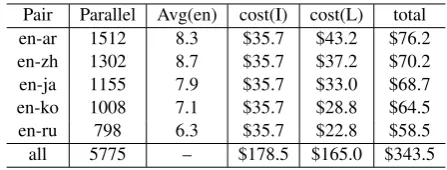
Table 7: AMT costs for crowdsourced corpora from Twitter.
notedAuto (Pos)). In the crowdsourcing case, we use theaccept(bal,3,4)setup, withn= 5, for the identification task and theaccept(lazy,4) setup, with n = 2, for the location task. From the re-sulting parallel tweets, we also remove all tweets that were used as reference in theaccept(lazy,4) quality estimator, as this would give an unfair ad-vantage to the crowdsourced corpora.
Results are shown in Table 5, where each cell contains the average BLEU score in 5 MERT runs, using a different tuning dataset. Surprisingly, us-ing the whole set of automatically extracted cor-pora actually achieves better results than using carefully selected data that are parallel. We be-lieve that is because many non-parallel segments actually contain comparable information that can be used to improve the weights during MERT tun-ing. However, this does not mean that the qual-ity of the automatically crawled corpus is better than the crowdsourced and expert annotated cor-pus. When using a similar number of parallel sen-tences, we observe that using the crowdsourced corpus yields better scores than the automatically extracted corpora, comparable to experts annota-tions. While results are not significantly better than automatically extracted corpora, this suggests that the crowdsourced corpora has a better overall quality than automatically extracted corpora.
5 Five Language Twitter Parallel Corpus Now that we have established the effectiveness of our technique for extracting high-quality parallel data in a scenario where we have gold standard annotations, we apply it to creating parallel cor-pora in five languages on Twitter, for which we have no gold-standard parallel data: Arabic, Man-darin, Japanese, Korean and Russian. Once again, we use the extracted automatically Twitter cor-pus from Ling et al. (2013) and deploy the task in Mechanical Turk. We use the setup that ob-tained the best results in Section 4. For the
identi-fication task, we used theaccept(bal,3,4)setup, with n = 5. The payment for each task was 0.06 dollars. Thus, for this task, each dollar spent yields 70 annotated tweets. For the location task, we used the accept(lazy,4) setup, with n = 2 and each task was rewarded with 0.3 dollars. To obtain the tweet sample, we filtered the corpora in Ling et al. (2013) for tweets with alignment scores higher than 0.1. Then, we uniformly ex-tracted 2500 tweets for each language. To gener-ate gold standard references, the authors manually annotated 40 samples for each pair.
Table 7 contains information about the result-ing corpora. The number of parallel sentences ex-tracted from the 2500 tweets in each language pair is shown in columnParallel and we can see that this differs given the language pair. We can also see in columnAvg(en)that the average number of English words is much smaller than what is seen in more formal domains. Finally, Arabic parallel data seems more predominant from our samples followed by Mandarin, while Russian parallel data seem scarcer.
6 Discriminative Parallel Data Detection While the work in (Ling et al., 2013) used a linear combination of three models, the alignment, lan-guage and segment features, these weights were determined manually. However, using the crowd-sourced corpus (in Section 5), we will apply previ-ously proposed methods that learn a classifier with machine learning techniques as in related work on finding parallel data (Resnik and Smith, 2003; Munteanu and Marcu, 2005). In our work, we use a max entropy classifier model, similar to that pre-sented by Munteanu and Marcu (2005) to detect parallel data in tweets. Our features are:
• Alignment feature- The baseline feature is the alignment score from the work in (Ling et al., 2013), and measures how well the paral-lel segments align, which is derived from the content-based matching methods for detect-ing parallel data (Resnik and Smith, 2003).
[image:8.595.71.295.62.147.2]Weibo (en-zh) Twitter (en-zh) Twitter (en-ar) Twitter (en-ru) Twitter (en-ko) Twitter (en-ja)
Alignment 0.781 0.599 0.721 0.692 0.635 0.570
+User 0.814 0.598 0.721 0.705 0.650 0.566
+Length 0.839 0.603 0.725 0.706 0.650 0.569
+Repetition 0.849 0.652 0.763 0.729 0.655 0.579
+Language 0.849 0.668 0.782 0.737 0.747 0.584
Table 6: Classification Results using a 10-fold cross validation over different datasets. Each cell contains the F-measure using a given dataset and an incremental set of features.
• Repetition features- There are many words that are not translated, such as hashtags, at mentions, numbers and named entities. So, if we see these repeated twice in the same post, it can be used as a strong cue that this was the result of a translation. Hence, we define features for each of these cases, that trigger if either of these occur in multiples of two times in the same post. Named Entities were iden-tified using a naive approach by considering words with capital letters.
• Length feature- It is known that the length differences between parallel sentences can be modelled by a normal distribution (Gale and Church, 1991). Hence, we used parallel data in the respective language to determine (˜µ,σ˜2), which lets us calculate the likelihood of two hypothesized segments being parallel. Since we did not have annotated parallel data for this domain, we used the top 2000 scoring parallel sentences from the respective Twitter dataset in (Ling et al., 2013).
• Language feature - It is common for non-English words to be found in non-English seg-ments, such as names of foreign celebri-ties, numbers and hashtags. However, when this happens to the majority of the words in a segment that is supposed to be English, it may indicated that there was an error in the language detection. The same happens with non-English segments. We used the same naive approach to detect languages as in (Ling et al., 2013), where we calculate the ratio of number of words in the English seg-ment and the total number of words from the segment detected as English and the ratio of the number of Foreign words and the total number of words in the Foreign segment ,de-tected by their unicode ranges. This was also included in the work in (Ling et al., 2013).
Results using a 10 fold cross-validation are shown in Table 6. In general, we can see that the classifier performs worse in Twitter datasets com-pared to the Weibo dataset. We believe that this is because parallel sentences extracted from Twitter are smaller, due to the 140 character limit, which does not hold in Sina Weibo. Each parallel En-glish segment from the Sina Weibo parallel data contains 15.4 words on average. On other hand, we see in Table 7 that this number is smaller in the parallel data from Twitter. This means that the aligner will have a much smaller range of words to align when detecting parallel data, which makes it more difficult to find parallel segments.
As for the features, we observe that by defin-ing these simple features, we can get a signifi-cant improvement over previous baselines. For the User feature, we see that the improvements in the Weibo dataset are much larger than in the Twitter datasets. This is because the Twitter dataset was crawled uniformly, whereas the Weibo dataset was focused on users that post parallel data frequently. Thus, in the Weibo dataset there more posts that were posted by the same user, which does not happen as frequently in the Twitter dataset. As for theLengthfeature, we can see that it yields a small but consistent improvement over all datasets.Repetitionbased features also lead to improvements across all datasets, and produces a 5% improvement in the English-Mandarin Twitter dataset. Finally,languagebased features also add another improvement over previous results. 7 Conclusions
compara-ble to those of expert annotators. Secondly, tweets that are found to contain translations are given to other workers to locate the parallel segments, where we can also obtain high quality results. Then, we use our method to extract high quality parallel data from Twitter in 5 language pairs. Fi-nally, we improve the automatic identification of tweets with translations by using a max entropy classifier trained on the crowdsourced data.
We are currently extracting more data and the crowdsourced parallel data from Twitter will made be available to the public.
References
[Ambati and Vogel2010] Vamshi Ambati and Stephan Vogel. 2010. Can crowds build parallel corpora for machine translation systems? In Proceedings of the NAACL HLT 2010 Workshop on Creating Speech and Language Data with Amazon’s Mechan-ical Turk, Stroudsburg, PA, USA. Association for Computational Linguistics.
[Ambati et al.2012] Vamshi Ambati, Stephan Vogel, and Jaime Carbonell. 2012. Collaborative workflow for crowdsourcing translation. InProceedings of the ACM 2012 Conference on Computer Supported Co-operative Work, CSCW ’12, pages 1191–1194, New York, NY, USA. ACM.
[Axelrod et al.2005] Amittai Axelrod, Ra Birch Mayne, Chris Callison-burch, Miles Osborne, and David Talbot. 2005. Edinburgh system description for the 2005 iwslt speech translation evaluation. In Pro-ceedings International Workshop on Spoken Lan-guage Translation (IWSLT.
[Bannard and Callison-burch2005] Colin Bannard and Chris Callison-burch. 2005. Paraphrasing with bilingual parallel corpora. In In ACL-2005, pages 597–604.
[Bojar et al.2013] Ondˇrej Bojar, Christian Buck, Chris Callison-Burch, Christian Federmann, Barry Had-dow, Philipp Koehn, Christof Monz, Matt Post, Radu Soricut, and Lucia Specia. 2013. Find-ings of the 2013 Workshop on Statistical Machine Translation. In Proceedings of the Eighth Work-shop on Statistical Machine Translation, pages 1– 44, Sofia, Bulgaria, August. Association for Com-putational Linguistics.
[Das and Petrov2011] Dipanjan Das and Slav Petrov. 2011. Unsupervised part-of-speech tagging with bilingual graph-based projections. In Proceedings of the 49th Annual Meeting of the Association for Computational Linguistics: Human Language Tech-nologies - Volume 1, HLT ’11, pages 600–609, Stroudsburg, PA, USA. Association for Computa-tional Linguistics.
[Gale and Church1991] William A. Gale and Ken-neth W. Church. 1991. A program for aligning sentences in bilingual corpora. In Proceedings of the 29th Annual Meeting on Association for Com-putational Linguistics, ACL ’91, pages 177–184, Stroudsburg, PA, USA. Association for Computa-tional Linguistics.
[Gale et al.1992] William A. Gale, Kenneth W. Church, and David Yarowsky. 1992. Using bilingual materi-als to develop word sense disambiguation methods. [Ganitkevitch et al.2012] Juri Ganitkevitch, Yuan Cao,
Jonathan Weese, Matt Post, and Chris Callison-Burch. 2012. Joshua 4.0: Packing, PRO, and para-phrases. In Proceedings of the Seventh Workshop on Statistical Machine Translation, pages 283–291, Montréal, Canada, June. Association for Computa-tional Linguistics.
[Goutte et al.2012] Cyril Goutte, Marine Carpuat, and George Foster. 2012. The impact of sentence alignment errors on phrase-based machine transla-tion performance. InProc. of AMTA.
[Heafield2011] Kenneth Heafield. 2011. KenLM: faster and smaller language model queries. In Pro-ceedings of the Sixth Workshop on Statistical Ma-chine Translation, pages 187–197, Edinburgh, Scot-land, United Kingdom, July.
[Jehl et al.2012] Laura Jehl, Felix Hieber, and Stefan Riezler. 2012. Twitter translation using translation-based cross-lingual retrieval. InProceedings of the Seventh Workshop on Statistical Machine Transla-tion, pages 410–421, Montréal, Canada, June. Asso-ciation for Computational Linguistics.
[Koehn et al.2007] Philipp Koehn, Hieu Hoang, Alexandra Birch, Chris Callison-burch, Richard Zens, Rwth Aachen, Alexandra Constantin, Mar-cello Federico, Nicola Bertoldi, Chris Dyer, Brooke Cowan, Wade Shen, Christine Moran, and Ondrej Bojar. 2007. Moses: Open source toolkit for statistical machine translation. In Proceedings of the 45th Annual Meeting of the Association for Computational Linguistics Companion Volume Proceedings of the Demo and Poster Sessions, pages 177–180, Prague, Czech Republic, June. Association for Computational Linguistics.
[Ling et al.2013] Wang Ling, Guang Xiang, Chris Dyer, Alan Black, and Isabel Trancoso. 2013. Microblogs as parallel corpora. InProceedings of the 51st An-nual Meeting on Association for Computational Lin-guistics, ACL ’13. Association for Computational Linguistics.
[Liu et al.2011] Feifan Liu, Fei Liu, and Yang Liu. 2011. Learning from chinese-english parallel data for chinese tense prediction. In IJCNLP, pages 1116–1124.
[Ng et al.2003] Hwee Tou Ng, Bin Wang, and Yee Seng Chan. 2003. Exploiting parallel texts for word sense disambiguation: An empirical study. InProceedings of ACL03, pages 455–462.
[Och2003] Franz Josef Och. 2003. Minimum error rate training in statistical machine translation. In Pro-ceedings of the 41st Annual Meeting on Association for Computational Linguistics - Volume 1, ACL ’03, pages 160–167, Stroudsburg, PA, USA. Association for Computational Linguistics.
[Papineni et al.2002] Kishore Papineni, Salim Roukos, Todd Ward, and Wei-Jing Zhu. 2002. Bleu: a method for automatic evaluation of machine trans-lation. InProceedings of the 40th Annual Meeting on Association for Computational Linguistics, ACL ’02, pages 311–318, Stroudsburg, PA, USA. Associ-ation for ComputAssoci-ational Linguistics.
[Post et al.2012] Matt Post, Chris Callison-Burch, and Miles Osborne. 2012. Constructing parallel cor-pora for six indian languages via crowdsourcing. In Proceedings of the Seventh Workshop on Statisti-cal Machine Translation, pages 401–409, Montréal, Canada, June. Association for Computational Lin-guistics.
[Resnik and Smith2003] Philip Resnik and Noah A. Smith. 2003. The web as a parallel corpus. Compu-tational Linguistics, 29:349–380.
[Schwarck et al.2010] Florian Schwarck, Alexander Fraser, and Hinrich Schütze. 2010. Bitext-based resolution of german subject-object ambiguities. In Human Language Technologies: The 2010 An-nual Conference of the North American Chapter of the Association for Computational Linguistics, HLT ’10, pages 737–740, Stroudsburg, PA, USA. Associ-ation for ComputAssoci-ational Linguistics.
[Smith et al.2010] Jason R. Smith, Chris Quirk, and Kristina Toutanova. 2010. Extracting parallel sen-tences from comparable corpora using document level alignment. InHuman Language Technologies: The 2010 Annual Conference of the North American Chapter of the Association for Computational Lin-guistics, HLT ’10, pages 403–411, Stroudsburg, PA, USA. Association for Computational Linguistics. [Specia et al.2005] Lucia Specia, Maria Das Graças,
Volpe Nunes, and Mark Stevenson. 2005. Exploit-ing parallel texts to produce a multilExploit-ingual sense tagged corpus for word sense disambiguation. In Proceedings of RANLP-05, Borovets, pages 525– 531.