Edinburgh’s Submission to all Tracks of the WMT2009 Shared Task
with Reordering and Speed Improvements to Moses
Philipp Koehn and Barry Haddow School of Informatics
University of Edinburgh
[email protected] [email protected]
Abstract
Edinburgh University participated in the WMT 2009 shared task using the Moses phrase-based statistical machine transla-tion decoder, building systems for all lan-guage pairs. The system configuration was identical for all language pairs (with a few additional components for the German-English language pairs). This paper de-scribes the configuration of the systems, plus novel contributions to Moses includ-ing truecasinclud-ing, more efficient decodinclud-ing methods, and a framework to specify re-ordering constraints.
1 Introduction
The commitment of the University of Edinburgh to the WMT shared tasks is to provide a strong sta-tistical machine translation baseline with our open source tools for all language pairs. We are again the only institution that participated in all tracks.
The shared task is also an opportunity to incor-porate novel contributions and test them against the best machine translation systems for these lan-guage pairs. In this paper we describe the speed improvements to the Moses decoder (Koehn et al., 2007), as well as a novel framework to specify re-ordering constraints with XML markup, which we tested with punctuation-based constraints.
2 System Configuration
We trained a default Moses system with the fol-lowing non-default settings:
• maximum sentence length 80
• grow-diag-final-and symmetrization of GIZA++ alignments
• interpolated Kneser-Ney discounted 5-gram language model
• msd-bidrectional-fe lexicalized reordering
Language ep nc news intpl.
[image:1.595.313.521.191.290.2]English 449 486 216 192 French 264 311 147 131 German 785 821 449 402 Spanish 341 392 219 190 Czech *:1475 1615 752 690 Hungarian hung:2148 815 786
Table 1: Perplexity (ppl) of the domain-trained (ep = Europarl (CzEng for Czech), nc = News Com-mentary, news = News) and interpolated language models.
2.1 Domain Adaptation
In contrast to last year’s task, where news transla-tion was presented as a true out-of-domain prob-lem, this year large monolingual news corpora and a tuning set (last year’s test set) were pro-vided. While still no in-domain news parallel pora were made available, the monolingual cor-pora could be exploited for domain adaption.
For all language pairs, we built a 5-gram lan-guage model, by first training separate lanlan-guage models for the different training corpora (the par-allel Europarl and News Commentary and new monolingual news), and then interpolated them by optimizing perplexity on the provided tuning set. Perplexity numbers are shown in Table 1.
2.2 Truecasing
Our traditional method to handle case is to low-ercase all training data, and then have a separate recasing (or recapitalization) step. Last year, we used truecasing: all words are normalized to their natural case, e.g. the, John, eBay, meaning that only sentence-leading words may be changed to their most frequent form.
To refine last year’s approach, we record the seen truecased instances and truecase words in test sentences (even in the middle of sentences) to seen forms, if possible.
case-language pair baseline w/ news mbr/mp truecased big beam ued’08 best’08
French-English uncased 21.2 23.1 23.3 22.7 22.9 19.2 21.9
cased 21.7 21.6 21.8
English-French uncased 17.8 19.4 19.6 19.6 19.7 18.2 21.4
cased 18.1 18.7 18.8
Spanish-English uncased 22.5 24.4 24.7 24.5 24.7 20.1 22.9
cased 23.0 23.3 23.4
English-Spanish uncased 22.4 23.9 24.2 23.8 24.4 20.7 22.7
cased 22.1 22.8 23.1
Czech-English uncased 16.9 18.9 18.9 18.6 18.6 14.5 14.7
cased 17.3 17.4 17.4
English-Czech uncased 11.4 13.5 13.6 13.6 13.8 9.6 11.9
cased 12.2 13.0 13.2
Hungarian-English uncased - 11.3 11.4 10.9 11.0 8.8
cased 8.3 10.1 10.2
English-Hungarian uncased - 9.0 9.3 9.2 9.5 6.5
[image:2.595.79.515.61.237.2]cased 8.1 8.4 8.7
Table 2: Results overview for news-dev2009b sets: We see significant BLEUscore increases with the addition of news data to the language model and using truecasing. As a comparison our results and the best systems from last year on the full news-dev2009 set are shown.
insensitiveBLEU, but to a significant gain in case-sensitiveBLEU. Note that we still do not properly address all-caps portions or headlines with our ap-proach.
2.3 Results
Results on the development sets are summarized in Table 2. We see significant gains with the addi-tion of news data to the language model (about 2
BLEUpoints) and using truecasing (about 0.5–1.0
BLEU points), and minor if any gains using
min-imum Bayes risk decoding (mbr), the monotone-at-punctuation reordering constraint (mp, see Sec-tion 3.2), and bigger beam sizes.
2.4 German–English
For German–English, we additionally incorpo-rated
rule-based reordering — We parse the input us-ing the Collins parser (Collins, 1997) and ap-ply a set of reordering rules to re-arrange the German sentence so that it corresponds more closely English word order (Collins et al., 2005).
compound splitting — We split German com-pound words (mostly nouns), based on the frequency of the words in the potential de-compositions (Koehn and Knight, 2003a).
part-of-speech language model — We use fac-tored translation models (Koehn and Hoang, 2007) to also output part-of-speech tags with each word in a single phrase mapping and run a second n-gram model over them. The
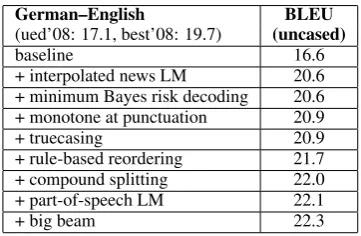
En-German–English BLEU (ued’08: 17.1, best’08: 19.7) (uncased)
baseline 16.6
+ interpolated news LM 20.6 + minimum Bayes risk decoding 20.6 + monotone at punctuation 20.9
+ truecasing 20.9
+ rule-based reordering 21.7
+ compound splitting 22.0
+ part-of-speech LM 22.1
[image:2.595.326.507.295.413.2]+ big beam 22.3
Table 3: Results for German–English with the in-cremental addition of methods beyond a baseline trained on the parallel corpus
English–German BLEU (ued’08: 12.1, best’08: 14.2) (uncased)
baseline 13.5
+ interpolated news LM 15.2 + minimum Bayes risk decoding 15.2 + monotone at punctuation 15.2
+ truecasing 15.2
+ morphological LM 15.2
+ big beam 15.7
Table 4: Results for English–German with the in-cremental addition of methods beyiond a baseline trained on the parallel corpus
glish part-of-speech tags are obtained using
MXPOST(Ratnaparkhi, 1996).
2.5 English-German
[image:2.595.325.506.463.559.2]&
[image:3.595.78.514.62.212.2]German-English & French-English
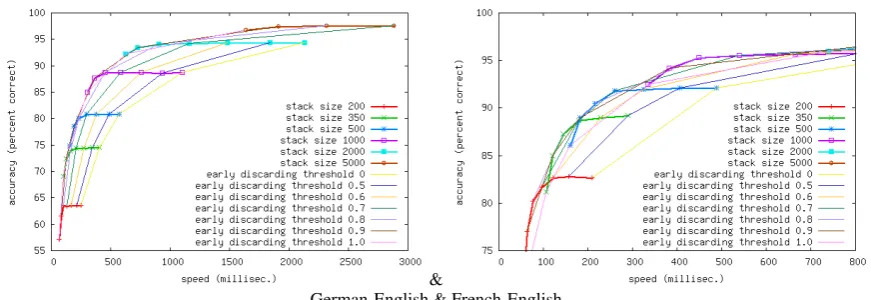
Figure 1: Early discarding results in speedier but still accurate search, compared to reducing stack size.
3 Recent Improvements
In this section, we describe recent improvements to the Moses decoder for the WMT 2009 shared task.
3.1 Early Discarding
We implemented in Moses a more efficient beam search, following suggestions by Moore and Quirk (2007). In short, the guiding principle of this work is not to build a hypothesis and not to compute its language model scores, if it is likely to be too bad anyway.
Before a hypothesis is generated, the following checks are employed:
1. theminimum allowed scorefor a hypothesis is the worst score on the stack (if full) or the threshold for the stack (if higher or stack not full)plusan early discarding threshold cush-ion
2. if (a) new hypothesis future score, (b) the cur-rent hypothesis actual score, and (c) the fu-ture cost of the translation option are worse than the allowed score, do not generate the hypothesis
3. if adding all real costs except for the language model costs (i.e., reordering costs) makes the score worse than the allowed score, do not generate the hypothesis.
4. complete generation of the hypothesis and add it to the stack
Note that check 1 and 2 mostly consists of adding and comparing already computed values. In our implementation, step 3 implies the some-what costly construction of the hypothesis data structure, while step 4 performs the expensive
language model calculation. Without these opti-mizations, the decoder spends about 60-70% of the search time computing language model scores. With these optimization, the vast majority of po-tential hypotheses are not built.
See Figure 1 for the time/search-accuracy trade-offs using this early discarding strategy. Given a stack size, we can vary the threshold cushion mentioned in step 1 above. A tighter threshold (the factor 1.0 implies no cushion at all), results in speedier but worse search. Note, however, that the degradation in quality for a given time point is less severe than the alternative — reducing the stack size (and also tightening the beam thresh-old, not shown in the figure). To mention just two data points in the German-English setting: Stack size of 500 and early discarding threshold of 1.0 results in faster search (150ms/word) and better quality (73.5% search accuracy) than the default search setting of a stack size 200 and no early dis-carding (252ms/word for 62.5% seach accuracy). Accuracy is measured against the best translations found under any setting.
Note that this early discarding is related to ideas behind cube pruning (Huang and Chiang, 2007), which generates the top n most promising hy-potheses, but in our method the decision not to generate hypotheses is guided by the quality of hy-potheses on the result stack.
3.2 Framework to Specify Reordering Constraints
'
&
$
%
Requiring the translation of quoted material as a block:
He said <zone> " yes " </zone> .
Hard reordering constraint:
Number 1 : <wall/> the beginning .
Local hard reordering constraint within zone:
A new idea <zone> ( <wall/> maybe not new <wall/> ) </zone> has come forward .
Nesting:
The <zone> " new <zone> ( old ) </zone> " </zone> proposal .
Figure 2: Framework to specify reordering constraints with zones and walls. Words within zones have to be translated without reordering with outside material. Walls form hard reordering constraints, over which words may not be reordered (limited to zones, if defined within them).
the most frequent tokens in a corpus and not very consistently translated across languages, it has a very noisy translation table, often with 10,000s if not 100,000s of translations.
Punctuation has a meaningful role in structur-ing a sentence, and we see some gains exploitstructur-ing this in the systems we built last year. By dis-allowing reordering over commas and sentence-ending punctuation, we avoid mixing words from different clauses, and typically see gains of 0.1– 0.2BLEU.
But also other punctuation tokens imply re-ordering constraints. Parentheses, brackets, and quotation marks typically define units that should be translated as blocks, meaning that words should not be moved in or out of sequences in quotes and alike.
To handle such reordering constraints, we intro-duced a framework that uses what we callzones
and walls. A zone is a sequence of words that should be translated as block. This does not mean that the sequence cannot be reordered as a whole, but that once we start to translate words in a zone, we have to finish all its words before moving out-side again. To put it another way: words may not reordered into or out of zones.
A wall is a hard reordering constraint that re-quires that all words preceeding it have to be trans-lated before words after may be transtrans-lated. If we specify walls within zones, then we consider them
local wallswhere the before-mentioned constraint only applies within the zone.
Walls and zones may be specified with XML markup to the Moses decoder. See Figure 2 for a few examples. We use the extended XML frame-work to
1. limit reordering of clause-ending punctuation (walls)
2. define zones for quoted and parenthetical word sequences
3. limit reordering of quotes and parentheses (local walls within zones)
4. specify translations for punctuation (not comma).
Only (1) leads to any noticable change inBLEUin
the WMT 2009 shared task, a slight gain 0.1–0.2. Note that this framework may be used in other ways. For instance, we may want to revisit our work on noun phrase translation (Koehn and Knight, 2003b), and check if enforcing the trans-lation of noun phrases as blocks is beneficial or harmful to overall machine translation perfor-mance.
Acknowledgements
This work was supported by the EuroMatrix project funded by the European Commission (6th Framework Programme) and made use of the re-sources provided by the Edinburgh Compute and Data Facility (http://www.ecdf.ed.ac.uk/). The ECDF is partially supported by the eDIKT initiative (http://www.edikt.org.uk/).
References
Collins, M. (1997). Three generative, lexicalized models for statistical parsing. InProceedings of the 35th Annual Meeting of the Association of Computational Linguistics (ACL).
Meeting of the Association for Computational Linguistics (ACL’05), pages 531–540, Ann Ar-bor, Michigan. Association for Computational Linguistics.
Huang, L. and Chiang, D. (2007). Forest rescor-ing: Faster decoding with integrated language models. In Proceedings of the 45th Annual Meeting of the Association of Computational Linguistics, pages 144–151, Prague, Czech Re-public. Association for Computational Linguis-tics.
Koehn, P. and Hoang, H. (2007). Factored trans-lation models. In Proceedings of the 2007 Joint Conference on Empirical Methods in Nat-ural Language Processing and Computational Natural Language Learning (EMNLP-CoNLL), pages 868–876.
Koehn, P., Hoang, H., Birch, A., Callison-Burch, C., Federico, M., Bertoldi, N., Cowan, B., Shen, W., Moran, C., Zens, R., Dyer, C. J., Bo-jar, O., Constantin, A., and Herbst, E. (2007). Moses: Open source toolkit for statistical ma-chine translation. In Proceedings of the 45th Annual Meeting of the Association for Com-putational Linguistics Companion Volume Pro-ceedings of the Demo and Poster Sessions, pages 177–180, Prague, Czech Republic. Asso-ciation for Computational Linguistics.
Koehn, P. and Knight, K. (2003a). Empirical methods for compound splitting. In Proceed-ings of Meeting of the European Chapter of the Association of Computational Linguistics (EACL).
Koehn, P. and Knight, K. (2003b). Feature-rich translation of noun phrases. In 41st Annual Meeting of the Association of Computational Linguistics (ACL).
Moore, R. C. and Quirk, C. (2007). Faster beam-search decoding for phrasal statistical machine translation. In Proceedings of the MT Summit XI.
Ratnaparkhi, A. (1996). A maximum entropy part-of-speech tagger. InProceedings of the Empir-ical Methods in Natural Language Processing Conference.