Manifold Learning for the Semi-Supervised Induction
of FrameNet Predicates: An Empirical Investigation
Danilo Croce and Daniele Previtali
{croce,previtali}@info.uniroma2.it Department of Computer Science, Systems and Production
University of Roma,Tor Vergata
Abstract
This work focuses on the empirical inves-tigation of distributional models for the automatic acquisition of frame inspired
predicate words. While several
seman-tic spaces, both word-based and syntax-based, are employed, the impact of ge-ometric representation based on dimen-sionality reduction techniques is
inves-tigated. Data statistics are accordingly
studied along two orthogonal perspectives: Latent Semantic Analysis exploits global properties while Locality Preserving Pro-jection emphasizes the role of local reg-ularities. This latter is employed by em-bedding prior FrameNet-derived knowl-edge in the corresponding non-euclidean transformation. The empirical investiga-tion here reported sheds some light on the role played by these spaces as complex kernels for supervised (i.e. Support Vector Machine) algorithms: their use configures, as a novel way to semi-supervised lexical learning, a highly appealing research di-rection for knowledge rich scenarios like FrameNet-based semantic parsing.
1 Introduction
Automatic Semantic Role Labeling (SRL) is a natural language processing (NLP) technique that maps sentences to semantic representations and identifies the semantic roles conveyed by senten-tial constituents (Gildea and Jurafsky, 2002). Sev-eral NLP applications have exploited this kind of semantic representation ranging from Information Extraction (Surdeanu et al., 2003; Moschitti et al., 2003)) to Question Answering (Shen and Lapata, 2007), Paraphrase Identification (Pado and Erk, 2005), and the modeling of Textual Entailment re-lations (Tatu and Moldovan, 2005). Large scale
annotated resources have been used by Seman-tic Role Labeling methods: they are commonly developed using a supervised learning paradigm where a classifier learns to predict role labels based on features extracted from annotated train-ing data. One prominent resource has been de-veloped under the Berkeley FrameNet project as a semantic lexicon for the core vocabulary of
En-glish, according to the so-called f rame
seman-tic model (Fillmore, 1985). Here, a frame is a conceptual structure modeling a prototypical sit-uation, evoked in texts through the occurrence of its lexical units (LU) that linguistically expresses the situation of the frame. Lexical units of the same frame share semantic arguments. For
ex-ample, the frame KILLING has lexical units such
as assassin, assassinate, blood-bath, fatal, mur-derer, killorsuicidethat share semantic arguments
such as KILLER, INSTRUMENT, CAUSE, VICTIM.
The current FrameNet release contains about 700 frames and 10,000 LUs. A corpus of 150,000 an-notated examples sentences, from the British Na-tional Corpus (BNC), is also part of FrameNet.
Despite the size of this resource, it is un-der development and hence incomplete: several frames are not represented by evoking words and the number of annotated sentences is unbalanced across frames. It is one of the main reason for the performance drop of supervised SRL systems in out-of-domain scenarios (Baker et al., 2007) (Jo-hansson and Nugues, 2008). The limited cover-age of FrameNet corpus is even more noticeable for the LUs dictionary: it only contains 10,000 lexical units, far less than the 210,000 entries in
WordNet 3.0. For example, the lexical unitcrown,
according to the annotations, evokes the ACCOU
-TREMENT frame. It refers to a particular sense: according to WordNet, it is “an ornamental jew-eled headdress signifying sovereignty”. Accord-ing to the same lexical resource, this LU has 12 lexical senses and the first one (i.e. “The Crown
(or the reigning monarch) as the symbol of the power and authority of a monarchy”) could evoke
other frames, like LEADERSHIP. In (Pennacchiotti
et al., 2008) and (De Cao et al., 2008), the prob-lem of LU automatic induction has been treated in a semi-supervised fashion. First, LUs are mod-eled by exploiting the distributional analysis of an unannotated corpus and the lexical information of WordNet. These representations were used in or-der to find out frames potentially evoked by novel words in order to extend the FrameNet dictionary limiting the effort of manual annotations.
In this work the distributional model of LUs is further developed. As in (Pennacchiotti et al., 2008), several word spaces (Pado and Lapata, 2007) are investigated in order to find the most suitable representation of the properties which characterize a frame. Two dimensionality reduc-tion techniques are applied here in this context.
Latent Semantic Analysis(Landauer and Dumais, 1997) uses the Singular Value Decomposition to find the best subspace approximation of the orig-inal word space, in the sense of minimizing the global reconstruction error projecting data along
the directions of maximal variance. Locality
Pre-serving Projection (He and Niyogi, 2003) is a linear approximation of the nonlinear Laplacian Eigenmap algorithm: its locality preserving prop-erties allows to add a set of constraints forcing LUs that belong to the same frame to be near in the resulting space after the transformation. LSA performs a global analysis of a corpus capturing relations between LUs and removing the noise in-troduced by spurious directions. However it risks to ignore lexical senses poorly represented into the corpus. In (De Cao et al., 2008) external knowl-edge about LUs is provided by their lexical senses from a lexical resource (e.g WordNet). In this work, prior knowledge about the target problem is directly embedded into the space through the LPP transformation, by exploiting locality constraints. Then a Support Vector Machine is employed to provide a robust acquisition of lexical units com-bining global information provided by LSA and the local information provided by LPP into a com-plex kernel function.
In Section 2 related work is presented. In Sec-tions 3 the investigated distributional model of LUs is presented as well as the dimensionality re-duction techniques. Then, in Section 4 the exper-imental investigation and comparative evaluations
are reported. Finally, in Section 5 we draw final conclusions and outline future work.
2 Related Work
As defined in (Pennacchiotti et al., 2008), LU in-duction is the task of assigning a generic lexical unit not yet present in the FrameNet database (the
so-called unknown LU) to the correct frame(s).
The number of possible classes (i.e. frames) and the multiple assignment problem make it a chal-lenging task. LU induction has been integrated at SemEval-2007 as part of the Frame Seman-tic Structure Extraction shared task (Baker et al., 2007), where systems are requested to assign the correct frame to a given LU, even when the LU is not yet present in FrameNet. Several approaches show low coverage (Johansson and Nugues, 2007) or low accuracy, like (Burchardt et al., 2005). This task is presented in (Pennacchiotti et al., 2008) and (De Cao et al., 2008), where two different mod-els which combine distributional and paradigmatic (i.e. lexical) information have been discussed. The distributional model is used to select a list of frame suggested by the corpus’ evidences and then the plausible lexical senses of the unknown LU are used to re-rank proposed frames.
In order to exploit prior information provided by the frame theory, the idea underlying is that se-mantic knowledge can be embedded from exter-nal sources (i.e the FrameNet database) into the distributional model of unannotated corpora. In (Basu et al., 2006) a limited prior knowledge is ex-ploited in several clustering tasks, in term of pair-wise constraints (i.e., pairs of instances labeled as belonging to same or different clusters). Sev-eral existing algorithms enhance clustering qual-ity by applying supervision in the form of
con-straints. These algorithms typically utilize the
pairwise constraints to either modify the clustering objective function or to learn the clustering distor-tion measure. The approach discussed in (Basu et al., 2006) employs Hidden Markov Random Fields (HMRFs) as a probabilistic generative model for semi-supervised clustering, providing a principled framework for incorporating constraint-based su-pervision into prototype-based clustering.
in high-dimensional spaces. Several algorithms are defined, including Isometric feature mapping (ISOMAP) (Tenenbaum et al., 2000), Locally Lin-ear Embedding (LLE) (Roweis and Saul, 2000), Local Tangent Space alignment (LTSA) (Zhang and Zha, 2004) and Locality Preserving Projec-tion (LPP) (He and Niyogi, 2003) and they have been successfully applied in several computer vi-sion and pattern recognition problems. In (Yang et al., 2006) it is demonstrated that basic nonlinear dimensionality reduction algorithms, such as LLE, ISOMAP, and LTSA, can be modified by taking into account prior information on exact mapping
of certain data points. The sensitivity analysis
of these algorithms shows that prior information improves stability of the solution. In (Goldberg and Elhadad, 2009), a strategy to incorporate lexi-cal features into classification models is proposed. Another possible approach is the strategy pursued in recent works on deep learning techniques to NLP tasks. In (Collobert and Weston, 2008) a unified architecture for NLP that learns features relevant to the tasks at hand given very limited
prior knowledge is presented. It embodies the
idea that a multitask learning architecture coupled with semi-supervised learning can be effectively applied even to complex linguistic tasks such as Semantic Role Labeling. In particular, (Collobert and Weston, 2008) proposes an embedding of lex-ical information using Wikipedia as source, and exploits the resulting language model for the mul-titask learning process. The extensive use of unla-beled texts allows to achieve a significant level of lexical generalization in order to better capitalize on the smaller annotated data sets.
3 Geometrical Embeddings as models of Frame Semantics
The aim of this distributional approach is to model frames in semantic spaces where words are repre-sented from the distributional analysis of their co-occurrences over a corpus. Semantic spaces are widely used in NLP for representing the meaning of words or other lexical entities. They have been successfully applied in several tasks, such as in-formation retrieval (Salton et al., 1975) and har-vesting thesauri (Lin, 1998). The fundamental in-tuition is that the meaning of a word can be de-scribed by the set of textual contexts in which it
appears (Distributional Hypothesisas described in
(Harris, 1964)), and that words with similar
vec-tors are semantically related. Contexts are words appearing together with a LU: such a space mod-els a generic notion of semantic relatedness, i.e. two LUs spatially close in the space are likely to be either in paradigmatic or syntagmatic relation as in (Sahlgren, 2006). Here, LUs delimit sub-spaces modeling the prototypical semantic of the corresponding evoked frames and novel LUs can be induced by exploiting their projections.
Since a semantic space supports the language in use from the corpus statistics in an unsuper-vised fashion, vectors representing LUs can be characterized by different distributions. For
exam-ple, LUs of the frame KILLING, such as
blood-bath, crucify or fratricide, are statistically infe-rior in a corpus if compared to a wide-spanning
term as kill. Moreover other ambiguous LUs, as
liquidate orterminate, could appear in sentences evoking different frames. These problems of data-sparseness and distribution noise can be over-come by applying space transformation techniques augmenting the space expressiveness in model-ing frame semantics. Semantic space models very elegantly map words in vector spaces (there are as many dimensions as words in the dictionary) and LUs collections into distributions of data-points. Every distribution implicitly expresses two orthogonal facets: global properties, as the occur-rence scores computed for terms across the entire collection (irrespectively from their word senses or evoking situation) and local regularities, for ex-ample the existence of subsets of terms that tend to be used every time a frame manifests. These also tend to be closer in the space and should be closer in the transformed space too. Another important aspect that a transformation could account is exter-nal semantic information. In the new space, prior knowledge can be exploited to gather a more regu-lar LUs representation and a clearer separation be-tween subspaces representing different frame se-mantics.
investigated through the Latent Semantic Analy-sis while in Section 3.3 the Locality Preserving Projection algorithm will be discussed in order to combine prior knowledge about frames with local regularities of LUs obtained from text.
3.1 Choosing the space
Different types of context define spaces with dif-ferent semantic properties. Such spaces model a
generic notion ofsemantic relatedness. Two LUs
close in the space are likely to be related by some type of generic semantic relation, either paradig-matic (e.g. synonymy, hyperonymy, antonymy) or syntagmatic (e.g. meronymy, conceptual and phrasal association), as observed in (Sahlgren, 2006). The target of this work is the construc-tion of a space able to capture the properties which characterize a frame, assuming those LUs in the same frame tend to be either co-occurring or
sub-stitutional words (e.g. murder/kill). Two
tradi-tional word-based co-occurrence models capture the above property:
Word-based space: Contexts are words, as
lemmas, appearing in a n-window of the LU.
The window width n is a parameter that allows
the space to capture different aspects of a frame: higher values risk to introduce noise, since a frame could not cover an entire sentence, while lower values lead to sparse representations.
Syntax-based space: Contexts words are en-riched through information about syntactic
rela-tions (e.g. X-VSubj-killerwhereX is the LU), as
described in (Pado and Lapata, 2007). Two LUs close in the space are likely to be in a paradig-matic relation, i.e. to be close in an IS-A hierarchy (Budanitsky and Hirst, 2006; Lin, 1998). Indeed, as contexts are syntactic relations, targets with the same part of speech are much closer than targets of different types.
3.2 Latent Semantic Analysis
Latent Semantic Analysis (LSA) is an algorithm presented in (Furnas et al., 1988) afterwards dif-fused by Landauer (Landauer and Dumais, 1997): it can be seen as a variant of the Principal Compo-nent Analysis idea. LSA aims to find the best sub-space approximation to the original word sub-space, in the sense of minimizing the global reconstruc-tion error projecting data along the direcreconstruc-tions of
maximal variance. It captures term (semantic)
dependencies by applying a matrix decomposi-tion process called Singular Value Decomposidecomposi-tion
(SVD). The original term-by-term matrix M is
transformed into the product of three new
matri-ces: U, S, andV so thatM = U SVT. Matrix
M is approximated by Ml = UlSlVlT in which
only the firstlcolumns ofU andV are used, and
only the firstlgreatest singular values are consid-ered. This approximation supplies a way to project
term vectors into the l-dimensional space using
Yterms = UlSl1/2. Notice that the SVD process accounts for the eigenvectors of the entire original
distribution (matrixM). LSA is thus an example
of a decomposition process strongly dependent on a global property. The original statistical
informa-tion aboutMis captured by the newl-dimensional
space which preserves the global structure while removing low-variant dimensions, i.e. distribu-tion noise. These newly derived features may be thought of as artificial concepts, each one repre-senting an emerging meaning component as a lin-ear combination of many different words (i.e. con-texts). Such contextual usages can be used instead of the words to represent texts. This technique has two main advantages. First, the overall computa-tional cost of the model is reduced, as similarities are computed on a space with much fewer dimen-sions. Secondly, it allows to capture second-order relations among LUs, thus improving the quality of the similarity measure.
3.3 The Locality Preserving Projection Method
An alternative to LSA, much tighter to local prop-erties of data, is the Locality Preserving Projection
(LP P), a linear approximation of the non-linear
Laplacian Eigenmap algorithm introduced in (He and Niyogi, 2003). LPP is a linear dimensional-ity reduction method whose goal is, given a set of LUsx1, x2, .., xm inRn, to find a transformation
matrix A that maps these m points into a set of
pointsy1, y2, .., yminRk(k n). LPP achieves this result through a cascade of processing steps described hereafter.
Construction of an Adjacency graph. LetG
denote a graph withmnodes. Nodesiandjhave
got a weighted connection if vectorsxiandxjare close, according to an arbitrary measure of simi-larity. There are many ways to build an adjacency
graph. The cosine graph with cosine weighting
scheme is explored: given two vectorsxi andxj,
the weightwij between them is set by
wij=max{0,
cos(xi, xj)−τ
|cos(xi, xj)−τ|
where a cosine threshold τ is necessary. The ad-jacency graph can be represented by using a
sym-metricm×madjacency matrix, namedW, whose
elementWij contains the weight between nodesi
andj. The method of constructing an adjacency
graph outlined above is correct if the data actually lie on a low dimensional manifold. Once such an adjacency graph is obtained, LPP will try to opti-mally preserve it in choosing projections.
Solve an Eigenmap problem. Compute the eigenvectors and eigenvalues for the generalized eigenvector problem:
XLXTa=λXDXTa
whereXis an×mmatrix whose columns are the
originalmvectors inRn,Dis a diagonalm×m
matrix whose entries are column (or row) sums of
W,Dii=PjWij andL=D−W is the
Lapla-cian matrix. The solution of this problem is the set of eigenvectorsa0,a1, ..,an−1, ordered
accord-ing to their eigenvalues λ0 < λ1 < .. < λn−1.
LPP projection matrixAis obtained by selecting
thekeigenvectors corresponding to theksmallest
eigenvalues: therefore it is an×kmatrix whose
columns are the selected n-dimensional k
eigen-vectors. Final projection of original vectors into
Rkcan be linearly performed byY =ATX. This
transformation provides a valid kernel that can be efficiently embedded into a classifier.
Embedding predicate knowledge through LPPs.While LSA finds a projection, according to the global properties of the space, LPP tries to pre-serve the local structures of the data. LPP exploits the adjacency graph in order to represent neigh-borhood information. It computes a transforma-tion matrix which maps data points into a lower di-mensional subspace. As the construction of an
ad-jacency graphGcan be based on any principle, its
definition could account on some external infor-mation reflecting prior knowledge available about the task.
In this work, prior knowledge about LUs is em-bedded by exploiting their membership to frame dictionaries, thus removing from the graph all
con-nections between LUsxiandxjthat do not evoke
the same prototypical situation. More formally Equation 1 can be rewritten more formally as:
wij=max{0,
cos(xi, xj)−τ
|cos(xi, xj)−τ|
·cos(xi, xj)·δ(i, j)}
where
δ(i, j) =
1 iff∃F s.t. LUi∈F∧LUj∈F
0 otherwise
so the resulting manifold keeps close all LUs evoking the same frame. Since the number of con-nections could introduce too many constraints to the Eigenmap problem, a threshold is introduced to avoid the space collapse: for each LU, only
the most-similar cconnections are selected. The
adoption of the propera priori knowledge about
the target task can be thus seen as a promising re-search direction.
4 Empirical Analysis
In this section the empirical evaluation of distribu-tional models applied to the task of inducing LUs is presented. Different spaces obtained through the dimensionality reduction techniques imply dif-ferent kernel functions used to independently train different SVMs. Our aim is to investigate the im-pact of these kernels in capturing both the frames and LUs’ properties, as well as the effectiveness of their possible combination.
The problem of LUs’ induction is here treated as a multi-classification problem, where each LU is considered as a positive or negative instance of a frame. We use Support Vector Machines (SVMs), (Joachims, 1999) a maximum-margin classifier that realizes a linear discriminative model. In case of not linearly separable examples, convolution
functions φ(·) can be used in order to transform
the initial feature space into another one, where a hyperplane that separates the data with the widest margin can be found. Here new similarity mea-sures, the kernel functions, can be defined through the dot-product K(oi, oj) =hφ(oi)·φ(oj)i over the new representation. In this way, kernel
func-tions KLSA and KLP P can be induced through
the dimensionality reduction techniquesφLSAand
φLP P respectively, as described in sections 3.2
and 3.3. Kernel methods are advantageous be-cause the combination of of kernel functions can be integrated into the SVM as they are still kernels.
Consequently, the kernel combinationαKLSA+
βKLP P linearly combines the global properties
captured by LSA and the locality constraints im-posed by the LPP transformation. Here,
parame-ters α and β weight the combination of the two
kernels. The evoking frame for a novel LU is
the one whose corresponding SVM has the
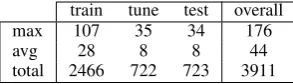
one-train tune test overall
max 107 35 34 176
avg 28 8 8 44
[image:6.595.107.254.62.104.2]total 2466 722 723 3911
Table 1: Number of LU examples for each data set from the 100 frames
vs-all scheme. In order to evaluate the quality of the presented models, accuracy is measured as the percentage of LUs that are correctly re-assigned to their original (gold-standard) frame. As the sys-tem can suggest more than one frame, different
accuracy levels can be obtained. A LU is
cor-rectly assigned if its correct frame (according to
FrameNet) belongs to the set of the best b
pro-posals by the system (i.e. the first bscores from
the underlying SVMs). Assigning different
val-ues tob, we obtained different levels of accuracy
as the percentage of LUs that is correctly assigned
among the firstbproposals, as shown in Table 3.
4.1 Experimental Setup
The adopted gold standard is a subset of the FrameNet database and it consists of the most 100 represented frames in term of annotated examples and LUs. As the number of example is extremely
unbalanced across frames1, the LUs dictionary of
each selected frame contains at least 10 LUs. It is a reasonable amount of information for the SVMs training and it is still a representative data set, be-ing composed of 3,911 LUs, i.e. the 55% of the
entire dictionary2 of 7,230 evoking words. All
word spaces are derived from the British National Corpus (BNC), which is underlying FrameNet and consisting of about 100 million words for English. Each selected frame is represented into the BNC by at least 362 annotated sentences, as the lack of a reasonable number of examples hardly pro-duces a good distributional model of LUs. Each frame’s list of LUs is split into train (60%), tuning (20%) and test set (20%) and LUs having Part-of-speech different from verb, noun or adjective are removed. In Table 1 the number of LUs for each set, as well as the maximum and the average num-ber per frame, are summarized.
Four different approaches for the Word Space
1For example the S
ELF MOTIONframe counts 6,248 amples while 119 frames are represented by less than 10 ex-amples
2The entire database contains 10,228 LUs and the number of evoking word is 7,230, without taking in account multiple frame assignments.
construction are used. The first two correspond to a Word-Based space, the last to a Syntax-Based, as described in section 3.1:
Window-n(Wn): contextual features correspond to the set of the 20,000 most frequent lemmatized words in the BNC. The association measure be-tween LUs and contexts is the Point-wise Mu-tual Information (PMI). Valid contexts for LUs are
fixed to an-window. Hereafter two window width
values will be investigated: Window5 (W5) and
Window10(W10).
Sentence(Sent): contextual features are the same above, but the valid contexts are extended to the entire sentence length.
SyntaxBased (SyntB): contextual features have been computed according to the
“dependency-based” vector space discussed3 in (Pado and
La-pata, 2007). Observable contexts here are made of syntactically-typed co-occurrences within depen-dency graphs built from the entire set of BNC sen-tences. The most frequent 20,000 basic features, i.e. (syntactic relation,lemma) pairs, have been employed as contextual features corresponding to PMI scores. Syntactic relations are extracted using the Minipar parser.
Word space models thus focus on the LUs of the selected 100 frames and the dimensionality have been reduced by applying LSA and LPP at a new
size ofl = 100. Any prior knowledge
informa-tion is provided to the tuning and test sets during the LPP transformation: the construction of the reduced feature space takes in account only LUs from the train set while remaining predicates are represented through the LPP linear projection. In
these experiments the cosine threshold τ and the
maximum number of constraints c are estimated
over the tuning set and the best parametrizations are shown in Table 2. The adopted
implementa-tion of SVM is SVM-Light-TK4.
4.2 Results
In these experiments the impact of the lexical knowledge gathered by different word-spaces is evaluated over the LU induction task. Moreover, the improvements achieved through LSA and LPP is measured. SVM classifiers are trained over the semantic spaces produced through the
dimension-3The Minimal context provided by the De-pendency Vectors tool is used. It is available at http://www.nlpado.de/∼sebastian/dv.html
α/β
τ c 1.0/0.0 .9/.1 .8/.2 .7/.3 .6/.4 .5/.5 .4/.6 .3/.7 .2/.8 .1/.9 0.0/1.0
[image:7.595.75.525.62.124.2]W5 0.668 0.669 0.672 0.673 0.669 0.662 0.649 0.632 0.612 0.570 0.033 0.55 5 W10 0.615 0.619 0.618 0.612 0.604 0.597 0.580 0.575 0.565 0.528 0.048 0.65 3 Sent 0.557 0.567 0.580 0.584 0.574 0.564 0.561 0.545 0.523 0.496 0.048 0.80 5 SyntB 0.654 0.664 0.662 0.652 0.651 0.647 0.649 0.634 0.627 0.592 0.056 0.40 3
Table 2: Accuracy at different combination weights of kernelαKLSA+βKLP P (specific baseline is
0.043)
b-1 b-2 b-3 b-4 b-5 b-6 b-7 b-8 b-9 b-10 α/β
W5orig 0,563 0,685 0,733 0,770 0,801 0,835 0,841 0,854 0,868 0,879
-W10orig 0,510 0,634 0,707 0,776 0,810 0,830 0,841 0,857 0,865 0,875
-Sentorig 0,479 0,618 0,680 0,734 0,764 0,793 0,813 0,837 0,845 0,852
-SyntBorig 0,585 0,741 0,803 0,840 0,866 0,874 0,886 0,903 0,907 0,913
-W5LSA+LP P 0.673 0.781 0.831 0.865 0.881 0.891 0.906 0.912 0.926 0.938 0.7/0.3
W10LSA+LP P 0.619 0.739 0.786 0.818 0.849 0.865 0.878 0.888 0.901 0.909 0.9/0.1
SentLSA+LP P 0.584 0.705 0.766 0.798 0.825 0.835 0.848 0.864 0.876 0.889 0.7/0.3
[image:7.595.305.530.324.502.2]SyntBLSA+LP P 0.664 0.791 0.840 0.864 0.878 0.893 0.901 0.903 0.907 0.911 0.9/0.1
Table 3: Accuracy of original word-space models (orig) and semantic space models (LSA+LPP) on
best-k proposed frames
ality reduction transformations. Representations of both semantic spaces are linearly combined as
αKLSA +βKLP P, where kernel weights α and
β are estimated over the tuning set. Both
ker-nels are used even without a combination: a
ra-tio α = 1.0/β = 0.0 denotes the LSA kernel
alone, whileα= 0.0/β = 1.0the LPP kernel. Ta-ble 2 shows best results, obtained through a RBF
kernel. The W indow5 model achieves the
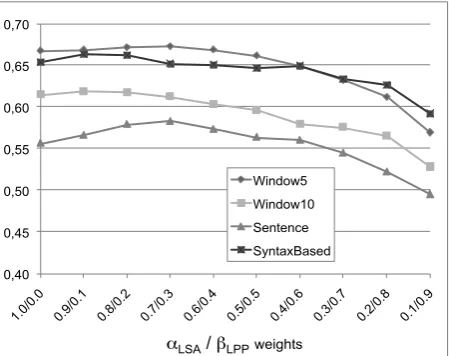
high-est accuracy, i.e. 67% of correct classification, where a baseline of 4.3% is estimated assigning LUs to the most likely frame in the training set (i.e. the one containing the highest number of LUs). Wider windows achieve lower classification accu-racy confirming that most of lexical information tied to a frame is near the LU. The Syntactic-based word space does not outperform the accuracy of a word-based space. The combination of both ker-nels has always provided the best outcome and the LSA space seems to be more accurate and expres-sive respect to the LPP one, as shown in Figure 1. In particular LPP alone is extremely unstable, suggesting that constraints imposed by the prior knowledge are orthogonal with respect to the cor-pus statistics.
Further experiments are carried out using the original co-occurrence space models, to assess im-provements due to LSA and LPP kernel. In the latter investigation linear kernel achieved best re-sults as confirmed in (Bengio et al., 2005), where the sensitivity to the curse of dimensionality of a large class of modern learning algorithms (e.g.
0,40 0,45 0,50 0,55 0,60 0,65 0,70
1.0/0.0 0.9/0.1 0.8/0.2 0.7/0.3 0.6/0.4 0.5/0.5 0.4/0.6 0.3/0.7 0.2/0.8 0.1/0.9
αLSA / βLPPweights Window5 Window10 Sentence SyntaxBased
Figure 1: Accuracy at different combination
weights of kernelαKLSA+βKLP P
SVM) based on local kernels (e.g. RBF) is ar-gued. As shown in Table 3, the performance drop
of original (orig) models against the best kernel
combination of LSA and LP P are significant,
i.e. ∼ 10%, showing how the latent semantic
spaces better capture properties of frames, avoid-ing data-sparseness, dimensionality problem and low-regularities of data-distribution.
Moreover, Table 3 shows how the accuracy level largely increases when more than one frame is
considered: at a level b = 3, i.e. the novel
LU is correctly classified if one of the original frames is comprised in the list (of three frames) proposed by the system, accuracy is 0.84 (i.e the
LU (# WNsyns) frame 1 frame 2 frame 3 Correct frames
boil.v (5) FOOD FLUIDIC MOTION CONTAINERS CAUSE HARM clap.v (7) SOUNDS MAKE NOISE COMMUNICATION NOISE BODY MOVEMENT crown.n (12) LEADERSHIP ACCOUTREMENTS PLACING ACCOUTREMENTS
OBSERVABLE BODYPARTS
school.n (7) EDUCATION TEACHING BUILDINGS LOCALE BY USE
EDUCATION TEACHING
LOCALE BY USE
AGGREGATE threat.n (4) HOSTILE ENCOUNTER IMPACT COMMITMENT COMMITMENT tragedy.n (2) TEXT KILLING EMOTION DIRECTED TEXT
Table 4: Proposed 3 frames for each LU (ordered by SVM scores) and correct frames provided by the FrameNet dictionary. In parenthesis the number of different WordNet lexical senses for each LU.
nearly 0.94 (i.e Window5). It is high enough to support tasks such as the semi-automatic creation of new FrameNets. An error analysis indicates that many misclassifications are induced by a lack in the frame annotations, especially those
concern-ing polysemic LUs5. Table 4 reports the analysis
of a LU subset where the first 3 frames proposed for each evoking word are shown, ranked by the margin of the SMVs. The last column contains the frames evoked by LUs, according to the FrameNet dictionary, and the frame names in bold suggest
their correct classification. Some LUs, likethreat
(characterized by 4 lexical senses) seem to be mis-classified: in this case the FrameNet annotation
regards a specific sense that evokes the COMMIT
-MENT frame (e.g. “There was a real threat that
she might have to resign”) without taking in ac-count other senses like WordNet’s “menace, threat (something that is a source of danger)” that could
evoke the HOSTILE ENCOUNTERframe. In other
cases proposed frames seem to enrich the LUs
dic-tionary, like BUILDINGS, here evoked byschool.
5 Conclusions
The core purpose of this was to present an em-pirical investigation of the impact of different dis-tributional models on the lexical unit induction task. The employed word-spaces, based on dif-ferent co-occurrence models (either context and syntax-driven), are used as vector models of the LU semantics. On these spaces, two dimensional-ity reduction techniques have been applied. Latent Semantic Analysis (LSA) exploits global proper-ties of data distributions and results in a global model for lexical semantics. On the other hand, the Locality Preserving Projection (LPP) method, that exploits regularities in the neighborhood of
5According to WordNet, in our dataset an average of 3.6 lexical senses for each LU is estimated.
each lexical predicate, is also employed in a semi-supervised manner: local constraints expressing prior knowledge on frames are defined in the ad-jacency graph. The resulting embedding is thefore expected to determine a new space where re-gions for LU of a given frame can be more eas-ily discovered. Experiments have been run using the resulting spaces for task dependent kernels in a SVM learning setting. The application of the FrameNet KB on the 100 best represented frames showed that a combined use of the global and lo-cal models made available by LSA and LPP, re-spectively, achieves the best results, as the 67.3% of LUs recovers the same frames of the annotated dictionary. This is a significant improvement with respect to previous results achieved by the pure distributional model reported in (Pennacchiotti et al., 2008).
Future work is required to increase the level of constraints made available from the semi-supervised setting of LPP: syntactic informa-tion, as well as role-related evidence, can be both accommodated by the adjacency constraints imposed for LPP. This constitutes a significant area of research towards a comprehensive semi-supervised model of frame semantics, entirely based on manifold learning methods, of which this study on LSA and LPP is just a starting point.
Acknowledgement We want to acknowledge Prof. Roberto Basili because this work would not exist without his ideas, inspiration and invaluable support.
References
pages 99–104, Prague, Czech Republic, June. Asso-ciation for Computational Linguistics.
Sugato Basu, Mikhail Bilenko, Arindam Banerjee, and Raymond Mooney. 2006. Probabilistic semi-supervised clustering with constraints. In Semi-Supervised Learning, pages 73–102. MIT Press.
Yoshua Bengio, Olivier Delalleau, and Nicolas Le Roux. 2005. The curse of dimensionality for lo-cal kernel machines. Technilo-cal report, Departement d’Informatique et Recherche Operationnelle.
Alexander Budanitsky and Graeme Hirst. 2006. Eval-uating WordNet-based measures of semantic dis-tance. Computational Linguistics, 32(1):13–47.
Aljoscha Burchardt, Katrin Erk, and Anette Frank. 2005. A WordNet Detour to FrameNet. In
Sprachtechnologie, mobile Kommunikation und lin-guistische Resourcen, volume 8 ofComputer Stud-ies in Language and Speech. Peter Lang, Frank-furt/Main.
Ronan Collobert and Jason Weston. 2008. A unified architecture for natural language processing: deep neural networks with multitask learning. InIn Pro-ceedings of ICML ’08, pages 160–167, New York, NY, USA. ACM.
Diego De Cao, Danilo Croce, Marco Pennacchiotti, and Roberto Basili. 2008. Combining word sense and usage for modeling frame semantics. InIn Pro-ceedings of STEP 2008, Venice, Italy.
Charles J. Fillmore. 1985. Frames and the semantics of understanding. Quaderni di Semantica, 4(2):222– 254.
G. W. Furnas, S. Deerwester, S. T. Dumais, T. K. Lan-dauer, R. A. Harshman, L. A. Streeter, and K. E. Lochbaum. 1988. Information retrieval using a sin-gular value decomposition model of latent semantic structure. InProc. of SIGIR ’88, New York, USA.
Daniel Gildea and Daniel Jurafsky. 2002. Automatic labeling of semantic roles. Computational Linguis-tics, 28(3):245–288.
Yoav Goldberg and Michael Elhadad. 2009. On the role of lexical features in sequence labeling. InIn Proceedings of EMNLP ’09, pages 1142–1151, Sin-gapore.
Zellig Harris. 1964. Distributional structure. In Jer-rold J. Katz and Jerry A. Fodor, editors,The Philos-ophy of Linguistics, New York. Oxford University Press.
Xiaofei He and Partha Niyogi. 2003. Locality preserv-ing projections. InProceedings of NIPS03, Vancou-ver, Canada.
T. Joachims. 1999.Making large-Scale SVM Learning Practical. MIT Press, Cambridge, MA.
Richard Johansson and Pierre Nugues. 2007. Using WordNet to extend FrameNet coverage. In Proceed-ings of the Workshop on Building Frame-semantic Resources for Scandinavian and Baltic Languages, at NODALIDA, Tartu, Estonia, May 24.
Richard Johansson and Pierre Nugues. 2008. The effect of syntactic representation on semantic role labeling. InProceedings of COLING, Manchester, UK, August 18-22.
Tom Landauer and Sue Dumais. 1997. A solution to plato’s problem: The latent semantic analysis the-ory of acquisition, induction and representation of knowledge. Psychological Review, 104.
Dekang Lin. 1998. Automatic retrieval and clustering of similar word. InProceedings of COLING-ACL, Montreal, Canada.
Alessandro Moschitti, Paul Morarescu, and Sanda M. Harabagiu. 2003. Open domain information ex-traction via automatic semantic labeling. InFLAIRS Conference, pages 397–401.
Sebastian Pado and Katrin Erk. 2005. To cause or not to cause: Cross-lingual semantic matching for paraphrase modelling. InProceedings of the Cross-Language Knowledge Induction Workshop, Cluj-Napoca, Romania.
Sebastian Pado and Mirella Lapata. 2007. Dependency-based construction of semantic space models. Computational Linguistics, 33(2):161–199.
Marco Pennacchiotti, Diego De Cao, Roberto Basili, Danilo Croce, and Michael Roth. 2008. Automatic induction of framenet lexical units. InProceedings of The Empirical Methods in Natural Language Pro-cessing (EMNLP 2008) Waikiki, Honolulu, Hawaii.
S.T. Roweis and L.K. Saul. 2000. Nonlinear dimen-sionality reduction by locally linear embedding. Sci-ence, 290(5500):2323–2326.
Magnus Sahlgren. 2006. The Word-Space Model. Ph.D. thesis, Stockholm University.
G. Salton, A. Wong, and C. Yang. 1975. A vector space model for automatic indexing. Communica-tions of the ACM, 18:613 ¨A`ı620.
Dan Shen and Mirella Lapata. 2007. Using semantic roles to improve question answering. In Proceed-ings of EMNLP-CoNLL, pages 12–21, Prague.
Mihai Surdeanu, , Mihai Surdeanu, A Harabagiu, John Williams, and Paul Aarseth. 2003. Using predicate-argument structures for information extraction. In
In Proceedings of ACL 2003.
Marta Tatu and Dan I. Moldovan. 2005. A seman-tic approach to recognizing textual entailment. In
J. B. Tenenbaum, V. Silva, and J. C. Langford. 2000. A Global Geometric Framework for Nonlinear Di-mensionality Reduction. Science, 290(5500):2319– 2323.
Xin Yang, Haoying Fu, Hongyuan Zha, and Jesse Bar-low. 2006. Semi-supervised nonlinear dimension-ality reduction. In 23rd International Conference on Machine learning, pages 1065–1072, New York, NY, USA. ACM Press.