Automatic Generation of Challenging Distractors
Using Context-Sensitive Inference Rules
Torsten Zesch
Language Technology Lab University of Duisburg-Essen [email protected]
Oren Melamud
Computer Science Department Bar-Ilan University [email protected]
Abstract
Automatically generating challenging dis-tractors for multiple-choice gap-fill items is still an unsolved problem. We propose to employ context-sensitive lexical infer-ence rules in order to generate distractors that are semantically similar to the gap tar-get word in some sense, but not in the par-ticular sense induced by the gap-fill con-text. We hypothesize that such distrac-tors should be particularly hard to distin-guish from the correct answer. We focus on verbs as they are especially difficult to master for language learners and find that our approach is quite effective. In our test set of 20 items, our proposed method de-creases the number of invalid distractors in 90% of the cases, and fully eliminates all of them in 65%. Further analysis on that dataset does not support our hypothesis re-garding item difficulty as measured by av-erage error rate of language learners. We conjecture that this may be due to limita-tions in our evaluation setting, which we plan to address in future work.
1 Introduction
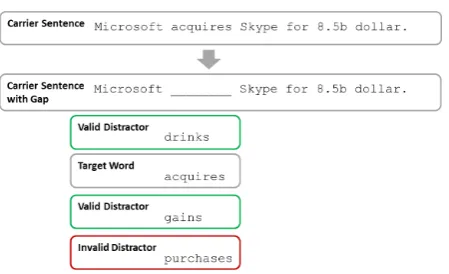
[image:1.595.308.533.199.336.2]Multiple-choice gap-fill items as illustrated in Fig-ure 1 are frequently used for both testing lan-guage proficiency and as a learning device. Each item consists of a carrier sentence that provides the context to a target word. The target word is blanked and presented as one possible gap-fill an-swer together with a certain number (usually 3) ofdistractors. Given a desired target word, car-rier sentences containing it can be automatically selected from a corpus. Some methods even select only sentences where the target word is used in a certain sense (Liu et al., 2005). Then, the main problem is to pick challenging distractors that are
Figure 1: Multiple-choice gap-fill item.
reasonably hard to distinguish from the correct an-swer (i.e. the target word) on one hand, yet cannot be considered as correct answers on the other.
In this paper we propose to generate distrac-tors that are semantically similar to the gap tar-get word in some sense, but not in the particu-lar sense induced by the gap-fill context, thereby making them difficult to distinguish from the tar-get word. For example, the distractorgainin Fig-ure 1 is semantically similar toacquire, but is not appropriate in the particular context of purchasing companies, and therefore has high distractive po-tential. On the other hand, the distractorpurchase
is a correct answer in this context and is therefore an invalid distractor. To generate challenging dis-tractors, we utilize context-sensitive lexical infer-ence rules that can discriminate between appropri-ate substitutes of a target word given its context and other inappropriate substitutes.
In the next section, we give an overview of pre-vious work in order to place our contribution into context.
2 Previous Work
The process of finding good distractors involves two steps: Candidate Selectioncontrols the diffi-culty of the items, whileReliability Checking en-sures that the items remain solvable, i.e. it enen-sures
that there is only one correct answer. We note that this work is focused on single-word distrac-tors rather than phrases (Gates et al., 2011), and only on target isolated carrier sentences rather than longer texts as in (Mostow and Jang, 2012).
2.1 Candidates Selection
In some settings the set of possible distractors is known in advance, e.g. the set of English prepo-sitions in preposition exercises (Lee and Seneff, 2007) or a confusion set with previously known errors like{two, too, to}. Sakaguchi et al. (2013) use data from the Lang-8 platform (a corpus of manually annotated errors1) in order to determine
typical learner errors and use them as distractors. However, in the common setting only the target word is known and the set of distractors needs to be automatically generated.
Randomly selecting distractors is a valid strat-egy (Mostow and Jang, 2012), but it is only suit-able for the most beginner learners. More ad-vanced learners can easily rule out distractors that do not fit grammatically or are too unrelated se-mantically. Thus, more advanced approaches usu-ally employ basic strategies, such as choosing dis-tractors with the same part-of-speech tag as the target word, or distractors with a corpus frequency comparable to the target word (Hoshino and Naka-gawa, 2007) (based on the assumption that corpus frequency roughly correlates with word difficulty). Pino and Eskenazi (2009) use distractors that are morphologically, orthographically, or phonetically similar (e.g.bread – beard).
Another approach used in previous works to make distractors more challenging is utilizing the-sauri (Sumita et al., 2005; Smith and Avinesh, 2010) or taxonomies (Hoshino and Nakagawa, 2007; Mitkov et al., 2009) to select words that are semantically similar to the target word. In addi-tion to the target word, some approaches also con-sider the semantic relatedness of distractors with the whole carrier sentence or paragraph (Pino et al., 2008; Agarwal and Mannem, 2011; Mostow and Jang, 2012), i.e. they pick distractors that are from the same domain as the target word.
Generally, selecting more challenging distrac-tors usually means making them more similar to the target word. As this increases the probability that a distractor might actually be another correct answer, we need a more sophisticated approach for
1http://cl.naist.jp/nldata/lang-8/
checking the reliability of the distractor set.
2.2 Reliability Checking
In order to make sure that there is only one correct answer to a gap-fill item, there needs to be a way to decide for each distractor whether it fits into the context of the carrier sentence or not. In those cases, where we have a limited list of potential tar-get words and distractors, e.g. in preposition exer-cises (Lee and Seneff, 2007), a supervised classi-fier can be trained to do this job. Given enough training data, this approach yields very high preci-sion, but it cannot be easily applied to open word classes like nouns or verbs, which are much larger and dynamic in nature.
When we do not have a closed list of potential distractors at hand, one way to perform reliabil-ity checking is by considering collocations involv-ing the target word (Pino et al., 2008; Smith and Avinesh, 2010). For example, if the target word is strong, we can find the collocationstrong tea. Then we can usepowerfulas a distractor because it is semantically similar tostrong, yet*powerful teais not a valid collocation. This approach is ef-fective, but requires strong collocations to discrim-inate between valid and invalid distractors. There-fore it cannot be used with carrier sentences that do not contain strong collocations, such as the sen-tence in Figure 1.
Sumita et al. (2005) apply a simple web search approach to judge the reliability of an item. They check whether the carrier sentence with the target word replaced by the distractor can be found on the web. If such a sentence is found, the distrac-tor is discarded. We note that the applicability of this approach is limited, as finding exact matches for such artificial sentences can be unlikely due to sparseness of natural languages. Therefore not finding an exact match does not necessarily rule out the possibility of an invalid distractor.
3 Automatic Generation of Challenging Distractors
dis-tractors. In the remainder of this section we de-scribe this procedure in more detail.
3.1 Context-Sensitive Inference Rules
A lexical inference rule ‘LHS → RHS’, such as ‘acquire → purchase’, specifies a directional in-ference relation between two words (or terms). A rule can beappliedwhen its LHS matches a word in a textT, and then that word is substituted for RHS, yielding the modified textH. For example, applying the rule above to “Microsoft acquired Skype”, yields “Microsoft purchased Skype”. If the rule is true then the meaning ofHis inferred from the meaning of T. A popular way to learn lex-ical inference rules in an unsupervised setting is by using distributional similarity models (Lin and Pantel, 2001; Kotlerman et al., 2010). Under this approach, target words are represented as vectors of context features, and the score of a rule between two target words is based on vector arithmetics.
One of the main shortcomings of such rules is that they are context-insensitive, i.e. they have a single score, which is not assessed with respect to the concrete context T under which they are ap-plied. However, the appropriateness of an infer-ence rule may in fact depend on this context. For example, ‘Microsoft acquire Skype → Microsoft purchase Skype’, is an appropriate application of the rule ‘acquire → purchase’, while ‘Children acquire skills→ Children purchase skills’ is not. To address this issue, additional models were in-troduced that compute a differentcontext-sensitive
score per each contextT, under which it is applied (Dinu and Lapata, 2010; Melamud et al., 2013).
In this work, we use the resource provided by Melamud et al. (2013), which includes both context-sensitive and context-insensitive rules for over 2,000 frequent verbs.2 We use these rules to
generate challenging distractors as we show next.
3.2 Distractor Selection & Reliability
We start with the following illustrative example to motivate our approach. While the wordspurchase
and acquire are considered to be almost perfect synonyms in sentences like Microsoft acquires Skype andMicrosoft purchases Skype, this is not true for all contexts. For example, in Children acquire skills vs. Children purchase skills, the meaning is clearly not equivalent. These context-dependent senses, which are particularly typical to
[image:3.595.319.514.84.186.2]2http://www.cs.biu.ac.il/nlp/downloads/wt-rules.html
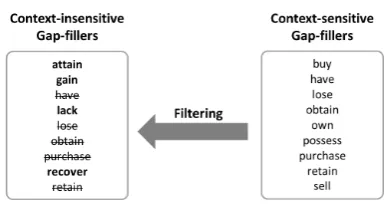
Figure 2: Filtering context-insensitive substitu-tions with context-sensitive ones in order to get challenging distractors.
verbs, make it difficult for learners to understand how to properly use these words.
Acquiring such fine-grained sense distinction skills is a prerequisite for really competent lan-guage usage. These skills can be trained and tested with distractors, such as purchase in the exam-ple above. Therefore, such items are good indi-cators in language proficiency testing, and should be specifically trained when learning a language.
To generate such challenging distractors, we first use the context-insensitive rules, whose LHS matches the carrier sentence target word, to create adistractor candidate setas illustrated on the left-hand side of Figure 2. We include in this set the top-n inferred words that correspond to the high-est rule scores. These candidate words are inferred by the target word, but not necessarily in the par-ticular context of the carrier sentence. Therefore, we expect this set to include both correct answers, which would render the item unreliable, as well as good distractors that are semantically similar to the target word in some sense, but not in the par-ticular sense induced by the carrier sentence.
3.3 Distractor Ranking
In case our approach returns a large number of good distractors, we should use ranking to select the most challenging ones. A simple strategy is to rely on the corpus frequency of the distractor, where less frequent means more challenging as it will not be known to the learner. However, this tends to put a focus on the more obscure words of the vocabulary while actually the more frequent words should be trained more often. Therefore, in this work we use the scores that were assigned to the distractors by the context-insensitive inference rules. Accordingly, the more similar a distractor is to the target word, the higher rank it will get (pro-vided that it was not in the distractor black-list).
4 Experiments & Results
In our experiments we wanted to test two hy-potheses: (i) whether context-sensitive inference rules are able to reliably distinguish between valid and invalid distractors, and (ii) whether the gener-ated distractors are more challenging for language learners than randomly chosen ones.
We used the Brown corpus (Nelson Francis and Kuc¸era, 1964) as a source for carrier sentences and selected medium-sized (5-12 tokens long) sen-tences that contain a main verb. We then manu-ally inspected this set, keeping only well-formed sentences that are understandable by a general au-dience without requiring too much context knowl-edge. In a production system, this manual pro-cess would be replaced by a sophisticated method for obtaining good carrier sentences, but this is be-yond the scope of this paper. Finally, for this ex-ploratory study, we only used the first 20 selected sentences from a much larger set of possible car-rier sentences.
4.1 Reliability
Our first goal was to study the effectiveness of our approach in generating reliable items, i.e. items where the target word is the only correct answer. In order to minimize impact of pre-processing and lemmatization, we provided the context-sensitive inference rules with correctly lemmatized carrier sentences and marked the target verbs. We found that we get better results when using a distractor black-list that is larger than the distractor candi-date set, as this more aggressively filters invalid distractors. We used the top-20 distractor black-list and top-10 distractor candidate set, which lead
Only valid distractors 13/20 (65%) Mix of valid and invalid 5/20 (25%) Only invalid distractors 2/20 (10%)
Table 1: Reliability of items after filtering
to generating on average 3.3 distractors per item. All our generated distractors were checked by two native English speakers. We count a distrac-tor as “invalid” if it was ruled out by at least one annotator. Table 1 summarizes the results. We found that in 13 of the 20 items (65%) all distrac-tors generated by our approach were valid, while only for 2 items all generated distractors were in-valid. For the remaining 5 items, our approach re-turned a mix of valid and invalid distractors. We note that the unfiltered distractor candidate set al-ways contained invalid distractors and in 90% of the items it contained a higher proportion of in-valid distractors than the filtered one. This sug-gests that the context-sensitive inference rules are quite effective in differentiating between the dif-ferent senses of the verbs.
A main source of error are sentences that do not provide enough context, e.g. because the subject is a pronoun. InShe [served] one four-year term on the national committee, it would be acceptable to insert sold in the context of a report on po-litical corruption, but a more precise subject like
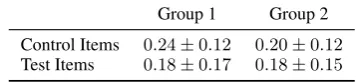
Group 1 Group 2 Control Items 0.24±0.12 0.20±0.12 Test Items 0.18±0.17 0.18±0.15
Table 2: Average error rates on our dataset
should thus not be used as distractors. The verb
float is different from the previous examples, as all its dominant senses involve some kind of “float-ing” even if only metaphorically used. This results in similar senses that are harder to differentiate.
4.2 Difficulty
Next, we wanted to examine whether our approach leads to more challenging distractors. For that purpose we removed the distractors that our an-notators identified as invalid in the previous step. We then ranked the remaining distractors accord-ing to the scores assigned to them by the context-sensitive inference rules and selected the top-3 tractors. If our method generated less than 3 tractors, we randomly generated additional dis-tractors from the same frequency range as the tar-get word.
We compared our approach with randomly se-lected distractors that are in the same order of magnitude with respect to corpus frequency as the distractors generated by our method. This way we ensure that a possible change in distractor diffi-culty cannot simply be attributed to differences in the learners’ familiarity with the distractor verbs due to their corpus frequency. We note that ran-dom selection repeatedly created invalid distrac-tors that we needed to manually filter out. This shows that better methods for checking the relia-bility of items like in our approach are definitely required.
We randomly split 52 participants (all non-natives) into two groups, each assigned with a dif-ferent test version. Table 2 summarizes the results. For both groups, the first 7 test items were identi-cal and contained only randomly selected distrac-tors. Average error rate for these items was 0.24 (SD0.12) for the first group, and 0.20 (SD0.12) for the second group, suggesting that the results of the two groups on the remaining items can be com-pared meaningfully. The first group was tested on the remaining 13 items with randomly selected distractors, while the second group got the same items but with distractors created by our method.
Contrary to our hypothesis, the average error
rate for both groups was equal (0.18, SD1=0.17, SD2=0.15). One reason might be that the English
language skills of the participants (mostly com-puter science students or faculty) were rather high, close to the native level, as shown by the low error rates. Furthermore, even if the participants were more challenged by our distractors, they might have been able to finally select the right answer with no measurable effect on error rate. Thus, in future work we want measure answer time instead of average error rate, in order to counter this effect. We also want to re-run the experiment with lower grade students, who might not have mastered the kind of sense distinctions that our approach is fo-cused on.
5 Conclusions
In this paper we have tackled the task of generating challenging distractors for multiple-choice gap-fill items. We propose to employ context-sensitive lexical inference rules in order to generate distrac-tors that are semantically similar to the gap target word in some sense, but not in the particular sense induced by the gap-fill context.
Our results suggest that our approach is quite ef-fective, reducing the number of invalid distractors in 90% of the cases, and fully eliminating all of them in 65%. We did not find a difference in aver-age error rate between distractors generated with our method and randomly chosen distractors from the same corpus frequency range. We conjecture that this may be due to limitations in the setup of our experiment.
Thus, in future work we want to re-run the ex-periment with less experienced participants. We also wish to measure answer time in addition to error rate, as the distractive powers of a gap-filler might be reflected in longer answer times more than in higher error rates.
Acknowledgements
References
Manish Agarwal and Prashanth Mannem. 2011. Au-tomatic Gap-fill Question Generation from Text
Books. InProceedings of the Sixth Workshop on
In-novative Use of NLP for Building Educational Ap-plications, pages 56–64.
Georgiana Dinu and Mirella Lapata. 2010. Measur-ing Distributional Similarity in Context. In Proceed-ings of the 2010 Conference on Empirical Methods in Natural Language Processing (EMNLP), pages 1162–1172.
Donna Gates, Margaret Mckeown, Juliet Bey, Forbes Ave, and Ross Hall. 2011. How to Generate Cloze Questions from Definitions : A Syntactic
Ap-proach. InProceedings of the AAAI Fall Symposium
on Question Generation, pages 19–22.
Ayako Hoshino and Hiroshi Nakagawa. 2007. As-sisting Cloze Test Making with a Web Application. InProceedings of the Society for Information Tech-nology and Teacher Education International
Confer-ence, pages 2807– 2814.
Lili Kotlerman, Ido Dagan, Idan Szpektor, and Maayan Zhitomirsky-Geffet. 2010. Directional Distribu-tional Similarity for Lexical Inference. Natural Lan-guage Engineering, 16(4):359–389.
John Lee and Stephanie Seneff. 2007. Automatic Generation of Cloze Items for Prepositions. In
Proceedings of INTERSPEECH, pages 2173–2176, Antwerp, Belgium.
Dekang Lin and Patrick Pantel. 2001. DIRT – Discov-ery of Inference Rules from Text. InProceedings of ACM SIGKDD Conference on Knowledge Discovery and Data Mining 2001.
Chao-lin Liu, Chun-hung Wang, and Zhao-ming Gao. 2005. Using Lexical Constraints to Enhance the Quality of Computer-Generated Multiple-Choice
Cloze Items. Computational Linguistics and
Chi-nese Language Processing, 10(3):303–328.
Oren Melamud, Jonathan Berant, Ido Dagan, Jacob Goldberger, and Idan Szpektor. 2013. A Two Level Model for Context Sensitive Inference Rules. In
Proceedings of the 51st Annual Meeting of the As-sociation for Computational Linguistics (Volume 1: Long Papers), pages 1331–1340, Sofia, Bulgaria. Ruslan Mitkov, Le An Ha, Andrea Varga, and Luz
Rello. 2009. Semantic Similarity of Distractors in Multiple-choice Tests: Extrinsic Evaluation. In Pro-ceedings of the Workshop on Geometrical Models of Natural Language Semantics, pages 49–56.
Jack Mostow and Hyeju Jang. 2012. Generating Diagnostic Multiple Choice Comprehension Cloze
Questions. InProceedings of the Seventh Workshop
on Building Educational Applications Using NLP, pages 136–146, Stroudsburg, PA, USA.
W. Nelson Francis and Henry Kuc¸era. 1964. Manual of Information to Accompany a Standard Corpus of Present-day Edited American English, for use with Digital Computers.
Juan Pino and Maxine Eskenazi. 2009.
Semi-Automatic Generation of Cloze Question
Distrac-tors Effect of Students L1. InSLaTE Workshop on
Speech and Language Technology in Education. Juan Pino, Michael Heilman, and Maxine Eskenazi.
2008. A Selection Strategy to Improve Cloze Ques-tion Quality. InProceedings of the Workshop on In-telligent Tutoring Systems for Ill-Defined Domains at the 9th Internationnal Conference on Intelligent Tutoring Systems.
Keisuke Sakaguchi, Yuki Arase, and Mamoru Ko-machi. 2013. Discriminative Approach to Fill-in-the-Blank Quiz Generation for Language Learners. InProceedings of the 51st Annual Meeting of the As-sociation for Computational Linguistics (Volume 2: Short Papers), pages 238–242, Sofia, Bulgaria. Simon Smith and P V S Avinesh. 2010. Gap-fill Tests
for Language Learners: Corpus-Driven Item
Gener-ation. InProceedings of ICON-2010: 8th
Interna-tional Conference on Natural Language Processing. Eiichiro Sumita, Fumiaki Sugaya, and Seiichi Ya-mamoto. 2005. Measuring Non-native Speakers’ Proficiency of English by Using a Test with Automatically-generated Fill-in-the-blank
Ques-tions. In Proceedings of the second workshop on