On the Robustness of Standalone Referring Expression Generation
Algorithms Using RDF Data
Pablo Ariel Duboue and Martin Ariel Dom´ınguez and Paula Estrella
Facultad de Matematica, Astronom´ıa y F´ısica Universidad Nacional de C´ordoba
C´ordoba, Argentina
Abstract
A sub-task of Natural Language Genera-tion (NLG) is the generaGenera-tion of referring expressions (REG). REG algorithms are expected to select attributes that unam-biguously identify an entity with respect to a set of distractors. In previous work we have defined a methodology to evaluate REG algorithms using real life examples. In the present work, we evaluate REG gorithms using a dataset that contains al-terations in the properties of referring en-tities. We found that naturally occurring ontological re-engineering can have a dev-astating impact in the performance of REG algorithms, with some more robust in the presence of these changes than others. The ultimate goal of this work is observing the behavior and estimating the performance of a series of REG algorithms as the enti-ties in the data set evolve over time.
1 Introduction
The main research focus in NLG is the creation of computer systems capable of generating human-like language. According to the consensus Natural Language Generation (NLG) architecture (Cahill et al., 2001) the NLG task takes as input non-linguistic data and operates over it as a series of enrichment steps, culminating with fully specified sentences from which output strings can be read out. Such a generation pipeline mimics, up to a certain extent, a Natural Language Understanding (NLU) pipeline. In NLU, however, it is expected that the text upon which the system is being run upon might contain a variety of errors. These er-rors include wrongly written text that a human might find it difficult to understand or idiosyn-cratic deviations from well accepted prose (what is
called “improper grammar” or “orthographic mis-takes” by defenders of prescriptive grammar). The fact that plenty of texts of interest to NLU exhibit poor quality explains the reason behind NLU’s fo-cus on robust approaches. Such approaches at-tempt to cope gracefully with inputs that do not conform to the standards of the original texts em-ployed for building the system (either as work-ing examples or trainwork-ing data in a machine learn-ing sense). In NLG, on the other hand, current approaches rarely explore fallback strategies for those cases where the data is not fully compliant with the expected input and, thus, there is little in-tuition about possible outputs of a system under such circumstances.
In this work we aim to explore robustness for the particular case of Referring Expressions Gen-eration (REG) algorithms by means of different versions of an ontology. Therefore, we can com-bine REG algorithms with ontologies to study their behavior as the entities in the chosen ontol-ogy change. In our case, we have chosen the on-tology built from Wikipedia though different ver-sions of DBpedia and three REG algorithms on which we will measure robustness, defined here as an algorithm’s resilience to adapt to changes in the data or its capability to gracefully deal with noisy data. In a sense, we are interested in two different phenomena: (1) whether an NLG subcomponent (REG in particular) can be used with outdated on-tological data to fulfill its task and (2) which im-plementation of the said subcomponent is better suited in this setting. Our research is driven by the second question but this current work sheds more light on the first one. See Section 7 for details.
Section 6 presents the results which are further discussed in Section 7.
2 Related work
The need to account for changes in ontologies has long been acknowledged, given that they may not be useful in real world applications if the repre-sentation of the knowledge they contain is out-dated. Eder and Koncilia (2004) present a formal-ism to represent ontologies as graphs that contain a time model including time intervals and valid times for concepts. They base their formalism on techniques developed for temporal databases, namely the versioning of databases instead of their evolution and they provide some guidelines on its possible implementation.
Another source of ontology transformation is spatiotemporal changes. Dealing with spatial changes on historical data (or over time series) is crucial for some NLP tasks, such as information retrieval (Kauppinen and Hyvnen, 2007). In their case, the authors deal with the evolution of the on-tology’s underlying domain instead of its version-ing or evolution due to developments or refine-ments. Their main result is the definition of partial overlaps between concepts in a given time series, which was applied to build a Finnish Temporal Re-gion Ontology, showing promising results.
More recently, with the development of one of the largest ontologies, DBpedia (Bizer et al., 2009), much research has been devoted to exploit-ing this resource in NLP or NLG tasks as well as to model its changes. For example, there is research on modeling DBpedia’s currency (Rula et al., 2014), that is, the age of the data in it and the speed at which those changes can be cap-tured by any system. Although currency could be computed based on the modification/creation dates of the resources, this information is not al-ways present in Wikipedia pages. To overcome this, the authors propose a model to estimate cur-rency combining information from the original re-lated pages and a couple of currency metrics mea-suring the speed of retrieval by a system and ba-sic currency or timestamp. Their experiments sug-gest that entities with high system currency are as-sociated with more complete DBpedia resources and entities with low system currency appear as-sociated with Wikipedia pages that are not easily tractable (or that “could not provide real world in-formation” according with the authors).
Closer to our work, Kutlak et al. (2013) use DBpedia for REG. As opposed to classical work in the field, this work experiments with entities that potentially have a large number of distrac-tors, a situation that may be difficult to handle for classical REG algorithms. Under this hypothesis, the authors propose a new corpus-based algorithm inspired by the notion of Communal Common Ground (CCG), defined as information shared by a particular community whose members assume that everyone knows. In the extrinsic evaluation CCG outperformed the more classical Incremental Al-gorithm (IA) (Dale and Reiter, 1995), thus authors suggest that CCG might be more suitable for large domains than other algorithms.
In previous work, we (Pacheco et al., 2012) em-ployed several REG algorithms to generate refer-ring expressions from DBpedia, in particular we used Full Brevity (Bohnet, 2007), Constraint Sat-isfaction approach (Gardent, 2002) and the Incre-mental Algorithm (Dale and Reiter, 1995). Ex-ploiting articles from Wikinews to generate the RE for a randomly selected group of entities (a tech-nique we also used in this work), we found that DBpedia contained information about half of the entities mentioned in the news and that the IA and the Constraint Satisfaction were able to generate a definite description in about 98% of the contexts extracted from the news articles. However, the algorithms produced satisfactory definite descrip-tions only in about 40% of the cases. The main problems identified in these experiments were that some properties are quite unique but lead to de-scriptions of little use to most people evaluating them (thus producing the low results obtained) and the rather odd choice of the preference order of the Incremental Algorithm. Our focus on robustness, however, is different from it.
3 Algorithms
In this section we describe the REG algorithms used in this work. We chose three representative algorithms that can deal with single entity refer-ents, a classic algorithm (Dale and Reiter, 1995), an algorithm generating negations (Gardent, 2002) and an algorithm using graph theory (Krahmer et al., 2003). We describe each of the algorithms us-ing the followus-ing notation: R is the referent, C
is the set of distractors andP is a list of
proper-ties, triples in the form (entity, attribute, value), describingR.
REG algorithms pick properties that might ulti-mately be used to generate nominal syntactic units that identify the entity that is the referent.1 We
define the context as the set of entities that the re-ceiver is currently paying attention to. Then, the distractor set is the context set without the pre-dicted reference. Once this is defined, they con-sider the components of a referral expression as rules to set aside or keep on considering the mem-bers of the contrast set. For example, if the speaker wants to identify asmall black dog in a situation where the distractor set consists of abig white dog and ablack small cat, we could choose the adjec-tive black to rule out the white dog and then the noun dog to rule out the noun cat. The resulting referral expression would be the black dog, which refers toRbut not to the other entities in this
con-text. Thus, theRwas unmistakably identified.
The algorithms listed here are implemented in the Java programming language and publicly available under an Open Source license as part of the Alusivo REG project.2
3.1 Incremental Algorithm
The incremental algorithm assumes the properties inP are ordered according to an established
cri-teria. Then the algorithm iterates over P, adding each triple one at a time and removing fromCall
entities ruled out by the new triple. Triples that do not eliminate any new entity fromCare ignored. The algorithm terminates whenC is empty. This
algorithm was created in 1995 (Dale and Reiter,
1At this level in the generation pipeline, the system op-erates on abstract semantic representations, the actual words and syntactic forms are left to other components, such as the lexical chooser and the surface generator. In this discussion we use nominal phrases to illustrate the topics, but this is with the understanding that is the output of the full system not the REG algorithm alone.
2https://github.com/DrDub/Alusivo
1995) as a simplification of previous work on the development of REG algorithms. Given its sim-plicity it is considered a baseline in many NLG articles.
This algorithm is strongly influenced by the preference order among attributes. We used the ordering for people in Wikipedia developed by Pacheco (Pacheco, 2012) which is shipped with Alusivo.
3.2 Gardent Algorithm
The algorithm (Gardent, 2002) is based on the idea that in many languages, a possible way to unam-biguously describe entities is to identify a set of related referents and to provide a quantified ex-pression, for example,“the team where Messi has played that is not in Argentina”should suffice to identifyBarcelona Ftbol Clubas the referred en-tity. The speaker offers enough information to the listener to identify the set of objects the speaker is talking about. From a generation perspective, this means that starting with a set of objects and their properties which are known to the speaker and the listener, a distinctive description must be created, in such a way that it allows the user to unmistak-ably identify the referred objects. The solution ad-dressed from this standpoint is an algorithm that generates minimal distinct descriptions, that is to say, with the least number of literals to identify the target. By definition, these will not be unnec-essarily long, redundant nor ambiguous. The algo-rithm performs this task using Constraint Satisfac-tion Programming (CSP) (Lassez, 1987)3to solve
two basic constraints: find a set of positive proper-tiesP+ and negative propertiesP−, such that all properties inP+are true for the referent and all in P−are false, and it is the smallerP+∪P−such
that for everyc∈Cthere exists a property inP+ that does not hold for cor a property in P− that
holds forc.
We further reuse the orderings from the incre-mental algorithm for the search process used by the constraints solver.
3.3 Graph Algorithm
The REG graph-based algorithm (Krahmer et al., 2003) constructs an initial directed graph G that
models the original problem. The nodes inG
be-long to{R} ∪Cand the edges represent the
prop-erties P. The algorithm recursively constructs a
3We employed the Choco CSP solver Java library:
sub-graph of G, V, starting with node R. At each step it explores the space of successors of the nodes inGthat are not inV. The search is guided
by a cost function that is calculated each time a node and edge are added to V. The goal of the
algorithm is to check whether the properties inV
serve to distinguishRfromC, meaning thatV is
distinctive. To verify whetherV is distinctive, at
each step the algorithm searches for the existence of a sub-graphGcisomorphic toV, whereGc
con-tains a nodec∈C; if no such graph exists, thenV
is distinctive. Finally, the least expensive distinc-tive graph is returned.
Different cost functions are possible. For our experiments, we use a cost function equal to the number of edges plus the number of vertices in the subgraph and we order the search over edges using the same ordering as the incremental algo-rithm. This is the particular parameterization of the graph algorithm that we are comparing against the other algorithms.
4 Data
We have chosen Wikipedia as our source of enti-ties, as it represents one of the biggest freely avail-able knowledge base. Started in January 2001 at present it contains over 37 million articles in 284 languages and it continues to grow thanks to the collaborative creation of content by thousands of users around the globe.
Given that the content in Wikipedia pages is stored in a structured way, it is possible to ex-tract and organize it in an ontology-like manner as implemented in the DBpedia community project. This is accomplished by mapping Wikipedia in-foboxes from each page to a curated shared on-tology that contains 529 classes and around 2,330 different properties. DBpedia contains the knowl-edge from 111 different language editions of Wikipedia and, for English the knowledge base consists of more than 400 million facts describing 3.7 million things (Lehmann et al., 2015). A noble feature of this resource is that it is freely available to download in the form ofdumpsor it can be con-sulted using specific tools developed to query it.
These dumps contain the information coded in a language called Resource Description Framework (RDF) (Lassila et al., 1998). The WWW Con-sortium (W3C) has developed RDF to encode the knowledge present in web pages, so that it is com-prehensible and exploitable by agents during any
information search. RDF is based on the concept of making statements about (Web) resources using expressions in the subject-predicate-object form. These expressions are known as triples, where the subject denotes the resource being described, the predicate denotes a characteristic of the subject and describes the relation between the subject and the object. A collection of such RDF declarations can be formally represented as a labeled directed multi-graph, naturally appropriate to represent on-tologies.
We have chosen to use the dumps of differ-ent versions of Wikipedia, namely versions 2014 (09/2014) and 3.6 (01/2011). DBpedia 3.6 ontol-ogy encompasses 359 classes and 1,775 properties (800 object properties, 859 datatype properties us-ing standard units, 116 datatype properties usus-ing specialized units) and DBpedia 2014 ontology en-compasses 685 classes and 2,795 properties (1,079 object properties, 1,600 datatype properties using standard units, 116 datatype properties using spe-cialized units).4 These versions have been
specifi-cally selected: the 2014 version for current up-to-date data and the 3.8 version for comparison with the results by Pacheco et al. (Pacheco et al., 2012).
5 Experimental setup
We follow an approach similar to Pacheco et al. (Pacheco et al., 2012) to ex-tract REG tasks from journalistic text: we exex-tract all people that appear explicitly linked in a given Wikinews article. By using Wikinews, we ensure all the people are disambiguated to their DBpedia URIs by construction (Figure 1).5 We selected a
Wikinews dump as closest to our target DBpedia (20140901). From there, we define all URIs for which DBpedia has a birthDate relation (761,830 entities) as “people” and all entities with a foundDate as an “organization” (19,694 entities). We extract all such people and organizations that appear in the same Wikinews article using the provided inter-wiki SQL links file. For each arti-cle, we randomly chose a person as the referent, turning them into a fully defined REG task. This approach produced 4,741 different REG tasks, over 9,660 different people and 3,062 over 8,539
4Statistics taken from the DBpedia change log available at http://wiki.dbpedia.org/services-resources/datasets/change-log.
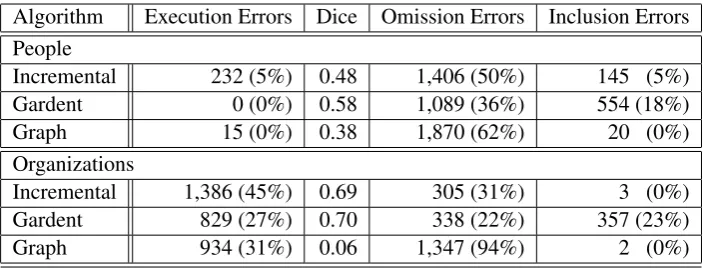
Algorithm Execution Errors Dice Omission Errors Inclusion Errors People
Incremental 232 (5%) 0.48 1,406 (50%) 145 (5%) Gardent 0 (0%) 0.58 1,089 (36%) 554 (18%)
Graph 15 (0%) 0.38 1,870 (62%) 20 (0%)
Organizations
[image:5.595.123.475.61.195.2]Incremental 1,386 (45%) 0.69 305 (31%) 3 (0%) Gardent 829 (27%) 0.70 338 (22%) 357 (23%) Graph 934 (31%) 0.06 1,347 (94%) 2 (0%)
Table 1: Our results, over 3,051 different REG tasks for people and 2,370 for organizations. The error percentages are computed over the total number of executed tasks.
organizations. Each REG task has an average of 4.89 people and 2.79 organizations.
We then created a subset of the relevant tu-ples for these people (291,039 tutu-ples on DBpe-dia 2014 and 129,782 on DBpeDBpe-dia 3.6, a 224% in-crease6) and organizations (468,041 tuples on
DB-pedia 2014 and 216,730 on DBDB-pedia 3.6, a 216% increase) by extracting all tuples were any of the people or organizations were involved, either as subject or object of the statement. Over these sub-sets were our algorithms executed.
As we are interested in REs occurring after first mentions, we filter properties from the data that unequivocally identify the entity, such as full name or GPS location of its headquarters.
6 Results
We run three representative algorithms that can deal with single entity referents, described in Sec-tion 3. As all our algorithms can fail to produce a RE, the first column in our results table (Table 1) contains the number of execution errors. The al-gorithms can fail either because they have a time-out argument (such as in Graph) or they have a restricted set of heuristics (like IA) that might fail to produce a unique description. In the event of unknown entities (36% of people tasks and 23% of organization tasks contain an entity unknown to DBpedia 3.6), Gardent Algorithm can attempt to produce a RE using negations (using a closed world assumption) while our implementation of the Graph Algorithm will also attempt building a RE if the unknown entity is not the referent. This seldom happens and we report only numbers on
6In DBpedia 2014, there was an average of 30.12 proper-ties per person while in DBpedia 3.6, there was an average of 17.3
fully defined tasks, which mean the algorithms can be run only on 64% of people tasks and 77% of organization tasks. Using the RE obtained in the old version of DBpedia, we executed on the new version and computed a Dice set similarity coeffi-cient between the two sets. However, Dice has its own problems when it comes to evaluating REG results (van Deemter and Gatt, 2009) and we thus computed two extra metrics: inclusion errors and omission errors. Inclusion errors imply the RE chosen on the old version of DBpedia included ex-tra disex-tractors when applied to the new version of DBpedia. Omission errors imply the RE chosen on the old version of DBpedia failed to include the referent in the new version (this figure includes all execution errors).
The number of inclusion errors is somewhat in line with our expectations from having a more de-tailed ontological resource: as more data is known about the world, properties that seemed a good fit in a knowledge poor situation all of sudden be-come too general. For example, trying to dis-tinguish a politicianAfrom two other politicians B, C when we do not have a record thatBandC
are politicians will lead us to a RE (x is a politi-cian) that will overgenerate on a newer, richer on-tology.
‘Politi-cian’) and dropping language annotations for val-ues (from “22nd”@en to “22nd” –note the drop-ping of @en). These two changes account for 90% of the omission errors and even a greater percent-age of the errors produced by the Graph Algorithm in organizations (the 0.06 Dice in the table).
Now, with further engineering on our behalf (or by choosing a different version of DBpedia where these changes have been already ironed out), we can have an experiment that will shed more light over which REG algorithm is more robust. How-ever, for the sake of our first research question, we find these results quite enlightening: these onto-logical changes were difficult to spot (the new ver-sion was 200%bigger, there were little reason to expect many types weredropped). Moreover, type information is key for most REG algorithms. We believe this highlights a different point-of-view when designing NLG subcomponents that operate with real data in a changing world.
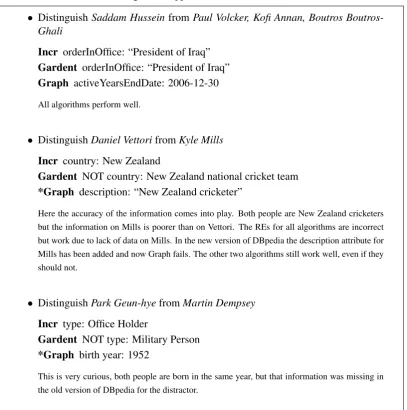
Given this, our results are too early to fully com-pare REG algorithms but as a preliminary result, the CSP approach seems to perform consistently at the top. We also found a few interesting exam-ples presented in the appendix.
All our code and data are available online for further analysis.7
7 Conclusions
We set ourselves to investigate the robustness of a NLG subcomponent when applied to Web data in RDF format. We were interested in two different phenomena: (1) whether an NLG subcomponent (REG in particular) can be used with outdated on-tological data to fulfill its task and (2) which im-plementation of said subcomponent is better suited to this setting. Our research is driven by the sec-ond question but this current work sheds more light on the first one: we found that, off the bat, one quarter of the entities of interest, using three year old data, will be unknown. Handling un-known ontological entities is a problem that has received no attention in NLG as far as we can tell (compare this to dealing with OOV words in NLU, a well defined task and problem). Moreover, we found that in the particular span we have chosen, the typesystem underwent massive re-engineering, which in turn renders the old referring
expres-7https://github.com/DrDub/Alusivo and
https://duboue.net/data.
Former [[New Mexico]] {{w|Governor of New Mexico|governor}} {{w|Gary Johnson}} ended his campaign for the {{w|Republican Party (United States)|Republican Party}} (GOP) presidential nomination to seek the backing of the {{w|Libertarian Party (United States)|Libertarian Party}} (LP).
Figure 1: Wikinews example, from
http://en.wikinews.org /wiki/U.S. presidential candidate Gary Johnson leaves GOP to vie
for the LP nom, adapted from Pacheco et al. (Pacheco et al., 2012).
sions meaningless for this exercise8 (and renders
their associated resources, such as lexicons, stale). Given these errors, it is still too early to conclude which algorithm from the three REG algorithms we analyzed fares better in this setting, but we found early evidence in favor of the constraint sat-isfaction algorithm proposed by Gardent (2002). We also believe that there is space for a new REG algorithm design with resiliency in mind that seeks to produce REs that hold better over time.
Our comparison has been done over three specifically parameterized versions of the chosen algorithms. We cannot conclude whether the dif-ferences among them are due to difdif-ferences in the algorithms themselves or in their parameteriza-tions. We believe a follow-up study measuring the impact of different parameterizations in this set-ting is merited.
Also in future work, we plan to simulate natural perturbations on the data in order to find the con-ditions on which REG algorithms start to fail (for example, a simulated DBpedia of 25 years in the future).
Acknowledgments
We would like to thank the anonymous reviewers as well as Annie Ying and Victoria Reggiardo.
References
C. Bizer, J. Lehmann, G. Kobilarov, S. Auer, C. Becker, R. Cyganiak, and S. Hellmann. 2009. DBpedia-a crystallization point for the web of data. Web Se-mantics: Science, Services and Agents on the World Wide Web, 7(3):154–165.
B. Bohnet. 2007. is-fbn, is-fbs, is-iac: The adaptation of two classic algorithms for the generation of refer-ring expressions in order to produce expressions like
humans do. MT Summit XI, UCNLG+ MT, pages 84–86.
Lynne Cahill, John Carroll, Roger Evans, Daniel Paiva, Richard Power, Donia Scott, and Kees van Deemter. 2001. From rags to riches: exploiting the potential of a flexible generation architecture. InProceedings of the 39th Annual Meeting on Association for Com-putational Linguistics, pages 106–113. Association for Computational Linguistics.
R. Dale and E. Reiter. 1995. Computational interpreta-tions of the gricean maxims in the generation of re-ferring expressions. Cognitive Science, 19(2):233– 263.
Pablo Duboue and Mart´ın Dom´ınguez. 2016. Using robustness to learn to order semantic properties in referring expression generation. In Proceedings of Iberamia 2016 (to appear).
Pablo Duboue, Mart´ın Dom´ınguez, and Paula Estrella. 2015. Evaluating robustness of referring expression generation algorithms. InProceedings of Mexican International Conference on Artificial Intelligence 2015. IEEE Computer Society.
Johann Eder and Christian Koncilia. 2004. C.: Mod-elling changes in ontologies. InIn: Proceedings of On The Move - Federated Conferences, OTM 2004, Springer (2004) LNCS 3292, pages 662–673.
C. Gardent. 2002. Generating minimal definite de-scriptions. InProceedings of the 40th Annual Meet-ing on Association for Computational LMeet-inguistics, pages 96–103. Association for Computational Lin-guistics.
Tomi Kauppinen and Eero Hyvnen. 2007. Modeling and reasoning about changes in ontology time series. In Integrated Series in Information Systems, pages 319–338. Springer-Verlag.
Emiel Krahmer, Sebastiaan Erk, and Andr Verleg. 2003. Graph-based generation of referring expres-sions. Computational Linguistics, 29:53–72.
Roman Kutlak, Kees van Deemter, and Chris Mellish. 2013. Generation of referring expressions in large domains. PRE-CogSci, Berlin.
Jean-Louis Lassez. 1987. Logic programming. In Proceedings of the Fourth International Conference.
Ora Lassila, Ralph R. Swick, World Wide, and Web Consortium. 1998. Resource description frame-work (rdf) model and syntax specification.
Jens Lehmann, Robert Isele, Max Jakob, Anja Jentzsch, Dimitris Kontokostas, Pablo N. Mendes, Sebastian Hellmann, Mohamed Morsey, Patrick van Kleef, S¨oren Auer, and Christian Bizer. 2015. DB-pedia - a large-scale, multilingual knowledge base extracted from wikipedia. Semantic Web Journal, 6(2):167–195.
Fabi´an Pacheco, Pablo Ariel Duboue, and Mart´ın Ariel Dom´ınguez. 2012. On the feasibility of open domain referring expression generation using large scale folksonomies. In Proceedings of the 2012 Conference of the North American Chapter of the Association for Computational Linguistics: Human Language Technologies, NAACL HLT ’12, pages 641–645, Stroudsburg, PA, USA. Association for Computational Linguistics.
Fabi´an Pacheco. 2012. Evaluacin en gran escala de algoritmos clsicos parade expresiones referenciales generacin. Master’s thesis, Facultad de Matematica Astronomia y Fisica, Universidad Nacional de Cor-doba.
Anisa Rula, Luca Panziera, Matteo Palmonari, and An-drea Maurino. 2014. Capturing the currency of db-pedia descriptions and get insight into their validity. InProceedings of the 5th International Workshop on Consuming Linked Data (COLD 2014) co-located with the 13th International Semantic Web Confer-ence (ISWC 2014), Riva del Garda, Italy, October 20, 2014.
Figure 2: Appendix: Selected Runs
• Distinguish Saddam HusseinfromPaul Volcker, Kofi Annan, Boutros
Boutros-Ghali
Incr orderInOffice: “President of Iraq” Gardent orderInOffice: “President of Iraq” Graph activeYearsEndDate: 2006-12-30
All algorithms perform well.
• DistinguishDaniel VettorifromKyle Mills
Incr country: New Zealand
Gardent NOT country: New Zealand national cricket team *Graph description: “New Zealand cricketer”
Here the accuracy of the information comes into play. Both people are New Zealand cricketers but the information on Mills is poorer than on Vettori. The REs for all algorithms are incorrect but work due to lack of data on Mills. In the new version of DBpedia the description attribute for Mills has been added and now Graph fails. The other two algorithms still work well, even if they should not.
• DistinguishPark Geun-hyefromMartin Dempsey
Incr type: Office Holder
Gardent NOT type: Military Person *Graph birth year: 1952
This is very curious, both people are born in the same year, but that information was missing in the old version of DBpedia for the distractor.
• DistinguishPaul McCartneyfromRingo Starr,John Lennon,George Harrison Incr instrument: Hfner 500/1
Gardent NOT associated musical artist: Plastic Ono Band *Graph background: solo singer
In the old DBpedia, McCartney was the only Beatle marked as a solo singer, while in the new version all of them are. Note how Gardent picks having not played in the Plastic Ono Band as McCartney’s most distinguishing feature from the rest.
• DistinguishVazgen SargsyanfromKaren Demirchyan, Paruyr Hayrikyan, Serzh Sargsyan, Hovik Abrahamyan
Incr type: Office Holder, Politician, Prime Minister Gardent type: Prime Minister
*Graph death date: 1999-10-27