Improving evaluation and optimization of MT systems against MEANT
Chi-kiuLo∗
NRC-CNRC
Multilingual Text Processing
National Research Council Canada
1200 Montreal Road, Ottawa,
Ontario K1A 0R6, Canada
Philipp C.Dowling∗
TUM
Fakultät für Informatik
Technische Universität München
Boltzmannstraße 3,
85748 Garching bei München, Germany
DekaiWu
HKUST
Human Language Technology Center
HK University of Science and Technology
Clear Water Bay
Kowloon, Hong Kong
Abstract
We show that, consistent with MEANT-tuned systems that translate into Chinese, MEANT-tuned MT systems that trans-late into English also outperforms BLEU-tuned systems across commonly used MT evaluation metrics, even in BLEU. The re-sult is achieved by significantly improv-ing MEANT’s sentence-level rankimprov-ing cor-relation with human preferences through incorporating a more accurate distribu-tional semantic model for lexical similar-ity and a novel backoff algorithm for eval-uating MT output which automatic seman-tic parser fails to parse. The surprising result of MEANT-tuned systems having a higher BLEU score than BLEU-tuned sys-tems suggests that MEANT is a more accu-rate objective function guiding the devel-opment of MT systems towards producing more adequate translation.
1 Introduction
Lo and Wu (2013) showed that MEANT-tuned system for translating into Chinese outperforms BLEU-tuned system across commonly used MT evaluation metrics, even in BLEU. However, such phenomena are not observed in MEANT-tuned system for translating into English. In this pa-per, for the first time, we present MT systems for translating into English, which is tuned to a improved version of MEANT, also outperforms BLEU-tuned system across commonly used MT evaluation metrics, even in BLEU. The improve-ments in MEANT include incorporating more ac-curate distributional semantic model for lexical similarity and a novel backoff algorithm for eval-uating MT output which the automatic semantic parser failed to parse. Empirical results show that
∗This work was completed at HKUST.
the new version of MEANT is significantly im-proved in terms of sentence-level ranking correla-tion with human preferences.
The accuracy of MEANT relies heavily on the accuracy of the model that determines the lexi-cal similarities of the semantic role fillers. How-ever, the discrete context vector model based on the raw co-occurrence counts used in the original proposal of MEANT does not work well in predict-ing the similarity of the lexicons used in the ref-erence and machine translations. Recent work by Baroniet al.(2014) shows that word embeddings trained by predict models outperforms the count based models in various lexical semantic tasks. Baroni et al. (2014) argues that predict models such as word2vec (Mikolov et al., 2013) outper-form count based models on a wide range of lexi-cal semantic tasks. It is also common knowledge that raw co-occurrence counts do not work very well and performance can be improved when trans-formed by reweighing the counts for context infor-mativeness and dimensionality reduction. In con-trast to conventional word vector models, predic-tion based word vector models estimate the vectors directly as a supervised task, where the weights in a word vector are set to maximize the probability of the contexts in which the word is observed in the corpus (Bengioet al., 2006; Collobert and Weston, 2008; Collobertet al., 2011; Huanget al., 2012; Mikolovet al., 2013; Turianet al., 2010).
In this paper, we show that MEANT’s correla-tion with human adequacy judgments can be fur-ther improved by incorporating the word embed-dings trained by the predict models. Subsequently, tuning MT system against the improved version of MEANT produce more adequate translations than tuning against BLEU.
2 The family of MEANT
MEANT and its variants (Lo et al., 2012) mea-sure weighted f-scores over corresponding
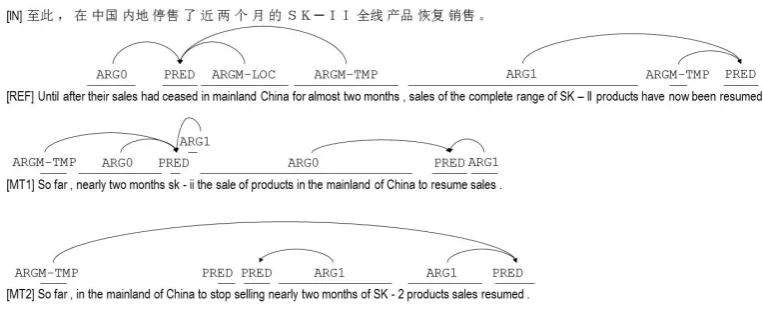
Figure 1: Examples of automatic shallow semantic parses. Both the reference and machine translations are parsed using automatic English SRL. There are no semantic frames for MT3 since there is no predicate in the MT output.
tic frames and role fillers in the reference and ma-chine translations. MEANT typically outperforms BLEU, NIST, METEOR, WER, CDER and TER in correlation with human adequacy judgment, and is relatively easy to port to other languages, re-quiring only an automatic semantic parser and a monolingual corpus of the output language, which is used to train the discrete context vector model for computing the lexical similarity between the semantic role fillers of the reference and transla-tion. Loet al.(2014) describe a cross-lingual qual-ity estimation variant, XMEANT, capable of eval-uating translation quality without the need for ex-pensive human reference translations, by utilizing semantic parses of the original foreign input sen-tence instead of a reference translation. MEANT is generally computed as follows:
1. Apply an automatic shallow semantic parser to both the reference and machine transla-tions. (Figure 1 shows examples of auto-matic shallow semantic parses on both refer-ence and MT.)
2. Apply the maximum weighted bipartite matching algorithm to align the semantic frames between the reference and ma-chine translations according to the lexical similarities of the predicates.
3. For each pair of the aligned frames, apply the maximum weighted bipartite matching algo-rithm to align the arguments between the ref-erence and MT output according to the lexical similarity of role fillers.
4. Compute the weighted f-score over the matching role labels of these aligned predi-cates and role fillers according to the follow-ing definitions:
q0
i,j ≡ ARG jof aligned frameiin MT
q1i,j ≡ ARG jof aligned frameiin REF w0
i ≡ #tokens filled in aligned frametotal #tokens in MT iof MT
w1
i ≡ #tokens filled in aligned frametotal #tokens in REFiof REF wpred ≡ weight of similarity of predicates
wj ≡ weight of similarity of ARG j
ei,pred ≡ the pred string of the aligned frameiof MT
fi,pred ≡ the pred string of the aligned frameiof REF
ei,j ≡ role fillers of ARGjof the aligned frameiof MT
fi,j ≡ role fillers of ARGjof the aligned frameiof REF
s(e, f) = lexical similarity of tokeneandf
prece,f =
∑
e∈emax
f∈f s(e, f)
|e|
rece,f = ∑
f∈fmaxe∈e s(e, f)
|f|
si,pred =
2·prece
i,pred,fi,pred·recei,pred,fi,pred
prece
i,pred,fi,pred+recei,pred,fi,pred
si,j =
2·precei,j,fi,j·recei,j,fi,j
prece
i,j,fi,j+recei,j,fi,j
precision =
∑
iw0iwpredsi,pred+
∑
jwjsi,j
w∑pred+∑jwj|q0i,j|
iw0i
(1)
recall =
∑
iw1iwpredsi,pred+
∑
jwjsi,j
w∑pred+∑jwj|q1i,j|
iw1i
(2)
MEANT = 2·precision·recall
wherewpredandwj are the weights of the lexical similarities of the predicates and role fillers of the arguments of typej of all frame between the ref-erence translations and the MT output. There is a total of 12 weights for the set of semantic role la-bels in MEANT as defined in Lo and Wu (2011b). The value of these weights are determined in su-pervised manner using a simple grid search to optimize the correlation with human adequacy judgments (Lo and Wu, 2011a) for MEANT and in unsupervised manner using relative frequency of each semantic role label in the references for UMEANT (Lo and Wu, 2012). Thus UMEANT is useful when human judgments on adequacy of the development set are unavailable.si,predandsi,jare the phrasal similarities of the predicates and role fillers of the arguments of typejbetween the ref-erence translations and the MT output. Loet al.
(2012) and Tumuluruet al.(2012) described how the lexical similarities, s(e, f), are computed us-ing a discrete context vector model and how the phrasal similarities are computed by aggregating the lexical similarities via various heuristics. In the latest version of MEANT (Loet al., 2014), as shown in above, it uses f-score to aggregate indi-vidual token similarities into the phrasal similar-ities of semantic role fillers. Another MEANT’s variant, IMEANT (Wu et al., 2014), which uses ITG to constrain the token alignments between the semantic role fillers of the reference and the machine translations and is shown outperforming MEANT (Loet al., 2014).
3 Improvements to MEANT
We improve the performance of MEANT by incor-porating a word embedding model for more accu-rate evaluation of the semantic role filler similarity and a novel backoff algorithm for evaluating trans-lations when the automatic semantic parser fails to reconstruct the semantic structure of the transla-tions. Our evaluation results show that the new version of MEANT is significantly improved in correlating with human ranking preferences at both the sentence-level and the document-level.
3.1 Discrete context vectors vs. word embeddings
MEANT’s discrete context vector model is very sparse because of the extremely high dimension of the discrete context vector model. The number of dimensions of a vector in the discrete context
vector model is the total number of token types in the training corpus. The vector sparsity issue makes the lexical similarity highly sensitive of ex-act token matching and thus hurts the accuracy of MEANT. We aim at tackling the sparse vector is-sue by replacing the discrete context vector model with the continuous word embeddings in order to further improve the accuracy of MEANT.
We first train the word embeddings on the same monolingual corpus as the discrete context vec-tor model, i.e. Gigaword, for a fair comparison. However, since the memory consumption of the word embeddings is significantly reduced when comparing with the discrete context vector model due to the reduced dimension in the vectors, it is now possible to increase the size of the train-ing corpus of the word embeddtrain-ings so as to im-prove the token coverage of the lexical similarity model. We compare the in-house Gigaword word embeddings which covers 1.2 million words and phrases with the Google pretrained word embed-dings (Mikolovet al., 2013) that is trained on a 100 billion tokens news dataset and covers 3 million words and phrases. We show that the high porta-bility of MEANT is preserved when replacing the discrete context vector model with word embed-dings as the size of the monolingual training data for the word embeddings does not significantly af-fect the correlation of MEANT with human ade-quacy judgments.
Another interesting property of the word embed-dings is the compositionality of words vectors into phrases. As described in Mikolov et al. (2013), for example, the result of linear vector calcula-tion vec(”Madrid”)-vec(”Spain”)+vec(”France”) is closer to vec(”Paris”) than to any other vectors. It seems to be natural that phrasal similarity of the semantic role fillers could be more accurately com-puted using the composite phrase vector than us-ing the align-and-aggregate approach because the vector composition approach is not affected by the errors of token misalignment. However, we show that surprisingly, the align-and-aggregate ap-proach outperforms the naive linear word vector composition in computing the phrasal similarities of the semantic role fillers.
3.2 Backoff algorithm for evaluating translations without semantic parse
transla-tions. According to the error analysis in Lo and Wu (2013) , the two main reasons for the auto-matic shallow semantic parser failing to identify the semantic frames are the failure to identify the semantic frames for copula or existential senses of ”be” in a perfectly grammatical sentence and the absence of any predicate verb at all in the sen-tence. They showed that manually reconstructing the ”be” semantic frames for MEANT yields sig-nificantly higher correlation with human adequacy judgment. Thus, we present a novel backoff algo-rithm for MEANT to reconstruct the ”be” semantic frame and evaluate the whole sentence using the lexical similarity function and weigh it according to the ratio of unlabeled tokens in the MT/REF.
The reconstruction of the ”be” semantic frame is triggered when the automatic shallow semantic parser fails to find a semantic frame in the sen-tence. It utilizes the syntactic parse of the sentence and labels the verb-to-be as the predicate. Then, it labels the constituent of the NP subtree sibling immediate left to the predicate as the ”who” role, the constituent of the NP subtree sibling immedi-ate right to the predicimmedi-ate as the ”what” role and any constituent of other subtree siblings of the predi-cate as ”other” role. The reconstructed ”be” frame is then evaluated the same way as other semantic frames using MEANT.
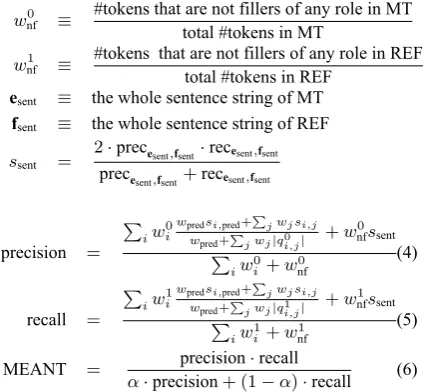
When there is no predicate verb in the whole sentence, we evaluate the whole sentence using the lexical similarity function and weighted according to the amount of unlabeled tokens in the MT/REF. Thus, equation (1), (2) and (3) are replaced by equation (4), (5) and (6).
wnf0 ≡
#tokens that are not fillers of any role in MT total #tokens in MT
w1
nf ≡
#tokens that are not fillers of any role in REF total #tokens in REF
esent ≡ the whole sentence string of MT
fsent ≡ the whole sentence string of REF
ssent =
2·precesent,fsent·recesent,fsent
precesent,fsent+recesent,fsent
precision =
∑
iwi0wpredsi,pred+
∑
jwjsi,j
wpred+∑jwj|q0i,j| +w 0 nfssent
∑
iw0i+w0nf
(4)
recall =
∑
iwi1wpredsi,pred+
∑
jwjsi,j
wpred+∑jwj|q1i,j| +w 1 nfssent
∑
iw1i+w1nf
(5)
MEANT = precision·recall
α·precision+ (1−α)·recall (6)
Note that we have also introduced the weight α for the precision and recall. Later, we show that
optimal value of α for MT evaluation is different from that for MT optimization.
[image:4.595.81.295.538.734.2]3.3 Results
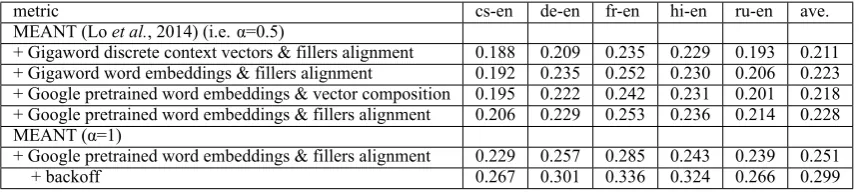
Table 1 shows the document-level Pearson’s score correlation and table 2 shows the sentence-level Kendall’s rank correlation with human preferences of the improved version of MEANT with the pre-vious version of MEANT (Lo et al., 2014) on WMT2014 metrics task test set (Macháček and Bojar, 2014). For the sake of stable performance across all the tested language pairs, the weights of the semantic role labels are estimated in unsuper-vised manner.
First and the most importantly, the document-level score correlation with human preferences of all versions of MEANT consistently outperforms all the submitted metrics in Macháček and Bojar (2014). While the variations on document-level correlation with human preferences of different versions of MEANT are not significant, we focus on discussing about the sentence-level results.
On sentence-level ranking, MEANT with Gi-gaword word embeddings correlates significantly better with human preference than MEANT with Gigaword discrete context vectors. Although the Google pretrained word embeddings covers more than twice as many token types as the Gigaword word embeddings, our results show that MEANT incorporated with the Google pretrained word em-beddings only marginally better that incorporated with the Gigaword word embeddings. Our re-sults show that MEANT’s portability to languages with lower resources is preserved as MEANT with Gigaword word embeddings achieves comparable accuracy without using huge amount of resources. While the linear vector composition property of word embeddings receive a lot of atten-tion recently, our results show that, surprisingly, MEANT with word embeddings using the align-and-aggregate approach in computing the phrasal similarities significantly outperforms that using the simple linear vector composition across all lan-guage pairs in the test set. Our results suggest that more investigation on using word embeddings is necessary for it to be useful for efficient evalua-tion of phrasal similarities.
sys-Table 1: System-level Pearson’s score correlation with human preferences of MEANT on WMT2014 metrics track test set
metric cs-en de-en fr-en hi-en ru-en ave.
MEANT (Loet al., 2014) (i.e. α=0.5)
+ Gigaword discrete context vectors & fillers alignment 0.975 0.973 0.972 0.957 0.877 0.951
+ Gigaword word embeddings & fillers alignment 0.939 0.967 0.979 0.948 0.912 0.949
+ Google pretrained word embeddings & vector composition 0.919 0.955 0.981 0.941 0.940 0.947
+ Google pretrained word embeddings & fillers alignment 0.948 0.970 0.979 0.950 0.922 0.954
MEANT (α=1)
+ Google pretrained word embeddings & fillers alignment 0.990 0.965 0.977 0.921 0.909 0.952
[image:5.595.78.512.90.191.2]+backoff 0.986 0.970 0.981 0.947 0.915 0.960
Table 2: Sentence-level Kendall’s rank correlation with human preferences of MEANT on WMT2014 metrics track test set
metric cs-en de-en fr-en hi-en ru-en ave.
MEANT (Loet al., 2014) (i.e. α=0.5)
+ Gigaword discrete context vectors & fillers alignment 0.188 0.209 0.235 0.229 0.193 0.211
+ Gigaword word embeddings & fillers alignment 0.192 0.235 0.252 0.230 0.206 0.223
+ Google pretrained word embeddings & vector composition 0.195 0.222 0.242 0.231 0.201 0.218
+ Google pretrained word embeddings & fillers alignment 0.206 0.229 0.253 0.236 0.214 0.228
MEANT (α=1)
+ Google pretrained word embeddings & fillers alignment 0.229 0.257 0.285 0.243 0.239 0.251
+ backoff 0.267 0.301 0.336 0.324 0.266 0.299
tems tend to under-generate (i.e. missing meaning in the translation output) rather than over-generate. This also explains why the precision-oriented met-rics, such as BLEU, usually correlate poorly with human adequacy judgments.
Lastly, our results show that the novel backoff algorithm significantly improves MEANT’s corre-lation with human preferences.
4 Tuning against the new MEANT
Loet al.(2013b) show that for MT system trans-lating into Chinese, tuning against MEANT out-performs the common practice of tuning against BLEU or TER across commonly used MT eval-uation metrics, i.e. beating BLEU-tuned systems in BLEU and TER-tuned systems in TER. How-ever, for MT system translating into English, pre-vious work (Lo et al., 2013a; Lo and Wu, 2013) show that tuning against MEANT only achieves balanced performance in both n-gram based met-rics and edit distance based metmet-rics, without over-fitting to either type of metrics. We argue with the significant improvement in sentence-level correla-tion with human preferences in evaluating trans-lations in English, the performance of MT system tuned against the newly improved MEANT would also improved.
For WMT2015 tuning task, we tuned the basic Czech-English baseline system against the newly improved MEANT using the official development
set and k-best MERT (with 100-best hypothesis list). Unfortunately, there is a bug in the integra-tion of MEANT and Moses k-best MERT in the submitted system. Table 3 and 4 shows the results of both the submitted buggy system and the de-bugged version of the experiments on the official dev and test test.
In the previous section, MEANT with an α value of 1, i.e. 100% recall, has the highest correlation with human preferences on the test set. However, surprisingly, our tuning experiment results show that tuning against a balanced precision-recall ver-sion of MEANT yields better scores across the commonly used MT evaluation metrics. This is because the optimization algorithm needs the guid-ance from precision to avoid blindly generating too many words which would achieve high recall.
More importantly, our results show that MT sys-tem tuning against the improved MEANT beats the BLEU-tuned system across the commonly used MT evaluation metrics, even in BLEU.
5 Related Work
[image:5.595.84.514.232.328.2]Table 3: Translation quality of MT system tuned against MEANT and BLEU on WMT15 tuning task dev set. MEANT reported here is the version using Google pretrained word embeddings with α=1 and backoff algorithm.
system BLEU NIST WER PER CDER TER MEANT
BLEU-tuned 19.38 6.48 67.63 50.48 58.17 63.57 42.77
MEANT-tuned (official submitted buggy system) 18.20 6.27 70.09 51.84 59.93 65.53 42.23
MEANT-tuned (α=1) 18.96 6.44 68.41 50.77 58.74 64.30 43.43
MEANT-tuned (α=0.5) 19.74 6.62 66.31 49.22 57.20 62.28 43.62
Table 4: Translation quality of MT system tuned against MEANT and BLEU on WMT15 tuning task test set. MEANT reported here is the version using Google pretrained word embeddings with α=1 and backoff algorithm.
system BLEU NIST WER PER CDER TER MEANT
BLEU-tuned 17.06 5.99 69.67 52.86 59.85 65.71 40.10
MEANT-tuned (official submitted buggy system) 15.89 5.80 71.82 53.93 61.43 67.59 39.34
MEANT-tuned (α=1) 16.75 5.95 70.19 53.05 60.29 66.25 40.12
MEANT-tuned (α=0.5) 17.15 6.08 68.53 52.03 59.07 64.65 40.23
meaning similarities of lexicons that do not share the same surface form, but also ignore the meaning structures of the translations.
METEOR (Banerjee and Lavie, 2005;
Denkowski and Lavie, 2014) evaluates lexical similarities beyond surface-form by incorporating a large collection of linguistic resources, like synonym table from hand-crafted WordNet and paraphrase table learned from large parallel cor-pus. Another trend of improving MT evaluation metrics is incorporating the evaluation of meaning structure of the translations. Owczarzak et al.
(2007a,b) improved the correlation with human
fluency judgments by using LFG to extend the approach of evaluating syntactic dependency structure similarity in Liu and Gildea (2005), but did not improve the correlation with human ade-quacy judgments when comparing to METEOR. Similarly, TINE, an automatic recall-oriented basic meaning event structured based evaluation metric (Rios et al., 2011) correlated with hu-man adequacy judgment comparable to that of BLEU but not as high as that of METEOR. ULC (Giménez and Màrquez, 2007, 2008) incorporates several semantic similarity features and shows improved correlation with human judgement of translation quality (Callison-Burch et al., 2007; Giménez and Màrquez, 2007; Callison-Burch et al., 2008; Giménez and Màrquez, 2008) but no work has been done towards tuning an MT system using a pure form of ULC perhaps due to its expensive run time.
By incorporating word embeddings into MEANT, translations are evaluated via both the
structural and lexical semantics accurately and thus, MT system tuned against the improved MEANT beats BLEU-tuned system across commonly used metrics, even in BLEU.
6 Conclusion
Acknowledgements
This material is based upon work supported in part by the Defense Advanced Research Projects Agency (DARPA) under BOLT contract nos. HR0011-12-C-0014 and HR0011-12-C-0016, and GALE contract nos. HR0011-06-C-0022 and HR0011-06-C-0023; by the European Union un-der the FP7 grant agreement no. 287658; and by the Hong Kong Research Grants Council (RGC) research grants GRF620811, GRF621008, and GRF612806. Any opinions, findings and conclu-sions or recommendations expressed in this mate-rial are those of the authors and do not necessarily reflect the views of DARPA, the EU, or RGC.
References
Satanjeev Banerjee and Alon Lavie. METEOR: An automatic metric for MT evaluation with improved correlation with human judgments. InWorkshop on Intrinsic and Extrin-sic Evaluation Measures for Machine Translation and/or Summarization, Ann Arbor, Michigan, June 2005.
Marco Baroni, Georgiana Dinu, and Germán Kruszewski. Don’t count, predict! a systematic comparison of context-counting vs. context-predicting semantic vectors. In Pro-ceedings of the 52nd Annual Meeting of the Association for Computational Linguistics, volume 1, 2014.
Yoshua Bengio, Holger Schwenk, Jean-Sébastien Senécal, Fréderic Morin, and Jean-Luc Gauvain. Neural probabilis-tic language models. InInnovations in Machine Learning, pages 137–186. Springer, 2006.
Chris Callison-Burch, Cameron Fordyce, Philipp Koehn, Christof Monz, and Josh Schroeder. (meta-) evaluation of machine translation. InSecond Workshop on Statistical Machine Translation (WMT-07), 2007.
Chris Callison-Burch, Cameron Fordyce, Philipp Koehn,
Christof Monz, and Josh Schroeder. Further
meta-evaluation of machine translation. InThird Workshop on Statistical Machine Translation (WMT-08), 2008.
Ronan Collobert and Jason Weston. A unified architecture for natural language processing: Deep neural networks with multitask learning. InProceedings of the 25th interna-tional conference on Machine learning, pages 160–167. ACM, 2008.
Ronan Collobert, Jason Weston, Léon Bottou, Michael Karlen, Koray Kavukcuoglu, and Pavel Kuksa. Natural language processing (almost) from scratch. The Journal of Machine Learning Research, 12:2493–2537, 2011.
Michael Denkowski and Alon Lavie. METEOR universal: Language specific translation evaluation for any target lan-guage. In9th Workshop on Statistical Machine Translation (WMT 2014), 2014.
George Doddington. Automatic evaluation of machine trans-lation quality using n-gram co-occurrence statistics. In
The second international conference on Human Language Technology Research (HLT ’02), San Diego, California, 2002.
Jesús Giménez and Lluís Màrquez. Linguistic features for au-tomatic evaluation of heterogenous MT systems. In Sec-ond Workshop on Statistical Machine Translation (WMT-07), pages 256–264, Prague, Czech Republic, June 2007.
Jesús Giménez and Lluís Màrquez. A smorgasbord of features for automatic MT evaluation. InThird Workshop on Sta-tistical Machine Translation (WMT-08), Columbus, Ohio, June 2008.
Eric H Huang, Richard Socher, Christopher D Manning, and Andrew Y Ng. Improving word representations via global context and multiple word prototypes. InProceedings of the 50th Annual Meeting of the Association for Compu-tational Linguistics: Long Papers-Volume 1, pages 873– 882. Association for Computational Linguistics, 2012.
Gregor Leusch, Nicola Ueffing, and Hermann Ney. CDer: Efficient MT evaluation using block movements. In11th Conference of the European Chapter of the Association for Computational Linguistics (EACL-2006), 2006.
Ding Liu and Daniel Gildea. Syntactic features for evalua-tion of machine translaevalua-tion. InWorkshop on Intrinsic and Extrinsic Evaluation Measures for Machine Translation and/or Summarization, Ann Arbor, Michigan, June 2005.
Chi-kiu Lo and Dekai Wu. MEANT: An inexpensive, high-accuracy, semi-automatic metric for evaluating translation utility based on semantic roles. In49th Annual Meeting of the Association for Computational Linguistics: Human Language Technologies (ACL HLT 2011), 2011.
Chi-kiu Lo and Dekai Wu. SMT vs. AI redux: How semantic frames evaluate MT more accurately. InTwenty-second International Joint Conference on Artificial Intelligence (IJCAI-11), 2011.
Chi-kiu Lo and Dekai Wu. Unsupervised vs. supervised
weight estimation for semantic MT evaluation metrics. In
Sixth Workshop on Syntax, Semantics and Structure in Sta-tistical Translation (SSST-6), 2012.
Chi-kiu Lo and Dekai Wu. Can informal genres be
bet-ter translated by tuning on automatic semantic metrics? In14th Machine Translation Summit (MT Summit XIV), 2013.
Chi-kiu Lo, Anand Karthik Tumuluru, and Dekai Wu. Fully automatic semantic MT evaluation. In7th Workshop on Statistical Machine Translation (WMT 2012), 2012.
Chi-kiu Lo, Karteek Addanki, Markus Saers, and Dekai Wu. Improving machine translation by training against an au-tomatic semantic frame based evaluation metric. In51st Annual Meeting of the Association for Computational Lin-guistics (ACL 2013), 2013.
Chi-kiu Lo, Meriem Beloucif, and Dekai Wu. Improving ma-chine translation into Chinese by tuning against Chinese
MEANT. InInternational Workshop on Spoken Language
Translation (IWSLT 2013), 2013.
Chi-kiu Lo, Meriem Beloucif, Markus Saers, and Dekai Wu. XMEANT: Better semantic MT evaluation without refer-ence translations. In52nd Annual Meeting of the Associa-tion for ComputaAssocia-tional Linguistics (ACL 2014), 2014.
Matouš Macháček and Ondřej Bojar. Results of the WMT14 metrics shared task. In Ninth Workshop on Statistical Machine Translation (WMT 2014), Baltimore, Maryland USA, June 2014.
Tomas Mikolov, Kai Chen, Greg Corrado, and Jeffrey Dean. Efficient estimation of word representations in vector space.arXiv preprint arXiv:1301.3781, 2013.
Karolina Owczarzak, Josef van Genabith, and Andy Way. Dependency-based automatic evaluation for machine translation. InSyntax and Structure in Statistical Trans-lation (SSST), 2007.
Karolina Owczarzak, Josef van Genabith, and Andy Way. Evaluating machine translation with LFG dependencies.
Machine Translation, 21:95–119, 2007.
Kishore Papineni, Salim Roukos, Todd Ward, and Wei-Jing Zhu. BLEU: a method for automatic evaluation of ma-chine translation. In40th Annual Meeting of the Associa-tion for ComputaAssocia-tional Linguistics (ACL-02), pages 311– 318, Philadelphia, Pennsylvania, July 2002.
Miguel Rios, Wilker Aziz, and Lucia Specia. TINE: A metric to assess MT adequacy. InSixth Workshop on Statistical Machine Translation (WMT 2011), 2011.
Matthew Snover, Bonnie Dorr, Richard Schwartz, Linnea
Micciulla, and John Makhoul. A study of translation
edit rate with targeted human annotation. In 7th Bien-nial Conference Association for Machine Translation in the Americas (AMTA 2006), pages 223–231, Cambridge, Massachusetts, August 2006.
Anand Karthik Tumuluru, Chi-kiu Lo, and Dekai Wu. Ac-curacy and robustness in measuring the lexical similarity of semantic role fillers for automatic semantic MT evalua-tion. In26th Pacific Asia Conference on Language, Infor-mation, and Computation (PACLIC 26), 2012.
Joseph Turian, Lev Ratinov, and Yoshua Bengio. Word
representations: a simple and general method for semi-supervised learning. InProceedings of the 48th Annual Meeting of the Association for Computational Linguistics, pages 384–394. Association for Computational Linguis-tics, 2010.