Note to readers:
This chapter, taken from
The
Physical
Environment:
A
New
Zealand
Perspective
, edited by Andrew
Sturman and Rachel Spronken‐Smith, South Melbourne, Vic. ; Auckland [N.Z.] : Oxford University
Press, 2001, has been reproduced with the kind permission of Oxford University Press (OUP). OUP
maintain copyright over the typography used in this publication.
Authors
retain
copyright
in
respect
to
their
contributions
to
this
volume.
The Physical Environment
A New Zealand Perspective
Edited by
Andrew Sturman and
Rachel Spronken-Sm
i
th
OXFORD
UNIVERSITY PRESS253 Normanby Road, South Melbourne, Victoria, Australia 3205 Oxford University Press is a department of the University of Oxford. It furthers the University's objective of excellence in research, scholarship, and education by publishing worldwide in
Oxford New York
Athens Auckland Bangkok Bogota Buenos Aires Cape Town Chennai Dar es Salaam Delhi Florence Hong Kong Istanbul Karachi Kolkata Kuala Lumpur Madrid Melbourne Mexico City Mumbai Nairobi Paris Port Moresby Sao Paulo Shanghai Singapore Taipei Tokyo Toronto Warsaw
with associated companies in Berlin Ibadan
OXFORD is a registered trade mark of Oxford University Press in the UK and in certain other countries
© Andrew Sturman and Rachel Spronken-Smith 2001
Authors retain copyright in respect of their contributions to this volume
First published 2001
All rights reserved. No part of this publication may be reproduced, stored in a retrieval system, or transmitted, in any form or by any means, without the prior permission in writing of Oxford University Press. Within New Zealand, exceptions are allowed in respect of any fair dealing for the purpose of research or private study, or criticism or review, as permitted under the Copyright Act 1994, or in the case of repro graphic reproduction in accordance with the terms of the licences issued by Copyright Licensing Limited. Enquiries concerning reproduction outside these terms and in other countries should be sent to the Rights Department, Oxford University Press, at the address above.
ISBN 0 19 558395 7
Edited by Richard King Indexed by Russell Brooks
Cover and text designed by Derrick I Stone Design Typeset by Derrick I Stone Design
The physical environment-a systems approach
The physical environment is the set of physical and biological conditions that sur-round human beings at the Earth's surface. This book is broadly based on a systems approach to the physical environment. A system may be defined as 'a structured set of components of variables (i.e. phenomena that are free to assume variable magnitudes) that exhibit discernible relationships with one another and operate together as a com-plex whole, according to some observed pattern' (Chorley
&
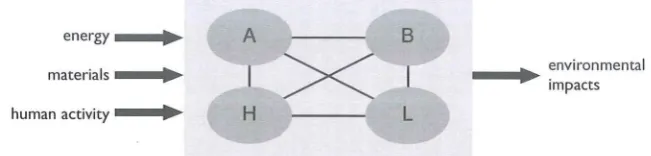
Kennedy 1971). The Earth can be viewed as a system since virtually no part of the system operates in isola-tion from another, and thus changes in one part of the Earth system can affect other parts. A systems approach provides a rational set of procedures for subdividing the physical environment into subsystems, or units that demonstrate strong internal con-nections. For example, the physical environment consists of four main subsystems -the atmospheric environment (or atmosphere), the hydrological environment (or hydrosphere), the geomorphic environment (part of which is often referred to as the lithosphere), and biological environment (or biosphere)-and the relationships between them (Figure 1.1). As Figure 1.1 shows, the subsystems interact within an open environmental system with inputs of energy, materials, and human activity, and outputs of specific environmental impacts.energy
•
A
Bmaterials
•
><
•
environmentalimpacts
human activity
•
H LFigure 1.1 Major subsystems of the physical environment, where A is the atmosphere, B the biosphere, H the hydrosphere and L the lithosphere. (After Slaymaker & Spencer 1998, p. 5)
[image:4.595.214.540.480.558.2]Broad Background to the Physical Environment 3
• physical climatology, which involves understanding the principles of mass and energy exchanges between the Earth and its atmosphere
• dynamic climatology, which examines the factors influencing climate according
to the laws of physics
• applied climatology, which considers the climate's influence on human activities such as agriculture, forestry, and energy consumption.
The waters of the Earth system-the oceans, rivers, lakes, and glaciers-consti
-tute the hydrological environment, or hydrosphere. Hydrology is the study of water quantity and movement through the hydrological cycle. There are two main branches of hydrology:
• physical hydrology, which involves understanding the functioning of the hydro-logic system
• applied hydrology, which concerns the management and modification of
hydro-logic processes, as in erosion and flooding problems (Slaymaker
&
Spencer 1998). The geomorphic environment includes landforms, rocks, soils, and minerals, and the study of this environment (geomorphology) concerns the understanding of the formation of landforms and their characteristics. There are three main branches of geomorphology:• historical geomorphology, which concerns the Earth's history
• functional geomorphology, which concerns the processes of erosion, weathering,
transport, and deposition and their rates of operation
• applied geomorphology, which involves the application of geomorphological knowledge for human benefit and includes such approaches as mapping of
geo-morphological phenomena and soil, and analysis of geomorphic processes and their interaction with human activity (Slaymaker
&
Spencer 1998).This book deals with both large-scale processes involved with the creation of major elements of the landscape (e.g. volcanics, tectonics, and orogenics), as well as smaller-scale processes responsible for shaping the landscape (e.g. the movement of water and the roles of gravity and wind).
The biological environment, or biosphere, is the focus of study in biogeography, which is concerned with the distribution and relationships of living organisms as well as their evolution over time, and human impacts on species, populations, and
eco-systems. The biosphere is shaped by the other three subsystems-atmospheric, hydro-logical, and geomorphic. Plants and animals need solar energy and water from the atmosphere and hydrosphere, while plant nutrients come from the rock minerals of the lithosphere. This book describes the role of vegetation and animals in the bio-sphere, as well as giving an overview of soil formation processes.
Rationale and structure of book
Solar energy drives the climate system, which in turn drives changes in the
4 Genera/ Concepts and the Origins af New Zealand
to discuss the atmospheric environment (Section 2), the hydrological environment (Section 3), the geomorphic environment (Section 4), and the biological environ
-ment (Section 5). The systems approach to the study of the physical environment has
a number of advantages:
• it recognises the need to identify the individual attributes characterising the environment
• it stresses the relationships between components of the environment
• it facilitates an understanding of the individual components of the environment through a knowledge of their interdependence with other components
• it assists in the formulation of predictions of how the environment is going to change in the future
• it is a useful tool for assessing the repercussions of human activities (Thompson
et at. 1986).
It is these functions of the systems approach that are used in Section 6 of the
book, which concerns interactions within the physical environment as well as human impacts on the physical environment (Chapters
22-24).
The concluding chapter con-siders sustainability and management of the physical environment.It is important to recognise that the human and physical environments interact in complex ways, and that understanding the physical environment requires a clear appreciation of the nature of these interactions. There is a need to understand the relationship between both natural and human processes, and how it varies over space and time. There is therefore a need for an holistic approach to such problems as ozone depletion, the enhanced greenhouse effect, urban air pollution, rainforest destruction, and natural hazards. The physical environments we observe today are mostly heavily
modified by human activity, and understanding our relationship with the physical environment is of fundamental importance to our future on Earth.
In summary, the main features of the physical environment include its complexity, which results from the interaction between the many physical, biological, and chemical processes. The range of physical factors vary in importance both spatially and temporally, producing patterns that consist of both random and organised elements. There is also significant scale interaction, with many up-and down-scale linkages. For example, the integration of urban-scale air pollution from the many cities of the world
contributes to a global change in atmospheric composition, which itself has an impact on the environment at the local scale. The heterogeneity that results from the inter-action of the many processes at varying time and space scales is enhanced through the
influence of human activity, although it is always difficult to assess the role of natural versus anthropogenic processes. However, it is clear that a major feature of the physical environment is that it is always changing. Another important characteristic is that a number of different processes can lead to the same result.
Energy and matter transfers in the physical environment
Systems function through the transfer of energy and matter, and conceptual models
Figure 1.2
Broad Background to the Physical Environment 5
hydrologic cycle is the representation of a system in which the movement and storage of water in its various forms is analysed. Similar schematic diagrams are used to illust -trate the movement of carbon and other chemicals through the Earth-atmosphere system. As illustrated in Figure 1.2, the system is driven by the input of energy in the form of solar radiation. Components of the system include processes such as evapora-tion, condensation, precipitation and runoff, and the transfer of matter in the form of water. Thus solar energy warms the ocean water, which then evaporates and later con-denses and falls as precipitation to the ground. Some of this water then runs off back to the ocean, where it can then repeat the cycle. The carbon cycle has a similar stru c-ture, with carbon changing form between solid, liquid, and gaseous forms as it moves through the Earth-atmosphere system.
Sunlight (energy)
Water
(matter)
is absorbed into (process) and warms (process)
The hydrological cycle. (After Gabler et al. 1999)
6 General Concepts and the Origins of New Zealand
Energy
input
Figure 1.3
These forms of energy are transferred through the environment by radiation, con
-vection, conduction, change of phase (evaporation, condensation, sublimation, and freezing), and chemical reaction. During these transfers it is transformed from one form to another. For example, energy is transmitted through space from the Sun as
electromagnetic radiation but is converted to sensible heat when it is absorbed by ter-restrial materials. Similarly, sensible heat is used to evaporate water, which is then stored in the atmosphere as latent heat.
Open and closed systems
The systems approach allows one to trace the movement of energy and matter into the system (inputs) and out of the system (outputs), as well as the interactions between energy and matter (feedback) within the system. Systems can be classified as either open or closed (Figure 1.3). In an open system, which includes most environmental systems, both energy and matter can enter and leave. Heating of the atmosphere is an example of an open subsystem, since energy and matter are not confined to the bound -aries of the system, but are continually entering and leaving. Closed systems have boundaries that prevent the transfer of matter but do allow energy inputs and outputs. For example, the global hydrologic cycle is a closed system because it has energy transfers both into and out of the system, but matter (water) is confined within the
system. Thus, although water may exist in all of its three states (liquid, gas, or ice) and may be transformed from one state to another, there is no net gain or loss of water (i.e. no output of matter) in the system.
Matter is contained within the system boundaries
Closed system
Energy Energy output input
Matter input
Open and closed systems. (After Gabler et al. 1999)
Open system
Energy output
Matter
output
The term ecosystem is often used to describe a system of particular spatial dimen -sions that focuses specifically on the interaction of biological activity with processes associated with the atmospheric, hydrological, and lithological components.
Models
Models are merely representations of systems that allow the development and testing
Brood Background to the Physical Environment 7
types of model are used by scientists, including conceptual models that may be
pre-sented in the form of schematic or box diagrams. Others include numerical models
comprising a computer code that describes the processes involved in a particular situ -ation, and hardware models such as wind tunnels in which small-scale analogues are
constructed and used in simulations of real-world processes.
Systems are therefore a type of model used to explain both the processes that operate within the environment and the outcomes that they produce. Cascades are
used to describe the flows of energy and matter between different parts of these
models. Process-response models are a particular type of model used to isolate and
examine the impact of a specific process on some aspect of the environment, while
ecosystems are models that focus on the biological environment and the physical and
chemical processes that influence it.
E.quilibrium in the physical environment
A system is said to be in a state of equilibrium when the inputs entering the system are
balanced by its outputs. Most environmental systems have a natural tendency towards
equilibrium and are thus considered to be stable systems. This stability is achieved
through the operation of negative feedback loops. Negative feedback is where one
change tends to offset the other, so that it is a natural counteracting effect that helps
the system to maintain equilibrium and be self-regulating. For example, animal popu
-lations adjust naturally to their food supply and in years of abundance may increase
their population. However, higher populations may deplete food supplies to such low
levels that animals die from starvation, thus decreasing population numbers. This
then allows recovery of the food supply and, subsequently, the animal population. The length of time between an initial effect (decreased food) and the subsequent impact
(decreased animal numbers) is known as the lag time, and a whole range of lag times
are associated with the many environmental processes.
In contrast, positive feedback may occur, whereby changes in the system may
reinforce the direction of the initial change. For example, decreases in global temper-atures in the past two million years led to the growth of huge ice sheets, which
increased the amount of solar energy reflected back to space from the Earth's surface.
This loss of solar energy caused an increase in the cooling trend of the atmosphere, and thus further growth of the ice sheets.
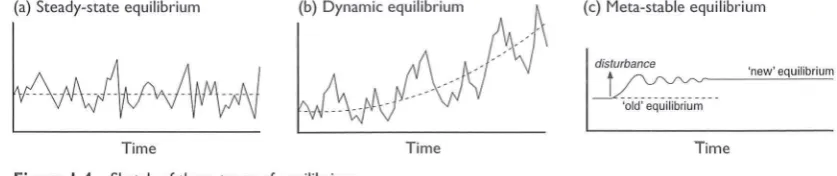
Most environmental systems operate in a relatively stable state through the oper-ation of negative feedback loops over a considerable time period. Systems are said to
be in steady state if they experience minor fluctuations but essentially retain their
cur-rent character in the long term (Figure 1.4). In some cases, they may shift their state
over time as a reaction to external conditions but keep within a range of tolerance or
maintain a dynamic equilibrium (Figure 1.4). However, a small change in part of the
8 Genera/ Concepts and the Origins of New Zealand
cause a fundamental change in the system and the way it behaves. For example, in the
global cooling scenario discussed above, the positive feedback loop resulted in the
climate becoming so cold that evaporation from oceans decreased, which in turn
decreased the amount of precipitation (and hence snow) to the glaciers. This
reduc-tion of moisture resulted in a threshold being crossed, because the decrease in snowfall caused the glaciers and ice sheets to shrink and the climate to warm as the system entered a new state. At a smaller scale, cumulus convection may occur as a result of
triggering by topography, in an atmosphere that would otherwise have been stable
and free of cloud.
(a) Steady-state equilibrium (b) Dynamic equilibrium (c) Meta-stable equilibrium
~
diSrrbance 'new' equilibrium~
'old' equilibrium [image:10.595.140.559.186.274.2]Time Time Time
Figure 1.4 Sketch of three types of equilibrium.
A number of characteristic time scales are associated with different processes in the physical environment. These include periodic variations such as daily (diurnal) and seasonal cycles, as well as random variations, which are by definition more chaotic and difficult to predict. The notions of environmental equilibrium and time scale are intimately related and have formed the basis for much early debate over fun-damental understanding of landscape evolution. For example, the equilibrium con-cept was originally used to suggest that environmental processes are dominated by gradual change. However, there is significant evidence to suggest that although catastrophic change may be less frequent, it may in fact have a greater impact in some situations.
Another notion related to the equilibrium concept is the idea that the Earth is a
self-healing organism with the ability to respond to the various processes that cause change, so that equilibrium is re-established. This is called the Gaia hypothesis and was originally proposed by Lovelock (1979). The notion clearly relies on the opera-tion of feedback mechanisms to provide environmental stability, in spite of factors that may cause instantaneous or long-term change. It also appears to be in conflict
with the idea of critical thresholds, which when exceeded may result in irreversible
change. On balance, it is an interesting idea that, if taken too literally, provides unre-alistic expectations of environmental stability. For example, the impact of a large
meteorite or global nuclear war could obviously upset the equilibrium of the global
environment to the extent that the future for life on Earth would be limited.
Approaches
to the study of the physical environment
Broad Background to the Physical Environment 9
and testing of hypotheses derived largely from the existing body of knowledge (theory), as well as previous experience the researcher has of environmental phenomena and
processes. This is normally a multi-step process, involving the establishment and spec-ification of the hypothesis to be tested; the selection of an appropriate methodology to conduct the test; the actual data processing required to complete the test; and, finally,
interpretation of the results. Scientific results are normally expressed in statistical
form, with the probability of coming to the wrong conclusion clearly specified. Hence
there is always some risk associated with accepting or rejecting the hypothesis being
tested. The outcome of this logical procedure may result in a re-evaluation of the
theory upon which the original hypothesis was based. This repeated testing and accepting or refuting of hypotheses is the way in which the pool of knowledge expands. However, this approach requires an objective and quantitative approach to
the measurement of environmental processes. Sometimes it is not always possible to express an environmental process in a quantitative form. For example, subjective, qualitative statements may be used when assessing environmental quality.
A number of other factors present difficulties for the analysis of environmental
problems. In particular, the rates of change of different processes in the environment vary considerably. For example, rates of erosion can be very slow, as is the transfer of
carbon through the Earth-atmosphere system. On the other hand, volcanic activity can produce an almost instantaneous impact on landforms, while air and water vapour
can be transported vertically through the troposphere in a matter of a few minutes.
Because it is not always possible to measure these processes directly, rates of change
often have to be inferred.
Different problems have resulted in different approaches to the study of the ph
ys-ical environment. For example, the longer-term problems require investment in lon g-term monitoring, while other problems can often be investigated using short-term
case studies. It all depends on the rate of change involved.
New Zealand's physical environment in the global
context
The uniqueness of the New Zealand environment is particularly marked for several reasons. Most importantly, it is the largest and most remote oceanic island group, with
a history of at least 80 million years. Developing without land mammals (except for a couple of species of bat), it produced an extremely diverse biological environment,
including unique bird, reptile, and plant life. The uniqueness of the environment flourished because of the islands' isolation, being separated by about 2000 km from Australia, the nearest continent to the west. The extensive latitudinal range of the islands that make up New Zealand (34- 48°S and 166-179°E) also enhances environ
-mental variability.
The present-day physical environment is influenced by both its evolutionary his
General Concepts and the Origins of New Zealand
scales. For example, the volcanic landforms of New Zealand have developed over many millions of years, while the surface weathering processes and the development of the soils that support plant life occur on a much shorter time scale. However, a major eruption can quickly destroy several decades of such development. Similarly, the loca-tion of New Zealand on the boundary of tectonic plates has resulted in the gradual uplift of mountains that provide the basis for the unique alpine environment that is a major feature of the country. The mid-latitude location provides a climatic environ-ment that favours the developenviron-ment of glaciers in these mountain regions, while more temperate conditions exist nearer the coast. The time scale over which the mountains are produced is much longer than that for the development of glaciers, while the much shorter-term weather events deposit the snow that ultimately leads to glacier growth. Although slow relative to the life cycle of humans, the lifting of the New Zealand alpine region is relatively fast, resulting in comparatively rapid erosion and the devel-opment of a complex and intricately carved landscape. This alpine landscape has developed in harsh climatic conditions that influence the distribution of both plant and animal species.
It is also interesting to note that only about 25% of the land area of New Zealand is below 200 m above sea level. These lowland areas represent the major regions of human activity, so that significant landscape modification has occurred there, partic-ularly through agriculture and the development of urban and transport facilities. Around the fringes of the country there is nearly 7000 km of coastline, with its own peculiar environment that has developed as the result of oceanic, atmospheric, and land-based processes. An extensive pattern of rivers and lakes lie between the alpine and marine environments, representing a distinct freshwater ecosystem, a pathway for water movement within the hydrological system, and an erosive tool for landscape development.
Each of these facets of New Zealand's physical environment owes its uniqueness to the particular interactions of processes that produce and maintain it. For example, the coastal environment is influenced by ocean waves and currents, its marine biology, atmospheric processes such as wind, the rivers that supply sediment, and the geomor-phic processes that operate on the coastal landforms. In order to properly understand the physical environment of a country such as New Zealand, it is therefore important to take a holistic view that incorporates knowledge of these various components and their interaction.
Broad Background to the Physical Environment I I that the New Zealand physical environment is therefore influenced not only by the natural processes that directly impact on it, but also by both local and international human actions.
Summary
This chapter began by outlining the approach, rationale, and structure of this text. The systems approach provides a useful framework because it allows consideration of the four main subsystems of the physical environment (the atmosphere, hydrosphere, lithosphere, and biosphere) and their interactions, as well as the impact of humans. This framework is reflected in the structure of the book, which consists of an intro -ductory section, followed by sections considering each subsystem in turn, and con-cluding with a section on interactions within the physical environment and human impacts on the physical environment. The second part of this chapter provided the necessary background to understand systems theory, with a discussion of energy and matter transfers and equilibrium in the physical environment. The chapter continued by considering different approaches to studying the physical environment, and con -cluded with an introduction to the uniqueness of New Zealand's environment. The following two chapters build on the New Zealand context by discussing the origin and creation of this environment.
Further reading
Briggs, D.]., Smithson,
P.A.
& Atkinson, K. 1997,Fundamentals of
the
Physical
Envi-ronment, Routledge, London.Gabler, R.E., Sager, R.]., Wise, D.L.
&
Petersen,J.F.
1999,Essentials of Physical
Geog-raphy,
6th edn, Saunders College Publishing, Orlando.