Rapid and Flexible User-Defined Low-Level Hybridization
for Metaheuristics Algorithm in Software Framework
S. Masrom*, Siti Z. Z. Abidin, N. Omar
Faculty of Computer and Mathematical Sciences, Universiti Teknologi MARA, Shah Alam, Malaysia. Email: *[email protected], [email protected], [email protected]
Received September 23rd, 2012; revised October 21st, 2012; accepted October 30th, 2012
ABSTRACT
The metaheuristics algorithm is increasingly important in solving many kinds of real-life optimization problems but the implementation involves programming difficulties. As a result, many researchers have relied on software framework to accelerate the development life cycle. However, the available software frameworks were mostly designed for rapid de- velopment rather than flexible programming. Therefore, in order to extend software functions, this approach involves modifying software libraries which requires the programmers to have in-depth understanding about the internal working structure of software and the programming language. Besides, it has restricted programmers for implementing flexible user-defined low-level hybridization. This paper presents the concepts and formal definition of metaheuristics and its low-level hybridization. In addition, the weaknesses of current programming approaches supported by available soft- ware frameworks for metaheuristics are discussed. Responding to the deficiencies, this paper introduces a rapid and flexible software framework with scripting language environment. This approach is more flexible for programmers to create a variety of user-defined low-level hybridization rather than bounded with built-in metaheuristics strategy in software libraries.
Keywords: Software Framework; Scripting Language; Metaheuristics; Low-Level Hybridization; User-Defined Strategy
1. Introduction
Since the last decade, rapid software development has emerged as a preferable approach in software engineer- ing especially for developing computer applications with complex computations such as distributed, scheduling and optimization systems [1]. The main critical factor for developing such kind of systems is time but complexity of programming development has led to very lengthy completion. As a result, in many aspects, rapid software development is able to provide easier, effective and pro- ductive method for each stage of the development. In order to facilitate rapid software development, a lot of innovations and improvements have been studied and invented. The ideas vary from diverse perspectives that include software design [2,3], software architecture [4], software modeling [5] and programming paradigm [6-8].
In the perspectives of programming paradigm, script- ing language has been widely accepted by programmers for two reasons. Firstly, scripting language has simpler language structure as compared to other kinds of pro- gramming languages. Therefore, scripting language is usable for gluing together different complex algorithms
from the low-level implementation of a software library [9]. Secondly, it can be used for developing strong func- tionality programs in a complex computer application such as distributed and collaborative application [10], grid computing [11] and agent based system [12].
In optimization based software, where the system foundation is structured with complex computational al- gorithm, scripting language programming is highly ap-plicable for rapid development. Examples of complex computational algorithm for optimization application include metaheuristics and metaheuristics hybridization.
In many cases, metaheuristics hybridization is more useful for different kinds of real life problems [13]. The main intention for metaheuristics hybridization is to com- pensate one single metaheuristic limit with the strength of other algorithms.
The metaheuristics hybridization techniques can be classified either as high-level or low-level hybridization. The level of hybridization is used to differentiate the strength of combination between the hybrid algorithms [14,15]. In high-level hybridization, the components from different hybrid algorithms are not strongly de- pendent because the implementation retains original identity or behavior of the hybrid algorithms. In contrast,
low-level hybridization requires internal structure modi- fication, which committed with internal components ex- change from the hybrid algorithms. Thus, the compo- nents from the hybrid algorithms are strongly connected to work together in finding optimal solutions.
The development of metaheuristics hybridization is very lengthy and difficult [5] especially to the low-level hybridization. Thus, in order to reduce the development time and difficulty, programmers might rely on software framework that provides software library for metaheuris- tics algorithm. Software framework promotes rapid im- plementation because the configurations for metaheuris- tics and hybridization in the software library could be simply specified with Graphical User Interface (GUI).
GUI provides convenient and easy to learn interface for supporting interactions between software user (pro- grammer) and software framework. However, in imple- menting low-level hybridization, GUI is not a suitable technique for enabling software library modification be- cause the interactions between GUI functions and other functions is defined by built-in functions and application program interface(API) within the software library [16]. Therefore, in order to implement low-level hybridization with software framework, an easy and flexible program- ming environment at front-end software should be pro- vided which could be supported by scripting language.
The remainder of this paper is organized as follows: Section 2 presents background of problem related to the software frameworks for metaheuristics. Then, the ge- neral concept of metaheuristics and formal definition of low-level hybridization is given in Section 3. The limita- tions of common programming approaches in software frameworks for metaheuristics are discussed in Section 4. Section 5 explains the proposed software framework be- fore the concluding remarks in Section 6.
2. Background of the Problem
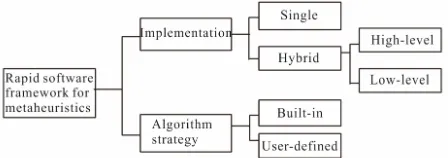
The research on rapid software framework for metaheu- ristics is still an ongoing research. Generally, there are two major issues in the development of rapid software framework for metaheuristics. These issues include im- plementation technique and algorithm strategy. Figure 1
[image:2.595.62.286.626.705.2]shows the related issues.
Figure 1. Development issues in rapid software framework for metaheuristics.
The first issue is categorized as metaheuristics imple- mentation technique, which can be single or hybrid. Single implementation does not combine one metaheuristic paradigm with other algorithms but hybrid techniques involve cooperation of different algorithms. There are varieties of techniques applied metaheuristics hybridiza- tion. Generally, these techniques can be divided into high-level and low-level [14,15]. In high-level hybridiza- tion, the hybrid algorithms establish their communication through a well defined interface [14]. Therefore, the im- plementation does not involve internal structure modifi- cations and retains original behavior of the hybrid algo- rithms. Besides, the components of hybrid algorithms are not dependent on each other. In contrast, low-level hy- bridization needs internal structure modification of the different hybrid algorithms. Thus, the original behavior of algorithms would be changed and different compo- nents from the hybrid algorithms are strongly connected to each other. Therefore, implementing low-level hy- bridization is more complicated than high-level hybridi- zation.
Many researchers have agreed that relying on single metaheuristics is quite restricted in achieving best solu- tion for real-life optimization problems [14,15]. There- fore, hybrid metaheuristics have been widely accepted as an effective approach as compared to single implementa- tion. Nevertheless, many of available software frame- works facilitate more functionality on single metaheuris- tic [5]. This is due to the simpler structures of single metaheuristics. Some of the software frameworks for single implementation are JCLEC [17], JEO[18], TEA [19], JSwarm[20] and NetLogo[21]. JCLEC, JEO and
TEA support Genetic Algorithm (GA) while NetLogo and JSwarm facilitate Particle Swarm Optimization (PSO) algorithm only.
However, a number of rapid software frameworks have been invented and introduced for hybrid metaheu- ristics such a HeuristicLab [22], ParadisEO [23] and Dis-tributed BEAGLE [24]. Unfortunately, many of these software frameworks are majorly developed for high- level hybridization due to the fact that high-level hy- bridization is less complicated than low-level. Imple- menting high-level hybridization with software frame- work might involve simple configurations of combina- tion that are not modifying internal structure of the hy- brid algorithms. Therefore, the programmer can rely on pre-defined hybridization strategies located in software library.
program amendment. In contrast, user-defined strategies allow programmers to extend or create new metaheuris- tics components according to their needs. With user-de- fined, a variety of new algorithm strategy such as hy- bridization scheme could be created at front-end software framework. As for example, with user-defined high-level hybridization, dynamic parallel algorithms could be im- plemented as provided in OpenTS software framework [25]. However, no low-level modification involves in implementing user-defined high-level hybridization. Hence the combination configurations could be defined simply with GUI or through template program.
Based on the reviewed literature, it can be concluded that software frameworks for metaheuristics and its hy- bridization are intentionally developed only to support rapid software development. The frameworks are not governed for flexible programming environment that support low-level hybridization as described in Figure 2. The grey box represents common features provided by the available software frameworks.
In addition, Figure 2 also shows the limitation of the software frameworks in providing user-defined strategy for metaheuristics and its hybridization. User-defined strategy supports high flexibility for programmers to develop low-level metaheuristics hybridization. Many empirical experiments have shown that low-level hybri- dization is increasingly significant to metaheuristics stra- tegy improvement [5]. However, difficulty in the deve- lopment might discourage researchers for exploring new strategy.
3. General Concept of Metaheuristics and
Low-Level Hybridization
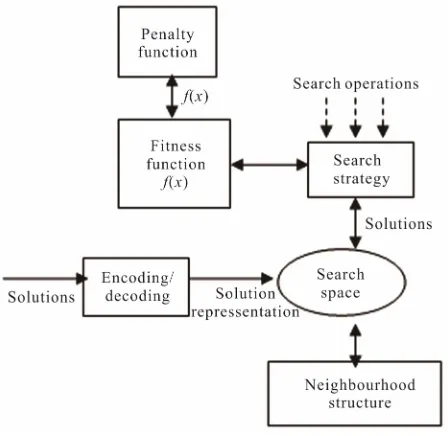
There are fives common questions for using metaheuris- tics in solving optimization problems. These questions are about the design of metaheuristics components which is composed of encoding method for solution representa- tion, neighborhood structure, search strategy, fitness func- tion and penalty function. Figure 3 shows the relation-ship of each component.
The encoding and decoding are two essential steps in designing metaheuristics for a particular optimization problem. It must be suitable and relevant to the search operators and solution evaluation technique [26]. There- fore, the encoding and decoding plays an important role in the efficiency and effectiveness of a particular meta- heuristics.
[image:3.595.309.540.88.167.2]The search space consists of a finite set of decision variables for each solution representation. At the first search, the solutions will be randomly selected to go through fitness evaluation process according to a particular search strategy and objective. Different metaheuristics has dif-ferent search strategy and operators.
Figure 2. Common features of metaheuristics software framework.
Figure 3. Metaheuristics components.
Fitness function is an important element of a metaheu- ristics that formulates the search objective. It describes the quality or fitness of solutions and will guide the search toward better solutions [26]. Depending on the problem, a fitness function might be subjected to some kinds of constraint that is formulated in a penalty func- tion.
The neighborhood structure is relatively important for some kind of metaheuristics. These metaheuristics are classified as single-based metaheuristics such as Simu- lated Annealing, Tabu Search and Variable Neighbor- hood Search. Different from population-based, the single- based metaheuristics implement generation and replace- ment of solutions from a single solution. The set of solu-tions for replacement is determined from the solution neighborhood. Therefore, in single-based metaheuristics, the structure of neighborhood plays a crucial role in their performance.
3.1. Metaheuristics Hybridization
[image:3.595.311.535.208.426.2]better performance. This process is called metaheuristics hybridization. When a metaheuristic changes its original paradigm by adding new components from other algo- rithms, it is described as implementing low-level hy- bridization [15].
In this paper, the metaheuristics that receive new com- ponents from other algorithms is referred to as master- metaheuristics. A master-metaheuristics can be included with new components from one or many sub-metaheu- ristics. Since the variation of low-level hybridization techniques is too broad, the hybridization techniques focus in this research is limited to hybridization among the family of population-based metaheuristics (p-meta- heuristics) only. Besides, the modification process is re- stricted to be occurred in the search strategy component which is referred to as Proprietary components by [5]. The illustration of low-level hybridization for proprietary components of metaheuristics is given in Figure 4.
The details about low-level hybridization of p-meta- heuristics are further described in the next sub-section as a formal definition.
3.2. Formal Definition of Low-Level Hybridization
The low-level hybridization of p-metaheuristics can be formally defined as a composition of (m,s)where: The m s, M are different algorithms from the set of
[image:4.595.60.286.444.706.2]p-metaheuristics M
a a1, , ,2 an
. The parameterFigure 4. Low-level hybridization of proprietary compo-nents.
ter m and s are devoted to master-metaheuristics and
sub-metaheuristics respectively in which only one m
can be integrated with more than one s.
Each metaheuristic M is composed of general com-
ponents G
S f, ,Ω
and proprietary components
1,x2,,xn
C x . While general components are
common to all M algorithms, they have distinction
with proprietary component.
S is one of the general components that define solu-
tion representation in a search space. The search space consists of a finite set of decision variables Vi
where
1, , n
. The type of variables can be indiscrete, continuous or mixed form [27].
i
Another general component for M is objective
func-tion f S R that assigns a cost value MIN and MAX to each solution of S. The set of constraints
among the variables is defined in a set of penalty functions Ω
f1,f2,,f3
fx:Vi C where
1, ,
.
i n
The proprietary components C are exclusive of their
respective metaheuristics M which can be crossover
into the routine of another metaheuristics M. It creates
specific metaheuristics paradigm and characteristics that consists of different parameters with different types T. The parameters can be associated with
dy-namic or constant value. The dydy-namic values can be determined by dynamic behaviour either self-adaptive
A or time-varying V. The sets of A
a a1, 2,,an
and V
v v1, 2,,vn
consist of different functionswith different types T. Each function calculates an
appropriate parameter value in relation to a particular metaheuristics condition.
4. Programming Approach in Metaheuristics
Software Framework
There are two types of programming approaches that can be implemented by programmers when developing meta- heuristics with software framework as depicted in Figure 5.
hybridization (e.g. MDF and ParadisEO), the strategies have been restricted to built-in metaheuristics compo- nents in software libraries. In order to perform extensive modification for user-defined strategy, the programmers have to modify software libraries which have been developed in JAVA, C++ or C#. These programming
languages are difficult for novice programmer.
[image:5.595.61.288.86.183.2]Despite the fact that GUI is easier than template, it has restricted program modification. While hybridization techniques could be enabled in HeuristicLab with GUI, the implementation supports only for built-in high-level hybridization. In MDF software framework, the resear- chers introduce modeling technique for designing new hybridization strategies. The program codes are auto- matically generated based on user-defined model but the strategies are still bounded with available metaheu- ristics components in software library. In order to create new functions or components, the developer has to un- derstand the detail of software working structure.
Figure 5. Programming approaches.
highly flexible than GUI, the task for modifying pro- grams in software library is too complicated [5]. Since the process of finding the best hybridization strategy involves repeating tasks include redeveloping and vali- dating, this approach is very costly and time consuming.
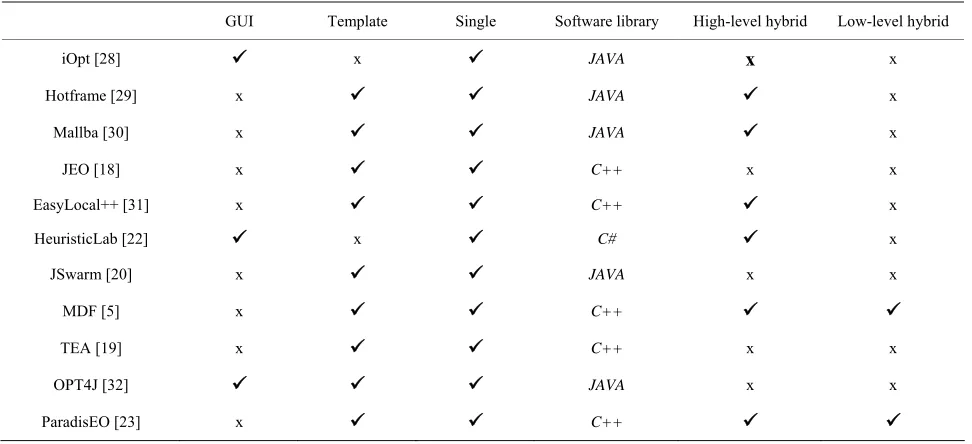
The implementation of flexible user-defined low-level hybridization is hindered by the limitation of these pro- gramming approaches. The GUI approach restricts users to modify software libraries while the template and soft- ware library modification involve tedious and compli- cated tasks. Nevertheless, these approaches are mostly adapted by the available software frameworks for meta- heuristics. Table 1 summarizes the available software frameworks with its programming approaches (GUI, template, software library) and implementation supports (single, high-level hybridization, low level hybridiza- tion).
In order to resolve these deficiencies, an alternative solution is by providing scripting language programming environment at front-end software framework. While scripting language is less complicated to be used, it is also applicable for the development of complex func- tional programs. Therefore, scripting language can sup- port rapid and flexible user-defined low-level hybridi- zation for metaheuristics.
As shown in Table 1, most of available software frame- works provide template programming approach and some software with GUI. Therefore, they are only ca- pable to support single and high-level implementation due to the GUI and template limitations. Although available software frameworks are useful for low-level
5. The Proposed Software Framework
The proposed software framework is designed with three-tier architecture namely front-end scripting language, intermediate compiler and back-end software libraries as illustrated in Figure 6.
Table 1. Available software frameworks for metaheuristics.
GUI Template Single Software library High-level hybrid Low-level hybrid
iOpt [28] x JAVA x x
Hotframe [29] x JAVA x
Mallba [30] x JAVA x
JEO [18] x C++ x x
EasyLocal++ [31] x C++ x
HeuristicLab [22] x C# x
JSwarm [20] x JAVA x x
MDF [5] x C++
TEA [19] x C++ x x
OPT4J [32] JAVA x x
[image:5.595.56.542.515.737.2]Figure 6. The proposed software framework.
5.1. The Back-End Software Library
[image:6.595.108.491.367.716.2]The back-end software libraries consist of high perfor- mance program codes for different metaheuristics. High performance programs are developed with JAVA. The basic feature of the back-end software architecture is to support generic and extensible environment for imple- menting different kind of metaheuristics and optimiza- tion problems. The class architecture is illustrated in
Figure 7.
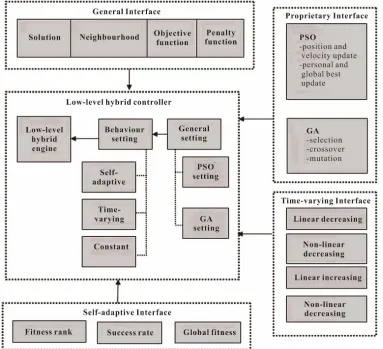
The back-end programs are bundled with a collection of software libraries that consists of five main elements, one is a collection of controller classes and the rest is a set of interface classes. The set of interface classes com- prise of general interface, proprietary interface, adaptive interface and time-varying interface. The interface classes are highly flexible for extensible through inheritance implementation. Therefore, the software frame-work can be used for developing different metaheuristics algo- rithms. In this paper, the focus is given to Particle Swarm Optimization (PSO) and Genetic Algorithm (GA).
The general interface consists of different classes for general metaheuristics components while proprietary inter- face provides specific component classes for specific metaheuristics. As shown in Figure 7, specific compo- nents for GA are selection, crossover and mutation while specific components for PSO are position and velocity update.
In addition, self-adaptive and time-varying interfaces facilitate dynamic behavior of metaheuristics parameters such as mutation rate for GA, inertia weight and con- striction parameters for PSO. Self-adaptive behavior
determines parameters value with regards to metaheuris- tics search ability namely exploration and exploitation. In metaheuristics, exploration ability promotes high accu- racy of solutions while exploitation facilitates fast con- vergence speed. Therefore, the balance of both abilities is very important to the performances of metaheuristics algorithms. Based on empirical studies, it is found that one of the successful ways to balance the search ability is by providing self-adaptive environment [33]. Neverthe- less, besides self-adaptive, time-varying behavior is also contributes to improvement of metaheuristics perform- ance. By providing time-varying behavior, the explora- tion and exploitation search abilities can be dynamically adjusted according to number of iteration.
The low-level hybrid controller is an important ele- ment that consists of low-level hybrid engine for imple- menting low-level hybridization. It is a JAVA codes ge- nerated by scripting compiler at the intermediate soft-ware framework.
5.2. The Intermediate Compiler
Scripting compiler is intermediate software between scripting program and software library that translates the scripting language codes for low-level metaheuristics hybridization into JAVA program. The JAVA program will be saved at back-end software to operate as a main program that defines class interactions between software libraries. It might also consist of new instantiations of metaheuristics components.
5.3. The Front-End Scripting Language
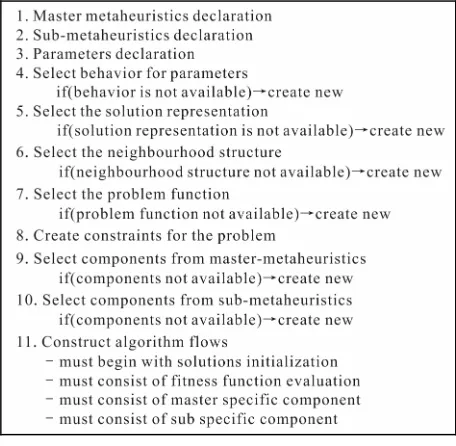
The front-end software framework is supported with scripting language to be used by programmers for defin- ing and developing new low-level hybridization of metaheuristics. The steps for basic operations in creating low-level hybridization are given in Figure 8.
The scripting language is not just usable for calling pre-defined operations from software libraries but capa- ble in creating new functions of metaheuristics compo- nents. The scripting language is capable to fulfill these requirements since it has the following special characte- ristics:
The scripting language tend not to have strong typing rules and not error-prone.
In particular, scripting language tend to have power- ful data structure and operations, which are tightly built-in with the language.
[image:7.595.309.537.86.309.2]These special characteristics have given additional advantages to developers to use scripting language for many purposes such as to support rapid software deve- lopment, API manipulation for back-end software libra- ries and software functions extension. These purposes are essential to the development of flexible user-defined
Figure 8. Basic operations of low-level hybridization.
low-level hybridization. The following parts discuss how scripting language can be used to fulfill these require- ments.
5.4. Scripting Language for Rapid Software Development
Scripting languages are simpler than application pro- gramming languages like C, C++ and JAVA. Thus, scripting language will considerably increase the effi- ciency of development. Some of the key enhancing fea- tures in scripting languages with regards to efficiency include simplify, expressiveness, and easiness.
Scripting language consists of simplify instructions which reduces the development errors for programming. A single statement of a scripting language can describe many instructions. In other words, scripting languages are normally expressiveness. It can generate roughly 10 to 100 times shorter code compared to application pro- gramming languages. For example, one statement in Tcl can represents more than 100 instructions while in C programming language, it means for several (5 to 10) instructions only.
5.5. Scripting Language for API
Scripting language can be used to call and communicate with different program codes from the software libraries [34]. Thus, scripting language can be used to operate as an API between the different programs or applications software.
plication programming language such as JAVA or C++.
Therefore, scripting language and application program- ing language are complimentary to each other. Pro- gramming with scripting language promises better pro- ductivity for integrating different software codes and libraries while application programming language sup- ports high efficiency performance for algorithm imple- mentation.
5.6. Scripting Language for Flexible Software Extension
At the beginning, conventional scripting languages have some limitations, which restrict their efficiency and ex- pressiveness. For instance, they have limited capability for concurrency, data structuring and object-oriented programming. Responding to the deficiencies, language developers have created advanced scripting languages such as Perl, Python and among others. Perl provides compact but very powerful sets of data types and data structures for example list, stack and queue. Python also has a great feature comparable Perl, but it is based on object-oriented programming. In addition, the Tcl is an excellent language for writing system or hardware pro- gram without using intermediate language to machine. With the very powerful sets of data types and data struc- tures, scripting languages are not just able to invoke and glue together other programs, but they are also appropri- ate for writing new complex program as flexible as ap- plication programming language.
With the flexibility, software designer interest has been attracted to invent different types of scripting lan- guages for different types of computer applications. As for example, the JACIE scripting language has been in- vented for developing collaborative and distributed ap- plication [10]. In addition, in order to develop grid based application Gaussion script has been introduced [11]. More than that, a group of researcher has created Japlo scripting language useful for rules based programming similar to Prologlanguage [35]. The Japlo language works on top of JAVA and it has better functionality than the Pro- log itself.
In addition, there are also available scripting languages for implementing metaheuristics based application. Ta- ble 2 lists the scripting languages for metaheuristics.
Some scripting use XML script which is integrated in metaheuristics software framework such as Open Beagle [36], Distributed Beagle [24] and JCLEC [17]. The XML in JCLEC is used for running different experiments with different configurations in parallel.
A scripting programming language is proven to be useful for facilitating user-defined strategy. The T++ scripting language for example, has been designed to support flexible user-defined strategy [25]. The language is incorporated in OpenTS software framework but it is only usable for high-level hybridization. More interesting, in METASIS software framework [37], the scripting with Sequential Interactive Synthesis System (SIS) could en- able user-defined strategy for low-level hybridization. How- ever, SIS is specifically usable for synthesizing and op-timizing sequential circuits only. Thus, it has a limit to be employed for different kinds of optimization problem.
6. Conclusions
Rapid programming is significant to the development of metaheuristics based applications. Therefore, the imple- mentation needs software framework in order to reduce development time and difficulty. However, for imple- menting low-level metaheuristics hybridization with soft- ware framework, another complexity has emerged due to its extensive programming. Current approaches in soft-ware frameworks have some limitations for supporting easy and flexible programming. As a result, they lack of flexibility in providing user-defined hybridization stra- tegy at front-end software. Besides, the deficiencies would discourage programmers to develop a variety of low- level hybridization strategies for metaheuristics algo-rithms.
[image:8.595.55.541.647.733.2]In order to enable rapid and flexible front-end pro- gramming environment, a scripting language should be developed. The scripting language is not just beneficial for integrating different metaheuristics programs, but it also permits the creation of new functionalities beyond the capability of software libraries. This paper has se- veral contributions to the metaheuristics community as well as to the software engineering. Firstly, formal defi- nition of low-level hybridization provides general views of the implementation. Secondly, it introduces three-tier software architecture that promotes rapid and flexible
Table 2. Scripting language for metaheuristics.
Scripting language Software library User-defined strategy High-level hybrid Low-level hybrid
XML [36] C++ x x
XML [24] C++ x x
T++ [25] C++ x
SIS [37] SIS x
programming at front-end software. In addition, this pa- per also provides operation steps for operating low-level metaheuristics hybridization that can be used for design- ing structure and details specification of a software framework.
7. Acknowledgements
The authors would like to thank Kementerian Pengajian Tinggi MALAYSIA and Universiti Teknologi MARA for their financial support to this project.
REFERENCES
[1] B. Boehm, “A View of 20th and 21st Century Software Engineering,” Proceedings of the 28th International Con- ference on Software Engineering, Shanghai, 2006, pp. 12- 29.
[2] E. Dubois, P. Gray and L. Nigay, “ASUR++: Supporting the Design of Mobile Mixed Systems,” Interacting with Computers, Vol. 15, No. 4, 2003, pp. 497-520.
doi:10.1016/S0953-5438(03)00037-7
[3] A. Neyem, S. F. Ochoa, J. A. Pino and R. D. Franco, “A Reusable Structural Design for Mobile Collaborative Ap-plications,” Journal of Systems and Software, Vol. 85, No. 3, 2012, pp. 511-524.
[4] R. Weinreich and G. Buchgeher, “Towards Supporting the Software Architecture Life Cycle,” Journal of Systems and Software, Vol. 85, No. 3, 2012, pp. 546-561.
doi:10.1016/j.jss.2011.05.036
[5] H. C. Lau, W. C. Wan, S. Halim and K. Toh, “A Software Framework for Fast Prototyping of Meta-Heuristics Hy-bridization,” International Transactions in Operational Research, Vol. 14, No. 2, 2007, pp. 123-141.
doi:10.1111/j.1475-3995.2007.00578.x
[6] S. H. Sadat-Mohtasham and A. Ghorbani, “A Language for High-Level Description of Adaptive Web Systems,”
Journal of Systems and Software, Vol. 81, No. 7, 2008,
pp. 1196-1217. doi:10.1016/j.jss.2007.08.033
[7] S. Z. Z. Abidin, M. Chen and P. W. Grant, “Designing Interaction Protocols Using Noughts and Crosses Type Games,” Journal of Network and Computer Applications,
Vol. 30, No. 2, 2007, pp. 586-613. doi:10.1016/j.jnca.2006.01.002
[8] T. C. Oliveira, P. S. C. Alencar, C. J. P. de Lucena and D. D. Cowan, “RDL: A Language for Framework Instantia- tion Representation,” Journal of Systems and Software,
Vol. 80, No. 11, 2007, pp. 1902-1929. doi:10.1016/j.jss.2007.01.005
[9] A. Boulis, C.-C. Han and M. B. Srivastava, “Design and Implementation of a Framework for Efficient and Pro- grammable Sensor Networks,” Proceedings of the 1st In- ternational Conference on Mobile Systems, Applications and Services, 2003, pp. 187-200.
[10] M. A. Ismail, M. Chen and P. Grant, “JACIE—An Au-thoring Language for WWW-Based Collaborative Appli-cations,” Annals of Software Engineering, Vol. 12, No. 1,
2001, pp. 47-75. doi:10.1023/A:1013354519370
[11] W. Tongming, Z. Ruisheng, S. Xianrong, C. Shilin and L. Lian, “GaussianScriptEditor: An Editor for Gaussian Scripting Language for Grid Environment,” Proceedings of the 8th International Conference on Grid and Coop- erative Computing, 2009, pp. 39-44.
[12] X. Hua, L. Qingshan, W. Yingqiang, Z. Chenguang, M. Shaojie and Z. Guilin, “A Scripting Language Used for Defining the Integration Rule in Agent System,” IEEE International Conference on E-Business Engineering,
2008, pp. 649-654.
[13] X. Fu, A. Li, L. Wang and C. Ji, “Short-Term Scheduling of Cascade Reservoirs Using an Immune Algorithm- Based Particle Swarm Optimization,” Computers & Ma- thematics with Applications, Vol. 62, No. 6, 2011, pp.
2463-2471. doi:10.1016/j.camwa.2011.07.032
[14] C. Blum and A. Roli, “Hybrid Metaheuristics: An Intro-duction,” In: C. Blum, M. J. B. Aguilera, A. Roli and M. Sampels, Eds., Hybrid Metaheuristics, Springer, Berlin/ Heidelberg, 2008, pp. 1-30.
doi:10.1007/978-3-540-78295-7_1
[15] E. G. Talbi, “A Taxonomy of Hybrid Metaheuristics,”
Journal of Heuristics, Vol. 8, No. 5, 2002, pp. 541-564.
doi:10.1023/A:1016540724870
[16] D. Orenstein, “Application Programming Interface (API),”
Quick Study: Application Programming Interface (API),
2000.
[17] S. Ventura, C. Romero, A. Zafra, J. A. Delgado and C. Hervás, “JCLEC: A Java Framework for Evolutionary Computation,” Springer, Berlin/Heidelberg, 2008. [18] M. G. Arenas, N. Dolin, J. J. Marelo, P. A. Castillo, I. F.
de Viana and M. Schonauer, “JEO: JAVA Evolving Ob- jects,” Proceedings of the Genetic and Evolutionary Com- putation Conference (GECCO), 2002.
[19] M. Emmerich and R. Hosenberg, “TEA : A C++ Library for the Design of Evolutionary Algorithms,” University of Dortmund, Dortmund, 2001.
[20] C. Pabl, “JSwarm-PSO,” 2006. http://jswarm-pso.sourceforge.net/
[21] F. Stonedahl and U. Wilensky, “NetLogo Particle Swarm Optimization Model.”
http://ccl.northwestern.edu/netlogo/models/
[22] S. Wagner and M. Affenzeller, “HeuristicLab: A Generic and Extensible Optimization Environment,” In: B. Ri- beiro, R. F. Albrecht, A. Dobnikar, D. W. Pearson and N. C. Steele, Eds., Adaptive and Natural Computing Algo-rithms, Springer, Vienna, 2005, pp. 538-541.
doi:10.1007/3-211-27389-1_130
[23] S. Cahon, N. Melab and E. Talbi, “ParadisEO : A Frame- work for the Reusable Design of Parallel and Distributed Metaheuristics,” Journal of Heuristics—Special Issue on New Advances on Parallel Meta-Heuristics for Complex Problems, Vol. 10, No. 3, 2004, pp. 357-380.
[24] M. Dubreuil and M. Parizeau, “Distributed BEAGLE : An Environment for Parallel and Distributed Evolutionary Computations,” Proceedings of the 17th Annual Interna- tional Symposum on High Performance Computing Sys- tems and Applications, 2003.
Y. Shevchuk and A. Vodomerov, “OpenTS: An Outline of Dynamic Parallelization Approach,” In: V. Malyshkin, Ed., Parallel Computing Technologies, Springer-Verlag,
Berlin/Heidelberg, 2005, pp. 303-312. doi:10.1007/11535294_26
[26] E. G. Talbi, “Metaheuristics: From Design to Implemen- tation,” Wiley, London, 2009.
[27] G. R. Raidl, J. Puchinger and C. Blum, “Metaheuristic Hybrids,” In: M. Pardalos, H. Panos, P. Van and M. Mi- lano, Eds., Handbook of Metaheuristics, Springer, New
York, 2010.
[28] L. Rapha and C. Voudouris, “HSF: The iOpt’s Frame-work to Easily Design Metaheuristic Methods,” In: M. G. C. Resende and J. P. de Sousa, Eds., Metaheuristics: Computer Decision-Making, Kluwer Academic Publish-
ers, Berlin/Heidelberg, 2004, pp. 237-256.
[29] A. Fink and S. Voß, “Hotframe: A Heuristic Optimization Framework,” In: S. Voß and D. L. Woodruff, Eds., Opti-mization Software Class Libraries, Springer, Heidelberg,
2002, pp. 81-154.
[30] E. Alba, et al., “MALLBA: A Library of Skeletons for
Combinatorial Optimisation,” In: R. Feldmann, Ed., Euro- Par 2002 Parallel Processing, Springer-Verlag, Berlin/
Heidelberg, 2002, pp. 63-72. doi:10.1007/3-540-45706-2_132
[31] L. D. Gaspero and A. Schaerf, “EASYLOCAL++: An Object-Oriented Framework for Flexible Design of Local
Search Algorithms,” Software-Practice and Experience,
2003, pp. 1-34.
[32] M. Lukasiewycz, M. Glaß, F. Reimann and D.-I. Sabine Helwig, “The OPT4J Documentation,” 2009.
[33] K. Suresh, S. Ghosh, D. Kundu, A. Sen, S. Das and A. Abraham, “Inertia-Adaptive Particle Swarm Optimizer for Improved Global Search,” Proceedings of the 8ht In- ternational Conference on Intelligent System Design and Applications—ISDA2008, Kaohsiung, 26-28 November
2008, pp. 253-258.
[34] G. Zao-Bin, L. Ching and V. Varadharajan, “A Middle- Ware-Based Script Language,” Proceedings of theInter- national Conference on Mobile Business (ICMB’05), 11-
13 July 2005, pp. 690-693. doi:10.1109/ICMB.2005.8 [35] M. Espak, “Japlo : Rule-Based Programming on Java,”
Journal of Universal Computer Science, Vol. 12, No. 9,
2006, pp. 1177-1189.
[36] C. Gagn and M. Parizeau, “Open BEAGLE : A New Ver- satile C++ Framework for Evolutionary Computations,”
Proceedings of the Genetic and Evolutionary Computa- tion Conference (GECCO-2002), 2002.
[37] G. Ranjan, P. Kumar and P. Gupta, “METASIS: A Meta Heuristic Based Logic Optimizer,” Proceedings of the
50th Midwest Symposium on Circuits and Systems,