ISSN Online: 2327-5227 ISSN Print: 2327-5219
DOI: 10.4236/jcc.2018.61002 Dec. 29, 2017 12 Journal of Computer and Communications
Improvements in a Puzzle
Authentication Method
Yutaka Hirakawa, Ayaka Shimoda, Isao Sasano, Kazuo Ohzeki
Shibaura Institute of Technology, Tokyo, Japan
Abstract
This article discusses improvements in a puzzle authentication method that adopts the interface of the Puzzle and Dragons game [1] and is tolerant against video-recording attacks. A problem that the conventional puzzle au-thentication methods face is that they are time consuming and have low suc-cess rate in authentication. We evaluated improvements of the interface to ve-rify the usability of the improved system. The results suggested that the usa-bility in terms of operation time and authentication success rate attained a level that was comparable with other leading methods in the field.
Keywords
Authentication Method, Vibration, Video-Recording Attack
1. Introduction
Currently, network services such as internet banking, internet finance, and net-work shopping are commonly used worldwide. The system requires user au-thentication to deliver these services. Additionally, with the explosive increase of smart phone users, authentication is used for smart phone locking to avoid the leaking of private information.
Many types of authentication methods have been proposed. However, this ar-ticle focuses on password authentication since it is the basic method and is occa-sionally used as a remedy when other authentication methods fail. The most popular method is called the personal identification number-entry (PIN-entry) system, which has been adopted worldwide by ATM machines.
The main problem with password authentication is the leaking of passwords. To avoid shoulder surfing, which means peeping over someone’s shoulder dur-ing their authentication operation to steal a password, is the first research objec-tive. The recent research objective is to achieve tolerance against video-recording How to cite this paper: Hirakawa, Y.,
Shimoda, A., Sasano, I. and Ohzeki, K. (2018) Improvements in a Puzzle Authen-tication Method. Journal of Computer and Communications, 6, 12-20.
https://doi.org/10.4236/jcc.2018.61002
DOI: 10.4236/jcc.2018.61002 13 Journal of Computer and Communications attacks, wherein authentication operations are video-recorded and analyzed. There are two major approaches. The first one uses acoustic information to se-cretly transmit information from the system to the users. Other approaches comprised using vibration to transmit information to the users.
This study focused on a puzzle authentication method that adopts the puzzle interface used in the Puzzle Dragon Game [1]. This interface is tolerant against video-recording attacks. However, the conventional puzzle authentication me-thods are time consuming and have low authentication success rate.
This article discusses improvements on the method. Through the proposed improvements, we show that the usability significantly improves and reaches a level that is comparable with that of other leading methods in this field with re-gard to operation time and authentication success rate.
2. Related Work
Numerous password authentication methods exist. In the early stages, shoulder surfing is discussed [2] [3]. The methods in this stage provide safety when someone tries to observe a user’s authentication operations. However, they are not safe when authentication operations are video-recorded and analyzed.
In the next stage, tolerance against video-recording attacks is discussed [4] [5] [6] under the assumption that authentication operations are video-recorded twice.
In these years, research objective moves to more difficult one. Tolerance is discussed under the assumption that authentication operations are vid-eo-recorded multiple times. There are two major approaches. One is to use acoustic information [7] [8] and the other is using haptic information [9] [10] [11] [12]. Haptic or acoustic information is used to secretly send a message to the user.
This article discusses authentication methods using vibrations. There is an advantage that it can be used by smart phone easily for these methods, but also long consuming time and low success rate are still problems and needed to im-prove.
3. Toward the Improvement
3.1. Authentication Method Using Vibration
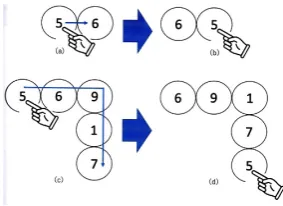
DOI: 10.4236/jcc.2018.61002 14 Journal of Computer and Communications Figure 1. Puzzle and dragon game.
In the puzzle authentication method, a user registers four passwords in ad-vance, and each password is a number less than 17 and larger than 0. Let us as-sume {3, 7, 11, 16} to be passwords. When these passwords are placed at the correct locations simultaneously by the user, authentication is successful. In this article, the correct locations are called target locations. The interface of the puz-zle authentication method is shown in Figure 2. If four corners, such as loca-tions 1, 4, 13, and 16, are the assumed target localoca-tions, a user moves these drops and all of his passwords to the target locations. The authentication method al-lows combinatory ambiguity. Therefore, when each password is located at one of the four target locations, the authentication is successful.
In this study, we assumed that two target locations are registered in advance. For authentication, four target locations are required for passwords with a length of four. The other two target locations are randomly designated by the system for each authentication.
The authentication operation is divided into two stages. In the first stage, the user touches all drops in a single stroke. In this stage, all drops are displayed in the order shown in Figure 2, and no drops are moved. The image of a single stroke touch is shown in Figure 3. Vibration occurs when a user’s finger touches a certain drop. It is a sign of a target location. There are two locations where vi-bration occurs. These are the target locations that the system selects for authen-tication.
In the beginning of the second stage, drops are displayed in a random order. In this stage, the drop moves freely. The user moves each password to the target place by his single stroke touch. The operation image is shown in Figure 4.
3.2. Preliminary Experiment
DOI: 10.4236/jcc.2018.61002 15 Journal of Computer and Communications Figure 2. Authentication interface.
Figure 3. Single stroke and vibration.
Figure 4. Finger touch and drop move.
In this experiment, drops are fixed and does not move. Each participant touches all drops in one stroke as shown in Figure 3. When a participant touch-es a drop at the target place, which is selected by the system, vibration occurs. Two places are selected as target places in each operation. After the operation, each participant answers which are the vibrating drops. Each participant repeats this operation fifteen times, where target places are randomly selected in each operation.
[image:4.595.301.443.409.512.2]DOI: 10.4236/jcc.2018.61002 16 Journal of Computer and Communications
3.3. Scenarios for Improvements
We considered the following to improve the recognition rate: 1) Designation using vibration and visual information:
When a user’s finger touches a drop, the drop changes its color. Therefore, a user can recognize the touched drop easily. When a finger touches a drop at the target location not only does the drop change its color but vibration also occurs.
2) Designation using acoustic and visual information:
In this method, a simple tone is used instead of a vibration. When a user’s finger touches a drop, the drop changes its color in every location. When a fin-ger touches a drop at the target location, the drop changes its color and a tone is produced. We assumed that users will use headphones to avoid leaking acoustic information.
3) Designation using acoustic, visual, and haptic information:
In this method, when a finger touches a drop at the target location, the drop changes its color and a vibration occurs along with a tone. Herein, the same tone is used for each of two different target places.
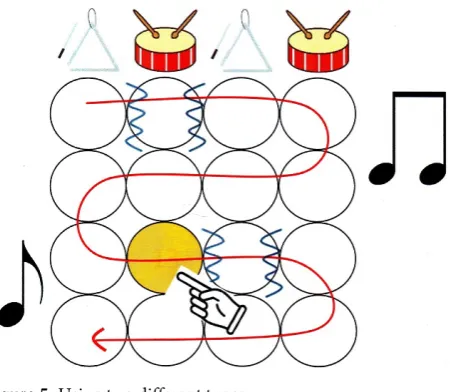
4) Designation using visual, haptic, and two kinds of acoustic information: In this method, two types of tones are used. The image is shown in Figure 5. We assume that positions 2 and 11 are target locations. When a user touches a drop at location 2, a drum tone is sounded along with vibration. When a user touches a drop at location 11, a triangle tone is emitted with vibration.
5) Finger touch pattern is changed from single stroke:
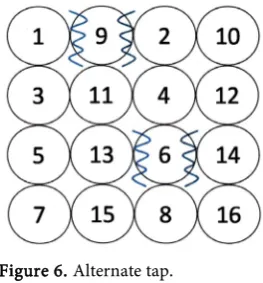
[image:5.595.263.492.523.719.2]In the case of a single touch stroke, a user follows must touch drops one after the other in a continuous order. In other words, user’s finger moves along the arrow in Figure 5. This causes a recognition error; therefore, we adopt a finger touch pattern in a non-continuous order, as shown in Figure 6, where the number on the drop indicates the tap order. In this article, this is called alternate tap. This approach is used in target location designation. The alternate tap is adopted and evaluated with each one of the above four improvements.
DOI: 10.4236/jcc.2018.61002 17 Journal of Computer and Communications Figure 6. Alternate tap.
4. Experiments Results and Discussions
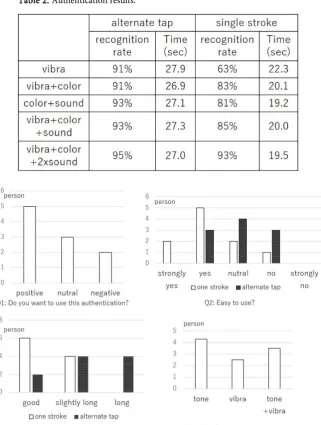
The experimental results are summarized in Table 1 and Table 2. Additionally, we asked every participant to answer four questions for usability evaluation. The results of the usability evaluation are summarized in Figure 7. We performed hypothesis testing with a 5% level of significance. Each of the improved methods was found to be significantly different from the conventional puzzle authentica-tion methods.
1) Simultaneous use of visual and acoustic information is effective.
When visual and acoustic information is used simultaneously in target loca-tion designaloca-tion, the recogniloca-tion rate significantly increases. The increase ex-ceeded our expectation. In particular, it was highly improved by the color change of the touched drop.
2) Division of neighbor column is effective.
In a single stroke, the introduction of two types of tone dividing neighbors contributed to significant improvement.
3) Alternate tap significantly improved the recognition rate; however, it took a rather long time.
We expected that alternate touch would improve the recognition rate and op-eration time. However, this did not happen. Young people are good at perform-ing movperform-ing operations used in the Puzzle and Dragon game. In this regard, our expectations were exceeded. The usability evaluation results of Q2 and Q3 in Figure 7 clearly show that they preferred the game interface to the alternate tap.
4) The usability of the improved system reached a level that was comparable with the usability of other leading PIN-entry methods with regard to operation time and authentication success rate.
DOI: 10.4236/jcc.2018.61002 18 Journal of Computer and Communications Table 1. Results of target place recognition experiments.
Table 2. Authentication results.
DOI: 10.4236/jcc.2018.61002 19 Journal of Computer and Communications
5. Conclusion
In this article, we discuss the improvement of the puzzle authentication method. The mistakes that occurred in the authentication operation were clarified while investigating the conventional methods, and possible improvements were eva-luated. In the improved method, the authentication success rate increased by 30% and the authentication time decreased by 3 seconds in comparison with the conventional method. The improved authentication method was compared to other leading PIN-entry methods. And it is shown that the usability of the im-proved method reaches the comparative level of these studies.
6. Further Work
This study focused on interface improvement. The experimental approach is not the most secure usage of the puzzle authentication method. In the experiment, two target locations were assumed to be registered in advance; however, if four target locations were designated by the system for each authentication without preliminary location registrations, tolerance against a random attack increased. Additionally, in the experiment, each password was allowed to be placed at one of the target locations, where ambiguity is allowed. If this was not allowed, to-lerance against random attack increased further. Thus, further usability evalua-tions according to various security levels are required and will be included in future work.
References
[1] GungHo: Puzzle and Dragons.
http://www.gunghoonline.com/games/puzzle-dragons/
[2] Roth, V., Richter, K. and Freidinger, R. (2004) A PIN-Entry Method Resilient against Shoulder Surfing. CCS’04, 236-245.
[3] Zhao, H. and Li, X. (2007) S3PAS: A Scalable Shoulder-Surfing Resistant Tex-tual-Graphical Password Authentication Scheme. IEEE Advanced Information Networking and Applications Workshops, 467-472.
https://doi.org/10.1109/AINAW.2007.317
[4] Sakurai, S. and Munaka, T. (2008) Resistance Evaluation of User Authentication Method Using Matrix against Shoulder Surfing. IPSJ Transaction, 49, 3038-3051. [5] Hirakawa, Y. (2013) Random Board: Password Authentication Method with
Toler-ance to Video-Recording Attacks. International Journal of Innovation Management and Technology, 4, 455-460. https://doi.org/10.7763/IJIMT.2013.V4.441
[6] Hirakawa, Y., Itoh, T. and Ohzeki, K. (2013) A New Numerical Password Authen-tication Method. International Journal of Information Technology and Computer Science (IJITCS), 12, 7-15.
[7] Lee, M.-K., Nam, H. and Kim, D.K. (2016) Secure Bimodal PIN-Entry Method Us-ing Audio Signals. Computer & Security, Elsevier, 56, 140-150.
https://doi.org/10.1016/j.cose.2015.06.006
DOI: 10.4236/jcc.2018.61002 20 Journal of Computer and Communications (IJCSEE), 3, 356-360.
[9] Hinokuma, K., Kita, Y., Yamaba, H., Kubota, S., Park, M. and Okazaki, N. (2015) A Study of Puzzle Authentication Method with Video Recording Attack Resistance. IPSJ Technical Report, 2015-IOT-31, 1-6.
[10] Bianchi, A., Oakley, I., Kostakos, V. and Kwon, D.S. (2011) The Phone Lock: Audio and Haptic Shoulder-Surfing Resistant PIN Entry Methods for Mobile Devices. TEI ’11, 197-200. https://doi.org/10.1145/1935701.1935740
[11] Kuribara, T., Shizuki, B. and Tanaka, J. (2014) VibraInput: Two-Step PIN Entry System Based on Vibration and Visual Information. Proc. CHI2014, 2473-2478.
https://doi.org/10.1145/2559206.2581187