http://www.scirp.org/journal/jss ISSN Online: 2327-5960
ISSN Print: 2327-5952
DOI: 10.4236/jss.2017.512002 Dec. 7, 2017 14 Open Journal of Social Sciences
Analysis on the Application of PPP Mode in
Hangzhou City Management
—Take the Infrastructure Construction as an Example
Zhenpeng Duan
Zhejiang Agriculture and Forestry University, Hangzhou, Zhejiang, China
Abstract
Facing the phenomenon that the increasingly serious shortage of infrastruc-ture causes urban problems, the government will introduce PPP mode to the field of city management, and it achieves good economic and social benefits to promote the sustainable development of PPP mode in city management. Based on the survey of Hangzhou Metro Line 1 and the travelling citizens and the analysis of SPSS data, we can know that the operation management of the later stage is the main reason that affects the sustainable development of PPP mode. Based on this, the paper proposes that in the operation management of the later stage, we should strive to improve the relevant supporting facilities and the quality of services, so as to enhance the public’s satisfaction to the project, thereby promoting the sustainable development of PPP mode in city management.
Keywords
PPP Mode, City Management, Infrastructure, Hangzhou Metro
1. Introduction
Traffic congestion, population expansion, housing tension, employment diffi-culty and environmental degradation are common problems in urban infra-structure derived from the rapid development of urbanization and the extension content of connotation of city management. Because of the particularity of pub-lic goods supply, government financial constraints, the shortage of government financial funds and because the supply of urban public services is difficult to keep pace with the increasingly growing demand for infrastructure, it is urgent
How to cite this paper: Duan, Z.P. (2017) Analysis on the Application of PPP Mode in Hangzhou City Management. Open Jour-nal of Social Sciences, 5, 14-26.
https://doi.org/10.4236/jss.2017.512002
Received: November 13, 2017 Accepted: December 4, 2017 Published: December 7, 2017
Copyright © 2017 by author and Scientific Research Publishing Inc. This work is licensed under the Creative Commons Attribution International License (CC BY 4.0).
DOI: 10.4236/jss.2017.512002 15 Open Journal of Social Sciences
for modern urban management to strengthen the construction of infrastructure and promote the harmonious and healthy development of cities. As an effective mode of social capital entering the field of public goods supply, PPP mode stemmed from Britain in the last century and has gained long-term progress in practice development. Since the reform and opening up, China has taken the in-itiative to integrate itself into the global tide of globalization to learn from and draw lessons from foreign advanced management experience and technology, so China has continuously improved its social and economic level and made re-markable achievements in public-private partnership (PPP). In the tide of eco-nomic globalization, as one of the cities that developed abroad earlier, Hangzhou actively explores and uses the PPP mode in the category of city management to ensure the smooth progress of G20 and earn a reputation as a world famous city for Hangzhou; therefore, Hangzhou enters the post era of G20. As a successful example of PPP mode in the field of infrastructure construction, Hangzhou Me-tro Line 1 has achieved remarkable economic and social benefits and become a model for city management circles to study. However, according to Hangzhou’s development goal of building a world famous city, its level of city management is far from enough, and based on reality, it should learn from others to explore new ideas of city management development and promote the construction of the world famous city.
Therefore, take Hangzhou Metro Line 1 as an example, the paper conducts deep analysis of its operation management to have an understanding of the in-fluencing factors of public satisfaction in infrastructure construction under PPP mode and discuss the sustainable development idea of PPP model in city agement, thereby ensuring supply of city infrastructure, improving the man-agement level of Hangzhou City and boosting the construction of a world fam-ous city for Hangzhou.
2. PPP Model
DOI: 10.4236/jss.2017.512002 16 Open Journal of Social Sciences
3. Sample Survey
3.1. Current Situation of Hangzhou Metro Line 1
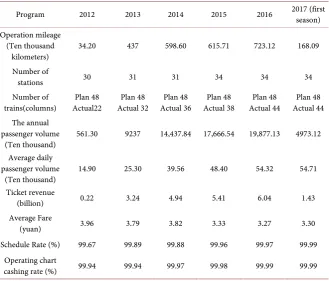
The total mileage of Hangzhou Metro Line 1 is 47.97 km, of which there are 30 stations with a total investment of RMB 22,076,000,000 [1]. It is analyzed from the angle of necessity that the construction of Hangzhou Metro relies heavily on the government and government subsidies are relatively high in terms of capital constitution while it has a relatively general level of operation and the supervi-sion of metros still needs to be strengthened. It is analyzed from feasibility that both the system level and the related laws and regulations are gradually per-formed, which has created a favorable policy environment for franchising, and the operation foundation of franchising is basically complete with conditions for operation [2], and its current situation of operation is as shown in Table 1.
As can be seen from Table 1, the Company’s Metro Line 1 was opened and put into trial operation in November 2012, and it is backbone of the rail transit network with the length of 47.47 km. The trial operation has been completed in November 2014. In 2016, Hangzhou Metro Line 1 (including Xiasha extension) achieved 198,771,300 times of passenger volume, 7,231,200 kilometers of total mileage of operation, 99.97% of punctuality rate of trains and 99.99% of fulfilled rate of run chart. From January to March 2017, it achieved RMB 143,000,000 of ticket revenue and 99.99% of punctuality rate.
3.2. Acquisition of Research Data
In recent years, China’s infrastructure construction has been developed and im-proved, and production and living conditions of residents have been significant-ly improved. However, are residents satisfied with the existing infrastructure? What are the factors influencing satisfaction? These questions should be impor-tant contents that government departments should know when carrying out in-frastructure construction. With the above analysis, we have a preliminary un-derstanding of Metro Line 1-representative of infrastructure in Hangzhou City and its operation. In order to further understand the application of PPP mode in Hangzhou infrastructure, the paper adopts the survey method of random sam-pling in the range of Hangzhou City to investigate and study the public’s satis-faction to Metro Line 1.
9,188,000 research objects are involved in the paper, and the number of sam-ple elements is determined according to the Scheaffer equation:
(
)
21 1
N N
N δ
∗ =
− + (1)
In the above formula, N∗ is the number of sample elements, and N is the
DOI: 10.4236/jss.2017.512002 17 Open Journal of Social Sciences Table 1. The operation of Hangzhou Metro Line 1.
Program 2012 2013 2014 2015 2016 2017 (first season)
Operation mileage (Ten thousand
kilometers) 34.20 437 598.60 615.71 723.12 168.09 Number of
stations 30 31 31 34 34 34
Number of
trains(columns) Actual22 Plan 48 Actual 32 Plan 48 Actual 36 Plan 48 Actual 38 Plan 48 Actual 44 Plan 48 Actual 44 Plan 48 The annual
passenger volume
(Ten thousand) 561.30 9237 14,437.84 17,666.54 19,877.13 4973.12 Average daily
passenger volume
(Ten thousand) 14.90 25.30 39.56 48.40 54.32 54.71 Ticket revenue
(billion) 0.22 3.24 4.94 5.41 6.04 1.43
Average Fare
(yuan) 3.96 3.79 3.82 3.33 3.27 3.30
Schedule Rate (%) 99.67 99.89 99.88 99.96 99.97 99.99 Operating chart
cashing rate (%) 99.94 99.94 99.97 99.98 99.99 99.99
Data from: Track rating report on Hangzhou Metro Refco Group Ltd.
contents of questionnaires include the overall satisfaction of residents to Metro Line 1, various supporting facilities in Metro Line 1, security check and other services, basic information and other relevant contents(See appendix for details). The research obtains 282 valid questionnaires, which meet the need for investi-gation.
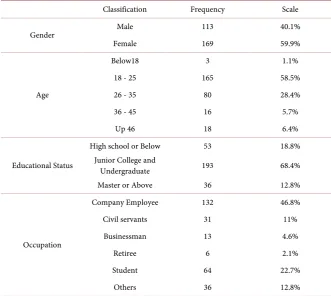
Table 2 shows that interviewees’ gender, age and other social attribute struc-tures are more reasonable. Female interviewees are 19.8% more than male inter-viewees; ages mainly concentrate in the range from 18 to 35,which accounts for 86.9% of the total sample, and with mental maturity, interviewees have the abili-ty to think independently and identify; interviewees with above college degree account for 81.2% in the total interviewees, which show that interviewees have higher level of knowledge and they have the basic ability to identify and judge contents of questionnaires; interviewees cover different occupations, and they are mainly personnel in companies. Therefore, we can believe that the survey shows different perceptions of different groups on Hangzhou Metro Line 1 from different genders, different ages, different knowledge structures and different industries to lay a better mass base for the study of this paper.
4. Analysis on Sample Data
DOI: 10.4236/jss.2017.512002 18 Open Journal of Social Sciences Table 2. Respondents basic information.
Classification Frequency Scale
Gender Male 113 40.1%
Female 169 59.9%
Age
Below18 3 1.1%
18 - 25 165 58.5%
26 - 35 80 28.4%
36 - 45 16 5.7%
Up 46 18 6.4%
Educational Status
High school or Below 53 18.8%
Junior College and
Undergraduate 193 68.4%
Master or Above 36 12.8%
Occupation
Company Employee 132 46.8%
Civil servants 31 11%
Businessman 13 4.6%
Retiree 6 2.1%
Student 64 22.7%
Others 36 12.8%
On the basis of the failed PPP case of the Hangzhou Bay Bridge, the Hangzhou municipal government actively learned from the experience of successful cases at home and abroad and worked with Hong Kong Railway Group to set up the op-eration management of Hangzhou Metro Line 1 that Hangzhou-Hong Kong Company is responsible for, thereby achieving good economic and social bene-fits. However, we can know that from the field social practice survey, the public has mixed opinions on Hangzhou Metro Line 1, which to a certain extent, affects the satisfaction of city infrastructure construction under PPP mode and is not conducive to promoting the management level in Hangzhou city. Based on the survey data, the paper selects related influencing factors to explore PPP mode embedded infrastructure construction ideas through data analysis, thereby en-suring its application in the field of city management and promoting transfor-mation and upgrade of city management. The following analysis is as follows:
4.1. Non-Parametric Test
DOI: 10.4236/jss.2017.512002 19 Open Journal of Social Sciences
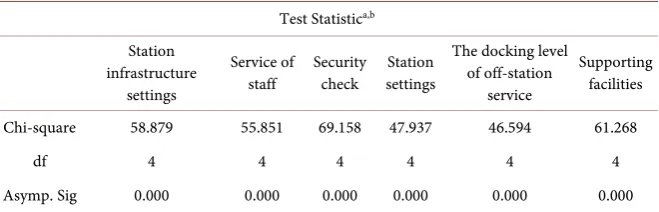
supporting facilities, service level of security check and other personnel and the docking level of off-station service based on different score perceptions. By the Kruskal-Wallis test, the significant P-values are less than 0.05 (as show in Table 3), which shows that there are significant differences between the six groups affect-ing the overall satisfaction score of Metro Line 1, so it is worthy to conduct fur-ther research.
4.2. Analysis on Multiple Linear Regression
4.2.1. Multiple Linear Regression TheoryThe multiple linear regression model is a linear regression model with multiple explanatory variables, which is used to reveal the linear relationship between the explained variable and other explanatory variables [3]. The mathematical model of the multiple linear regression is:
0 1 1 2 2 p p
y=
β
+β
x +β
x + +β
x +ε
(2)Equation (2) is a p linear regression model, in which there are p explanatory variables. It shows that the variation of the explained variable y can be explained by two parts: the first part is the linear variation party caused by the change x of
p explanatory variables, which is y=
β
0+β
1 1x +β
2 2x + +β
pxp; the secondpart is the change y caused by other random factors, and in other words,
0 1
, , p
ε β β
β
are the unknown number in the model, which are calledregres-sion constant and partial regresregres-sion coefficient respectively. ε is called random
error and random variable [4].
4.2.2. Equation Establishment Process
[image:6.595.209.539.594.700.2]In order to study the factors affecting the operation management of Hangzhou Metro Line 1, the overall evaluation data of 282 metro passengers in Hangzhou on Metro Line 1 were collected and the multivariate linear regression method was used for analysis. Here, the explained variable is the score of Metro Line 1 (y), and the explanatory variable (x) is the satisfaction of station supporting fa-cilities (such as the proportion of shops, advertisements, toilets and waiting seats), construction mode (PPP mode), station personnel service (personnel ex-cerpt for security check), station settings, docking procedures with services out-side a station (such as buses, parking lots, public bicycles, shopping centers and
Table 3. Kruskal-Wallis test.
Test Statistica,b Station
infrastructure settings
Service of
staff Security check settings Station
The docking level of off-station
service
Supporting facilities
Chi-square 58.879 55.851 69.158 47.937 46.594 61.268
df 4 4 4 4 4 4
Asymp. Sig 0.000 0.000 0.000 0.000 0.000 0.000
DOI: 10.4236/jss.2017.512002 20 Open Journal of Social Sciences
scenic spots), station infrastructure setting (such as ticket machine, inquiry equipment and other electronic devices you need) and security check. In this paper, the backward screening strategy is used to make SPSS automatically com-plete the selection of explanatory variables, observe the changes in each step of the test and carry out residual analysis and detection of abnormal points
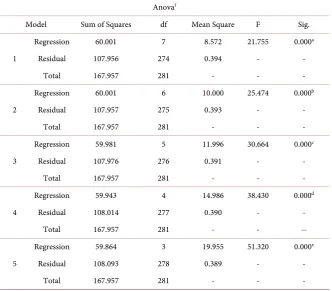
As shown in Table 4, the backward screening strategy is used to complete the establishment of the regression equation with five steps, and the final model is the sixth model. From the process of equation establishment, with the conti-nuous decrease of explanatory variables, the fitting degree of the equation de-creases slightly, which not only explains the characteristics of the judgment coef-ficient, but also shows that the establishment of the regression equation should pay attention to examine whether explanatory variables contribute to explained variables rather than blindly taking the pursuit of high fitting degree as the sole goal [5]. The variables that are eliminated in the equation are station setting, construction mode, service of station personnel and docking degree with the service outside a station. If the significance level α is 0.05, we can see that the probability P-values of partial F test of these eliminated variables are greater than the significance level, so the original hypothesis in the test can’t be rejected, and without significant difference between the partial regression coefficients of these variables and without significant contribution to the linear interpretation of the explained variables, they should be kept in the equation [6]. The variables which are kept in the equation at last are station supporting facilities, basic sta-tion infrastructure settings as well as works of stasta-tion security check and security personnel. The test value of the DW equation is 2.046, and the residual error has a certain degree of positive autocorrelation.
4.2.3. Test of Linear Relationship among Variables
The fifth model in Table 5 is the final equation. If the significant level α is 0.05, because the probability P-value of its significance test of regression coefficients is less than the significant level, the linear relationship between the explanatory va-riable and the explained vava-riable is significant and it is proper to establish the li-near model.
Table 4. Multiple linear regression analysis results (a).
Mode Summaryf
model R Square R Adjusted R Square Std. Error of the Estimate
Change Statistics Durbin- Watson R Square
Change Change df1 df2 F Change Sig. F 1 0.598a 0.357 0.341 0.628 0.357 210.755 7 274 0.000 - 2 0.598b 0.357 0.343 0.627 0.000 0.001 1 274 0.977 - 3 0.598c 0.357 0.345 0.625 0.000 0.050 1 275 0.824 - 4 0.597d 0.357 0.348 0.624 0.000 0.098 1 276 0.755 - 5 0.597e 0.356 0.349 0.624 0.000 0.202 1 277 0.653 2.046
DOI: 10.4236/jss.2017.512002 21 Open Journal of Social Sciences Table 5. Multiple linear regression analysis results (b).
Anovaf
Model Sum of Squares df Mean Square F Sig.
1
Regression 60.001 7 8.572 21.755 0.000a
Residual 107.956 274 0.394 - -
Total 167.957 281 - - -
2
Regression 60.001 6 10.000 25.474 0.000b
Residual 107.957 275 0.393 - -
Total 167.957 281 - - -
3
Regression 59.981 5 11.996 30.664 0.000c
Residual 107.976 276 0.391 - -
Total 167.957 281 - - -
4
Regression 59.943 4 14.986 38.430 0.000d
Residual 108.014 277 0.390 - -
Total 167.957 281 - - --
5
Regression 59.864 3 19.955 51.320 0.000e
Residual 108.093 278 0.389 - -
Total 167.957 281 - - -
f: Dependent Variable: Metro Line 1 scoring (Full score is 5).
4.2.4. Partial Regression Coefficient and Significance Test of Each Variable in the Model
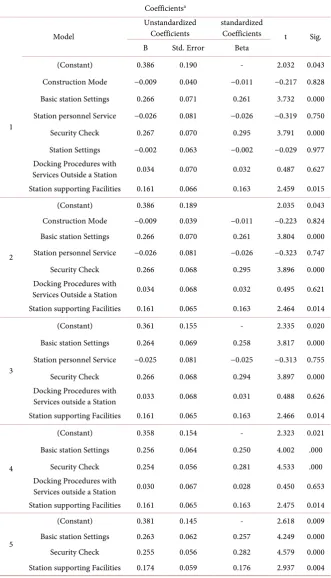
Table 6 shows the partial regression coefficients and the significance test of par-tial regression coefficients of each explanatory variable in each model. If the sig-nificant level α is 0.05, the above four models are not available because there are insignificant explanatory variables in regression coefficients. The fifth model is the final equation, and the probability P-value of its significance test of regres-sion coefficients is less than the significant level α, so the linear relationship be-tween the explained variables and the basic station infrastructure settings, sta-tion security check and its security personnel work and stasta-tion supporting facili-ties is significant and it is reasonable to keep it in the model. The final regression equation leaves three explanatory variables, and the equation is:
0 1 1 2 2 3 3
y=β +β x +β x +β x (3)
After the change of correlation coefficients, the multiple regression model in model 4 is used as the regression model:
1 2 3
0.381 0.263 0.255 0.174
y= + x + x + x (4)
We can know by using the multiple linear regression equation:
DOI: 10.4236/jss.2017.512002 22 Open Journal of Social Sciences Table 6. Multiple linear regression analysis results (c).
Coefficientsa
Model
Unstandardized
Coefficients standardized Coefficients t Sig. B Std. Error Beta
1
(Constant) 0.386 0.190 - 2.032 0.043
Construction Mode −0.009 0.040 −0.011 −0.217 0.828 Basic station Settings 0.266 0.071 0.261 3.732 0.000 Station personnel Service −0.026 0.081 −0.026 −0.319 0.750 Security Check 0.267 0.070 0.295 3.791 0.000 Station Settings −0.002 0.063 −0.002 −0.029 0.977 Docking Procedures with
Services Outside a Station 0.034 0.070 0.032 0.487 0.627 Station supporting Facilities 0.161 0.066 0.163 2.459 0.015
2
(Constant) 0.386 0.189 2.035 0.043
Construction Mode −0.009 0.039 −0.011 −0.223 0.824 Basic station Settings 0.266 0.070 0.261 3.804 0.000 Station personnel Service −0.026 0.081 −0.026 −0.323 0.747 Security Check 0.266 0.068 0.295 3.896 0.000 Docking Procedures with
Services Outside a Station 0.034 0.068 0.032 0.495 0.621 Station supporting Facilities 0.161 0.065 0.163 2.464 0.014
3
(Constant) 0.361 0.155 - 2.335 0.020
Basic station Settings 0.264 0.069 0.258 3.817 0.000 Station personnel Service −0.025 0.081 −0.025 −0.313 0.755 Security Check 0.266 0.068 0.294 3.897 0.000 Docking Procedures with
Services outside a Station 0.033 0.068 0.031 0.488 0.626 Station supporting Facilities 0.161 0.065 0.163 2.466 0.014
4
(Constant) 0.358 0.154 - 2.323 0.021
Basic station Settings 0.256 0.064 0.250 4.002 .000 Security Check 0.254 0.056 0.281 4.533 .000 Docking Procedures with
Services outside a Station 0.030 0.067 0.028 0.450 0.653 Station supporting Facilities 0.161 0.065 0.163 2.475 0.014
5
(Constant) 0.381 0.145 - 2.618 0.009
Basic station Settings 0.263 0.062 0.257 4.249 0.000 Security Check 0.255 0.056 0.282 4.579 0.000 Station supporting Facilities 0.174 0.059 0.176 2.937 0.004 a: Dependent Variable: Metro Line 1 scoring (Full score is 5).
2) The influencing degree of the satisfaction of basic station settings (x1) on
DOI: 10.4236/jss.2017.512002 23 Open Journal of Social Sciences
and station supporting facilities (x3) are unchanged, when the satisfaction of
ba-sic station settings (x1) increases (or declines) one unit, the score of Metro Line
1 increases (or declines) 0.263 units averagely.
3) The influencing degree of the satisfaction of security check (x2) on Metro
Line 1: under the condition that the satisfaction of basic station settings (x1) and
station supporting facilities (x3) are unchanged, when the satisfaction of security
check (x2) increases (or declines) one unit, the score of Metro Line 1 increases
(or declines) 0.255 units averagely.
4) The influencing degree of the satisfaction of station supporting facilities (x3) on Metro Line 1: under the condition that the satisfaction of basic station
settings (x1) and security check (x2) are unchanged, when the satisfaction of
station supporting facilities (x3) increases (or declines) one unit, the score of
Metro Line 1 increases (or declines) 0.174 units averagely.
5. Tentative Suggestion
Through observing sample elements and analyzing relevant data, the relation-ship between explanatory variables and explained variables has been clearly de-fined. The overall satisfaction evaluation of basic station settings, security check and station supporting facilities on Hangzhou Metro Line 1 is the most obvious one; although other explanatory variables have an unobvious impact, they can’t be ignored and should be considered from the same perspective. We should be free from any bias to promote the sustainable development of Hangzhou Metro Line 1. Based on this, in the case of comprehensive assessment of other factors, this paper believes that the late operation management of PPP project has a sig-nificant effect on the sustainable development of PPP mode in city management. Therefore, the PPP project in city management should pay attention to support-ing facilities and work and service quality in the late stage to strive to improve the public’s satisfaction to the project, thereby ensuring the benign application of PPP mode in city management.
1) Establish and improve an effective staff management system
Scientific and effective management system is the precondition for subway operation and management in PPP mode. Specifically, you can try from the fol-lowing aspects: First, Improve staff supervision and evaluation mechanism. Second, Effective implementation of reward and punishment mechanism. Final-ly, Implementation of employee care policy.
2) Effectively improve the effectiveness of public participation
First, cultivate public awareness of public participation in public decision- making. Second, Establish and improve the information disclosure system. Third, Set up a variety of information disclosure platform.
3) Standardize the planning and construction of PPP projects
DOI: 10.4236/jss.2017.512002 24 Open Journal of Social Sciences
and to put the management in front. The adjusted sequence is “management, planning → management, construction → management”.
4) Clarify the functional roles of the government and the private sector The construction of the PPP project is jointly completed by the government and the private sector. A successful PPP project is inseparable from the govern-ment and the private sector’s sincere cooperation, including the early planning and design, mid-term construction, post-operational management. It is neces-sary for the government and the private sector to clarify the roles of self-serving functions, give full play to their respective duties and promote the healthy and orderly development of PPP projects.
5) Gradually improve the relevant laws and regulations policy
First, develop guidelines for industry indicators. Second, the municipalities and districts can formulate PPP policies and regulations that are suitable for their own characteristics, exert the advantages of local legislative powers and sa-feguard the sound development of local PPP projects legally. Finally, establish and improve the supervision and management of PPP project and feedback sys-tem.
6. Conclusion
Taking Hangzhou Metro Line 1 as an example, this paper discusses the practical application of PPP project. From the perspective of perfecting the infrastructure, it improves the urban management level of Hangzhou and further promotes the integration of PPP mode and urban management. However, the research object selected in this paper is too single to universal applicability, the other areas of PPP mode of use, pending further study.
Fund Projects
Science and technology innovation plan of college students in Zhejiang and new talent assistance project: research of application of PPP mode in Hangzhou city law enforcement management (2017R412047).
References
[1] Zhejiang Provincial Development and Reform Commission (2015) Case Study on PPP Model of Construction Project.
http://www.zjdpc.gov.cn/art/2015/9/2/art_74_1495146.html
[2] Gao, X.L. (2015) Application of PPP Financing Mode in Hangzhou Urban Rail Transit Project. Master’s Thesis, Zhejiang Sci-Tech University, Hangzhou.
[3] Zhou, B. and Li, Y. (2011) Research on the Contribution Rate of Guangxi Bama Tourism to Poverty Alleviation. Tourism Forum, 4, 72-76.
DOI: 10.4236/jss.2017.512002 25 Open Journal of Social Sciences
DOI: 10.4236/jss.2017.512002 26 Open Journal of Social Sciences
Appendix
1) Gender
A. male B. female 2) Age
A. below 18 B. 18 - 25 C. 26 - 35 D. 36 - 45 E. beyond 45 3) What’s your occupation
A. company employee B. civil servants C. businessman D. student E retiree F. others
4) What’s your educational background
A. High school or bellow B. Undergraduate C. Master or above 5) Do you know the construction mode of Hangzhou Metro Line 1(PPP)?
A. Yes, absolutely B. Yes C. Yes, but a little D. I don’t know E. Not at all
6) Do you think that the Hangzhou Metro Station infrastructure settings is perfect?(Please indicate how much the current charity-related policy of our company is perfect on a scale of 1 to 5 with “1” meaning “not at all” and “5”meaning “very perfect”)
A. 5 B. 4 C. 3 D. 2 E. 1
7) Do you think that the service of staff in Hangzhou Metro Station is per-fect?
A. 5 B. 4 C. 3 D. 2 E. 1
8) Do you think that the security check in Hangzhou Metro Station is per-fect?
A. 5 B. 4 C. 3 D. 2 E. 1 9) Do you think that the station settings is perfect?
A. 5 B. 4 C. 3 D. 2 E. 1
10) Do you think that the docking level of off-station service at Hangzhou Metro Station is perfect?
A. 5 B. 4 C. 3 D. 2 E. 1
11) Do you think that supporting facilities with Hangzhou Metro Station is perfect?
A. 5 B. 4 C. 3 D. 2 E. 1