CAPABILITY-BASED
PLANNING WITH TOGAF
AND ARCHIMATE
Papazoglou Anastasios
BUSINESS INFORMATION TECHNOLOGY SCHOOL OF MANAGEMENT AND GOVERNANCE
Capability-based
planning with
TOGAF® and
ArchiMate®
Author
Papazoglou Anastasios
Study
Business Information Technology
School of Management and Governance
Graduation committee
Dr. Maria-Eugenia Iacob
Department
University of Twente, School of Management and Governance
Dr. Maya Daneva
Department
University of Twente, Computer Science
Dr. Dick Quartel
started in April of 2013. I remember my first discussion with Dick Quartel of BiZZdesign about possible topics and asking him for something that would be both original and challenging. I surely got what I asked for and then some, to the point that, since then I questioned my choice several times. With this document comes the end of this big chapter of my life as a student at the University of Twente, which itself had many ups and downs. However, I do believe that hardships are what make us push a little further and make achieving our goal even sweeter.
There are many people that without their help and support I wouldn’t be writing these lines now. First and foremost, I would like to thank my supervisors Maria-Eugenia Iacob, Maya Daneva and Dick Quartel who have always been there for me to guide me, inspire me and putting up with my sometimes annoying self, who tries to ask the right questions but doesn’t always succeed. Maria and Maya, you have been very patient with me and have always steered me in the right direction, as my thesis supervisors as well as my professors. I owe you a big part of my success. Dick, you have truly been the supervisor I had hoped for and I cannot describe how much I appreciate the communication that we established. Wilco Engelsman and Bas van Gils, your guidance and contribution made this work significantly better.
Big thanks goes to my companions in this journey, without whom it would have been less fun, less interesting and I would have no one to hear me complain over beers. Especially Dimitris, Aidai, and Melis who started this journey with me and we shared big parts of our lives with each other during this time; also Sapphire and Panos.
To my colleagues both at the university and at BiZZdesign: thank you for the memories. Milan, Boyan, and Istvan: we made a great team! Adina, Emmanouil, Marlies, Jean-Paul, Matthijs, Joel, Michael, Tesfahun, Abel, Prince, Agung, and Roel: you made the days at the office a true
pleasure. We shared our accomplishments, our frustrations, and with some of you, our common love of gaming.
Above all I would like to thank my parents Giorgos and Sevi, for their unconditional love and support, both financially and morally: this was possible because of you. My sisters, Anna and Maria: thank you for being there for me.
Anastasios Papazoglou,
The business capabilities define a stable view of the business, which focuses on what the organization is doing or should be doing in order to successfully fulfill its strategy, rather than how it is or should be doing it. Capability-based planning comes to incorporate the development of the capabilities into the architectural effort following the ADM cycle of TOGAF, and
everything that this pertains.
The business has to be able to identify which capabilities are of strategic importance and constitute the focal points of attention. Therefore, a complete method for capability-based planning starts from the business strategy, then goes through the determination of those capabilities, and concludes by guiding the architectural work up to the post-deployment of the business capabilities. This method consists of three phases that respectively address the why, the what and the how of the process.
Since capabilities are not currently addressed by the ArchiMate modeling language, four new concepts are proposed for extension: capability, capability increment, metric, and resource, as those essential for modeling purposes. ArchiMate’s syntax is then extended with these
concepts, and four new viewpoints are distinguished which focus on different architectural areas.
The proposed method and language extension are showcased by means of an example, using the fictional organization ArchiSurance as a case. Along the way, a number of models are created, most of them including prescriptive elements.
ADM Architecture Development Method CBA Capability-based Analysis
CBBA Capability Based Business Architecture CBP Capability-based Planning
CSP Scenario-based Capability Planning DCA Dynamic Capabilities Approach DCV Dynamic Capabilities View
DISA Defense Information Systems Agency
DNDAF (CA) Department of Defence Architecture Framework DoD (US) Department of Defense
DoDAF (US) Department of Defense Architectural Framework DSRM Design Science Research Methodology
IEEE Institute of Electrical and Electronics Engineers MoD (UK) Ministry of Defence
MoDAF (UK) Ministry of Defence Architectural Framework NAF Netherlands Architecture Forum
PPBS (US) Planning, Programming, and Budgeting System PS Planning Scenario
RBV Resource-based View SBU Strategic Business Unit SOA Service Oriented Architecture
TAFIM Technical Architecture Framework for Information Management TAM Technology Audit Model
growing significantly ever since. With offices across Europe (the Netherlands, Germany, Belgium, United Kingdom and recently Slovakia) and America (Canada and Mexico), it has achieved an increasing number of international sales and a Leaders position in the Gartner Magic Quadrant. BiZZdesign’s primary goal is to help organizations worldwide to get a firm grip on change in an increasingly complex business reality.
BiZZdesign is a spin-off of a large (multi million) research project. From 1996 to 2001, Dutch Pension Fund APG, The Dutch Internal Revenue Service, IBM, ING Group and Novay (formerly known as the Telematica Instituut) executed the Testbed-project; the development of a virtual model based testing environment for changing business processes.
Being much more than a consulting company, BiZZdesign offers a suite of solutions to its clients, designed to seamlessly fit their business needs in designing and improving their business. The package consists of several tools (Architect, BiZZdesigner, InSite, RiskManager, GripManager, the Decision Modeler), business consultancy (advising, preparing, (re)designing and
implementing new business structures, processes, products, services and applications with a starting point in the business strategy and business goals), best practice models and methods (architecture drafting and usage, process analysis and design, improving quality – Lean 6-Sigma, implementation) and trainings (ArchiMate, TOGAF, Business Process Management, Business Model Management).
BiZZdesign is a leader in the domain of Enterprise Architecture (EA) and in particular in EA modeling and management. It also has expertise in the areas of business requirements management, business process design and improvement, business process management, and structured implementation and governance. Additionally, it’s one of the primary contributors in ArchiMate, the Open Group standard for EA modeling, which originated from the Netherlands and eventually became the standard that is getting worldwide attention. BiZZdesign was also the first company to develop and market a tool for ArchiMate, named BiZZdesign Architect1 and accredited by The Open Group2.
BiZZdesign has been using ArchiMate as a modeling language and TOGAF’s Architecture development method (ADM) as a methodology in designing EA for its client organizations. TOGAF is the Open Group Framework for developing an enterprise architecture and BiZZdesign is involved in the work group working towards its next version and its alignment with ArchiMate. With the latest version, the concept of capability-based planning was introduced, but the
suggestions and guidelines around it given were quite limited. BiZZdesign has grown interested in ways that capability-based planning can help companies become more successful in the competitive and complex business reality.
1 http://www.bizzdesign.com/tools/bizzdesign-architect 2
Management Summary ... ii
Acronyms and Abbreviations ... iii
About BiZZdesign ... iv
Overview ... 1
1. Research aim ... 3
2. Problem analysis ... 5
2.1 Problem statement ... 5
2.2 Research methodology ... 8
3. Literature review ... 9
3.1 Defining Enterprise Architecture ... 11
3.2 Background ... 14
3.2.1 The origin of Capability-based planning ... 14
3.2.2 Influencing Methodologies and Frameworks ... 16
3.3 Collected definitions ... 20
3.3.1 Capability ... 21
3.3.2 Business capability ... 23
3.3.3 Strategic business capability ... 25
3.3.4 Technological capability ... 27
3.3.5 Strategic technological capability ... 27
3.3.6 Organizational capability ... 28
3.3.7 IT capability ... 29
3.3.8 Dynamic capability ... 30
3.3.9 Capability, competence and core competence ... 31
3.3.10 Capability and resource ... 35
3.3.11 Capability and service ... 36
3.3.12 Capability and process ... 37
3.3.13 Capability and function ... 38
3.3.14 Capability-based planning ... 39
3.4 The online survey ... 40
A. Start with the Business Strategy ... 50
B. Perform scenario planning ... 52
5.2 Phase II: Capability Analysis... 56
C. Define high-level target capabilities ... 57
D. Create target capability/heat map ... 58
E. Create present capability/heat map ... 64
F. Identify capability gaps ... 65
5.3 Phase III: Capability Development and Delivery... 66
G. Plan (evaluate, prioritize, and select) ... 66
H. Engineer (define increments, dimensions, timeline) ... 68
I. Deliver ... 74
6. Modeling Capability-based planning ... 76
6.1 ArchiMate core, extensions, and viewpoints ... 76
6.2 Extending ArchiMate ... 79
6.2.1 Essential concepts ... 79
6.2.2 Abstract syntax ... 81
6.2.3 Concrete syntax and viewpoints in ArchiMate ... 84
7. Demonstration of the method ... 89
7.1 Introduction to the ArchiSurance organization ... 89
7.2 Current situation in ArchiSurance ... 90
7.3 Thinking in capabilities in the post-merger landscape ... 92
7.4 Applying the capability-based planning method ... 93
7.4.1 Step A: Start with the Business Strategy ... 93
7.4.2 Step B: Perform scenario planning ... 93
7.4.3 Step C: Define high-level target capabilities ... 95
7.4.4 Step D: Create target capability/heat map ... 97
7.4.5 Step E: Create present capability/heat map ... 103
7.4.6 Step F: Identify capability gaps ... 104
7.4.7 Step G: Plan (evaluate, prioritize, and select) ... 105
The definitions ... 114
The method ... 114
The extensions to the abstract and the concrete syntaxes ... 115
9. Conclusions and implications ... 117
9.1 Answers to RQs ... 117
9.2 Implications for research and practice ... 119
9.3 Recommendations for BiZZdesign ... 119
10. Limitations and future work ... 123
10.1.1 Limitations of the research ... 123
10.1.2 Limitations in practice ... 124
10.1.3 Future Work... 124
Table of figures ... 126
References ... 128
Appendix A: Survey Questionnaire ... 139
Appendix B: The strategy model-based approach ... 142
Appendix C: Forecasts vs. Scenarios ... 143
Appendix D: Five Steps of Scenario-Based Planning ... 144
Appendix E: Iterations in building a capability map ... 145
Appendix F: Example of Level 1 and Level 2 capability maps ... 146
Appendix G: Post-merger risks ... 148
Appendix H: Excerpts of the capability heat map view of ArchiSurance showing maturity gaps in Level 3 ... 149
Appendix I: Comparison table of capability maturity levels ... 151
Overview
Capability-based planning focuses on goals and end-states and encourages innovation. It starts by asking questions regarding what the organisation needs to do, rather than how to do it. This level of abstraction and way of thinking in different terms stem from the concept of capability, which to put it broadly, deals with what an organisation is doing, needs or is planning to do.
In Chapter 1 the research goals of this thesis are presented and justified. Three research questions have been identified as instrumental in dealing with the topic of capability-based planning with TOGAF. A more detailed motivation about the research follows in Chapter 2. There, in the problem statement we discuss the significance of business capabilities for organizations and how they act as facilitating instruments in the communication between the business and the IT sides within an organization. It is argued that there is, indeed, a need for further investigation of the concepts of capabilities and capability-based planning and for establishing a method about how to perform the latter in an enterprise architecture-enabled organization. The objectives of a solution are highlighted, i.e. what an artifact should take into account to address the recognized issue. Additionally, in the same chapter, the adopted overall research methodology based on the work of Peffers et al. (2007) is discussed.
Chapter 3 deals with the literature review and the systematic literature review methodology implicitly adopted and appropriately adjusted from Kitchenham (2004). In the four sub-sections that comprise this chapter, we first introduce the reader to the concepts and importance of enterprise architecture, The Open Group Architecture Framework and ArchiMate. Then in the second sub-section we investigate the origins of Capability-based planning and of the closely related theory of the resource-based view and it is followed by a brief discussion on the present state of Enterprise architecture. In the third sub-section, past literature and insights from practitioners will be thoroughly examined for a set of concepts and definitions. Fourteen concepts are put under the microscope, some in relation to the concept of capability and the found definitions will be evaluated. Finally, in 3.4, the last sub-section of this chapter, the results of a survey among enterprise architecture practitioners that was performed online from June until August 2013 are summarized.
Following up, in Chapter 4 a set of definitions for the concepts discussed earlier is given, which according to the author’s opinion describe those concepts the best. They will be further used in an extensive ontology domain model, which will aim to bring them all together and illustrate the hierarchy and relationships that characterize them.
draws concepts and techniques from the fields of Business (or Strategic) management, Business (and/or) Enterprise Architecture and National defense.
Chapter 6 includes the modeling aspects of the thesis. In 6.1 an introduction to ArchiMate is given briefly presenting and shortly explaining the core language, the extensions and the viewpoints. The section 6.2 deals with the suggestion of the extension to ArchiMate. First, in 6.2.1 we describe a selection of concepts from the ontology domain model and the suggested method that are essential for modeling purposes. This also uncovers the missing language elements, which are included in a metamodel fragment or abstract syntax of the language in section 6.2.2. It aims to fill in the gap in the existing ArchiMate metamodel and to expand it appropriately. The last section of this chapter, section 6.2.3 presents the concrete ArchiMate syntax for the new concepts, as well as four distinguished viewpoints that derive from the metamodel.
Chapter 7 deals with demonstration and validation of the solution, using the ArchiSurance case study, a fictitious example developed to illustrate the use of ArchiMate in the context of the TOGAF framework. Sections 7.1 and 7.2 describe the case, while section 7.3 places the capabilities in the context of a post-merger landscape. Finally, in section 7.4 the proposed method for capability-based planning is applied in the ArchiSurance case from Step A to Step I.
In Chapter 8 the validation of the findings with four practitioners are presented. First the description of the validation method and then the results on three areas: definitions, proposed method and extension to the ArchiMate language. The feedback received was mostly positive, although some aspects did fuel up discussions on the meaning behind some of the concepts.
In Chapter 9 the conclusions of this thesis are summarized. More specifically, the research questions are addressed along with the main results. The implications for research and the implications for practice are also discussed there. Finally, some recommendations for BiZZdesign about how to use the findings (the method and regarding modeling) commercially close the chapter.
1.
Research aim
The goal behind this thesis is to contribute to the ongoing discussion about capability-based planning within the Enterprise Architecture field, by suggesting a roadmap for developing and set of concepts for modeling capability-based planning in organizations that have implemented or planning to implement a TOGAF-powered EA. Reformulating this sentence, the main research question that this thesis will attempt to answer is the following:
How can ArchiMate support organizations that have adopted TOGAF to perform capability-based planning?
But in order to do that, first the related concepts need to be clarified appropriately, since there is not a single point of consensus. Therefore, the starting point of this research is formulated as the RQ1, stated as:
RQ1: What are the definitions found in scientific literature and in the practice regarding capability-based planning and other related concepts?
EA practitioners have different views on how the concepts are defined. Moreover, the literature available tends to be contradictive at times, mostly due to the different scientific paradigms dealing with the same topics, but from different points of view. With this research question, an attempt will be made to bring all these aspects together, combine them into a single and solid set of definitions, thus building the foundation for the second and central point of this research: suggesting a method for performing capability-based planning.
Although capability-based planning has been a hype term that many organizations are interested in and was already addressed in the most recent version of TOGAF, unfortunately, there is still no clear picture regarding the individual steps it consists of. Drawing methodologies from academic literature, practitioner literature and military defense reports, the aim will be to select the elements that are applicable to TOGAF and EA, that can create value and facilitate the adoption of capability-based planning in an enterprise and integrate them seamlessly into a complete roadmap, fittingly connected with TOGAF. The proposed method will adhere to the needs of the practitioner community, without losing its scientific vigor. Thus, the second research question is formulated as such:
RQ2: What would constitute a good method for capability-based planning in TOGAF?
Finally, the concepts defined in RQ1 and the proposed capability-based planning method from RQ2 will offer a new set of constructs to be modeled accordingly in a metamodel, which will connect these newly introduced concepts to the existing metamodel of the modeling language. Since this is expressed in ArchiMate, we will follow the same path and use ArchiMate as well. Thus, the third and final research question is the following:
In summary, the result of this research will be a robust foundation in the form of an ontology domain model of the definitions necessary for capability-based planning, a method to perform capability-based planning from the ground up in an organization and the corresponding theoretical framework expressed in an ArchiMate metamodel. Finally, these results will hopefully be of interest and value to enterprise architecture practitioners, consultants and upper management, because they are closely related to how each group of these stakeholders communicates with the others, aligning their efforts towards a more competitive and effective business.
The “right” solution must accomplish the following objectives:
Maintain its scientific validity but also address the needs of the practitioner community;
Provide a solid terminological foundation for capabilities;
Promoting a common language through semantic interoperability;
Guide enterprise architecture practitioners in developing and managing the important capabilities of an organization;
Help bridge the capability gap of an organization;
Address the needs of organizations in different levels of preparedness;
Integrate the method metamodel seamlessly with the ArchiMate metamodel; and
2.
Problem analysis
In this section the details and characteristics of the recognized problem will be highlighted, justifying the need for this research. It will be argued that although capabilities in the business context are of value, they have not been extensively researched until now. Furthermore, it is also argued that capabilities and capability models have significant recognized advantages and can foster business/IT alignment, but have not been put in the spotlight until recently, with capability-based planning. However, the area of capability-based planning and in particular in combination with enterprise architecture has not been sufficiently covered. Practitioners have been told what can be accomplished with it, but are left to their own devices.
2.1
Problem statement
It has been established that two of the most common issues enterprise architects face are engaging business people and integrating with business strategy. Various recent Gartner reports, for example (Burton et al. 2010; Burton 2009; Robertson 2012), have documented the struggle of enterprise architecture practitioners to overcome the obstacle of initiating a
discussion on business outcomes, which business leaders can be engaged in, instead of focusing on technology. As (Scott 2009) describes, most of these conversations are centered on projects, processes and applications, leading to IT-centric discussions, whereas business leaders are focused on business outcomes such as increased output, better quality, lower costs, revenue growth or improved market share. The problem is that processes are too detailed, applications are too technical and projects focus on short term results, usually void of much strategic value. Consequently, EA practitioners find it challenging to articulate organizational changes (regarding business, people, process or technology) which are reflected in the organization’s EA, in terms that the business leaders can recognize increase value in. According to that report, one reason this happens is that architects often lack a clear way of depicting what the business "does" and overlaying architectural guidance on "how to support" those decisions. This issue can be shortly referred to as business/IT alignment which as a topic has been much researched and discussed in the past years (leading business architect William Ulrich has defined it as “[t]he state in which business strategies, capabilities, semantics, processes, rules and governance structures interact in harmony with automated systems and data”), it still remains a challenge to achieve.
One of the main contributions of capabilities and capability modeling in the business context is that they can help bridge this communication gap characterized by business interests on the one side and IT concerns on the side across. A model based on the concept of a business capability can perfectly handle the complexity of the alignment problem, while thinking and planning in capability terms is a powerful mechanism which provides integrated business and IT planning and management (Wilkes 2011a; Rosen 2010). Describing an organization in terms of its capabilities has the advantage of focusing on what this organization is capable of doing (both in as-is and in to-be situations), without stating or limiting how it is done (Wilkes 2011a;
thus offering a stable overarching view of the business and what it does in its very core (the ‘what’). In other words, well-defined business capabilities rarely change; usually it will take a significant shift in the underlying business model, which might occur through a business transformation initiative or with a new acquisition (Scott 2009). They are a useful abstraction because they represent the next level of detail beneath the business strategy and facilitate performance improvement and redesign analysis, as the purely essential building blocks (Homann 2006). Many organizations in the past 5-6 years have started thinking of the key elements of their business in capability terms and have widely accepted the capability concept as a useful technique to bridge the business perspective and the IT. The concept of the business capability can help them to realign their thinking and address complex issues in highly targeted ways; it can also make the redundancies and inconsistencies of the current state of their IT implementations much more obvious and the transition to the future state much clearer (Ulrich & Rosen 2011a).
There are many different types of capabilities an organization might possess or seek to develop, some of which are reviewed in section 3.3: Collected definitions. For now, it is important to highlight those of their characteristics that enable business/IT transformations and that have aided the emergence and growing popularity of the business capability. Summarizing the benefits of business capabilities, they:
provide business with a common language;
enable laser-like business investment focus;
serve as a baseline for strategic planning, change management, and impact analysis;
lead directly to business service specification and design, and
clarify modernization and transformation approaches for IT architectures.
Capability models provide significant advantages towards this end and there are many
suggestions, especially in practitioner literature on how to model an organization’s capability in a capability map. A gap in scientific literature has been recognized in this area, in the sense that EA practitioners do not have sufficient guidance about how to develop a coherent and complete capability model for their organisation and they often have to discover what works best through trial-and-error. However, best practices in building capability models have long been discussed in the practitioner community, although they appear fragmented and sometimes contradictive, especially when it comes to definitions and naming conventions. However, capability maps begin and end with a modeled representation of what an organization is capable of doing, presented in a structured, hierarchical way. For a business to be viable within the competitive environment of today’s markets, it has to have at least one strategic business capability, i.e. something that the company does which differentiates it and can justify its existence. But capability identification is frequently as far as it goes (Wilkes 2011a) and very few organizations are actively involved in the planning and development of their capabilities.
organizations in obtaining those capabilities that hold strategic value. The concept of capability-based planning was first introduced in TOGAF with the latest version, as a business planning technique focusing on business outcomes, where the definition is given as “Capability-based planning focuses on the planning, engineering, and delivery of strategic business capabilities to the enterprise”(The Open Group 2011). Apart from a definition of capabilities mentioned elsewhere in the documentation, which by itself does not make things clearer, the reader is left to figure out on his/her own what a strategic business capability is, since it is never explained. Other capability-related concepts such as capability increments and capability dimensions are well documented in TOGAF, as well as the relationships between capability-based planning, enterprise architecture, and portfolio/project management. Nevertheless, it is not detailed how an organization can go on about designing and performing capability-based planning nor how it fits with their TOGAF-based enterprise architecture.
Since this thesis deals with capability-based planning within the context of enterprise architecture and more specifically The Open Group’s architectural framework, the above
definition was used as the starting point. The Open Group is the standardization body publishing the widely known The Open Group Architecture Framework (TOGAF) and the ArchiMate
modeling language for Enterprise Architecture. In this definition the focal concept is that of the strategic business capability. But in order to comprehend what this concept describes and what it does not, it is essential to consider adjacent concepts too. For example, what is the difference of a strategic business capability and a business capability? Or what is the connection between a strategic business capability and competitive advantage? The statement by (Winter 2000) that there is “a rather thick terminological haze over the landscape where 'capability' lies” still holds true today; in fact since that article was published that haze has probably become thicker. This point became even stronger from the answers collected in the online survey performed for the needs of this research (for more about the survey, please refer to section 3.4). Enterprise architecture practitioners are indeed facing a challenge when trying to agree upon semantics and the interrelationships of the capability with other related concepts. Hence, this constitutes a gap in research that needs to be filled before we discuss capability-based planning and it is one of the goals of this thesis, as stated above. Of course, attempting to provide definitions for every single related concept can very easily culminate into a big and perhaps unnecessary
undertaking. Consequently, a selection was made based on the terms recognized as relevant (presented in section 3.3).
and methodologies that can be properly adjusted and added to the enterprise architect’s tool belt.
2.2
Research methodology
For this research project, the design science research methodology (DSRM) suggested by (Peffers et al. 2007) was implicitly adopted, mainly because it is a highly cited piece of information systems research (Web of Science gives 63, ACM 78 and Google Scholar 536 citations). This process proposes six consecutive steps where the output of each is treated as input in the next one and with some iterative activity as shown in Figure 1 below.
Figure 1: The DSRM Process Model by Peffers et al. (2007)
The first step is the problem identification and motivation, where the specific research problem is defined and the value of the solution is justified. The second step is the definition of the objectives for a solution, during which the objectives of the solution are deducted from the problem definition in the previous step and from what is feasible. During the third activity of design and development the actual artifact is created an in the fourth one, demonstration, the use of the artifact to solve one or more instances is demonstrated. Evaluation of the artifact is the fifth step with observation and measurement of how well the designed artifact supports a solution to the problem. In the final step communication takes place about the problem and its importance, the artifact and its quality characteristics (utility, novelty, design rigor and
3.
Literature review
The purpose of the conducted literature review is, on one hand, to create an exhaustive
collection of papers and articles that contain one or more of the specified set of definitions from the domains of Business (or Strategic) management, Business (and/or) Enterprise Architecture and National defense; and on the other hand to investigate the body of work regarding capability-based planning methodologies and practices. An explorative research in articles indexed by Google Scholar showed that scientific literature on this topic is scarce and does not address the problem sufficiently and in its entirety. Due to this realization it was deemed necessary first to perform a more extensive literature review and to also look at the practitioner literature and body of knowledge. By doing so, it became possible to tap into the different thinking streams within the practitioner community and furthermore to cover the gray area of the developing topic of capability-based planning. This resulted in two different methods of literature investigation that took place successively; first a systematic literature review for academic research was performed as proposed by (Kitchenham 2004), followed by a research for insights from practitioners. However, the method was not followed in its entirety and some steps were excluded, namely the creation of an explicit research protocol and the participation of two researchers who would validate each other’s work as well as the search and selection criteria used. When enough material was selected and indexed with both methods, it was treated uniformly, regardless of its nature (be it academic or practitioner).
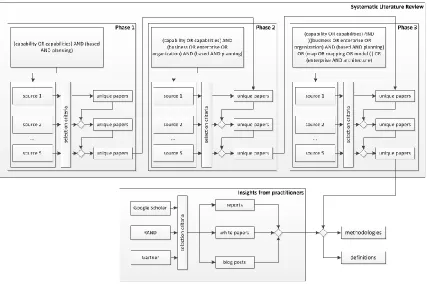
The systematic literature review consisted of three phases in order to assemble the paper collection, using three different search strings while searching in the scientific databases. Five electronic scientific databases were selected as appropriate to be used in the research: i) Scopus (http://www.scopus.com/home.url), ii) ACM Digital Library (http://dl.acm.org/), iii) Emerald (http://www.emeraldinsight.com/), vi) IEEE (http://ieeexplore.ieee.org/) and v) ScienceDirect (http://www.sciencedirect.com/). All three search strings were used consistently over the five databases, giving several tens of thousands of results; to give an idea, they are presented in Table 1 below.
Table 1: Number of returned search results
Database String 1 String 2 String 3
1 Scopus 7106 1547 12070
2 ACM Digital Library 12256 1853 363
3 Emerald 24504 22188 40106
4 IEEE 2833 25 1
5 ScienceDirect 4605 3127 7836
Total 51304 28740 60376
process for the other four databases, duplicate papers were exempted and newly found and unique ones were added to the list of papers to be considered. With every new search string entered into the databases more papers were discovered, but as expected, there was also significant overlap. Hence, the results from the each subsequent search string were treated in an accumulative manner in relation to prior results. Additionally, the reference lists of the mist relevant papers were scoured for papers not previously discovered during the database searches. To keep track of all the sources found and to facilitate the check for duplicates, a software tool called Mendeley3 was used.
On the other side, to look for non-academic literature an elaborate search using Google Search (https://www.google.nl/) and Google Scholar (http://scholar.google.nl/) was executed. A limited number of articles were provided by three BiZZdesign consultants and they were reviewed in this stage alongside the ones discovered through the research. Finally, the database of Gartner was searched for reports from EA consultants related to the topic. This entire process resulted in a large number of blog posts, magazine articles and white papers written by the EA practitioner community, as well as military and technical reports (e.g. from RAND Corporation).
When the search was concluded, the final compilation of papers, reports, posts and articles amounted to 90 items. Regarding the definitions encountered in them, many were citing and quoting the same source and were considered identical. All definitions and
methodologies/practices were considered and evaluated, but not all of them were adopted. A schematic overview of the entire process is depicted in Figure 2 below.
3
Figure 2: Literature review method
3.1
Defining Enterprise Architecture
Enterprise Architecture (EA) has become a necessity for organizations especially in the last two decades. As (Zachman 2001) points out, without EA an organization cannot achieve i) business and IT alignment, ii) alignment of data, messages and rules across the stakeholders, iii) change with minimum time, disruption and cost, and iv) production of custom, on demand
implementation with significantly reduced time-to-market. Organizations can use EA to move from what Len Fehskens of The Open Group called Level 1 of IT to Levels 2 and 3. In Level 1, where most IT departments are stuck today, the IT staff is engaged in a struggle to even make technology work. In Level 2 the IT department attempts to get the technology do the right thing for the business. And in Level 3 technology is adapted, so that the process of doing the right thing is optimized. Without an explicit description of how IT supports their business,
organizations are in high risk of being stuck in Level 1 (Woods 2011).
There is widespread attention on enterprise architecture and every enterprise has a definition of their own EA which is a bit different than the definitions of other enterprises. This happens mainly because an EA program that delivers business value is customized to the culture, strategic maturity and strategy of the enterprise (Lapkin et al. 2008). As a result, there are numerous definitions of EA in literature as well, varying on the level of explicitness and
analysis and documentation of an enterprise in its current and future states from an integrated strategy, business, and technology perspective”. The defining characteristic of EA is that it crosses internal organizational boundaries and provides coordinated views of the entire enterprise, acting as a single source of reference and thus efficiently supporting management planning and decision making (Bernard 2012; Bredemeyer et al. 2003).
In a Gartner report from 2008, EA is given a rather extensive definition as “the process of translating business vision and strategy into effective enterprise change by creating,
communicating and improving the key requirements, principles and models that describe the enterprise's future state and enable its evolution”. This definition is extended by stating that the EA scope is to include “the people, processes, information and technology of the enterprise, and their relationships to one another and to the external environment”. Furthermore, “[e]nterprise architects compose holistic solutions that address the business challenges of the enterprise and support the governance needed to implement them” (Lapkin et al. 2008). However, it is
explicitly stated that the above definition should be used as the basis for developing an enterprise-specific definition that will supply EA's value within that particular enterprise.
More organizations, foundations and legislative texts have offered their own definitions for architecture, enterprise architecture and IT architecture, like the Netherlands Architecture Forum (NAF), Capgemini, the Institute of Electrical and Electronics Engineers (IEEE) and the Clinger–Cohen Act. Exploring this area is a research in its own merit, therefore mentioning the ones above is deemed sufficient for this thesis. What is noteworthy though is that the variety in all these definitions seems to indicate that the field is still in its infancy. Moreover, it is obvious from the attention that it is receiving that enterprises do feel a profound need to steer the development of their business and IT portfolio with the contribution of EA (Op’t Land et al. 2009).
For the purposes of this research, the definitions of The Open Group for ‘enterprise’ and ‘architecture’ are adopted, as presented in The Open Group Architecture Framework (TOGAF) specification. The Open Group Architecture Framework (TOGAF) is The Open Group’s framework for enterprise architecture which provides a comprehensive approach for designing, planning, implementing, and governing an enterprise information architecture. It is developed and maintained by The Open Group Architecture Forum, which comprises of more than 200
enterprises and publishes successive versions at regular intervals. The first version of TOGAF was published in 1995 and the latest one is version 9.1, launched on 1 December 2011. According to the data from the web site of The Open Group, the 223 organizations that use TOGAF span across 29 market sectors such as academia, aerospace, IT and retail worldwide4.
As stated in the specification, enterprise is “[t]he highest level (typically) of description of an organization and typically covers all missions and functions. An enterprise will often span multiple organizations”. Furthermore, TOGAF embraces but does not strictly adhere to ISO/IEC
4
42010:2007 terminology about architecture (“[t]he fundamental organization of a system, embodied in its components, their relationships to each other and the environment, and the principles governing its design and evolution”). In TOGAF the definition of architecture has two meanings, depending upon its contextual usage. It may be specified as either a “formal
description of a system, or a detailed plan of the system at component level to guide its
implementation”, or as “the structure of components, their interrelationships, and the principles and guidelines governing their design and evolution over time” (The Open Group 2011).
Enterprise Architecture began as an IT discipline; initially as Technology Architecture, then as Enterprise-wide IT Architecture and finally it evolved to the present form which combines the latter with Business Architecture. Its scope has also evolved and broadened since then; from reducing IT complexity and costs, to increasing enterprise agility and enhancing IT alignment with business strategy. Similarly, while TOGAF has strong roots in Technology Architecture, in recent releases it has evolved out of IT and into a more strategic position between IT and the business, offering higher potential value. In other words, TOGAF is now a tool not just for architecture, but also a tool for aligning IT and business goals (Bredemeyer et al. 2003).
There are four interrelated architecture domains that are commonly accepted as subsets of an overall enterprise architecture, all of which TOGAF is designed to support (The Open Group 2011):
The Business Architecture defines the business strategy, governance, organization, and key business processes.
The Data Architecture describes the structure of an organization's logical and physical data assets and data management resources.
The Application Architecture provides a blueprint for the individual applications to be deployed, their interactions, and their relationships to the core business processes of the organization.
The Technology Architecture describes the logical software and hardware capabilities that are required to support the deployment of business, data, and application services. This includes IT infrastructure, middleware, networks, communications, processing, standards, etc.
The focus of this research will be on the first subset, the Business Architecture, whether we are talking about TOGAF or EA in general. The main reason behind this is that business capabilities are the top layer of the Business Architecture; they belong to the business domain and are governed by the business principles of the organization5.
For describing enterprise architectures in diagram form and representing them consistently, an enterprise architecture modeling language called ArchiMate which is managed by The Open Group (The Open Group 2013) and which is at the moment the leading Enterprise Architecture
5
description language. ArchiMate is a graphical description language for higher level
architectures in all architectural domains – the UML for Enterprise Architecture. It is meant as a common language that allows Enterprise Architects to develop one consistent picture of the present or future reality together with specialists from different fields. As an international standard, it is also explicitly meant to facilitate the evolution of Enterprise Architecture best practice across organizations. Apart from the representation of enterprise architectures over time, ArchiMate also supports the representation of their motivation and rationale, especially with the motivation extension and the implementation and migration extension (Iacob, Quartel, et al. 2012). ArchiMate is now an Open Group Standard and with its latest version being 2.0, it is fully aligned with TOGAF and follows the same definitions.
3.2
Background
In this section, we investigate how capability-based planning came to the forefront in defense planning, considering also the related origins of TOGAF and the ADM cycle, which are placed in the Technical Architecture Framework for Information Management (TAFIM) of the US
Department of Defense. We also look into The Technical Cooperation Program (TTCP) which is the starting point of all capability-based planning discussions. Finally, a mapping between the elements of the TTCP and the phases of the ADM cycle is made.
3.2.1 The origin of Capability-based planning
Over the past decade, Capability-based planning or capability-based planning has become something of a ‘gold standard’ in defense planning throughout the NATO alliance (De Spiegeleire 2011) and has been widely adopted by the Defense community led by Australia, Canada, the United States and the United Kingdom (Hales & Chouinard 2011). One of the earliest and clearest definitions of capability-based planning was provided by Paul K. Davis, an analyst at RAND’s National Defense Research Institute, who described it as “planning, under uncertainty, to provide capabilities suitable for a wide range of modern-day challenges and circumstances while working within an economic framework that necessitates choice” (Davis 2002). This term has been used to address the paradigm shift from ‘threat-based models’ to ‘capabilities-based models’, which occurred because of the increased uncertainty of future environments in which a country’s next opponent could not be easily predicted (Asiedu 2010). Additionally, military operations until then constituted of planning for large single conventional wars, which often left militaries ill-equipped to respond to smaller concurrent operations that might include operations other than war. In other words, the emphasis was placed on
“delivering capability packages as the core element in a more systemic defense-planning approach to address a wide range of threats to a nation’s security, rather than on delivering a capability to defeat a specific adversary”.
Programming, and Budgeting System (PPBS) implemented by Secretary of U.S. Defense McNamara in 1961. Its intention was to “facilitate analyses of capabilities by assembling
complements and substitutes into mutually exclusive, collectively exhaustive sets.” When those programs were introduced it was the first time in defence that groupings of resources were made by defined capability groups and by function rather than budget account.
The central components in capability-based planning in the defense sector are the Planning Scenarios (PSs) which describe a representative spectrum of possible needed operations. Challenges arise when there is a requirement for multiple scenarios to be met, especially in concurrent operations. In this case, the operations are executed sequentially with respect to the level of capabilities needed to meet the requirements.
[image:24.612.102.514.379.637.2]It is not surprising that capability-based planning in TOGAF originates from the defense sector where it had been incubating for some years. After all, TOGAF was originally based on the US DoD Technical Architecture Framework for Information Management (TAFIM). The US Defense Information Systems Agency (DISA) contributed extensively to the development of TOGAF and as a result they both share a very similar high-level reference model. The core of TOGAF, the Architecture Development Method (ADM) was originally based on parts of TAFIM (a side-by-side comparison is given in Figure 3 for reference purposes; ADM is covered in more detail later in section 3.2.2). TAFIM was officially canceled by the DoD in early 2000.
Figure 3: The DoD Standards-Based Architecture Planning Process in TAFIM (left) and The ADM cycle in TOGAF (right)
as the resource-based view of the firm (Grant 2008). The resource-based model of competitive advantage by Barney suggests that sources of sustained competitive advantage are firm resources that are valuable, rare, imperfectly imitable and non-substitutable, in a paper that is widely regarded as the first formalization of the then-fragmented resource-based literature into a comprehensive (and thus empirically testable) theoretical framework (Barney 1991). Although Barney and other proponents of the resource-based view generally tend to define firm
resources broadly, to include assets, knowledge, information, firm attributes, capabilities, and organizational processes, (Grant 1991) distinguishes between resources and capabilities and provides a classification of resources into tangible, intangible, and personnel-based resources (Bharadwaj 2000). Competitive advantage is gained by assembling, integrating, and deploying resources that work together in combination or in co-presence.
3.2.2 Influencing Methodologies and Frameworks
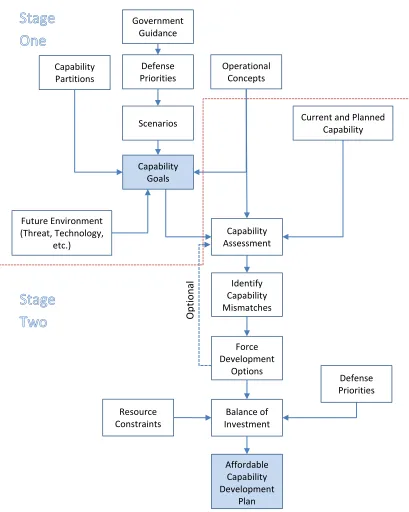
In the defense sector capability-based planning was the subject of The Technical Cooperation Program (TTCP), a program established by the United States, the United Kingdom, Canada, Australia, and New Zealand to foster technical collaboration between the defense communities of these countries (Walker 2005). TTCP adopted the definition by Paul K. Davis for capability-based planning and went further by outlining a generic planning process for it, which starts with overarching guidance, identifies capability gaps, explores options, and ends with an affordable investment plan (Figure 4).
Figure 4: TTCP Capability-based Planning process model (Walker 2005)
Looking into the process model closer, we see that the priorities are recognized and set early on, driven by an overarching guidance from the government. These priorities are placed within a context of a wide range of scenarios that represent future possibilities in regards to the environment and the technology projections. Thus, capabilities can be assessed in a way that addresses not only present situations, but also uncertainty about the future. TTCP grouped similar capabilities into what they called ‘capability partitions’ which makes the analysis more manageable and able to yield capability goals for each capability partition. These goals are then
Government Guidance Capability Partitions Scenarios Defense Priorities Capability Goals Operational Concepts
assessed considering operational concepts, current and already planned capabilities, and feedback from previous development efforts to identify areas where there is a mismatch or a gap between capabilities (as-is) and capability goals (to-be). This gap can highlight possible areas for investment or disinvestment if a capability is non-existent or underdeveloped or if a
capability is redundant or overdeveloped. This leads into the development of certain alternative options and by taking into account the limited economic framework and, once again, the defense priorities, an affordable and realistic plan for developing the desired capabilities can be devised.
The Architecture Development Method (ADM) cycle (shown in Figure 5 below) is the core of TOGAF and one of its main parts (the others being the Enterprise Continuum and the TOGAF Resource Base). It describes a method for developing an enterprise architecture and is the result of continuous contributions from a large number of architecture practitioners. The ADM cycle is thoroughly covered in Part II of the TOGAF 9.1 specification document (The Open Group 2011) and here an overview of the nine phases and of their objectives will be presented. As described in the specification document, architecture development is a “continuous, cyclical process, and in executing the ADM repeatedly over time, the architect gradually adds more and more content to the organization's Architecture Repository”. The ADM is iterative, over the whole process, between phases, and within phases. For each iteration of the ADM a fresh set of decisions must be taken (e.g. regarding the breadth of coverage and the level of detail).
First and foremost the ADM cycle begins with the Preliminary Phase for an organization that is about to do architecture work with TOGAF and tailor the framework to its needs. The
organization is preparing for the architecture initiative by identifying its scope and its architecture footprint on the organization, and by also identifying the sponsors and other stakeholders. This Preliminary Phase defines the Architecture Principles that will form part of the constraints on any architecture work undertaken in the enterprise and also defines alignment with other frameworks and methodologies.
Figure 5: The ADM Cycle of TOGAF
Continuing further with the phases of the ADM cycle, the objective of Phase F is the creation of an Implementation and Migration Plan in co-operation with the portfolio and project managers. The plan must be aligned with other management and governance frameworks in the
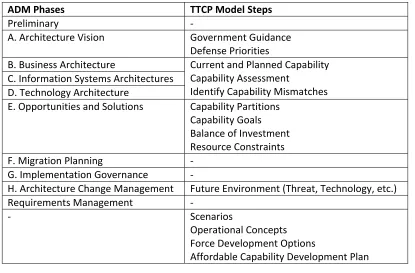
Placing the capability-based planning process model by TTCP and the ADM by The Open Group side by side we can observe some conceptual relationships. Most of the steps of the process model can be mapped onto phases of the ADM (shown in Table 2), although the cyclical and iterative nature of the ADM creates phases that are not translated into the linear TTCP model (i.e. the Implementation Governance and Requirements Management phases). The Preliminary Phase and the Migration Planning Phase of the ADM are not applicable to the process model and similarly the steps of Scenarios, Operational Concepts, Force Development Options and Affordable Capability Development Plan of the process model cannot me mapped to ADM phases.
Table 2: Mapping the steps of TTCP onto the phases of the ADM
ADM Phases TTCP Model Steps
Preliminary -
A. Architecture Vision Government Guidance Defense Priorities
B. Business Architecture Current and Planned Capability Capability Assessment
Identify Capability Mismatches C. Information Systems Architectures
D. Technology Architecture
E. Opportunities and Solutions Capability Partitions Capability Goals Balance of Investment Resource Constraints F. Migration Planning -
G. Implementation Governance -
H. Architecture Change Management Future Environment (Threat, Technology, etc.) Requirements Management -
- Scenarios
Operational Concepts Force Development Options
Affordable Capability Development Plan
3.3
Collected definitions
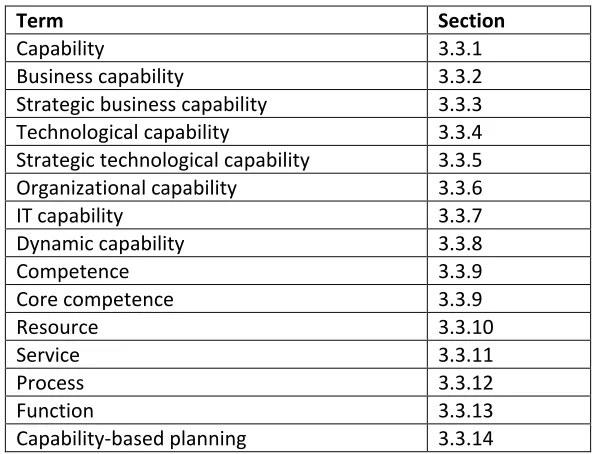
clear definitions for capability and the some of the most common specializations of capability and, on the other hand, provide clear definition for the associated terms and attempt to clarify their relationships with the capabilities. The terms in Table 3 were recognized as relevant from the literature.
Table 3: List of terms defined
Term Section
Capability 3.3.1
Business capability 3.3.2 Strategic business capability 3.3.3 Technological capability 3.3.4 Strategic technological capability 3.3.5 Organizational capability 3.3.6
IT capability 3.3.7
Dynamic capability 3.3.8
Competence 3.3.9
Core competence 3.3.9
Resource 3.3.10
Service 3.3.11
Process 3.3.12
Function 3.3.13
Capability-based planning 3.3.14
The goal is to collect those definitions that the author either agrees with or finds that they encapsulate key elements of the examined concepts and should be taken into account. This is necessary in order to construct a set of definitions as complete as possible and that best reflect their meaning within the EA context. Later in chapter 4, one of the main contributions of this thesis is introduced; an ontology domain model that will bring those definitions together and will help clarify the meaning of these ambiguous terms further, as well as the relationships between them.
3.3.1 Capability
When discussing capabilities, many different definitions come into light. It is not uncommon that this term is used interchangeably with others, such as business capability, technological/IT capability or organizational capability (e.g. in (Winter 2000)), but the intended meaning depends on the context in which the term is being used. This means that different authors use the same term for describing somewhat different things, which can be confusing. This section tries to clarify the concept of capabilities and highlight their meaning in the business context.
found. One of the most prominent ones is found in the “National Preparedness Guidelines” published by the US Department of Homeland Security in 2007, where capabilities are defined as providing the means to accomplish a mission or function and achieve desired outcomes by performing critical tasks, under specified conditions, to target levels of performance. In this document capabilities are characterised by their capacity (i.e. how many are needed) and their proficiency (i.e. how well must they be able to perform) (Department of Homeland Security 2007; Moore et al. 2010) and it is accompanied by the “Target Capabilities List” document published in the same year and which describes the core capabilities required to perform critical tasks. Attached to this concept is the work by (Cheng et al. 2011) and by (Tagarev 2009) who defines capability as “the capacity provided by a set of resources and abilities, to achieve a measurable result in performing a task under specified conditions and to specific performance standards”.
Similarly, from the practitioner world, Scott and Ulrich & Rosen define a capability as the fundamental element that provides an organization’s capacity to achieve a desired outcome (Scott 2009; Ulrich & Rosen 2011a). Scott states that the set of an organization’s capabilities can be regarded as its potential and that they represent the functional abilities needed to be
executed, in order for the organization to fulfill its mission. This perspective of capability as capacity originates again from the resource-based theory by (Grant 1991).
Taking a step back, and abstracting from the idea of a capability owned by an organization, the Merriam-Webster online dictionary generally defines a capability6 as:
1: the quality or state of being capable; also: ability
2: a feature or faculty capable of development: potentiality
3: the facility or potential for an indicated use or deployment <the capability of a metal to be fused> <nuclear capability>.
This threefold definition highlights the different aspects of capabilities, especially the first two; in other words possessing a capability means meeting the requirements that put their owner in a position of being able to perform something or obtain a characteristic, if the situation or the conditions ordain the owner to do so.
In TOGAF a capability is defined as “an ability that an organization, person or system possesses. Capabilities are typically expressed in general and high-level terms and typically require a combination of organization, people, processes, and technology to achieve. For example, marketing, customer contact, or outbound telemarketing” (The Open Group 2011). There are three important elements here: i) a capability can be owned not only by a person or an organization, but also by a system, ii) a capability is a high-level concept and iii) a capability is considered to be a composite object and not atomic; several components have to come together to yield a capability that has quality characteristics. Overall this definition comes very close to precisely describing what a capability is, although it would be more concrete if it
included the notion of potentiality. Therefore, the definition proposed here is slightly altered, to
6
include capacity and potentiality and to group together organization, people and processes under ‘assets’:
A capability is an ability, capacity or potential that an organization, person or system possesses. Capabilities are typically expressed in general and high-level terms and typically require a combination of organization and different assets (e.g. people, processes, and technology) to be achieved and thus realize their goal.
With this high-level definition, a capability can be considered as a super class of all other sub-types of capabilities, or a generalization to put it differently, with a hierarchical structure. Consequently, those specialization sub-types inherit the characteristics of a capability and the definition for each one of them builds on top of the definition of a capability. While in the TOGAF ® definition there is no explicit connection of a capability with a goal, it is included in this one so that it makes the definition a bit more precise. It is true that all types of capabilities aim to achieve a desired effect or a goal, which in turn is connected to some kind of value; otherwise there is no point in having that capability. This connection of capability to a goal is also inherited in its subtypes, which we are going to discuss next. It should be noted here that the
differentiating factor of each type of capability is the different goal each one serves. In the definition above the goal is intentionally not strictly specified, since capability itself is a high level concept. Later, for all the subtypes of capability, the goals are more precisely stated.
3.3.2 Business capability
If the idea of value creation and delivery within an organization is injected into the notion of capabilities, we are then talking about business capabilities (Wilkes 2011b; van Dijk 2012; Ulrich & Rosen 2011a; Rosen 2010; Greski 2009b). Furthermore, (van Dijk 2012; Rosen 2010) follow the same logic for business capabilities as (Tagarev 2009) for capabilities in the security sector, describing them as the means to define the organization’s capacity to successfully perform a unique business activity and that deliver measurable value.
A Gartner report from 2010 considers the following definitions of a business capability, all of which illustrate what a business does to deliver value (Burton et al. 2010):
“An ability of capacity for a company to deliver value, either to customers or shareholders.”7
“A capability models what a business function does - its externally visible behavior (versus how it does it, its internal behavior) - and the expected level of performance.”8
“The business capability is 'what' the organization does, the business processes are 'how' the organization executes its capabilities.”9
7
“Business Capability Modeling”, Leonard Greski, Architecture and Governance Magazine, 2009 (Volume 5, Issue 7)
8http://msdn.microsoft.com/en-us/library/aa479368.aspx 9
The authors of that report chose to adopt the definition by Balasubramanian, Kulatilaka and Storck from the Boston University School of Management, which states that “a business
capability is similar to the notion of a value discipline, which Treacy and Wiersema (1995) define as the way in which companies combine systems, processes, and their environment to deliver value to their customers”. The focus of this definition lies on the delivery of value to the customers, with “customer” being described in the broader sense to include both internal and external stakeholders of an organization.
A few years later, one of the authors came back to the definition of business capability and expanded it to put emphasis on the “what” character of capabilities: “Business capabilities are the ways in which enterprises combine resources, competences, information, processes and their environments to deliver consistent value to customers. They describe what the business does and what it will need to do differently in response to strategic challenges and opportunities” (Burton 2013). This definition reflects best the concept of the business capability, although the mention of ‘strategic challenges’ makes the definition more restrictive than it should, and hints towards the strategic business capability, which in this paper is considered a specialization of the business capability and explained in the next part (sub-chapter 3.3.3). Although a concrete definition of value is important, it is difficult to be found in the vast amount of related literature and attempting to extricate it is beyond the scope of this thesis. For the sake of completeness and comparison, some additional found definitions of business capability are presented next.
The plethora of definitions of business capabilities include the ones by (Freitag et al. 2011), (Wilkes 2011a), (Klinkmüller et al. 2010) and the one by (Homann 2006) who posits that a business capability is “a particular ability or capacity that a business may possess or exchange to achieve a specific purpose or outcome. A capability describes what the business does (outcomes and service levels) that creates value for customers; for example, pay employee or ship product”.
Alike capabilities, business capabilities as a specialization sub-type are also non-atomic; according to (Pandza et al. 2003) individual skills, implicit forms of knowledge and social
relations that are embedded in a firm's routines, managerial processes, forms of communication and culture, when collaboratively combined, can offer a capability. Pandza et al. (2003) follow the real options valuation approach (ROV) to managing resources and capabilities and mention that capability development is somewhat aligned with the application of the real options heuristic to strategy, through which a firm's resources, capabilities and knowledge create options for future exploitation (Brits et al. 2006). Compared to Burton’s (2013) definition, parallels are found regarding the combination of different assets for making decisions under uncertainty, but the value offering angle is missing.
Another similar definition comes from Bredemeyer Consulting10: business capabilities are “a combination of business processes, people (organization, knowledge and skills, culture), technology solutions, and assets (facilities, funds, etc.) aligned by strategic performance
objectives” (Bredemeyer et al. 2003). Additionally, in this definition the business capabilities are
10
considered the building blocks of the enterprise and they have relationships to each other and to the environment. They mention that these three elements along with performance
management are the quality characteristics that are “important in driving the capability design process”. Something that differentiates this definition from the one by Burton (2013) is the explicit mention of the external and internal relationships of the capabilities; they are not independent and autonomous. Burton mentions that business capabilities are related to the business’ external environment, but not to each other. On the other hand, Jeff Scott of Forrester Research has a different opinion, that business capabilities are unique and independent from each other. Bridging the two, we could say that they represent discrete ways to generate measurable value, but at the same time they are hierarchically connected to each other (Greski 2009b) and are governed by a stimulus-response relationship with the organization’s
environment. This aspect of the business capabilities could be added to the Burton’s definition (2013) to make it more descriptive.
Concluding, a good definition for the business capability can be the following:
Business capabilities are the ways in which enterprises combine resources, competences, information, processes and their environments to deliver consistent value to customers. They describe what the business does and what it will need to do differently in response to strategic challenges and opportunities. They can be synthesized by or connected to other capabilities, business or otherwise.
The first two parts are taken from Burton’s definition and the last part aims to explicitly include the internal or external relationships that they can have, a point made in (Bredemeyer et al. 2003)
3.3.3 Strategic business capability
Business capabilities can be divided into two sub-types; on one hand, the basic business
capabilities owned by an organization enable it to perform activities and run its business and on the other hand, the strategic business capabilities that offer a competitive advantage to the organization and have a bilateral relationship to its business strategy. As (Teece & Pisano 1994) indicate, one way to make the distinction is to first identify what isn’t strategic; for a capability to be strategic, they remark, it must be “honed” to a user need, unique and difficult to replicate. Likewise, according to the conceptual framework for modeling business capabilities by (Brits et al. 2006) two of the distinctive characteristics of strategic business capabilities are that they are better than those owned by the organization’s competitors and that they are difficult to imitate or replicate. In other words, all organizations possess some basic capabilities in order to
function, but strategic business capabilities are above and beyond them. The authors also list a third one; that it should be of value to the customer, which overlaps with the definition of business capabilities in general, as described previously.