IN
PERFORMANCE APPRAISALS
A TWO SAMPLE STUDY
A thesis submitted in partial fulfilment of the requirement for the degree of Master of Arts in Psychology
at the University of Canterbury New Zealand
John N Erceg
i i
Abstract
The purpose of this study was to determine what is perceived as fair in performance appraisals by two samples of workers ; those in charge of personnel (superiors) and those without such responsibilities (subordinates).
87 Government Department employees from different departments responded to an open ended questionnaire in which they described the determinants of particularly fair or unfair performance appraisals . By Q - sort analysis , the responses were categorised into 15 distinct determinants of fairness in performance evaluations from which an importance weighting questionaire was constructed . Another 280 subjects from government departments completed the questionaire : 109 superiors and 171 subordinates . Ratings of the perceived importance of each determinant were factor analysed for the entire sample , yielding 5 factors : 'thoroughness of appraisal for each individual' , 'contact with appraiser
I
appraiser feedback' , 'consequences of appraisal due to input', 'qualification of assesser' , and 'sources of bias' .One factor 'Contact with the appraisor
I
appraisal feedback' found a significant difference between the two samples . The other four factors were perceived and rated the same over both samples . Also the recognition of both procedural and distributive factors was achieved by both superiors and subordinates .Acknowledgements
First and foremost I would like to thank my supervisor, Dr. M. S. Singer, for her guidance and encouragement throughout this exercise .
I also wish to thank all those Government employees who did make an effort to assist in my plight for data , and to those departmental officials who took time out to listen , talk and help my cause . In particular I acknowledge Allan Thomas (Works and Development Services Corporation (N.Z.) Ltd .) , Dick Sumicz (Department of Social Welfare) , Bob Wyn - Williams (Department of Scientific and Industrial Research) , and Keith Milligan (Ministry of Agriculture and Fisheries) .
Thanks also go to my Q - sorters and my immeasurable gratitude goes to Gill Finaghan for her expertise and tutoring in implementing SPSSx .
Table of Contents
CHAPTER ONE ... Introduction
CHAPTER TWO ... Literature Review Organisational Justice Theories Performance Appraisal Theories Conclusion
CHAPTER THREE ... Rationale Hypothesis
CHAPTER FOUR ... Method
Phase One : Response Generation Phase Two : Importance Rating CHAPTER FIVE ... Results
CHAPTER SIX ... Discussion Limitations
List of Tables
Table
1 ) Government Departments used in the sample. 33
2 ) Distribution of age for both samples and the numbers in each samples . 38 3 ) Factor loadings , mean importance ratings and T - values
for the total sample . 41
4) Mean importance ratings for the 15 determinants of perceived fairness. 42 5 ) Mean importance ratings and T - values for factors 1 - 5
for the two samples . 44
6 ) Procedural and distributive factors and their mean importance rating
Vi
List of Figures
Figure
1 ) Taxonomy of organisation of justice theories with corresponding
predominant exemplars . 6
Introduction
Few topics in the industrial and personnel resource management field have
been written about as much as that of performance appraisal. For decades now
researchers have been striving to develop an appraisal instrument that
accurately and effectively evaluates the performance of the worker . For
almost as long there has been reports of the 'standard' evaluation format
failing to achieve its aims . As far back as 1957 Mc Gregor pointed out that
methods and results weren't effective . Since then there has been a plethora of
articles and studies, and every now and again one will take time out to bring
attention to the fallacy of attempting to devise a single closed system to serve
all needs (Kelly, 1958; Kindall and Gatza, 1963; Meyer, Kay, and French, Jnr,
1965; Thompson and Dalton, 1970) . Included in amongst this accumulation
of documentation is the recommendation of Management by Objectives
(MBO) as the answer to appraisal woes , as well as the demise of such a
recommendation. Yet even today one can leaf through the latest management
magazines and find articles titled "Job Evaluation - the new methodology " ,
"Appraising Your Appraisal System 11
, and even "Making M.B.O. Work 11
(Management, Sept, 1987
I
37; Feb . 1988I
25 and 71 .) These articles merelyreiterate early findings and the numerous reminders of pitfalls and failings ,
underlining the fact that even with 30 years plus experience , performance
appraisal is still not being implemented the way people should know it should
be . Reasons for this stress the lack of the human relation element . Good
2
think through the human consequences of the procedures they set in motion .
Performance appraisals can have negative as well as positive motivational
consequences in the context of a complex social system and it is exactly this
that management so often overlooks , or more realistically , fails to
unde-rstand . For almost as long there has been reports of the 'standard' evaluation
format failing to achieve its aims .
In addition to this literature , there has been an approach which
de-emph-asises technique and instead , places emphasis on the organisational justice
approach . Originating from the legal field ; organisational justice has been
found to be well suited to the organisational work world and to performance
appraisal.
Because too many years of discontent have already passed, a remedy is long
overdue . The problem though has not been in finding an answer to years of
inaccurate and damaging appraisals , but rather in pursuading those who use
performance evaluations to do so properly . The main dilemma has come
down to using a closed , pre - designed package where answers are placed
inside limited spaces , versus an ad hoc approach between the person best
qualified to appraise and the appraisee , using a piece of blank paper and a
good rapport. The latter approach requires more effort, possibiy more time,
and the ability to communicate . It is an approach which people avoid when
there is an easier way , which is assumed to be as effective , and which has
supposedly fulfilled all the necessary requirements for such a long time .
One of the possible reasons why the organisational justice approach hasn't
been adopted is that there is a lack of scientific research . To this end alone it is
important that research increase in this field and hopefully the result will be a
Perceived fairness in performance appraisals has been studied before and there . are findings which support the organisational justice literature . But there are still limitations to most of these studies , therefore this study looks toward providing some of the explanations .
Chapter Two reviews the literature that exists on organisational justice and performance appraisal , and the final section concludes with a tie between the two sections of literature .
Chapter Three discusses a rationale for the study. The fallacy that a closed ap-praisal system conducted every now and again as a satisfactory evaluation procedure is exposed as well as a need for further study investigating determ-inants of fairness in performance appraisals .
Chapter Four describes the method used in this study .
Chapter Five presents the results .
Chapter Six discusses what has been found with respect to the number and types of determinants , and the two generations . Limitations of the study are listed along with recommendations for further research .
4
CHAPTER TWO
Literature Review
Organisational Justice Theories
How does a person come to perceive a process as being fair ?
For a number of years now research has explored the manner in which people react to decisions involving resource allocation , and it appears that recipient's responses to allocation decisions are directly affected by their evaluations of the fairness of the resulting distributions (Crosby (1976) ; Walster / Walster + Berscheid (1978)).
Traditional views of justice such as these, are discussed by the "equity theory" (Adams , 1965) . This perspective known as the "distributive justice" pers-pective , focuses on the fairness of the evaluations received relative to the work performed . vVorkers may in fact assess the fairness of their appraisals by comparing the relative ratings in return for the work they contributed.
procedures used to determine the ratings . For example , organisational questionnaire studies have found that the fairness of performance evaluations is related to several process variables (eg, the opportunity to express feelings when evaluated) regardless of the rating outcomes (Landy, Barnes +Murphy, 1978 ; Landy , Barnes-Farrell + Cleveland , 1980 ) . The distinction between distributive justice and procedural justice focuses on the differences between the ends or consequences of organisational outcome states and the means or processes used to determine those outcomes (Walker, Lind+ Thibaut 1979) .
So , the most basic research question bearing on the current topic is ; "what makes a performance evaluation appear to be fair? Is it what you get, or how you get it , or both , that makes them seem fair?"
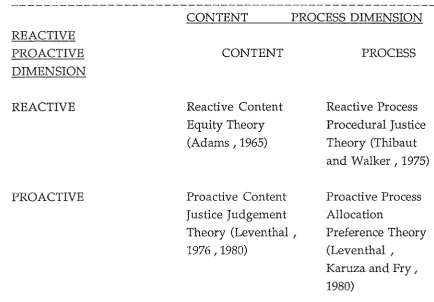
A comprehensive classification of the laws and principles of organisational justice theories is given by Greenberg (1987) , where he presents categorised theories of organisational justice with respect to two independent dimensions; a reactive - proactive dimension , and a process - content dimension . These conceptually presumably independent dimensions , although not the only organising dimensions to be identified , appear as useful for organising a wide range of conceptualisations of interest in the field of organisational behaviour. \\Then the two dimensions are combined , four distinct classes of justice theories are identified :
reactive-content.. ... reactive-process proactive-con tent ... proactive-process
Figure one REACTIVE PROACTIVE DIMENSION REACTIVE PROACTIVE
CONTENT PROCESS DIMENSION
CONTENT
Reactive Content Equity Theory (Adams, 1965)
Proactive Content Justice Judgement Theory (Leventhal ,
1976 I 1980)
PROCESS
Reactive Process Procedural Justice Theory (Thibaut and Walker , 1975)
Proactive Process Allocation
Preference Theory (Leventhal , Karuza and Fry , 1980)
6
Reference : Greenberg ,
J .
(1987) A Taxonomy of Organisational JusticeTheories .
Academy of Management Review , 12 , 9 - 22
Reactive - Content Theories
Reactive - content theories are the approaches that focus on how individuals
react to unfair treatment . The most popular conceptualisations of justice in
organisations falls within this category , and included among these are the
theories of "distributive justice" (Homan 1961) and the "equity theory"
(Adams , 1965 i Walster , Berscheid + Walster , 1973i Walster , Walster +
Berscheid , 1978) . The main premise of equity theory is that people will
res-pond to unfair relationships by displaying certain negative emotions , which
[image:12.595.75.510.100.402.2]inequity . Such an approach to organisational justice conceptualised
"equitable" or "distributively just" relations where there was an equal balance
between inputs (Adams , 1965) or investments (Homan 1961) , and what the
person receives , termed outputs. Unequal balances were assumed to be
un-pleasant and were theorised to prompt changes in job satisfaction and/ or
performance. Equity theory proposes that these negative states were expected
to motivate behavioural and/ or attitudinal changes in an attempt by a person
to reduce the inequity (Adams, 1965) .It was because the equity theory was so
suited to work related exchanges that it came to be applied to organisational
research . And it was within simulated work settings that most research on
equity theory was conducted (Lawler + O'Gara, 1967; Pritchard, Dunette +
Jorgenson , 1972) . Characteristically , these experiments involved the
manip-ulation of inequity by way of fair /unfair pay - qualification comparison
(Adams + Rosenham , 1962 ; Garland , 1973) . Theories have developed in
response to Adams's work , in particular , the status value version of equity
theory . This is when a person's feeling of inequity results from comparisons
to a generalised other (a referential comparison) such as an occupational group
(Anderson , Berger , Zelditch + Cohen , 1969 ; Berger , Zelditch , Anderson +
Cohen, 1972).
Taking this approach further , the distributive justice theory defined justice in
terms of the comparisons made by people between their actual share of goods
and their ideas about a "just share" . This theory doesn't make use of an
outside comparison for its justice evaluations (Jasso , 1980).
The final reactive content theory is the theory of "relative deprivation" which
examines how people will respond to perceived unfair reward distributions '
(Crosby , 1976) . Its basic premise is that certain reward distribution patterns
8
feelings of deprivation and resentment causing a variety of reactions . These reactions range from depression through to the outbreak of violent riots (Martin , 1981) . Although most research on this theory has focused on violent attempts to change political systems (Crosby , 1976) , there has been some work done on how aggrieved employees react to organisationally-induced dis-content (Martin, 1981) . One survey study found that working women in high level jobs, who should see themselves as more advantaged than unemployed women , tend to be more aggrieved when they compare themselves to working men, who are relatively more advantaged (Crosby, 1982; 1984).
Proactive Q Content Theories
In contrast to these theories on how people respond to perceived unfair reward distributions , 11
Proactive - Contene1
A more moralistic approach is the "justice motive" theory (Lerner , 1977 ; Lerner + Whitehead , 1980) . This predicts that an individual reacting to a close friend as an individual will emphasise that person's needs when making an allocation decision . Likewise , in more distant relationships , people are expected to follow the party norm when the other is recognised as an individual , and the equity norm when reacting to the other as a role incumbent . Therefore both these theories (justice judgement and justice motive) predict how people will allocate rewards under various conditions .
Reactive - Process Theories
Reactive process theories stem from the intellectual tradition of the law . Thibaut + Walker (1975) under took an investigation to compare reactions to various dispute resolution procedures . Their resulting "procedural justice" theory is the most dominant reactive - process theory from which much research has originated . It distinguishes between three parties : Two dis-putants (litigating parties) and an interviewing third party (judge) . There are two stages to the dispute resolution : the process stage when evidence is presented , and the decision stage , when evidence is used to resolve the dispute.
1 0
participatory and non-participatory , will be more satisfied with procedures that give them process control , such as the adversary system (Houlden , La Tour , Walker + Thibaut , 1978 ; Leung + Ling , 1986 ;Musante , Gilbert + Thibaut , 1983) . Also , verdicts resulting from procedures of process control are perceived as fairer and are therefore preferred (Walker , Lind + Thibaut , 1979 ; Lind , Kurtz , Musante , Walker + Thibaut , 1980) . Even procedures giving disputants a voice in the decision-making process tends to make an unfavourable decision more acceptable (La Tour, 1978; Lind et al., 1980) .
Research has generalised Thibaut and Walker's findings to less formal settings, some to a variety of organisational contexts . Sheppard (1984) applied the findings to the resolution of labour disputes, Greenberg (1986 a+b) applied them to the appraisal of job performance , and Tyler and Caine (1981) found reactions to decisions and encounters with politicians were very much influenced by procedure.
Proactive - Process Theory
Allocation preference theory says allocation procedures are preferred because they help the allocator attain valued goals such as the attainment of justice.The individual forms cognitive maps which shape the individual's perceptions of a particular procedure / distribution or outcome . Variables which are found to have an effect on moderating an individual's judgement are procedures that are stable over time as they reduce distrust and increase personal security (Leventhal et al / 1980) . Eight procedures are identified that may help promote the attainment of justice:
- selection of decision making agent - consistency rule
- accuracy of information
- identification o.f the structure of the decision making power - safeguards against bias
- allowing for appeals to be heard
- provision for opportunities for changes to be made in the procedure - prevailing moral and ethical standards
These procedures are supported by research resulting from allocation preference theory.
12
Role playing investigations found that consistency was believed to be the most important procedural determinant of fairness across a variety of allocation settings (Greenberg, 1987) .
In a more extensive study it was confirmed that consistency was a powerful determinant of perceived fairness within interpersonal relationships (Barret , Howard+ Tyler, 1986).
Therefore the Allocation Preference Theory , because of its moderating var-iables / effectively joins the Proactive theories in a common purpose since the Justice Judgement Model also strives to maintain social harmony.
From this taxonomy of Greenberg one can evidence that much of the research
.
has been guided by Equity Theory . However the literature now shows that this theory is no longer satisfactory and i:i-ajor problems now appear when it is applied (Leventhal, 1980) .These problems are that :
1 ) Equity Theory adopts only a unidimensional concept of fairness , seeing things in terms of merit .
2 ) Equity Theory considers only the final distribution of reward and not the procedures generating distribution .
3) Equity Theory exaggerates the importance of fairness in social
relationships whereas concern for justice is only one motivator and often the weaker.
Distribution Ru1es
A distribution rule is defined as an individual's belief that all is fair and
appropriate when rewards , punishments , or resources are distributed in
acc-ordance with certain criteria . Hence the individual's basic criteria for
evaluating fairness may change with circumstance . Leventhal (1980) assumes
a four stage justice judgement sequence by which one evaluates rewards and
punishments :
-Weighting ... where one decides which distribution rules are applicable
and their importance .
-Preliminary estimation ... of the amount and type of outcomes that
receivers deserve based on each applicable rule .
-Rule combination ... one combines several estimates to arrive at a final
judgement of the receiver's deservedness .
-Outcome evaluation .. .is the assessment of the receiver's outcomes .
Urtforturtately little is ktlO\AJ'n about tfte situatior .. s ir .. v\rfticl1 tl1ese rules are
applied and the degree of importance given to each.
Procedural Ru1es
The second category of justice rules is the concept of procedural fairness which
is an individual's perception of the fairness of procedural components that
14
of events that precede the distribution of reward and the evaluation of these events . The internal representations of the social environment contain ele-ments that correspond to important features of the allocation process . A
person may evaluate the fairness of any of these structural elements based on rules of fair procedure.
Six procedural justice rules are postulated that define criteria which allocation procedures must satisfy to be perceived as fair . The analysis assumes that an individual applies procedural rules selectively and follows different rules at different times . In a given situation one procedural rule may be considered more relevant than others , therefore judgement of procedural fairness will be dominated by that rule.
The six justice rules presumed to govern the evaluation of procedural fairness are as follows :
-The Consistency Rule ... allocation procedures should be consistent across persons and over time
-The Bias Suppression Rule ... personal self interest and blind allegiance to narrow preconceptions should be avoided in the allocation process
-The Accuracy Rule ... allocation process should be based on good information and informed opinion
-The Representativeness Rule ... all phases of the allocation process must
reflect the basic concerns , values and outlook of the group affected by
the allocation process
-The Ethicality Rule ... allocation procedures must be compatible with
moral and ethical values
A point that must be emphasised is that in the absence of research on the
determinants of rule weight , only general statements can be made about the
relative importance of different rules in different situations.
Based on this literature , one can assume that the proactive dimension
approach to organisational justice is the most encompassing . The Proactive
-Process dimension encompasses the Allocation Preference Theory which
emphasises the interaction and inclusion of the individual's psychological
processes / and the social structure of the organisation . The perception of
fairness is governed by two types of justice rules : distribution rules and
procedural rules . These rules come under the Justice Judgement Model which
according to Greenberg's taxonomy, comes under the guise of the Proactive
-Content Theory . Theories such as the Equity Theory are no longer viable
because of their serious limitations . Instead , a larger framework must be
incorporated which takes into account the problems that other theories don't
consider, as well as those that they do. The Allocation Preference Theory with
1 6
Performance Appraisal Theories
The Early Years
On A Wayward Direction
In 1957 , McGregor wrote a landmark article which was essentially a send up of approaches to performance appraisals to that date . His view of managers "playing God" by having to take the responsibility of being judge and jury towards their workers , was the crux of his argument as to why appraisals weren't achieving widespread acceptance . People had become disillusioned about the purposes which had led to a confusion in methodology and manner in which appraisals had been formulated . The result was a combined mess of past practices . What the work world had to develop was an appreciation of a reversal of traditional work roles . Instead of staff work being seen as merely a supporting activity of the line , the line activities should be viewed to be in support of a total marketing effort heavily centred around staff activities . Historically, such problems could be seen to be linked to a Puritan heritage of salvation through physical work , and the deeply entrenched idea of being seen to be busy . This may in turn have influenced standards of managerial behaviour and expectations such as action for actions sake . Suggested remedies were that appraisees weren't in control of all the factors on which the appraisal was based , but that the management was responsible as well . Therefore successful coaching therefore isn't entirely technique but involves an appreciation of relationships (~vfc Gregor , 1957) . This train of thought suggested that an appreciation of organisational justice was essential for accurate job evaluation .
Critiques
18
appraisal systems were failing to meet objectives and were doing real damage ,
were omni - present . Appraisal systems were failing and the reason was that
judgement was based on personality traits, which amounted to quackery since
psychologists couldn't even agree on how personalities are defined (Kindall +
Gatza, 1963) .
Failure to avoid negative appraisals was one major fault . Criticism only
brings on defensive reactions which are essentially denials of responsibility for
a poor performance (Meyer, Kay,+, French, 1965) . One suggestion for more
accurate appraisal and less negative reports was the placing of review
responsibilites in the hands of the subordinate . This results in greater
satis-faction , less defensiveness and less unwarranted criticism (Bassett + Meyer ,
1968).
Additional sources of appraisal inaccuracies were that personal values and bias
were replacing organisational standards, ratings were not known because of a
lack of communication , and of appraisal techniques tended to be used as
performance appraisal panaceas when no appraisal program could substitute
for selection or placement programs . Also validity was reduced by supervisory
resistance to making ratings . Rather than face the discomfort of informing an
employee of negative ratings , supervisors would give average to above
average ratings to inferior performers . And performance interviews tended to
emphasise the superior position of the supervisor thus interfering with the
more constructive coaching relationship that should exist between a superior
and his /her subordinates (Oberg, 1972) .
From the writings about the effectiveness of methods and techniques of
performance appraisals , there emerges two categories of techniques :
quanti-tative methods in an attempt to remedy consistency problems such as rater inflation and the halo effect (Glickman , 19~5 ; Hollander , 1956 ; Duffy + Webber , 1974 ; Taylor + Wilsted , 1974) . The traditional technique puts for-ward the argument that the traditional rating systems are effective and free from difficulties when used with reasonable judgement (Mayfield , 1960 ; Oberg, 1972; Stone, 1973) .
While this may be so , there is another group who believes that the tradi-tional approach ignores the issue of what performance appraisal does to people . This school recommend a collaborative approach to performance appraisal where the human development of the employee is the major concern . They argue for increased communication , focused on joint goal set-ting and feedback (McGregor, 1957 ;Kelly, 1958; Levinson, 1962; Kendal + Gatza , 1963 ;Thompson + Dalton , 1970 ; Conant , 1973 ; Odiorne , 1974 ; Zawacki, 1974).
A limited number of field experiments has given impetus to the collab-orative approach (Kay, Meyer,+ French, 1965; Cummings, 1973;
Ivancevich , 1974) .
conclusions of either the traditional or collaborative approaches (Zawacki + Taylor, 1976) .
20
widespread treatment of the evaluation interview as a chore . But managers
persevere despite knowing all of this , because they think the existence of an
appraisal, any type of appraisal, must be of some'benefit (Patz, 1975) .
Beginings of the Organisational Justice Approach
By the end of the ' 50s not all researchers had pursued the performance
appraisal study in this direction . Literature took up the task of investigating
what it was that people were doing while appraising and not necessarily
what type of appraisal was being used (Meyer+ Walker, 1961) .These works
de - emphasised the appraisal instrument . Job evaluations , to be effective ,
had to be ad hoc . Different approaches must be used to satisfy different
objectives (Meyer, 1977) .
In contrast to this , what had been happening was that management
recog-nised the value and need for an appraisal system and so adopted the
tech-nique which most impressed them . This tended to mean minimal cost and
effort in its implementation . But for a successful appraisal , some amount of
effort is essential, and the literature directs an approach towards the defining
of appraisai objectives and the training of appraisers , and the deemphasising
of instruments per se (Locher +Teel, 1977) .
Research exploring relation_ships and reactions between subordinates and
superiors , and how they affect job evaluations , dates back quite a way
(Morton , Rothaus + Hanson , 1961 ; Rathaus , Hanson + Oglesby , 1962 ;
Hanson , Morton + Rothaus , 1963) .These references incorporate a series of
and subordinates emerging from two distinct methods of performance
appraisal:
and
1 ) the "traditional traits approach" ... where the supervisor assumes
responsibility of making judgements about assets , liabilities and
personality traits of subordinates and decides on any change .
2) the "goals approach" ... where both superior and subordinate share
the responsibility for creating performance goals and planning
concrete actions for goal accomplishment .
These studies through role playing techniques demonstrated that under a
traits approach superiors tended to be more negative in rating a
subord-inate's performance than the subordsubord-inate's rating of themselves . When
discussion of the superiors ensued , subordinates sensed the superiors critical
attitude and reacted with feelings of dissatisfaction and conflict .
Taking this further , an investigation of rating attitudes of superiors and
subordinates , and their reactions during public and private performance
evaluation was carried out using traits rating interviews . The results clearly
indicated that superiors were more negative in their initial subordinate
appraisal ratings than the subordinates . vVhat was concluded was that the
disparity in ratings by superior and subordinate participants is not due to
their expectation of interview interaction . Rather role assignment as
superior and subordinate seems to imply and usher in stereotyped and
conflicting rating attitudes (Rothaus , Morton +Hanson, 1965) .
For the subordinates there were differences in their reactions in public
compared to private appraisal interviews . Publicly subordinates reported
confidence of the person being evaluated . This was also viewed by Locke in
his theory of goal setting and motivation (Locke, Cartiledge +Knerr, 1970) .
Lawler (1967) showed that the ultimate value of performance information
doesn't depend solely on the physical characteristics of the evaluation
instrument but may also be affected by the evaluation process or system.
Landy , Barnes and Murphy (1978) examined the perceptions of fairness in
the light of process variables and suggested that the perceived fairness and
accuracy of the performance evaluation was related to the frequency of
evaluation , identification of goals , the supervisor's knowledge of the
per-formance , and the job duties of the subordinate . Perceived fairness was
thought to be an important mediator of the effectiveness of performance
feedback as well as a possible source of job satisfaction , in and of itself .
A follow up study to this examined whether perceptions of fairness were
affected by the level of previous performance rating . The highly rated
described the evaluation process as fair and accurate , and vice versa .
Indi-cations were that perceptions of fairness and accuracy were not related to the
previous performance rating of the respondents, thus adding strength to the
the level of performance that yielded satisfaction in the past was not
necessarily that which produced it in the future (Locke et al , 1970) . Here it
was found that the subjects anticipation of satisfaction ( rather than going on
past experience) that best described subsequent goal setting.
Perceived favourability of the appraisal is an important correlate with
opinions directed at the appraisal outcome as well as the total system . There
24 important as the perceived favourability . Most of the perceived process attributes are related to employee opinions after the perceived favourability of the appraisal is controlled . This suggests that the halo isn't a sufficient explanation for the positive correlation found in research (Dipboye + de Pontbraid , 1981) .
Theoretical conceptualisations of procedural justice that have postulated the importance of various determinants of fair procedure have received empirical support . Ability to challenge or rebutt evaluations and consistent application of standards tie in with appeal procedures and consistency of allocation practices as determinants of fair procedures for the distribution of resources (Leventhal, Karuza +Fry, 1980) .
Likewise , the concern for process control (the opportunity to influence the information that will be used to make decisions ) postulated by Thibaut and Walker (1975) is supported by Greenberg's (1986) soliciting input factor and two way communication factor .
that the closed format of the questionnaire didn't allow subjects to identify any aspects of the appraisal process .
Figure two
Determinant
Procedural factors
Soliciting input prior to evaluating and using it
Two-way communication during interview
Ability to challenge/rebut evaluation
Rater familiarity with ratee's work
Consistent application of standards
Distributive factors
Receipt of rating based on performance achieved
T.> Ar<"'""'""' 01" rl"' 1-; "ll +,..,. .... c "'1.,, "l"U I ..l."\.\:..\..V.1..1.l.L.LL\,....LL\.A,U.L..1.V.L .l.\...1.1. \ ... H..~.LU...1. JI
promtion based on rating
N.B. N=75
Factor loading
1 2
.46 .09 .67 .10 .66 .15 .59 .18 .55 .20
.25 .70
.15 .61
Importance rating
M SD
6.1 1.2 5.8 1.5 4.9 2.0 5.1 1.6 6.9 1.5
7.1 0.9 7.2 1.3
Reference : Greenberg ,
J .
(1986) Determinants of Perceived Fairness of Performance Evaluations .Journal of Management Review ,
71 , 340 - 342 .26 managers as subjects and came up with results which provide support for concepts of procedural justice that purport the importance of determinants of fair procedure . Figure two lists the 7 factors found by Greenberg together with factor loadings and mean importance ratings of determinants of fair performance appraisals .
The results showed the two main factors of procedural and distributive determinants , and that distributive factors were rated as being as important as procedural factors as determinants of fairness .
Conclusion
From this review it can be seen that performance evaluation is considered to be an essential part of the work place procedure, with 30 years of literature substantiating it . Just as essential is a complete appreciation of organi-sational justice . Appraisal formats , when approached solely as instruments , cannot do the job of evaluation because it is impossible for a rigid procedure to evaluate humans in the work force . Each person is an individual , and every position filled has its own characteristics . The evaluation system must be abie to take aU these facets into consideration . The performance appraisal literature is rife with articles on how a set appraisal technique has failed yet again , and almost just as often , there is an accompanying section de - emphasising 'technique ' .
incorporates all of these questions and places emphasis on human relation-ships between subordinates and superiors .
Studies of such relationships have not been conducted recently and are not numerous , hence the lack of supportive literature for the allocation prefer-ence theory .
28
CHAPTER THREE
Rationale
When reading performance appraisal literature , the majority of it that
appears in personnel journals has a familiar ring about it . There are claims
that job evaluations have an impact on virtually every aspect of human
resource function , questions such as "how well is your company's
performance system working ?" , summaries such as "sounds great but in
actual fact doesn't work" , through to the reality that performance reviews
are really a burden for most managers and employees which, at the end of
the day , are for the most part avoided and/ or regarded as an unpleasant and
ineffective necessity .
When McGregor (1957) was taking an uneasy look at performance appraisal,
he pointed out then that over the past twenty years evaluation procedures
had become standard practice in many companies and yet from what he had
studied he could see the method and results going askew. ~v1cGregor writes
about an approach from the point of view of basic social values , of
subordinate participation and of the one unavoidable cost: that the manager
must spend considerably more time implementing the appraisal
progra-mme, all in an attempt to make the appraisal a rewarding exercise for all
involved .
Organisational Justice theories , specifically the allocation preference theory ,
procedures people will use to achieve justice . The limited research inspired
by allocation preference theory offers general support for this approach .
Adams (1965) and the distributive justice perspective focuses on the fairness
of the evaluations received relative to the work performed . Landy Barnes
and Murphy (1978) and Landy Barnes - Farrell and Cleveland (1980)
experi-mented with the procedural justice perspective with focus on the fairness of
the evaluation procedures used to determine ratings . They found that the
fairness of performance evaluations was related to several variables
regard-less of rating outcomes . They used a sample of workers which excluded any
management personnel and they used a closed format questionnaire which
left subjects unable to say which aspects of the process affected their
per-ception of its fairness .
This method of a closed questionnaire format attracted criticism from
Greenberg (1986) when he studied a sample of middle management workers
who responded to an open ended questionnaire in which they described
determinants of fairness in their performance appraisal . Greenberg claimed
that the Landy et al . (1978) study was designed to examine the influence of
process variables and therefore paid little attention to the potential
contri-bution of distributive factors as determinants of fairness . Interestingly
enough literature on organisational climate has also encountered varying
degrees of competence and fairness of hierarchical superiors . Johnston (1976)
found two substantially different perceptions of climate in a small , single
office firm surrounding two distinct samples . The first was made up of
employees who .had been with the organisation for over 3 years (first
generation) , and the second , who had been with the organisation for 6
months to 2 years . Indications were that early joiners of an organisation (1st
generation ) do indeed establish and maintain a different and more positive
30
Further findings from this study 's qualitative content , which looked at superior - subordinate relations and presssure on the job , found both groups agreed that the type of work and environment placed great pressure on the job . First generation subject's told of approaching the president or high officer to intercede in problems with a superior , to secure a different assignment or to gain necessary additional resources , including a few days extension of a deadline or just a few days extra vacation to escape the pressure . Second generation employees described less success in dealing with superior - subordinate and work pressure problems . For some subjects these problems had become so great as to reduce their ability to perform effectively . The common element in these findings is that variations in situational factors , such as level in hierarchy , longevity or environmental demands in differing geographic location , can result in more than one climate within an organisation . If performance appraisal doesn't take this into account, perceived fairness would certainly vary amongst employees.
the same determinants of fairness of their performance appraisals as supervisors ?
The following hypothesis is therefore proposed :
32
CHAPTER FOUR
Method
This study based its method on Greenberg's (1986) work on the determinants of perceived fairness of performance evaluations . The host organisation was in fact the New Zealand Public Service which consists of a number of different departments and ministries in and around Christchurch . The aim of this study was to compare the determinants of perceived fairness of performance appraisals of two generations of workers . The two samples of workers are made of the Superiors I who have the responsibilities of
personnel administration , and the Subordinates , who do not have such responsibilities but are instead answerable to this first sample . A prerequisite was that both samples be subjected to a performance appraisal system , preferably the same type . The N.Z. Public Service provided this necessary prerequisite as well as a large enough staff of workers to provide sufficient numbers for both samples . All of the sample had at least 1 year's
• • • t" , r • '1 • .. 1 r r . ,
exposure to rece1vmg rorma1 perrormance appra1sa1s m me rorm or me
Public Service requirement .
Table one
LIST OF DEPARTMENTS USED IN EACH OF THE METHOD PHASES.
GROUP A ... RESPONSE GENERATION PHASE I
I Works and Development Services Corporation. I Department of Inland Revenue.
I Housing Corporation of New Zealand ... Loans Department. I Department of Social Welfare ... Beneficiaries.
I
GROUP B .... .IMPORTANCE WEIGHTING PHASE I
I Ministry of Defence.
I Department of Scientific and Industrial Research ... Lincoln. I Ministry of Agriculture and Fisheries ... Lincoln.
I Department of Justice ... Courts.
T"\_~ - 1~ - f ! - -- T""'\ - - - - -~I - - -- I
... .r ruuctuun vepctnl11el1t.
34
Phase One : Response Generation Phase
This first stage involved the generation of determinants of what makes an
appraisal system fair or unfair .
The Sample
87 completed forms were collected from subjects in the departments from
category 'A' (Table one) after responding to the response generation phase .
These forms were distributed to as many employees as possible with the
intention of getting sufficient responses from the two desired groups of
workers.
The Procedure
The heads of the departments in category 'A' were approached, the purpose
of the study was explained to them and permission was asked to use their
staff as subjects for this phase . Permission was duly granted as long as it was
made clear to the employees that the study was university based , voluntary
and completely anonymous . Procedure for the distribution of the response
sheet
appendix one
varied with each department .The heads of the Works and Development Services Corporation (W+DSC),
oversee the distribution of the response sheet through normal office memo channels to their section heads . They in turn asked their workers to com-plete the form . Most departments received a covering letter
appendix two
briefly explaining the purpose of the request .The Inland Revenue Department (I.RD.) allowed distribution of the response sheet by the researcher who handed them out at morning, lunch, or afternoon breaks . A brief verbal explanation was given to groups of workers sitting at the cafetaria tables and the response sheet was handed to as many people as possible . In all cases estimates of participants and numbers of volunteers was high but the response rate was extremely low.
The response rate from the Housing Corporation was so poor (less than 10
%) that the department head gave permission to approach the workers in the same manner as was done at the I.RD . This improved the response rate, but only minimally (to just over 10 %) .
The Response Generation Technique
The response generation phase was virtuaiiy the same technique as that used in Greenberg's (1986) study . Participants were asked to think of an incident in which they received either a particularly fair or unfair performance evaluation during their time at their job . They were then asked to write down the one most important factor that made that incident (or incidences ) fair or unfair,on the sheet provided
appendix one .
36
charge of personnel while the remaining 25 came from those who were in
charge.
Categorisation
The 130 statements were typed onto individual index cards and 10 copies
were made of each one . The categorisation phase consisted of giving these
groups of statements to 10 volunteer post graduate psychology students (the
researcher and 9 others) who assisted in this phase . These assistants were
given the statements in two lots ; set one (1-25) from superiors , and set two
(1-105) from subordinates . The assistants were given written instructions
appendix three
which requested that they sort each set into anundetermined number of similar groupings following the unstructured
Q-sort technique (Stephenson 1953) . Assistants were also asked to give a label
to each category . A discard pile was also available .
To generate a homogeneous composite of these sortings that reduced the
number of idiosyncratic statements , the criterion of retaining statement
clusters that showed at least 50% common overlap was used . That is , a
grouped together by at least 5 of the 10 assistants . This procedure reduced
the 25 statements of the superiors to 7 categories
appendix four
and the 105Cross Validation
In the cross validation phase of the study , the same 10 psychology post graduate students assisted . They were given back the original cards as well as the category groupings for each set . They were given instructions to sort the cards back into the given categories
appendix six
along the same format as in the categorisation stage .The within category rate of interrater agreement minimum level was set at 50% . This resulted in 69% of the subordinates' statements being sorted into the 14 categories . At the 70% level of common overlap 45% of the statement went into making up these 14 categories .
For the superiors' statements the within category of interrater agreement which was set at 50% common overlap resulted in 76% of the statements being sorted into 6 categories (number 5 was dropped) . At the 70% level, 44% were sorted into the 6 categories .
Of the final list of categories only one of the superiors' categories was unique to them
appendix four .
The other 5 were included in both sets , thus a totalof 15 categories Vv"'ere iderLtified . Tftese 5 categories v\rere cor1structed i:n.to
38
Phase Two : Importance Rating
Sample
Six government departments agreed to participate in the rating of importance of each of the 15 categories . Again , all departments were from in and around Christchurch . From these , 280 subjects completed the importance weighting questionnaire .
Table two
DISTRIBUTION OF AGE OF EACH SAMPLE , AND NUMBERS IN EACH SAMPLE.
Total Sample
Those In Charge
Those Not In Charge
Total # of Subject Mean Age 280
109
172
40.5 (19-60)
40.46 (19-60)
39.87
(18-59)
---~---Procedure
New subjects were sought from these six government departments , to
complete this final phase of the method . Again the heads of departments
were approached, and permission was asked to make use of their workers .
In most cases , where section heads had to be informed , an accompanying
letter was attached providing a brief explanation
appendix seven.
Withthose departments which did not require this , a verbal explanation was
adequate and the questionnaire was distributed by the department heads ,
who attached a covering letter of explanation .
The response rate for these groups was better than for the response
generation phase ·with an average response rate of 48% .
The Instrument
The leading page of the questionnaire
appendix eight
gave an introductionand description of what it consisted of, and what was required of the subject.
The instrument sought information regarding the subject's sex , age ,
number of job appraisals that the subject could recall having attended , and
whether or not they were in charge of staff . They were then asked to mark
the 7 point bipolar scale for each of the 15 items as determinants of fair
40
CHAPTER FIVE
Results
The Perceived Factors of Fairness
Responses to the fifteen questionnaire items were factor analysed by using the principal components analysis and the varimax rotation technique . Using an Eigenvalue criterion , five factors accounting for 62.6% of the total variance were identified . Factor 1 , "thoroughness of appraisal for each individual" accounted for 20.8% of the variance ; Factor 2 , "contact with assessor
I
appraisor feedback" accounted for 17.5% of the variance ; Factor 3 , "consequences of appraisal due to input" accounted for 9.45 of the variance; Factor 4 , "qualification of assessor" accounted for 8.0% of the variance ; and Factor 5 , "sources of bias" accounted for 6.9% of the variance .The factor loadings , the mean importance ratings and T-values for each factor for the total sample are presented in Table three .
The most important factor was Factor 4 (mean
=
6.39) and Factor 2 was the second most important (mean=
6.30) . The ratings for Factor 3 was 5.20 , Factor 5 was 4.98, and Factor 1was3.79.Table three
FACTOR LOADINGS, MEAN IMPORTANCE RATINGS OF FACTORS AND T-V ALUES FOR THE TOTAL SAMPLE
DETERMINANTS FACTOR LOADINGS X IMPT
RATING
1 2 3 4 5
T
---Thoroughness of A1212raisal for Each Individual 3.7979 1.03 Consideration of Situational
Factors .74 -.07 .26 -.07 .07
Flexibility .76 .01 -.21 .08 .26
Objectivity .78 .08 .12 .01 -.25
Proficiency and Accuracy .75 -.04 .27 -.12 -.20
Contact With A1212raisor LA1212raisor Feedback 6.3018 *3.34 Appropriateness of Assessing
Officer .006 .49 .20 .46 -.02
Assessor Contact -.03 .63 .47 .03 -.02 Communication Feedback .006 .83 -.05 -.03 .03 Work Recognition .007 .58 -.08 -.25 .20
Consequences of A1212raisals Due To In12ut 5.2057 0.73 Usefulness and/ or Relevance .41 -.01 .57 .02 .23
Assessee Input /Participation -.02 .31 .53 .24 -.13 Promotion Assistance .27-.07 .73 -.03 .03
Qualification of Assessor 6.3965 -0.47
Assessor Qualities -.08 .24 .19 .77 -.05 Assessor Experience .002-.02 -.12 .83 .02
Sources of Bias 4.9863 0.31
Assessor Bias -.10 .03 -.10 -.01 .81 Performance NOT Personality .007 .15 .39 -.03 .61
42 Table four
MEAN IMPORTANCE RATINGS FOR THE 15 DETERMINANTS OF PERCEIVED FAIRNESS
DETERMINANTS ALL SUPERS SUBS T
SUBJECTS
I.Appropriateness of assessing
officer 6.35 (0.86)
2.Assessor bias 4.69 (1.32)
3.Usefulness and/ or relevance 4.83 (1.7) 4.Consideration of situational
factors 3.65 (1.56)
5.Flexibility 3.88 (1.47)
6.0bjectivity 3.96 (1.39)
7.Performance NOT personality 5.28 (1.41) 8.Assessor contact 5.98 (1.28) 9.Communication/feedback 6.42 (0.77) 10.Assess input/participation 5.84 (1.28) 11.Promotion assistance 4.93 (1.64) 12.Work recognition 6.4 (0.77) 13.Assessor qualities 6.59 (0.78) 14.Assessor experience 6.19 (1.01) 15.Proficiency and accuracy 3.69 (1.47)
Standard Deviation Is In Parentheses. *Significance P < 0.05 (Two-Tailed Test) **Significance P < 0.01 (Two-Tailed Test)
The mean importance ratings for the 15 determinants of each sample are presented in Table four . A T-test for independent samples was used to compare the mean ratings of Superiors and Subordinates . Differences were found on 3 of the 15 determinants ; 'appropriateness of the assessing officer', 'assessor contact' and'work recognition' .
To examine any differences across samples on the five factors , the factor scores for each were calculated and then a T-test on each factor was carried out . The results of this analysis are presented in Table five . A significant difference in the importance ratings was found only for Factor # 2 (contact with assessor
I
appraisal feedback) . In this case , Superiors perceived this factor to be more important in relation to fairness in appraisals than did Subordinates .44
Table five
MEAN IMPORTANCE RATING AND T-VALUES FOR FACTORS 1 TO 5 ACROSS THE TWO SAMPLES
SUPERIOR SUBORD T-VALUE SIGNIF
FACTOR 1 3.86 3.75 1.03
FACTOR 2 6.43 6.21 3.34 P<0.001
FACTOR 3 5.26 5.16 0.73
FACTOR 4 6.32 6.44 -0.47
CHAPTER SIX
Discussion
The results brought up five factors from fifteen determinants over the two samples of subjects . Of these five factors , three were identified as "pro-cedural" factors and two were identified as "distributive" factors . These are displayed in Table six . (Refer to Table five for this data from each sample)
The results from this study produce determinants which are specifically related to the literature . For example, factor # 1.,"thoroughness of apprai-sals for each individual" . This factor had four determinants loaded on it (Table three) they being 4, 5 , 6, and 15
appendix eight.
Greenberg (1986) identified the consistent application of evaluation standards , which in fact was one of his highest importance rated factor . So too did Leventhal , Karuza , and Fry (1980) , when they recognised the consistency of allocation practices as determinants of four procedures for the distribution of resources .
46
This is in keeping with the Consistency rule which maintains that the allocation procedures should be consistant across people and time.
Table six
PROCEDURAL AND DISTRIBUTIVE FACTORS AND THEIR MEAN IMPORTANCE RATINGS
FOR THE TWO SAMPLES .
Determinant
Procedural Factors
1 . Thoroughness of appraisal for each individual .
2 . Contact with assessor
I
appraisal feedback.4 . Qualification of assessor . Distributive Factors
3 . Consequences of appraisal due to input.
5 . Sources of bias .
Importance Rating
3.79
6.30
6.39
5.20
Viewing the results from a two sample perspective , only one question
(determinant) was unique to either sample , that being question # 15 ,
"proficiency and accuracy" (refer Table four) . This determinant was unique
to the 'superior' sample and was loaded on factor # 1 , "thoroughness of
appraisal for each individual" . The results show both samples scoring in a
similar way (T(264)=1.03,p>0.05) . Empirical evidence corresponds with the
same procedural factor (Greenberg, 1986; Leventhal et al. , 1980) . Greenberg
in particular found his sample producing a similar determinant . This study
proposes that workers with personnel responsibilities (superiors) as well as
those without (subordinates) , perceive an accurate and thorough appraisal
as a determinant of fairness in job evaluations .
Factor # 2 of this study "contact with the assessor
I
appraisal feedback"parallels a major concept of the procedural justice theory (Thibaut
+
walker1975) . This is a concern for process control where it is preferred that the
opportunity to influence the information used to make decisions does exist.
In this study this factor had four determinants loaded on it : determinants 1 ,
8 , 9 ,
+
12 (refer Table three) . All four determinants indicate a concern forwork appraisal through a communication link by way of superior
-subordinate relationship in the workplace .
The Justice Judgement Model specifies this with its Representative rule
where all phases of the allocation process must reflect the basic concerns ,
values and outlook of the group affected by the allocation process . This
together with the Correctability Rule , which offers opportunities to modify
and reverse decisions , can hopefully be achieved through a good
48 The one factor which resulted in a significant difference between the two samples was this factor , factor # 2 , "contact with appraiser
I
appraisal feedback" (T(271)=3.34, p<O. 01) . Interestingly enough, the determinants that loaded on this factor are as follows :Quest#1. "appropriateness of assessing officer ... T(276)=2.44, p<0.05 Quest#8. "assessor contact" ... T(275)=3.21, p<0.01 Quest#9. "communication feedback" ... no significant difference . Quest#12. "work recognition" ... T(276)=1.99, p<0.05
What is demonstrated here is that three out of the four determinants loading on factor # 2 had significant differences between the two samples at least at the 0.05 level . This means that the 'superiors' perceived this factor to be more important in relation to fairness in their performance appraisals than did the 'subordinates' . This was the same finding for three out of the four determinants loading on this factor . Of these four determinants #1 and #9 were perceived by both the 'superior' and 'subordinate' samples , while #8 and #12 were perceived solely by the 'subordinate' sample . What this result means is that statistically there was a difference in the way that the two samples scored this factor , but in more practical terms the difference is a matter of degree . Both samples in fact scored at the same end of the scale .
The last of the five factors in this study which has provided support for the
concept of procedural justice , is factor # 4 , "Qualification of Assessor" .
Although this factor is not an overly strong result with only two
determinants loading on it (questions 13 and 14) , both determinants scored
mean importance ratings of 6.59 and 6.19 respectively, and together formed
· the most important factor out of the resulting five factors in this study with
a mean importance rating of 6.39 (refer Table one) . This expresses a
preference on the part of the appraisees for an assessor who is not only
appropriate , for example , being the person who directly supervises the
subordinate , but also that they have the appropriate qualities / abilities and
experience to evaluate job performance .
The Allocation Preference Theory (Leventhal et al . 1980) states that people
seek to determine what procedures others will use to achieve justice. Of the
eight procedures proposed to help attain justice , "allowing opportunities to
select the decision making" could be seen to describe this fourth factor .
Although Greenberg's study didn't list the assessor's qualities , ablities and
experience , it did identify the degree of the evaluators familiarity with the
ratee's work and the consistent application of evaluation as an extension to
these determinants .
Lawler (1967) stressed the point that the ultimate success of a performance
evaluation system depended on the confidence of the person being
evaluated in appraisal process . Locke + Bryan (1969) and Locke , Cartledge +
Knerr (1970) proposed that the individual must first accept the process before
it can assume any control over behaviour . A worker is going to lack
confidence of doing well in an appraisal interview if he
I
she perceives theprocess as a disadvantage to them. And, as it has been proposed , that the
50
of the evaluation , does depend on the appraisee's confidence , then it is in
keeping with the literature that this study place major importance on the
qualification of the assessor . McGregor (1957) wrote about this over 30 years
ago when it was pointed out that appraisees weren't in control of all the
factors in the appraisal system , but that the management were responsibile
as well . Validity has been found to be reduced all because the assessor can
experience discomfort through having to inform appraisees of unfavourable
ratings . Therefore it has been suggested that more review responsibility be
placed in the hands of the subordinate so as to generate greater satisfaction
and less unwarranted critcism (Basset+ 1·1eyer, 1968) .
The two distributive factors identified in this study , factor # 3
"Conse-quences of Appraisal Due to Input" and factor# 4 "Sources of Bias" provides
some degree of evidence to show that distributive factors are as important as
procedural factors as determinants of fairness .
Factor # 3 , "Consequences of Appraisal Due to Input" , had three
deter-minants loaded on it : question 3 'useful and/ or relevance ' , question 10 '
assessee input/participation ', and question 11 ' promotion assistance ' .
Although only three determinants are loading on this factor the mean
importance rating of 5.20 is 3rd out of the five factors .
One of the earliest works investigating the effectiveness of performance
appraisals concluded that the best predictor of whether or not the subject
took constructive action based on the appraisal was how well their manager
had handled the appraisal feedback discussion . Ultimately this meant
whether the discussion allowed the subordinate to contribute (Meyer +
Meyer , Kay + French (1965) directed peoples' attention to the one major fault of performance appraisal which was it's failure to avoid negative appraisals . The suggestion for more accurate appraisals and less negative reports was to be achieved through the placing of review responsibilities in the hands of the subordinates . Basset + Meyer (1968) supported these ideas by producing results which indicated greater satisfaction , less defensiveness and less unwarranted criticism.
These studies are supportive of factor # 3 and its determinants where subjects want to see their appraisal to be useful and relevant . They want an active part in their appraisal process so that they can in some way have a certain amount of control and therefore have more control over their promotion chances .
With reference to the Justice Judgement Theory and its distribution rules , question 3 parallels the "weighting" stage of Leventhal's sequence where one decides which distribution rules are applicable and their importance . Questions 10 and 11 can be seen to relate to Leventhal's "rule combination" , where one combines several estimates to arrive at a final judgement of the receiver's deservedness . In fact , factor # 3 is a combination of these three rules in an attempt to evaluate their appraisal format and effectively their experiences .
The final factor , "Sources of Bias 11
52
Kindall +Gat