Leveraging Effective Query Modeling Techniques
for Speech Recognition and Summarization
Kuan-Yu Chen
*†, Shih-Hung Liu
*, Berlin Chen
#, Ea-Ee Jan
+,
Hsin-Min Wang
*, Wen-Lian Hsu
*, and Hsin-Hsi Chen
†*
Institute of Information Science, Academia Sinica, Taiwan †
National Taiwan University, Taiwan #
National Taiwan Normal University, Taiwan +
IBM Thomas J. Watson Research Center, USA
{kychen, journey, whm, hsu}@iis.sinica.edu.tw,
[email protected], [email protected], [email protected]
Abstract
Statistical language modeling (LM) that purports to quantify the acceptability of a given piece of text has long been an in-teresting yet challenging research area. In particular, language modeling for infor-mation retrieval (IR) has enjoyed re-markable empirical success; one emerg-ing stream of the LM approach for IR is to employ the pseudo-relevance feedback process to enhance the representation of an input query so as to improve retrieval effectiveness. This paper presents a con-tinuation of such a general line of re-search and the main contribution is three-fold. First, we propose a principled framework which can unify the relation-ships among several widely-used query modeling formulations. Second, on top of the successfully developed framework, we propose an extended query modeling formulation by incorporating critical que-ry-specific information cues to guide the model estimation. Third, we further adopt and formalize such a framework to the speech recognition and summarization tasks. A series of empirical experiments reveal the feasibility of such an LM framework and the performance merits of the deduced models on these two tasks.
1
Introduction
Along with the rapidly growing popularity of the Internet and the ubiquity of social web commu-nications, tremendous volumes of multimedia contents, such as broadcast radio and television programs, digital libraries and so on, are made available to the public. Research on multimedia content understanding and organization has wit-nessed a booming interest over the past decade. By virtue of the developed techniques, a variety of functionalities were created to help distill im-portant content from multimedia collections, or provide locations of important speech segments
in a video accompanied with their corresponding transcripts, for users to listen to or to digest. Sta-tistical language modeling (LM) (Jelinek, 1999; Jurafsky and Martin, 2008; Zhai, 2008), which manages to quantify the acceptability of a given word sequence in a natural language or capture the statistical characteristics of a given piece of text, has been proved to offer both efficient and effective modeling abilities in many practical applications of natural language processing and speech recognition (Ponte and Croft, 1998; Jelin-ek, 1999; Huang, et al., 2001; Zhai and Lafferty, 2001a; Jurafsky and Martin, 2008; Furui et al., 2012; Liu and Hakkani-Tur, 2011).
The LM approach was first introduced for the information retrieval (IR) problems in the late 1990s, indicating very good potential, and was subsequently extended in a wide array of follow-up studies. One typical realization of the LM ap-proach for IR is to access the degree of relevance between a query and a document by computing the likelihood of the query generated by the doc-ument (usually referred to as the query-likelihood approach) (Zhai, 2008; Baeza-Yates and Ribeiro-Neto, 2011). A document is deemed to be relevant to a given query if the correspond-ing document model is more likely to generate the query. On the other hand, the Kullback-Leibler divergence measure (denoted by KLM for short hereafter), which quantifies the degree of relevance between a document and a query from a more rigorous information-theoretic per-spective, has been proposed (Lafferty and Zhai, 2001; Zhai and Lafferty, 2001b; Baeza-Yates and Ribeiro-Neto, 2011). KLM not only can be thought as a natural generalization of the query-likelihood approach, but also has the additional merit of being able to accommodate extra infor-mation cues to improve the performance of doc-ument ranking. For example, a main challenge facing such a measure is that since a given query usually consists of few words, the true infor-mation need is hard to be inferred from the sur-face statistics of a query. As such, one emerging stream of thought for KLM is to employ the
pseudo-relevance feedback process to construct an enhanced query model (or representation) so as to achieve better retrieval effectiveness (Hi-emstra et al., 2004; Lv and Zhai, 2009; Carpineto and Romano, 2012; Lee and Croft, 2013).
Following this line of research, the major con-tribution of this paper is three-fold: 1) we ana-lyze several widely-used query models and then propose a principled framework to unify the rela-tionships among them; 2) on top of the success-fully developed query models, we propose an extended modeling formulation by incorporating additional query-specific information cues to guide the model estimation; 3) we explore a nov-el use of these query modnov-els by adapting them to the speech recognition and summarization tasks. As we will see, a series of experiments indeed demonstrate the effectiveness of the proposed models on these two tasks.
2
Language Modeling Framework
2.1 Kullback-Leibler Divergence Measure
A promising realization of the LM approach to IR is the Kullback-Leibler divergence measure (KLM), which determines the degree of rele-vance between a document and a query from a rigorous information-theoretic perspective. Two different language models are involved in KLM: one for the document and the other for the query. The divergence of the document model with re-spect to the query model is defined by
. ) | ( ) | ( log ) | ( ) || (
KL wV
D w P Q w P Q w P D
Q (1)
KLM not only can be thought as a natural gener-alization of the traditional query-likelihood ap-proach (Yi and Allan, 2009; Baeza-Yates and Ribeiro-Neto, 2011), but also has the additional merit of being able to accommodate extra infor-mation cues to improve the estiinfor-mation of its component models in a systematic way for better document ranking (Zhai, 2008).
Due to that a query usually consists of only a few words, the true query model P(w|Q) might not be accurately estimated by the simple ML estimator (Jelinek, 1991). There are several stud-ies devoted to estimating a more accurate query modeling, saying that it can be approached with the pseudo-relevance feedback process (Lavren-ko and Croft, 2001; Zhai and Lafferty, 2001b). However, the success depends largely on the as-sumption that the set of top-ranked documents, DTop={D1,D2,...,Dr,...}, obtained from an initial
round of retrieval, are relevant and can be used to estimate a more accurate query language model.
2.2 Relevance Modeling
Under the notion of relevance modeling (RM, often referred to as RM-1), each query Q is
as-sumed to be associated with an unknown rele-vance class RQ, and documents that are relevant
to the semantic content expressed in query are samples drawn from the relevance class RQ.
Since there is no prior knowledge about RQ, we
may use the top-ranked documents DTop to
ap-proximate the relevance class RQ. The
corre-sponding relevance model can be estimated using the following equation (Lavrenko and Croft, 2001; Lavrenko, 2004):
. ) | ( ) ( ) | ( ) | ( ) ( ) | ( RM Top r D Top r D Q w r r Q w r r r D w P D P D w P D w P D P Q w P D D (2)
2.3 Simple Mixture Model
Another perspective of estimating an accurate query model with the top-ranked documents is the simple mixture model (SMM), which as-sumes that words in DTop are drawn from a
two-component mixture model: 1) One two-component is the query-specific topic model PSMM(w|Q), and 2) the other is a generic background model
P(w|BG). By doing so, the SMM model
PSMM(w|Q) can be estimated by maximizing the likelihood over all the top-ranked documents (Zhai and Lafferty, 2001b; Tao and Zhai, 2006):
SMM( | ) (1 ) ( | )( , ),
Top r r
D wV
D w c BG w P Q w P L D (3)
where is a pre-defined weighting parameter used to control the degree of reliance between
PSMM(w|Q) and P(w|BG). This estimation will enable more specific words to receive more probability mass, thereby leading to a more dis-criminative query model PSMM(w|Q).
Although the SMM modeling aims to extract extra word usage cues for enhanced query mod-eling, it may confront two intrinsic problems. One is the extraction of word usage cues from DTop is not guided by the original query. The
oth-er is that the mixing coefficient is fixed across all top-ranked documents albeit that different documents would potentially contribute different amounts of word usage cues to the enhanced query model. To mitigate these two problems, the regularized simple mixture model has been proposed and can be estimated by maximizing the likelihood function (Tao and Zhai, 2006; Dil-lon and Collins-Thompson, 2010)
( | ) (1 ) ( | )
,) | ( ) , ( RSMM ) | ( RSMM Top r r r r
D wV
D w c D D V w Q w P BG w P Q w P Q w P L D (4) where is a weighting factor indicating the con-fidence on the prior information.
3
The Proposed Modeling Framework
3.1 Fundamentalsrepresentative query models mentioned above is how to capitalize on the set of top-ranked docu-ments and the original query. Several subtle rela-tionships can be deduced through the following in-depth analysis. First, a direct inspiration of the LM-based query reformulation framework can be drawn from the celebrated Rocchio’s formula-tion, while the former can be viewed as a proba-bilistic counterpart of the latter (Robertson, 1990; Ponte and Croft, 1998; Baeza-Yates and Ribeiro-Neto, 2011). Second, after some mathematical manipulation, the formulation of the RM model (c.f. Eq. (2)) can be rewritten as
. ) ( ) | ( ) ( ) | ( ) | ( ) | (
RM
Top r D Top r
D r r
r r r D P D Q P D P D Q P D w P Q w P D D (5)
It becomes evident that the RM model is com-posed by mixing a set of document models
P(w|Dr). As such, the RM model bears a close
resemblance to the Rocchio’s formulation. Fur-thermore, based on Eq. (5), we can recast the estimation of the RM model as an optimization problem, and the likelihood (or objective) func-tion is formulated as
1 ) | ( . . , ) | ( ) | ( ) , ( Top r Top r D r V w Q w c
D r r
Q D P t s Q D P D w P L D D (6)
where the document models P(w|Dr) are known
in advance; the conditional probability P(Dr|Q)
of each document Dr is unknown and leave to be
estimated. Finally, a principled framework can be obtained to unify all of these query models, including RM (c.f. Eq. (6)), SMM (c.f. Eq. (3)) and RSMM (c.f. Eq. (4))), by using a generalized objective likelihood function:
1 ) ( . . , ) ( ) | ( ) , ( M E M r i i r M r V w E E w c
M r r
M P t s M P M w P L (7)
where E represents a set of observations which we want to maximize their likelihood, and M denotes a set of mixture components.
3.2 Query-specific Mixture Modeling
The SMM model and the RSMM model are in-tended to extract useful word usage cues from DTop, which are not only relevant to the original
query Q but also external to those already cap-tured by the generic background model. Howev-er, we argue in this paper that the “generic in-formation” should be carefully crafted for each query due mainly to the fact that users’ infor-mation needs may be very diverse from one an-other. To crystallize the idea, a query-specific background model PQ(w|BG) for each query Q
can be derived from DTop directly. Another
con-sideration is that since the original query model
P(w|Q) cannot be accurately estimated, it thus may not necessarily be the best choice for use in defining a conjugate Dirichlet prior for the en-hanced query model to be estimated. We propose to use the RM model as a prior to guide the esti-mation of the enhanced query model. The en-hanced query model is termed query-specific mixture model (QMM), and its corresponding training objective function can be expressed as
Top r r r rD wV
D w c Q D D V w Q w P BG w P Q w P Q w P L D . ) | ( ) 1 ( ) | ( ) | ( ) , ( QMM ) | ( QMM RM (8)
4
Applications
4.1 Speech RecognitionLanguage modeling is a critical and integral component in any large vocabulary continuous speech recognition (LVCSR) system (Huang et al., 2001; Jurafsky and Martin, 2008; Furui et al., 2012). More concretely, the role of language modeling in LVCSR can be interpreted as calcu-lating the conditional probability P(w|H), in which H is a search history, usually expressed as a sequence of words H=h1, h2,…, hL, and w is
one of its possible immediately succeeding words. Once the various aforementioned query modeling methods are applied to speech recogni-tion, for a search history H, we can conceptually regard it as a query and each of its immediately succeeding words w as a (single-word) document. Then, we may leverage an IR procedure that takes H as a query and poses it to a retrieval sys-tem to obtain a set of top-ranked documents from a contemporaneous (or in-domain) corpus. Final-ly, the enhanced query model (that is P(w|H) in speech recognition) can be estimated by RM, SMM, RSMM or QMM, and further combined with the background n-gram (e.g., trigram) lan-guage model to form an adaptive lanlan-guage model to guide the speech recognition process.
4.2 Speech Summarization
On the other hand, extractive speech summariza-tion aims at producing a concise summary by selecting salient sentences or paragraphs from the original spoken document according to a pre-defined target summarization ratio (Carbonell and Goldstein, 1998; Mani and Maybury, 1999; Nenkova and McKeown, 2011; Liu and Hakkani-Tur, 2011). Intuitively, this task could be framed as an ad-hoc IR problem, where the spoken document is treated as an information need and each sentence of the document is garded as a candidate information unit to be re-trieved according to its relevance to the infor-mation need. Therefore, KLM can be used to quantify how close the document D and one of its sentences S are: the closer the sentence model
likely the sentence would be part of the summary. Due to that each sentence S of a spoken docu-ment D to be summarized usually consists of only a few words, the corresponding sentence model P(w|S) might not be appropriately esti-mated by the ML estimation. To alleviate the deficiency, we can leverage the merit of the above query modeling techniques to estimate an accurate sentence model for each sentence to enhance the summarization performance.
5
Experimental Setup
The speech corpus consists of about 196 hours of Mandarin broadcast news collected by the Aca-demia Sinica and the Public Television Service Foundation of Taiwan between November 2001 and April 2003 (Wang et al., 2005), which is publicly available and has been segmented into separate stories and transcribed manually. Each story contains the speech of one studio anchor, as well as several field reporters and interviewees. A subset of 25-hour speech data compiled during November 2001 to December 2002 was used to bootstrap the acoustic model training. The vo-cabulary size is about 72 thousand words. The background language model was estimated from a background text corpus consisting of 170 mil-lion Chinese characters collected from the Chi-nese Gigaword Corpus released by LDC.
The dataset for use in the speech recognition experiments is compiled by a subset of 3-hour speech data from the corpus within 2003 (1.5 hours for development and 1.5 hours for test). The contemporaneous (in-domain) text corpus used for training the various LM adaptation methods was collected between 2001 and 2003 from the corpus (excluding the test set), which consists of one million Chinese characters of the orthographic broadcast news transcripts. In this paper, all the LM adaptation experiments were performed in word graph rescoring. The associ-ated word graphs of the speech data were built beforehand with a typical LVCSR system (Ort-manns et al., 1997; Young et al., 2006).
In addition, the summarization task also em-ploys the same broadcast news corpus as well. A subset of 205 broadcast news documents com-piled between November 2001 and August 2002 was reserved for the summarization experiments (185 for development and 20 for test). A subset of about 100,000 text news documents, compiled during the same period as the documents to be summarized, was employed to estimate the relat-ed summarization models comparrelat-ed in this paper. We adopted three variants of the widely-used ROUGE metric (i.e., ROUGE-1, ROGUE-2 and ROUGE-L) for the assessment of summarization performance (Lin, 2003). The summarization ratio, defined as the ratio of the number of words in the automatic (or manual) summary to that in
the reference transcript of a spoken document, was set to 10% in this research.
6
Experimental Results
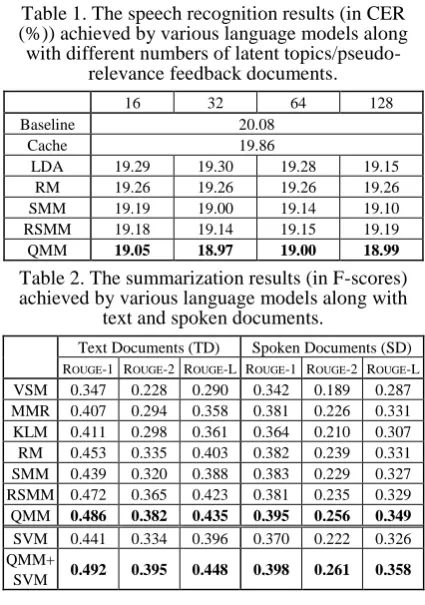
In the second part of experiments, we evaluate the utilities of the various query models as ap-plied to the speech summarization task. At the outset, we assess the performance level of the baseline KLM method by comparison with two well-practiced unsupervised methods, viz. the vector space model (VSM) (Gong and Liu, 2001), and its extension, maximal marginal relevance (MMR) (Carbonell and Goldstein, 1998). The corresponding results are shown in Table 2 and can be aligned with several related literature re-views. By looking at the results, we find that KLM outperforms VSM by a large margin, con-firming the applicability of the language model-ing framework for speech summarization. Fur-thermore, MMR that presents an extension of VSM performs on par with KLM for the text summarization task (TD) and exhibits superior performance over KLM for the speech summari-zation task (SD). We now turn to evaluate the effectiveness of the various query models (viz. RM, SMM, RSMM and QMM) in conjunction with the pseudo-relevance feedback process for enhancing the sentence model involved in the KLM method. The corresponding results are also shown in Table 2. Two noteworthy observations can be drawn from Table 2. One is that all these query models can considerably improve the summarization performance of the KLM method, which corroborates the advantage of using them for enhanced sentence representations. The other is that QMM is the best-performing one among all the formulations studied in this paper for both the TD and SD cases.
Going one step further, we explore to use extra prosodic features that are deemed complemen-tary to the LM cue provided by QMM for speech summarization. To this end, a support vector ma-chine (SVM) based summarization model is trained to integrate a set of 28 commonly-used prosodic features (Liu and Hakkani-Tur, 2011) for representing each spoken sentence, since SVM is arguably one of the state-of-the-art su-pervised methods that can make use of a diversi-ty of indicative features for text or speech sum-marization (Xie and Liu, 2010; Chen et al., 2013). The sentence ranking scores derived by QMM and SVM are in turn integrated through a simple log-linear combination. The correspond-ing results are shown in Table 2, demonstratcorrespond-ing consistent improvements with respect to all the three variants of the ROUGE metric as compared to that using either QMM or SVM in isolation. We also investigate using SVM to additionally integrate a richer set of lexical and relevance fea-tures to complement QMM and further enhance the summarization effectiveness. However, due to space limitation, we omit the details here. As a side note, there is a sizable gap between the TD and SD cases, indicating room for further
im-provements. We may seek remedies, such as ro-bust indexing schemes, to compensate for imper-fect speech recognition.
7
Conclusion and Outlook
In this paper, we have presented a systematic and thorough analysis of a few well-practiced query models for IR and extended their novel applica-bility to speech recognition and summarization in a principled way. Furthermore, we have pro-posed an extension of this research line by intro-ducing query-specific mixture modeling; the util-ities of the deduced model have been extensively compared with several existing query models. As to future work, we would like to investigate jointly integrating proximity and other different kinds of relevance and lexical/semantic infor-mation cues into the process of feedback docu-ment selection so as to improve the empirical effectiveness of such query modeling.
Acknowledgements
[image:5.595.307.520.73.376.2]This research is supported in part by the “Aim for the Top University Project” of National Tai-wan Normal University (NTNU), sponsored by the Ministry of Education, Taiwan, and by the Ministry of Science and Technology, Taiwan, under Grants MOST 103-2221-E-003-016-MY2, NSC 101-2221-E-003-024-MY3, NSC 102-2221-E-003-014-, NSC 101-2511-S-003-057-MY3, NSC 101-2511-S-003-047-MY3 and NSC 103-2911-I-003-301.
Table 1.The speech recognition results (in CER (%)) achieved by various language models along
with different numbers of latent topics/pseudo-relevance feedback documents.
16 32 64 128 Baseline 20.08
Cache 19.86
LDA 19.29 19.30 19.28 19.15 RM 19.26 19.26 19.26 19.26 SMM 19.19 19.00 19.14 19.10 RSMM 19.18 19.14 19.15 19.19
QMM 19.05 18.97 19.00 18.99
Table 2.The summarization results (in F-scores) achieved by various language models along with
text and spoken documents.
Text Documents (TD) Spoken Documents (SD) ROUGE-1 ROUGE-2 ROUGE-L ROUGE-1 ROUGE-2 ROUGE-L VSM 0.347 0.228 0.290 0.342 0.189 0.287 MMR 0.407 0.294 0.358 0.381 0.226 0.331 KLM 0.411 0.298 0.361 0.364 0.210 0.307 RM 0.453 0.335 0.403 0.382 0.239 0.331 SMM 0.439 0.320 0.388 0.383 0.229 0.327 RSMM 0.472 0.365 0.423 0.381 0.235 0.329
QMM 0.486 0.382 0.435 0.395 0.256 0.349
SVM 0.441 0.334 0.396 0.370 0.222 0.326 QMM+
References
Ricardo Baeza-Yates and Berthier Ribeiro-Neto. 2011. Modern information retrieval: the con-cepts and technology behind search, ACM Press.
David M. Blei, Andrew Y. Ng, and Michael I. Jordan. 2003. Latent dirichlet allocation.
Journal of Machine Learning Research, pp.993–1022.
David M. Blei and John Lafferty. 2009. Topic models. In A. Srivastava and M. Sahami, (eds.), Text Mining: Theory and Applications. Taylor and Francis.
Jaime Carbonell and Jade Goldstein. 1998. The use of MMR, diversitybased reranking for reordering documents and producing sum-maries. In Proc. SIGIR, pp. 335–336.
Claudio Carpineto and Giovanni Romano. 2012. A survey of automatic query expansion in in-formation retrieval. ACM Computing Surveys, vol. 44, pp.1–56.
Stephane Clinchant and Eric Gaussier. 2013. A theoretical analysis of pseudo-relevance feedback models. In Proc. ICTIR.
Guihong Cao, Jian-Yun Nie, Jianfeng Gao, and Stephen Robertson. 2008. Selecting good expansion terms for pseudo-relevance feed-back. In Proc. SIGIR, pp. 243–250.
Berlin Chen, Shih-Hsiang Lin, Yu-Mei Chang, and Jia-Wen Liu. 2013. Extractive speech summarization using evaluation metric-related training criteria. Information Pro-cessing & Management, 49(1), pp. 1cess Arthur P. Dempster, Nan M. Laird, and Donald
B. Rubin. 1977. Maximum likelihood from incomplete data via the EM algorithm. Jour-nal of Royal Statistical Society B, 39(1), pp. 1–38.
Joshua V. Dillon and Kevyn Collins-Thompson. 2010. A unified optimization framework for robust pseudo-relevance feedback algorithms. In Proc. CIKM, pp. 1069–1078.
Sadaoki Furui, Li Deng, Mark Gales, Hermann Ney, and Keiichi Tokuda. 2012. Fundamen-tal technologies in modern speech recogni-tion. IEEE Signal Processing Magazine, 29(6), pp. 16–17.
Yihong Gong and Xin Liu. 2001. Generic text summarization using relevance measure and latent semantic analysis. In Proc. SIGIR, pp. 19–25.
Djoerd Hiemstra, Stephen Robertson, and Hugo Zaragoza. 2004. Parsimonious language
models for information retrieval. In Proc. SIGIR, pp. 178–185.
Thomas Hofmann. 1999. Probabilistic latent se-mantic indexing. In Proc. SIGIR, pp. 50–57. Thomas Hofmann. 2001. Unsupervised learning by probabilistic latent semantic analysis.
Machine Learning, 42, pp. 177–196.
Xuedong Huang, Alex Acero, and Hsiao-Wuen Hon. 2001. Spoken language processing: a guide to theory, algorithm, and system de-velopment. Prentice Hall PTR, Upper Saddle River, NJ, USA.
Frederick Jelinek, Bernard Merialdo, Salim Rou-kos, and M. Strauss. 1991. A dynamic lan-guage model for speech recognition. In Proc. the DARPA workshop on speech and natural language, pp. 293–295.
Frederick Jelinek. 1999. Statistical methods for speech recognition. MIT Press.
Daniel Jurafsky and James H. Martin. 2008. Speech and language processing. Prentice Hall PTR, Upper Saddle River, NJ, USA.
Roland Kuhn and Renato D. Mori. 1990. A cache-based natural language model for speech recognition. IEEE Transactions on Pattern Analysis and Machine Intelligence, 12(6), pp. 570–583.
Solomon Kullback and Richard A. Leibler. 1951. On information and sufficiency. The Annals of Mathematical Statistics, 22(1), pp. 79–86. Chin-Yew Lin. 2003. ROUGE: Recall-oriented
Understudy for Gisting Evaluation. Availa-ble: http://haydn.isi.edu/ROUGE/.
Feifan Liu and Yang Liu. 2007. Unsupervised language model adaptation incorporating named entity information. In Proc. ACL, pp. 672–769.
Yang Liu and Dilek Hakkani-Tur. 2011. Speech summarization. Chapter 13 in Spoken Lan-guage Understanding: Systems for Extract-ing Semantic Information from Speech, G. Tur and R. D. Mori (Eds), New York: Wiley.
John Lafferty and Chengxiang Zhai. 2001. Doc-ument language models, query models, and risk minimization for information retrieval. In Proc. SIGIR, pp. 111–119.
Victor Lavrenko and W. Bruce Croft. 2001. Rel-evance-based language models. In Proc. SIGIR, pp. 120–127.
Shasha Xie and Yang Liu. 2010. Improving su-pervised learning for meeting summarization using sampling and regression. Computer Speech & Language, 24(3), pp. 495–514. Yuanhua Lv and Chengxiang Zhai. 2009. A
comparative study of methods for estimating query language models with pseudo feed-back. In Proc. CIKM, pp. 1895–1898. Yuanhua Lv and Chengxiang Zhai. 2010.
Posi-tional relevance model for pseudo-relevance feedback. In Proc. SIGIR, pp. 579–586. Kyung Soon Lee, W. Bruce Croft, and James
Allan. 2008. A cluster-based resampling method for pseudo-relevance feedback. In
Proc. SIGIR, pp. 235–242.
Kyung Soon Lee and W. Bruce Croft. 2013. A deterministic resampling method using over-lapping document clusters for pseudo-relevance feedback. Inf. Process. Manage. 49(4), pp. 792–806.
Inderjeet Mani and Mark T. Maybury (Eds.). 1999. Advances in automatic text summari-zation. Cambridge, MA: MIT Press.
Ani Nenkova and Kathleen McKeown. 2011. Automatic summarization. Foundations and Trends in Information Retrieval, 5(2–3), pp. 103–233.
Stefan Ortmanns, Hermann Ney, and Xavier Au-bert. 1997. A word graph algorithm for large vocabulary continuous speech recognition.
Computer Speech and Language, pp. 43–72. Jay M. Ponte and W. Bruce Croft. 1998. A
lan-guage modeling approach to information re-trieval. In Proc. SIGIR, pp. 275–281.
Stephen E. Robertson. 1990. On term selection for query expansion. Journal of Documenta-tion, 46(4), pp. 359–364.
Andreas Stolcke. 2005. SRILM - An extensible language modeling toolkit. In Proc. INTER-SPEECH, pp.901–904.
Tao Tao and Chengxiang Zhai. 2006. Regular-ized estimation of mixture models for robust pseudo-relevance feedback. In Proc. SIGIR, pp. 162–169.
Yik-Cheung Tam and Tanja Schultz. 2005. Dy-namic language model adaptation using vari-ational Bayes inference. In Proc. INTER-SPEECH, pp. 5–8.
Xuanhui Wang, Hui Fang, and Chengxiang Zhai. 2008. A study of methods for negative rele-vance feedback. In Proc. SIGIR, pp. 219–226. Hsin-Min Wang, Berlin Chen, Jen-Wei Kuo, and
Shih-Sian Cheng. 2005. MATBN: A
Manda-rin Chinese broadcast news corpus. Interna-tional Journal of ComputaInterna-tional Linguistics & Chinese Language Processing, 10(2), pp. 219–236.
Xing Yi and James Allan. 2009. A comparative study of utilizing topic models for infor-mation retrieval. In Proc. ECIR, pp. 29–41. Steve Young, Dan Kershaw, Julian Odell, Dave
Ollason, Valtcho Valtchev, and Phil Wood-land. 2006. The HTK book version 3.4. Cambridge University Press.
Chengxiang Zhai and John Lafferty. 2001a. A study of smoothing methods for language models applied to ad hoc information re-trieval. In Proc. SIGIR, pp. 334–342.
Chengxiang Zhai and John Lafferty. 2001b. Model-based feedback in the language mod-eling approach to information retrieval. In
Proc. CIKM, pp. 403–410.
Chengxiang Zhai. 2008. Statistical language models for information retrieval: a critical review. Foundations and Trends in Infor-mation Retrieval, 2 (3), pp. 137–213.