Prune-and-Score: Learning for Greedy Coreference Resolution
Chao Ma, Janardhan Rao Doppa†, J. Walker Orr, Prashanth Mannem Xiaoli Fern, Tom DietterichandPrasad Tadepalli
School of Electrical Engineering and Computer Science, Oregon State University {machao,orr,mannemp,xfern,tgd,tadepall}@eecs.oregonstate.edu
†School of Electrical Engineering and Computer Science, Washington State University
Abstract
We propose a novel search-based approach for greedy coreference resolution, where the mentions are processed in order and added to previous coreference clusters. Our method is distinguished by the use of two functions to make each corefer-ence decision: a pruning function that prunes bad coreference decisions from fur-ther consideration, and ascoringfunction that then selects the best among the maining decisions. Our framework re-duces learning of these functions to rank learning, which helps leverage powerful off-the-shelf rank-learners. We show that ourPrune-and-Scoreapproach is superior to using a single scoring function to make both decisions and outperforms sever-al state-of-the-art approaches on multiple benchmark corpora including OntoNotes.
1 Introduction
Coreference resolution is the task of clustering a set of mentions in the text such that all mentions in the same cluster refer to the same entity. It is one of the first stages in deep language understanding and has a big potential impact on the rest of the stages. Several of the state-of-the-art approaches learn a scoring function defined over mention pair, cluster-mention or cluster-cluster pair to guide the coreference decision-making process (Daum´e II-I, 2006; Bengtson and Roth, 2008; Rahman and Ng, 2011b; Stoyanov and Eisner, 2012; Chang et al., 2013; Durrett et al., 2013; Durrett and Klein, 2013). One common and persistent problem with these approaches is that the scoring function has to make all the coreference decisions, which leads to a highly non-realizable learning problem.
Inspired by the recent success of theHC-Search Framework (Doppa et al., 2014a) for studying a
variety of structured prediction problems (Lam et al., 2013; Doppa et al., 2014c), we study a novel approach for search-based coreference resolution called Prune-and-Score. HC-Search is a divide-and-conquer solution that learns multiple compo-nents with pre-defined roles, and each of them contribute towards the overall goal by making the role of the other components easier. The HC -Search framework operates in the space of com-plete outputs, and relies on the loss function which is only defined on the complete outputs to drive it-s learning. Unfortunately, thiit-s method doeit-s not work for incremental coreference resolution since the search space for coreference resolution con-sists of partial outputs, i.e., a set of mentions only some of which have been clustered so far.
We develop an alternative framework to HC -Search that allows us to effectively learn from par-tial output spaces and apply it to greedy corefer-ence resolution. The key idea of our work is to address the problem of non-realizability of the s-coring function by learning two different function-s: 1) apruning function to prune most of the bad decisions, and 2) a scoring function to pick the best decision among those that are remaining. Our Prune-and-Score approach is a particular instanti-ation of the general idea of learning nearly-sound constraints for pruning, and leveraging the learned constraints to learn improved heuristic function-s for guiding the function-search. The pruning confunction-straintfunction-s can take different forms (e.g., classifiers, decision-list, or ranking functions) depending on the search architecture. Therefore, other coreference resolu-tion systems (Chang et al., 2013; Durrett and K-lein, 2013; Bj¨orkelund and Kuhn, 2014) can also benefit from this idea. While our basic idea of two-level selection might appear similar to the coarse-to-fine inference architectures (Felzenszwalb and McAllester, 2007; Weiss and Taskar, 2010), the details differ significantly. Importantly, our prun-ing and scorprun-ing functions operate sequentially at
each greedy search step, whereas in the cascades approach, the second level function makes its pre-diction only when the first level decision-making is done.
Summary of Contributions.The main contribu-tions of our work are as follows. First, we moti-vate and introduce thePrune-and-Scoreapproach to search-based coreference resolution. Second, we identify a decomposition of the overall loss of the Prune-and-Score approach into the pruning loss and the scoring loss, and reduce the problem of learning these two functions to rank learning, which allows us to leverage powerful and efficien-t off-efficien-the-shelf rank learners. Third, we evaluaefficien-te our approach on OntoNotes, ACE, and MUC da-ta, and show that it compares favorably to sever-al state-of-the-art approaches as well as a greedy search-based approach that uses a single scoring function.
The remainder of the paper proceeds as follows. In Section 2, we dicuss the related work. We intro-duce our problem setup in Section 3 and then de-scribe ourPrune-and-Scoreapproach in Section 4. We explain our approaches for learning the prun-ing and scorprun-ing functions in Section 5. Section 6 presents our experimental results followed by the conclusions in Section 7.
2 Related Work
The work on learning-based coreference resolu-tion can be broadly classified into three types. First, the pair-wise classifier approaches learn a classifier on mention pairs (edges) (Soon et al., 2001; Ng and Cardie, 2002; Bengtson and Roth, 2008), and perform some form of approximate de-coding or post-processing using the pair-wise s-cores to make predictions. However, the pair-wise classifier approach suffers from several drawback-s including cladrawback-sdrawback-s imbalance (fewer podrawback-sitive edgedrawback-s compared to negative edges) and not being able to leverage the global structure (instead making in-dependent local decisions).
Second, the global approaches such as Struc-tured SVMs and Conditional Random Fields (CRFs) learn a cost function to score a potential clustering output for a given input set of men-tions (Mccallum and Wellner, 2003; Finley and Joachims, 2005; Culotta et al., 2007; Yu and Joachims, 2009; Haghighi and Klein, 2010; Wick et al., 2011; Wick et al., 2012; Fernandes et al., 2012). These methods address some of the
prob-lems with pair-wise classifiers, however, they suf-fer from the intractability of “Argmin” insuf-ference (finding the least cost clustering output among ex-ponential possibilities) that is encountered during both training and testing. As a result, they resort to approximate inference algorithms (e.g., MCMC, loopy belief propagation), which can suffer from local optima.
Third, theincrementalapproaches construct the clustering output incrementally by processing the mentions in some order (Daum´e III, 2006; De-nis and Baldridge, 2008; Rahman and Ng, 2011b; Stoyanov and Eisner, 2012; Chang et al., 2013; Durrett et al., 2013; Durrett and Klein, 2013). These methods learn a scoring function to guide the decision-making process and differ in the form of the scoring function (e.g., mention pair, cluster-mention or cluster-cluster pair) and how it is being learned. They have shown great success and are very efficient. Indeed, several of the approach-es that have achieved state-of-the-art rapproach-esults on OntoNotes fall under this category (Chang et al., 2013; Durrett et al., 2013; Durrett and Klein, 2013; Bj¨orkelund and Kuhn, 2014). However, their efficiency requirement leads to a highly non-realizable learning problem. Our Prune-and-Score approach is complementary to these methods, as we show that having a pruning function (or a set of learned pruning rules) makes the learning prob-lem easier and can improve over the performance of scoring-only approaches. Also, the models in (Chang et al., 2013; Durrett et al., 2013) try to leverage cluster-level information implicitly (vi-a l(vi-atent (vi-antecedents) from mention-p(vi-air fe(vi-atures, whereas our model explicitly leverages the cluster level information.
Coreference resolution systems can benefit by incorporating the world knowledge including rules, constraints, and additional information from external knowledge bases (Lee et al., 2013; Rah-man and Ng, 2011a; Ratinov and Roth, 2012; Chang et al., 2013; Zheng et al., 2013; Hajishirzi et al., 2013). Our work is orthogonal to this line of work, but domain constraints and rules can be incorporated into our model as done in (Chang et al., 2013).
3 Problem Setup
Coreference resolution is a structured pre-diction problem where the set of mentions
cor-reponds to a structured inputxand the structured output y corresponds to a partition of the men-tions into a set of clustersC1, C2,· · ·, Ck. Each
mentionmibelongs to exactly one of the clusters
Cj. We are provided with a training set of
input-output pairs drawn from an unknown distribution D, and the goal is to return a function/predictor from inputs to outputs. The learned predictor is evaluated against a non-negative loss function
L:X × Y × Y 7→ <+,L(x, y0, y)is the loss asso-ciated with predicting incorrect outputy0for input
xwhen the true output isy(e.g., B-Cubed Score). In this work, we formulate the coreference resolution problem in a search-based framework. There are three key elements in this framework: 1) the Search space Sp whose states correspond
to partial clustering outputs; 2) the Action prun-ing functionFprunethat is used to prune irrelevant
actions at each state; and 3) the Action scoring function Fscore that is used to construct a
com-plete clustering output by selecting actions from those that are left after pruning. Sp is a 3-tuple
hI, A, Ti, whereI is the initial state function, A
gives the set of possible actions in a given state, andT is a predicate which is true for terminal s-tates. In our case,s0 = I(x)corresponds to a
s-tate where every mention is unresolved, andA(si)
consists of actions to place the next mentionmi+1
in each cluster insior a NEW action which creates
a new cluster for it. Terminal nodes correspond to states with all mentions resolved.
We focus on greedy search. The decision pro-cess for constructing an output corresponds to s-electing a sequence of actions leading from the initial state to a terminal state using bothFprune
and Fscore, which are parameterized functions
over state-action pairs (Fprune(φ1(s, a))∈ <and
Fscore(φ2(s, a))∈ <), whereφ1 andφ2stand for
feature functions. We want to learn the parameters of bothFprune andFscore such that the predicted
outputs on unseen inputs have low expected loss.
4 Greedy Prune-and-Score Approach Our greedy Prune-and-Scoreapproach for coref-erence resolution is parameterized by a pruning functionFprune : S × A 7→ <, a scoring
func-tionFscore :S × A 7→ <, and a pruning
param-eterb ∈ [1, Amax], whereAmax is the maximum
number of actions at any state s ∈ S. Given a set of input mentionsm1, m2,· · ·, mD extracted
from a document (inputx), and a pruning
param-Algorithm 1Greedy Prune-and-Score Resolver Input: x = set of mentions m1, m2,· · · , mD from a document D, hI, A, Ti = Search space defini-tion, Fprune =learned pruning function, b = prun-ing parameter, Fscore = learned scoring function
1: s←I(x)// initial state 2: while notT(s)do
3: A0 ← Top b actions from A(s) according to
Fprune// prune
4: ap←arg maxa∈A0Fscore(s, a)// score 5: s←Applyapons
6: end while
7: returncoreference output corresponding tos
eterb, our Prune-and-Score approach makes pre-dictions as follows. The search starts at the ini-tial states0 = I(x) (see Algorithm 1). At each
non-terminal states, the pruning functionFprune
retains only the topbactions (A0) fromA(s)(Step 3), and the scoring functionFscore picks the best
scoring actionap ∈ A0 (Step 4) to reach the next
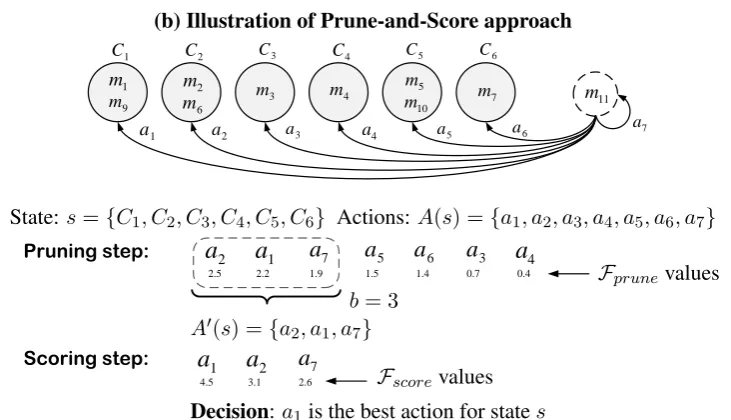
state. When a terminal state is reached its con-tents are returned as the prediction. Figure 1 illus-trates the decision-making process of our Prune-and-Score approach for an example state.
We now formalize the learning objective of our Prune-and-Score approach. Letyˆbe the predicted coreference output for a coreference input-output pair (x, y∗). The expected loss of the greedy Prune-and-Score approachE(Fprune,Fscore)for a
given pruning function Fprune and scoring
func-tionFscore can be defined as follows.
E(Fprune,Fscore) =E(x,y∗)∼D L(x,y, yˆ ∗)
Our goal is to learn an optimal pair of pruning and scoring functions Fo
prune,Fscoreo
(a) Text with input set of mentions
Ramallah ( West Bank2)1 10-15 ( AFP3) - Eyewitnesses4 reported that Palestinians5
demonstrated today Sunday in the West Bank6 against the Sharm el-Sheikh7 summit to be
held in Egypt8tomorrow Monday. In Ramallah9, around 500 people10took tothe town11’s
streets chanting slogans denouncing the summit ...
(b) Illustration of Prune-and-Score approach
1 m
9
m m3 m4
6 m
2 m 1
C
1
a a2 a3 a4 a5 a6 a7
5 m
10
m m7 m11 2
C C3 C4 C5 C6
State:s={C1, C2, C3, C4, C5, C6} Actions: A(s) ={a1, a2, a3, a4, a5, a6, a7}
Pruning step:
Scoring step:
2.5 2.2 1.9 1.5 1.4 0.7 0.4
4.5 3.1 2.6 2
a
a
1 a7 a5 a6 a3a
41
a
a
2 a7A0(s) ={a2, a1, ab7}= 3
Decision:a1is the best action for states
Fprune values
[image:4.595.117.483.136.346.2]Fscore values
Figure 1: Illustration of Prune-and-Score approach. (a) Text with input set of mentions. Mentions are highlighted and numbered. (b) Illustration of decision-making process for mentionm11. The partial clustering output
corre-sponding to the current statesconsists of six clusters denoted byC1, C2,· · ·, C6. Highlighted circles correspond
to the clusters. Edges from mentionm11to each of the six clusters and to itself stand for the set of possible actions
A(s)in states, and are denoted bya1, a2,· · · , a7. The pruning functionFprunescores all the actions inA(s)and only keeps the top 3 actionsA0 ={a2, a1, a7}as specified by the pruning parameterb. The scoring function picks the best scoring actiona1∈A0as the final decision, and mentionm11is merged with clusterC1.
Ng, 2011b) whenb=∞. Additionally, forb= 1, our pruning function coincides with the scoring function.
Analysis of Representational Power. The fol-lowing proposition formalizes the intuition that t-wo functions are strictly better than one in expres-sive power. See Appendix for the proof.
Proposition 1. Let Fprune and Fscore be
func-tions from the same function space. Then for all learning problems,minFscoreE(Fscore,Fscore) ≥
min(Fprune,Fscore)E(Fprune,Fscore). More-over there exist learning problems for which minFscoreE(Fscore,Fscore) can be arbitrarily worse thanmin(Fprune,Fscore)E(Fprune,Fscore).
5 Learning Algorithms
In general, learning the optimal Fo
prune,Fscoreo
pair can be intractable due to their potential inter-dependence. Specifically, when learning Fprune
in the worst case there can be ambiguity about which of the non-optimal actions to retain, and
for only some of those an effectiveFscore can be
found. However, we observe a loss decomposi-tion in terms of the individual losses due toFprune
andFscore, and develop a stage-wise learning
ap-proach that first learns Fprune and then learns a
correspondingFscore.
5.1 Loss Decomposition
The overall loss of thePrune-and-Scoreapproach E(Fprune,Fscore) can be decomposed into
prun-ing loss prune, the loss due to Fprune not
be-ing able to retain the optimal terminal state in the search space; and scoring loss score|Fprune, the additional loss due to Fscore not guiding the
greedy search to the best terminal state after prun-ing usprun-ing Fprune. Below, we will define these
losses more formally.
Pruning Loss is defined as the expected loss of the Prune-and-Scoreapproach when we perform greedy search with Fprune and Fscore∗ , the
Sp, and for any set of remaining actions A(s), it
can score each actiona ∈ A(s)such that greedy search can reach the best terminal state (as eval-uated by task loss function L) that is reachable from s throughA(s). Unfortunately, computing the optimal scoring function is highly intractable for the non-decomposable loss functions that are employed in coreference resolution (e.g., B-Cubed F1). The main difficulty is that the decision at any one state has interdependencies with future deci-sions (see Section 5.5 in (Daum´e III, 2006) for more details). So we need to resort to some form ofapproximate optimal scoring function that ex-hibits the intended behavior. This is very similar to the dynamic oracle concept developed for de-pendency parsing (Goldberg and Nivre, 2013).
Let y∗
prune be the coreference output
corre-sponding to the terminal state reached from input
xbyPrune-and-Scoreapproach when performing search usingFprune andFscore∗ . Then the pruning
loss can be expressed as follows.
prune=E(x,y∗)∼D L x, y∗prune, y∗
Scoring Lossis defined as the additional loss due toFscorenot guiding the greedy search to the best
terminal state reachable via the pruning function Fscore(i.e.,yprune∗ ). Letyˆbe the coreference
out-put corresponding to the terminal state reached by Prune-and-Score approach by performing search withFprune andFscore for an inputx. Then the
scoring loss can be expressed as follows:
score|Fprune
=E(x,y∗)∼DL(x,y, yˆ ∗)−L x, y∗prune, y∗
The overall loss decomposition of our Prune-and-Scoreapproach can be expressed as follows.
E(Fprune,Fscore)
=E(x,y∗)∼DL x, yprune∗ , y∗
| {z }
prune
+
E(x,y∗)∼DL(x,y, yˆ ∗)−L x, yprune∗ , y∗
| {z }
score|Fprune
5.2 Stage-wise Learning
The loss decomposition motivates a learning ap-proach that targets minimizing the errors of prun-ing and scorprun-ing functions independently. In par-ticular, we optimize the overall loss of the Prune-and-Scoreapproach in a stage-wise manner. We
first train a pruning function Fˆprune to optimize
the pruning loss componentprune and then train
a scoring functionFˆscore to optimize the scoring
lossscore|Fˆprune conditioned onFˆprune.
ˆ
Fprune ≈arg minFprune∈Fp prune
ˆ
Fscore ≈arg minFscore∈Fs score|Fˆprune
Note that this approach is myopic in the sense that
ˆ
Fprune is learned without considering the
impli-cations for learning Fˆscore. Below, we first
de-scribe our approach for pruning function learning, and then explain our scoring function learning al-gorithm.
5.3 Pruning Function Learning
In our greedyPrune-and-Scoreapproach, the role of the pruning function Fprune is to prune away
irrelevant actions (as specified by the pruning pa-rameterb) at each search step. More specifically, we want Fprune to score actionsA(s) at each
s-tates such that the optimal actiona∗ ∈ A(s) is ranked within the topbactions to minimizeprune.
For this, we assume that for any training input-output pair(x, y∗)there exists a unique action se-quence, or solution path(initial state to terminal state), for producingy∗fromx. More formally, let (s∗
0, a∗0),(s∗1, a1∗),· · · ,(s∗D,∅) correspond to the
sequence of state-action pairs along this solution path, wheres∗
0is the initial state ands∗D is the
ter-minal state. The goal is to learn the parameters of Fprune such that at each state s∗i, ai∗ ∈ A(s∗i)is
ranked among the topbactions.
While we can employ anonline-LaSOstyle ap-proach (III and Marcu, 2005; Xu et al., 2009) to learn the parameters of the pruning function, it is quite inefficient, as it must regenerate the same search trajectory again and again until it learn-s to make the right decilearn-sion. Additionally, thilearn-s approach limits applicability of the off-the-shelf learners to learn the parameters of Fprune. To
overcome these drawbacks, we apply offline train-ing.
Reduction to Rank Learning. We reduce the pruning function learning to a rank learning prob-lem. This allows us to leverage powerful and effi-cient off-the-shelf rank-learners (Liu, 2009). The reduction is as follows. At each states∗
i on the
so-lution path of a training example(x, y∗), we create an example by labeling optimal actiona∗
i ∈A(s∗i)
a ranking function that can rank actions such that the relevant actiona∗
i is in the topbactions, where
b is the input pruning paramter. In other word-s, we have a rank learning problem, where the learner’s goal is to optimize thePrecision at Top-b. The training approach creates such an exam-ple for each statesin the solution path. The set of aggregate imitation examples collected over al-l the training data is then given to a rank al-learner (e.g., LambdaMART (Burges, 2010)) to learn the parameters ofFprune by optimizing thePrecision
at Top-bloss. See appendix for the pseudocode. If we can learn a function Fprune that is
con-sistent with these imitation examples, then the learned pruning function is guaranteed to keep the solution path within the pruned space for al-l the training exampal-les. We can aal-lso empal-loy more advanced imitation learning algorithms in-cluding DAgger (Ross et al., 2011) and SEARN (Hal Daum´e III et al., 2009) if we are provid-ed with an (approximate) optimal scoring function F∗
score that can pick optimal actions at states that
are not in the solution path (i.e., off-trajectory s-tates).
5.4 Scoring Function Learning
Given a learned pruning functionFprune, we want
to learn a scoring function that can pick the best action from theb actions that remain after prun-ing at each state. We formulate this problem in the framework ofimitation learning(Khardon, 1999). More formally, let(ˆs0, a∗0),(ˆs1, a∗1),· · ·,(ˆs∗D,∅)
correspond to the sequence of state-action pairs along the greedy trajectory obtained by running the Prune-and-Score approach with Fprune and
F∗
score, the optimal scoring function, on a
train-ing example(x, y∗), whereˆs∗
Dis the best terminal
state in the pruned space. The goal of our imita-tion training approach is to learn the parameters of Fscore such that at each state sˆi, a∗i ∈ A0 is
ranked higher than all other actions inA0, where
A0 ⊆A(ˆsi)is the set ofbactions that remain after pruning.
It is important to note that the distribution of states in the pruned space due to Fprune on the
testing data may be somewhat different from those on training data. Therefore, we train our scoring function via cross-validation by training the scor-ing function on heldout data that was not used to train the pruning function. This methodology is commonly employed in Re-Ranking and Stacking
approaches (Collins, 2000; Cohen and de Carval-ho, 2005).
Our scoring function learning procedure uses cross validation and consists of the following four steps. First, we divide the training data D in-tokfolds. Second, we learnk different pruners, where each pruning functionFi
prune is learned
us-ing the data from all the folds excludus-ing the ith
fold. Third, we generate ranking examples for scoring function learning as described above us-ing each prunus-ing function Fi
prune on the data it
was not trained on. Finally, we give the aggregate set of ranking examplesRto a rank learner (e.g., SVM-Rank or LambdaMART) to learn the scoring functionFscore. See appendix for the pseudocode.
Approximate Optimal Scoring Function. If the learned pruning function is not consistent with the training data, we will encounter states ˆsi that are
not on the target path, and we will need some su-pervision for learning in those cases. As discussed before in Section 5.1, computing an optimal scor-ing functionF∗
scoreis intractable for combinatorial
loss functions that are used for coreference resolu-tion. So we employ an approximate function from existing work that is amenable to evaluate partial outputs (Daum´e III, 2006). It is a variant of the ACE scoring function that removes the bipartite matching step from the ACE metric. Moreover this score is computed only on the partial coref-erence output corresponding to the “after state”
s0 resulting from taking action a in state s, i.e., F∗
score(s, a) =Fscore∗ (s0). To further simplify the
computation, we give uniform weight to the three types of costs: 1) Credit for correct linking, 2) Penalty for incorrect linking, and 3) Penalty for missing links. Intuitively, this is similar to the correct-link count computed only on a subgraph. We direct the reader to (Daum´e III, 2006) for more details (see Section 5.5).
6 Experiments and Results
6.1 Experimental Setup
Datasets. For OntoNotes corpus, we employ the official split for training, validation, and testing. There are 2802 documents in the training set; 343 documents in the validation set; and 345 docu-ments in the testing set. The ACE 2004 corpus contains 443 documents. We follow the (Culot-ta et al., 2007; Bengtson and Roth, 2008) split in our experiments by employing 268 documents for training, 68 documents for validation, and 107 documents (ACE2004-CULOTTA-TEST) for test-ing. We also evaluate our system on the 128 newswire documents in ACE 2004 corpus for a fair comparison with the state-of-the-art. The MUC6 corpus containts 255 documents. We em-ploy the official test set of 30 documents (MUC6-TEST) for testing purposes. From the remaining 225 documents, which includes 195 official train-ing documents and 30 dry-run test documents, we randomly pick 30 documents for validation, and use the remaining ones for training.
Evaluation Metrics.We compute three most pop-ular performance metrics for coreference resolu-tion: MUC (Vilain et al., 1995), B-Cubed (Bag-ga and Baldwin, 1998), and Entity-based CEAF (CEAFφ4) (Luo, 2005). As it is commonly done
in CoNLL shared tasks (Pradhan et al., 2012), we employ the average F1 score (CoNLL F1) of these three metrics for comparison purposes. We evalu-ate all the results using the updevalu-ated version1(7.0)
of the coreference scorer.
Features. We built2 our coreference resolver
based on the Easy-first coreference system (Stoy-anov and Eisner, 2012), which is derived from the Reconcile system (Stoyanov et al., 2010). We es-sentially employ the same features as in the Easy-first system. However, we provide some high-level details that are necessary for subsequent dis-cussion. Recall that our features φ(s, a) for both pruning and scoring functions are defined over state-action pairs, where each state s consists of a set of clusters and an action a corresponds to merging an unprocessed mentionm with a clus-terCin statesor create one for itself. Therefore,
φ(s, a)defines features over cluster-mention pairs
(C, m). Our feature vector consists of three part-s: a) mention pair features; b) entity pair features; and c) a single indicator feature to represent NEW
1http://code.google.com/p/reference-coreference-scorers/ 2See http://research.engr.oregonstate.edu/dral/ for our
software.
action (i.e., mentionmstarts its own cluster). For mention pair features, we average the pair-wise features over all links betweenmand every men-tionmcin clusterC(often referred to as
average-link). Note that, we cannot employ the best-link feature representation because we perform offline training and do not have weights for scoring the links. For entity pair features, we treat mention
m as a singleton entity and compute features by pairing it with the entity represented by clusterC
(exactly as in the Easy-first system). The indica-tor feature will be 1 for the NEW action and 0 for all other actions.We have a total of 140 features: 90 mention pair features; 49 entity pair features; and one NEW indicator feature. We believe that our approach can benefit from employing features of the mention for the NEW action (Rahman and Ng, 2011b; Durrett and Klein, 2013). However, we were constrained by the Reconcile system and could not leverage these features for the NEW ac-tion.
Base Rank-Learner. Our pruning and scoring function learning algorithms need a base rank-learner. We employ LambdaMART (Burges, 2010), a state-of-the art rank learner from the RankLib3 library. LambdaMART is a variant of
boosted regression trees. We use a learning rate of 0.1, specify the maximum number of boost-ing iterations (or trees) as 1000 notboost-ing that its ac-tual value is automatically decided based on the validation set, and tune the number of leaves per tree based on the validation data. Once we fix the hyper-parameters of LambdaMART, we train the final model on all of the training data. Lamb-daMART uses an internal train/validation split of the input ranking examples to decide when to stop the boosting iterations. We fixed this ratio to 0.8 noting that the performance is not sensitive to this parameter. For scoring function learning, we used 5 folds for the cross-validation training.
Pruning Parameter b. The hyper-parameter b
controls the amount of pruning in our Prune-anScore approach. We perform experiments with d-ifferent values ofb and pick the best value based on the performance on the validation set.
Singleton Mention Filter for OntoNotes Cor-pus.We employ the Illinois-Coref system (Chang et al., 2012) to extract system mentions for our OntoNotes experiments, and observe that the
ber of predicted mentions is thrice the number of gold mentions. Since the training data provides the clustering supervision for only gold mentions, it is not clear how to train with the system mention-s that are not part of gold mentionmention-s. A common way of dealing with this problem is to treat all the extra system mentions as singleton clusters (Dur-rett and Klein, 2013; Chang et al., 2013). Howev-er, this solution most likely will not work with our current feature representation (i.e., NEW action is represented as a single indicator feature). Recall that to predict these extra system mentions as s-ingleton clusters with our incremental clustering approach, the learned model should first predic-t a NEW acpredic-tion while processing predic-these menpredic-tion- mention-s to form a temporary mention-singleton clumention-ster, and then refrain from merging any of the subsequent men-tions with that cluster so that it becomes a single-ton cluster in the final clustering output. Howev-er, in OntoNotes corpus, the training data does not include singleton clusters for the gold mentions. Therefore, only the large number (57%) of system mentions that are not part of gold mentions will constitute the set of singleton clusters. This leads to a highly imbalanced learning problem because our model needs to learn (the weight of the sin-gle indicator feature) to predict NEW as the best action for a large set of mentions, which will bias our model to predict large number of NEW actions during testing. As a result, we will generate many singleton clusters, which will hurt the recall of the mention detection after post-processing. There-fore, we aim to learn a singleton mention filter that will be used as a pre-processor before training and testing to overcome this problem. We would like to point out that our filter is complementary to other solutions (e.g., employing features that can discriminate a given mention to be anaphoric or not in place of our single indicator feature, or us-ing a customized loss to weight our rankus-ing exam-ples for cost-sensitive training)(Durrett and Klein, 2013).
Filter Learning. The singleton mention filter is a classifier that will label a given mention as “s-ingleton” or not. We represent each mention m
in a document by averaging the mention-pair fea-tures φ(m, m0) of the k-most similar mentions (obtained by ranking all other mentionsm0 in the document with a learned ranking functionRgiven
m) and then learn a decision-tree classifier by opti-mizing the F1 loss. We learn the mention-ranking
function R by optimizing the recall of positive pairs for a givenk, and employ LambdaMART as our base ranker. The hyper-parameters are tuned based on the performance on the validation set.
6.2 Results
We first describe the results of the learned single-ton mention filter, and then the performance of our Prune-and-Score approach with and without the filter. Next, we compare the results of our ap-proach with several state-of-the-art apap-proaches for coreference resolution.
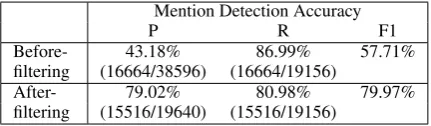
Singleton Mention Filter Results.Table 1 shows the performance of the learned singleton mention filter with k = 2 noting that the results are ro-bust for all values ofk ≥ 2. As we can see, the learned filter improves the precision of the men-tion detecmen-tion with only small loss in the recall of gold mentions.
Mention Detection Accuracy
P R F1
Before- 43.18% 86.99% 57.71%
filtering (16664/38596) (16664/19156)
After- 79.02% 80.98% 79.97%
[image:8.595.309.525.337.400.2]filtering (15516/19640) (15516/19156)
Table 1: Performance of the singleton mention filter on the OntoNotes 5.0 development set. The numerators of the fractions in the brackets show the exact numbers of mentions that are matched with the gold mentions.
Prune-and-Score Results.Table 2 shows the per-formance of Prune-and-Score approach with and without the singleton mention filter. We can see that the results with filter are much better than the corresponding results without the filter. These re-sults show that our approach can benefit from hav-ing a good shav-ingleton mention filter.
Filter settings MUC B3 CEAF
φ4 CoNLL
OntoNotes 5.0 Dev Set w. Predict Ment. O.S. (w.o. Filter) 66.73 53.40 44.23 54.79 P&S (w.o. Filter) 65.93 52.96 50.24 56.38 P&S (w. Filter) 71.18 58.87 57.88 62.64
Table 2: Performance of Prune-and-Score approach with and without the singleton mention filter, and Only-Score approach without the filter.
[image:8.595.307.528.577.638.2]MUC B3 CEAF
φ4 CoNLL
P R F1 P R F1 P R F1 Avg-F1
a. Results on OntoNotes 5.0 Test Set with Predicted Mentions
Prune-and-Score 81.03 66.16 72.84 66.90 51.10 57.94 68.75 44.34 53.91 61.56 Only-Scoring 75.95 61.53 67.98 63.94 47.37 54.42 58.54 49.76 53.79 58.73 HOTCoref 67.46 74.3 70.72 54.96 62.71 58.58 52.27 59.4 55.61 61.63
CPL3M - - 69.48 - - 57.44 - - 53.07 60.00
Berkeley 74.89 67.17 70.82 64.26 53.09 58.14 58.12 52.67 55.27 61.41 Fernandes et al., 2012 75.91 65.83 70.51 65.19 51.55 57.58 57.28 50.82 53.86 60.65 Stanford 65.31 64.11 64.71 56.54 48.58 52.26 46.67 52.29 49.32 55.43
b. Results on OntoNotes 5.0 Test Set with Gold Mentions
Prune-and-Score 88.10 85.85 86.96 76.82 76.16 76.49 80.90 74.06 77.33 80.26 Only-Scoring 86.96 84.52 85.73 74.51 74.25 74.38 79.04 70.67 74.62 78.24
CPL3M - - 84.80 - - 78.74 - - 68.75 77.43
Berkeley 85.73 89.26 87.46 78.23 75.11 76.63 82.89 70.86 76.40 80.16 Stanford 89.94 78.17 83.64 81.75 68.95 74.81 73.97 61.20 66.98 75.14
c. Results on ACE2004 Culotta Test Set with Gold Mentions
Prune-and-Score 85.57 72.68 78.60 90.09 77.02 83.04 74.64 86.02 79.42 80.35 Only-Scoring 82.75 69.25 75.40 88.54 74.22 80.75 73.69 85.22 78.58 78.24
CPL3M - - 78.29 - - 82.20 - - 79.26 79.91
Stanford 82.91 69.90 75.85 89.14 74.05 80.90 75.67 77.45 76.55 77.77 d. Results on ACE2004 Newswire with Gold Mentions
Prune-and-Score 89.72 75.72 82.13 90.89 76.15 82.87 72.43 86.83 78.69 81.23 Only-Scoring 86.92 76.49 81.37 88.10 75.83 81.51 73.15 84.31 78.05 80.31
Easy-first - - 80.1 - - 81.8 - - -
-Stanford 84.75 75.34 79.77 87.50 74.59 80.53 73.32 81.49 77.19 79.16 e. Results on MUC6 Test Set with Gold Mentions
Prune-and-Score 89.53 82.75 86.01 86.48 76.18 81.00 60.74 80.33 68.68 78.56 Only-Scoring 86.77 80.96 83.76 81.72 72.99 77.11 57.56 75.38 64.91 75.26
Easy-first - - 88.2 - - 77.5 - - -
-Stanford 91.19 69.54 78.91 91.07 63.39 74.75 62.43 69.62 65.83 73.16
Table 4: Comparison of Prune-and-Score with state-of-the-art approaches. Metric values reflect version 7 of CoNLL scorer.
The performance is clearly better than the degen-erate case (b=∞) over a wide range ofbvalues, suggesting that it is not necessary to carefully tune the parameterb.
Pruning param.b MUC B3 CEAF
φ4 CoNLL
OntoNotes 5.0 Dev Set w. Predict Ment.
2 69.12 56.80 56.30 60.74
3 70.50 57.89 57.24 61.88
4 71.00 58.65 57.41 62.35
5 71.18 58.87 57.88 62.64
6 70.93 58.66 57.85 62.48
8 70.12 58.13 57.37 61.87
10 70.24 58.34 56.27 61.61
20 67.97 57.73 56.63 60.78
∞ 67.03 56.31 55.56 59.63
Table 3: Performance of Prune-and-Score approach with different values of the pruning parameterb. For
b=∞, Prune-and-Score becomes an Only-Scoring al-gorithm.
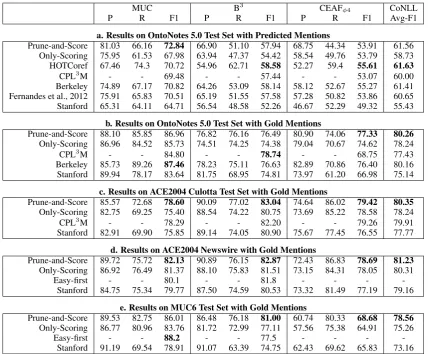
Comparison to State-of-the-Art. Table 4 shows the results of our Prune-and-Score
ap-proach compared with the following state-of-the-art coreference resolution approaches:HOTCoref system (Bj¨orkelund and Kuhn, 2014); Berkeley system with the FINALfeature set (Durrett and
K-lein, 2013);CPL3Msystem (Chang et al., 2013);
Stanfordsystem (Lee et al., 2013);Easy-first sys-tem (Stoyanov and Eisner, 2012); and Fernan-des et al., 2012 (Fernandes et al., 2012). On-ly Scoring is the special case of our Prune-and-Score approach where we employ only the scoring function. This corresponds to existing incremen-tal approaches (Daum´e III, 2006; Rahman and Ng, 2011b). We report the best published results for CPL3M system, Easy-first, and Fernandes et al.,
[image:9.595.85.514.60.414.2] [image:9.595.72.294.541.662.2]that results of the Prune-and-Score approach are comparable to or better than the state-of-the-art in-cluding Only-Scoring.
7 Conclusions and Future Work
We introduced the Prune-and-Score approach for greedy coreference resolution whose main idea is to learn a pruning function along with a scor-ing function to effectively guide the search. We showed that our approach improves over the meth-ods that only learn a scoring function, and gives comparable or better results than several state-of-the-art coreference resolution systems.
Our Prune-and-Score approach is a particular instantiation of the general idea of learning nearly-sound constraints for pruning, and leveraging the learned constraints to learn improved heuristic functions for guiding the search (See (Chen et al., 2014) for another instantiation of this idea for multi-object tracking in videos). Therefore, oth-er corefoth-erence resolution systems (Chang et al., 2013; Durrett and Klein, 2013; Bj¨orkelund and Kuhn, 2014) can also benefit from this idea. One way to further improve the peformance of our approach is to perform a search in the Limited Discrepancy Search (LDS) space (Doppa et al., 2014b) using the learned functions.
Future work should apply this general idea to other natural language processing tasks including dependency parsing (Nivre et al., 2007) and in-formation extraction (Li et al., 2013). We would expect more beneficial behavior with the prun-ing constraints for problems with large action sets (e.g., labeled dependency parsing). It would be in-teresting and useful to generalize this approach to search spaces where there are multiple target paths from the initial state to the terminal state, e.g., as in the Easy-first framework.
Acknowledgments
Authors would like to thank Veselin Stoyanov (JHU) for answering several questions related to the Easy-first and Reconcile systems; Van Dang (UMass, Amherst) for technical discussions relat-ed to the RankLib library; Kai-Wei Chang (UIUC) for the help related to the Illinois-Coref mention extractor; and Greg Durrett (UC Berkeley) for his help with the Berkeley system. This work was supported in part by NSF grants IIS 1219258, I-IS 1018490 and in part by the Defense Advanced Research Projects Agency (DARPA) and the Air
Force Research Laboratory (AFRL) under Con-tract No. FA8750-13-2-0033. Any opinions, findings and conclusions or recommendations ex-pressed in this material are those of the author(s) and do not necessarily reflect the views of the NS-F, the DARPA, the Air Force Research Laboratory (AFRL), or the US government.
References
Amit Bagga and Breck Baldwin. 1998. Algorithms for scoring coreference chains. InIn The First Interna-tional Conference on Language Resources and Eval-uation Workshop on Linguistics Coreference, pages 563–566.
Eric Bengtson and Dan Roth. 2008. Understanding the value of features for coreference resolution. In Pro-ceedings of Empirical Methods in Natural Language Processing (EMNLP), pages 294–303.
Anders Bj¨orkelund and Jonas Kuhn. 2014. Learn-ing structured perceptrons for coreference resolution with latent antecedents and non-local features. In
Proceedings of the 52nd Annual Meeting of the As-sociation for Computational Linguistics (Volume 1: Long Papers), pages 47–57, Baltimore, Maryland, June. Association for Computational Linguistics.
Christopher Burges. 2010. From RankNet to Lamb-daRank to LambdaMART: An overview. Microsoft Technical Report, (MSR-TR-2010).
Kai-Wei Chang, Rajhans Samdani, Alla Rozovskaya, Mark Sammons, and Dan Roth. 2012. Illinois-Coref: The UI system in the CoNLL-2012 shared task. InJoint Conference on EMNLP and CoNLL - Shared Task, pages 113–117, Jeju Island, Korea, July. Association for Computational Linguistics.
Kai-Wei Chang, Rajhans Samdani, and Dan Roth. 2013. A constrained latent variable model for coreference resolution. In Proceedings of Em-pirical Methods in Natural Language Processing (EMNLP), pages 601–612.
Sheng Chen, Alan Fern, and Sinisa Todorovic. 2014. Multi-object tracking via constrained sequential la-beling. InTo appear in Proceedings of IEEE Con-ference on Computer Vision and Pattern Recognition (CVPR).
William W. Cohen and Vitor Rocha de Carvalho. 2005. Stacked sequential learning. InProceedings of In-ternational Joint Conference on Artificial Intelli-gence (IJCAI), pages 671–676.
Aron Culotta, Michael L. Wick, and Andrew Mc-Callum. 2007. First-order probabilistic models for coreference resolution. In Proceedings of Hu-man Language Technology Conference of the North American Chapter of the Association of Computa-tional Linguistics (HLT-NAACL), pages 81–88. Hal Daum´e III. 2006. Practical Structured Learning
Techniques for Natural Language Processing. Ph.D. thesis, University of Southern California, Los Ange-les, CA.
Pascal Denis and Jason Baldridge. 2008. Specialized models and ranking for coreference resolution. In
Proceedings of Empirical Methods in Natural Lan-guage Processing (EMNLP), pages 660–669. Janardhan Rao Doppa, Alan Fern, and Prasad
Tadepal-li. 2014a. HC-Search: A learning framework for search-based structured prediction. Journal of Arti-ficial Intelligence Research (JAIR), 50:369–407. Janardhan Rao Doppa, Alan Fern, and Prasad
Tade-palli. 2014b. Structured prediction via output s-pace search.Journal of Machine Learning Research (JMLR), 15:1317–1350.
Janardhan Rao Doppa, Jun Yu, Chao Ma, Alan Fern, and Prasad Tadepalli. 2014c. HC-Search for multi-label prediction: An empirical study. In Proceed-ings of AAAI Conference on Artificial Intelligence (AAAI).
Greg Durrett and Dan Klein. 2013. Easy victories and uphill battles in coreference resolution. In Proceed-ings of the Conference on Empirical Methods in Nat-ural Language Processing (EMNLP), pages 1971– 1982.
Greg Durrett, David Leo Wright Hall, and Dan Klein. 2013. Decentralized entity-level modeling for coref-erence resolution. InProceedings of Association of Computational Linguistics (ACL) Conference, pages 114–124.
Pedro F. Felzenszwalb and David A. McAllester. 2007. The generalized A* architecture. Journal of Artifi-cial Intelligence Research (JAIR), 29:153–190. Eraldo Rezende Fernandes, C´ıcero Nogueira dos
San-tos, and Ruy Luiz Milidi´u. 2012. Latent structure perceptron with feature induction for unrestricted coreference resolution. International Conference on Computational Natural Language Learning (CoNL-L), pages 41–48.
Thomas Finley and Thorsten Joachims. 2005. Su-pervised clustering with support vector machines. InProceedings of International Conference on Ma-chine Learning (ICML), pages 217–224.
Yoav Goldberg and Joakim Nivre. 2013. Training deterministic parsers with non-deterministic oracles.
Transactions of the Association for Computational Linguistics, 1:403–414.
Aria Haghighi and Dan Klein. 2010. Coreference res-olution in a modular, entity-centered model. In Pro-ceedings of Human Language Technology Confer-ence of the North American Chapter of the Associa-tion of ComputaAssocia-tional Linguistics (HLT-NAACL).
Hannaneh Hajishirzi, Leila Zilles, Daniel S. Weld, and Luke S. Zettlemoyer. 2013. Joint corefer-ence resolution and named-entity linking with multi-pass sieves. In Proceedings of Conference on Em-pirical Methods in Natural Language Processing (EMNLP), pages 289–299.
Hal Daum´e III, John Langford, and Daniel Marcu. 2009. Search-based structured prediction. Machine Learning Journal (MLJ), 75(3):297–325.
Hal Daum´e III and Daniel Marcu. 2005. Learning as search optimization: Approximate large margin methods for structured prediction. InICML.
Roni Khardon. 1999. Learning to take actions. Ma-chine Learning Journal (MLJ), 35(1):57–90.
Michael Lam, Janardhan Rao Doppa, Xu Hu, Sinisa Todorovic, Thomas Dietterich, Abigail Reft, and Marymegan Daly. 2013. Learning to detect basal tubules of nematocysts in sem images. In ICCV Workshop on Computer Vision for Accelerated Bio-sciences (CVAB). IEEE.
Heeyoung Lee, Angel X. Chang, Yves Peirsman, Nathanael Chambers, Mihai Surdeanu, and Dan Ju-rafsky. 2013. Deterministic coreference resolu-tion based on entity-centric, precision-ranked rules.
Computational Linguistics, 39(4):885–916.
Qi Li, Heng Ji, and Liang Huang. 2013. Joint event extraction via structured prediction with global fea-tures. InProceedings of the 51st Annual Meeting of the Association for Computational Linguistics (A-CL), pages 73–82.
Tie-Yan Liu. 2009. Learning to rank for information retrieval. Foundations and Trends in Information Retrieval, 3(3):225–331.
Xiaoqiang Luo. 2005. On coreference resolution per-formance metrics. In Proceedings of the Confer-ence on Human Language Technology and Empir-ical Methods in Natural Language Processing, HLT ’05, pages 25–32, Stroudsburg, PA, USA. Associa-tion for ComputaAssocia-tional Linguistics.
Andrew Mccallum and Ben Wellner. 2003. To-ward conditional models of identity uncertainty with application to proper noun coreference. In Pro-ceedings of Neural Information Processing Systems (NIPS), pages 905–912. MIT Press.
Vincent Ng and Claire Cardie. 2002. Improving machine learning approaches to coreference resolu-tion. InProceedings of Association of Computation-al Linguistics (ACL) Conference, pages 104–111. NIST. 2004. The ACE evaluation plan.
Joakim Nivre, Johan Hall, Jens Nilsson, Atanas Chanev, G¨ulsen Eryigit, Sandra K¨ubler, Svetoslav Marinov, and Erwin Marsi. 2007. Maltparser: A language-independent system for data-driven de-pendency parsing. Natural Language Engineering, 13(2):95–135.
Sameer Pradhan, Alessandro Moschitti, Nianwen Xue, Olga Uryupina, and Yuchen Zhang. 2012. Conll-2012 shared task: Modeling multilingual unrestrict-ed coreference in ontonotes. InProceedings of the Joint Conference on EMNLP and CoNLL: Shared Task, pages 1–40.
Altaf Rahman and Vincent Ng. 2011a. Coreference resolution with world knowledge. In Proceedings of Association of Computational Linguistics (ACL) Conference, pages 814–824.
Altaf Rahman and Vincent Ng. 2011b. Narrowing the modeling gap: A cluster-ranking approach to coref-erence resolution. Journal of Artificial Intelligence Research (JAIR), 40:469–521.
Lev-Arie Ratinov and Dan Roth. 2012. Learning-based multi-sieve co-reference resolution with knowledge. In Proceedings of Empirical Methods in Natural Language Processing (EMNLP) Confer-ence, pages 1234–1244.
St´ephane Ross, Geoffrey J. Gordon, and Drew Bagnell. 2011. A reduction of imitation learning and struc-tured prediction to no-regret online learning. Jour-nal of Machine Learning Research - Proceedings Track, 15:627–635.
Wee Meng Soon, Daniel Chung, Daniel Chung Yong Lim, Yong Lim, and Hwee Tou Ng. 2001. A ma-chine learning approach to coreference resolution of noun phrases.
Veselin Stoyanov and Jason Eisner. 2012. Easy-first coreference resolution. In Proceedings of Inter-national Conference on Computational Linguistics (COLING), pages 2519–2534.
Veselin Stoyanov, Claire Cardie, Nathan Gilbert, Ellen Riloff, David Buttler, and David Hysom. 2010. Coreference resolution with reconcile. In Proceed-ings of Association of Computational Linguistics (A-CL) Conference, pages 156–161.
Marc B. Vilain, John D. Burger, John S. Aberdeen, Dennis Connolly, and Lynette Hirschman. 1995. A model-theoretic coreference scoring scheme. In
MUC, pages 45–52.
David Weiss and Benjamin Taskar. 2010. Structured prediction cascades. Journal of Machine Learning Research - Proceedings Track, 9:916–923.
Michael L. Wick, Khashayar Rohanimanesh, Kedar Bellare, Aron Culotta, and Andrew McCallum. 2011. SampleRank: Training factor graphs with atomic gradients. In Proceedings of International Conference on Machine Learning (ICML).
Michael L. Wick, Sameer Singh, and Andrew McCal-lum. 2012. A discriminative hierarchical model for fast coreference at large scale. InProceedings of As-sociation of Computational Linguistics (ACL) Con-ference, pages 379–388.
Yuehua Xu, Alan Fern, and Sung Wook Yoon. 2009. Learning linear ranking functions for beam search with application to planning. Journal of Machine Learning Research (JMLR), 10:1571–1610. Chun-Nam John Yu and Thorsten Joachims. 2009.
Learning structural SVMs with latent variables. In
Proceedings of International Conference on Ma-chine Learning (ICML).